Skip to content
TestMacher
Chapter 5 · Class 11 Business Studies

Internal Trade — Important Questions

58 questions With answers CBSE format

SUMMARY: The chapter on Internal Trade in Class 11 Business Studies explores the concept, significance, and types of internal trade within a country.
KEY TOPICS: Internal trade definition, wholesale trade, retail trade, services of wholesalers, services of retailers, types of retail trade, large-scale retailing, small-scale retailing, role of chambers of commerce, government support for internal trade.

Q1 1 Mark

Internal trade refers to:

ATrade between two countries
BTrade within the boundaries of a country
COnline trade
DTrade in services only
Check answerHide answer
Correct answer: Option 2 — Trade within the boundaries of a country
Q2 1 Mark

Wholesalers buy goods from:

AManufacturers
BRetailers
CConsumers
DGovernment
Check answerHide answer
Correct answer: Option 1 — Manufacturers
Q3 1 Mark

A retailer sells goods to:

AManufacturers
BWholesalers
CFinal consumers
DGovernment only
Check answerHide answer
Correct answer: Option 3 — Final consumers
Q4 1 Mark

Which of these is a large-scale retailer?

AHawker
BGeneral store
CDepartmental store
DStall
Check answerHide answer
Correct answer: Option 3 — Departmental store
Q5 1 Mark

Multiple shops or chain stores are characterised by:

AOne owner one shop
BMany shops under common ownership and management
CDifferent products in each shop
DRandom ownership
Check answerHide answer
Correct answer: Option 2 — Many shops under common ownership and management
Q6 1 Mark

What is the primary characteristic of internal trade?

ATrade between two or more sovereign nations.
BBuying and selling of goods and services within the geographical boundaries of a single nation.
CTrade involving international currencies and foreign exchange regulations.
DImport and export of goods through international sea routes.
Check answerHide answer
Correct answer: Option 2 — Buying and selling of goods and services within the geographical boundaries of a single nation.
Q7 1 Mark

Wholesalers generally sell goods to which of the following market intermediaries?

AUltimate consumers
BRetailers
CForeign importers
DCommission agents only
Check answerHide answer
Correct answer: Option 2 — Retailers
Q8 1 Mark

Which type of retailers do not have a fixed place of business to operate from?

AChain stores
BDepartmental stores
CItinerant retailers
DMail order houses
Check answerHide answer
Correct answer: Option 3 — Itinerant retailers
Q9 1 Mark

What is the main defining feature of a departmental store?

AIt offers a large variety of goods under one roof divided into well-defined departments.
BIt operates through small mobile vans traveling across residential areas.
CIt sells goods strictly on a cash-and-carry basis to wholesalers.
DIt has multiple branches in different cities selling a single line of products.
Check answerHide answer
Correct answer: Option 1 — It offers a large variety of goods under one roof divided into well-defined departments.
Q10 1 Mark

Which of the following is a direct service provided by retailers to ultimate consumers?

ALarge-scale purchasing from manufacturers
BProviding credit facilities to selected regular customers
CBearing the entire risk of price fluctuations for the manufacturer
DHelping in the standardization and grading of raw materials
Check answerHide answer
Correct answer: Option 2 — Providing credit facilities to selected regular customers
Q11 1 Mark

How do wholesalers assist manufacturers in achieving economies of scale?

ABy selling directly to the final consumers in very small quantities.
BBy collecting small orders from numerous retailers and placing large-scale bulk orders with manufacturers.
CBy controlling and fixing the retail prices of goods in the local market.
DBy providing after-sales services to the end-users on behalf of manufacturers.
Check answerHide answer
Correct answer: Option 2 — By collecting small orders from numerous retailers and placing large-scale bulk orders with manufacturers.
Q12 1 Mark

Which of the following is a distinguishing feature of Multiple Shops or Chain Stores?

AThey offer a wide variety of different product lines under one roof.
BThey are located in central places and attract customers from far-off areas.
CThey are owned and operated by a single business enterprise and have identical merchandising strategies.
DThey primarily sell goods on credit to low-income groups.
Check answerHide answer
Correct answer: Option 3 — They are owned and operated by a single business enterprise and have identical merchandising strategies.
Q13 1 Mark

What role do Chambers of Commerce and Industry play in internal trade?

AThey directly buy goods from manufacturers and sell them to retailers.
BThey act as an association of business firms to promote and protect common business interests.
CThey regulate the retail prices of essential commodities in the market.
DThey provide direct financial loans to consumers for purchasing durable goods.
Check answerHide answer
Correct answer: Option 2 — They act as an association of business firms to promote and protect common business interests.
Q14 1 Mark

Which of the following itinerant retailers deals in cheap, daily-use items and sets up temporary shops on specific days of the week in different localities?

APeddlers and hawkers
BMarket traders
CStreet traders
DCheap jacks
Check answerHide answer
Correct answer: Option 2 — Market traders
Q15 1 Mark

How do retailers help manufacturers in the promotion of their products?

ABy financing the manufacturer's production cycle.
BBy participating in personal selling and displaying products attractively in their shops.
CBy undertaking national-level television advertising campaigns.
DBy standardizing and grading the raw materials.
Check answerHide answer
Correct answer: Option 2 — By participating in personal selling and displaying products attractively in their shops.
Q16 3 Marks

Define internal trade and state any three of its features.

View sample solutionHide solution
Internal trade refers to the buying and selling of goods and services within the geographical boundaries of a country. Features: (1) takes place within a country — between two parties resident in the same country; (2) uses domestic currency; (3) governed by domestic laws — no customs duty (only GST); (4) shorter distances and quicker delivery typically; (5) easier communication and dispute resolution; (6) consumer protection laws apply uniformly; (7) products tailored to domestic preferences; (8) supports domestic industries and employment.
Q17 3 Marks

Distinguish between wholesale trade and retail trade.

View sample solutionHide solution
WHOLESALE TRADE — buying in bulk from manufacturers/producers and selling in smaller (but still bulk) quantities to retailers. Wholesalers: deal in fewer products in larger volumes; provide warehousing; offer credit to retailers; create economies of scale. RETAIL TRADE — selling smaller quantities to final consumers. Retailers: deal in many products in smaller volumes; have direct contact with consumers; offer customer service; smaller premises. Wholesalers operate B2B; retailers operate B2C. The chain is: Manufacturer → Wholesaler → Retailer → Consumer (though direct manufacturer-to-retailer or manufacturer-to-consumer is increasingly common).
Q18 3 Marks

Explain the various types of small-scale retailers.

View sample solutionHide solution
(1) ITINERANT RETAILERS — mobile, no fixed shop. Examples: hawkers (carry goods door-to-door), peddlers (carry on head/bicycle), market traders (sell at weekly markets). Provide convenience but offer limited choice. (2) STREET TRADERS — operate from a fixed but small spot on streets. Sell daily-need items. (3) STALL HOLDERS — at marketplaces, fairs, exhibitions. (4) FIXED-SHOP SMALL RETAILERS — own/rent a small shop. Examples: general stores (kirana), specialty shops (electronics, books), petty shops. (5) CHEAP JACKS — operate at fairs/festivals selling discounted goods. (6) MARKET STALLS in regulated markets. Most Indian retail is fragmented small-scale; large retail is growing but kirana stores remain dominant.
Q19 3 Marks

List the main types of large-scale retailers.

View sample solutionHide solution
(1) DEPARTMENTAL STORE — large store with many departments, each selling a different category (cosmetics, apparel, electronics, food). Examples: Shoppers Stop, Westside, Lifestyle. (2) SUPER-MARKET — self-service food and household goods retailer. Examples: Big Bazaar, DMart, Reliance Smart, More. (3) MULTIPLE/CHAIN STORES — multiple outlets under one brand selling identical products. Examples: Bata, Big Bazaar, Reliance Trends. (4) MAIL-ORDER HOUSES — historic; replaced by e-commerce today. (5) HYPERMARKET — combines supermarket + departmental + general merchandise on a vast scale. (6) E-COMMERCE — Amazon, Flipkart, Myntra; rapidly growing in India. (7) CONVENIENCE STORE — neighbourhood format. (8) DISCOUNT STORE — DMart, Reliance Smart. Large-scale retail offers consumers wider choice, better prices, and convenience but threatens traditional kirana stores.
Q20 3 Marks

Explain the role of Chamber of Commerce and Industry (CCI) in internal trade.

View sample solutionHide solution
Chambers of Commerce and Industry (CCI) are voluntary organisations of businesses that represent industry interests and support trade. ROLES: (1) Represent business interests to government on policy matters (taxation, labour laws, FDI). (2) Promote trade and industry through trade fairs, exhibitions, conferences, B2B match-making. (3) Resolve trade disputes through mediation and arbitration. (4) Issue certificates of origin for exports. (5) Provide market intelligence and trade statistics. (6) Networking platform for businesses. (7) Support member businesses through training, advisory services. (8) Promote ethical practices and corporate governance. Examples: ASSOCHAM, FICCI, CII (national); local chambers in every city. CCI plays a critical role in India's economic development and policy formulation.
Q21 3 Marks

What is meant by internal trade?

View sample solutionHide solution
Internal trade refers to the buying and selling of goods and services within the geographical boundaries of a nation. In this type of trade, payments are made and received in the home currency of the country, and there are no customs duties or import tariffs involved.
Q22 3 Marks

Define wholesale trade.

View sample solutionHide solution
Wholesale trade refers to the buying of goods in large quantities from manufacturers and selling them in relatively smaller quantities to retailers. Wholesalers act as an important intermediary link between the producers and the retailers.
Q23 3 Marks

What is retail trade?

View sample solutionHide solution
Retail trade refers to the business activity associated with selling goods and services directly to the ultimate consumers for their personal, non-business use. Retailers purchase goods from wholesalers or manufacturers and sell them in very small quantities to end-users.
Q24 3 Marks

Who are itinerant retailers?

View sample solutionHide solution
Itinerant retailers are traders who do not have a fixed place of business to operate from. They move from one locality to another along with their goods in search of customers, such as hawkers, peddlers, and weekly market traders.
Q25 3 Marks

State any two services rendered by wholesalers to manufacturers.

View sample solutionHide solution
Wholesalers facilitate large-scale production by placing bulk orders with manufacturers, allowing them to focus on production. They also bear the risk of price fluctuations, spoilage, and theft by storing goods in large quantities in their warehouses.
Q26 6 Marks

Discuss the various services provided by wholesalers to manufacturers and retailers.

View sample solutionHide solution
Wholesalers provide essential services to BOTH manufacturers (suppliers) and retailers (customers). SERVICES TO MANUFACTURERS: (1) BULK PURCHASE — buy large quantities helping the manufacturer maintain steady production. (2) WAREHOUSING — store goods between production and retail demand. (3) MARKETING — promote products to retailers through their network. (4) FINANCIAL SUPPORT — pay manufacturers immediately or with short credit; advance payment for orders. (5) MARKET INTELLIGENCE — feedback on consumer preferences and competitor activity. (6) RISK SHARING — bear inventory risks (stockouts, obsolescence). (7) GEOGRAPHIC REACH — distribute to retailers across regions. (8) ASSORTMENT — combine products from multiple manufacturers for retailers. SERVICES TO RETAILERS: (1) AVAILABILITY — keep stock available so retailers can replenish quickly. (2) GRADING AND PACKING — break bulk into retail-ready sizes. (3) CREDIT — extend credit to retailers. (4) ASSORTMENT — provide a range of complementary products. (5) BUYING ASSISTANCE — advice on what's selling. (6) DELIVERY — transport goods to retailer's door. (7) SMALL QUANTITIES — retailers can buy in smaller lots than from manufacturer directly. Wholesalers fill the GAP between mass production and dispersed consumption.
Q27 6 Marks

Explain the various forms of large-scale retail with examples.

View sample solutionHide solution
(1) DEPARTMENTAL STORE — large store divided into departments each catering to a category (men/women apparel, kids, accessories, cosmetics, books, furniture, food court). Located in city centres or shopping malls. Examples: Shoppers Stop, Lifestyle, Westside, Pantaloons. Convenience: wide choice under one roof; restaurants and entertainment too. (2) SUPER-MARKET — self-service store specialising in food groceries and household items. Customers pick goods from open shelves and pay at checkout. Examples: DMart, Reliance Smart, Big Bazaar (now Smart Bazaar), More. Lower prices through bulk buying. (3) MULTIPLE/CHAIN STORES — many outlets under common ownership and management; each outlet sells the same range of products. Standardised look, prices, and quality. Examples: Bata (footwear), Domino's (pizza), McDonald's, Café Coffee Day, Reliance Trends, Westside. Strong brand identity and consistent customer experience. (4) HYPERMARKET — combines supermarket + departmental store on much larger scale. Examples: Walmart, HyperCity (closed), Big Bazaar's older format. (5) MAIL-ORDER HOUSES — customers order from a catalogue and receive delivery; historically important, now replaced by e-commerce. (6) E-COMMERCE — online retailing; vast assortment, home delivery, easy returns. Examples: Amazon, Flipkart, Myntra, Nykaa, BigBasket. Each form serves different customer needs and budgets.
Q28 6 Marks

Discuss the role of internet (e-commerce) in modern retail trade.

View sample solutionHide solution
E-commerce has revolutionised retail trade in India: (1) MARKET ACCESS — customers in remote areas can buy products previously available only in metros. (2) WIDER CHOICE — Amazon and Flipkart catalogues are vastly larger than any physical store can carry. (3) PRICE COMPARISON — customers can easily compare prices across sellers; promotes competition. (4) CONVENIENCE — 24x7 shopping; home delivery; no need to visit stores. (5) COST EFFICIENCY — sellers save on rent and staff; pass savings to customers. (6) DIGITAL PAYMENTS — UPI, cards, wallets, BNPL enable seamless transactions. (7) REVIEWS AND RATINGS — democratise product information; informed decisions. (8) SUPPORT FOR MSMEs — small sellers access national markets via marketplaces (Amazon Saheli, Flipkart Samarth). (9) ONDC — Open Network for Digital Commerce democratises e-commerce further. (10) GIG ECONOMY — created millions of delivery, customer support, warehouse jobs. CHALLENGES: (1) Counterfeit and quality issues. (2) Last-mile delivery in rural areas. (3) Returns and refunds friction. (4) Competition harms small kirana stores. (5) Predatory pricing concerns. (6) Tax compliance. (7) Cybersecurity. India's e-commerce sector is projected to reach $300+ billion by 2030 with rural e-commerce being the next big frontier.
Q29 6 Marks

Distinguish between traditional kirana stores and modern retail formats.

View sample solutionHide solution
TRADITIONAL KIRANA STORES — small neighbourhood shops; family-owned and operated; counter-service (customer asks shopkeeper for items); credit relationships with regular customers (khata system); products selected based on local demand and personal judgement; limited assortment but personalised service; flexible hours; low overhead. MODERN RETAIL FORMATS — large-scale stores; corporate-owned chains; self-service (customers pick from shelves); cashless and structured transactions; standardised assortment from category management; wider choice; air-conditioned with attractive displays; bigger investment; trained staff. ADVANTAGES OF KIRANA: personal touch, local relationship, trust, free home delivery to neighbourhood, credit, flexibility on quantities. ADVANTAGES OF MODERN RETAIL: lower prices through bulk buying, hygienic packaging, wide choice, comfortable shopping environment, standardised quality, GST-compliant invoices. COEXISTENCE: in India both formats coexist — modern retail dominates urban markets while kirana stores still hold over 75% of grocery retail. Hybrid models are emerging: kirana stores partnering with online platforms (Amazon, Reliance JioMart) for ordering and delivery.
Q30 6 Marks

Discuss the role of GST in internal trade.

View sample solutionHide solution
GST (Goods and Services Tax) implemented on 1 July 2017 transformed India's internal trade. ROLE: (1) UNIFIED INDIRECT TAX — replaced multiple state and central taxes (VAT, service tax, excise, octroi, entry tax). (2) ONE NATION ONE TAX — uniform rates across India; reduced cross-state tax differential. (3) ABOLISHED ENTRY BARRIERS — pre-GST border check posts removed; goods now move freely; reduced transit time and corruption. (4) INPUT TAX CREDIT — businesses can offset GST on inputs against GST on outputs; eliminated cascading effect of taxes. (5) FORMALISATION — GST encouraged businesses to register; brought informal sector into formal economy. (6) COMPLIANCE THROUGH GSTN — online portal for registration, returns, e-way bills, e-invoices. (7) COMPETITIVENESS — Indian products more competitive in domestic and global markets. (8) DESTINATION-BASED — tax goes to consuming state; ended producer state advantage. (9) DUAL STRUCTURE — CGST + SGST (intra-state); IGST (inter-state). (10) SLABS — 0%, 5%, 12%, 18%, 28% based on essentiality. CHALLENGES: complex compliance for small businesses, frequent rate changes, IT system glitches, penalty on small lapses. Despite teething issues GST has been a major reform that's strengthening internal trade.
Q31 6 Marks

Compare internal trade and external trade with the help of a table on five features.

Q32 1 Mark

Assertion (A): Internal trade takes place within the boundaries of a country.

Reason (R): It does not involve any customs duty since goods do not cross national borders.

Show explanationHide explanation
Correct answer: Option 1 — Both A and R are true, and R is the correct explanation of A.
Q33 1 Mark

Assertion (A): Wholesalers serve as a link between manufacturers and retailers.

Reason (R): They buy in bulk from manufacturers and sell in smaller bulk to retailers.

Show explanationHide explanation
Correct answer: Option 1 — Both A and R are true, and R is the correct explanation of A.
Q34 1 Mark

Assertion (A): Retailers have direct contact with final consumers.

Reason (R): They are the last link in the distribution chain.

Show explanationHide explanation
Correct answer: Option 1 — Both A and R are true, and R is the correct explanation of A.
Q35 1 Mark

Assertion (A): A departmental store offers a wide variety under one roof.

Reason (R): It has multiple departments each specialising in different categories.

Show explanationHide explanation
Correct answer: Option 1 — Both A and R are true, and R is the correct explanation of A.
Q36 1 Mark

Assertion (A): E-commerce has expanded the reach of retail trade.

Reason (R): Customers in remote areas can now access products previously available only in metros.

Show explanationHide explanation
Correct answer: Option 1 — Both A and R are true, and R is the correct explanation of A.
Q37 1 Mark

Assertion (A): Internal trade refers to the buying and selling of goods and services within a country.

Reason (R): Internal trade is essential for the economic development of a nation.

Show explanationHide explanation
Correct answer: Option 1 — Both A and R are true, and R is the correct explanation of A.
Q38 1 Mark

Assertion (A): Wholesale trade involves selling goods in large quantities to retailers.

Reason (R): Retailers purchase goods in bulk from wholesalers to sell to consumers.

Show explanationHide explanation
Correct answer: Option 1 — Both A and R are true, and R is the correct explanation of A.
Q39 1 Mark

Assertion (A): Retail trade is primarily concerned with selling goods to other businesses.

Reason (R): Retailers directly sell products to the end consumers.

Show explanationHide explanation
Correct answer: Option 3 — A is true, but R is false.
Q40 1 Mark

Statement 1: Internal trade is conducted within a country.

Statement 2: External trade is between two or more countries.

Show answerHide answer
Correct answer: Option 1 — Both statements are true.
Q41 1 Mark

Statement 1: Wholesalers provide warehousing services.

Statement 2: They buy bulk from manufacturers and sell smaller bulk to retailers.

Show answerHide answer
Correct answer: Option 1 — Both statements are true.
Q42 1 Mark

Statement 1: Multiple shops are also called chain stores.

Statement 2: They have many outlets under common ownership and uniform branding.

Show answerHide answer
Correct answer: Option 1 — Both statements are true.
Q43 1 Mark

Statement 1: GST has unified India's internal trade.

Statement 2: It replaced multiple state and central taxes with a single uniform tax.

Show answerHide answer
Correct answer: Option 1 — Both statements are true.
Q44 1 Mark

Statement 1: Kirana stores still dominate Indian grocery retail.

Statement 2: Despite the rise of modern retail traditional stores hold over 75% of the market.

Show answerHide answer
Correct answer: Option 1 — Both statements are true.
Q45 1 Mark

Statement 1: Internal trade refers to the buying and selling of goods and services within a country.

Statement 2: Wholesale trade involves selling goods in large quantities to retailers.

Show answerHide answer
Correct answer: Option 1 — Both statements are true.
Q46 1 Mark

Statement 1: Retail trade is primarily concerned with selling goods to consumers in small quantities.

Statement 2: Wholesalers typically sell goods directly to end consumers.

Show answerHide answer
Correct answer: Option 3 — Only Statement 2 is true.
Q47 1 Mark

Statement 1: Wholesalers provide services such as warehousing and transportation.

Statement 2: Retailers do not offer any services to consumers.

Show answerHide answer
Correct answer: Option 2 — Only Statement 1 is true.
Q48 3 Marks
M/s Ravi Wholesale buys goods in bulk from a soap manufacturer in Mumbai and sells in smaller bulk to 200 retailers across the city. They store goods in their warehouse, extend 30-day credit to retailers, and provide market feedback to the manufacturer.
  1. Ravi's business in the distribution chain is:
    AManufacturer
    BWholesaler
    CRetailer
    DConsumer
  2. Services Ravi provides include:
    ABulk purchase
    BWarehousing
    CCredit to retailers
    DAll of these
  3. Explain the dual role of wholesalers connecting manufacturers and retailers.
Show answersHide answers
1. Option 2 — Wholesaler
2. Option 4 — All of these
3. Wholesalers like Ravi play a critical bridging role between manufacturers and retailers. SERVICES TO MANUFACTURER: (1) BULK PURCHASE — buys regularly in large quantities helping manufacturer maintain steady production and cash flow. (2) MARKETING — promotes products to network of 200 retailers; reaches markets manufacturer can't directly. (3) MARKET FEEDBACK — relays consumer preferences and competitor activity. (4) FINANCIAL SUPPORT — pays manufacturer immediately or with short credit. (5) RISK BEARING — bears inventory risks. (6) WAREHOUSING — stores between manufacture and retail demand. (7) GEOGRAPHIC REACH — distributes across Mumbai. SERVICES TO RETAILER: (1) AVAILABILITY — keeps stock available for replenishment. (2) GRADING AND PACKING — breaks bulk into retail-ready sizes. (3) CREDIT — 30-day credit period helps retailers manage cash flow. (4) ASSORTMENT — provides multiple complementary products. (5) BUYING ASSISTANCE — advice on what's selling. (6) DELIVERY — to retailer's door. (7) SMALL QUANTITIES — retailer can buy what's needed without minimum-order constraints. Without wholesalers, manufacturers would have to deal directly with thousands of retailers — costly and inefficient. Wholesalers achieve economies of scale and specialisation. In modern times, e-commerce platforms (Amazon B2B, Udaan) are partly disrupting traditional wholesalers but they remain essential for many product categories — especially for kirana stores.
Q49 3 Marks
M/s Lifestyle Stores plans to open a new 50000 sq ft departmental store in a Tier-2 city. The store will have departments for men's apparel, women's apparel, kids, cosmetics, accessories, footwear, and home furnishings. Investment ₹15 crore. The owner expects 5-10 lakh footfall per month.
  1. A departmental store offers:
    AOne product category
    BMultiple departments under one roof
    CSingle brand only
    DOnline only
  2. Departmental stores attract customers through:
    AWide choice and convenience
    BLower prices
    CPersonal service
    DAll of these
  3. Discuss the strengths and challenges of departmental stores.
Show answersHide answers
1. Option 2 — Multiple departments under one roof
2. Option 1 — Wide choice and convenience
3. A departmental store is a large retail outlet divided into departments each catering to a specific category. ADVANTAGES for the new store: (1) ONE-STOP SHOPPING — customers buy multiple categories under one roof; saves time. (2) WIDE CHOICE — many brands and styles in each department. (3) SHOPPING EXPERIENCE — air-conditioned, comfortable, service. (4) STAFF AND SERVICE — trained personnel, alterations, returns, gift-wrapping. (5) PROMOTIONS — frequent sales attract customers. (6) BRAND ASSOCIATION — stores like Shoppers Stop, Lifestyle, Westside have strong brand recognition. (7) AMENITIES — restaurants, parking, sometimes entertainment. CHALLENGES: (1) HIGH INVESTMENT — fit-out, inventory, staff (₹15 crore here). (2) HIGH OPERATING COSTS — rent, utilities, salaries; can run into crores per month. (3) COMPETITION — other departmental stores, online retail (Myntra, Amazon Fashion), specialty stores. (4) INVENTORY RISK — slow-moving stock can pile up; trends change fast. (5) FOOTFALL DEPENDENCY — if footfall drops (recession, online shift), profitability suffers. SUCCESS FACTORS: (a) good location with high footfall potential; (b) strong brand mix that draws customers; (c) attractive store design; (d) efficient supply chain; (e) staff training; (f) digital marketing; (g) loyalty programs. INDIAN MARKET: organised retail growing rapidly; Tier-2 and Tier-3 cities are next growth frontiers. Lifestyle, Westside, Shoppers Stop, Pantaloons compete in this space. Successful departmental stores generate ₹2-5 crore monthly revenue with 8-12% profit margin.
Q50 3 Marks
Mr Patel runs a kirana store in a residential area. With BigBasket Amazon Pantry and Reliance Smart entering the market he's seen monthly sales decline 20%. He's considering: (1) closing the shop; (2) joining an online platform; (3) starting his own delivery; (4) value-added services like UPI/credit/instant delivery.
  1. The best response to e-commerce competition is:
    AYes - innovate and adapt
    BNo - close the shop
    CDon't change
    DReduce hours
  2. Kirana stores can survive by adopting digital tools.
    AYes
    BNo
    CSometimes
    DOptional
  3. Recommend strategies for Mr Patel's kirana store to compete.
Show answersHide answers
1. Option 1 — Yes - innovate and adapt
2. Option 1 — Yes
3. Mr Patel faces the classic small retail dilemma. ADAPTATION STRATEGIES: (1) JOIN E-COMMERCE — partner with Amazon Local, Reliance JioMart, Swiggy Instamart, Zepto. He provides last-mile delivery; they bring orders. Hybrid model. (2) START OWN DELIVERY — within 1 km radius, free; charges for further. WhatsApp orders. (3) UPI INTEGRATION — already done by most; reduces friction. (4) CREDIT — traditional khata for regular customers; trust-based; e-commerce can't replicate. (5) PERSONALISATION — knows customer preferences; suggests new products; remembers regular orders. (6) ESSENTIAL CONVENIENCE — home delivery within 30 minutes; emergency stock; community knowledge. (7) PRICE ADVANTAGE — lower prices than chain stores due to lower overheads. (8) FRESHNESS — local sources; vegetables, milk, bread fresher than e-commerce delivery. (9) COMMUNITY ANCHOR — known local face; parents trust him for kids' running errands. (10) ONDC PARTICIPATION — Open Network for Digital Commerce levels the playing field. CHALLENGES TO ADDRESS: (1) HYGIENE AND CLEANLINESS — modern customers expect clean stores. (2) PRODUCT RANGE — needs to expand beyond traditional grocery. (3) TECHNOLOGY ADOPTION — barcodes, software for inventory tracking. (4) DIGITAL MARKETING — social media presence. (5) GROUP PURCHASING — joining cooperatives or groups for better prices from manufacturers. KIRANA NETWORK strength: 12-15 million stores; ₹40+ trillion annual market; deeply embedded in Indian society. Coexistence with modern retail is possible — kirana stores hold ~75% of grocery market even with e-commerce growth. Mr Patel can survive and thrive by combining traditional service with modern tools.
Q51 4 Marks
Ramesh is a wholesaler who purchases large quantities of rice, wheat, and pulses directly from farmers and food processing companies. He stores these goods in his large warehouse and then sells them in smaller lots to various retailers in the city. The retailers, in turn, sell these goods to the final consumers. Ramesh also provides credit facilities to the retailers and gives them market information about price changes and new products. He employs a team of salespeople who regularly visit retailers to take orders. Ramesh's business plays a crucial role in the supply chain by acting as a link between producers and retailers, ensuring that goods are available in the right quantities at the right time. His business operates entirely within the country, involving the buying and selling of goods without crossing national boundaries.
  1. The type of trade described in the passage is called:
    AInternational Trade
    BInternal Trade
    CExport Trade
    DEntrepot Trade
  2. Ramesh's role in the supply chain is best described as:
    ARetailer
    BConsumer
    CWholesaler
    DProducer
  3. Mention any two services that Ramesh (the wholesaler) provides to retailers as described in the passage.
  4. Explain the significance of a wholesaler as a 'link between producers and retailers' in the context of internal trade.
Show answersHide answers
1. Option 2 — Internal Trade
2. Option 3 — Wholesaler
3. Ramesh provides two services to retailers: (1) Credit facilities – he allows retailers to purchase goods on credit, helping them manage their finances. (2) Market information – he provides retailers with information about price changes and new products available in the market.
4. A wholesaler acts as an important intermediary between producers and retailers. Producers often manufacture goods in bulk but cannot directly reach numerous retailers spread across different locations. The wholesaler purchases large quantities from producers, stores them, and distributes them in smaller lots to retailers as per their requirements. This ensures a smooth and continuous flow of goods, helps producers focus on production, and enables retailers to obtain goods without dealing directly with multiple producers. The wholesaler thus facilitates the distribution process and stabilises prices by maintaining adequate stock.
Q52 3 Marks

Wholesale vs retail trade:

AspectWholesaleRetail
Volume per transactionBulkSmaller
CustomerRetailersFinal consumers
Profit marginLower per unitHigher per unit
LocationIndustrial/wholesale areasResidential/commercial
Operating areaCity or regionLocal area
Stock varietyFew products in bulkMany products in smaller quantities
Operating modelB2BB2C
  1. The wholesaler buys in:
    AWholesale
    BRetail
    CBoth
    DNeither
  2. The retail margin per unit is generally:
    AWholesale
    BRetail
    CBoth equally
    DNeither
  3. Why are both wholesale and retail trade essential for distribution?
Show answersHide answers
1. Option 1 — Wholesale
2. Option 2 — Retail
3. Wholesale and retail are two distinct stages in the distribution chain. WHOLESALERS — buy in bulk from manufacturers and sell in smaller bulk to retailers. Operate B2B. Few products but in large volumes. Lower margin per unit but high volume. Located in wholesale markets, industrial areas. Provide warehousing, credit, marketing services. Know retailers personally. RETAILERS — buy from wholesalers (or directly from manufacturer) and sell smaller quantities to final consumers. Operate B2C. Many products in smaller volumes. Higher margin per unit. Located near customers (residential or commercial areas). Provide customer service, returns, after-sales support. Know consumers personally. The CHAIN: Manufacturer → Wholesaler → Retailer → Consumer. MODERN VARIATIONS: (a) D2C — Direct-to-consumer (manufacturer skips both wholesaler and retailer); (b) Manufacturer-to-Retailer (skipping wholesaler) — large retailers buy directly. (c) E-commerce — combines retail with direct manufacturer access. MOST FMCG products still go through wholesale + retail because: (1) manufacturers don't want to deal with millions of small retailers; (2) wholesalers provide credit and market expertise; (3) retailers provide last-mile customer service. INDIAN WHOLESALE MARKET: Mandi, Sarafa Bazaar, Chandni Chowk are famous wholesale hubs. Modern wholesale: Walmart Cash & Carry, Metro Cash & Carry. RETAIL: from kirana stores to chain departmental stores to e-commerce.
Q53 3 Marks

Forms of large-scale retail:

FormDescriptionIndian examples
Departmental storeMany departments under one roofShoppers Stop, Lifestyle
SupermarketSelf-service food and householdDMart, Reliance Smart
Multiple/Chain storesSame brand multiple outletsBata, Cafe Coffee Day
HypermarketSupermarket + departmental at huge scaleWalmart, Star Bazaar
E-commerceOnline retailAmazon, Flipkart
Convenience storeSmall neighbourhood format24x7 stores
Discount storeLower prices through bulkDMart, Reliance Smart
  1. A retail format with multiple departments under one roof is:
    ADepartmental store
    BSupermarket
    CHypermarket
    DAll
  2. A famous example of multiple/chain stores in India:
    ABata
    BDMart
    CBig Bazaar
    DReliance
  3. How do different retail formats coexist in Indian markets?
Show answersHide answers
1. Option 1 — Departmental store
2. Option 1 — Bata
3. Modern Indian retail offers diverse formats. DEPARTMENTAL STORE — multiple departments (apparel, cosmetics, food, etc.) under one roof; comfortable shopping; service; mid-to-premium price; e.g., Shoppers Stop, Lifestyle, Westside, Pantaloons. SUPERMARKET — self-service format for food and household items; lower prices through volume; e.g., DMart, Reliance Smart, More. MULTIPLE/CHAIN STORES — same brand multiple outlets selling identical products; consistent customer experience; e.g., Bata (footwear), Cafe Coffee Day, Domino's, McDonald's, Reliance Trends, Westside. HYPERMARKET — combines supermarket + departmental + general merchandise on a vast scale (typically 1+ lakh sq ft); e.g., Walmart, Star Bazaar, HyperCity (closed). E-COMMERCE — online retailing with vast assortment; home delivery; e.g., Amazon, Flipkart, Myntra, Nykaa, BigBasket. CONVENIENCE STORE — neighbourhood format for daily needs; longer hours; e.g., 24x7. DISCOUNT STORE — lower prices through bulk and minimal frills; e.g., DMart. EACH FORMAT SERVES different customer needs: hypermarkets for monthly grocery, convenience stores for emergency, departmental stores for shopping experience, e-commerce for variety and price comparison. INDIAN RETAIL MIX: traditional kirana ~75%, modern formats ~25%; kirana share declining as modern retail grows but still dominant. The next decade will see further blurring of online and offline through omnichannel retailers (Reliance, Tata Cliq, Croma).
Q54 6 Marks

Distinguish between wholesale and retail trade based on the criteria below.

CriterionWholesaleRetail
Volume per transactionBulkSmaller
CustomerRetailersFinal consumers
Profit marginLower per unitHigher per unit
LocationIndustrial/wholesaleResidential/commercial
Operating areaCity or regionLocal area
Stock varietyFew products in bulkMany products in small
ModelB2BB2C
Q55 6 Marks

Identify each large-scale retail format with its key features and Indian examples.

FormatDescriptionIndian Example
Departmental storeMultiple departments under one roof? Shoppers Stop, Lifestyle
SupermarketSelf-service food and household? DMart, Reliance Smart
Multiple/ChainSame brand many outlets? Bata, Cafe Coffee Day
HypermarketSupermarket + Department + Merchandise? Walmart, Star Bazaar
E-commerceOnline retailing? Amazon, Flipkart
Q56 3 Marks

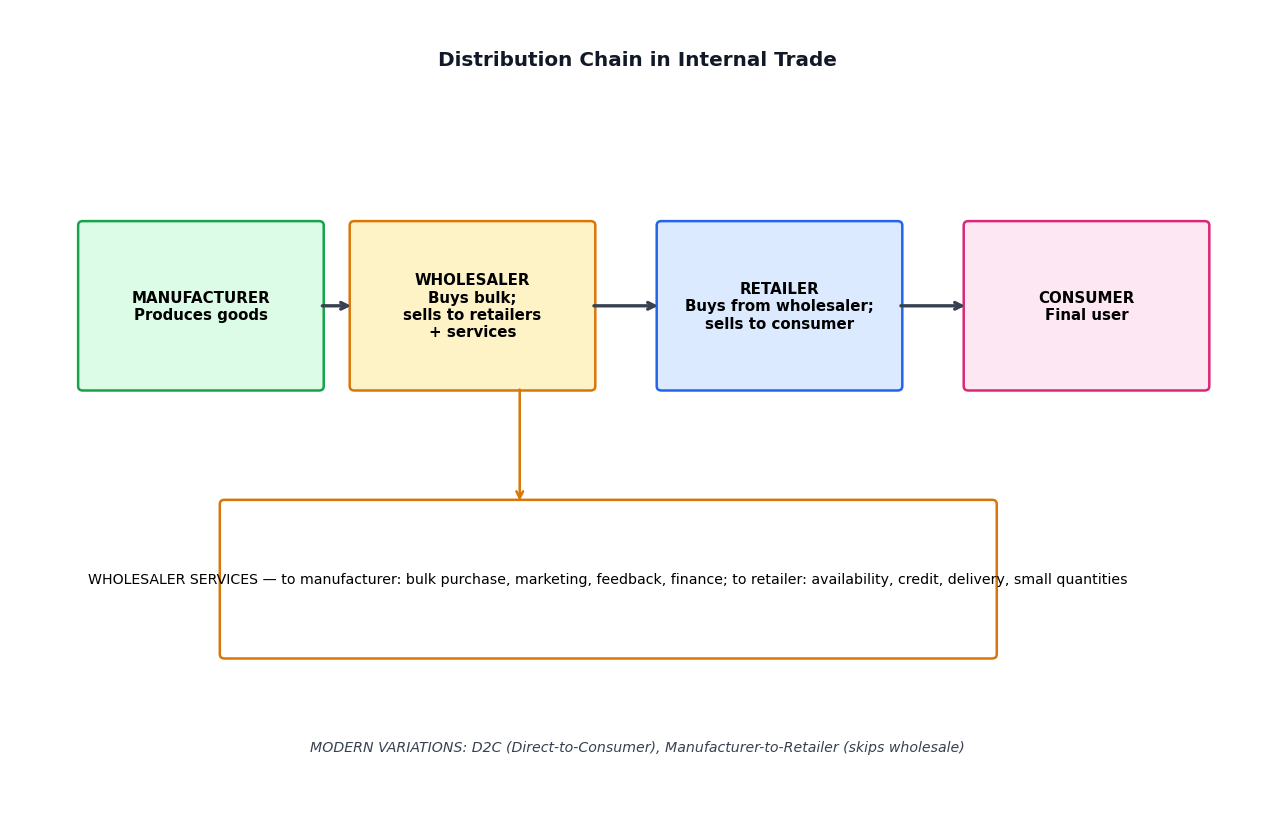
Study the distribution chain in internal trade and answer:

Internal Trade figure
  1. Who is the FIRST link in the distribution chain?
    AManufacturer
    BWholesaler
    CRetailer
    DConsumer
  2. Wholesalers provide which service to retailers?
    ABulk purchase
    BWarehousing
    CCredit to retailers
    DAll of these
  3. Explain the distribution chain and the role of each link.
Show answersHide answers
1. Option 1 — Manufacturer
2. Option 4 — All of these
3. The traditional DISTRIBUTION CHAIN is Manufacturer → Wholesaler → Retailer → Consumer. Each link performs a specific function. MANUFACTURER produces goods. WHOLESALER buys in bulk from manufacturer and sells in smaller bulk to retailers; provides multiple services to MANUFACTURER (bulk purchase, marketing, market feedback, finance, warehousing) AND to RETAILERS (availability, credit, delivery, small quantities, assortment). RETAILER buys from wholesaler (or manufacturer directly) and sells smaller quantities to final consumers; provides customer service, returns, after-sales support. CONSUMER is the final user. MODERN VARIATIONS include: (a) D2C (Direct-to-Consumer) — manufacturer skips both wholesaler and retailer (Mamaearth, Boat); (b) Manufacturer-to-Retailer (skipping wholesaler) — large retailers buy directly; (c) E-commerce — combines retail with direct manufacturer access. MOST FMCG products still go through wholesale + retail because the wholesaler provides essential services that manufacturers can't easily replicate. Each link fills a specific gap and adds value.
Q57 53 Marks

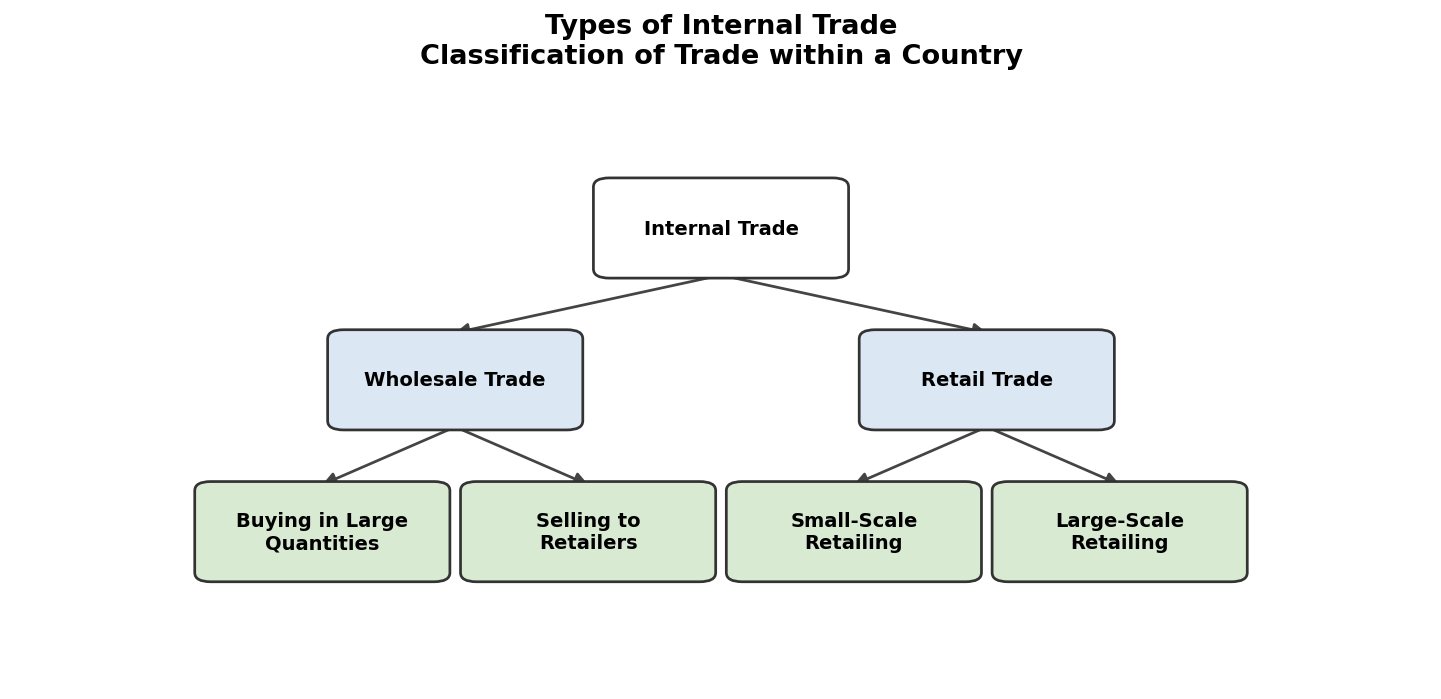
Based on the given diagram, answer the following:

Internal Trade figure
  1. Which of the following best defines Internal Trade?
    ATrade between two different countries
    BBuying and selling of goods within the boundaries of a country
    CExport of goods to foreign markets
    DTrade involving foreign currency exchange
  2. From the diagram, identify the two main types of Internal Trade.
  3. Which type of retailer falls under Large-Scale Retailing?
    AStreet hawkers
    BPeddlers
    CDepartmental stores
    DMarket traders
  4. Explain the role of a wholesaler as shown in the diagram in the chain of distribution.
  5. According to the diagram, which of the following is a service provided by wholesalers to manufacturers?
    AGrant of Credit
    BMarket Information to consumers
    CFacilitates Large-Scale Production
    DDirect selling to customers
  6. How does a wholesaler provide financial assistance to manufacturers? Explain briefly.
  7. Which service of the wholesaler helps retailers maintain a steady supply of goods?
    ABearing Risk
    BAvailability of Goods
    CFinancial Assistance to manufacturers
    DLarge-Scale Production
  8. Explain how wholesalers help in 'Bearing Risk' for manufacturers.
  9. Which form of large-scale retailing sells goods through printed catalogues without a physical store visit by the customer?
    ADepartmental Stores
    BChain Stores
    CMail Order Houses
    DConsumer Cooperative Stores
  10. Differentiate between Departmental Stores and Chain Stores/Multiple Shops as shown in the diagram.
  11. Consumer Cooperative Stores are owned and managed by:
    AGovernment authorities
    BPrivate entrepreneurs
    CConsumers themselves
    DWholesalers
  12. State any two advantages of large-scale retailing over small-scale retailing.
  13. What is the key characteristic that distinguishes Itinerant Retailers from Fixed Shop Retailers?
    AItinerant retailers sell only luxury goods
    BItinerant retailers do not have a fixed place of business and move from place to place
    CItinerant retailers operate only in rural areas
    DItinerant retailers buy directly from foreign markets
  14. Name any two types of itinerant retailers shown in the diagram and explain one of them.
  15. Which of the following is an example of a Fixed Shop Small Retailer?
    AHawker selling vegetables on a cart
    BStreet trader at a weekly market
    CGeneral store in a neighbourhood
    DPeddler moving door to door
  16. Explain the significance of small-scale retailers in the Indian economy.
  17. According to the bar chart, who has the highest average transaction size in the distribution chain?
    ARetailer
    BConsumer
    CManufacturer
    DWholesaler
  18. The chart shows that a retailer's average transaction size is ₹50,000 while a wholesaler's is ₹3,00,000. What does this difference indicate about the nature of their respective trades?
  19. Which of the following correctly describes the position of a retailer in the distribution chain as reflected in the chart?
    ARetailer buys from consumers and sells to wholesalers
    BRetailer is the last link between wholesaler and the final consumer
    CRetailer deals in the largest transaction sizes
    DRetailer imports goods directly from foreign countries
  20. State any two services that retailers provide to consumers that justify their role in internal trade.
  21. Which of the following is a form of large-scale retailing as shown in the diagram?
    AItinerant Retailers
    BFixed Shop Retailers
    CDepartmental Stores
    DWholesale Trade
  22. What are the two main types of internal trade shown in the diagram?
  23. Which category of retail trade do 'Itinerant Retailers' fall under?
    ALarge-Scale Retailing
    BWholesale Trade
    CSmall-Scale Retailing
    DChain Stores
  24. Distinguish between wholesale trade and retail trade as depicted in the diagram.
  25. How do wholesalers facilitate large-scale production for manufacturers?
  26. Which service of the wholesaler helps retailers to sell goods even before making full payment?
    AAvailability of Goods
    BRisk Sharing
    CMarket Information
    DCredit Facility
  27. Explain how wholesalers perform the function of 'Bearing Risk' as shown in the diagram.
  28. In the channel of distribution shown, who acts as the link between the manufacturer and the retailer?
    AConsumer
    BRetailer
    CWholesaler
    DAgent
  29. What does the term 'internal trade' mean in the context of this distribution channel?
  30. Which of the following best describes the role of the retailer in the given distribution channel?
    ABuys goods directly from consumers
    BSells goods in bulk to wholesalers
    CBuys from wholesalers and sells in small quantities to consumers
    DManufactures goods and distributes them
  31. Why is the wholesaler considered an important intermediary in internal trade? Explain with reference to the diagram.
  32. Which form of large-scale retailing operates on the principle of 'all goods under one roof'?
    AChain Stores
    BMail Order Houses
    CDepartmental Stores
    DConsumer Cooperative Stores
  33. What is the unique feature of Consumer Cooperative Stores as shown in the diagram, and how does it benefit consumers?
  34. Which type of large-scale retailing involves no direct contact between buyer and seller and relies on catalogues?
    ASuper Markets
    BDepartmental Stores
    CConsumer Cooperative Stores
    DMail Order Houses
  35. Differentiate between Multiple Shops (Chain Stores) and Super Markets based on the features shown in the diagram.
  36. Which of the following is an example of Large-Scale Retailing as shown in the diagram?
    AHawkers
    BPeddlers
    CDepartmental Stores
    DMarket Traders
  37. Distinguish between Itinerant Traders and Fixed Shop Retailers as shown under Small-Scale Retailing.
  38. According to the diagram, how does a wholesaler help manufacturers in terms of production?
    ABy reducing the quality of goods
    BBy enabling large-scale production through bulk purchasing
    CBy directly selling to consumers
    DBy importing goods from abroad
  39. Explain how a wholesaler provides financial assistance to manufacturers.
  40. Which service of the wholesaler to retailers is shown in the diagram that helps retailers avoid maintaining large stocks?
    AProvides Market Knowledge
    BGrants Credit Facilities
    CHelps in Storage
    DMakes Goods Available
  41. Why is the wholesaler considered a link between the manufacturer and the retailer? Use the diagram to support your answer.
  42. Which form of large-scale retailing operates on the principle of 'self-service' and offers goods at low prices due to bulk buying?
    ADepartmental Stores
    BMail Order Houses
    CChain Stores
    DSuper Markets
  43. Explain two features of Departmental Stores as shown in the diagram.
  44. A retail business sells goods through printed catalogues without any face-to-face interaction with customers. Which type of large-scale retailing does this represent?
    AConsumer Co-operative Stores
    BChain Stores
    CMail Order Houses
    DSuper Markets
  45. How do Chain Stores (Multiple Shops) differ from Departmental Stores in terms of location and pricing strategy? Use the diagram to support your answer.
  46. From the diagram, which service of the retailer to consumers ensures that customers can purchase goods without paying immediately?
    AHome Delivery
    BWide Variety & Choice
    CCredit Facilities
    DRegular Availability of Goods
  47. How does the retailer help wholesalers and manufacturers by collecting market information? Explain with an example.
  48. Which of the following services does a retailer provide to manufacturers that supports large-scale production?
    AProvides credit to consumers
    BHelps in distribution of goods to final consumers, ensuring steady demand
    CStores goods in warehouses
    DImports goods from foreign countries
  49. Analyze the dual role of a retailer as shown in the diagram. Why is the retailer considered the most important link in the chain of distribution?
  50. Which of the following is an example of an itinerant retailer?
    ADepartmental Store
    BSuper Market
    CHawkers and Peddlers
    DConsumer Co-operative Store
  51. What is the key difference between itinerant retailers and fixed shop retailers?
  52. Which of the following large-scale retail formats is owned and operated by consumers themselves to eliminate middlemen?
    AChain Stores
    BDepartmental Stores
    CSuper Markets
    DConsumer Co-operative Stores
  53. Name any two features of departmental stores that distinguish them from speciality shops.
  54. How does the wholesaler render the service of 'facilitating large scale production' to the manufacturer?
  55. Which of the following services does a wholesaler provide to retailers by allowing them to purchase goods on credit?
    AMarket Information
    BCredit Facilities
    CStorage of Goods
    DBearing Risk
  56. Wholesalers bear the risk of price fluctuations and spoilage of goods on behalf of manufacturers. Which service does this represent?
    AFinancial Assistance
    BStorage of Goods
    CBearing Risk
    DMarket Information
  57. Explain how wholesalers serve as a link between manufacturers and retailers in the context of market information.
Show answersHide answers
1. Option 2 — Buying and selling of goods within the boundaries of a country
2. The two main types of Internal Trade are Wholesale Trade and Retail Trade.
3. Option 3 — Departmental stores
4. A wholesaler buys goods in large quantities from manufacturers and sells them to retailers, acting as an important link between producers and retailers in the distribution chain.
5. Option 3 — Facilitates Large-Scale Production
6. Wholesalers provide financial assistance to manufacturers by making advance payments for orders placed. This helps manufacturers manage their working capital and continue production without financial strain.
7. Option 2 — Availability of Goods
8. Wholesalers purchase goods in bulk from manufacturers and store them in their warehouses. By doing so, they bear the risk of price fluctuations, spoilage, and demand changes, thereby relieving manufacturers of these risks.
9. Option 3 — Mail Order Houses
10. Departmental Stores are large retail establishments that offer a wide variety of goods under one roof, divided into different departments. Chain Stores or Multiple Shops are a network of retail stores that sell the same type of goods at different locations under central ownership and management.
11. Option 3 — Consumers themselves
12. Two advantages of large-scale retailing are: (1) Economies of scale — goods can be purchased in bulk at lower prices, reducing costs. (2) Wide variety of goods — customers can choose from a large range of products available at one place, saving time and effort.
13. Option 2 — Itinerant retailers do not have a fixed place of business and move from place to place
14. Two types of itinerant retailers are Hawkers & Peddlers and Market Traders. Hawkers and Peddlers are small retailers who carry goods on their heads, carts, or cycles and move from street to street selling everyday items like vegetables, fruits, and household goods.
15. Option 3 — General store in a neighbourhood
16. Small-scale retailers play a vital role in the Indian economy. They provide employment to a large number of people, especially in rural and semi-urban areas. They make goods available to consumers at their doorstep or nearby locations, offer personalised services, extend credit facilities, and help in the distribution of goods across the country at low operating costs.
17. Option 3 — Manufacturer
18. The difference indicates that wholesalers deal in bulk quantities, buying and selling large volumes of goods at a time, which results in higher transaction values. Retailers, on the other hand, sell goods in small quantities directly to consumers for personal use, resulting in much smaller transaction sizes. This reflects the fundamental distinction between wholesale trade (bulk) and retail trade (small lots).
19. Option 2 — Retailer is the last link between wholesaler and the final consumer
20. Two services provided by retailers to consumers are: (1) Regular availability of goods — Retailers maintain a stock of various goods so that consumers can purchase them as and when needed without delay. (2) New products information — Retailers inform consumers about new products available in the market through displays and personal interaction, helping consumers make informed purchase decisions.
21. Option 3 — Departmental Stores
22. The two main types of internal trade are Wholesale Trade and Retail Trade.
23. Option 3 — Small-Scale Retailing
24. Wholesale trade involves buying goods in large quantities from manufacturers and selling them to retailers, whereas retail trade involves buying goods in relatively smaller quantities from wholesalers and selling them directly to consumers.
25. Wholesalers purchase goods in large quantities from manufacturers, which enables manufacturers to produce on a large scale continuously without worrying about selling their output directly to numerous retailers or consumers.
26. Option 4 — Credit Facility
27. Wholesalers purchase goods in large quantities and store them in their warehouses. By doing so, they bear the risk of price fluctuations, damage, spoilage, or changes in demand, thereby relieving manufacturers of these risks.
28. Option 3 — Wholesaler
29. Internal trade refers to the buying and selling of goods and services within the boundaries of a country. In this distribution channel, all transactions between the producer, wholesaler, retailer, and consumer take place within the same country.
30. Option 3 — Buys from wholesalers and sells in small quantities to consumers
31. The wholesaler acts as a crucial link between the producer and the retailer. As shown in the diagram, the wholesaler buys goods in bulk from the producer, thereby enabling large-scale production, and then distributes them in smaller lots to retailers. This ensures smooth flow of goods, provides storage facilities, and reduces the burden on both producers and retailers.
32. Option 3 — Departmental Stores
33. Consumer Cooperative Stores are owned and managed by consumers themselves. This eliminates the middlemen's profit, allowing goods to be sold at lower prices. Profits earned are distributed among members as dividends, directly benefiting the consumer-owners.
34. Option 4 — Mail Order Houses
35. Multiple Shops or Chain Stores are a network of retail shops spread across different locations selling the same type of goods under a common ownership and management. Super Markets, on the other hand, are large retail stores that offer a wide variety of goods at low prices using a self-service system, where customers pick goods themselves and pay at the counter. Chain stores focus on one category of product across locations, while super markets offer multiple categories under one roof with self-service.
36. Option 3 — Departmental Stores
37. Itinerant traders do not have a fixed place of business and move from place to place to sell goods (e.g., hawkers, peddlers). Fixed shop retailers operate from a permanent location and serve customers at a fixed place of business (e.g., general stores, specialty shops).
38. Option 2 — By enabling large-scale production through bulk purchasing
39. Wholesalers provide financial assistance to manufacturers by making advance payments for orders placed. This helps manufacturers meet their working capital requirements and continue production without financial strain.
40. Option 3 — Helps in Storage
41. The wholesaler acts as a crucial link because they purchase goods in bulk from manufacturers (enabling large-scale production and providing financial assistance) and then distribute them to retailers in smaller quantities (making goods available, granting credit, and providing market knowledge). This two-way service role makes the wholesaler an essential intermediary in the distribution channel.
42. Option 4 — Super Markets
43. 1. All goods under one roof: Departmental stores offer a wide variety of goods organized into different departments, allowing customers to purchase everything they need in one place. 2. Located in central areas: They are typically situated in prime commercial locations to attract maximum customer footfall and provide easy accessibility.
44. Option 3 — Mail Order Houses
45. Chain Stores are spread across many locations (different cities or areas) and maintain uniform prices across all their outlets, making them accessible to customers in various regions. Departmental Stores, on the other hand, are typically located in central or prime commercial areas and operate as a single large establishment offering multiple product lines under one roof. While chain stores focus on geographic spread with standardized pricing, departmental stores focus on variety and convenience at a single premium location.
46. Option 3 — Credit Facilities
47. Retailers are in direct contact with consumers and can observe their preferences, complaints, and changing tastes. They collect this valuable market information and pass it on to wholesalers and manufacturers. For example, if customers frequently ask for a product in a different size or packaging, the retailer can relay this feedback to the manufacturer, who can then modify the product accordingly. This helps manufacturers align their production with consumer demand.
48. Option 2 — Helps in distribution of goods to final consumers, ensuring steady demand
49. The diagram shows that a retailer serves both consumers and wholesalers/manufacturers simultaneously, making them a pivotal link in the distribution chain. For consumers, retailers provide convenience through regular availability, home delivery, credit facilities, and product information. For wholesalers and manufacturers, retailers ensure the distribution of goods reaches the final consumer, promote new products, and provide crucial market feedback that enables large-scale production. Since retailers are the final point of sale before goods reach consumers, they directly influence consumer satisfaction and sales volume, making them the most important link in the distribution chain.
50. Option 3 — Hawkers and Peddlers
51. Itinerant retailers do not have a fixed place of business and move from place to place to sell their goods, whereas fixed shop retailers operate from a permanent location and serve customers at that specific place.
52. Option 4 — Consumer Co-operative Stores
53. Departmental stores offer a wide variety of goods under one roof catering to diverse customer needs, whereas speciality shops deal in only one type of product. Additionally, departmental stores provide various customer services such as rest rooms, restaurants, and home delivery, which are generally not offered by speciality shops.
54. Wholesalers collect orders from numerous retailers and pass them on to manufacturers. This ensures a continuous and large demand for goods, enabling manufacturers to produce on a large scale without worrying about individual sales, thereby achieving economies of scale.
55. Option 2 — Credit Facilities
56. Option 3 — Bearing Risk
57. Wholesalers act as an important channel of communication between manufacturers and retailers. They collect and pass on information about consumer preferences, market trends, new products, and competitor activities to manufacturers, helping them plan production accordingly. At the same time, they inform retailers about new products, price changes, and promotional schemes introduced by manufacturers, thus keeping both parties updated about market conditions.

Q58 4 Marks

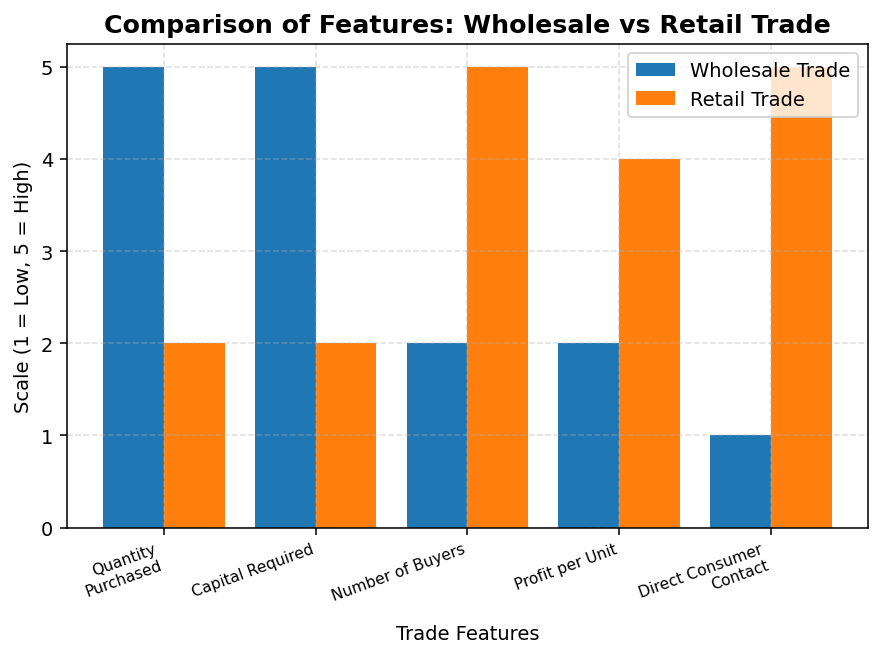
Based on the given chart, answer the following:

Internal Trade figure
  1. According to the chart, which type of trade requires higher capital investment?
    ARetail Trade
    BWholesale Trade
    CBoth require equal capital
    DNeither requires capital
  2. Which type of trade has a higher profit per unit as shown in the chart, and why?
  3. From the chart, which trade type has greater direct consumer contact?
    AWholesale Trade
    BBoth equally
    CRetail Trade
    DNeither
  4. Based on the chart, explain why the number of buyers is higher in retail trade compared to wholesale trade.
  5. From the bar chart, which type of trade transaction has the highest average transaction size?
    ARetailer to Consumer
    BWholesaler to Retailer
    CWholesaler to Manufacturer
    DSmall Retailer to Consumer
  6. What does the significant difference in transaction sizes between wholesale and retail trade indicate about the nature of these two types of trade?
  7. The average transaction size of a Retailer to Consumer is ₹20,000 while that of a Small Retailer to Consumer is ₹5,000. What type of small retailer might account for the ₹5,000 transactions?
    ADepartmental Store
    BChain Store
    CItinerant Trader or Hawker
    DMail Order House
  8. Calculate the difference in average transaction size between a Wholesaler to Manufacturer and a Retailer to Consumer. What does this difference signify in the context of internal trade?
Show answersHide answers
1. Option 2 — Wholesale Trade
2. Retail trade has a higher profit per unit because retailers sell goods in small quantities directly to consumers and add a higher margin per unit to cover their operating costs and earn profit, unlike wholesalers who deal in bulk with lower margins per unit.
3. Option 3 — Retail Trade
4. In retail trade, goods are sold directly to a large number of individual consumers who purchase in small quantities for personal use. In contrast, wholesale trade involves selling to a limited number of retailers or industrial buyers who purchase in bulk, resulting in fewer buyers.
5. Option 3 — Wholesaler to Manufacturer
6. The significant difference indicates that wholesale trade involves buying and selling in large quantities (bulk), which results in much higher transaction values. Retail trade, on the other hand, involves selling goods in small quantities directly to consumers for personal use, resulting in much smaller transaction sizes. This reflects the fundamental difference: wholesalers deal in bulk while retailers deal in small lots.
7. Option 3 — Itinerant Trader or Hawker
8. The difference is ₹5,00,000 - ₹20,000 = ₹4,80,000. This large difference signifies that wholesalers operate at a much larger scale than retailers. Wholesalers buy in bulk directly from manufacturers and break these large quantities into smaller lots for retailers. This process of breaking bulk is one of the most important functions of a wholesaler in internal trade, making goods accessible to retailers and ultimately to consumers.

Make a full Business Studies paper on Internal Trade.

Pick the question mix, set the marks, hit generate. You get a ready-to-print paper with an answer key.

Generate your paper — free