Skip to content
TestMacher
Chapter 4 · Class 11 Business Studies

Forms of Business Organisation — Important Questions

57 questions With answers CBSE format

SUMMARY: This chapter discusses the various forms of business organizations and their characteristics, advantages, and disadvantages.
KEY TOPICS: Sole proprietorship, partnership, joint Hindu family business, cooperative societies, company, types of companies, formation of a company, choice of form of business organization

Q1 1 Mark

A sole proprietorship is owned by:

AOne person
BTwo persons
CMany persons
DGovernment
Check answerHide answer
Correct answer: Option 1 — One person
Q2 1 Mark

The maximum number of partners in a partnership firm is:

A10
B20
C50
D100
Check answerHide answer
Correct answer: Option 3 — 50
Q3 1 Mark

A Joint Hindu Family business is governed by:

AIndian Companies Act
BHindu Law
CPartnership Act
DCooperative Societies Act
Check answerHide answer
Correct answer: Option 2 — Hindu Law
Q4 1 Mark

Which of the following has limited liability?

ASole proprietorship
BPartnership
CJoint stock company
DJoint Hindu Family
Check answerHide answer
Correct answer: Option 3 — Joint stock company
Q5 1 Mark

A cooperative society works on the principle of:

AProfit maximisation
BService to members and community
CFree competition
DMonopoly
Check answerHide answer
Correct answer: Option 2 — Service to members and community
Q6 1 Mark

In a sole proprietorship, what is the nature of the liability of the owner?

ALimited to the extent of capital invested
BUnlimited, extending to personal assets
CShared equally among all family members
DLimited to the value of business assets only
Check answerHide answer
Correct answer: Option 2 — Unlimited, extending to personal assets
Q7 1 Mark

Who has the absolute decision-making power and control over the management of a Joint Hindu Family Business?

AAll coparceners equally
BThe eldest female member only
CKarta
DThe youngest male member
Check answerHide answer
Correct answer: Option 3 — Karta
Q8 1 Mark

Under the current rules prescribed by the Government (Companies (Miscellaneous) Rules, 2014), what is the maximum number of members allowed in a partnership firm?

A20
B50
C100
D200
Check answerHide answer
Correct answer: Option 2 — 50
Q9 1 Mark

Which of the following principles governs the voting rights of members in a cooperative society?

AOne share, one vote
BOne member, one vote
CVoting rights proportional to capital contributed
DVoting rights based on seniority of membership
Check answerHide answer
Correct answer: Option 2 — One member, one vote
Q10 1 Mark

What is the minimum number of members required to form a Public Company?

A2
B3
C7
D10
Check answerHide answer
Correct answer: Option 3 — 7
Q11 1 Mark

A person who is not a partner in a firm but knowingly permits themselves to be represented as a partner is known as a:

ANominal partner
BPartner by holding out / estoppel
CSecret partner
DActive partner
Check answerHide answer
Correct answer: Option 2 — Partner by holding out / estoppel
Q12 1 Mark

In a Joint Hindu Family Business, how is the liability of the Karta different from that of the other coparceners?

AKarta has limited liability while coparceners have unlimited liability.
BBoth Karta and coparceners have unlimited liability.
CKarta has unlimited liability while coparceners have limited liability up to their share in the family property.
DBoth Karta and coparceners have limited liability up to their share in the business.
Check answerHide answer
Correct answer: Option 3 — Karta has unlimited liability while coparceners have limited liability up to their share in the family property.
Q13 1 Mark

Which type of cooperative society is established to protect the interests of small producers by making available raw materials, machinery, and other inputs?

AConsumers' Cooperative Society
BProducer’s Cooperative Society
CMarketing Cooperative Society
DCooperative Credit Society
Check answerHide answer
Correct answer: Option 2 — Producer’s Cooperative Society
Q14 1 Mark

Which of the following documents defines the relationship of the company with the outside world and contains the objects clause?

AArticles of Association
BMemorandum of Association
CProspectus
DCertificate of Incorporation
Check answerHide answer
Correct answer: Option 2 — Memorandum of Association
Q15 1 Mark

If an entrepreneur desires complete confidentiality of business operations and wants to avoid sharing profits, which form of business organization is most suitable?

APartnership
BCooperative Society
CSole Proprietorship
DPrivate Limited Company
Check answerHide answer
Correct answer: Option 3 — Sole Proprietorship
Q16 3 Marks

Define sole proprietorship and state any three of its features.

View sample solutionHide solution
A sole proprietorship is a form of business owned, managed and controlled by a single person who is the owner of all profits and bears all losses. Features: (i) single ownership; (ii) one-person control of management and decisions; (iii) unlimited liability — owner's personal assets can be used to pay business debts; (iv) no separate legal entity from the owner; (v) easy to form (no registration required); (vi) limited capital and life (terminates with owner's death).
Q17 3 Marks

Distinguish between general partnership and limited partnership.

View sample solutionHide solution
General partnership — all partners are general partners with unlimited liability and equal management rights; firm decisions require all partners' consent. Limited partnership — has at least one general partner (unlimited liability, manages the firm) and one or more limited partners (liability limited to their investment, no role in management). The general partner is the active manager; limited partners are silent investors. Limited Liability Partnership (LLP) — a hybrid where ALL partners have limited liability per LLP Act 2008. The choice depends on management and risk preferences.
Q18 3 Marks

Explain the term Karta in a Joint Hindu Family business.

View sample solutionHide solution
Karta is the senior-most male member (or now, by court rulings, can be female) of the Joint Hindu Family who manages the family business. He has unlimited liability while other coparceners (members of the family with rights in ancestral property) have liability limited to their share in the family property. The Karta makes all business decisions, signs contracts, and represents the family business. The business runs on principles of Hindu Succession Law as amended.
Q19 3 Marks

List the merits and limitations of a sole proprietorship.

View sample solutionHide solution
MERITS: (1) Easy formation — no registration; (2) Direct motivation — owner gets all profit; (3) Quick decisions — no consultation needed; (4) Confidentiality — only owner knows business secrets; (5) Direct contact with customers; (6) Tax savings — taxed as personal income at lower slab rates. LIMITATIONS: (1) Limited capital — only one person's funds; (2) Unlimited liability — personal assets at risk; (3) Limited managerial ability; (4) Limited life — terminates with owner; (5) Difficulty in expansion; (6) No separate legal entity. Best for small businesses where individual control is critical.
Q20 3 Marks

What is a cooperative society and what are its types?

View sample solutionHide solution
A cooperative society is a voluntary association of persons who come together for mutual benefit by pooling resources and sharing profits/services. Types: (1) Consumer cooperative — for affordable goods to members (e.g., Apna Bazar). (2) Producer cooperative — protects producers (e.g., dairy cooperatives like Amul). (3) Marketing cooperative — markets members' produce (e.g., NAFED). (4) Farmers' cooperative — for agricultural inputs and services. (5) Credit cooperative — provides credit at fair rates. (6) Housing cooperative — affordable housing for members. (7) Cooperative bank — banking services on cooperative principles. Operates under the Cooperative Societies Act with one-member-one-vote democracy.
Q21 3 Marks

What is meant by sole proprietorship, and who bears all the risks in this form of business?

View sample solutionHide solution
A sole proprietorship is a form of business organization owned, managed, and controlled by a single individual. In this form, the sole proprietor bears all the risks of the business alone, as there are no other co-owners to share the losses.
Q22 3 Marks

Who is a 'Karta' in a Joint Hindu Family Business, and what is the extent of their liability?

View sample solutionHide solution
The 'Karta' is the eldest member of the Joint Hindu Family who manages and controls the family business. Unlike other members whose liability is limited to their share in the family property, the Karta has unlimited liability.
Q23 3 Marks

Define a partnership as per the Indian Partnership Act, 1932.

View sample solutionHide solution
According to the Indian Partnership Act, 1932, partnership is the relation between persons who have agreed to share the profits of a business carried on by all or any of them acting for all. It requires a minimum of two persons to form.
Q24 3 Marks

What is the main guiding principle of a cooperative society, and how is its management democratic?

View sample solutionHide solution
The main guiding principle of a cooperative society is 'one for all and all for one' with a service motive. Its management is democratic because every member gets one voting right, irrespective of the amount of capital contributed by them.
Q25 3 Marks

State any two basic differences between a private company and a public company.

View sample solutionHide solution
A private company must have a minimum of two members and restricts the transfer of its shares. In contrast, a public company must have a minimum of seven members and allows its shares to be freely transferred to the public.
Q26 6 Marks

Explain the merits and limitations of a partnership firm.

View sample solutionHide solution
MERITS: (1) Easier formation than a company — only registration with Registrar of Firms (optional). (2) More capital than sole proprietorship — multiple partners pool funds. (3) Combined judgement — partners with different skills and experiences contribute. (4) Flexibility — partners can amend terms by mutual agreement. (5) Sharing of risk — losses are distributed. (6) Better business decisions due to multiple perspectives. (7) Maintains confidentiality compared to companies. LIMITATIONS: (1) Unlimited liability of partners. (2) Limited capital — capped at maximum 50 partners and personal funds. (3) Possibility of disputes — different views on direction. (4) Lack of public confidence — no statutory disclosure. (5) Lack of continuity — death/insolvency of partner can dissolve. (6) Limited transferability of interest. Best for medium-sized businesses where partners trust each other and want quick decision-making.
Q27 6 Marks

Distinguish between a partnership firm and a Joint Hindu Family business.

View sample solutionHide solution
PARTNERSHIP — formed by agreement among partners; governed by Indian Partnership Act 1932; minimum 2 partners maximum 50 (per Companies Act 2013); all partners have unlimited liability; profits shared as per agreement; any partner can be active or sleeping; can be dissolved by agreement or by death/insolvency of a partner. JHF BUSINESS — created by birth into the family; governed by Hindu Law; minimum 2 coparceners (no maximum); only Karta has unlimited liability — others have limited liability; profits distributed as per Hindu Law (typically equal among coparceners); managed by Karta only; continues until partition; younger generations join automatically by birth. Membership in partnership is voluntary and contractual; in JHF it is involuntary and by birth.
Q28 6 Marks

Explain the various forms of business organisation suitable for small medium and large businesses.

View sample solutionHide solution
SMALL businesses (low capital, single owner, simple operations): (1) Sole proprietorship — easy to start, full control, unlimited liability. (2) Joint Hindu Family — for family-run businesses with ancestral capital. Suitable for shops, agencies, professional services, small workshops. MEDIUM businesses (moderate capital, multiple skills needed): (1) Partnership — pool of funds and skills, shared risk; suitable for legal/CA firms, mid-size trading. (2) Limited Liability Partnership (LLP) — partnership benefits with limited liability; growing in popularity. (3) Cooperative — for community welfare (housing, agriculture, dairy). LARGE businesses (high capital, public participation): (1) Joint Stock Company — limited liability, separate legal entity, perpetual succession; private (max 200 members) for closely held; public for share trading. (2) Multinational Corporation (MNC) — for global scale. The choice depends on capital needs, liability tolerance, control preference, regulatory burden, and exit strategy.
Q29 6 Marks

Explain the cooperative form of organisation and its principles.

View sample solutionHide solution
A cooperative society is a voluntary association of persons formed to promote the common economic interests of its members through self-help and mutual help. PRINCIPLES (per Cooperative Societies Act and ICA principles): (1) Voluntary and open membership — anyone can join who shares the common interest. (2) Democratic control — one member one vote regardless of investment. (3) Member economic participation — members contribute and control capital. (4) Autonomy and independence — self-governing, free from external control. (5) Education, training and information — for members. (6) Cooperation among cooperatives — networking. (7) Concern for community — social responsibility. ADVANTAGES: democratic management, equality, profit sharing among members, government support, low capital requirement. LIMITATIONS: limited capital, lack of business expertise, slow decision-making, lack of secrecy, internal politics. Examples in India: Amul (Anand Pattern), NAFED, IFFCO, KVIC.
Q30 6 Marks

Discuss the choice of an appropriate form of business organisation: factors to consider.

View sample solutionHide solution
Factors influencing the choice of organisation: (1) Nature of business — small retail (sole proprietorship), professional services (partnership), large manufacturing (company). (2) Scale of operations — small (proprietorship/JHF), medium (partnership/LLP/cooperative), large (joint stock company). (3) Capital requirements — limited capital favours simpler forms; large requirements need company. (4) Liability tolerance — risk-averse founders prefer limited liability (LLP, company). (5) Degree of control — full control in proprietorship, shared in partnership/company. (6) Continuity — partnership and proprietorship lack perpetual succession; company offers continuity. (7) Government regulations — companies face the most regulation; cooperatives less; proprietorships least. (8) Management ability — single decision-maker (proprietorship) vs collective (partnership/company). (9) Tax planning — different forms have different tax treatments. (10) Geographical scope — local/regional/national/international. The right form balances control, liability, capital, regulation, and growth potential.
Q31 6 Marks

Compare sole proprietorship and partnership form of business with the help of a table.

Q32 1 Mark

Assertion (A): A sole proprietor has unlimited liability.

Reason (R): The owner and the business are not separate legal entities; the proprietor's personal assets can be used to satisfy business debts.

Show explanationHide explanation
Correct answer: Option 1 — Both A and R are true, and R is the correct explanation of A.
Q33 1 Mark

Assertion (A): A partnership requires registration with the Registrar of Firms.

Reason (R): While not mandatory registration provides certain legal benefits and prevents disputes.

Show explanationHide explanation
Correct answer: Option 1 — Both A and R are true, and R is the correct explanation of A.
Q34 1 Mark

Assertion (A): A joint stock company has separate legal entity from its members.

Reason (R): The company is created by law and can sue or be sued in its own name.

Show explanationHide explanation
Correct answer: Option 1 — Both A and R are true, and R is the correct explanation of A.
Q35 1 Mark

Assertion (A): A cooperative society is based on the principle of one-member-one-vote.

Reason (R): Democratic control means decisions are made by majority regardless of investment size.

Show explanationHide explanation
Correct answer: Option 1 — Both A and R are true, and R is the correct explanation of A.
Q36 1 Mark

Assertion (A): Membership in a Joint Hindu Family business arises by birth.

Reason (R): The youngest generation joins the family business automatically by virtue of being born into the family.

Show explanationHide explanation
Correct answer: Option 1 — Both A and R are true, and R is the correct explanation of A.
Q37 1 Mark

Assertion (A): Registration of a partnership firm is compulsory under the Indian Partnership Act, 1932.

Reason (R): An unregistered partnership firm cannot file a suit against third parties in a court of law.

Show explanationHide explanation
Correct answer: Option 4 — A is false, but R is true.
Q38 1 Mark

Assertion (A): In a Joint Hindu Family business, the liability of co-parceners is limited.

Reason (R): Co-parceners have limited liability to the extent of their share in the joint family property.

Show explanationHide explanation
Correct answer: Option 1 — Both A and R are true, and R is the correct explanation of A.
Q39 1 Mark

Assertion (A): A cooperative society is a voluntary association of persons.

Reason (R): Any person can join a cooperative society at any time and leave it at their own will, without any discrimination.

Show explanationHide explanation
Correct answer: Option 1 — Both A and R are true, and R is the correct explanation of A.
Q40 1 Mark

Statement 1: Sole proprietors have unlimited liability.

Statement 2: Joint stock company shareholders have liability limited to their shareholding.

Show answerHide answer
Correct answer: Option 1 — Both statements are true.
Q41 1 Mark

Statement 1: A joint stock company has perpetual succession.

Statement 2: The company continues to exist regardless of changes in shareholders.

Show answerHide answer
Correct answer: Option 1 — Both statements are true.
Q42 1 Mark

Statement 1: A company can raise large amounts of capital from the public.

Statement 2: Sole proprietorships have limited capital sources.

Show answerHide answer
Correct answer: Option 1 — Both statements are true.
Q43 1 Mark

Statement 1: A partnership has multiple managers (partners).

Statement 2: A sole proprietorship has only one decision-maker.

Show answerHide answer
Correct answer: Option 1 — Both statements are true.
Q44 1 Mark

Statement 1: Cooperative societies aim to serve their members.

Statement 2: Profit maximisation is not the primary objective of cooperatives.

Show answerHide answer
Correct answer: Option 1 — Both statements are true.
Q45 1 Mark

Statement 1: In a sole proprietorship, the liability of the owner is unlimited, meaning their personal assets can be used to satisfy business debts.

Statement 2: A sole proprietorship has no separate legal entity distinct from its owner.

Show answerHide answer
Correct answer: Option 1 — Both statements are true.
Q46 1 Mark

Statement 1: In a Joint Hindu Family business, the Karta has unlimited liability while the other co-parceners have limited liability up to their share in the family property.

Statement 2: The Joint Hindu Family business is controlled and managed by all the co-parceners equally through democratic voting.

Show answerHide answer
Correct answer: Option 2 — Only Statement 1 is true.
Q47 1 Mark

Statement 1: A partnership firm must be compulsorily registered under the Indian Partnership Act, 1932, before commencing any business operations.

Statement 2: The maximum number of partners in a partnership firm is restricted to 50 as per the Companies (Miscellaneous) Rules, 2014.

Show answerHide answer
Correct answer: Option 3 — Only Statement 2 is true.
Q48 3 Marks
Anil wants to start a small electronic repair shop. He has limited capital ₹50000 and wants full control. His friend suggests forming a private company. His CA suggests sole proprietorship. Anil is unsure which form to choose.
  1. The simplest form of business that gives Anil full control is:
    ASole proprietorship
    BPartnership
    CPrivate Company
    DCooperative
  2. A sole proprietor has:
    ALimited liability
    BUnlimited liability
    CNo liability
    DJoint liability
  3. Recommend the best form for Anil and explain the trade-offs.
Show answersHide answers
1. Option 1 — Sole proprietorship
2. Option 2 — Unlimited liability
3. For Anil's situation — small electronic repair shop, limited capital, wants full control — SOLE PROPRIETORSHIP is the most suitable choice: (1) EASY FORMATION — no registration required; just start operating. (2) FULL CONTROL — Anil makes all decisions. (3) ALL PROFIT — no sharing with partners. (4) LOW COMPLIANCE — minimal regulatory burden. (5) TAX FAVOURABLE — taxed as personal income. (6) DIRECT CUSTOMER CONTACT — important for repair business. LIMITATIONS to consider: (a) UNLIMITED LIABILITY — Anil's personal assets are at risk if business fails; (b) LIMITED CAPITAL — only his own funds; (c) LIMITED LIFE — terminates with him. PRIVATE COMPANY would offer LIMITED LIABILITY but: (a) registration cost (₹15-20k); (b) annual compliance (₹40k+); (c) loss of full control if shareholders are added; (d) more complex taxation. For a small repair shop, sole proprietorship is cheaper and more flexible. As Anil grows, he can convert to LLP or company later.
Q49 3 Marks
Akash Bharat and Chetan are friends who want to start a CA firm. Akash has client relationships, Bharat has tax expertise, and Chetan has audit experience. They decide to form a partnership with profit-sharing 4:3:3. Capital contributions: Akash ₹200000, Bharat ₹150000, Chetan ₹150000.
  1. The maximum number of partners in a non-banking partnership firm is:
    A2
    B5
    C10
    D50
  2. Partners share profits/losses based on:
    AProfit-sharing ratio
    BCapital ratio
    CEqually
    DRandom
  3. Explain why partnership is suitable for them and what their deed should specify.
Show answersHide answers
1. Option 4 — 50
2. Option 1 — Profit-sharing ratio
3. A partnership is well-suited for a CA firm where partners bring complementary expertise. ADVANTAGES of partnership for the three friends: (1) POOLED EXPERTISE — Akash's client relationships, Bharat's tax knowledge, Chetan's audit skills; together they offer a complete service. (2) POOLED CAPITAL — combined ₹500000 vs only ₹200000 alone. (3) SHARED RISK — losses are distributed; one partner doesn't bear all. (4) COMBINED JUDGEMENT — major decisions discussed by three. (5) FLEXIBILITY — partners can amend terms. POINTS TO ADDRESS in partnership deed: (a) profit-sharing ratio (4:3:3 here); (b) interest on capital, salary, drawings; (c) admission/retirement procedures; (d) dispute resolution; (e) dissolution conditions. LIMITATIONS: (1) UNLIMITED LIABILITY — each partner is liable for the firm's debts; (2) one partner's bad decision can bind others; (3) limited capital (capped at maximum partners). For a professional services firm, traditional partnership is common but LLP (Limited Liability Partnership) is increasingly preferred for the limited liability protection.
Q50 3 Marks
The Sharma family has run a steel trading business in Delhi for three generations. The current Karta is Mr Ravi Sharma. Other coparceners are his three brothers and his sons. The business is governed by Hindu Law and operates from ancestral premises. Mr Ravi makes all major decisions.
  1. Mr Ravi who manages the JHF business is called the:
    AKarta
    BCoparcener
    CManager
    DDirector
  2. The JHF business is governed by:
    ACompanies Act
    BPartnership Act
    CHindu Law
    DCooperative Societies Act
  3. Explain the unique features of JHF business and contrast with partnership.
Show answersHide answers
1. Option 1 — Karta
2. Option 3 — Hindu Law
3. Joint Hindu Family (JHF) business is a unique form found primarily in India. KEY FEATURES: (1) Created BY BIRTH not by agreement — coparceners join automatically by virtue of being born into the family. (2) Governed by Hindu Law (not Partnership Act or Companies Act). (3) Min 2 coparceners no maximum; lineal descendants up to 4 generations. (4) KARTA — senior-most male member (or female after court rulings) manages the business. Has unlimited liability and full management authority. (5) OTHER COPARCENERS — have liability LIMITED to their share in family property. (6) PROFITS AND LOSSES — shared per Hindu Law (typically equal among coparceners). (7) CONTINUITY — survives changes in membership; partition can dissolve it. (8) NO REGISTRATION REQUIRED. UNIQUE FEATURES: only Karta has unlimited liability; other coparceners have limited liability — making JHF safer than partnership for family members. CHALLENGES: disputes among coparceners can disrupt; succession issues; modern joint families are dissolving into nuclear families. Recently the Hindu Succession (Amendment) Act 2005 gives daughters equal coparcenary rights.
Q51 4 Marks
Ramesh started a small grocery store in his neighbourhood with his own savings. He manages all the operations himself, takes all decisions independently, and keeps all the profits. However, he also bears all the losses personally. His liability is unlimited, meaning his personal assets can be used to pay off business debts. The business has no separate legal identity from its owner. Ramesh enjoys complete control and secrecy over his business affairs. The business is easy to form and can be dissolved at any time without any legal formalities. This type of business is most common in retail trade, small services, and professional services.
  1. What form of business organisation is Ramesh running?
    APartnership
    BSole Proprietorship
    CJoint Stock Company
    DCooperative Society
  2. What does 'unlimited liability' mean in the context of Ramesh's business?
  3. Which of the following is NOT an advantage of sole proprietorship?
    AQuick decision making
    BDirect motivation through profit retention
    CLimited liability
    DEase of formation
  4. Explain why sole proprietorship is considered the most suitable form of business for small-scale operations.
Show answersHide answers
1. Option 2 — Sole Proprietorship
2. Unlimited liability means that if the business is unable to pay its debts, Ramesh's personal assets such as his house, savings, and other property can be used to settle the business obligations. There is no distinction between personal and business assets in terms of liability.
3. Option 3 — Limited liability
4. Sole proprietorship is most suitable for small-scale operations because it requires minimal capital, has no complex legal formalities for formation or dissolution, allows quick decision-making, and gives the owner complete control. The owner directly benefits from profits, which motivates efficiency. It is ideal for businesses requiring personal attention and direct customer relationships.
Q52 3 Marks

Compare different forms of business organisation:

  1. Which form has limited liability and can raise the most capital?
    ASole proprietorship
    BPartnership
    CJoint stock company
    DJHF
  2. Minimum members for a public limited company:
    A2
    B7
    C5
    D200
  3. How does the choice of form affect a business's growth potential?
Show answersHide answers
1. Option 3 — Joint stock company
2. Option 2 — 7
3. Each form has trade-offs in liability, capital, control, and complexity. SOLE PROPRIETORSHIP — simplest, full control, but unlimited liability and limited capital. PARTNERSHIP — pooled expertise and capital but unlimited liability for all (or one) partners. LLP — partnership benefits with limited liability; modern preferred form. PRIVATE COMPANY — limited liability but max 200 shareholders, restricted transferability. PUBLIC COMPANY — unlimited members, listed on stock exchange, can raise massive capital, full disclosure required. JHF — unique to Hindu families; created by birth; Karta has unlimited liability. COOPERATIVE — democratic, focused on member welfare. The CHOICE depends on: business size, capital needs, liability tolerance, control preference, regulatory burden, growth ambitions, and exit strategy. Many businesses progress: sole proprietor → partnership → LLP → company as they grow.
Q53 3 Marks

Cooperative society types and their purpose:

TypePurposeExample
Consumer cooperativeAffordable goods to membersApna Bazar
Producer cooperativeProtect producers' interestsAmul
Marketing cooperativeMarket members' produceNAFED
Farmers' cooperativeAgricultural inputs and servicesVarious
Credit cooperativeCredit at fair ratesVarious
Housing cooperativeAffordable housingVarious
Cooperative bankBanking on cooperative principlesVarious
  1. Amul is a famous example of:
    AConsumer
    BProducer
    CMarketing
    DCredit
  2. A cooperative providing banking services to members is a:
    ACooperative bank
    BMarketing cooperative
    CProducer cooperative
    DConsumer cooperative
  3. Why are cooperatives important in agriculture and rural sectors?
Show answersHide answers
1. Option 2 — Producer
2. Option 1 — Cooperative bank
3. Cooperative societies pool resources to serve common interests of members. CONSUMER cooperatives buy in bulk and sell affordable goods to members (Apna Bazar in Mumbai, NCCF nationwide). PRODUCER cooperatives like Amul (originally Anand Pattern) protect dairy farmers from middlemen — Amul today is a global brand owned by farmers. MARKETING cooperatives help members sell their produce (NAFED for agricultural produce). FARMER cooperatives provide inputs (seeds, fertilisers) and services. CREDIT cooperatives provide affordable credit. HOUSING cooperatives build affordable housing for members. COOPERATIVE BANKS extend banking services on cooperative principles (state and district cooperative banks). PRINCIPLES: voluntary membership, democratic control (one-member-one-vote regardless of investment), member economic participation, autonomy, education, cooperation among cooperatives, concern for community. Cooperatives empower marginalised communities and promote economic democracy. They are particularly important in agriculture, dairy, sugar, and rural finance in India.
Q54 6 Marks

Recommend the most suitable form of business organisation for each scenario below and justify.

ScenarioBest Form
Stationery shop, ₹50000 capital? Sole proprietorship
Three friends, CA firm? Partnership/LLP
Family-run steel business? JHF
Dairy farmers cooperative? Cooperative
Tech startup needing ₹100 crore? Joint stock company
Q55 6 Marks

Compare the key features of cooperative society types with their primary purposes.

TypePurposeFamous Example
ConsumerAffordable goods to members? Apna Bazar
ProducerProtect producers? Amul
MarketingMarket members' produce? NAFED
Farmers'Agricultural inputs and services? Various
CreditAffordable credit? Cooperative banks
HousingAffordable housing? Various
Q56 3 Marks

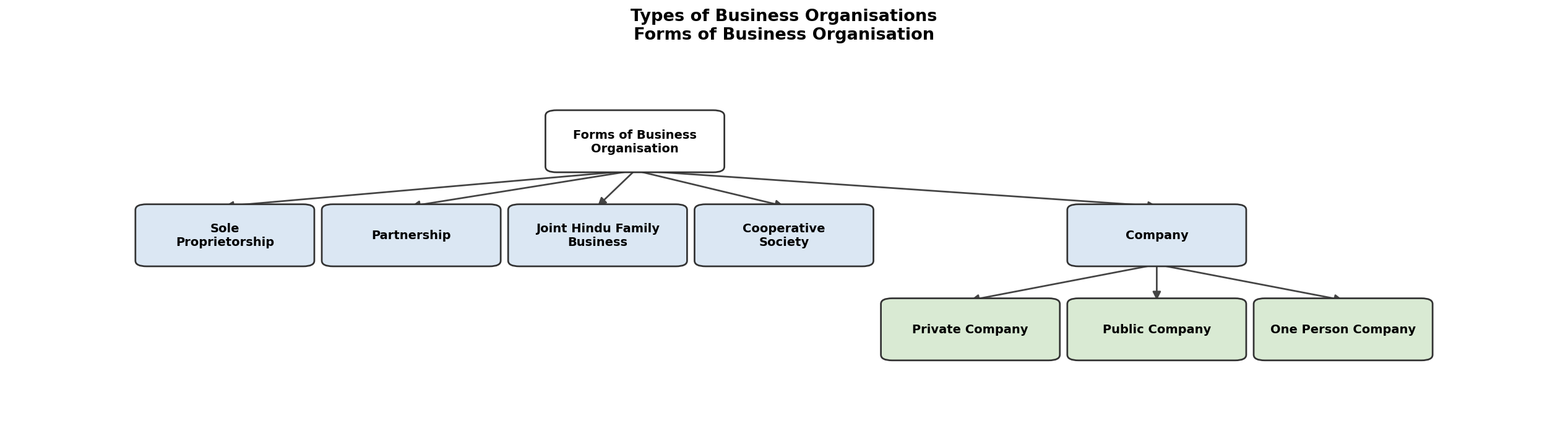
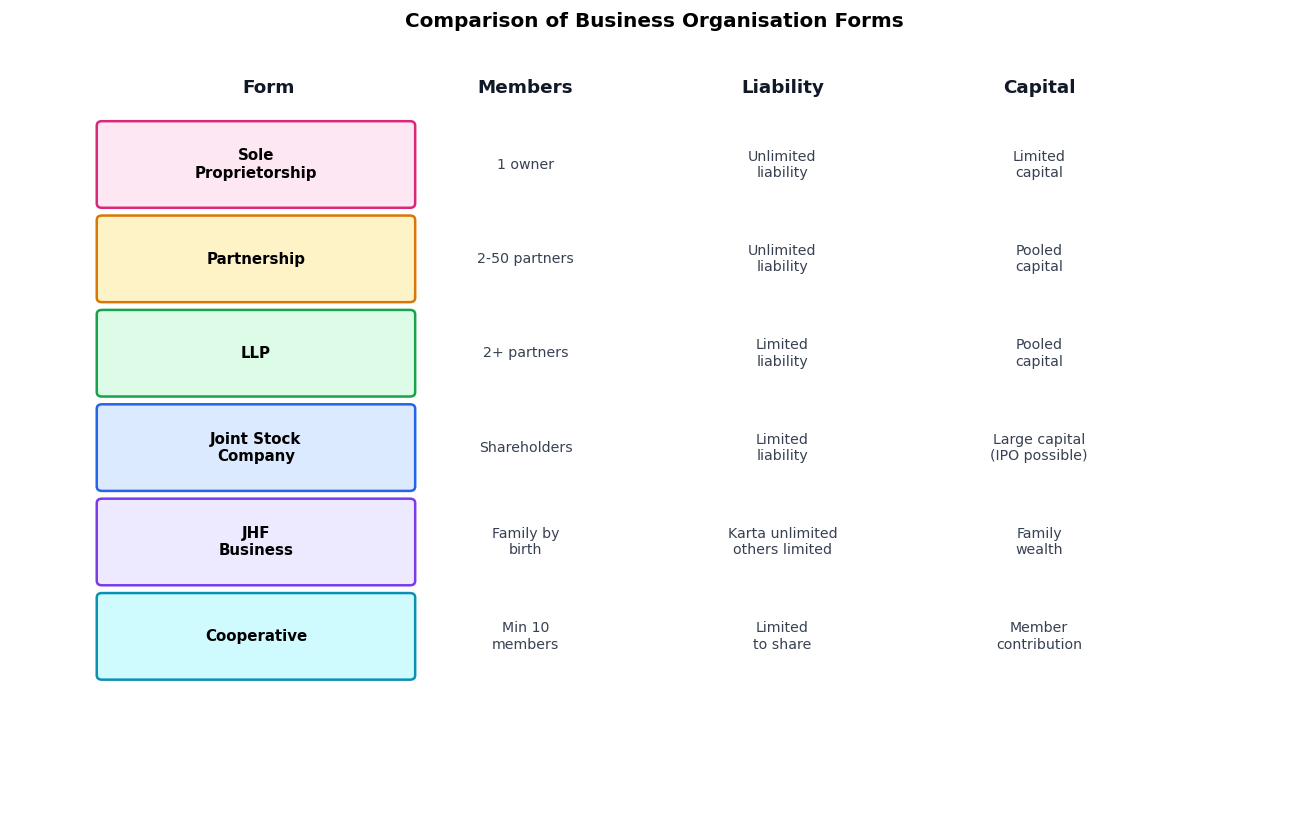
Study the comparison of business organisation forms and answer:

Forms of Business Organisation figure
  1. Which form has UNLIMITED liability and only ONE owner?
    ASole Proprietorship
    BJoint Stock Company
    CPartnership
    DLLP
  2. Which form can raise the LARGEST capital through public issue?
    AJHF Business
    BJoint Stock Company
    CSole Proprietorship
    DPartnership
  3. Compare the various forms of business organisation and explain when each is most suitable.
Show answersHide answers
1. Option 1 — Sole Proprietorship
2. Option 2 — Joint Stock Company
3. Each form of business organisation has trade-offs in liability, capital, control, and complexity. SOLE PROPRIETORSHIP — simplest, full control, but unlimited liability and limited capital. PARTNERSHIP — pooled expertise and capital but unlimited liability for partners. LLP — partnership benefits with limited liability; modern preferred form for professional services. JHF BUSINESS — unique to Hindu families; created by birth; Karta has unlimited liability while other coparceners have limited. JOINT STOCK COMPANY — limited liability, separate legal entity, perpetual succession; private (max 200 members) for closely held; public for share trading and IPO. COOPERATIVE — democratic, focused on member welfare. The CHOICE depends on capital needs, liability tolerance, control preference, regulatory burden, and growth ambitions. Many businesses progress: sole proprietor → partnership → LLP → company as they grow.
Q57 59 Marks

Based on the given diagram, answer the following:

Forms of Business Organisation figure
  1. Which form of business organisation is owned and managed by a single individual?
    APartnership
    BSole Proprietorship
    CCooperative Society
    DJoint Hindu Family Business
  2. How many types of companies are shown in the diagram? Name them.
  3. Which form of business organisation is governed by the Hindu Succession Act and managed by the Karta?
    ACooperative Society
    BPartnership
    CJoint Hindu Family Business
    DPrivate Company
  4. State one key difference between a Private Company and a Public Company as shown in the diagram.
  5. What is the first stage in the formation of a company?
    AIncorporation
    BCommencement of Business
    CPromotion
    DSubscription of Capital
  6. Which document is issued during the Subscription of Capital stage and why is it important?
  7. Which certificate is obtained at the Incorporation stage that gives the company a legal identity?
    ACertificate of Commencement
    BCertificate of Incorporation
    CCertificate of Registration
    DCertificate of Promotion
  8. Is the stage of 'Commencement of Business' required for all types of companies? Explain briefly.
  9. Which type of cooperative society helps members by providing loans at low interest rates?
    AConsumer Cooperative
    BMarketing Cooperative
    CHousing Cooperative
    DCredit Cooperative
  10. How does a Consumer Cooperative Society benefit its members? Refer to the diagram.
  11. How many types of cooperative societies are shown in the diagram?
    AFour
    BFive
    CSix
    DSeven
  12. State the principle on which all cooperative societies are based and mention any one feature of cooperative societies.
  13. Which document is referred to as the 'charter' of the company and defines its relationship with the outside world?
    AArticles of Association
    BProspectus
    CMemorandum of Association
    DCertificate of Incorporation
  14. What is the purpose of the 'Object Clause' in the Memorandum of Association?
  15. Which document governs the internal management and day-to-day affairs of a company?
    AMemorandum of Association
    BProspectus
    CCertificate of Commencement
    DArticles of Association
  16. Which type of company is NOT required to issue a Prospectus and why?
  17. What does 'Mutual Agency' mean in the context of a partnership firm?
    APartners share profits equally without any agreement
    BEach partner can act as an agent of the firm and bind other partners by his acts
    CPartners are liable only for their own actions
    DOnly the senior partner can represent the firm
  18. Explain the concept of 'Unlimited Liability' in a partnership firm and how it affects partners personally.
  19. Under which Act is a partnership firm governed in India?
    ACompanies Act, 2013
    BIndian Contract Act, 1872
    CPartnership Act, 1932
    DHindu Succession Act
  20. Compare the liability of a partner in a partnership firm with that of a member in a cooperative society. Give one point of difference.
  21. What is the minimum number of members required to form a Private Company?
    A5
    B10
    C2
    D7
  22. Name any two types of companies shown in the diagram and state one key difference between them.
  23. Which form of business organisation shown in the diagram is governed by the Hindu Succession Act and managed by the Karta?
  24. Which is the first stage in the formation of a company?
    AIncorporation
    BCommencement of Business
    CPromotion
    DSubscription of Capital
  25. What document is issued during the Subscription of Capital stage?
    AMemorandum of Association
    BCertificate of Incorporation
    CArticles of Association
    DProspectus
  26. What is the significance of the Certificate of Incorporation in the formation of a company?
  27. Which stage of company formation is applicable only to a Public Company and not a Private Company?
    APromotion
    BIncorporation
    CSubscription of Capital
    DAll stages are common
  28. Which type of cooperative society is formed to protect the interests of small producers by providing them with raw materials and marketing support?
    AConsumer Cooperative
    BHousing Cooperative
    CCredit Cooperative
    DProducer Cooperative
  29. State the principle on which cooperative societies are based and name any one feature that distinguishes them from other forms of business.
  30. Which cooperative society helps members obtain loans at low interest rates?
    AMarketing Cooperative
    BHousing Cooperative
    CCredit Cooperative
    DConsumer Cooperative
  31. How does a Consumer Cooperative Society benefit its members? Explain with reference to the diagram.
  32. What is meant by 'Mutual Agency' in a partnership firm?
  33. Which feature of partnership shown in the diagram means that the personal assets of partners can be used to pay business debts?
    AMutual Agency
    BLack of Continuity
    CUnlimited Liability
    DPartnership Deed
  34. What is a Partnership Deed and what does it typically contain?
  35. Which of the following is NOT a feature of a partnership firm?
    AMutual Agency
    BUnlimited Liability
    CPerpetual Succession
    DSharing of Profit and Loss
  36. According to the chart, what is the maximum number of members allowed in a Private Company?
    A50
    B100
    C200
    DUnlimited
  37. Which form of business organisation has the highest minimum membership requirement as shown in the chart?
    APartnership
    BCooperative Society
    CPublic Company
    DPrivate Company
  38. Based on the chart, compare the membership structure of a Private Company and a Public Company. Why does a Public Company require more members?
  39. A Sole Proprietorship has both minimum and maximum members as 1. What does this tell us about its nature, and state one advantage and one disadvantage of this structure?
  40. Which document is issued during the stage of Subscription of Capital to invite the public to invest?
    AMemorandum of Association
    BArticles of Association
    CCertificate of Incorporation
    DProspectus
  41. Explain the significance of the Certificate of Incorporation in the formation of a company.
  42. Which stage of company formation involves filing documents such as Memorandum of Association and Articles of Association with the Registrar?
  43. Name the example of a Consumer Cooperative Society shown in the diagram and state its main objective.
  44. State two features of a Cooperative Society that distinguish it from a Partnership firm.
  45. What is a Partnership Deed? State whether it is mandatory for it to be in written form.
  46. Which feature of partnership means that the firm may dissolve upon the death, insolvency, or retirement of a partner?
    AUnlimited Liability
    BMutual Agency
    CLack of Continuity
    DSharing of Profit and Loss
  47. Explain the feature of 'Unlimited Liability' in a partnership firm and how it differs from a company.
  48. According to the bar chart, which form of business organisation allows the highest maximum number of members?
    ASole Proprietorship
    BPartnership
    CPrivate Company
    DCooperative Society
  49. What is the maximum number of members allowed in a Partnership firm as per the Companies Act, 2013?
    A10
    B20
    C50
    D100
  50. Why is the maximum number of members in a Sole Proprietorship shown as 1 in the chart? Explain.
  51. Compare the membership limits of a Private Company and a Public Company. Which one is NOT shown in the chart, and what is its maximum membership limit?
  52. Which is the FIRST stage in the formation of a company as shown in the diagram?
    AIncorporation
    BPromotion
    CSubscription of Capital
    DCommencement of Business
  53. What is the significance of the Memorandum of Association filed during the Incorporation stage?
  54. A private limited company does NOT need to issue a prospectus during the Subscription of Capital stage. What document does it use instead?
    AArticles of Association
    BCertificate of Incorporation
    CStatement in Lieu of Prospectus
    DCertificate of Commencement
  55. Which type of company requires a Certificate of Commencement of Business before it can start operations, and why is this stage absent for private companies?
  56. Which type of cooperative society is formed to protect the interests of small producers by providing them with raw materials and helping them sell finished goods?
    AConsumer Cooperative
    BHousing Cooperative
    CProducer Cooperative
    DCredit Cooperative
  57. What is the primary objective of a Credit Cooperative Society? Give one example.
  58. The principle of 'one member, one vote' in cooperative societies reflects which core value?
    AProfit maximisation
    BDemocratic management
    CLimited liability
    DPerpetual succession
  59. Distinguish between a Consumer Cooperative Society and a Marketing Cooperative Society.
  60. As shown in the diagram, both Sole Proprietorship and Partnership share which common feature?
    ASeparate legal entity
    BUnlimited liability
    CMinimum 2 members required
    DGoverned by a partnership deed
  61. What is a Partnership Deed? State any two contents that must be included in it.
  62. Which of the following is an advantage of Sole Proprietorship over Partnership, as suggested by the diagram?
    AGreater availability of capital
    BShared risk among members
    CQuick and independent decision making
    DDiverse skills and expertise
  63. The diagram shows that Partnership can have up to 50 members. What is the minimum number of members required to form a partnership, and what happens if the number of partners falls below this minimum?
Show answersHide answers
1. Option 2 — Sole Proprietorship
2. Three types of companies are shown: Private Company, Public Company, and One Person Company.
3. Option 3 — Joint Hindu Family Business
4. A Private Company restricts the transfer of shares and can have a minimum of 2 and maximum of 200 members, whereas a Public Company allows free transfer of shares and requires a minimum of 7 members with no maximum limit.
5. Option 3 — Promotion
6. A Prospectus is issued during the Subscription of Capital stage. It is important because it invites the public to subscribe to the shares of the company and provides all necessary information about the company to potential investors.
7. Option 2 — Certificate of Incorporation
8. No, the stage of Commencement of Business (obtaining a Certificate of Commencement) is required only for a Public Company that raises capital from the public. A Private Company can start business immediately after receiving the Certificate of Incorporation.
9. Option 4 — Credit Cooperative
10. A Consumer Cooperative Society benefits its members by eliminating middlemen and providing goods directly to consumers at reasonable prices, thereby reducing the cost of purchases.
11. Option 3 — Six
12. All cooperative societies are based on the principle of 'mutual help' or 'each for all and all for each.' One feature is that membership is voluntary and open to all — any person can join or leave the society at will.
13. Option 3 — Memorandum of Association
14. The Object Clause in the MOA defines the objectives and purposes for which the company is formed. It specifies the main business activities the company is authorised to carry out. Any activity beyond this clause is considered 'ultra vires' (beyond powers) and is void.
15. Option 4 — Articles of Association
16. A Private Company is NOT required to issue a Prospectus because it is prohibited from inviting the general public to subscribe to its shares or debentures. It raises capital privately from its members, friends, and relatives.
17. Option 2 — Each partner can act as an agent of the firm and bind other partners by his acts
18. Unlimited Liability in a partnership means that if the firm's assets are insufficient to pay its debts, the personal assets of the partners can be used to settle the firm's liabilities. This puts the personal wealth of partners at risk, which is a major disadvantage of the partnership form of business.
19. Option 3 — Partnership Act, 1932
20. In a partnership firm, partners have unlimited liability — their personal assets can be used to pay the firm's debts. In contrast, members of a cooperative society have limited liability — their liability is limited to the amount of capital contributed by them, and their personal assets cannot be used to settle the society's debts.
21. Option 3 — 2
22. The two types are Private Company and Public Company. A Private Company restricts the transfer of shares and limits membership to 200, whereas a Public Company allows free transfer of shares and requires a minimum of 7 members.
23. Joint Hindu Family Business is governed by the Hindu Succession Act and is managed by the Karta, who is the senior-most male member of the family.
24. Option 3 — Promotion
25. Option 4 — Prospectus
26. The Certificate of Incorporation is issued by the Registrar of Companies after all required documents are filed. It gives the company a legal existence and makes it a separate legal entity. Without this certificate, a company cannot function.
27. Option 3 — Subscription of Capital
28. Option 4 — Producer Cooperative
29. Cooperative societies are based on the principle of 'mutual help and welfare'. One distinguishing feature is that they follow the principle of 'one member, one vote', regardless of the number of shares held, ensuring democratic management.
30. Option 3 — Credit Cooperative
31. A Consumer Cooperative Society benefits its members by eliminating middlemen and purchasing goods directly from manufacturers or wholesalers. This allows members to buy goods at lower prices, reducing the cost of living. The surplus earned is distributed among members as dividends.
32. Mutual Agency means that every partner is both an agent and a principal. Each partner can act on behalf of the firm and bind all other partners by their actions. At the same time, each partner is bound by the actions of other partners carried out in the ordinary course of business.
33. Option 3 — Unlimited Liability
34. A Partnership Deed is a written agreement between partners that governs the partnership. It typically contains details such as the name and address of the firm, names of partners, capital contributed by each partner, profit and loss sharing ratio, duties and rights of partners, and procedures for dissolution of the firm.
35. Option 3 — Perpetual Succession
36. Option 3 — 200
37. Option 2 — Cooperative Society
38. A Private Company requires a minimum of 2 and a maximum of 200 members, while a Public Company requires a minimum of 7 members with no upper limit. A Public Company requires more members because it raises capital from the general public through the stock exchange. It needs a broader ownership base to mobilise large amounts of capital for large-scale operations.
39. The fact that a Sole Proprietorship has only 1 member (both minimum and maximum) tells us that it is owned and controlled entirely by a single individual. Advantage: The owner enjoys complete control over all decisions and retains all profits. Disadvantage: The owner bears unlimited liability, meaning personal assets can be used to pay business debts, and the business has limited capital since it depends on one person's resources.
40. Option 4 — Prospectus
41. The Certificate of Incorporation is issued by the Registrar of Companies after verifying all submitted documents. It gives the company a legal existence and a separate legal identity. The company comes into existence from the date mentioned on this certificate.
42. The stage of Incorporation involves filing documents such as the Memorandum of Association, Articles of Association, and other required documents with the Registrar of Companies.
43. Kendriya Bhandar is shown as an example of a Consumer Cooperative Society. Its main objective is to eliminate middlemen and provide goods to consumers at reasonable prices.
44. Two distinguishing features of a Cooperative Society compared to a Partnership firm are: (1) A cooperative society is based on the principle of service motive (not profit motive), whereas a partnership is profit-oriented. (2) A cooperative society has a separate legal existence under the Cooperative Societies Act, while a partnership firm does not have a separate legal identity from its partners.
45. A Partnership Deed is a written agreement between the partners that contains the terms and conditions of the partnership, such as profit-sharing ratio, capital contribution, duties of partners, etc. It is not mandatory for it to be in written form; it can be oral as well. However, a written deed is preferred to avoid disputes.
46. Option 3 — Lack of Continuity
47. In a partnership firm, unlimited liability means that if the firm's assets are insufficient to pay its debts, the partners' personal assets can be used to settle the firm's liabilities. In contrast, in a company, the liability of shareholders is limited to the amount unpaid on their shares, and their personal assets cannot be used to pay company debts.
48. Option 4 — Cooperative Society
49. Option 3 — 50
50. The maximum number of members in a Sole Proprietorship is 1 because it is a business form owned, managed, and controlled by a single individual. There is no concept of multiple owners or members in a sole proprietorship; the entire business belongs to one person who bears all risks and enjoys all profits.
51. A Private Company has a maximum limit of 200 members, as shown in the chart. A Public Company is NOT shown in the chart, and it has no maximum limit on the number of members — any number of people can become shareholders of a public company by purchasing its shares from the stock exchange.
52. Option 2 — Promotion
53. The Memorandum of Association is the fundamental document of a company that defines its relationship with the outside world. It contains the company's name, registered office address, objectives, liability clause, capital clause, and association clause. It sets the limits beyond which the company cannot operate.
54. Option 3 — Statement in Lieu of Prospectus
55. A public limited company requires a Certificate of Commencement of Business because it needs to raise capital from the public through a prospectus, and the Registrar must verify that minimum subscription has been received. A private limited company can commence business immediately after receiving the Certificate of Incorporation since it does not raise capital from the public, making this stage unnecessary for it.
56. Option 3 — Producer Cooperative
57. The primary objective of a Credit Cooperative Society is to provide easy and affordable credit to its members, protecting them from the exploitation of moneylenders who charge very high interest rates. Example: Self-Help Groups (SHGs) or urban cooperative banks.
58. Option 2 — Democratic management
59. A Consumer Cooperative Society is formed by consumers to obtain goods of good quality at reasonable prices by eliminating middlemen. For example, Kendriya Bhandar. A Marketing Cooperative Society is formed by producers to help them sell their products at better prices by pooling their produce and undertaking collective marketing, thereby eliminating middlemen from the selling side. For example, IFFCO (Indian Farmers Fertiliser Cooperative).
60. Option 2 — Unlimited liability
61. A Partnership Deed is a written agreement between the partners of a firm that outlines the terms and conditions of the partnership. Two important contents are: (1) The profit and loss sharing ratio among partners, and (2) The amount of capital contributed by each partner.
62. Option 3 — Quick and independent decision making
63. The minimum number of members required to form a partnership is 2. If the number of partners falls below 2 (i.e., only one partner remains), the partnership is dissolved because a partnership by definition requires at least two persons carrying on a business together with the aim of earning profit.

Make a full Business Studies paper on Forms of Business Organisation.

Pick the question mix, set the marks, hit generate. You get a ready-to-print paper with an answer key.

Generate your paper — free