Skip to content
TestMacher
Chapter 1 · Class 11 Business Studies

Business Services — Important Questions

58 questions With answers CBSE format

SUMMARY: The chapter "Business Services" in Class 11 Business Studies explores the nature and significance of services in business, differentiating them from goods and highlighting their role in the economy.
KEY TOPICS: nature of services, types of services, banking services, insurance services, transportation services, warehousing services, communication services, characteristics of services, e-banking, importance of business services

Q1 1 Mark

Banking helps business by providing:

AStorage
BCapital and payment services
CTransport
DManufacturing
Check answerHide answer
Correct answer: Option 2 — Capital and payment services
Q2 1 Mark

Insurance covers risk of:

ALoss or damage
BEarning profit
CImproving quality
DHiring staff
Check answerHide answer
Correct answer: Option 1 — Loss or damage
Q3 1 Mark

The principle of utmost good faith applies to:

ABanking
BInsurance
CTransport
DCommunication
Check answerHide answer
Correct answer: Option 2 — Insurance
Q4 1 Mark

A current account is suitable for:

ASalary holders
BBusinessmen who need frequent transactions
CLong-term savings
DChildren
Check answerHide answer
Correct answer: Option 2 — Businessmen who need frequent transactions
Q5 1 Mark

Marine insurance covers:

AHealth
BSea transport
CProperty only
DCrops
Check answerHide answer
Correct answer: Option 2 — Sea transport
Q6 1 Mark

Which characteristic of services implies that they cannot be touched, seen, tasted, or smelt before they are purchased?

AInseparability
BIntangibility
CInconsistency
DInventory loss
Check answerHide answer
Correct answer: Option 2 — Intangibility
Q7 1 Mark

Services that are undertaken voluntarily to achieve certain social goals, such as providing education to underprivileged children, are classified as:

APersonal Services
BBusiness Services
CSocial Services
DPublic Utility Services
Check answerHide answer
Correct answer: Option 3 — Social Services
Q8 1 Mark

Which type of bank account is primarily opened by businessmen to facilitate a large number of daily transactions, and generally does not pay any interest?

ASavings Deposit Account
BRecurring Deposit Account
CCurrent Deposit Account
DFixed Deposit Account
Check answerHide answer
Correct answer: Option 3 — Current Deposit Account
Q9 1 Mark

Under which principle of insurance is the insured compensated only to the extent of the actual loss suffered, ensuring they do not make a profit from the insurance contract?

APrinciple of Indemnity
BPrinciple of Subrogation
CPrinciple of Insurable Interest
DPrinciple of Mitigation
Check answerHide answer
Correct answer: Option 1 — Principle of Indemnity
Q10 1 Mark

Warehouses that are licensed by the government to accept imported goods prior to the payment of customs duty are known as:

APublic Warehouses
BBonded Warehouses
CPrivate Warehouses
DCooperative Warehouses
Check answerHide answer
Correct answer: Option 2 — Bonded Warehouses
Q11 1 Mark

A doctor must be present at the time of treating a patient, meaning the production and consumption of the service occur simultaneously. Which characteristic of services does this illustrate?

AInconsistency
BInseparability
CInventory
DIntangibility
Check answerHide answer
Correct answer: Option 2 — Inseparability
Q12 1 Mark

In the context of e-banking, what does the term 'RTGS' stand for, and what is its primary feature regarding transaction settlement?

AReal Time Gross Settlement; transactions are settled individually on a continuous basis
BReal Time General Settlement; transactions are settled in hourly batches
CRegional Transfer Gross System; transactions are restricted to state borders
DRapid Transfer Gross Settlement; transactions are processed only during night hours
Check answerHide answer
Correct answer: Option 1 — Real Time Gross Settlement; transactions are settled individually on a continuous basis
Q13 1 Mark

After paying the full claim for a damaged car, the insurance company sells the scrap of the car to recover some money. This action is justified under which principle of insurance?

APrinciple of Contribution
BPrinciple of Mitigation
CPrinciple of Subrogation
DPrinciple of Proximate Cause
Check answerHide answer
Correct answer: Option 3 — Principle of Subrogation
Q14 1 Mark

If a shipowner insures the vessel itself against damages caused by rough seas and collisions, what specific type of marine insurance policy have they taken?

ACargo Insurance
BFreight Insurance
CHull Insurance
DLiability Insurance
Check answerHide answer
Correct answer: Option 3 — Hull Insurance
Q15 1 Mark

When a warehouse performs activities like grading, packaging, and labeling of goods before they are sent to retailers, which function of warehousing is it performing?

AConsolidation
BValue-added services
CPrice stabilization
DBreak-the-bulk
Check answerHide answer
Correct answer: Option 2 — Value-added services
Q16 3 Marks

Define a service. State any three characteristics that distinguish services from goods.

View sample solutionHide solution
A service is an act, performance, or experience offered by one party to another that creates value but does not result in ownership of any physical product. Characteristics distinguishing services from goods: (1) Intangibility — cannot be touched, seen, or stored; e.g., a doctor's consultation. (2) Inseparability — production and consumption are simultaneous (a haircut is given and received together). (3) Variability — quality varies with provider, time, and place. (4) Perishability — cannot be stored or saved (an empty plane seat is gone forever). (5) No transfer of ownership — a service is consumed not owned. Goods, by contrast, are tangible, separable, standardisable, storable, and ownable.
Q17 3 Marks

List the various types of bank accounts and their suitability.

View sample solutionHide solution
(1) Savings A/c — for individuals; encourages saving; limited transactions; earns interest. (2) Current A/c — for businessmen; unlimited transactions; no interest (or very low); chequebook facility; overdraft possible. (3) Fixed Deposit (FD) — for medium/long-term savings; locked-in for fixed period; higher interest. (4) Recurring Deposit (RD) — regular monthly deposits; for systematic savings. (5) Salary A/c — special for salaried employees; minimum balance often nil. (6) Joint A/c — for two or more persons. (7) NRO/NRE A/c — for non-resident Indians.
Q18 3 Marks

Explain the principle of utmost good faith in insurance.

View sample solutionHide solution
The principle of utmost good faith (uberrima fides) requires both insurer and insured to disclose all material facts honestly when entering an insurance contract. Material fact = any fact that would affect the insurer's decision to insure or the premium charged (e.g., applicant's medical history for life insurance, fire safety measures for fire insurance). Failure to disclose or misrepresentation makes the contract voidable at the insurer's option. This principle is essential because the insurer cannot personally verify every fact and must rely on the applicant's truthfulness.
Q19 3 Marks

Distinguish between life insurance and fire insurance.

View sample solutionHide solution
LIFE INSURANCE — covers risk to life of the insured; insured must outlive (or family receives money on death); contract is for the long term (years); insured amount paid on death/maturity; premium based on age, health, sum assured. FIRE INSURANCE — covers loss or damage to property due to fire; contract is short-term (typically 1 year); insurance pays only the actual loss (indemnity principle); premium based on property value, fire risk; covers building, stock, machinery. Life insurance is a contract of CERTAINTY (death is certain, only timing uncertain); fire insurance is a contract of INDEMNITY.
Q20 3 Marks

List any three e-banking services available today.

View sample solutionHide solution
(1) Internet Banking — login to bank website for fund transfer, balance check, bill payment, statement download. (2) Mobile Banking — banking via smartphone apps; same services as internet banking with added convenience. (3) ATM (Automated Teller Machine) — cash withdrawal, balance inquiry, mini-statement, deposit, fund transfer 24x7. (4) Debit and Credit Cards — for cashless payment at merchants and online. (5) NEFT, RTGS, IMPS, UPI — electronic fund transfer between banks. (6) Online bill payment — utility bills, mobile recharge, education fee. E-banking has revolutionised retail banking in India.
Q21 3 Marks

What are the '5 Is' that describe the unique characteristics of services?

View sample solutionHide solution
The '5 Is' of services are Intangibility, Inconsistency, Inseparability, Inventory (lack of), and Involvement. These characteristics distinguish services from physical goods, as services cannot be touched, are highly customized, are produced and consumed simultaneously, cannot be stored, and require customer participation.
Q22 3 Marks

Distinguish between a Current Account and a Fixed Deposit Account.

View sample solutionHide solution
A Current Account is maintained by businessmen for frequent transactions with no limit on withdrawals and generally carries no interest. In contrast, a Fixed Deposit Account involves depositing a lump sum of money for a specified fixed period, offering a higher rate of interest, with withdrawals permitted only after maturity or with a penalty.
Q23 3 Marks

What is the primary purpose of a Bonded Warehouse?

View sample solutionHide solution
Bonded warehouses are licensed by the government to accept and store imported goods before the payment of customs duty. They allow importers to defer duty payments until the goods are actually released or sold, helping them manage cash flows and facilitate re-exporting.
Q24 3 Marks

Define the principle of 'Utmost Good Faith' (Uberrimae Fidei) in insurance.

View sample solutionHide solution
The principle of 'Utmost Good Faith' states that both the insurer and the insured must disclose all material facts honestly and completely regarding the insurance contract. Any non-disclosure or misrepresentation of material facts can make the insurance contract voidable at the option of the affected party.
Q25 3 Marks

What is e-banking and name two popular electronic fund transfer systems used in India.

View sample solutionHide solution
E-banking, or electronic banking, refers to the provision of banking services through electronic media and internet platforms without visiting a physical branch. Two popular electronic fund transfer systems used in India are National Electronic Funds Transfer (NEFT) and Real Time Gross Settlement (RTGS).
Q26 6 Marks

Explain the various types of insurance and their importance for business.

View sample solutionHide solution
Types: (1) LIFE insurance — protects family in case of death; pays sum assured on death/maturity; long-term contract. (2) FIRE insurance — covers property loss due to fire, lightning, explosion; contract of indemnity. (3) MARINE insurance — covers loss to ship, cargo, freight during sea/air/road transit; very old form of insurance going back centuries. (4) HEALTH insurance — covers medical expenses; cashless or reimbursement. (5) MOTOR insurance — third-party (mandatory) and own damage cover. (6) CROP insurance — protects farmers against crop failure due to weather, pests. (7) BUSINESS interruption insurance — covers loss of profits due to insured event. (8) DIRECTORS and OFFICERS LIABILITY insurance. IMPORTANCE FOR BUSINESS: (a) protects against unforeseen losses; (b) enables risk-taking — businesses can undertake ventures knowing risks are insured; (c) provides credit support — banks lend more readily to insured businesses; (d) safeguards employees and customers; (e) statutory compliance — many insurances are mandatory; (f) social welfare — life insurance secures families.
Q27 6 Marks

Discuss the role of banking in trade and industry.

View sample solutionHide solution
Banking is the foundation of modern commerce. ROLE: (1) Acceptance of deposits — banks safely keep public savings; channelise savings to investment. (2) Lending — banks finance trade (working capital, term loans), industry (project finance), agriculture (KCC), housing (home loans), small business (MUDRA). (3) Credit creation — through fractional reserve system banks expand the money supply. (4) Payment services — cheques, drafts, electronic transfer (NEFT, RTGS, UPI); facilitate trade. (5) Foreign exchange — handle exports/imports payments; manage forex. (6) Discounting bills of exchange — provides immediate cash for credit sales. (7) Letter of credit — facilitates international trade by guaranteeing payment. (8) Cash management for corporates — managing receivables and payables. (9) Investment banking — capital raising, mergers and acquisitions advisory. (10) Government services — tax collection, paying salaries. Without banking, complex modern trade would be impossible. RBI regulates the entire banking system.
Q28 6 Marks

Explain the principles of insurance.

View sample solutionHide solution
Insurance contracts are governed by several principles: (1) UTMOST GOOD FAITH (uberrima fides) — both parties must disclose all material facts honestly; non-disclosure makes contract voidable. (2) INSURABLE INTEREST — insured must have a financial interest in the subject matter (cannot insure neighbour's house). For life insurance, husband-wife and parent-child have insurable interest. (3) INDEMNITY — insurer pays only actual loss not more; applies to fire and marine but NOT to life insurance (which is a contract of certainty). (4) SUBROGATION — after paying claim insurer takes over rights of insured against third parties. (5) CONTRIBUTION — when same risk is insured by multiple insurers each contributes proportionately. (6) CAUSA PROXIMA (proximate cause) — only the immediate cause of loss is considered; insurer pays only if loss is caused by an insured peril. (7) MITIGATION — insured must take reasonable steps to minimise loss after the event. These principles ensure fairness and prevent moral hazard.
Q29 6 Marks

Discuss the role of communication and transportation as auxiliaries to trade.

View sample solutionHide solution
COMMUNICATION facilitates the flow of information between buyers, sellers, and intermediaries. Forms: (1) Postal services — letters, parcels (slow but reliable). (2) Courier services — faster, door-to-door, with tracking. (3) Telephone — instant voice. (4) Internet/Email — written communication globally instant. (5) Mobile messaging (SMS, WhatsApp). (6) Video conferencing. (7) E-commerce platforms. Importance: enables negotiation, order placement, payment, customer service, market intelligence. Modern trade is impossible without instant global communication. TRANSPORTATION moves goods and people between places. Modes: (1) Road — flexible, door-to-door, suitable for short-medium distance. (2) Rail — cost-effective for bulk goods and long distance. (3) Water — cheapest for international trade and bulk; slow. (4) Air — fastest but expensive; for high-value or perishable goods. (5) Pipeline — for liquids/gases. Importance: creates place utility (goods reach where needed); enables specialisation (different regions produce what they're best at); supports just-in-time inventory. Together communication and transportation removed the spatial and informational hindrances of trade.
Q30 6 Marks

Explain the role of warehousing in modern business.

View sample solutionHide solution
Warehousing involves the storage of goods until they are needed for consumption or distribution. ROLES: (1) BRIDGES TIME GAP — between production and consumption (cane sugar produced seasonally but consumed year-round). (2) PRICE STABILITY — by holding stock, warehouses prevent shortages and price spikes during low-supply periods. (3) ENABLES BULK PRODUCTION — producers can manufacture large quantities and store; reduces per-unit cost. (4) PRESERVES QUALITY — proper storage conditions prevent spoilage; cold storage for perishables, dry storage for grains. (5) FACILITATES TRADE — wholesalers and exporters store stock; importers hold imported goods. (6) FINANCIAL SUPPORT — warehouse receipt can be pledged to bank for working capital loans. (7) GRADING AND PACKING — value-added services often offered. TYPES: (a) Private warehouses — owned by manufacturers/traders; (b) Public warehouses — open to anyone for hire; (c) Bonded warehouses — under customs supervision for imported goods; (d) Cooperative warehouses — for members; (e) Cold storage — for perishables. Modern logistics relies heavily on warehousing networks; e-commerce companies have transformed it into hyper-efficient fulfilment centres.
Q31 6 Marks

Differentiate between business ethics and social responsibility in tabular form.

Q32 1 Mark

Assertion (A): Services are intangible.

Reason (R): Services cannot be touched seen or stored unlike goods.

Show explanationHide explanation
Correct answer: Option 1 — Both A and R are true, and R is the correct explanation of A.
Q33 1 Mark

Assertion (A): A current account is suitable for businessmen.

Reason (R): A current account allows unlimited transactions and chequebook facilities essential for daily business operations.

Show explanationHide explanation
Correct answer: Option 1 — Both A and R are true, and R is the correct explanation of A.
Q34 1 Mark

Assertion (A): The insured must have insurable interest in the subject matter.

Reason (R): Without insurable interest the insurance contract would amount to mere wagering and is not enforceable.

Show explanationHide explanation
Correct answer: Option 1 — Both A and R are true, and R is the correct explanation of A.
Q35 1 Mark

Assertion (A): Warehousing creates time utility.

Reason (R): Goods produced now can be stored and made available when consumers need them.

Show explanationHide explanation
Correct answer: Option 1 — Both A and R are true, and R is the correct explanation of A.
Q36 1 Mark

Assertion (A): E-banking has revolutionised retail banking.

Reason (R): Customers can now perform most banking transactions online without visiting a branch.

Show explanationHide explanation
Correct answer: Option 1 — Both A and R are true, and R is the correct explanation of A.
Q37 1 Mark

Assertion (A): Services are intangible in nature.

Reason (R): Services cannot be touched, seen, or tasted before they are purchased.

Show explanationHide explanation
Correct answer: Option 1 — Both A and R are true, and R is the correct explanation of A.
Q38 1 Mark

Assertion (A): Services can be stored for future use just like physical goods.

Reason (R): Services are perishable and must be consumed at the time of production.

Show explanationHide explanation
Correct answer: Option 4 — A is false, but R is true.
Q39 1 Mark

Assertion (A): A recurring deposit account is suitable for people who want to save a fixed sum of money every month.

Reason (R): The depositor can withdraw money from a recurring deposit account anytime they want through an ATM.

Show explanationHide explanation
Correct answer: Option 3 — A is true, but R is false.
Q40 1 Mark

Statement 1: Services are intangible.

Statement 2: They cannot be stored for future use.

Show answerHide answer
Correct answer: Option 1 — Both statements are true.
Q41 1 Mark

Statement 1: Savings accounts encourage individuals to save.

Statement 2: Current accounts are designed for businessmen.

Show answerHide answer
Correct answer: Option 1 — Both statements are true.
Q42 1 Mark

Statement 1: Life insurance covers risk to life.

Statement 2: Fire insurance covers risk of loss due to fire.

Show answerHide answer
Correct answer: Option 1 — Both statements are true.
Q43 1 Mark

Statement 1: Transportation creates place utility.

Statement 2: It moves goods from where they are produced to where they are consumed.

Show answerHide answer
Correct answer: Option 1 — Both statements are true.
Q44 1 Mark

Statement 1: Subrogation and contribution are principles of insurance.

Statement 2: They prevent the insured from making profit out of insurance.

Show answerHide answer
Correct answer: Option 1 — Both statements are true.
Q45 1 Mark

Statement 1: Services are tangible economic activities that can be stored for future use.

Statement 2: Goods are physical objects that can be transferred from seller to buyer.

Show answerHide answer
Correct answer: Option 3 — Only Statement 2 is true.
Q46 1 Mark

Statement 1: Inconsistency is a key characteristic of services because different customers have different demands and expectations.

Statement 2: Inseparability means that the production and consumption of services are performed simultaneously.

Show answerHide answer
Correct answer: Option 1 — Both statements are true.
Q47 1 Mark

Statement 1: A current account is generally opened by business firms and does not pay any interest on deposits.

Statement 2: Fixed deposit accounts offer the lowest rate of interest among all types of bank accounts.

Show answerHide answer
Correct answer: Option 2 — Only Statement 1 is true.
Q48 3 Marks
Geeta runs a kirana shop. Her CA suggests she should have appropriate bank accounts: a savings account for her personal use, a current account for the business, a fixed deposit for surplus funds, and a recurring deposit for systematic savings.
  1. Which account is best for daily business transactions?
    ASavings account
    BCurrent account
    CFixed deposit
    DRecurring deposit
  2. A current account allows:
    AYes — full chequebook
    BNo — limited transactions
    CYes — limited cheques
    DRandom
  3. Explain the appropriate use of each account type for Geeta's situation.
Show answersHide answers
1. Option 2 — Current account
2. Option 1 — Yes — full chequebook
3. Each bank account type serves different purposes. SAVINGS ACCOUNT — for individuals; encourages saving; minimum balance and limited transactions; earns interest. Geeta's PERSONAL account. CURRENT ACCOUNT — for businessmen; unlimited transactions; chequebook facility; no interest (or very low); can have overdraft facility. Geeta's BUSINESS account allows daily payments to suppliers, salaries, deposits of customer payments. FIXED DEPOSIT — locks money for fixed period (7 days to 10 years); higher interest than savings; suitable for surplus funds Geeta doesn't need immediately. RECURRING DEPOSIT — fixed monthly deposit for fixed period; helps systematic savings; useful for planning future expenses (renewing rental, buying inventory in bulk). The four together provide LIQUIDITY for daily operations (current), PERSONAL savings (savings), GROWTH for surplus (FD), and DISCIPLINED savings (RD). Geeta's CA's advice is sound: separating personal and business accounts is essential for clarity, tax compliance, and easier reconciliation.
Q49 3 Marks
M/s Solar Industries has a textile factory worth ₹50000000 (building + machinery). The owner Mr Khanna takes a fire insurance policy from National Insurance for ₹40000000 sum insured. Three months later a fire destroys 70% of the factory. The actual loss is ₹35000000. Mr Khanna files a claim.
  1. Fire insurance is governed by which principles?
    AIndemnity
    BUtmost good faith
    CBoth
    DNeither
  2. Insurance company should pay according to which principle?
    APay full ₹40000000
    BPay ₹35000000 (actual loss)
    CPay only proportionate
    DPay nothing
  3. Explain how the fire insurance claim is settled and what principles apply.
Show answersHide answers
1. Option 3 — Both
2. Option 3 — Pay only proportionate
3. This case illustrates the PRINCIPLE OF INDEMNITY in fire insurance. INDEMNITY — insurance pays the actual loss not more (insured cannot make profit from insurance). Calculation: Khanna's policy is ₹40000000 on a ₹50000000 property (under-insured by 80%). PROPORTIONATE PAYMENT (Average Clause): When property is under-insured, insurer pays only the proportionate share. Insurance pays = (Sum insured / Actual value) × Loss = (40000000 / 50000000) × 35000000 = 0.8 × 35000000 = ₹28000000. Khanna bears the remaining ₹7000000 himself. PRINCIPLES applicable: (1) UTMOST GOOD FAITH — Khanna must have disclosed all material facts (existing fire safety, type of materials stored). (2) INDEMNITY — actual loss only. (3) AVERAGE CLAUSE — proportionate payment for under-insurance. (4) SUBROGATION — if loss was caused by a third party, insurance can recover from them after paying Khanna. (5) PROXIMATE CAUSE — only if loss caused by an insured peril (fire here). LESSON: insure for FULL value to get full coverage in case of loss. Mr Khanna's mistake was under-insuring to save premium — costly choice.
Q50 3 Marks
M/s Ramesh Textiles exports cotton garments to USA. The order is for 5000 garments worth $25000. The shipping is from Mumbai to New York. The exporter must arrange transportation insurance documentation banking and customs.
  1. The most economical mode of transport for bulk goods to USA is:
    AMarine
    BAir
    CRoad
    DRail
  2. For payment security in international trade Ramesh should use:
    ALetter of Credit
    BBill of Exchange
    CCash on Delivery
    DRandom
  3. Identify the various business services required for the export and explain the role of each.
Show answersHide answers
1. Option 1 — Marine
2. Option 1 — Letter of Credit
3. International trade involves multiple business services working together. SERVICES NEEDED: (1) TRANSPORTATION — goods move from Mumbai factory to ship at Mumbai port, then by sea to USA. MARINE shipping is most economical for bulk; takes 30-45 days. (2) MARINE INSURANCE — covers loss/damage during transit (storm, theft, fire). Premium based on cargo value and route risk. (3) WAREHOUSING — at Mumbai port before loading, at US port after arrival. (4) BANKING — Letter of Credit (LC) issued by buyer's US bank guarantees payment to Ramesh after he ships. Foreign exchange handled by his bank in India. (5) DOCUMENTATION — bill of lading (proof of shipment), commercial invoice, packing list, certificate of origin (issued by Indian Chamber of Commerce), marine insurance policy. (6) CUSTOMS CLEARANCE — both Indian export customs (shipping bill, export duty if applicable) and US import customs (import duty). (7) COMMUNICATION — email, phone for negotiation, order updates, dispute resolution. (8) ADVERTISING — finding the buyer in the first place. EACH SERVICE addresses a specific hindrance: transport (place), warehousing (time), insurance (risk), banking (finance and payment), documentation (legal validity), communication (information). Without these auxiliaries, international trade would be impossible.
Q51 4 Marks
Ramesh runs a small manufacturing unit in Pune. He deposits his daily sales revenue in a savings account at a nearby bank. Whenever he needs funds for expansion, he applies for a business loan. The bank also provides him with facilities like overdraft, discounting of bills, and online fund transfers. Recently, the bank introduced e-banking services, allowing Ramesh to check his account balance, pay suppliers, and apply for loans through a mobile application without visiting the branch. The bank also issues letters of credit to help Ramesh deal with suppliers in other cities. Ramesh feels that banking services have made his business operations smoother, faster, and more efficient. He no longer needs to carry large amounts of cash, and all transactions are recorded digitally, making accounting easier.
  1. Which of the following is NOT a function of a commercial bank?
    AAccepting deposits
    BGranting loans
    CIssuing insurance policies
    DDiscounting bills of exchange
  2. What is e-banking?
  3. The facility that allows Ramesh to withdraw more money than his account balance is called:
    AFixed Deposit
    BOverdraft
    CLetter of Credit
    DRecurring Deposit
  4. State any two advantages of e-banking for a businessman like Ramesh.
Show answersHide answers
1. Option 3 — Issuing insurance policies
2. E-banking, or electronic banking, refers to the provision of banking services and transactions through electronic channels such as the internet, mobile applications, and ATMs, allowing customers to perform banking activities without visiting a physical branch.
3. Option 2 — Overdraft
4. Two advantages of e-banking for a businessman: (1) Convenience – Banking transactions can be performed anytime and anywhere without visiting the branch, saving time and effort. (2) Faster Transactions – Fund transfers, bill payments, and loan applications are processed quickly, improving business efficiency.
Q52 3 Marks

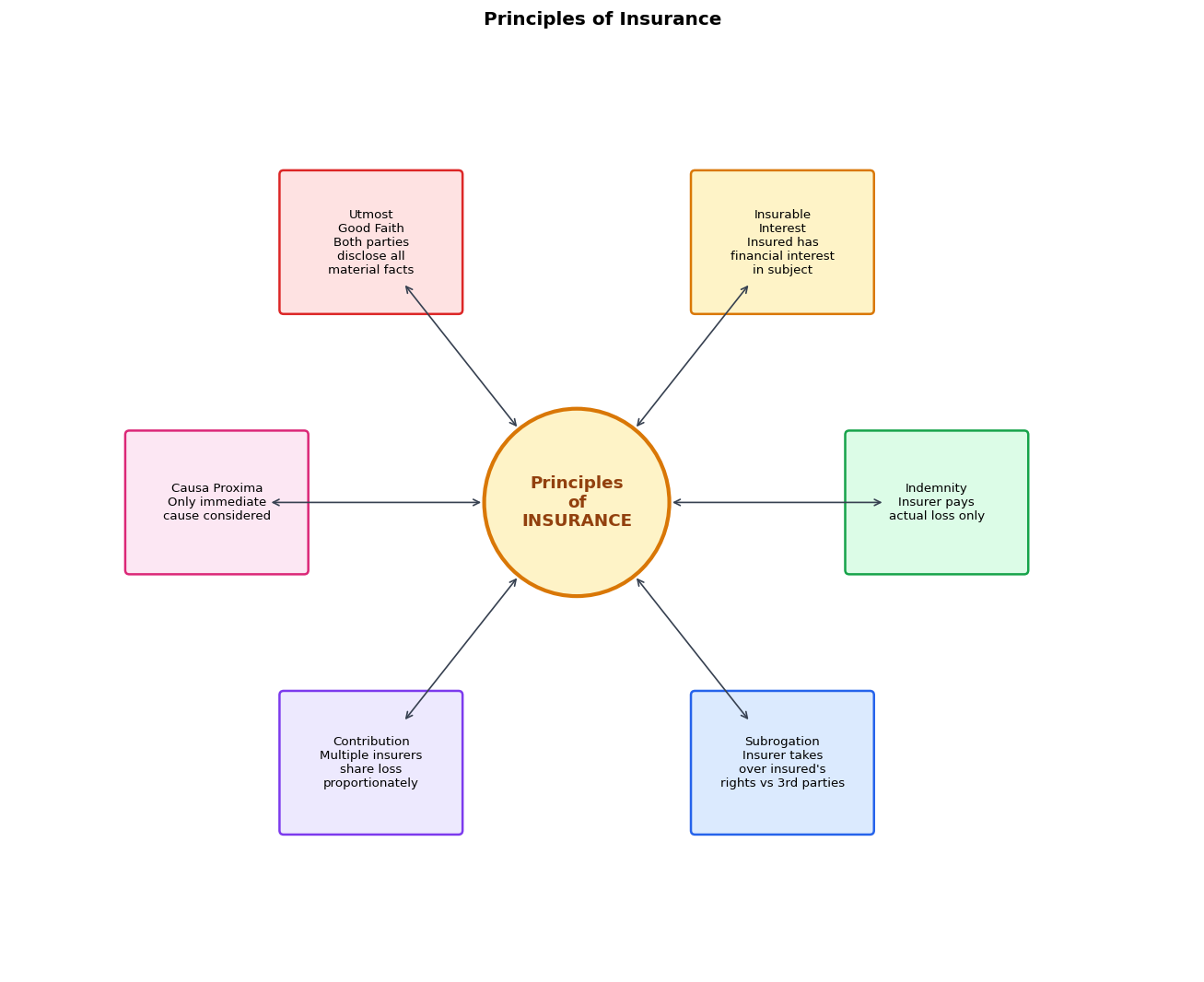
Principles of insurance and their application:

PrincipleDescriptionApplication
Utmost good faithBoth parties disclose all material factsAll insurance
Insurable interestInsured has financial interest in subjectAll insurance
IndemnityInsurer pays actual loss onlyProperty/marine/fire (NOT life)
SubrogationInsurer takes over insured's rights vs third partiesProperty after claim
ContributionMultiple insurers share loss proportionatelyMultiple policies
Causa proximaOnly immediate cause of loss consideredAll insurance
MitigationInsured must minimise lossAll insurance
  1. Which principle does NOT apply to life insurance?
    AIndemnity
    BUtmost good faith
    CSubrogation
    DContribution
  2. Insurance contract requires:
    AInsurable interest
    BSubrogation
    CCausa proxima
    DMitigation
  3. Why doesn't the principle of indemnity apply to life insurance?
Show answersHide answers
1. Option 1 — Indemnity
2. Option 1 — Insurable interest
3. Insurance is governed by these principles to ensure fair dealings between insurer and insured. UTMOST GOOD FAITH (uberrima fides) — fundamental; both parties must disclose all material facts honestly. Failure makes contract voidable. INSURABLE INTEREST — insured must have a financial interest in the subject (cannot insure neighbour's house). For life insurance, husband-wife and parent-child have insurable interest. INDEMNITY — applies to property, fire, marine insurance — pays actual loss only; prevents profit-making. Does NOT apply to life insurance (which pays the agreed sum on death/maturity). SUBROGATION — after paying, insurer takes over insured's rights against third parties. CONTRIBUTION — when same risk is insured by multiple insurers, each pays proportionately. CAUSA PROXIMA — only the immediate cause of loss is considered; insurer pays only if caused by an insured peril. MITIGATION — insured must take reasonable steps to minimise loss after the event (call fire brigade, move stock to safety). These principles ensure fairness and prevent moral hazard.
Q53 3 Marks

Compare modes of transport:

  1. The cheapest mode for international bulk goods is:
    ARoad
    BRail
    CWater
    DAir
  2. For perishable goods that must reach quickly which mode is best?
    ARoad
    BRail
    CWater
    DAir
  3. Why is water the dominant mode for international trade?
Show answersHide answers
1. Option 3 — Water
2. Option 4 — Air
3. Each transport mode has its niche. ROAD — most flexible (door-to-door); good for short to medium distances; suitable for individual orders. Major mode within India. RAIL — cost-effective for bulk goods over long distances; less flexible (only railhead to railhead); ideal for coal, iron ore, cement, food grains, vehicles. India has world's 4th largest rail network. WATER — cheapest for very long distance and bulk; SLOWEST; primary mode for international trade (90% by value). India's ports handle hundreds of millions of tonnes annually. AIR — FASTEST but most expensive; suitable for urgent or high-value goods (fresh flowers, electronics, mail, vaccines, gold). Limited cargo capacity. PIPELINE — continuous flow; lowest cost for liquids and gases; needs huge initial capital but low operating cost. Used for crude oil, natural gas, water. CHOICE depends on weight, value, urgency, distance, infrastructure, and destination. Modern logistics often uses MULTIMODAL transport (road + rail + ship + road) optimising cost vs time.
Q54 6 Marks

Match each insurance type with the risk it covers and explain the principle of indemnity.

Insurance TypeRisk Covered
Life? Risk to life
Fire? Property loss due to fire
Marine? Loss during transit
Health? Medical expenses
Motor? Vehicle loss + third-party
Crop? Crop failure
Q55 6 Marks

Recommend the most suitable mode of transport for each scenario and explain.

ScenarioRecommended Mode
Fresh flowers Delhi to Mumbai? Air
Iron ore Gujarat to railway yards? Rail
Household groceries in a city? Road
Textile exports India to USA? Water
Crude oil Assam to Mumbai? Pipeline
Q56 3 Marks

Study the principles of insurance wheel and answer:

Business Services figure
  1. The principle of INDEMNITY does NOT apply to which insurance?
    ALife
    BFire
    CMarine
    DBoth Fire and Marine
  2. Which principle requires both parties to disclose all material facts?
    AInsurable Interest
    BUtmost Good Faith
    CSubrogation
    DCausa Proxima
  3. Explain the principles of insurance and how they ensure fairness in insurance contracts.
Show answersHide answers
1. Option 1 — Life
2. Option 2 — Utmost Good Faith
3. Insurance contracts are governed by several principles to ensure fair dealings between insurer and insured. UTMOST GOOD FAITH — fundamental; both parties must disclose all material facts honestly; failure makes contract voidable. INSURABLE INTEREST — insured must have a financial interest in the subject matter; cannot insure neighbour's house. INDEMNITY — insurer pays only actual loss, not more; applies to property/fire/marine but NOT to life insurance (which is a contract of certainty). SUBROGATION — after paying claim, insurer takes over insured's rights against third parties. CONTRIBUTION — when same risk is insured by multiple insurers, each contributes proportionately. CAUSA PROXIMA — only the immediate cause of loss is considered; insurer pays only if loss is caused by an insured peril. MITIGATION — insured must take reasonable steps to minimise loss after the event. These principles ensure fairness and prevent moral hazard.
Q57 59 Marks

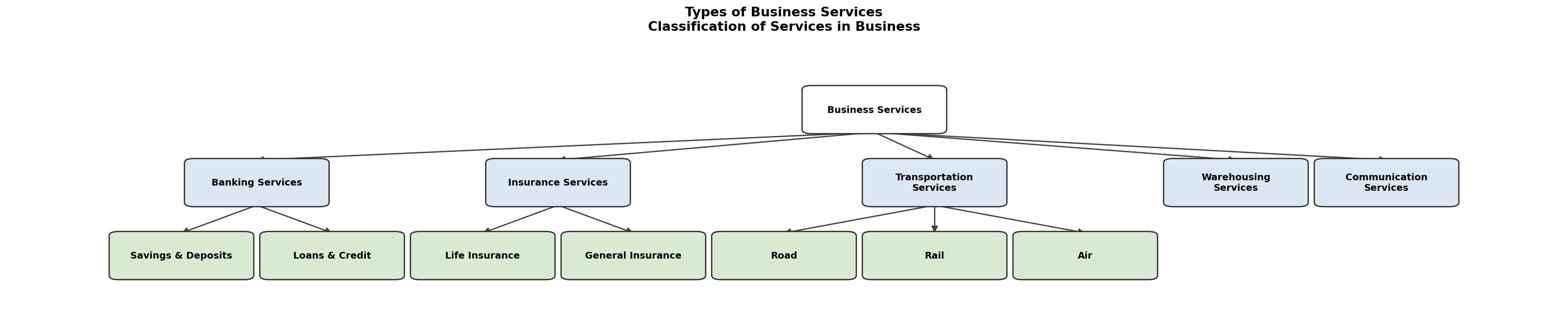
Based on the given diagram, answer the following:

Business Services figure
  1. Which of the following is NOT a type of business service shown in the diagram?
    ABanking Services
    BManufacturing Services
    CInsurance Services
    DWarehousing Services
  2. How many main types of business services are shown in the diagram?
    AThree
    BFour
    CFive
    DSix
  3. Differentiate between Life Insurance and General Insurance as shown under Insurance Services in the diagram.
  4. Why are warehousing services considered an important business service? Explain briefly.
  5. Which characteristic of services means that services cannot be stored for future use?
    AIntangibility
    BInseparability
    CInconsistency
    DInventory (Perishability)
  6. Which characteristic of services is depicted by the statement: 'A doctor's service is consumed at the same time it is produced'?
    AIntangibility
    BInseparability
    CInconsistency
    DPerishability
  7. Explain the characteristic of 'Inconsistency' in services with an example.
  8. How does 'Intangibility' create a challenge for businesses offering services? Give one example.
  9. Which type of bank account is most suitable for a businessman who needs to make frequent transactions daily?
    ASavings Account
    BFixed Deposit Account
    CCurrent Account
    DRecurring Deposit Account
  10. Which of the following is an example of an E-Banking service as shown in the diagram?
    ACash Credit
    BOverdraft
    CMobile Banking
    DFixed Deposit
  11. Distinguish between 'Overdraft' and 'Cash Credit' as forms of loans and advances provided by banks.
  12. Explain any two agency services provided by banks as shown in the diagram.
  13. Which principle of insurance requires that the insured must have a financial stake in the subject matter of insurance?
    APrinciple of Indemnity
    BPrinciple of Utmost Good Faith
    CPrinciple of Insurable Interest
    DPrinciple of Subrogation
  14. Which type of insurance covers risks related to loss of goods transported by sea?
    AFire Insurance
    BMotor Insurance
    CHealth Insurance
    DMarine Insurance
  15. Explain the Principle of Indemnity in insurance. Why does it not apply to Life Insurance?
  16. Distinguish between a 'Term Insurance' policy and an 'Endowment Policy' under Life Insurance.
  17. How many major types of Business Services are shown in the diagram?
    A3
    B4
    C5
    D6
  18. Which of the following is NOT a sub-type of Transportation Services shown in the diagram?
    ARoad
    BRail
    CWater
    DAir
  19. Distinguish between Life Insurance and General Insurance as shown under Insurance Services in the diagram.
  20. Why is Warehousing Services considered an important type of Business Service? Explain briefly.
  21. Which characteristic of services is described by the statement: 'A haircut cannot be given without the customer being present'?
    AIntangibility
    BInconsistency
    CInseparability
    DPerishability
  22. Which of the following best explains the 'Intangibility' characteristic of services?
    AServices cannot be stored for later use
    BServices cannot be seen, touched, or felt before purchase
    CServices vary from one provider to another
    DServices require the consumer to be present
  23. Explain the characteristic of 'Inconsistency' in services with a suitable example.
  24. How does the perishability (inventory) characteristic of services affect businesses? Give one example.
  25. Which type of bank account shown in the diagram is most suitable for businessmen who need frequent transactions?
    ASavings Account
    BFixed Deposit
    CCurrent Account
    DRecurring Deposit
  26. Which of the following is an E-Banking service shown in the diagram?
    ACash Credit
    BOverdraft
    CFixed Deposit
    DInternet Banking
  27. Differentiate between 'Overdraft' and 'Cash Credit' as shown under Granting Loans & Advances in the diagram.
  28. Explain any two advantages of E-Banking services as shown in the diagram.
  29. According to the bar chart, which mode of transportation carries the highest percentage of goods in India?
    ARail
    BWater
    CRoad
    DAir
  30. Which mode of transportation shown in the chart has the least share in transporting goods?
    AAir
    BPipeline
    CWater
    DRail
  31. Despite having the lowest cost per unit, why does Rail transport not dominate over Road transport in India? Give two reasons.
  32. Air transport has only a 5% share in goods transportation. Identify two limitations of air transport that explain this low share.
  33. Which principle of insurance shown in the diagram states that after compensating the insured, the insurer acquires the rights of the insured against the third party?
    AIndemnity
    BInsurable Interest
    CSubrogation
    DUtmost Good Faith
  34. Which type of Life Insurance policy shown in the diagram provides coverage for a specific period and pays only if the insured dies within that period?
    AWhole Life Policy
    BEndowment Policy
    CTerm Insurance
    DHealth Insurance
  35. Explain the principle of 'Utmost Good Faith' as shown in the diagram with reference to an insurance contract.
  36. Why is the principle of 'Indemnity' not applicable to Life Insurance? Explain with reference to the diagram.
  37. Name the two sub-types of Insurance Services shown in the diagram.
  38. Which business service is responsible for holding and storing goods until they are needed?
    ABanking Services
    BCommunication Services
    CTransportation Services
    DWarehousing Services
  39. How do business services differ from goods? Mention any two points.
  40. Which type of bank account is most suitable for a business firm that makes frequent transactions?
    ASavings Bank Account
    BFixed Deposit Account
    CCurrent Account
    DRecurring Deposit Account
  41. What is the key feature of a Fixed Deposit Account as shown in the diagram?
  42. Which account requires the depositor to deposit a fixed amount every month?
    ASavings Bank Account
    BCurrent Account
    CFixed Deposit Account
    DRecurring Deposit Account
  43. Explain the meaning of e-banking and mention any two services offered through it.
  44. The principle that requires both the insurer and insured to disclose all material facts truthfully is called:
    AIndemnity
    BSubrogation
    CUtmost Good Faith
    DContribution
  45. Explain the principle of Subrogation as shown in the diagram.
  46. Which principle of insurance states that the insured can only claim compensation to the extent of actual loss suffered?
    AInsurable Interest
    BIndemnity
    CCausa Proxima
    DContribution
  47. Can a person insure the life of a stranger? Justify your answer using the principle of Insurable Interest.
  48. Which mode of transport is most suitable for carrying heavy and bulky goods over long distances at low cost?
    AAir Transport
    BRoad Transport
    CRail Transport
    DPipeline Transport
  49. Name the two sub-types of Water Transport shown in the diagram and state one advantage of Ocean Transport.
  50. Pipeline transport is mainly used for transporting which of the following?
    AFinished manufactured goods
    BPetroleum, natural gas, and liquids
    CPerishable food items
    DElectronic equipment
  51. Why is Air Transport considered the most suitable mode for transporting perishable and high-value goods? Give two reasons.
  52. By how many million did e-banking users increase from 2019 to 2023?
    A200 million
    B280 million
    C330 million
    D450 million
  53. In which year did e-banking users show the highest single-year increase? Calculate the increase.
  54. Which of the following is NOT a feature of e-banking?
    A24/7 availability of banking services
    BOnline fund transfer
    CPhysical presence required for every transaction
    DOnline bill payment
  55. Based on the trend shown in the chart, explain how the growth of e-banking has benefited businesses and customers.
  56. According to the diagram, which of the following is NOT listed as a type of Business Service?
    ABanking Services
    BInsurance Services
    CManufacturing Services
    DWarehousing Services
  57. Which sub-type of Insurance Services is shown in the diagram, and how does Life Insurance differ from General Insurance?
  58. Which of the following best describes the role of Warehousing Services in business?
    AIt facilitates the movement of goods from one place to another
    BIt provides storage facilities and helps create time utility
    CIt enables exchange of information between parties
    DIt provides funds to businesses for expansion
  59. From the diagram, identify any two sub-types of Communication Services and explain their importance to business.
  60. According to the diagram, which of the following is a facility provided under ATM services?
    AUPI Payments
    BOnline Bill Payment
    CBalance Enquiry
    DNEFT Transfer
  61. Distinguish between NEFT and RTGS as shown under Electronic Fund Transfer (EFT) in the diagram.
  62. Which of the following e-banking services allows customers to make payments at shops and retail outlets using their cards?
    ASMS Banking
    BInternet Banking
    CPoint of Sale (POS)
    DNEFT
  63. Explain any two advantages of e-banking for businesses, with reference to the services shown in the diagram.
Show answersHide answers
1. Option 2 — Manufacturing Services
2. Option 3 — Five
3. Life Insurance provides financial protection against the risk of death or disability of a person, whereas General Insurance covers risks related to property, goods, vehicles, health, and other non-life assets.
4. Warehousing services are important because they help in storing goods from the time of production until they are needed for consumption or sale, thus bridging the gap between production and consumption and ensuring a steady supply of goods.
5. Option 4 — Inventory (Perishability)
6. Option 2 — Inseparability
7. Inconsistency means that the quality of services varies from one provider to another and even from one occasion to another. For example, the haircut given by the same barber may differ in quality on different days depending on his mood, health, or skill level.
8. Intangibility means services cannot be seen, touched, or felt before purchase, making it difficult for customers to evaluate them beforehand. For example, a customer cannot assess the quality of a legal consultation before actually receiving it, which makes it hard to build customer trust and confidence.
9. Option 3 — Current Account
10. Option 3 — Mobile Banking
11. Overdraft is a facility provided to current account holders to withdraw more than the balance in their account up to a certain limit, usually for a short period. Cash Credit is a short-term loan facility where a borrower can withdraw money up to a sanctioned limit against security of stock or assets, and interest is charged only on the amount actually withdrawn.
12. 1. Collection of Cheques and Bills: Banks collect cheques, bills of exchange, and other negotiable instruments on behalf of their customers and credit the proceeds to their accounts. 2. Payment of Insurance Premium: Banks make payments of insurance premiums, utility bills, and other dues on behalf of their customers as per standing instructions, making financial management convenient.
13. Option 3 — Principle of Insurable Interest
14. Option 4 — Marine Insurance
15. The Principle of Indemnity states that insurance is meant to compensate the insured for the actual financial loss suffered, and not to allow the insured to make a profit from the insurance claim. The insured can only claim the amount of actual loss, not more. It does not apply to Life Insurance because human life cannot be valued in monetary terms — the loss of life or disability cannot be precisely measured financially, so the insured receives the full sum assured regardless of the actual financial loss.
16. Term Insurance provides pure life cover for a specific period. If the insured dies during the term, the nominee receives the sum assured. If the insured survives the term, no maturity benefit is paid. It is the most affordable form of life insurance. Endowment Policy combines life insurance with savings. It provides the sum assured either on the death of the insured during the policy term or on survival till the end of the policy term (maturity). It offers both protection and a savings component, making it more expensive than term insurance.
17. Option 3 — 5
18. Option 3 — Water
19. Life Insurance covers the risk of death or disability of a person and provides financial protection to the insured's family. General Insurance covers risks related to property, goods, vehicles, health, etc., and does not involve human life.
20. Warehousing creates time utility by storing goods from the time of production until they are needed for consumption. It helps businesses maintain a steady supply of goods, protects them from seasonal price fluctuations, and ensures availability of goods throughout the year.
21. Option 3 — Inseparability
22. Option 2 — Services cannot be seen, touched, or felt before purchase
23. Inconsistency means that the quality of services is not uniform and varies depending on the service provider, time, and circumstances. For example, the quality of medical treatment provided by two different doctors for the same illness may differ significantly.
24. Since services cannot be stored, any unused service capacity is lost forever, leading to revenue loss. For example, an empty airline seat on a flight cannot be stored and sold later — once the flight departs, that revenue opportunity is permanently lost. This forces businesses to carefully manage demand and supply.
25. Option 3 — Current Account
26. Option 4 — Internet Banking
27. Overdraft is a facility given to current account holders to withdraw more than the balance in their account up to a specified limit. Cash Credit is a short-term loan facility where the borrower can withdraw money up to a sanctioned limit against security of stock or assets. Interest is charged only on the amount actually withdrawn in both cases.
28. 1. Convenience: E-Banking services like Internet Banking and Mobile Banking allow customers to perform transactions 24x7 from anywhere without visiting the bank branch. 2. Time-saving: ATMs and online platforms enable quick fund transfers, bill payments, and account management, saving significant time for customers and businesses.
29. Option 3 — Road
30. Option 2 — Pipeline
31. 1. Limited Reach: Rail transport is restricted to fixed tracks and cannot reach remote or rural areas, whereas road transport can reach almost any location. 2. Flexibility: Road transport offers door-to-door delivery and greater flexibility in routes and schedules, making it more convenient for businesses, especially for short distances and small consignments.
32. 1. High Cost: Air transport is the most expensive mode of transportation, making it unsuitable for carrying bulk or low-value goods. 2. Limited Capacity: Aircraft have limited cargo space compared to ships or trains, restricting the volume and weight of goods that can be transported at one time.
33. Option 3 — Subrogation
34. Option 3 — Term Insurance
35. The principle of Utmost Good Faith (Uberrimae Fidei) requires both the insurer and the insured to disclose all material facts truthfully and completely at the time of entering into the insurance contract. For example, a person taking a life insurance policy must disclose any pre-existing medical conditions. If the insured conceals material information, the insurer has the right to cancel the policy.
36. The principle of Indemnity states that the insured should be compensated only to the extent of actual loss suffered, not more. However, this principle does not apply to Life Insurance because human life cannot be valued in monetary terms. The loss of life is immeasurable, so the insurer pays the full sum assured as agreed in the policy, regardless of any calculation of actual financial loss. This is why Life Insurance is a contract of assurance, not indemnity.
37. The two sub-types of Insurance Services shown are Life Insurance and General Insurance.
38. Option 4 — Warehousing Services
39. 1. Services are intangible (cannot be touched or seen), whereas goods are tangible. 2. Services are inseparable from the provider, whereas goods can be separated from their producer.
40. Option 3 — Current Account
41. In a Fixed Deposit Account, a lump sum amount is deposited for a fixed period of time and earns a higher rate of interest compared to other accounts.
42. Option 4 — Recurring Deposit Account
43. E-banking (electronic banking) refers to the use of electronic means to conduct banking transactions over the internet. Two services offered: 1. Online fund transfer (NEFT/RTGS) 2. Online bill payment and account management.
44. Option 3 — Utmost Good Faith
45. The principle of Subrogation states that after the insurer compensates the insured for the loss, the rights of the insured over the damaged property are transferred to the insurer. The insurer can then recover the amount from the third party responsible for the loss.
46. Option 2 — Indemnity
47. No, a person cannot insure the life of a stranger. According to the principle of Insurable Interest, the insured must have a financial stake or interest in the subject matter of insurance. A stranger's life does not cause any financial loss to the person, so there is no insurable interest.
48. Option 3 — Rail Transport
49. The two sub-types are: 1. Inland Water Transport and 2. Ocean Transport. Advantage of Ocean Transport: It is the cheapest mode for carrying large volumes of goods across international borders.
50. Option 2 — Petroleum, natural gas, and liquids
51. Air Transport is suitable for perishable and high-value goods because: 1. It is the fastest mode of transport, reducing transit time and preventing spoilage of perishable goods. 2. It provides high security and reliability, making it ideal for valuable or fragile items.
52. Option 3 — 330 million
53. The highest single-year increase was from 2022 to 2023, with an increase of 450 - 350 = 100 million users.
54. Option 3 — Physical presence required for every transaction
55. The steady growth in e-banking users shows increasing adoption of digital banking. Benefits: For businesses — faster payments, reduced transaction costs, easy access to credit and financial services. For customers — convenience of banking from anywhere, 24/7 access, quick fund transfers, and reduced need to visit bank branches.
56. Option 3 — Manufacturing Services
57. The diagram shows Life Insurance and General Insurance as sub-types. Life Insurance covers the risk of death or disability of a person and provides financial security to the family, whereas General Insurance covers risks related to property, goods, vehicles, health, etc., and is typically a short-term contract renewed annually.
58. Option 2 — It provides storage facilities and helps create time utility
59. The two sub-types of Communication Services shown are Postal Services and Telecom Services. Postal Services help in sending letters, parcels, and money orders, facilitating correspondence between businesses and customers. Telecom Services (telephone, internet, mobile) enable instant communication, support e-commerce, and help businesses coordinate operations efficiently across long distances.
60. Option 3 — Balance Enquiry
61. NEFT (National Electronic Funds Transfer) allows transfer of funds in batches at specific time intervals and is suitable for smaller amounts with no minimum limit. RTGS (Real Time Gross Settlement) enables real-time, individual transaction-by-transaction settlement and is used for large-value transactions (minimum ₹2 lakh). RTGS is faster as settlement is immediate, while NEFT operates in hourly batches.
62. Option 3 — Point of Sale (POS)
63. Two advantages of e-banking for businesses are: (1) Convenience and Time-Saving: Through Internet Banking and Mobile Banking (UPI, SMS Banking), businesses can transfer funds, pay bills, and manage accounts 24x7 without visiting a bank branch, saving time and effort. (2) Quick and Secure Fund Transfers: Using EFT services like NEFT and RTGS, businesses can transfer large amounts quickly and securely to suppliers, employees, or partners anywhere in the country, improving cash flow management and reducing the risk associated with handling physical cash.

Q58 4 Marks

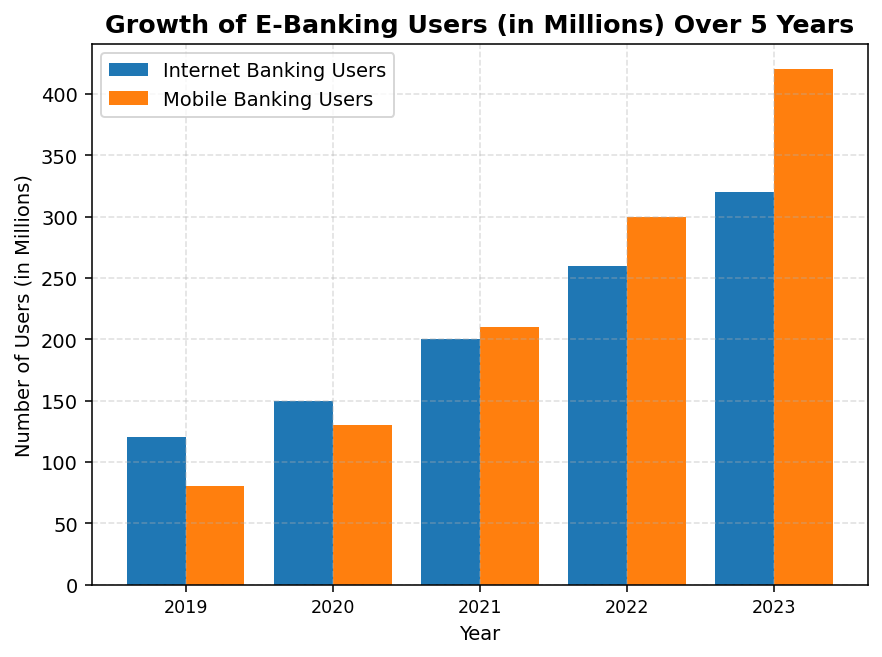
Based on the given chart, answer the following:

Business Services figure
  1. In which year did Mobile Banking users first exceed Internet Banking users according to the chart?
    A2019
    B2020
    C2021
    D2022
  2. What was the total number of Internet Banking users in 2023 as shown in the chart?
    A260 million
    B300 million
    C320 million
    D420 million
  3. Calculate the percentage increase in Mobile Banking users from 2019 to 2023.
  4. Based on the trend shown in the chart, explain why Mobile Banking has grown faster than Internet Banking. Give two reasons.
Show answersHide answers
1. Option 3 — 2021
2. Option 3 — 320 million
3. Percentage increase = [(420 - 80) / 80] × 100 = [340 / 80] × 100 = 425%. Mobile Banking users increased by 425% from 2019 to 2023.
4. Mobile Banking has grown faster than Internet Banking due to: 1. Widespread availability of affordable smartphones and cheap mobile internet, making banking accessible to a larger population including rural areas. 2. Convenience of 24x7 banking from anywhere without needing a computer or visiting a bank branch, making it more user-friendly for daily transactions like fund transfers, bill payments, and balance enquiries.

Make a full Business Studies paper on Business Services.

Pick the question mix, set the marks, hit generate. You get a ready-to-print paper with an answer key.

Generate your paper — free