The economic activity carried out with the objective of earning profit is called:
Business, Trade and Commerce — Important Questions
SUMMARY: This chapter provides an introduction to the concepts of business, trade, and commerce, exploring their roles and significance in the economy.
KEY TOPICS: Definition of business, objectives of business, classification of business activities, concept of trade, types of trade, commerce and its components, role of commerce in business, evolution of business in India, indigenous banking system, transport and communication.
Trade is concerned with:
Check answerHide answer
Auxiliaries to trade include:
Check answerHide answer
Commerce is a wider term that includes:
Check answerHide answer
The risk-bearing function of business arises mainly because of:
Check answerHide answer
Which of the following instruments of exchange was widely used in ancient India, involving a contract that warrants the payment of money, and could be unconditional or conditional?
Check answerHide answer
Under the indigenous banking system in ancient India, what was the primary characteristic of a 'Darshani Hundi'?
Check answerHide answer
Which type of Hundi used in ancient India was drawn against goods shipped on a vessel, where the drawer bore the risk if the goods were lost in transit?
Check answerHide answer
Activities which are meant for assisting trade and removing various bottlenecks in the flow of goods are classified as:
Check answerHide answer
Mining, agriculture, and fishing are examples of which type of industry?
Check answerHide answer
An oil refinery separates crude oil into various useful components like petrol, diesel, and kerosene. This is an example of which type of manufacturing industry?
Check answerHide answer
Which of the following is NOT an economic objective of a business?
Check answerHide answer
Business risk arising due to fluctuations in demand, changes in prices, or changes in fashion is classified as:
Check answerHide answer
Commerce removes various hindrances in the process of exchange. Which component of commerce specifically helps in overcoming the 'hindrance of persons'?
Check answerHide answer
When goods are imported from one country for the purpose of exporting them to some other country, it is known as:
Check answerHide answer
Define business and state any three of its features.
View sample solutionHide solution
Distinguish between business profession and employment.
View sample solutionHide solution
Explain the term industry and classify its types.
View sample solutionHide solution
What are auxiliaries to trade and why are they important?
View sample solutionHide solution
List any three objectives of business other than earning profit.
View sample solutionHide solution
What is meant by the term 'Business'?
View sample solutionHide solution
Define the term 'Trade'.
View sample solutionHide solution
State the two broad categories into which business activities are classified.
View sample solutionHide solution
State the primary objective of a business and explain why it is important.
View sample solutionHide solution
What are auxiliaries to trade? Name any two examples.
View sample solutionHide solution
Explain the meaning of business and discuss its essential features.
View sample solutionHide solution
Distinguish between trade, industry and commerce. Give examples.
View sample solutionHide solution
Explain the various types of industries with examples.
View sample solutionHide solution
Discuss the various objectives of business.
View sample solutionHide solution
Discuss the role and importance of commerce in modern economy.
View sample solutionHide solution
Differentiate between business profession and employment in tabular form on five features.
Assertion (A): Business involves regular and recurring transactions.
Reason (R): A single isolated transaction does not amount to business; recurrence is essential.
Show explanationHide explanation
Assertion (A): Profit is the primary objective of business.
Reason (R): Profit is necessary for the survival and growth of any commercial enterprise.
Show explanationHide explanation
Assertion (A): Mining is classified as primary industry.
Reason (R): Primary industries deal with the extraction of natural resources from the earth.
Show explanationHide explanation
Assertion (A): Commerce is broader than trade.
Reason (R): Commerce includes trade plus auxiliaries to trade like banking insurance and transport.
Show explanationHide explanation
Assertion (A): Business always involves an element of risk.
Reason (R): Future demand prices and economic conditions are uncertain so the outcome is not guaranteed.
Show explanationHide explanation
Assertion (A): Business is considered an economic activity.
Reason (R): It is undertaken with the object of earning money or livelihood and not out of love, affection, or sympathy.
Show explanationHide explanation
Assertion (A): Commerce includes trade and auxiliaries to trade.
Reason (R): Industry is concerned with the production or processing of goods and materials.
Show explanationHide explanation
Assertion (A): The indigenous banking system in ancient India helped in the promotion of economic activities.
Reason (R): It provided merchants with ready funds through instruments like Hundis to facilitate long-distance trade.
Show explanationHide explanation
Statement 1: Business is an economic activity.
Statement 2: The aim of business is to earn profit through production or exchange of goods and services.
Show answerHide answer
Statement 1: Industry produces goods.
Statement 2: Trade buys and sells goods.
Show answerHide answer
Statement 1: Auxiliaries to trade facilitate the exchange of goods.
Statement 2: Banking insurance and transport are examples of auxiliaries.
Show answerHide answer
Statement 1: Profit is one of many objectives of business.
Statement 2: Modern businesses also focus on market standing innovation and social responsibility.
Show answerHide answer
Statement 1: Customer satisfaction ensures long-term business survival.
Statement 2: A satisfied customer brings repeat business and word-of-mouth promotion.
Show answerHide answer
Statement 1: Business is an economic activity concerned with the production and sale of goods and services required by society.
Statement 2: The primary objective of any business is social service, and profit-making is purely secondary and optional.
Show answerHide answer
Statement 1: Trade refers to the buying and selling of goods and services.
Statement 2: Commerce is a wider term than trade and includes both trade and auxiliaries to trade.
Show answerHide answer
Statement 1: Analytical industry is a type of primary industry.
Statement 2: Genetic industry is involved in activities like breeding plants and animals.
Show answerHide answer
-
Sundar's kirana shop is an example of:AProfessionBEmploymentCBusinessDHobby
-
Which features of business does his kirana shop demonstrate?ARisk-bearingBProfit motiveCRegular operationsDAll of these
-
Explain how Sundar's shop satisfies the features of a business and how it differs from profession and employment.
Show answersHide answers
-
Spice merchants weighing and selling spices are doing:ATradeBIndustryCCommerceDProfession
-
Auxiliaries to trade observed in the market include:ABankingBInsuranceCTransportDAll of these
-
Identify trade activities and auxiliaries from the field trip and explain why both are needed.
Show answersHide answers
-
Buying cotton from farmers is which type of industry?APrimaryBSecondaryCTertiaryDAll
-
The factory weaving cloth from yarn is which type of industry?AManufacturingBServiceCTradeDMining
-
Classify each stage by type of industry and explain how the three types interlock.
Show answersHide answers
-
What type of trade does Ramesh engage in by selling goods directly to final consumers?AWholesale tradeBRetail tradeCForeign tradeDEntrepot trade
-
Which hindrance of trade is removed by transport services like the one Suresh works for?AHindrance of timeBHindrance of riskCHindrance of placeDHindrance of finance
-
What is the indigenous banking system mentioned in the passage, and what role did it play in the Indian economy?
-
Which of the following best describes commerce?AOnly buying and selling of goodsBProduction of goods and servicesCAll activities that facilitate exchange of goods and servicesDOnly transportation of goods
Show answersHide answers
Compare business profession and employment:
| Aspect | Business | Profession | Employment |
|---|---|---|---|
| Activity | Production/exchange | Service with specialised knowledge | Service to employer |
| Qualification | Not required | Formal qualification + registration | Specified by employer |
| Reward | Profit | Fee | Wage/salary |
| Risk | High | Low to moderate | Minimal |
| Capital | Required | Some required | Not required |
| Examples | Trader, manufacturer | Doctor, CA, lawyer | Teacher, clerk |
-
A doctor is engaged in:AProfessionBBusinessCEmploymentDAll same
-
Business and employment differ in terms of:ARewardBRiskCCapitalDAll of these
-
Why is risk higher in business than in employment?
Show answersHide answers
Industry types and their examples:
| Type | Sub-type | Examples |
|---|---|---|
| Primary | Extractive | Mining, fishing, hunting |
| Primary | Genetic | Agriculture, animal husbandry, poultry |
| Secondary | Manufacturing | Cotton to cloth, iron to steel |
| Secondary | Processing | Sugar from sugarcane, oil refining |
| Secondary | Construction | Buildings, bridges, roads |
| Secondary | Assembly | Automobiles, electronics |
| Tertiary | Services | Banking, insurance, transport, IT |
-
Iron ore being processed into steel is:APrimaryBSecondaryCTertiaryDAll
-
A bank providing services is:APrimaryBSecondaryCTertiaryDManufacturing
-
Why is each industry type interdependent on the others?
Show answersHide answers
Match each economic activity with the correct industry type and explain the basis of classification.
| Activity | Industry Type |
|---|---|
| Coal mining | ? Primary (extractive) |
| Wheat farming | ? Primary (genetic) |
| Cotton to cloth | ? Secondary (manufacturing) |
| Oil refining | ? Secondary (processing) |
| Building construction | ? Secondary (construction) |
| Banking services | ? Tertiary |
| Software development | ? Tertiary |
Distinguish between business profession and employment based on the criteria below.
| Criterion | Business | Profession | Employment |
|---|---|---|---|
| Activity | Production/exchange | Specialised service | Service to employer |
| Qualification | Not required | Formal + registration | Specified by employer |
| Reward | Profit | Fee | Wage/salary |
| Risk | High | Low to moderate | Minimal |
| Capital | Required | Some required | Not required |
| Examples | Trader, shop owner | Doctor, CA, lawyer | Teacher, clerk |
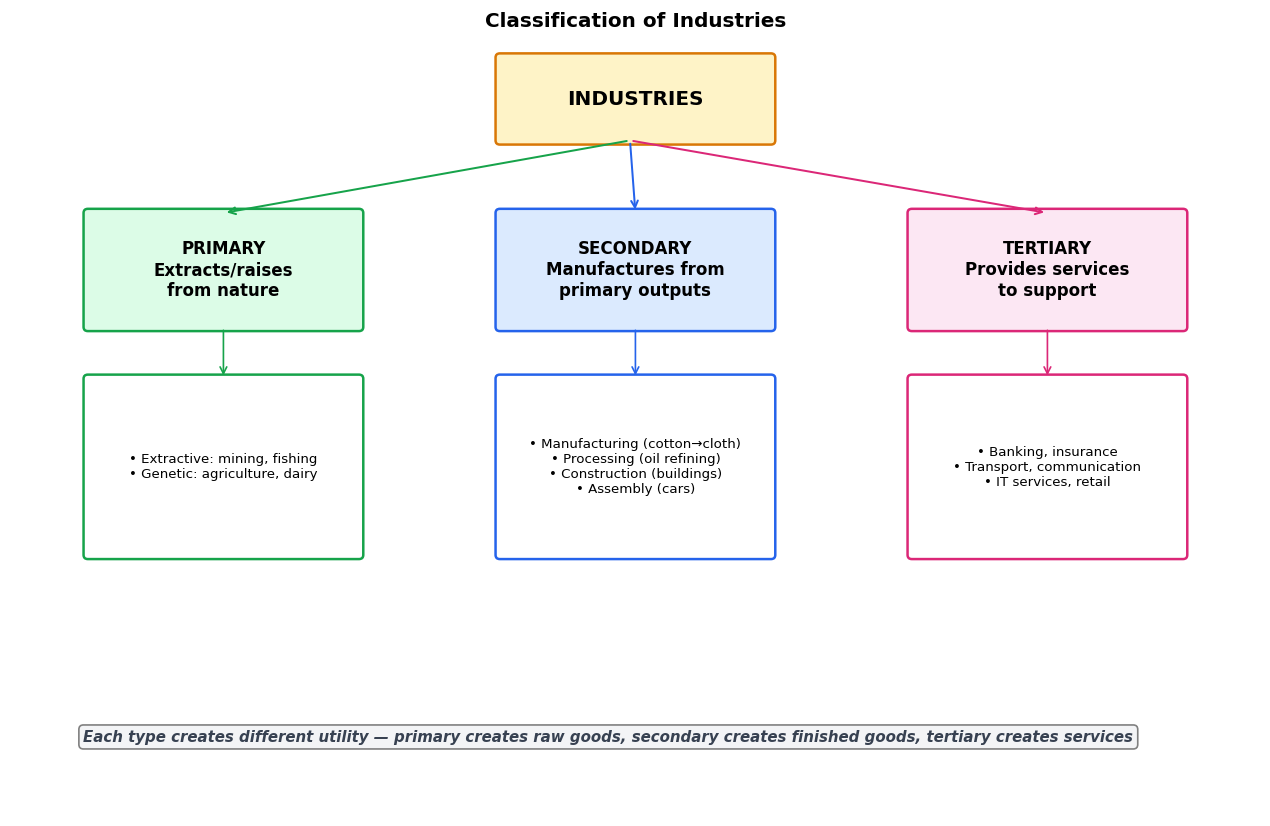
Study the industry classification tree and answer:
-
Mining is classified as which type of industry?APrimaryBSecondaryCTertiaryDQuaternary
-
A bank providing services to other businesses is which type?APrimaryBSecondaryCTertiaryD
-
Explain the three types of industries with examples and how they interrelate.
Show answersHide answers
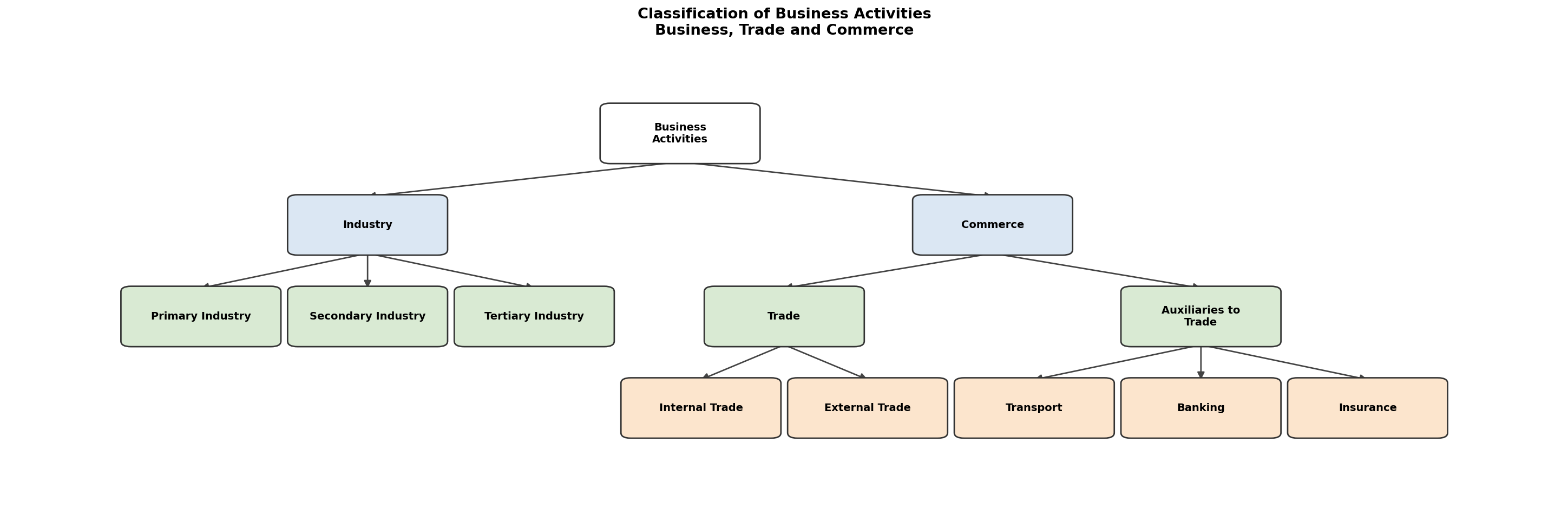
Based on the given diagram, answer the following:
-
Which of the following is an 'Auxiliary to Trade' as shown in the diagram?AInternal TradeBPrimary IndustryCBankingDExternal Trade
-
According to the diagram, under which major category does 'Commerce' fall within Business Activities?APrimary IndustryBA direct branch of Business ActivitiesCSecondary IndustryDTertiary Industry
-
Distinguish between Internal Trade and External Trade as shown in the diagram.
-
Name any two auxiliaries to trade shown in the diagram and explain their role in commerce.
-
Which type of external trade involves importing goods and then re-exporting them to other countries?AImport TradeBExport TradeCEntrepot TradeDWholesale Trade
-
How many types of External Trade are shown in the diagram?ATwoBFourCFiveDThree
-
Define Export Trade as shown in the diagram and give one example.
-
Why is Entrepot Trade also called 'Re-export Trade'? Explain with reference to the diagram.
-
According to the diagram, 'Profit Earning' falls under which category of business objectives?ASocial ObjectivesBHuman ObjectivesCEconomic ObjectivesDNational Objectives
-
Which of the following is a Human Objective of business as shown in the diagram?AMarket ShareBEmployee WelfareCFair Trade PracticesDSelf-Sufficiency
-
Explain any two Social Objectives of business as depicted in the diagram.
-
Why is 'Profit Earning' considered the most important economic objective of business? Explain briefly.
-
According to the diagram, which auxiliary to trade removes the 'Hindrance of Risk'?ATransport & CommunicationBWarehousingCAdvertisingDInsurance
-
Which component of Commerce directly involves buying and selling of goods?AAuxiliaries to TradeBTradeCWarehousingDAdvertising
-
Explain how 'Warehousing' as an auxiliary to trade removes the hindrance of storage.
-
Differentiate between Wholesale Trade and Retail Trade as shown in the diagram, giving two points of distinction.
-
Which of the following is NOT an auxiliary to trade as shown in the diagram?ATransportBBankingCWholesale TradeDInsurance
-
Under which main category of business activities does 'Commerce' fall, and what are its two main components as shown in the diagram?
-
Which type of industry involves extraction of natural resources?ASecondary IndustryBTertiary IndustryCPrimary IndustryDCommerce
-
Explain the role of 'Auxiliaries to Trade' in the context of commerce.
-
Which type of external trade involves buying goods from a foreign country and selling them to another foreign country?AImport TradeBExport TradeCEntrepot TradeDWholesale Trade
-
Distinguish between Wholesale Trade and Retail Trade as shown in the diagram.
-
Internal Trade is also known as:AForeign TradeBHome TradeCEntrepot TradeDExport Trade
-
What is Export Trade? Give one example.
-
Which of the following is an Economic Objective of business as shown in the diagram?ACommunity DevelopmentBEmployee WelfareCProfit EarningDEmployment Generation
-
Why is profit earning considered the primary economic objective of a business?
-
Employment Generation is classified under which category of business objectives?AEconomic ObjectivesBSocial ObjectivesCHuman ObjectivesDNational Objectives
-
Which auxiliary to trade removes the 'Hindrance of Risk' in commerce?ABankingBTransportCInsuranceDWarehousing
-
How does Warehousing remove the hindrance of storage in trade?
-
Advertising as an auxiliary to trade removes which hindrance?AHindrance of PlaceBHindrance of FinanceCHindrance of StorageDHindrance of Information
-
Name any two hindrances in trade and explain how they are removed by the respective auxiliaries as shown in the diagram.
-
According to the chart, which objective has the highest importance score for Small Business?AMarket ShareBEmployee WelfareCProfit EarningDCommunity Development
-
For which objective is the difference in importance score between Large Business and Small Business the greatest? What does this suggest?
-
Which of the following correctly describes a trend visible in the chart for Large Business?ALarge businesses focus only on profit and ignore social objectives.BLarge businesses balance both economic and social objectives relatively evenly.CLarge businesses score lower than small businesses on all objectives.DLarge businesses have no interest in national growth.
-
Explain why profit earning is considered an essential objective of business even though businesses are also expected to fulfil social objectives.
-
Which of the following is NOT a branch of Commerce as shown in the diagram?ATradeBAuxiliaries to TradeCManufacturingDInternal Trade
-
Name the two types of Primary Industry shown in the diagram and give one example of each.
-
External Trade is a sub-type of which of the following?AAuxiliaries to TradeBCommerceCTradeDSecondary Industry
-
Explain the role of 'Auxiliaries to Trade' in business activities.
-
Which type of trade involves buying goods from one country and selling them to another country?AImport TradeBExport TradeCEntrepot TradeDWholesale Trade
-
How many types of External Trade are shown in the diagram? Name them.
-
Which auxiliary to trade removes the 'Hindrance of Time'?ATransportationBInsuranceCWarehousingDAdvertising
-
Explain how Banking and Finance removes the hindrance of finance in trade.
-
The hindrance of risk in trade is removed by which of the following auxiliaries?AWarehousingBAdvertisingCTransportationDInsurance
-
How does Advertising act as an auxiliary to trade? Which hindrance does it remove?
-
Which financial instrument was commonly used during the Medieval Period of Indian business as shown in the diagram?AChequesBHundisCDemand DraftsDPromissory Notes
-
What was the Barter System and what was its main limitation?
-
What was the primary characteristic of the Colonial Period of Indian business as depicted in the diagram?AGrowth of Public Sector UnitsBIntroduction of the Barter SystemCDrain of wealth and export of raw materialsDEntry of multinational companies
-
Describe the role of the indigenous banking system (Shroffs/Seths) in the evolution of trade and commerce in India.
-
According to the diagram, which of the following is an 'Auxiliary to Trade'?AManufacturingBExtractive IndustryCWarehousingDInternal Trade
-
Under which category of Industry would a fish hatchery (breeding fish for sale) be classified? Identify from the diagram and justify your answer.
-
Which of the following correctly describes the relationship shown in the diagram between 'Commerce' and 'Trade'?ATrade is broader than CommerceBTrade and Commerce are the same conceptCCommerce includes Trade as well as Auxiliaries to TradeDCommerce is a part of Trade
-
Distinguish between Internal Trade and External Trade as shown in the diagram. Give one example of each.
Show answersHide answers
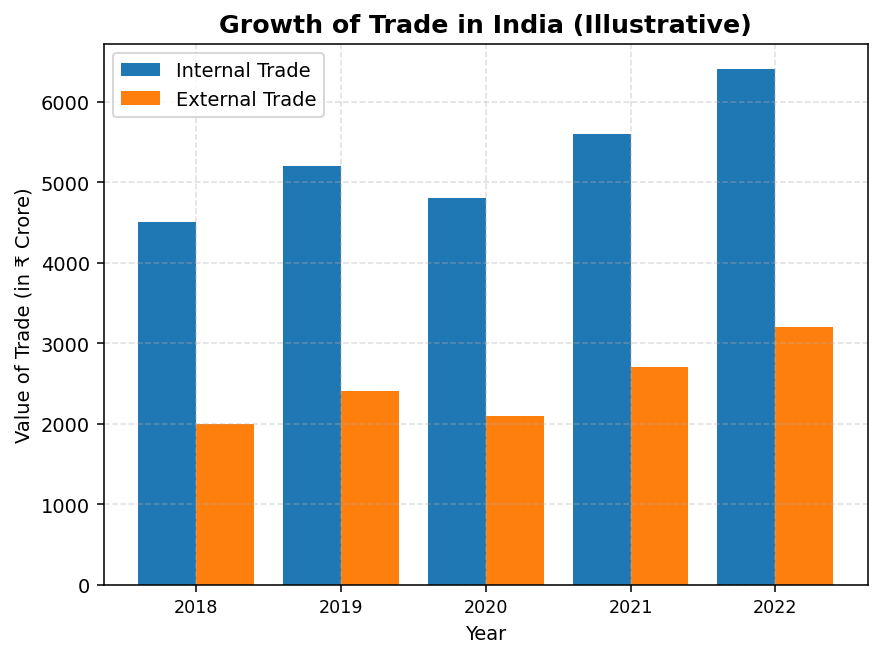
Based on the given chart, answer the following:
-
In which year was the value of Internal Trade the highest according to the chart?A2019B2020C2021D2022
-
In which year did both Internal Trade and External Trade show a decline compared to the previous year?A2019B2020C2021D2022
-
Calculate the difference between the value of Internal Trade and External Trade in the year 2022.
-
What does the overall trend in the chart suggest about the growth of trade in India? What factors could have caused the dip in 2020?
-
According to the chart, which economic objective has the highest weightage?AMarket ShareBGrowthCProfit EarningDProductivity
-
Why is profit earning considered the primary economic objective of business?
-
In the chart, which objective has the highest social weightage?AProfit EarningBMarket ShareCGrowthDProductivity
-
Explain the difference between economic objectives and social objectives of a business with one example each.
Show answersHide answers
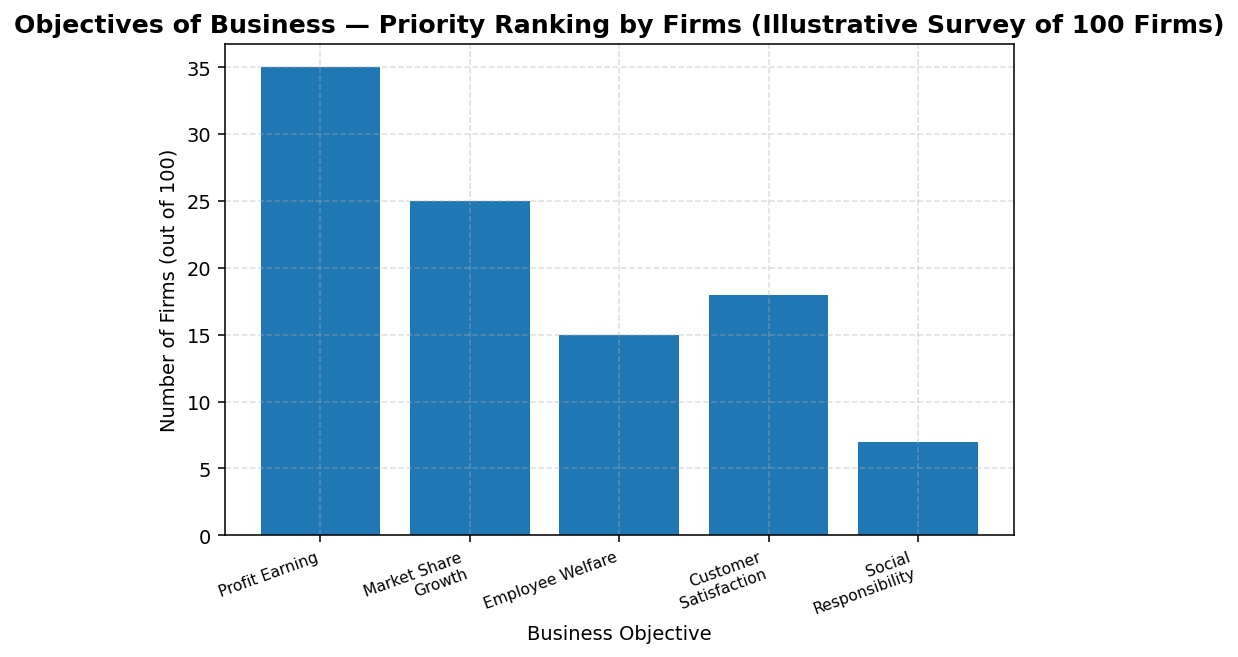
Based on the given graph, answer the following:
-
According to the bar graph, which objective was ranked as the top priority by the highest number of firms?AMarket Share GrowthBCustomer SatisfactionCProfit EarningDSocial Responsibility
-
Only 7 firms ranked Social Responsibility as their top priority. Does this mean businesses should ignore social responsibility? Give a reason based on the objectives of business.
-
How many firms in total prioritised either 'Employee Welfare' or 'Customer Satisfaction' as their top objective?A15B18C33D25
-
Explain why 'Profit Earning' is considered an important objective of business. Is it the only objective? Support your answer with reference to the graph.
Show answersHide answers
Make a full Business Studies paper on Business, Trade and Commerce.
Pick the question mix, set the marks, hit generate. You get a ready-to-print paper with an answer key.
Generate your paper — free