SUMMARY: The chapter on International Business in Class 11 Business Studies explores the concept, significance, and complexities of conducting business across national borders. KEY TOPICS: Definition of international business, modes of entry into international business, benefits of international business, challenges in international business, export and import procedures, international trade institutions, World Trade Organization (WTO), trade barriers, foreign direct investment (FDI), multinational corporations (MNCs).
Correct answer: Option 2 — Trade between countries
Q21 Mark
A country importing goods from another country pays in:
ADomestic currency only
BForeign currency or convertible currency
CBarter only
DGold only
Check answerHide answer
Correct answer: Option 2 — Foreign currency or convertible currency
Q31 Mark
A Letter of Credit (LC) is issued by:
ABuyer's bank
BSeller's bank
CGovernment
DCustoms department
Check answerHide answer
Correct answer: Option 1 — Buyer's bank
Q41 Mark
The bill of lading is issued by:
AInsurance company
BBank
CShipping company
DGovernment
Check answerHide answer
Correct answer: Option 3 — Shipping company
Q51 Mark
An Export Promotion Council:
APromotes exports of a particular industry
BImports goods
CSets tariffs
DSets exchange rates
Check answerHide answer
Correct answer: Option 1 — Promotes exports of a particular industry
Q61 Mark
What is the primary focus of international business?
AConducting business within a single country
BConducting business across national borders
CManaging domestic supply chains
DInvesting solely in local markets
Check answerHide answer
Correct answer: Option 2 — Conducting business across national borders
Q71 Mark
Which of the following is NOT a mode of entry into international business?
AExporting
BLicensing
CFranchising
DLocal sourcing
Check answerHide answer
Correct answer: Option 4 — Local sourcing
Q81 Mark
What is one major benefit of engaging in international business?
AIncreased competition
BAccess to larger markets
CHigher regulatory compliance
DLimited consumer base
Check answerHide answer
Correct answer: Option 2 — Access to larger markets
Q91 Mark
Which of the following is a challenge faced in international business?
AStandardized marketing strategies
BCultural differences
CUniform pricing strategies
DSimilar legal systems
Check answerHide answer
Correct answer: Option 2 — Cultural differences
Q101 Mark
What does FDI stand for in the context of international business?
AForeign Direct Investment
BForeign Domestic Investment
CFinancial Direct Investment
DFiscal Domestic Investment
Check answerHide answer
Correct answer: Option 1 — Foreign Direct Investment
Q111 Mark
Which international trade institution is responsible for regulating and facilitating international trade agreements?
AInternational Monetary Fund (IMF)
BWorld Trade Organization (WTO)
CUnited Nations (UN)
DWorld Bank
Check answerHide answer
Correct answer: Option 2 — World Trade Organization (WTO)
Q121 Mark
What is a trade barrier?
AA method to increase exports
BA restriction imposed by a government on international trade
CA type of international agreement
DA feature of multinational corporations
Check answerHide answer
Correct answer: Option 2 — A restriction imposed by a government on international trade
Q131 Mark
Which of the following is an example of an export procedure?
ACustoms clearance
BLocal market analysis
CEmployee training
DProduct development
Check answerHide answer
Correct answer: Option 1 — Customs clearance
Q141 Mark
What is the primary role of multinational corporations (MNCs) in international business?
ATo operate solely in their home country
BTo manage international supply chains
CTo invest and operate in multiple countries
DTo avoid foreign markets
Check answerHide answer
Correct answer: Option 3 — To invest and operate in multiple countries
Q151 Mark
Which of the following best describes the concept of 'exporting'?
AProducing goods for local consumption only
BSelling domestically produced goods to foreign markets
CBuying goods from foreign markets
DInvesting in foreign companies
Check answerHide answer
Correct answer: Option 2 — Selling domestically produced goods to foreign markets
Short Answer Questions10 questions
Q163 Marks
Distinguish between internal trade and international trade.
View sample solutionHide solution
INTERNAL TRADE — within a country; uses domestic currency; governed by domestic laws (no customs duty, only GST); shorter distances; faster delivery; easier dispute resolution; products tailored to domestic preferences. INTERNATIONAL TRADE — between countries; uses foreign/convertible currency; subject to customs duty, exchange rate fluctuations, tariffs, quotas, and complex documentation; longer distances and shipping times; multiple legal systems and risk; higher transaction costs. International trade enables specialisation (countries produce what they're best at) and access to goods not domestically available. Internal trade supports domestic industries; international trade brings foreign exchange and global integration.
Q173 Marks
Explain the concept of comparative cost advantage in international trade.
View sample solutionHide solution
Theory of comparative cost advantage by David Ricardo: a country should specialise in producing goods in which it has a RELATIVE cost advantage — even if another country can produce all goods more cheaply (absolute advantage). The country with relative advantage in good X gains by producing more of X and importing other goods. Example: India has comparative advantage in textiles, IT services, gems & jewellery; importing crude oil. Even if a country can produce both X and Y cheaper than another, specialising in the one with greatest relative advantage maximises both countries' total output. This forms the theoretical basis for free trade.
Q183 Marks
List the main documents used in international trade.
View sample solutionHide solution
(1) PROFORMA INVOICE — preliminary invoice indicating price and terms before order. (2) COMMERCIAL INVOICE — actual invoice issued after shipment showing description, quantity, unit price, total. (3) BILL OF LADING — document issued by shipping company; receipt of goods; document of title; transferable. (4) AIRWAY BILL — for air shipments; not negotiable. (5) PACKING LIST — describes contents of each package. (6) CERTIFICATE OF ORIGIN — issued by chamber of commerce; identifies country of manufacture; for tariff purposes. (7) CONSULAR INVOICE — visa for import (rarely used now). (8) LETTER OF CREDIT (LC) — guarantee of payment from buyer's bank to seller. (9) MARINE INSURANCE POLICY — covers risk during transit. (10) BILL OF EXCHANGE — written order from seller to buyer to pay specified amount. (11) FOREIGN EXCHANGE FORM. (12) CUSTOMS DOCUMENTS — shipping bill, import declaration. The documentation ensures legal validity, tax compliance, and risk management.
Q193 Marks
What is a Letter of Credit (LC) and why is it important?
View sample solutionHide solution
A Letter of Credit is a document issued by the BUYER's bank guaranteeing payment to the SELLER provided the seller meets specified conditions (delivery within time, presents required documents). LC mitigates the trust gap between buyer and seller in international trade where they often haven't dealt before. PROCESS: (1) Buyer arranges LC with their bank; (2) Bank communicates LC to seller's bank; (3) Seller ships goods and presents documents; (4) Seller's bank forwards documents to buyer's bank; (5) Buyer's bank pays seller; (6) Buyer reimburses bank with goods. TYPES: revocable (can be modified — rare) vs irrevocable; sight (paid immediately) vs usance (paid after specified period); confirmed (additional guarantee from seller's bank) vs unconfirmed. LC is the most secure payment method in international trade.
Q203 Marks
Explain the role of WTO (World Trade Organization).
View sample solutionHide solution
WTO is an international organisation established in 1995 (replacing GATT) to regulate world trade. ROLES: (1) Administer multilateral trade agreements; (2) Reduce trade barriers among member countries through negotiations; (3) Provide a forum for dispute settlement among members; (4) Monitor national trade policies; (5) Provide technical assistance to developing countries. PRINCIPLES: (a) Most-Favoured Nation (MFN) — equal treatment to all trading partners; (b) National Treatment — imports treated same as domestic goods after entering the country; (c) Lower trade barriers through negotiations; (d) Transparency — predictable trade policies; (e) Encourage development. India is a founding member; WTO has been central to global trade liberalisation.
Q213 Marks
What is international business?
View sample solutionHide solution
International business refers to the exchange of goods, services, and capital across national borders. It involves various activities such as exporting and importing, as well as investments in foreign countries.
Q223 Marks
List two benefits of engaging in international business.
View sample solutionHide solution
Two benefits of engaging in international business are access to a larger market, which can lead to increased sales and profits, and diversification of business activities, which can reduce risks associated with domestic market fluctuations.
Q233 Marks
What are the main modes of entry into international business?
View sample solutionHide solution
The main modes of entry into international business include exporting, licensing, franchising, joint ventures, and foreign direct investment (FDI). Each mode has its own advantages and risks associated with it.
Q243 Marks
Explain the concept of foreign direct investment (FDI).
View sample solutionHide solution
Foreign direct investment (FDI) refers to the investment made by a company or individual in one country in business interests in another country. This often involves acquiring assets or establishing business operations in the foreign country.
Q253 Marks
What challenges do businesses face when entering international markets?
View sample solutionHide solution
Businesses face several challenges when entering international markets, including cultural differences, legal and regulatory barriers, currency fluctuations, and political instability in the host country.
Long Answer Questions6 questions
Q266 Marks
Discuss the various forms of international trade and modes of entry into foreign markets.
View sample solutionHide solution
FORMS OF INTERNATIONAL TRADE: (1) IMPORT — buying goods from foreign countries. (2) EXPORT — selling goods to foreign countries. (3) ENTREPÔT TRADE — re-exporting imported goods (often after value-addition or just transit through ports like Singapore Dubai). MODES OF ENTRY into foreign markets: (1) DIRECT EXPORTING — selling directly to foreign customers; full control but high cost. (2) INDIRECT EXPORTING — using an intermediary (export house, trading company) in home country; easier but less control. (3) LICENSING — granting foreign company right to use IP (patents, trademarks, technology) for royalty. (4) FRANCHISING — like licensing but with operational support (McDonald's, Subway in India). (5) JOINT VENTURE — partnership with foreign company; shared risk and rewards. (6) WHOLLY-OWNED SUBSIDIARY — set up own company abroad; full control and profit; high investment and risk. (7) STRATEGIC ALLIANCES — collaborations without forming a new entity. (8) CONTRACT MANUFACTURING — local manufacturer makes products to foreign company's specs. (9) E-COMMERCE — selling on platforms like Amazon Global. The choice depends on capital, risk appetite, control preference, regulatory environment, and market knowledge. Indian companies use mix of modes — TCS, Infosys established subsidiaries; small exporters often use intermediaries.
Q276 Marks
Explain the various export procedure stages.
View sample solutionHide solution
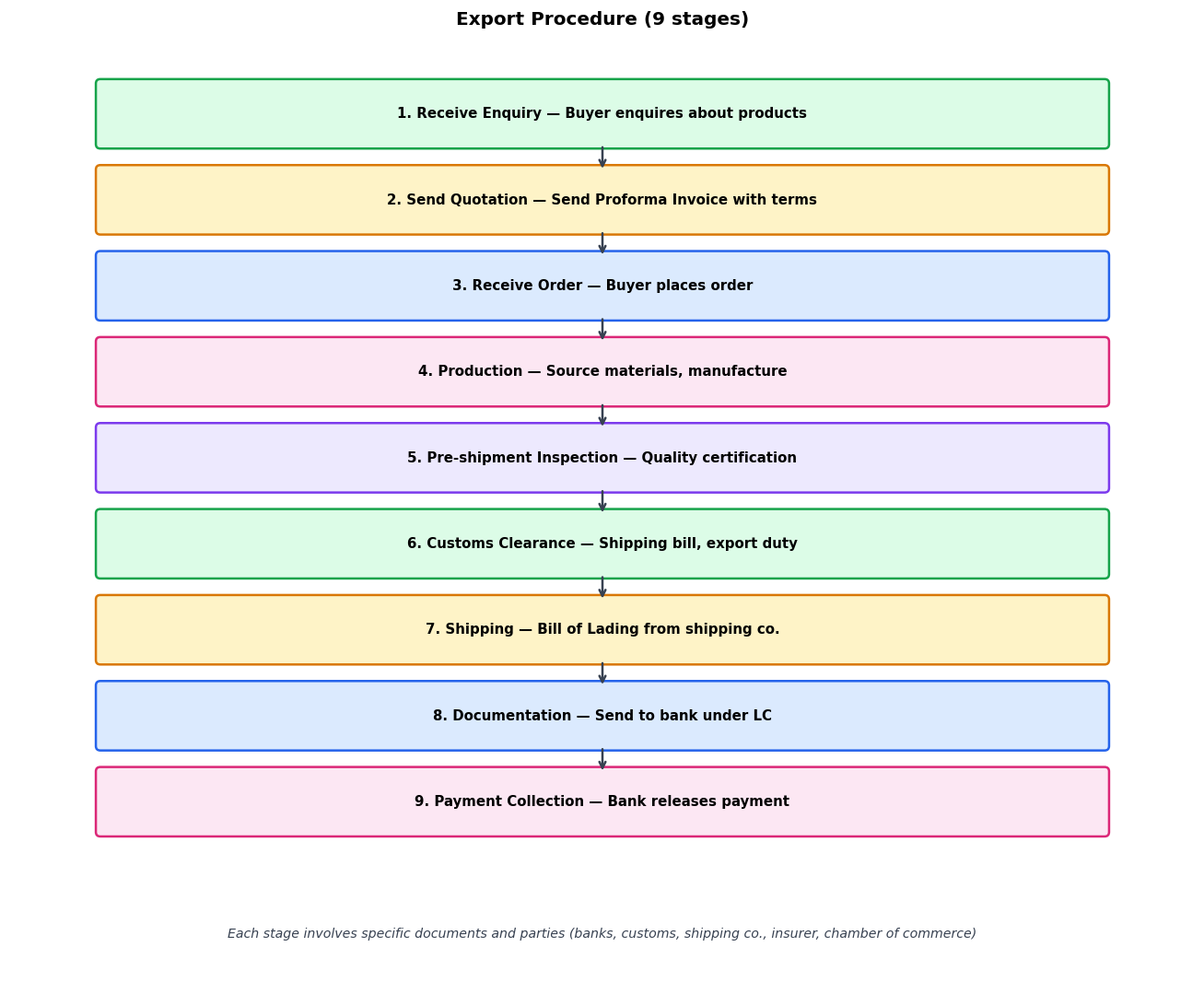
EXPORT PROCEDURE involves multiple stages: (1) RECEIVING ENQUIRY — foreign buyer enquires about products. (2) SENDING QUOTATION/PROFORMA INVOICE — exporter sends price quote, terms, and conditions. (3) RECEIVING ORDER — buyer places order with order details. (4) ASSESSING THE BUYER'S CREDITWORTHINESS — through banks, credit reports. (5) OBTAINING EXPORT LICENCE if applicable. (6) ARRANGING PRE-SHIPMENT FINANCE — packing credit from banks. (7) PROCURING/MANUFACTURING THE GOODS. (8) PRE-SHIPMENT INSPECTION — quality certification by export inspection agency. (9) EXCISE CLEARANCE if applicable. (10) RESERVING SHIPPING SPACE with shipping/airline company. (11) PACKING AND FORWARDING goods to port. (12) GETTING INSURANCE — marine insurance for transit. (13) CUSTOMS CLEARANCE — submitting shipping bill, paying export duty if any. (14) OBTAINING MATE'S RECEIPT and BILL OF LADING from shipping company. (15) PAYMENT OF FREIGHT to shipping company. (16) PRESENTING DOCUMENTS TO BANK — for collection or under LC. (17) COLLECTING PAYMENT through bank. (18) CLAIMING POST-SHIPMENT INCENTIVES — duty drawback, export credit, EPCG benefits. The procedure ensures compliance with regulations, mitigation of risks, and proper documentation for finance and tax purposes.
Q286 Marks
Discuss the import procedure and key documentation involved.
View sample solutionHide solution
IMPORT PROCEDURE: (1) MARKET RESEARCH — identifying overseas suppliers. (2) PROCURING IMPORT LICENCE if applicable (most products are under Open General Licence). (3) OBTAINING FOREIGN EXCHANGE — RBI permission via authorised dealer. (4) PLACING ORDER — sending purchase order to overseas supplier. (5) ARRANGING LETTER OF CREDIT — buyer's bank issues LC to supplier's bank. (6) ARRIVAL OF GOODS at port. (7) RECEIVING DOCUMENTS from bank — bill of lading, invoice, insurance, certificate of origin. (8) BILL OF ENTRY — declaration to customs authorities; assessment of customs duty. (9) PAYMENT OF DUTIES — customs duty (basic + IGST + cess). (10) CUSTOMS CLEARANCE — verification of documents and goods; release order. (11) DELIVERY ORDER from shipping company. (12) RELEASING GOODS — clearing agent obtains goods from port. (13) PAYMENT TO SUPPLIER through bank. KEY DOCUMENTS: (a) Import licence (if applicable); (b) Letter of credit; (c) Commercial invoice; (d) Bill of lading; (e) Bill of entry (customs declaration); (f) Certificate of origin; (g) Marine insurance policy; (h) Packing list; (i) Foreign exchange application form. The procedure ensures regulatory compliance, customs payment, and efficient clearance.
Q296 Marks
Explain the important international trade institutions: WTO IMF and World Bank.
View sample solutionHide solution
(1) WTO (World Trade Organization) — established 1995, headquartered in Geneva. Successor to GATT (1947-1994). ROLES: regulate world trade; reduce trade barriers; settle disputes; provide forum for negotiations. Principles: Most-Favoured Nation (MFN), National Treatment, transparency. India is a founding member. Major rounds: Uruguay Round (1986-94), Doha Round (2001-still ongoing). (2) IMF (International Monetary Fund) — established 1944 (Bretton Woods), headquartered in Washington DC. ROLES: maintain stability of international monetary system; provide short-term loans to member countries facing balance of payments problems; provide policy advice; SDR (Special Drawing Rights) as international reserve asset. India was an early borrower in 1991 BoP crisis. (3) WORLD BANK (IBRD + IDA) — established 1944, sister institution of IMF. ROLES: long-term loans for development projects (infrastructure, education, health); poverty alleviation; technical assistance. Has 5 components — IBRD, IDA, IFC, MIGA, ICSID. India is one of largest borrowers; world bank has funded countless development projects in India. Together these BRETTON WOODS INSTITUTIONS shape global financial and trade architecture; India plays a growing role in their governance.
Q306 Marks
Discuss the benefits and challenges of international trade.
View sample solutionHide solution
BENEFITS: (1) ACCESS TO GOODS — countries can import what they cannot produce efficiently (oil for India). (2) SPECIALISATION — based on comparative advantage; raises overall efficiency. (3) FOREIGN EXCHANGE — exports earn forex; imports finance development. (4) ECONOMIES OF SCALE — larger global market enables mass production. (5) EMPLOYMENT — export industries create jobs. (6) STANDARD OF LIVING — wider variety and lower prices for consumers. (7) TECHNOLOGY TRANSFER — international competition drives technology adoption. (8) CULTURAL EXCHANGE — broader understanding of other societies. (9) ECONOMIC GROWTH — trade-led growth has lifted many countries (China, Korea, India). CHALLENGES: (1) PROTECTIONISM — tariffs, quotas, NTBs make trade expensive. (2) EXCHANGE RATE FLUCTUATION — can wipe out profit margins. (3) DOCUMENTATION COMPLEXITY — many forms to complete. (4) PAYMENT RISK — buyers may default; need LC and other safeguards. (5) DIFFERENT LEGAL SYSTEMS — disputes hard to resolve. (6) CULTURAL AND LANGUAGE BARRIERS. (7) POLITICAL RISK — wars, sanctions, regime changes. (8) TIME LAG — long shipping times. (9) HARDWARE/SOFTWARE INCOMPATIBILITIES. (10) ENVIRONMENTAL CONCERNS — international transport contributes to emissions. (11) JOB DISPLACEMENT — global competition can hurt domestic industries. Despite challenges international trade is essential for modern economies; benefits typically far outweigh costs when properly managed.
Q316 Marks
Explain the role of foreign trade promotion organisations in India.
View sample solutionHide solution
India has multiple organisations supporting foreign trade: (1) MINISTRY OF COMMERCE AND INDUSTRY — formulates trade policy; Foreign Trade Policy (FTP) revised every 5 years sets export targets and incentives. (2) DGFT (Directorate General of Foreign Trade) — implements FTP; issues import-export licences; allocates IEC (Import Export Code). (3) EXPORT PROMOTION COUNCILS (EPCs) — industry-specific councils that promote exports of their respective industries; examples: Engineering Export Promotion Council (EEPC), Apparel Export Promotion Council (AEPC), Council for Leather Exports (CLE), Pharmaceuticals Export Promotion Council (PHARMEXCIL), Chemexcil etc. (4) COMMODITY BOARDS — for traditional exports like tea coffee rubber spices coir tobacco. (5) FIEO (Federation of Indian Export Organisations) — apex body of Indian exporters. (6) INDIA TRADE PROMOTION ORGANISATION (ITPO) — organises trade fairs and exhibitions. (7) SEZs (Special Economic Zones) — duty-free zones for export-oriented manufacturing. (8) ECGC (Export Credit Guarantee Corporation) — insures exporters against payment risks. (9) EXIM BANK (Export-Import Bank of India) — provides finance for exporters and importers. (10) NCCT (National Centre for Trade Information). Together these institutions support all stages of export-import: market access, finance, insurance, infrastructure, dispute resolution. India's exports have grown from $5 billion in 1990 to over $700 billion in 2024 thanks to this ecosystem.
Assertion–Reason Questions8 questions
Q321 Mark
Assertion (A): International trade involves crossing of national borders.
Reason (R): It is subject to customs duty exchange rates and complex documentation.
Show explanationHide explanation
Correct answer: Option 1 —
Both A and R are true, and R is the correct explanation of A.
Q331 Mark
Assertion (A): Countries specialise based on comparative cost advantage.
Reason (R): Specialisation maximises total output and is the foundation of free trade theory.
Show explanationHide explanation
Correct answer: Option 1 —
Both A and R are true, and R is the correct explanation of A.
Q341 Mark
Assertion (A): A Letter of Credit reduces payment risk in international trade.
Reason (R): The buyer's bank guarantees payment to the seller subject to specified conditions.
Show explanationHide explanation
Correct answer: Option 1 —
Both A and R are true, and R is the correct explanation of A.
Q351 Mark
Assertion (A): Bill of Lading serves multiple purposes.
Reason (R): It is a receipt of goods a document of title and an evidence of contract of carriage.
Show explanationHide explanation
Correct answer: Option 1 —
Both A and R are true, and R is the correct explanation of A.
Q361 Mark
Assertion (A): WTO regulates world trade through multilateral agreements.
Reason (R): It provides a forum for negotiation and dispute settlement among member countries.
Show explanationHide explanation
Correct answer: Option 1 —
Both A and R are true, and R is the correct explanation of A.
Q371 Mark
Assertion (A): International business refers to the exchange of goods and services across national borders.
Reason (R): It encompasses both exports and imports between countries.
Show explanationHide explanation
Correct answer: Option 1 —
Both A and R are true, and R is the correct explanation of A.
Q381 Mark
Assertion (A): Foreign Direct Investment (FDI) is a mode of entry into international business.
Reason (R): FDI involves investing directly in foreign businesses or assets.
Show explanationHide explanation
Correct answer: Option 1 —
Both A and R are true, and R is the correct explanation of A.
Q391 Mark
Assertion (A): Multinational Corporations (MNCs) operate in multiple countries but are primarily based in one country.
Reason (R): MNCs have a centralized management system located in their home country.
Show explanationHide explanation
Correct answer: Option 1 —
Both A and R are true, and R is the correct explanation of A.
Statement-Based Questions8 questions
Q401 Mark
Statement 1: Import is buying from foreign countries.
Statement 2: Export is selling to foreign countries.
Show answerHide answer
Correct answer: Option 1 —
Both statements are true.
Q411 Mark
Statement 1: Bill of lading and commercial invoice are key trade documents.
Statement 2: They are needed for customs clearance and payment processing.
Show answerHide answer
Correct answer: Option 1 —
Both statements are true.
Q421 Mark
Statement 1: Direct exporting gives more control than indirect exporting.
Statement 2: But it requires more capital and overseas market knowledge.
Show answerHide answer
Correct answer: Option 1 —
Both statements are true.
Q431 Mark
Statement 1: Most-Favoured Nation principle requires equal treatment to all trading partners.
Statement 2: National Treatment requires imports to be treated same as domestic goods.
Show answerHide answer
Correct answer: Option 1 —
Both statements are true.
Q441 Mark
Statement 1: India's exports have grown significantly since 1991 liberalisation.
Statement 2: Government schemes like FTP EPCs and SEZs have supported export growth.
Show answerHide answer
Correct answer: Option 1 —
Both statements are true.
Q451 Mark
Statement 1: International business refers to the exchange of goods and services across national borders.
Statement 2: International business is limited to only exporting goods.
Show answerHide answer
Correct answer: Option 2 —
Only Statement 1 is true.
Q461 Mark
Statement 1: Multinational corporations (MNCs) operate in multiple countries and have a centralized head office.
Statement 2: MNCs are only involved in exporting products to foreign markets.
Show answerHide answer
Correct answer: Option 3 —
Only Statement 2 is true.
Q471 Mark
Statement 1: The World Trade Organization (WTO) aims to promote free trade by reducing trade barriers.
Statement 2: WTO is primarily focused on regulating domestic trade policies.
Show answerHide answer
Correct answer: Option 4 —
Both statements are false.
Case Study / Passage Questions4 questions
Q483 Marks
Mr Reddy of Hyderabad receives his first export order from a US wholesaler — 2000 cotton garments worth $20000. He needs to handle: (1) production; (2) quality inspection; (3) shipping arrangement; (4) documentation; (5) payment.
The most secure payment method for international trade is:
ALetter of Credit
BCash on delivery
CCheque
DNet banking
For a 2000-piece garment shipment USA to India most economical mode is:
AAir
BSea
CRoad
DRail
Walk through the export procedure step by step.
Show answersHide answers
1. Option 1 — Letter of Credit
2. Option 2 — Sea
3. Reddy's first export requires careful coordination of multiple services. STEP-BY-STEP PROCESS: (1) NEGOTIATION — agree on price, quality specs, delivery date, payment terms with the US buyer. Issue PROFORMA INVOICE. (2) PRODUCTION — source quality cotton, dye, sew. Quality inspection at every stage. (3) PRE-SHIPMENT INSPECTION — by certified inspector or Export Inspection Council if required. (4) PACKING — proper packaging with labelling, master cartons. (5) SHIPPING ARRANGEMENT — book sea cargo (most economical for 2000 garments); typical transit USA = 30-45 days. (6) DOCUMENTATION — Bill of Lading (issued by shipping company), Commercial Invoice (showing value, terms), Packing List, Certificate of Origin (from Indian Chamber of Commerce or Apparel Export Promotion Council), Bill of Exchange, Marine Insurance Policy. (7) CUSTOMS CLEARANCE — submit Shipping Bill at Indian customs; pay export duty (usually nil for most goods); IEC (Import Export Code) required (one-time registration). (8) LETTER OF CREDIT — buyer's bank issues LC guaranteeing payment to Reddy; sent to Reddy's bank in India. (9) NEGOTIATION OF DOCUMENTS — Reddy gives docs to his bank; bank verifies LC requirements met; processes payment. (10) PAYMENT RECEIVED in foreign currency; converted to INR. SUPPORT INSTITUTIONS: AEPC (Apparel Export Promotion Council) — guidance, marketing support. ECGC (Export Credit Guarantee Corporation) — insures against payment default. EXIM Bank — finance. SIDBI — pre-shipment finance. Reddy should join AEPC for ongoing support. EXPORT promotion schemes: Duty Drawback (refund of import duties used in export), MEIS/RoDTEP (rebate on duties), EPCG (zero-duty import of capital goods). Successfully completing the first export opens doors to repeat orders.
Q493 Marks
M/s Maruti Suzuki imports specific automobile parts (engine components) from Japan. Each shipment is worth $2 million; lead time is 45 days. Maruti needs to manage: (1) supplier relationships; (2) currency fluctuations; (3) customs clearance; (4) lead-time management.
Importing involves customs duty payment.
AYes
BNo
CSometimes
DRandom
To manage currency risk Maruti can use:
AForward contract
BSpot rate
CCash settlement
DRandom
Discuss the various aspects of Maruti's import operations.
Show answersHide answers
1. Option 1 — Yes
2. Option 1 — Forward contract
3. Maruti's import process involves multiple complexities. SUPPLIER RELATIONSHIP: long-term contracts ensure reliable supply; supplier development programs help suppliers meet quality standards; quality audits regular. LEAD-TIME MANAGEMENT: 45-day shipping (Japan to India by sea) requires forecasting demand 60+ days ahead; safety stock of 30-45 days; consider air freight for emergency. CURRENCY RISK: $2 million shipment value fluctuates with INR-USD exchange rate. If INR depreciates from 75 to 80 over 45 days, Maruti pays 6.7% more in INR. RISK MANAGEMENT: (1) FORWARD CONTRACT — lock today's rate for future delivery; banks like SBI, HDFC, ICICI offer forward forex; cost ~1-2% premium. (2) FUTURES — exchange-traded contracts. (3) OPTIONS — flexibility to walk away. (4) NATURAL HEDGE — invoice in INR if supplier accepts. CUSTOMS PROCESS: (1) Bill of Entry filed online via ICEGATE. (2) Customs duty assessed (Basic Customs Duty + IGST + Cess). (3) Duty paid; customs releases cargo. (4) Clearing agent retrieves goods from port. DOCUMENTATION: Bill of Lading, Commercial Invoice, Packing List, Country of Origin Certificate, Insurance, IGM (Import General Manifest). LICENSING: most automotive parts under OGL (Open General Licence) — no specific licence needed. PAYMENT METHOD: Letter of Credit ensures payment only after Maruti receives goods; advance payment for trusted suppliers. EXPORTER FINANCING: pre-shipment credit, post-shipment credit. INSURANCE: Marine insurance covers transit risks. STORAGE: bonded warehouse for duty-deferred storage. DISPUTE RESOLUTION: International Chamber of Commerce arbitration. Maruti likely uses sophisticated supply chain management with forecasts, ERP systems, and multiple supplier relationships to manage these complexities.
Q503 Marks
M/s GreenTech Pvt Ltd makes solar-powered lights. They want to enter the Sri Lankan market. Options: (1) DIRECT EXPORTING — sell directly to retailers; (2) INDIRECT EXPORTING — through Indian export house; (3) LICENSING — license technology to a Sri Lankan firm; (4) JOINT VENTURE with Sri Lankan partner; (5) WHOLLY-OWNED SUBSIDIARY in Sri Lanka.
Direct exporting is:
AEasiest entry mode
BHardest entry mode
CNo control
DHighest investment
Indirect exporting through an export house reduces risk.
AYes
BNo
CSometimes
DRandom
Recommend the appropriate entry mode and explain progression strategy.
Show answersHide answers
1. Option 1 — Easiest entry mode
2. Option 1 — Yes
3. GreenTech's choice depends on capital, control, risk, and market knowledge. EVALUATION: (1) DIRECT EXPORTING — sell directly to Sri Lankan retailers; full control over branding and pricing; full margin; HIGH cost (sales team, marketing, transport); HIGH risk (no local market knowledge); suitable for experienced exporters. (2) INDIRECT EXPORTING — through Indian export house (e.g., merchant exporter, trading house); EASIEST entry; LOW cost; LOW risk; LOW margin (export house takes commission); LIMITED brand visibility. Suitable for first-time exporters like GreenTech. RECOMMENDED INITIALLY. (3) LICENSING — grant Sri Lankan firm right to manufacture under GreenTech brand; royalty income; LOW investment by GreenTech; LIMITED control over quality and marketing; suitable when Sri Lankan demand is large but GreenTech can't manufacture there. (4) JOINT VENTURE — partner with Sri Lankan firm; shared investment, shared risk; combines local knowledge with technology; medium investment; medium control. (5) WHOLLY-OWNED SUBSIDIARY — set up GreenTech Sri Lanka; FULL control; HIGHEST investment; HIGH risk; only for established brands with deep pockets. PROGRESSION: typical sequence is Indirect Export → Direct Export → Licensing → JV → Subsidiary. As GreenTech learns the Sri Lankan market through indirect exports they can progressively move to higher-control modes. SUPPORT for Indian exporters: (a) Federation of Indian Export Organisations (FIEO); (b) Export Promotion Councils; (c) DGFT; (d) Embassies and Trade Offices abroad. RECOMMENDATION for GreenTech: Start with INDIRECT EXPORTING via a Mumbai export house with Sri Lankan connections. After 1-2 years of learning the market, move to DIRECT EXPORTING by establishing relationships with Sri Lankan distributors. Later consider JV if scale justifies. Avoid wholly-owned subsidiary until firm is well-established.
Q514 Marks
Tata Motors, an Indian automobile company, decided to expand its operations beyond India. It began by exporting vehicles to neighboring countries, then established joint ventures with foreign firms, and eventually set up wholly owned subsidiaries in South Africa and the United Kingdom. The company faced several challenges including differences in consumer preferences, foreign exchange fluctuations, and compliance with host country regulations. However, the benefits outweighed the challenges as Tata Motors gained access to larger markets, reduced production costs through economies of scale, and enhanced its brand recognition globally. This expansion is a classic example of how Indian firms are increasingly participating in international business through various modes of entry.
Which of the following is NOT a mode of entry into international business mentioned in the passage?
AExporting
BJoint ventures
CWholly owned subsidiaries
DLicensing
What is one major benefit of international business highlighted in the passage?
AReduced tax liability in home country
BAccess to larger markets
CElimination of foreign exchange risk
DAvoidance of host country regulations
Explain any two challenges faced by Tata Motors in its international business expansion as mentioned in the passage.
A wholly owned subsidiary, as a mode of entry into international business, means:
AA company that is partially owned by a foreign firm
BA company set up in a foreign country and fully owned by the parent company
CA company that only exports goods to foreign markets
DA company formed through a contract with a foreign government
Show answersHide answers
1. Option 4 — Licensing
2. Option 2 — Access to larger markets
3. Two challenges faced by Tata Motors were: (1) Foreign exchange fluctuations – changes in currency values can affect the profitability of international transactions. (2) Compliance with host country regulations – different countries have different legal and regulatory frameworks that companies must adhere to, which can be complex and costly.
4. Option 2 — A company set up in a foreign country and fully owned by the parent company
Table-Based Questions4 questions
Q523 Marks
Key documents in international trade:
Document
Issued by
Purpose
Proforma Invoice
Exporter
Preliminary price quote
Commercial Invoice
Exporter
Actual invoice after shipment
Bill of Lading
Shipping company
Receipt of goods + document of title
Airway Bill
Airline
Air shipment receipt (non-negotiable)
Packing List
Exporter
Contents of packages
Certificate of Origin
Chamber of Commerce
Country of manufacture
Letter of Credit
Buyer's bank
Payment guarantee
Marine Insurance Policy
Insurance company
Transit risk cover
Bill of Exchange
Exporter
Order for payment
Document of title to goods is:
ABill of Lading
BAir Way Bill
CBoth
DNeither
Letter of Credit is issued by the buyer's bank.
AYes
BNo
CSometimes
DOptional
Why is the Bill of Lading considered the most important document in international trade?
Show answersHide answers
1. Option 3 — Both
2. Option 1 — Yes
3. International trade documentation serves multiple purposes: legal validity, tax compliance, payment security, risk management, customs clearance. EACH DOCUMENT has a specific role. PROFORMA INVOICE — preliminary price quote and terms before order; not a final invoice. COMMERCIAL INVOICE — actual invoice after shipment showing description, quantity, unit price, total. BILL OF LADING — issued by shipping company; serves THREE PURPOSES: (1) receipt of goods received for shipment; (2) document of TITLE — whoever holds it owns the goods; (3) evidence of contract of carriage. Negotiable instrument; can be transferred. Critical for international trade. AIRWAY BILL — for air shipments; not negotiable (so not document of title). PACKING LIST — describes contents of each package; helps customs and recipient. CERTIFICATE OF ORIGIN — issued by chamber of commerce; identifies country of manufacture; for tariff purposes (preferential rates under FTAs). LETTER OF CREDIT — issued by buyer's bank guaranteeing payment to exporter on meeting specified conditions. MARINE INSURANCE POLICY — covers loss/damage during transit. BILL OF EXCHANGE — written order from exporter to importer to pay specified amount. CUSTOMS DOCUMENTS — Shipping Bill (export), Bill of Entry (import), tax declarations. Modern trade is increasingly DIGITAL — e-AWB, e-Bills of Lading, blockchain for trade finance. India's TRADENXT and other digital platforms are streamlining documentation.
Q533 Marks
International trade institutions:
Institution
Established
Role
WTO
1995
Regulate world trade; reduce barriers; settle disputes
IMF
1944
Maintain monetary stability; lend to BoP-troubled countries
World Bank
1944
Long-term development loans
DGFT (India)
Trade policy
Implement Foreign Trade Policy; issue licences
EPCs (India)
Industry-specific
Promote exports
ECGC (India)
1957
Insure exporters against payment defaults
EXIM Bank (India)
1982
Finance for exporters and importers
Which regulates international trade through agreements?
AWTO
BIMF
CWorld Bank
DAll
Which Indian institution implements the Foreign Trade Policy?
ADGFT
BECGC
CEXIM Bank
DAll
Why does international trade need so many institutions?
Show answersHide answers
1. Option 1 — WTO
2. Option 1 — DGFT
3. Multiple institutions support and regulate international trade. GLOBAL: (1) WTO (World Trade Organization) — established 1995 (replaces GATT); 164 member countries; regulates world trade through multilateral agreements; reduces tariff and non-tariff barriers; provides forum for disputes; principles include Most-Favoured Nation (MFN), National Treatment, and Free Trade. (2) IMF (International Monetary Fund) — established 1944 (Bretton Woods); maintains stability of international monetary system; lends to countries with balance of payments problems; provides policy advice. India was an IMF borrower in 1991 BoP crisis. (3) WORLD BANK — established 1944; long-term loans for development projects (infrastructure, education, health, poverty alleviation); has 5 components — IBRD, IDA, IFC, MIGA, ICSID. INDIA-SPECIFIC: (1) MINISTRY OF COMMERCE AND INDUSTRY — formulates Foreign Trade Policy (FTP); revised every 5 years. (2) DGFT (Directorate General of Foreign Trade) — implements FTP; issues IEC (Import Export Code); allocates licences. (3) EXPORT PROMOTION COUNCILS — industry-specific (Engineering, Apparel, Pharma, etc.) — promote exports. (4) ECGC (Export Credit Guarantee Corporation) — established 1957; insures Indian exporters against payment defaults by foreign buyers; reduces risk of exporting on credit. (5) EXIM BANK — established 1982; provides finance to Indian exporters and importers; lines of credit to foreign governments to import from India. (6) FIEO (Federation of Indian Export Organisations) — apex body of Indian exporters. Together these institutions help India's exports grow from $5 billion in 1990 to over $700 billion in 2024.
Q546 Marks
Match each international trade document with its issuer and purpose.
Document
Issued By
Purpose
Bill of Lading
Shipping company
? Receipt + title
Letter of Credit
Buyer's bank
? Payment guarantee
Certificate of Origin
Chamber of Commerce
? Country of manufacture
Commercial Invoice
Exporter
? Actual invoice
Marine Insurance
Insurance company
? Transit risk
Bill of Exchange
Exporter
? Order for payment
Q556 Marks
Match each foreign market entry mode with its key feature.
Mode
Investment
Control
Suitability
Direct Exporting
Medium
High
? Experienced exporters
Indirect Exporting
Low
Low
? First-time exporters
Licensing
Low
Medium
? Tech-rich firms
Joint Venture
Medium
Medium
? Both partners benefit
Wholly-owned Subsidiary
High
Full
? Established multinationals
Picture-Based Questions4 questions
Q563 Marks
Study the export procedure flowchart and answer:
The FIRST step in the export procedure is:
ASend Quotation
BReceive Enquiry
CReceive Order
DProduction
Which documents are involved in the export procedure?
ALetter of Credit
BBill of Lading
CMarine Insurance
DAll of these
Walk through the export procedure step-by-step and identify the documents involved.
Show answersHide answers
1. Option 2 — Receive Enquiry
2. Option 4 — All of these
3. Export procedure involves multiple stages and documents: (1) RECEIVING ENQUIRY — foreign buyer enquires about products. (2) SENDING QUOTATION/PROFORMA INVOICE — exporter sends price quote, terms, conditions. (3) RECEIVING ORDER — buyer places order with details. (4) ASSESSING THE BUYER'S CREDITWORTHINESS through banks and credit reports. (5) ARRANGING PRE-SHIPMENT FINANCE — packing credit from banks. (6) PRODUCTION/PROCUREMENT of goods. (7) PRE-SHIPMENT INSPECTION by certified inspector or Export Inspection Council. (8) RESERVING SHIPPING SPACE with shipping/airline company. (9) GETTING INSURANCE — marine insurance for transit. (10) CUSTOMS CLEARANCE — submitting Shipping Bill, paying export duty if applicable. (11) OBTAINING BILL OF LADING from shipping company. (12) PRESENTING DOCUMENTS TO BANK for collection or under Letter of Credit. (13) COLLECTING PAYMENT through bank. KEY DOCUMENTS: Proforma Invoice, Commercial Invoice, Bill of Lading, Packing List, Certificate of Origin, Letter of Credit, Marine Insurance Policy, Bill of Exchange, Shipping Bill. The procedure ensures compliance with regulations, mitigation of risks, and proper documentation for finance and tax purposes.
Q574 Marks
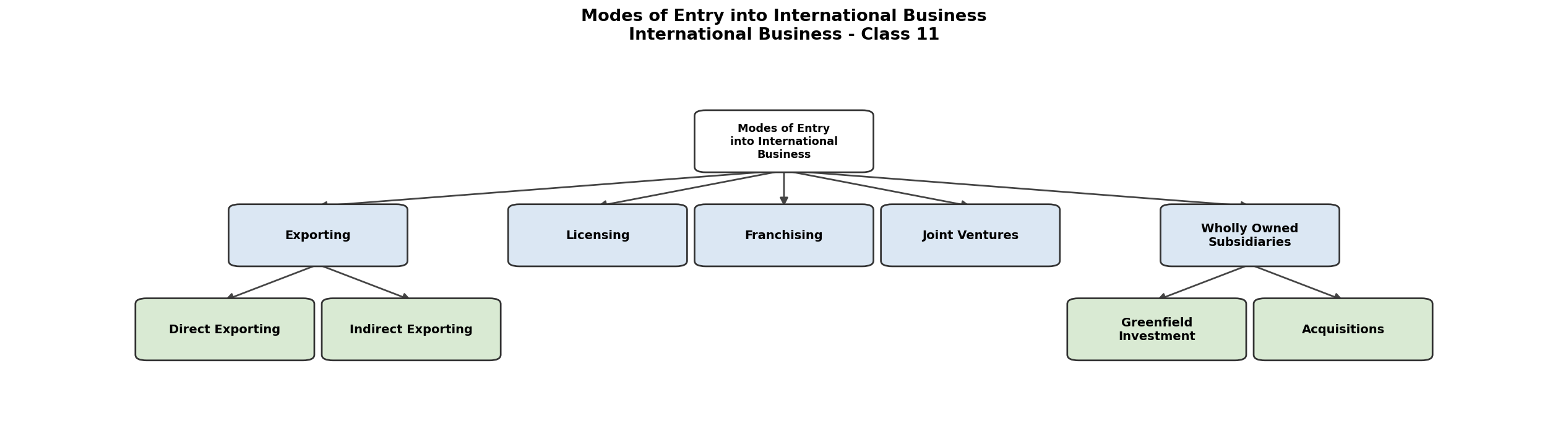
Based on the given diagram, answer the following:
Which mode of entry into international business involves granting rights to a foreign firm to use intellectual property such as patents or trademarks?
AFranchising
BLicensing
CJoint Ventures
DDirect Exporting
Differentiate between Direct Exporting and Indirect Exporting as shown in the diagram.
A Greenfield Investment, shown as a sub-type of Wholly Owned Subsidiaries, refers to:
APurchasing an existing foreign company
BEntering into a partnership with a foreign firm
CSetting up a new facility from scratch in a foreign country
DExporting goods through an agent
Why is a Joint Venture considered a preferred mode of entry into international business for many firms? Give two reasons.
Which of the following is classified as a Non-Tariff Barrier as shown in the diagram?
AAd Valorem Duty
BSpecific Duty
CImport Quotas
DCountervailing Duty
Distinguish between 'Specific Duty' and 'Ad Valorem Duty' as types of Tariff Barriers.
An 'Embargo' as shown in the diagram as a Non-Tariff Barrier refers to:
AA tax imposed on imported goods
BA complete ban on trade with a particular country or on specific goods
CA limit on the quantity of goods that can be imported
DA government payment to domestic producers to reduce their costs
Why do governments impose trade barriers in international business? State any three reasons.
Show answersHide answers
1. Option 2 — Licensing
2. Direct Exporting means the firm itself handles the export process and deals directly with foreign buyers without intermediaries. Indirect Exporting involves using intermediaries such as export houses or trading companies to sell goods in foreign markets.
3. Option 3 — Setting up a new facility from scratch in a foreign country
4. A Joint Venture is preferred because: (1) It allows sharing of financial risks and resources between the domestic and foreign partner. (2) It provides access to the local partner's knowledge of the foreign market, culture, and regulatory environment, making market entry easier.
5. Option 3 — Import Quotas
6. Specific Duty is a fixed amount of tax levied per unit of the imported good, regardless of its price (e.g., Rs. 500 per tonne). Ad Valorem Duty is a tax calculated as a percentage of the value of the imported goods (e.g., 10% of the invoice value). While Specific Duty is simpler to administer, Ad Valorem Duty is more equitable as it is proportional to the value of goods.
7. Option 2 — A complete ban on trade with a particular country or on specific goods
8. Governments impose trade barriers for the following reasons: (1) Protection of Domestic Industries — To shield newly established or infant industries from intense foreign competition until they become strong enough to compete globally. (2) Generating Revenue — Tariffs and duties on imports serve as a significant source of revenue for the government. (3) Conservation of Foreign Exchange — By restricting imports through quotas and licensing, the government reduces the outflow of foreign exchange, thereby protecting the country's balance of payments position.
Q584 Marks
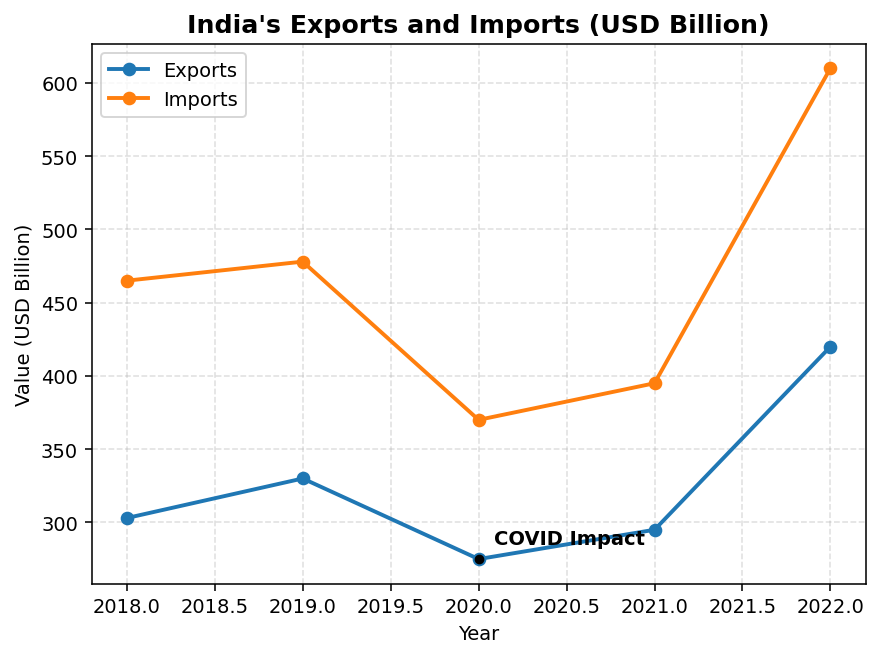
Based on the given chart showing India's Export and Import trends, answer the following:
In which year did both Exports and Imports show the lowest values as seen in the chart?
A2018
B2019
C2020
D2021
What does the consistent gap between Imports and Exports in the chart indicate about India's Balance of Trade?
The sharp rise in both Exports and Imports in 2022 as shown in the chart can be attributed to:
ADecrease in foreign direct investment
BPost-pandemic recovery and resumption of international trade activities
CIntroduction of new trade barriers by WTO
DReduction in multinational corporations
State any two benefits of increasing exports for a country as reflected in the trend shown in the chart.
Show answersHide answers
1. Option 3 — 2020
2. The consistent gap where Imports exceed Exports indicates that India has an unfavourable or negative Balance of Trade (also called a Trade Deficit). This means India is spending more on purchasing goods from foreign countries than it earns by selling goods abroad.
3. Option 2 — Post-pandemic recovery and resumption of international trade activities
4. Two benefits of increasing exports are: (1) It earns foreign exchange for the country, which can be used to pay for imports and strengthen the economy. (2) It leads to increased production, which creates employment opportunities and promotes economic growth in the exporting country.
Q594 Marks
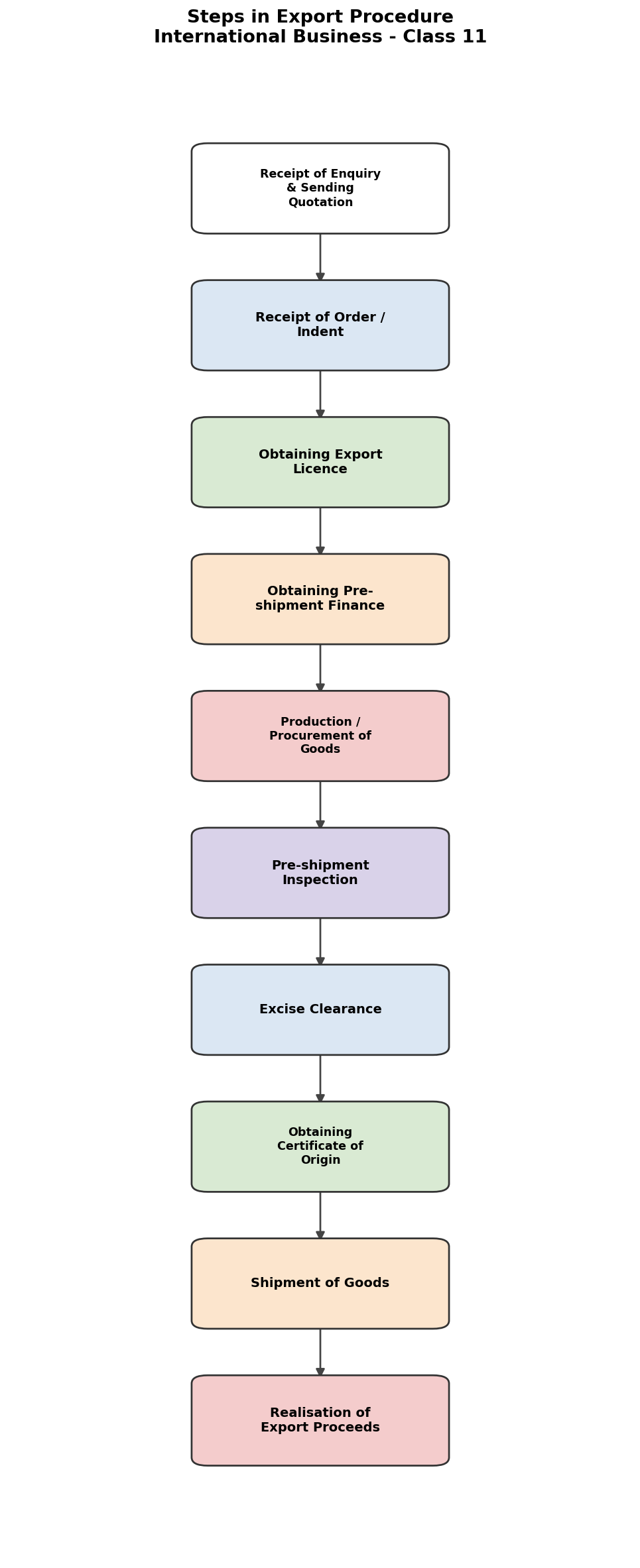
Based on the given diagram of the Export Procedure in International Business, answer the following:
According to the export procedure shown, which step immediately follows 'Pre-shipment Inspection'?
AObtaining Certificate of Origin
BShipment of Goods
CExcise Clearance
DObtaining Export Licence
What is the purpose of obtaining a 'Certificate of Origin' in the export procedure?
Pre-shipment finance in the export procedure is obtained from:
AThe World Trade Organization (WTO)
BThe importing country's government
CBanks or financial institutions to fund production of export goods
DThe Export Inspection Council
Why is 'Pre-shipment Inspection' an important step in the export procedure? Explain briefly.
Show answersHide answers
1. Option 3 — Excise Clearance
2. A Certificate of Origin is a document that certifies the country in which the exported goods were manufactured or produced. It is required by the importing country to determine the applicable customs duties and to verify eligibility for preferential tariff treatment under trade agreements.
3. Option 3 — Banks or financial institutions to fund production of export goods
4. Pre-shipment Inspection is important because it ensures that the goods being exported meet the required quality standards and specifications agreed upon with the foreign buyer. In India, it is conducted by the Export Inspection Council (EIC) or other approved agencies. It protects the reputation of Indian exports and ensures compliance with international quality norms, thereby preventing rejection of goods by the importer.