Skip to content
TestMacher
Chapter 10 · Class 11 Business Studies

Sources of Business Finance — Important Questions

59 questions With answers CBSE format

SUMMARY: This chapter discusses the various sources of finance available to businesses and their significance in business operations.
KEY TOPICS: internal sources of finance, external sources of finance, equity shares, preference shares, debentures, retained earnings, trade credit, factoring, lease financing, venture capital.

Q1 1 Mark

Owner's funds include:

AEquity capital
BLoans
CTrade credit
DDebentures
Check answerHide answer
Correct answer: Option 1 — Equity capital
Q2 1 Mark

Working capital is required for:

ADay-to-day operations
BBuying fixed assets
CLong-term projects
DCapital reserve
Check answerHide answer
Correct answer: Option 1 — Day-to-day operations
Q3 1 Mark

Trade credit is provided by:

ABanks
BSuppliers of goods on credit
CGovernment
DInvestors
Check answerHide answer
Correct answer: Option 2 — Suppliers of goods on credit
Q4 1 Mark

A debenture is:

AEquity share
BLong-term debt instrument
CShort-term loan
DReserve
Check answerHide answer
Correct answer: Option 2 — Long-term debt instrument
Q5 1 Mark

Public deposits are accepted by:

ACompanies (with limits)
BBanks only
CCooperatives
DGovernment
Check answerHide answer
Correct answer: Option 1 — Companies (with limits)
Q6 1 Mark

What is the primary source of internal finance for a business?

AEquity shares
BRetained earnings
CDebentures
DTrade credit
Check answerHide answer
Correct answer: Option 2 — Retained earnings
Q7 1 Mark

Which of the following is considered an external source of finance?

ARetained earnings
BVenture capital
CDepreciation
DOwner's savings
Check answerHide answer
Correct answer: Option 2 — Venture capital
Q8 1 Mark

What is a characteristic feature of preference shares?

AThey have voting rights
BThey offer fixed dividends
CThey are repayable on demand
DThey are the same as equity shares
Check answerHide answer
Correct answer: Option 2 — They offer fixed dividends
Q9 1 Mark

Which source of finance involves selling accounts receivable at a discount?

AFactoring
BLease financing
CVenture capital
DTrade credit
Check answerHide answer
Correct answer: Option 1 — Factoring
Q10 1 Mark

What is the main advantage of using debentures as a source of finance?

ANo repayment obligation
BFixed interest payments
COwnership dilution
DUnlimited liability
Check answerHide answer
Correct answer: Option 2 — Fixed interest payments
Q11 1 Mark

What type of financing allows a business to use an asset without purchasing it outright?

AFactoring
BLease financing
CEquity shares
DRetained earnings
Check answerHide answer
Correct answer: Option 2 — Lease financing
Q12 1 Mark

Which of the following is NOT a feature of equity shares?

AOwnership in the company
BFixed dividend
CVoting rights
DResidual claim on assets
Check answerHide answer
Correct answer: Option 2 — Fixed dividend
Q13 1 Mark

Venture capital is primarily used for which type of business?

AEstablished firms
BStartups and new ventures
CLarge corporations
DNon-profit organizations
Check answerHide answer
Correct answer: Option 2 — Startups and new ventures
Q14 1 Mark

Which source of finance is considered the cheapest for a business?

AEquity shares
BDebentures
CRetained earnings
DPreference shares
Check answerHide answer
Correct answer: Option 3 — Retained earnings
Q15 1 Mark

What is the main disadvantage of using trade credit?

AHigh interest rates
BLimited availability
CShort repayment period
DEquity dilution
Check answerHide answer
Correct answer: Option 3 — Short repayment period
Q16 3 Marks

Distinguish between owner's funds and borrowed funds.

View sample solutionHide solution
OWNER'S FUNDS — capital contributed by owners; permanent in nature; no fixed cost (dividends are paid only if profit); ownership rights and control; bear residual risk. Examples: equity shares, retained earnings, reserves. BORROWED FUNDS — capital obtained from outsiders; repayable with interest; fixed cost (interest must be paid even in losses); no ownership; secured against assets typically. Examples: debentures, loans, public deposits, trade credit. The mix of owner's and borrowed funds determines the firm's CAPITAL STRUCTURE. Owner's funds provide stability; borrowed funds amplify returns through leverage but increase risk.
Q17 3 Marks

Define equity shares and state any three of their features.

View sample solutionHide solution
Equity shares represent ownership in a company. Features: (i) PERMANENT CAPITAL — not repaid during the company's life; (ii) RESIDUAL CLAIM — equity shareholders are paid LAST after all creditors and preference shareholders; (iii) DIVIDEND VARIES — depends on profitability and management decision; (iv) VOTING RIGHTS — equity shareholders elect the board and approve major decisions; (v) RISK AND REWARD — bear maximum risk; receive maximum upside in profitable years; (vi) MARKET PRICE — varies with company performance and market sentiment.
Q18 3 Marks

Explain trade credit as a source of finance.

View sample solutionHide solution
Trade credit is the credit extended by one trader to another for the purchase of goods and services. The buyer can defer payment for a stipulated period (typically 30/60/90 days). Features: (1) Short-term — usually less than 1 year. (2) No formal interest typically — though some suppliers offer cash discount for early payment. (3) Easy to arrange — based on relationship and creditworthiness. (4) Limited amount — proportional to the buyer's purchasing scale. (5) No collateral required. (6) Helps cash flow management. Most B2B trade in India operates on trade credit.
Q19 3 Marks

What are public deposits and what are their features?

View sample solutionHide solution
Public deposits are deposits raised by companies directly from the public for medium-term financing. Features: (1) MEDIUM TERM — typically 6 months to 3 years. (2) UNSECURED — no collateral; relies on company's reputation. (3) HIGHER INTEREST — than bank fixed deposits; competitive rate to attract depositors. (4) REGULATED BY RBI — under Companies Acceptance of Deposits Rules; companies have limits and disclosure requirements. (5) NO PROCESSING FEES — unlike bank loans. (6) DOCUMENTATION SIMPLE. Suitable for established companies needing medium-term funds without diluting ownership. Risk: deposit holders face higher risk than bank depositors since deposits are unsecured.
Q20 3 Marks

Distinguish between equity shares and debentures.

View sample solutionHide solution
EQUITY SHARES — owner's capital; shareholders are owners of the company; receive dividend (variable) only if declared and profit available; have voting rights and elect the board; rank LAST in liquidation; risk and return are highest. DEBENTURES — borrowed capital; debenture holders are creditors of the company; receive fixed interest paid even in loss years; have NO voting rights (no ownership); rank ahead of shareholders in liquidation; can be secured against company assets; risk and return are moderate. Companies use both: equity for long-term ownership capital; debentures for fixed-cost long-term funds. Choice depends on capital structure goals interest rate environment and company's earnings stability.
Q21 3 Marks

What are internal sources of finance? Provide two examples.

View sample solutionHide solution
Internal sources of finance refer to funds generated within the business itself. Examples include retained earnings and depreciation funds.
Q22 3 Marks

Define external sources of finance and give two examples.

View sample solutionHide solution
External sources of finance are funds raised from outside the business. Examples include equity shares and debentures.
Q23 3 Marks

What are equity shares and how do they differ from preference shares?

View sample solutionHide solution
Equity shares represent ownership in a company and provide voting rights, while preference shares offer fixed dividends and priority over equity shares in asset distribution but typically do not carry voting rights.
Q24 3 Marks

Explain the concept of retained earnings as a source of finance.

View sample solutionHide solution
Retained earnings are the profits that a company retains for reinvestment in the business rather than distributing them as dividends to shareholders. This source is cost-effective as it does not incur any interest or dilution of ownership.
Q25 3 Marks

What is trade credit and how does it benefit businesses?

View sample solutionHide solution
Trade credit is an arrangement where a buyer can purchase goods or services and pay for them later. It benefits businesses by allowing them to manage cash flow and maintain inventory without immediate cash outflow.
Q26 6 Marks

Discuss the various sources of long-term finance available to a company.

View sample solutionHide solution
Long-term sources (over 5 years) finance fixed assets and major investments. SOURCES: (1) EQUITY SHARES — permanent ownership capital; pays variable dividend; voting rights; bears highest risk. (2) PREFERENCE SHARES — preferred over equity for dividend (fixed) and capital repayment; usually no voting rights; cumulative or non-cumulative; redeemable or irredeemable. (3) RETAINED EARNINGS — profits ploughed back; no cost; preserves ownership; subject to availability of profit. (4) DEBENTURES — long-term debt; fixed interest; can be convertible/non-convertible secured/unsecured; interest is tax-deductible. (5) LONG-TERM LOANS — from banks, financial institutions (LIC, IDBI, IFCI); repaid in instalments; usually secured against assets; loan agreement specifies terms. (6) BONDS — government and corporate bonds; similar to debentures. (7) FOREIGN CAPITAL — FDI, ECBs (External Commercial Borrowings), ADRs/GDRs (American/Global Depository Receipts) for raising capital abroad. (8) VENTURE CAPITAL — for start-ups and high-risk ventures; equity stake plus mentorship. The choice of source depends on cost, risk tolerance, control preference, and tax considerations.
Q27 6 Marks

Explain the various sources of short-term finance.

View sample solutionHide solution
Short-term sources (under 1 year) finance working capital and routine operations. SOURCES: (1) TRADE CREDIT — credit from suppliers; typically 30-90 days; no formal interest; based on relationships. (2) BANK CREDIT — most common: (a) Cash credit — overdraft against security; (b) Overdraft — temporary excess withdrawal beyond balance; (c) Discounting bills — bank pays cash for bills of exchange before maturity; (d) Term loans for short-term assets. (3) PUBLIC DEPOSITS — (medium-term too) raised directly from public for 6 months to 3 years. (4) COMMERCIAL PAPER — short-term unsecured promissory notes issued by companies (typically 90-364 days); only large reputed firms can issue. (5) FACTORING — selling receivables to a factor at a discount for immediate cash; with or without recourse. (6) INTER-CORPORATE DEPOSITS — short-term loans between companies. (7) ADVANCE FROM CUSTOMERS — for high-value or custom orders. (8) ACCRUED EXPENSES — wages payable, taxes payable; effectively interest-free until due. The mix depends on cost, availability, and the specific working capital need.
Q28 6 Marks

Distinguish between preference shares and equity shares.

View sample solutionHide solution
PREFERENCE SHARES — preferred over equity in two respects: (1) DIVIDEND — paid first at a fixed rate before equity; (2) CAPITAL REPAYMENT — preferred in winding up. Voting rights only on matters affecting their interests. Types: cumulative (unpaid dividend accumulates) vs non-cumulative; participating (additional dividend after equity gets specified rate) vs non-participating; convertible (into equity) vs non-convertible; redeemable (repaid after fixed period) vs irredeemable (rare since Companies Act 2013 restricts). EQUITY SHARES — owners of the company; receive dividend (variable) AFTER preference; have full voting rights; bear residual risk in liquidation; potential for highest returns through dividend AND capital appreciation. RELATIONSHIP: preference shareholders are like senior creditors among shareholders — lower risk than equity but higher than debentures. Equity is the permanent core ownership; preference is hybrid debt-equity. Companies issue preference for steady-yield investors and equity for risk-takers seeking growth.
Q29 6 Marks

Discuss the merits and limitations of using debentures as a source of finance.

View sample solutionHide solution
MERITS of debentures: (1) FIXED COST — predictable interest payments help financial planning. (2) NO DILUTION OF CONTROL — debenture holders have no voting rights so existing owners retain control. (3) TAX BENEFITS — interest is tax-deductible reducing effective cost. (4) TRADEABLE — listed debentures are liquid for holders. (5) LEVERAGE — debt-financing magnifies returns to equity holders when business is profitable. (6) APPEALS TO RISK-AVERSE INVESTORS who want fixed returns. LIMITATIONS: (1) FIXED OBLIGATION — interest must be paid even in loss years; can lead to financial distress. (2) RISK OF DEFAULT — failure to pay interest or principal can trigger liquidation. (3) CHARGE ON ASSETS — secured debentures restrict the company's freedom to dispose assets. (4) DRR REQUIREMENT — under Companies Act 2013, 10% Debenture Redemption Reserve must be created from profits. (5) RIGID — repayment terms are fixed; cannot defer in difficult years. (6) NEGATIVE GEARING — in loss years, fixed interest depresses equity returns. (7) NEGATIVE COVENANTS — bond agreements may restrict dividends, additional borrowing, asset sales. Optimal debt-equity mix balances these benefits and costs.
Q30 6 Marks

Explain the factors influencing the choice of source of finance.

View sample solutionHide solution
FACTORS in choosing source of finance: (1) COST — interest rates, dividend expectations, processing fees, taxes. Cheaper is generally better but consider risk-adjusted cost. (2) RISK — fixed obligations (debt) carry higher risk than equity; assess the firm's earnings stability. (3) FINANCIAL CONDITION — cash flows; firms with stable cash flows can take more debt. (4) GENERAL ECONOMIC CLIMATE — high interest rates discourage debt; recession favours equity (less fixed obligations). (5) CONTROL — issuing equity dilutes ownership; debt does not. (6) DURATION — long-term needs (fixed assets) require long-term funds; short-term needs (working capital) can use short-term sources. (7) TAX CONSIDERATIONS — interest is tax-deductible (debt cheaper after tax); dividends are not. (8) FLEXIBILITY — debt has fixed repayment schedule; equity has no fixed obligations. (9) REGULATORY ENVIRONMENT — SEBI rules for issue of shares; RBI rules for ECBs; Companies Act for deposits. (10) CREDITWORTHINESS — only large reputed firms can issue commercial paper or debentures; smaller firms rely on bank loans and trade credit. (11) SECURITY AVAILABLE — secured borrowing requires collateral. (12) TIME REQUIRED — equity issues take longer than bank loans. The optimal source mix balances all these factors.
Q31 6 Marks

Differentiate between fixed capital and working capital in tabular form on five features.

Q32 1 Mark

Assertion (A): Equity capital is the most permanent source of business finance.

Reason (R): Equity capital is not repaid during the company's life and represents permanent ownership.

Show explanationHide explanation
Correct answer: Option 1 — Both A and R are true, and R is the correct explanation of A.
Q33 1 Mark

Assertion (A): Debenture holders are creditors of the company.

Reason (R): Debentures represent borrowed funds that must be repaid with interest.

Show explanationHide explanation
Correct answer: Option 1 — Both A and R are true, and R is the correct explanation of A.
Q34 1 Mark

Assertion (A): Trade credit is a short-term source of finance.

Reason (R): Suppliers typically allow credit for 30 to 90 days only.

Show explanationHide explanation
Correct answer: Option 1 — Both A and R are true, and R is the correct explanation of A.
Q35 1 Mark

Assertion (A): Interest on debentures provides a tax shield to the company.

Reason (R): Interest is deductible from profit before computing income tax.

Show explanationHide explanation
Correct answer: Option 1 — Both A and R are true, and R is the correct explanation of A.
Q36 1 Mark

Assertion (A): Factoring helps a firm convert receivables into cash quickly.

Reason (R): The factor pays the firm immediately and collects from debtors later for a fee.

Show explanationHide explanation
Correct answer: Option 1 — Both A and R are true, and R is the correct explanation of A.
Q37 1 Mark

Assertion (A): Equity shares provide ownership in a company.

Reason (R): Equity shareholders have a claim on the company's profits and assets.

Show explanationHide explanation
Correct answer: Option 1 — Both A and R are true, and R is the correct explanation of A.
Q38 1 Mark

Assertion (A): Preference shares have a fixed rate of dividend.

Reason (R): Preference shareholders are paid dividends before equity shareholders.

Show explanationHide explanation
Correct answer: Option 1 — Both A and R are true, and R is the correct explanation of A.
Q39 1 Mark

Assertion (A): Debentures are a form of equity financing.

Reason (R): Debentures represent a loan made to the company by the debenture holder.

Show explanationHide explanation
Correct answer: Option 3 — A is true, but R is false.
Q40 1 Mark

Statement 1: Capital structure is the mix of debt and equity.

Statement 2: Optimal capital structure balances cost and risk.

Show answerHide answer
Correct answer: Option 1 — Both statements are true.
Q41 1 Mark

Statement 1: Retained earnings are an internal source of finance.

Statement 2: They are profits ploughed back into the business rather than distributed as dividend.

Show answerHide answer
Correct answer: Option 1 — Both statements are true.
Q42 1 Mark

Statement 1: Cash credit is a popular form of bank finance.

Statement 2: It allows the borrower to overdraw within a sanctioned limit against security.

Show answerHide answer
Correct answer: Option 1 — Both statements are true.
Q43 1 Mark

Statement 1: Commercial paper is a short-term unsecured instrument.

Statement 2: Only large credit-worthy companies are allowed to issue commercial paper.

Show answerHide answer
Correct answer: Option 1 — Both statements are true.
Q44 1 Mark

Statement 1: FDI (Foreign Direct Investment) is a long-term source of foreign capital.

Statement 2: It brings not just capital but also technology and management expertise.

Show answerHide answer
Correct answer: Option 1 — Both statements are true.
Q45 1 Mark

Statement 1: Equity shares represent ownership in a company and come with voting rights.

Statement 2: Preference shares have a fixed dividend but do not usually carry voting rights.

Show answerHide answer
Correct answer: Option 1 — Both statements are true.
Q46 1 Mark

Statement 1: Retained earnings are considered an internal source of finance.

Statement 2: Trade credit is an external source of finance that involves borrowing from suppliers.

Show answerHide answer
Correct answer: Option 1 — Both statements are true.
Q47 1 Mark

Statement 1: Debentures are a type of equity financing.

Statement 2: Debentures provide fixed interest payments to investors.

Show answerHide answer
Correct answer: Option 3 — Only Statement 2 is true.
Q48 3 Marks
Riya is starting a tech startup. She has personal savings of ₹5 lakh. She needs ₹50 lakh total to get the product ready and launch. Options under consideration: (1) angel investor ₹15 lakh for 20% equity; (2) bank loan ₹15 lakh at 12% p.a. for 5 years; (3) friends and family ₹5 lakh; (4) bootstrapping with her savings.
  1. For an early-stage startup the best funding mix usually involves:
    AEquity
    BDebt
    CBoth
    DMix recommended
  2. Should Riya accept the angel investor?
    AYes — gives capital and mentorship
    BNo — too much equity dilution
    CSometimes
    DOnly later stage
  3. Recommend the optimal funding mix and explain the trade-offs.
Show answersHide answers
1. Option 4 — Mix recommended
2. Option 1 — Yes — gives capital and mentorship
3. Riya's funding decision must balance capital adequacy ownership control and risk. RECOMMENDED MIX: (1) Personal savings ₹5 lakh — owner's commitment signal (she has skin in the game). (2) Angel investor ₹15 lakh for 20% equity — brings capital AND mentorship; angel typically provides industry expertise and network; gives ₹5 lakh runway plus credibility. (3) Friends and family ₹5 lakh — softer terms; should still be documented as loan or convertible note. (4) Bank loan ₹15 lakh — preserves equity; adds debt obligation; but startups are risky and banks rarely lend without collateral. Maybe partial loan ₹5-10 lakh secured by property. (5) Crowdfunding or grants ₹5 lakh through programs like Startup India, Atal Innovation Mission. RATIONALE: (a) DIVERSIFICATION reduces risk; (b) ANGEL INVESTOR provides more than money — mentorship, network, credibility; (c) BANK LOAN preserves equity (Riya keeps more ownership); (d) FRIENDS/FAMILY are typically the easiest first investors. AVOIDING all-in equity (giving up too much ownership) is critical — Riya should aim to retain 60-70% post angel round. As the business grows, future rounds (Series A, B) bring more dilution. Most successful Indian startups have used a similar mix: bootstrapping → angel → VC → IPO. The choice depends on Riya's risk tolerance, growth ambitions, and exit strategy.
Q49 3 Marks
M/s Solar Manufacturing wants to expand its plant. They need ₹50 crore. Existing equity capital is ₹80 crore. The CFO recommends issuing 9% debentures (10-year maturity redeemable at par). Net profit is healthy at ₹15 crore per year.
  1. Interest on debentures is treated as:
    ACharge against profit
    BAppropriation of profit
    CReserve transfer
    DOptional
  2. Should Solar Manufacturing issue debentures?
    AYes — sufficient interest coverage
    BNo — too risky
    CMaybe
    DOnly with collateral
  3. Should Solar Manufacturing issue debentures? Justify the decision.
Show answersHide answers
1. Option 1 — Charge against profit
2. Option 1 — Yes — sufficient interest coverage
3. Solar Manufacturing's debenture issue makes financial sense for several reasons. INTEREST COVERAGE: Annual interest = 50 × 9% = ₹4.5 crore. Net profit ₹15 crore covers interest 3.3x — well above the standard 1.5x minimum. SAFE FROM DEFAULT. DEBT-EQUITY RATIO: After issue, debt = 50 crore vs equity = 80 crore = 0.625:1 (well below typical 2:1 limit). REASONABLE LEVERAGE. ADVANTAGES of debentures here: (1) PRESERVES OWNERSHIP — no dilution of equity holders; (2) TAX BENEFIT — interest is deductible from profit reducing effective cost (₹4.5 crore × 25% tax saving = ₹1.13 crore); after-tax cost of debt = 9% × (1 − 0.25) = 6.75%; (3) FIXED COST — easier to plan; (4) LEVERAGE — magnifies return on equity in profitable years. CONSIDERATIONS: (1) DEBT REDEMPTION RESERVE — must create 10% of face value over the life = ₹5 crore from profits; (2) FIXED OBLIGATION — interest must be paid even in loss years; if business turns down, this could cause distress; (3) NEGATIVE COVENANTS — debenture agreement may restrict dividends or further borrowing. Healthy companies regularly issue debentures for growth — Reliance, Tata, Infosys all have publicly traded debentures. SOLAR'S PROFILE (healthy profit, low existing debt) makes debenture issue prudent.
Q50 3 Marks
Mr Suresh runs a printing press business with annual turnover ₹40 lakh. He needs ₹10 lakh working capital to buy paper and ink. He approaches his bank. The bank offers a Cash Credit limit of ₹8 lakh against stock and debtors as security and a Cash Credit of ₹8 lakh.
  1. A cash credit account is suitable for working capital because:
    AYes — flexible
    BNo — too rigid
    CSometimes
    DOnly for big firms
  2. Cash credit is typically secured against:
    AStock and debtors
    BReal estate
    CPersonal property
    DAll of these
  3. Explain how cash credit works and why it suits small businesses.
Show answersHide answers
1. Option 1 — Yes — flexible
2. Option 1 — Stock and debtors
3. Cash Credit (CC) is a popular form of bank finance for small businesses for working capital. FEATURES of CC: (1) Bank sets a SANCTIONED LIMIT (here ₹8 lakh). (2) Borrower can WITHDRAW UP TO that limit anytime. (3) Interest charged ONLY on utilised amount (not the full limit). (4) Repayment is FLEXIBLE — borrower can deposit and withdraw repeatedly. (5) SECURITY is typically stock and debtors (current assets). (6) RENEWED ANNUALLY based on business performance. (7) Like an overdraft but with formal agreement. ADVANTAGES for Mr Suresh: (a) FLEXIBLE — pay interest only on amount used; suits seasonal cash needs; (b) FAST DISBURSAL once limit is sanctioned; (c) SUITABLE for working capital — buying paper/ink as orders come in. PROCEDURE: (1) Apply to bank with last 3 years' financials, GST returns, ITRs, balance sheet, P&L. (2) Bank evaluates creditworthiness — turnover, profit, debt-equity ratio, debtor quality, stock turnover. (3) Bank sanctions limit (typically 75-80% of stock value or 60-70% of debtors). (4) Loan agreement signed; security charged. (5) Account opened; borrower draws as needed. ALTERNATIVES: (a) Term loan — for long-term assets; (b) Bill discounting — convert receivables to cash; (c) Bank guarantee — for tendering; (d) Letter of credit — for purchase finance. Working capital finance is the lifeblood of small business in India. CC limit grows with business — Mr Suresh's ₹8 lakh today might become ₹50 lakh as turnover doubles.
Q51 4 Marks
Ramesh started a small manufacturing business five years ago using his personal savings. As the business grew, he needed additional funds to expand his production capacity. His accountant suggested that instead of borrowing from banks, he could use the profits that had been accumulated over the years and kept within the business. The accountant explained that this source of finance does not require any interest payment and does not dilute ownership. However, it is limited by the amount of profits earned. Ramesh also considered issuing equity shares to the public to raise long-term capital. Equity shareholders are the real owners of the company and share in its profits through dividends. They also bear the maximum risk associated with the business.
  1. The internal source of finance suggested by Ramesh's accountant refers to:
    ATrade Credit
    BRetained Earnings
    CDebentures
    DVenture Capital
  2. Which of the following is a characteristic of equity shares?
    AFixed rate of dividend
    BNo voting rights
    COwners bear maximum risk
    DGuaranteed repayment of capital
  3. Why are retained earnings considered a cost-free source of finance?
  4. What is a major limitation of using retained earnings as a source of finance?
Show answersHide answers
1. Option 2 — Retained Earnings
2. Option 3 — Owners bear maximum risk
3. Retained earnings are considered cost-free because they are profits already earned by the business that are reinvested rather than distributed as dividends. There is no interest payment involved, no obligation to repay, and no dilution of ownership, making it an economical internal source of finance.
4. The major limitation of retained earnings is that it is limited by the amount of profits the business has earned and retained. New or loss-making businesses cannot rely on this source. Excessive retention may also cause dissatisfaction among shareholders who expect higher dividends.
Q52 3 Marks

Compare owner's funds and borrowed funds:

AspectOwner's fundsBorrowed funds
ExamplesEquity, retained earningsDebentures, loans, deposits
PermanencePermanentRepayable
CostVariable (dividend if profit)Fixed (interest mandatory)
Tax treatmentDividend not deductibleInterest deductible
ControlVoting rightsNo voting
Risk to providerHighestLower (priority over equity)
Risk to firmNone of forced paymentsDefault risk if interest unpaid
  1. Interest payment is mandatory and tax-deductible for:
    AOwner's funds
    BBorrowed funds
    CBoth
    DNeither
  2. Equity capital is more permanent than borrowed capital.
    AYes
    BNo
    CSometimes
    DOptional
  3. Explain why a firm uses both owner's and borrowed funds rather than one source.
Show answersHide answers
1. Option 2 — Borrowed funds
2. Option 1 — Yes
3. Owner's funds and borrowed funds are the two pillars of corporate finance. OWNER'S FUNDS — capital from owners; permanent in nature (not repaid during firm's life); cost is dividend (variable, paid only if profit). PROVIDERS bear residual risk — paid LAST in liquidation. EXAMPLES: equity shares, retained earnings (profits ploughed back), reserves and surplus. BORROWED FUNDS — capital from outsiders; repayable with interest; FIXED COST (must pay interest even in loss years). PROVIDERS rank ahead of equity holders in liquidation. EXAMPLES: debentures, term loans, bonds, public deposits, trade credit. CAPITAL STRUCTURE is the mix of owner's and borrowed funds. Optimal structure balances: (a) COST — debt is cheaper after-tax (interest is deductible) but (b) RISK — debt creates fixed obligations (default risk). Highly leveraged firms (high debt) magnify equity returns in good years but face distress in bad years. Conservatively financed firms (low debt) are more stable but earn lower equity returns. Indian firms typically operate with debt-equity ratio of 1:1 to 2:1; sectors vary widely (banks/NBFCs are highly leveraged; tech firms often have low debt). MODIGLIANI-MILLER theorem (with taxes) suggests debt is preferable due to tax shield, but in practice firms balance tax benefit with bankruptcy costs.
Q53 3 Marks

Long-term vs short-term sources of finance:

SourceTermUse case
Equity sharesLong-term (permanent)Fixed assets, growth
Preference sharesLong-termFixed assets
Retained earningsLong-termReinvestment
DebenturesLong-term (5-15 years)Major projects
Long-term loansLong-term (3-7 years)Plant and machinery
Trade creditShort-term (30-90 days)Routine purchases
Cash creditShort-term (annual renewable)Working capital
Commercial paperShort-term (90-364 days)Working capital
Public depositsMedium-term (6 months-3 years)Mid-term needs
  1. Which is a SHORT-term source?
    AEquity
    BTrade credit
    CCash credit
    DLong-term loan
  2. For buying plant and machinery the appropriate source is:
    ALong-term loan
    BTrade credit
    CCommercial paper
    DCash credit
  3. Why is matching the term of finance to the use of funds important?
Show answersHide answers
1. Option 2 — Trade credit
2. Option 1 — Long-term loan
3. The principle of MATCHING is critical: long-term needs require long-term sources; short-term needs use short-term sources. LONG-TERM SOURCES (over 5 years) finance fixed assets and major investments — equity, preference shares, retained earnings, debentures, long-term bank loans, bonds. The cost is generally higher but the funds are stable. SHORT-TERM SOURCES (under 1 year) finance working capital and routine operations — trade credit, cash credit, overdraft, bill discounting, commercial paper, factoring, public deposits (medium-term). Cheaper but must be replaced or renewed. WORKING CAPITAL CYCLE: cash → inventory → receivables → cash. The cycle's length determines working capital need. Any FUNDING MISMATCH leads to problems: (1) Using short-term funds for long-term assets — when short-term funds need repayment, the firm may not have liquidity. (2) Using long-term funds for short-term assets — capital is locked up in low-return current assets; firm pays unnecessary interest. The MATCHING PRINCIPLE: match the maturity of the funding to the maturity of the need. CFO's job is to maintain optimal funding mix while keeping cost low and flexibility high.
Q54 6 Marks

Match each source of finance with its appropriate use case.

Use CaseRecommended Source
Buying plant and machinery? Long-term loan / Debentures
Day-to-day working capital? Trade credit / Cash credit
Major expansion project? Equity / Debentures
Routine raw material purchase? Trade credit
Quick short-term cash for large firm? Commercial paper
Q55 6 Marks

Distinguish between owner's funds and borrowed funds based on these criteria.

CriterionOwner's FundsBorrowed Funds
PermanencePermanentRepayable
CostVariable (dividend)Fixed (interest)
Tax treatmentDividend not deductibleInterest deductible
ControlVoting rightsNo voting
Risk to providerHighestLower
Risk to firmNone of forced paymentsDefault risk
Q56 3 Marks

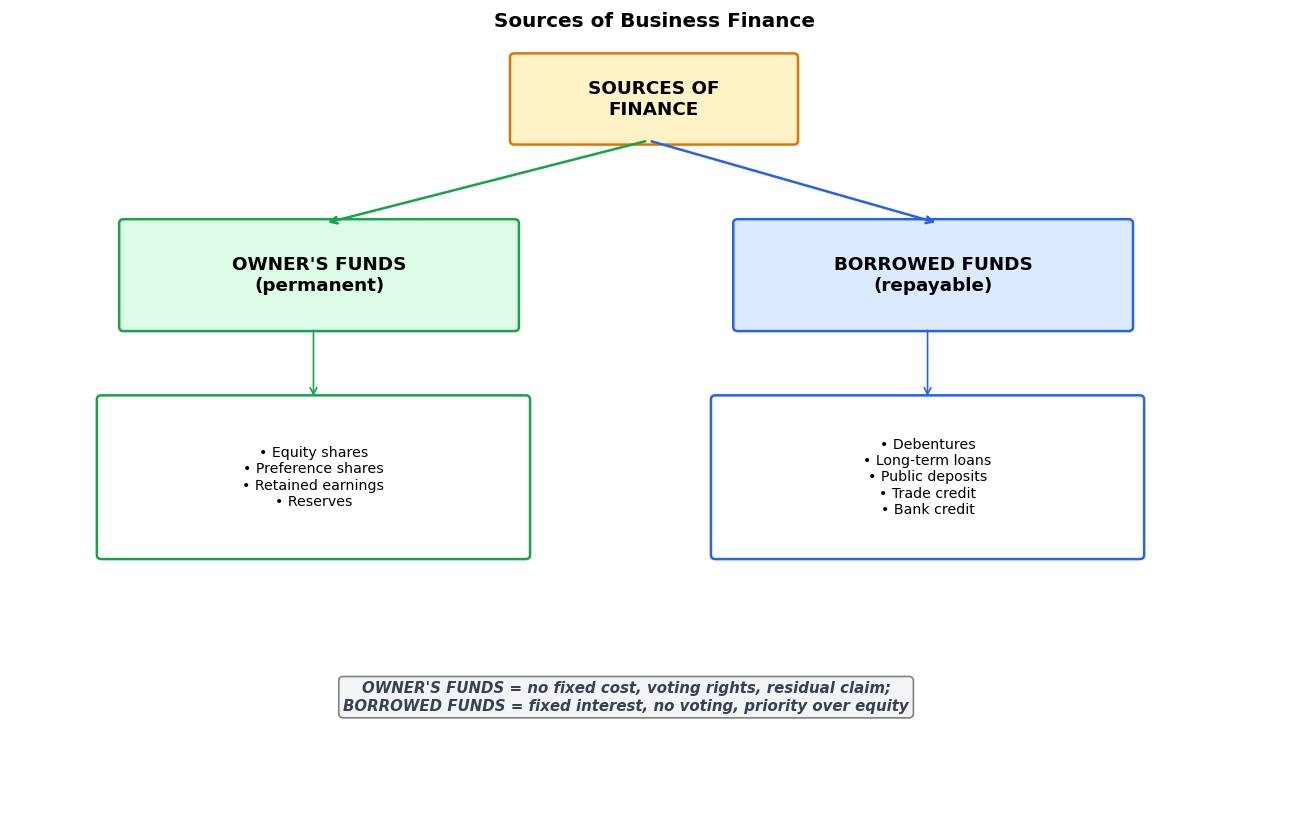
Study the sources of business finance tree and answer:

Sources of Business Finance figure
  1. Equity shares fall under:
    AOwner's funds
    BBorrowed funds
    CBoth
    DNeither
  2. Debentures and trade credit fall under:
    AOwner's funds
    BBorrowed funds
    CBoth
    DNeither
  3. Distinguish between owner's funds and borrowed funds and explain when each is appropriate.
Show answersHide answers
1. Option 1 — Owner's funds
2. Option 2 — Borrowed funds
3. Sources of business finance are broadly classified into OWNER'S FUNDS and BORROWED FUNDS. OWNER'S FUNDS — capital contributed by owners; permanent in nature; no fixed cost (dividends are paid only if profit); ownership rights and control; bear residual risk. Examples: equity shares, preference shares, retained earnings, reserves. BORROWED FUNDS — capital obtained from outsiders; repayable with interest; fixed cost (interest must be paid even in losses); no ownership; secured against assets typically. Examples: debentures, long-term loans, public deposits, trade credit, bank credit. The MIX of owner's and borrowed funds determines the firm's CAPITAL STRUCTURE. Owner's funds provide stability; borrowed funds amplify returns through leverage but increase risk. The MATCHING PRINCIPLE: long-term needs (fixed assets, expansion) require long-term sources; short-term needs (working capital) use short-term sources. The optimal mix depends on cost, risk, control preference, tax considerations, and the firm's growth stage.
Q57 27 Marks

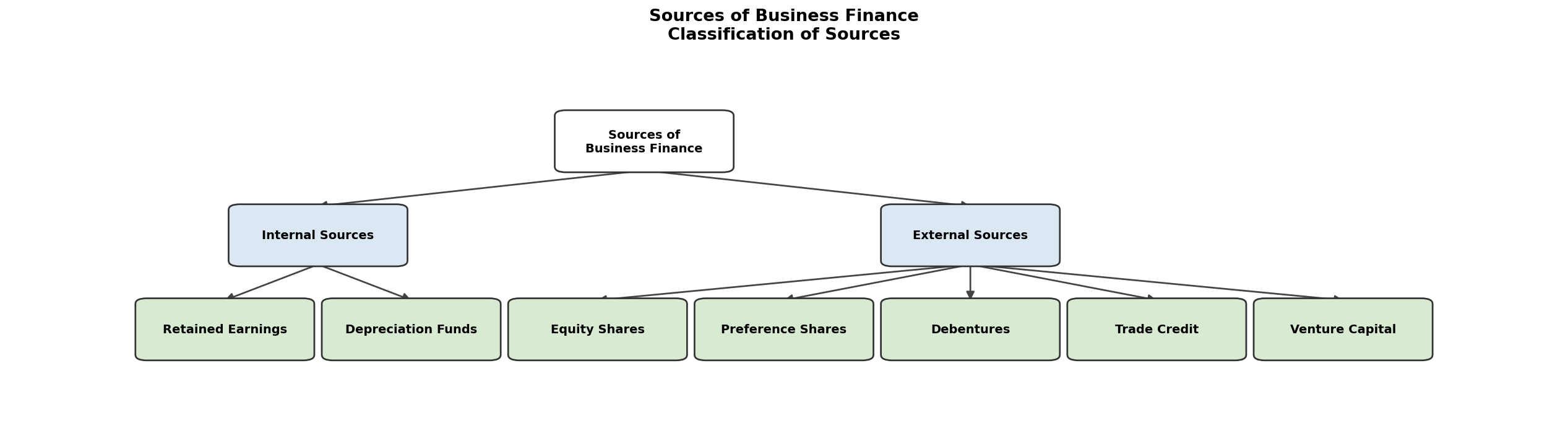
Based on the given diagram, answer the following:

Sources of Business Finance figure
  1. Which of the following is an internal source of business finance?
    ADebentures
    BRetained Earnings
    CTrade Credit
    DVenture Capital
  2. Name any two external sources of business finance shown in the diagram.
  3. Which external source of finance involves providing funds to new and innovative businesses with high growth potential?
    ATrade Credit
    BDebentures
    CVenture Capital
    DPreference Shares
  4. Distinguish between internal and external sources of business finance.
  5. Which type of shareholders are considered the real owners of a company?
    APreference Shareholders
    BDebenture Holders
    CEquity Shareholders
    DBond Holders
  6. State one advantage of preference shares over equity shares from an investor's perspective.
  7. Which of the following statements about equity shares is INCORRECT?
    AEquity shareholders have voting rights.
    BEquity shareholders receive a fixed rate of dividend.
    CEquity shareholders bear the highest risk.
    DEquity shares are a permanent source of capital.
  8. Why is equity share capital called a 'permanent source' of finance?
  9. In the process of factoring, who is referred to as the 'factor'?
    AThe seller of goods
    BThe buyer of goods
    CA financial institution that purchases book debts
    DThe government regulatory authority
  10. What percentage of the receivables does the factor typically advance to the seller immediately?
    A50–60%
    B70–75%
    C80–90%
    D95–100%
  11. Explain how factoring helps a business firm manage its working capital needs.
  12. State one limitation of factoring as a source of finance.
  13. In lease financing, the party who owns the asset and gives it on lease is called:
    ALessee
    BLessor
    CFactor
    DVenture Capitalist
  14. Which type of lease is typically long-term and where the lessee bears the cost of maintenance?
    AOperating Lease
    BShort-term Lease
    CFinance Lease
    DCancellable Lease
  15. State two advantages of lease financing as a source of finance for a business.
  16. How does an operating lease differ from a finance lease in terms of contract duration and maintenance responsibility?
  17. From the diagram, identify any two external sources of finance and explain one of them briefly.
  18. Which of the following best describes 'Venture Capital' as shown in the diagram?
    AFunds raised by issuing bonds to the public
    BFinance provided to new and risky enterprises with high growth potential
    CShort-term credit extended by suppliers
    DProfits retained within the business
  19. Why are internal sources of finance considered more reliable than external sources? Give two reasons.
  20. In the factoring process, who is referred to as the 'Factor'?
    AThe seller of goods
    BThe buyer of goods on credit
    CA financial institution that purchases receivables
    DThe government regulatory body
  21. What percentage of the invoice value does the Factor typically advance to the seller as shown in the diagram?
    A50-60%
    B70-80%
    C90-100%
    D30-40%
  22. Explain the concept of factoring as a source of short-term finance.
  23. State one advantage and one disadvantage of factoring as a source of finance.
  24. Which type of debenture can be converted into equity shares after a specified period?
    ASecured Debentures
    BIrredeemable Debentures
    CConvertible Debentures
    DUnsecured Debentures
  25. What is the key difference between Secured and Unsecured Debentures?
  26. Debentures are considered a safer investment than equity shares because:
    ADebenture holders receive higher returns than equity shareholders
    BDebenture holders receive fixed interest regardless of profit or loss
    CDebenture holders have voting rights in the company
    DDebentures are always convertible into shares
  27. Why would a company prefer to issue debentures rather than equity shares to raise long-term finance? Give two reasons.
  28. Which type of shareholders are considered the 'real owners' of a company?
    APreference Shareholders
    BEquity Shareholders
    CDebenture Holders
    DCumulative Preference Shareholders
  29. What is the key feature of Cumulative Preference Shares that distinguishes them from Non-Cumulative Preference Shares?
  30. Which of the following is NOT a feature of Preference Shares?
    AFixed rate of dividend
    BPriority over equity shares in repayment of capital
    CVoting rights in all company matters
    DPriority in payment of dividend
  31. Explain the meaning of 'Convertible Preference Shares' as shown in the diagram.
Show answersHide answers
1. Option 2 — Retained Earnings
2. Any two from: Equity Shares, Preference Shares, Debentures, Trade Credit, Venture Capital.
3. Option 3 — Venture Capital
4. Internal sources are funds generated from within the business (e.g., retained earnings, depreciation funds) without borrowing from outside. External sources are funds raised from outside the business (e.g., shares, debentures, trade credit) through borrowings or investments by outsiders.
5. Option 3 — Equity Shareholders
6. Preference shareholders receive a fixed dividend before equity shareholders and also have priority in repayment of capital at the time of liquidation, making it a safer investment.
7. Option 2 — Equity shareholders receive a fixed rate of dividend.
8. Equity share capital is called a permanent source of finance because it does not have to be repaid during the lifetime of the company. The capital remains with the company until it is wound up.
9. Option 3 — A financial institution that purchases book debts
10. Option 3 — 80–90%
11. Factoring helps a business firm by converting its credit sales (receivables) into immediate cash. Instead of waiting for the buyer to pay on the due date, the firm sells its receivables to a factor and receives an advance (80–90% of the value). This improves liquidity and helps meet day-to-day working capital requirements without waiting for the collection period.
12. One limitation of factoring is that it is a costly source of finance. The factor charges a fee/commission for its services, which reduces the net amount received by the seller. It is generally more expensive than traditional bank credit.
13. Option 2 — Lessor
14. Option 3 — Finance Lease
15. Two advantages of lease financing: (1) It allows a business to use an asset without making a large capital investment, thus preserving working capital. (2) Lease rentals are tax-deductible as a business expense, reducing the tax burden of the lessee. It also provides flexibility as the lessee can upgrade to newer technology at the end of the lease period.
16. An operating lease is a short-term lease that can be cancelled by the lessee, and the lessor is responsible for maintenance, insurance, and repairs of the asset. A finance lease, on the other hand, is a long-term non-cancellable lease where the lessee bears all costs of maintenance and repairs. In a finance lease, the lessee gets almost all the benefits and risks of ownership even though the legal title remains with the lessor.
17. Two external sources: Equity Shares and Debentures. Equity Shares represent ownership capital where shareholders are part-owners of the company and share in profits through dividends.
18. Option 2 — Finance provided to new and risky enterprises with high growth potential
19. Internal sources are more reliable because: (1) They do not involve any obligation to repay or pay interest, reducing financial burden. (2) They are readily available without lengthy procedures or dependence on external parties.
20. Option 3 — A financial institution that purchases receivables
21. Option 2 — 70-80%
22. Factoring is a financial service where a business sells its accounts receivables (book debts) to a financial institution called a factor at a discount. The factor provides immediate cash to the business, which helps in managing working capital. The factor then collects the payment from the debtors on the due date. It is a short-term source of finance useful for businesses that sell on credit.
23. Advantage: It provides immediate liquidity to the business without waiting for debtors to pay, improving cash flow. Disadvantage: It is a costly source of finance as the factor charges a fee/commission, reducing the total amount received by the seller.
24. Option 3 — Convertible Debentures
25. Secured Debentures are backed by a charge on the assets of the company, meaning debenture holders have a claim on specific assets in case of default. Unsecured Debentures, also called naked debentures, are not backed by any charge on assets and carry higher risk for the investor.
26. Option 2 — Debenture holders receive fixed interest regardless of profit or loss
27. A company may prefer debentures over equity shares because: (1) Issuing debentures does not dilute the ownership and control of existing shareholders, as debenture holders do not have voting rights. (2) Interest paid on debentures is a tax-deductible expense, reducing the overall tax liability of the company, whereas dividends on equity shares are paid from after-tax profits.
28. Option 2 — Equity Shareholders
29. In Cumulative Preference Shares, any unpaid dividend accumulates and is carried forward to subsequent years. It must be paid before any dividend is paid to equity shareholders. In Non-Cumulative Preference Shares, unpaid dividends lapse and do not accumulate.
30. Option 3 — Voting rights in all company matters
31. Convertible Preference Shares are those preference shares that can be converted into equity shares after a specified period of time, as per the terms of issue. This gives holders the option to become equity shareholders of the company.

Q58 8 Marks

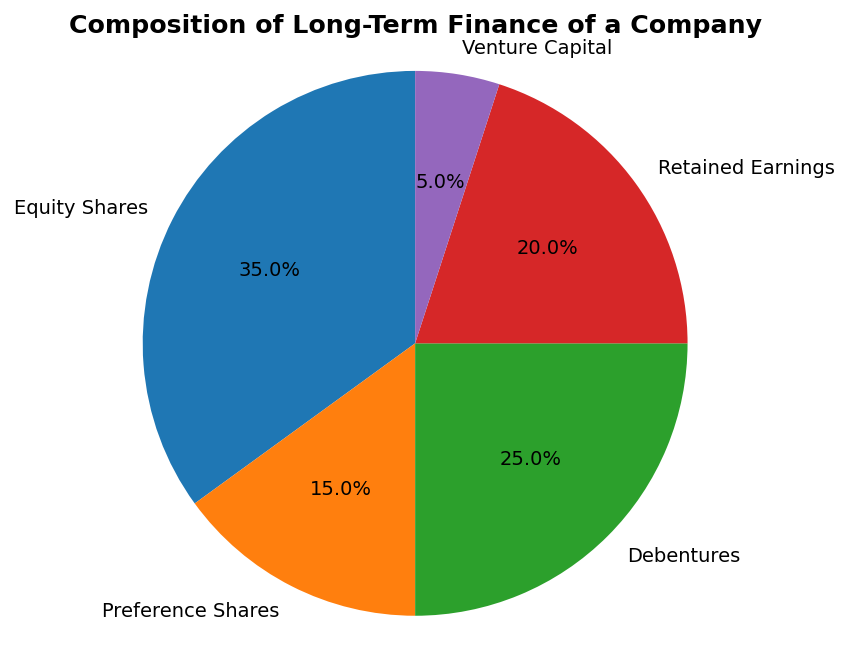
Based on the given chart, answer the following:

Sources of Business Finance figure
  1. Which source of long-term finance has the largest share in the company's capital structure as shown in the chart?
    ADebentures
    BRetained Earnings
    CEquity Shares
    DPreference Shares
  2. What is the combined percentage of debt-based sources (Debentures) and internal sources (Retained Earnings) in the company's finance?
    A30%
    B40%
    C45%
    D50%
  3. Why do companies prefer to include retained earnings as a source of finance despite having access to external sources?
  4. Debentures are shown as 25% of the finance. State one key feature that distinguishes debentures from equity shares.
  5. Which source of finance has the largest share in the company's capital structure as shown in the chart?
    ADebentures
    BPreference Shares
    CEquity Shares
    DRetained Earnings
  6. What is the combined percentage of debt-based sources (Debentures and Preference Shares) in the capital structure?
    A35%
    B45%
    C55%
    D25%
  7. Differentiate between Equity Shares and Preference Shares on the basis of dividend payment.
  8. Why might a company prefer to use Retained Earnings as a source of finance?
  9. According to the chart, which source of finance has the lowest cost?
    ATrade Credit
    BDebentures
    CRetained Earnings
    DPreference Shares
  10. Which source of finance has the highest availability period (longest term) as shown in the chart?
    ADebentures
    BPreference Shares
    CTrade Credit
    DEquity Shares
  11. Why is Trade Credit shown as having a very short availability period in the chart? Explain the nature of trade credit.
  12. Based on the chart, compare Debentures and Preference Shares as sources of finance in terms of cost and availability period.
Show answersHide answers
1. Option 3 — Equity Shares
2. Option 3 — 45%
3. Companies prefer retained earnings because it is a cost-free internal source of finance. There is no need to pay interest or dividends on retained earnings, no dilution of ownership, no legal formalities, and it does not create any obligation. It also signals financial strength to investors.
4. A key distinguishing feature is that debenture holders are creditors of the company and receive a fixed rate of interest regardless of profit or loss, whereas equity shareholders are owners who receive dividends only when profits are available. Debenture holders do not have voting rights, while equity shareholders do.
5. Option 3 — Equity Shares
6. Option 2 — 45%
7. Equity shareholders receive dividends at a variable rate depending on the profits of the company, and dividend is not guaranteed. Preference shareholders receive dividends at a fixed rate and have priority over equity shareholders in the payment of dividends.
8. A company may prefer retained earnings because they do not involve any cost of raising funds, there is no obligation to repay or pay interest, they do not dilute ownership, and they strengthen the financial base of the company without external dependence.
9. Option 3 — Retained Earnings
10. Option 4 — Equity Shares
11. Trade Credit is shown with a very short availability period because it is a short-term source of finance. It refers to the credit extended by suppliers of goods and services to a business, allowing the buyer to pay at a later date (usually within 30-90 days). Since it must be repaid in a short time, it is not suitable for long-term financing needs.
12. From the chart, Debentures have a slightly lower cost (score 5) compared to Preference Shares (score 6), making debentures a cheaper source of finance. However, Preference Shares have a longer availability period (score 7) compared to Debentures (score 6), as preference shares may be irredeemable while debentures are typically redeemed after a fixed period. Overall, debentures are cheaper but have a shorter tenure, whereas preference shares are slightly costlier but available for a longer period.
Q59 4 Marks

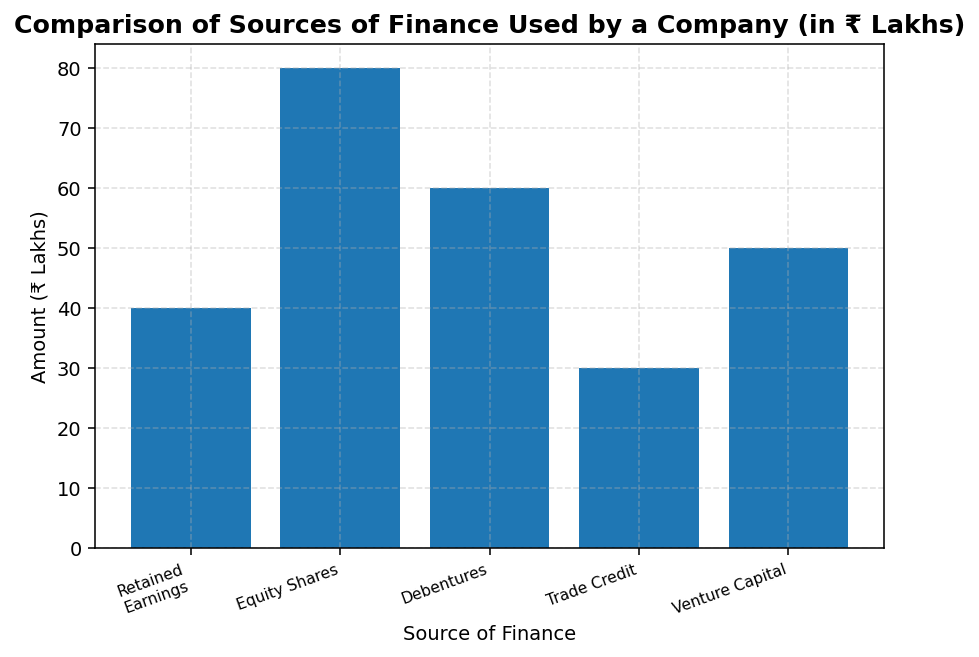
Based on the given graph, answer the following:

Sources of Business Finance figure
  1. Which source of finance has raised the highest amount as shown in the bar graph?
    ARetained Earnings
    BDebentures
    CEquity Shares
    DVenture Capital
  2. What is the total amount raised through internal sources of finance as shown in the graph?
    A₹40 Lakhs
    B₹80 Lakhs
    C₹120 Lakhs
    D₹60 Lakhs
  3. Differentiate between Debentures and Equity Shares as sources of finance on the basis of return given to investors.
  4. Why is Trade Credit considered a short-term source of finance? Explain briefly.
Show answersHide answers
1. Option 3 — Equity Shares
2. Option 1 — ₹40 Lakhs
3. Debenture holders receive a fixed rate of interest irrespective of whether the company makes a profit or loss. This interest is a charge against profits. Equity shareholders, on the other hand, receive dividends which are not fixed and depend on the profits earned by the company and the decision of the Board of Directors.
4. Trade Credit is considered a short-term source of finance because it refers to the credit extended by suppliers of goods and services to a business for a short period, usually ranging from 30 to 90 days. It helps businesses manage their working capital needs temporarily without immediate cash outflow, but it must be repaid within a short duration.

Make a full Business Studies paper on Sources of Business Finance.

Pick the question mix, set the marks, hit generate. You get a ready-to-print paper with an answer key.

Generate your paper — free