An MSME refers to:
Small Business — Important Questions
SUMMARY: This chapter focuses on the role, importance, and challenges faced by small businesses in India, along with the support provided by the government.
KEY TOPICS: Definition of small business, characteristics of small business, role of small business in India, problems faced by small businesses, government assistance for small businesses, District Industries Centres (DICs), National Small Industries Corporation (NSIC), Micro, Small and Medium Enterprises Development Act, 2006, entrepreneurship development programs.
A small business in manufacturing sector has investment up to:
Check answerHide answer
The MSME Development Act was passed in:
Check answerHide answer
Khadi and Village Industries Commission (KVIC) supports:
Check answerHide answer
Which of these is NOT a problem of small businesses?
Check answerHide answer
What is the primary characteristic of a small business in India according to the NCERT definition?
Check answerHide answer
Which of the following is NOT a characteristic of small businesses?
Check answerHide answer
What role do small businesses play in the Indian economy?
Check answerHide answer
Which of the following is a major problem faced by small businesses in India?
Check answerHide answer
What is the function of District Industries Centres (DICs)?
Check answerHide answer
The National Small Industries Corporation (NSIC) primarily aims to:
Check answerHide answer
Which act was introduced to promote the development of micro, small, and medium enterprises in India?
Check answerHide answer
Which of the following is a benefit of entrepreneurship development programs?
Check answerHide answer
What is a common challenge faced by small businesses in accessing finance?
Check answerHide answer
Small businesses are often characterized by:
Check answerHide answer
Define small business as per the MSME classification.
View sample solutionHide solution
List any three roles of small business in the Indian economy.
View sample solutionHide solution
Explain any three problems faced by small business.
View sample solutionHide solution
List any three government schemes supporting small businesses in India.
View sample solutionHide solution
What is a cottage industry and how does it differ from small-scale industry?
View sample solutionHide solution
Define a small business as per the Indian context. What criteria are used to classify a business as small?
View sample solutionHide solution
List three characteristics of small businesses. How do these characteristics differentiate them from large businesses?
View sample solutionHide solution
What is the role of small businesses in the Indian economy? Provide two examples of their contributions.
View sample solutionHide solution
Identify two major problems faced by small businesses in India. How do these problems impact their growth?
View sample solutionHide solution
Explain the significance of District Industries Centres (DICs) in supporting small businesses. What services do they provide?
View sample solutionHide solution
Discuss the role of small business in rural India.
View sample solutionHide solution
Explain the various government measures to support and promote small businesses in India.
View sample solutionHide solution
Discuss the contribution of small business to industrial development of India.
View sample solutionHide solution
Explain how technology can help small businesses overcome their problems.
View sample solutionHide solution
Differentiate between small business and large business in tabular form.
Compare cottage industry and small-scale industry with the help of a table.
Assertion (A): MSMEs are classified by investment and turnover.
Reason (R): The MSME Development Act 2006 (as amended in 2020) provides the basis of classification.
Show explanationHide explanation
Assertion (A): Small businesses contribute significantly to India's exports.
Reason (R): About 45% of India's total exports come from MSMEs.
Show explanationHide explanation
Assertion (A): Lack of finance is a major problem for small businesses.
Reason (R): Banks often hesitate to lend to small firms due to lack of collateral and high default risk.
Show explanationHide explanation
Assertion (A): The MUDRA Yojana provides collateral-free loans to small businesses.
Reason (R): The scheme aims to fund non-corporate small businesses through banks at concessional rates.
Show explanationHide explanation
Assertion (A): Small businesses prevent rural-to-urban migration.
Reason (R): They provide local employment so villagers do not need to migrate to cities for jobs.
Show explanationHide explanation
Assertion (A): Small businesses contribute significantly to the employment generation in India.
Reason (R): Small businesses are often labor-intensive and require a large workforce.
Show explanationHide explanation
Assertion (A): The Micro, Small and Medium Enterprises Development Act, 2006 aims to promote small businesses in India.
Reason (R): The Act provides a legal framework for the growth and development of small enterprises.
Show explanationHide explanation
Assertion (A): District Industries Centres (DICs) are established to support large-scale industries.
Reason (R): DICs provide various support services to small and medium enterprises.
Show explanationHide explanation
Statement 1: MSMEs are classified into Micro Small and Medium.
Statement 2: The classification considers both investment in plant and machinery and annual turnover.
Show answerHide answer
Statement 1: MSMEs contribute about 30% of India's GDP.
Statement 2: They also employ over 110 million people.
Show answerHide answer
Statement 1: SIDBI is the apex institution for MSME finance.
Statement 2: It refinances commercial banks for their lending to MSMEs.
Show answerHide answer
Statement 1: Cottage industries operate from home using traditional methods.
Statement 2: KVIC supports khadi and village industries.
Show answerHide answer
Statement 1: Technology can help small businesses access global markets.
Statement 2: Platforms like Amazon Flipkart and ONDC enable small sellers to reach customers nationwide.
Show answerHide answer
Statement 1: Small businesses are defined as enterprises with a limited investment and turnover.
Statement 2: Small businesses play a negligible role in the Indian economy.
Show answerHide answer
Statement 1: One characteristic of small businesses is their ability to provide employment opportunities.
Statement 2: Small businesses are typically large-scale operations.
Show answerHide answer
Statement 1: The government provides support to small businesses through various schemes and institutions.
Statement 2: Small businesses do not face any challenges in their operations.
Show answerHide answer
-
Lakshmi's enterprise (turnover ₹4 crore) is classified as:AMicroBSmallCMediumDLarge
-
For MSME benefits Lakshmi should obtain:AUdyam RegistrationBIncome Tax registrationCPan cardDAadhaar only
-
Explain how Lakshmi's MSME has benefited from registration and what schemes she can access.
Show answersHide answers
-
Maximum MUDRA loan amount in Tarun category is:AUp to ₹50000BUp to ₹5 lakhCUp to ₹10 lakhDUp to ₹50 lakh
-
MUDRA loans are:AYes — collateral-freeBNo — needs collateralCSometimesDOnly with security
-
Discuss MUDRA's role in supporting small businesses like Akash's.
Show answersHide answers
-
Cottage industries face competition from mass-produced goods.AYes — cottage industries face stiff competitionBNo — they are protectedCSometimesDRandom
-
Which institution specifically supports village industries?AKVICBSIDBICRBIDStock Exchange
-
Discuss the challenges of cottage industries and the support available.
Show answersHide answers
-
Under the MSME Development Act, 2006, a manufacturing enterprise with investment in plant and machinery up to Rs. 10 crore is classified as:AMicro enterpriseBSmall enterpriseCMedium enterpriseDLarge enterprise
-
Which of the following is the PRIMARY function of District Industries Centres (DICs)?ATo provide foreign exchange to exportersBTo provide integrated administrative support and services to small industries at the district levelCTo regulate stock markets at the district levelDTo manage large-scale public sector enterprises
-
Explain how small businesses like Ramesh's unit help in reducing regional imbalances in India.
-
Identify any two problems faced by small businesses as mentioned in the passage and suggest one government measure to address each.
Show answersHide answers
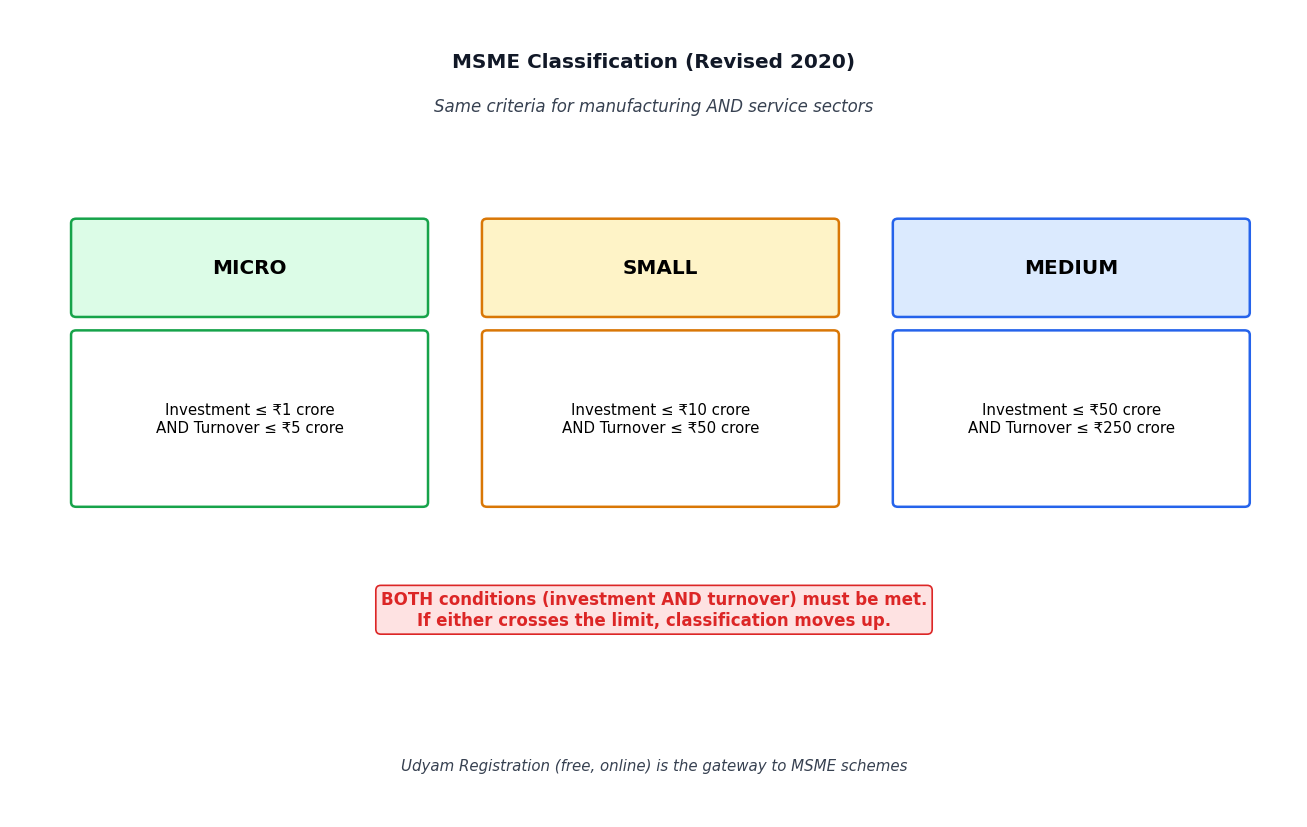
MSME classification (revised 2020):
| Type | Investment in P&M/Equipment | Annual turnover |
|---|---|---|
| Micro | Up to ₹1 crore | Up to ₹5 crore |
| Small | Up to ₹10 crore | Up to ₹50 crore |
| Medium | Up to ₹50 crore | Up to ₹250 crore |
| Note | Same criteria for manufacturing and service | Investment AND turnover both must be within limit |
-
A unit with ₹50 lakh investment and ₹3 crore turnover is:AMicroBSmallCMediumDLarge
-
Are the criteria same for manufacturing and service sectors?AYes (revised 2020)BNoCDifferent criteria for bothDRandom
-
Why was the 2020 revision of MSME classification important?
Show answersHide answers
Government schemes supporting small business:
| Scheme | Purpose | Limit |
|---|---|---|
| MUDRA | Collateral-free credit | ₹50000 to ₹10 lakh |
| PMEGP | Employment generation through new units | ₹25 lakh manufacturing; ₹10 lakh service |
| Stand-up India | SC/ST and women entrepreneurs | ₹10 lakh to ₹1 crore |
| CGTMSE | Credit guarantee for collateral-free loans | Up to ₹2 crore |
| Udyam Registration | Simplified MSME registration | Free, online |
| ZED Certification | Quality and environmental standards | For all MSMEs |
| TReDS | Trade receivables discounting | Receivables-based credit |
-
For collateral-free credit up to ₹10 lakh the scheme is:AMUDRABStand-up IndiaCPMEGPDAll
-
Stand-up India focuses on:ASC/ST and womenBAllCOnly womenDOnly SC/ST
-
Why does the government support MSMEs through so many schemes?
Show answersHide answers
Classify each unit by MSME category based on investment and turnover.
| Unit | Investment | Turnover | Category |
|---|---|---|---|
| A | ₹50 lakh | ₹3 crore | ? Micro |
| B | ₹5 crore | ₹40 crore | ? Small |
| C | ₹30 crore | ₹150 crore | ? Medium |
| D | ₹2 crore | ₹4 crore | ? Small |
| E | ₹15 crore | ₹15 crore | ? Medium |
Match each MSME government scheme with its purpose and amount.
| Scheme | Purpose | Amount Limit |
|---|---|---|
| MUDRA | Collateral-free credit | ? ₹10 lakh |
| PMEGP | Employment generation, new units | ? ₹25 lakh |
| Stand-up India | SC/ST and women entrepreneurs | ? ₹1 crore |
| CGTMSE | Credit guarantee for collateral-free | ? ₹2 crore |
| ZED Certification | Quality and environmental standards | ? For all MSMEs |
Study the MSME classification thresholds (revised 2020) and answer:
-
The investment limit for a MICRO enterprise is:A₹1 croreB₹5 croreC₹10 croreD₹50 crore
-
Manufacturing and service MSMEs have:ADifferent criteriaBSame criteriaCInvestment onlyDTurnover only
-
Explain MSME classification thresholds (revised 2020) and why the revision was important.
Show answersHide answers
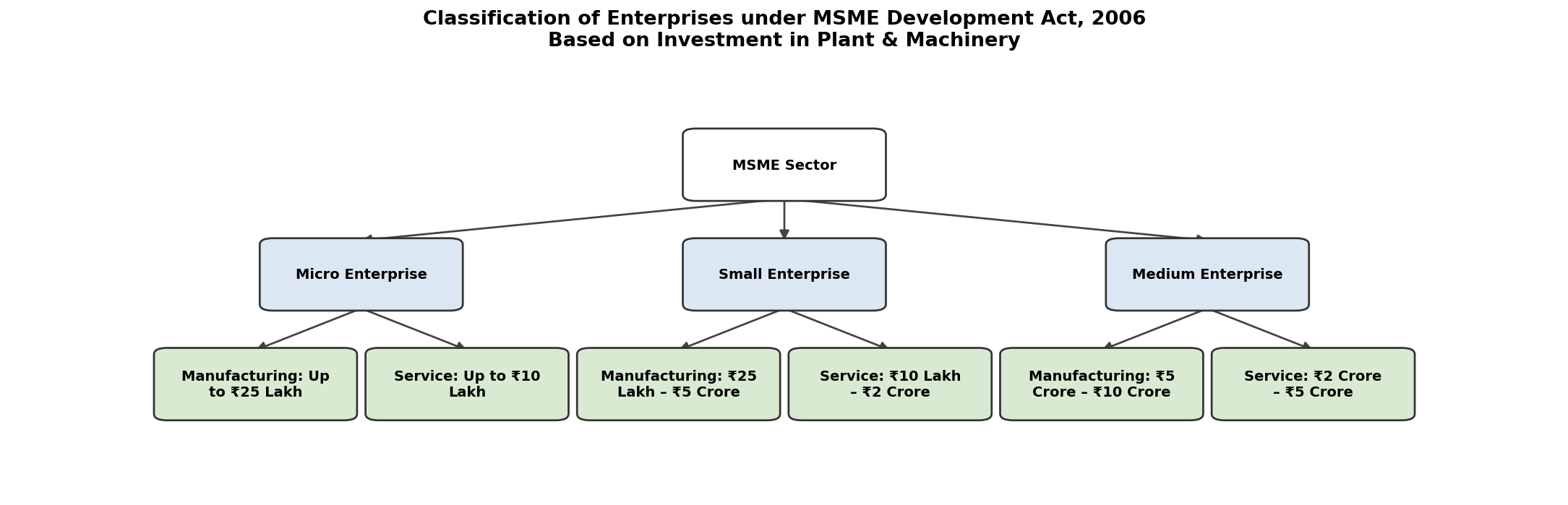
Based on the given diagram, answer the following:
-
According to the MSME Development Act, 2006, what is the investment limit in plant and machinery for a Micro Enterprise in the manufacturing sector?AUp to ₹10 LakhBUp to ₹25 LakhCUp to ₹5 CroreDUp to ₹2 Crore
-
Which category of enterprise in the service sector has an investment limit between ₹10 Lakh and ₹2 Crore?AMicro EnterpriseBMedium EnterpriseCSmall EnterpriseDLarge Enterprise
-
What is the full form of MSME and which Act governs its classification?
-
Why is it important to have a separate classification for Micro, Small, and Medium enterprises rather than treating them as a single category?
-
Which of the following is NOT a problem typically faced by small businesses in India?ALimited access to creditBExcess availability of skilled managersCIrregular supply of raw materialsDPoor brand recognition
-
The problem of 'Capacity Utilisation' in small businesses refers to which of the following?AOverproduction beyond market demandBUnderutilisation of installed plant and machineryCExcessive use of labour over machineryDInability to hire new workers
-
Explain why small businesses face difficulties in accessing finance from formal banking institutions.
-
How does the problem of marketing affect the growth and survival of small businesses? Suggest one solution.
-
DICs were established in India in which year?A1971B1978C1990D2006
-
Which of the following is a function of the District Industries Centre (DIC)?ASetting up large-scale industries in urban areasBGranting export licences to multinational companiesCSupply of machinery on hire-purchase basis to small businessesDRegulating stock markets at the district level
-
What is the primary objective behind establishing District Industries Centres across India?
-
How do Entrepreneurship Development Programmes (EDPs) conducted by DICs help in the growth of small businesses?
-
NSIC was established in India in which year?A1945B1955C1965D1975
-
Which of the following services is provided by NSIC under its Marketing Support programme?AProviding subsidised land to small industriesBSingle Point Registration for Government PurchasesCGranting import licences to small businessesDFixing minimum support prices for small business products
-
How does NSIC's 'Raw Material Assistance' scheme benefit small businesses? Explain briefly.
-
Distinguish between the roles of NSIC and DIC in supporting small businesses in India. Mention any two points of difference.
-
What is the investment limit for a Small Enterprise in the service sector under the MSME Development Act, 2006?AUp to ₹10 lakhB₹25 lakh – ₹5 croreC₹10 lakh – ₹2 croreD₹2 crore – ₹5 crore
-
Distinguish between a Micro Enterprise and a Small Enterprise in the manufacturing sector based on investment limits as per the MSME Development Act, 2006.
-
Why was the MSME Development Act, 2006 considered a landmark legislation for small businesses in India?
-
Explain why small businesses face problems related to marketing and how this affects their competitiveness.
-
Identify and explain any two financial problems faced by small businesses in India.
-
In which year were District Industries Centres (DICs) established in India?A1971B1978C1991D2006
-
What is the primary objective of District Industries Centres (DICs)?ATo provide large-scale industrial infrastructure to metro citiesBTo provide all services and support to small entrepreneurs under one roof at the district levelCTo regulate foreign direct investment in IndiaDTo manage public sector undertakings at the district level
-
How do District Industries Centres help in the identification and development of entrepreneurs?
-
State any two functions of District Industries Centres that directly help small businesses overcome their operational problems.
-
How does the presence of small businesses in rural areas help in achieving balanced regional development?ABy attracting foreign investment to rural areasBBy setting up industries in rural and backward areas, reducing concentration of industries in citiesCBy replacing large industries in metropolitan citiesDBy exporting goods directly from rural areas to foreign countries
-
Which of the following best describes how small businesses contribute to the mobilisation of local resources?AThey import machinery and technology from abroadBThey use locally available raw materials, labour, and capital that would otherwise remain idleCThey depend entirely on government grants for their operationsDThey transfer resources from rural to urban areas
-
Explain how small businesses in rural India help in the preservation of traditional skills and crafts.
-
Explain the relationship between small businesses in rural areas and equitable distribution of income in India.
-
A service enterprise has an investment of ₹3 crore. Under which category will it be classified as per the MSME Development Act, 2006?AMicro EnterpriseBSmall EnterpriseCMedium EnterpriseDLarge Enterprise
-
What is the significance of the MSME Development Act, 2006 for small businesses in India?
-
Which of the following correctly distinguishes between a Small and Medium Enterprise in the manufacturing sector?ASmall: up to ₹25 lakh; Medium: ₹25 lakh – ₹5 croreBSmall: ₹25 lakh – ₹5 crore; Medium: ₹5 crore – ₹10 croreCSmall: ₹10 lakh – ₹2 crore; Medium: ₹2 crore – ₹5 croreDSmall: up to ₹5 crore; Medium: ₹5 crore – ₹20 crore
-
Explain the problem of finance faced by small businesses in India.
-
The marketing problem of small businesses arises mainly because:AThey produce goods of inferior qualityBThey cannot compete with large firms in terms of price and promotionCThey do not have any products to sellDThey have too many employees
-
How does the use of outdated technology affect the productivity and competitiveness of small businesses?
-
District Industries Centres (DICs) were established in India in which year?A1956B1978C1991D2006
-
What is the primary objective of the National Small Industries Corporation (NSIC)?ATo provide large-scale loans to big industriesBTo promote, aid, and foster the growth of small industriesCTo regulate foreign trade in IndiaDTo control inflation in the economy
-
Explain the concept of 'single-window clearance' provided by District Industries Centres (DICs).
-
How do Entrepreneurship Development Programmes (EDPs) contribute to the growth of small businesses in India?
-
How do small businesses contribute to balanced regional development in India?
-
Which of the following is a direct benefit of small businesses providing livelihood in villages?AIncrease in rural-urban migrationBReduction in rural-urban migrationCDecrease in agricultural productivityDIncrease in urban unemployment
-
Preservation of traditional skills and handicrafts by small businesses is important because:AIt increases dependence on foreign technologyBIt helps in maintaining India's cultural heritage and provides export earningsCIt reduces employment in the rural sectorDIt leads to overproduction of industrial goods
-
Explain how small businesses help in the mobilisation of local resources in rural areas.
-
Which of the following is shown as a major problem faced by small businesses in the diagram?ASurplus of skilled labourBLimited access to creditCExcess production capacityDOverabundance of raw materials
-
Explain why small businesses face the problem of 'High Cost of Capital' as shown in the diagram.
-
Which government institution was set up specifically to address the marketing and technology problems of small businesses, as indicated in the diagram?AReserve Bank of India (RBI)BSecurities and Exchange Board of India (SEBI)CNational Small Industries Corporation (NSIC)DNational Stock Exchange (NSE)
-
How does the problem of 'Lack of Managerial Skills' (shown in the diagram) affect the overall performance of a small business? Explain with an example.
-
According to the diagram, which institution provides 'Single Window Clearance' to small businesses?ANational Small Industries Corporation (NSIC)BEntrepreneurship Development ProgrammesCDistrict Industries Centres (DICs)DMSME Development Act, 2006
-
What is the significance of the MSME Development Act, 2006 as shown in the diagram? Explain any two features.
-
Which of the following is a function of the National Small Industries Corporation (NSIC) as shown in the diagram?AProviding single window clearance for new businessesBOffering training and skill development programmesCAssisting with marketing and technology upgradationDClassifying enterprises under the MSME Act
-
Explain the role of Entrepreneurship Development Programmes (EDPs) in the growth of small businesses in India.
Show answersHide answers
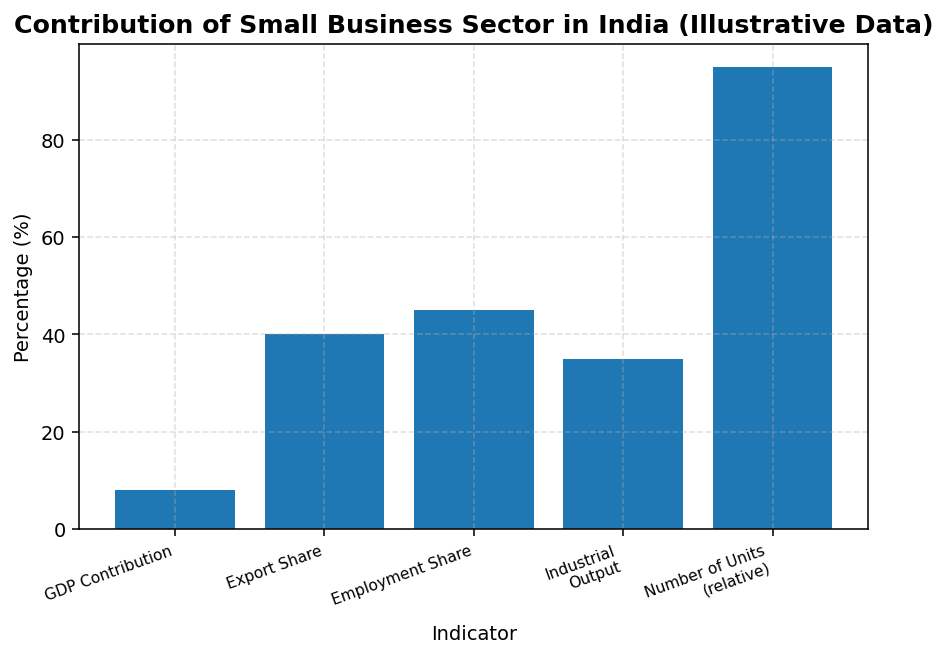
Based on the given chart, answer the following:
-
According to the chart, which indicator shows the highest contribution of the small business sector in India?AGDP ContributionBExport ShareCNumber of Units (relative)DIndustrial Output
-
The chart shows that small businesses contribute approximately 40% to India's exports. Which of the following best explains this?ASmall businesses produce only luxury goods for exportBSmall businesses produce a wide variety of labour-intensive goods that are competitive in global marketsCSmall businesses receive no government support for exportsDSmall businesses export only agricultural products
-
Based on the chart, explain the role of small businesses in generating employment in India.
-
Despite a large number of small business units, their GDP contribution is relatively low. Give two reasons for this disparity.
-
According to the bar chart, which indicator shows the highest contribution of small scale industries?AGDPBTotal Industrial OutputCTotal ExportsDEmployment (of industrial workforce)
-
What percentage of India's total industrial output is contributed by small scale industries as shown in the chart?A7%B35%C40%D45%
-
Based on the chart, explain why employment generation is considered one of the most significant roles of small businesses in India.
-
How does the contribution of small scale industries to exports benefit the Indian economy? Explain with reference to the chart.
-
According to the bar chart, which indicator shows the highest contribution of the small business sector in India?AGDPBExportsCManufacturing UnitsDIndustrial Output
-
The small business sector contributes approximately 40% to India's total exports. What does this indicate about the role of small businesses?
-
Which of the following best describes the role of small businesses in employment generation as shown in the chart?AThey contribute less than 10% to total employmentBThey contribute about 45% to total employment, making them the second largest employer after agricultureCThey contribute 100% to employment in the service sectorDThey have no significant role in employment generation
-
Why is the contribution of small businesses to industrial output (35%) considered significant despite being lower than their share in manufacturing units (95%)?
Show answersHide answers
Make a full Business Studies paper on Small Business.
Pick the question mix, set the marks, hit generate. You get a ready-to-print paper with an answer key.
Generate your paper — free