Skip to content
TestMacher
Chapter 3 · Class 11 Business Studies

Emerging Modes of Business — Important Questions

58 questions With answers CBSE format

SUMMARY: The chapter "Emerging Modes of Business" explores the new and evolving ways businesses operate in the digital and globalized world.
KEY TOPICS: e-business, e-commerce, online transactions, outsourcing, business process outsourcing (BPO), knowledge process outsourcing (KPO), e-tailing, payment mechanisms, security and safety of business transactions, benefits and limitations of e-business.

Q1 1 Mark

E-business is the conduct of business through:

ABricks and mortar
BElectronic networks (internet)
CPrint only
DMail only
Check answerHide answer
Correct answer: Option 2 — Electronic networks (internet)
Q2 1 Mark

B2C means:

ABusiness to Business
BBusiness to Customer
CCustomer to Business
DCustomer to Customer
Check answerHide answer
Correct answer: Option 2 — Business to Customer
Q3 1 Mark

Outsourcing means:

ADoing all work in-house
BContracting out specific tasks to external providers
CHiring full-time staff
DManufacturing only
Check answerHide answer
Correct answer: Option 2 — Contracting out specific tasks to external providers
Q4 1 Mark

BPO stands for:

ABusiness Process Outsourcing
BBusiness Plan Operation
CBusiness Pure Output
DBrand Promotion Office
Check answerHide answer
Correct answer: Option 1 — Business Process Outsourcing
Q5 1 Mark

The technology that enables IoT (Internet of Things) in business is:

AMainframe computers
BSmart sensors and connected devices
CPen and paper
DMobile phones only
Check answerHide answer
Correct answer: Option 2 — Smart sensors and connected devices
Q6 1 Mark

Which of the following statements best describes the relationship between e-business and e-commerce?

AE-commerce is a broader term that includes e-business.
BE-business is a broader term that includes e-commerce.
CBoth terms are synonymous and can be used interchangeably in all contexts.
DE-business only deals with external transactions, while e-commerce deals with internal transactions.
Check answerHide answer
Correct answer: Option 2 — E-business is a broader term that includes e-commerce.
Q7 1 Mark

Selling used books or household items through online portals like OLX or eBay is an example of which type of e-business transaction?

AB2C (Business-to-Consumer)
BB2B (Business-to-Business)
CC2C (Consumer-to-Consumer)
DIntra-B (Intra-Business)
Check answerHide answer
Correct answer: Option 3 — C2C (Consumer-to-Consumer)
Q8 1 Mark

Under which payment mechanism does the buyer make the payment in cash only when the physical delivery of goods is received?

ADigital Cash
BCredit Card
CCash on Delivery (COD)
DNet Banking Transfer
Check answerHide answer
Correct answer: Option 3 — Cash on Delivery (COD)
Q9 1 Mark

What is the practice of contracting out non-core business activities to external specialized agencies called?

AE-tailing
BOutsourcing
CInternalization
DFranchising
Check answerHide answer
Correct answer: Option 2 — Outsourcing
Q10 1 Mark

Which of the following is considered a major limitation of e-business compared to traditional business?

AHigh transaction costs
BLack of personal touch
CLimited geographical reach
DInability to operate 24/7
Check answerHide answer
Correct answer: Option 2 — Lack of personal touch
Q11 1 Mark

When a firm uses an internal computer network (Intranet) to interact, share information, and manage inventory among its various departments, it is engaging in:

AB2B Commerce
BB2C Commerce
CIntra-B Commerce
DC2B Commerce
Check answerHide answer
Correct answer: Option 3 — Intra-B Commerce
Q12 1 Mark

An unauthorized attempt to gain access to a computer system or network to steal, alter, or destroy data is known as:

AData Encryption
BHacking
CBrand Spoofing
DDigital Signature
Check answerHide answer
Correct answer: Option 2 — Hacking
Q13 1 Mark

Which of the following is a key distinguishing feature of Knowledge Process Outsourcing (KPO) compared to Business Process Outsourcing (BPO)?

AKPO involves low-end, routine data entry tasks.
BKPO requires highly advanced technical, analytical, and decision-making skills.
CKPO is strictly limited to domestic operations.
DKPO does not involve any intellectual or cognitive processes.
Check answerHide answer
Correct answer: Option 2 — KPO requires highly advanced technical, analytical, and decision-making skills.
Q14 1 Mark

What is the correct chronological sequence of stages involved in a typical online transaction?

APlacing an order, Registration, Payment mechanism
BRegistration, Placing an order, Payment mechanism
CPayment mechanism, Registration, Placing an order
DRegistration, Payment mechanism, Placing an order
Check answerHide answer
Correct answer: Option 2 — Registration, Placing an order, Payment mechanism
Q15 1 Mark

How does e-business contribute to environmental sustainability and a 'paperless society'?

ABy eliminating the need for any physical logistics or delivery vehicles.
BBy conducting transactions electronically, reducing the reliance on paper-based documentation.
CBy shifting all manufacturing processes to virtual simulation models.
DBy restricting the consumption of electricity during business hours.
Check answerHide answer
Correct answer: Option 2 — By conducting transactions electronically, reducing the reliance on paper-based documentation.
Q16 3 Marks

Define e-business and state any three of its forms.

View sample solutionHide solution
E-business is the conduct of business activities through electronic networks particularly the internet. It includes buying selling marketing customer service and intra-organizational processes done electronically. Forms: (1) B2B (Business-to-Business) — businesses transacting with other businesses (e.g., a manufacturer ordering raw materials online). (2) B2C (Business-to-Consumer) — businesses selling directly to consumers (Amazon, Flipkart). (3) C2C (Consumer-to-Consumer) — consumers selling to other consumers (OLX, eBay). (4) C2B (Consumer-to-Business) — consumers offering products/services to businesses (freelance platforms).
Q17 3 Marks

Distinguish between e-business and traditional business.

View sample solutionHide solution
E-business — conducted through electronic networks; 24x7 availability; global reach; lower setup cost; uses digital marketing; payments via online methods. Customers can compare prices easily; reviews and ratings influence decisions. Traditional business — physical location; limited operating hours; local/regional reach; higher fixed costs (rent, staff); face-to-face interaction; cash and card payments. Customers see physical product. E-business has lower entry barriers but faces challenges of trust, returns, and last-mile delivery. Traditional business builds personal relationships and tangible product experience but has limited scalability.
Q18 3 Marks

Explain the term outsourcing and its benefits.

View sample solutionHide solution
Outsourcing means hiring an external party to perform specific business activities that were previously done in-house. Benefits: (1) Focus on core competencies — company concentrates on what it does best. (2) Cost reduction — external providers may have economies of scale. (3) Access to specialised expertise. (4) Flexibility — scale up/down without hiring. (5) Risk sharing — vendor takes on operational risk. (6) Geographic flexibility — can be done from low-cost locations (India for IT/BPO). Common areas: IT, customer support, payroll, accounting, manufacturing. India has been a global outsourcing hub since the 1990s.
Q19 3 Marks

What are the various types of e-payment systems?

View sample solutionHide solution
E-payment systems include: (1) Credit/Debit cards — Visa MasterCard RuPay; for online and POS payments. (2) Net banking — direct bank-to-bank transfer through bank's web portal. (3) Mobile banking apps — UPI-based instant transfers (Paytm, PhonePe, Google Pay). (4) Mobile wallets — pre-loaded balance for payments (Paytm, Amazon Pay). (5) IMPS/NEFT/RTGS — interbank transfer systems (RBI). (6) UPI — Unified Payments Interface for instant inter-bank transfers using virtual ID. (7) BHIM — government-backed UPI app. (8) International — PayPal Stripe for cross-border. (9) Cryptocurrency — emerging form. (10) Buy Now Pay Later (BNPL) — short-term credit at point of purchase. India leads in UPI adoption with billions of monthly transactions.
Q20 3 Marks

List any three benefits of e-business for consumers.

View sample solutionHide solution
(1) 24x7 access — shop anytime; (2) Wider choice — access to global products and many sellers; (3) Easy price comparison — across multiple platforms; (4) Convenience — home delivery; (5) Discounts and offers — frequent promotions and lower prices; (6) Reviews and ratings — informed decisions based on others' experience; (7) Easy return policies — 7-30 day returns standard; (8) Cashless payment — secure transactions; (9) Tracking — real-time order status; (10) Customisation — products tailored to individual taste. E-commerce has democratised access to products and information for consumers worldwide.
Q21 3 Marks

State the basic difference between the terms 'e-business' and 'e-commerce'.

View sample solutionHide solution
E-business is a broader term that includes not only buying and selling of goods and services (e-commerce) but also other electronically conducted business activities such as production, inventory management, and customer support. E-commerce is a subset of e-business that focuses solely on commercial transactions over the internet.
Q22 3 Marks

What is meant by B2B commerce? Give one example.

View sample solutionHide solution
B2B (Business-to-Business) commerce refers to electronic transactions taking place between two or more business firms. An example is a car manufacturer purchasing components like tyres or glass from another manufacturing company online.
Q23 3 Marks

Explain 'Cash on Delivery' (COD) as a payment mechanism in online transactions.

View sample solutionHide solution
Cash on Delivery (COD) is a payment method where the buyer makes physical payment in cash at the time of actual delivery of the goods. It is highly popular in online shopping as it reduces the transaction risk for the buyer.
Q24 3 Marks

Define the term 'e-tailing' in the context of emerging modes of business.

View sample solutionHide solution
E-tailing, or electronic retailing, refers to the activity of selling retail goods and services directly to the ultimate consumers through the internet. It allows consumers to browse virtual storefronts and place orders from the comfort of their homes.
Q25 3 Marks

What is the role of a digital signature in securing online transactions?

View sample solutionHide solution
A digital signature is an electronic security mechanism used to verify the authenticity and integrity of a digital document or transaction. It ensures that the sender's identity is verified and that the data has not been altered during transmission.
Q26 6 Marks

Discuss the various scope of e-business activities.

View sample solutionHide solution
E-business covers a wide range of activities: (1) MARKETING — digital advertising, search engine marketing, social media campaigns, email marketing, content marketing, influencer marketing. (2) SELLING — online catalogues, e-commerce platforms (Amazon, Flipkart), marketplaces, mobile commerce, social commerce. (3) BUYING — B2B procurement portals, supplier management systems, online auctions. (4) BANKING — internet banking, mobile banking, UPI, RTGS, NEFT. (5) PAYMENT — credit/debit cards, e-wallets, UPI, BNPL, cryptocurrency. (6) CUSTOMER SERVICE — chatbots, live chat, video support, knowledge bases, AI-powered support. (7) LOGISTICS — order tracking, real-time delivery, last-mile optimisation. (8) HUMAN RESOURCES — online recruitment portals, video interviews, e-learning, performance management software. (9) MANUFACTURING — IoT-enabled factories, predictive maintenance, supply chain visibility. (10) FINANCIAL SERVICES — robo-advisors, online stock trading, peer-to-peer lending. (11) HEALTHCARE — telemedicine, e-prescriptions, electronic health records. E-business has transformed nearly every aspect of commercial life.
Q27 6 Marks

Discuss the limitations of e-business in India.

View sample solutionHide solution
LIMITATIONS: (1) DIGITAL DIVIDE — many rural areas have poor or no internet connectivity; significant population offline. (2) LACK OF DIGITAL LITERACY — older generation and uneducated population struggle. (3) PAYMENT SECURITY CONCERNS — fear of fraud and data theft; though improving with safer protocols. (4) TRUST DEFICIT — buyers can't physically see/touch product; quality may not match images; counterfeit products. (5) RETURN/REFUND HASSLE — though policies exist, the process can be cumbersome. (6) LANGUAGE BARRIERS — most platforms are English-first; non-English speakers struggle. (7) LAST-MILE DELIVERY — challenges in rural and remote areas. (8) CYBER CRIMES — phishing, identity theft, hacking. (9) LEGAL ISSUES — jurisdiction, consumer protection across e-commerce. (10) COMPETITION — small local sellers face stiff competition from large platforms. (11) NETWORK CONNECTIVITY — patchy 4G/5G in many areas. (12) HIGH COST OF SETUP for full-fledged e-commerce. The government's Digital India initiative aims to address many of these issues.
Q28 6 Marks

Explain the concept and types of outsourcing.

View sample solutionHide solution
Outsourcing is the practice of contracting out specific business processes or services to external providers (often in another country). TYPES: (1) BUSINESS PROCESS OUTSOURCING (BPO) — back-office processes like payroll, accounting, HR, customer support outsourced. (2) KNOWLEDGE PROCESS OUTSOURCING (KPO) — high-level analytical work like financial research, market research, legal services, R&D. KPO is more skilled and higher-value than BPO. (3) IT OUTSOURCING — software development, app development, infrastructure management. (4) MANUFACTURING OUTSOURCING — contract manufacturing where companies outsource production to specialised manufacturers (e.g., Apple to Foxconn). (5) LEGAL PROCESS OUTSOURCING (LPO) — legal research and document preparation. (6) ENGINEERING SERVICES OUTSOURCING — design, CAD, engineering analysis. India has been a global leader in BPO/KPO with companies like TCS, Infosys, Wipro, Accenture earning billions in foreign exchange. Outsourcing benefits both the contracting company (cost savings, focus on core) and the host country (employment, foreign exchange, tech transfer).
Q29 6 Marks

Discuss the impact of e-commerce on Indian retail trade.

View sample solutionHide solution
E-commerce has profoundly transformed Indian retail: (1) MARKET SIZE — Indian e-commerce grew from a small base to over $80 billion by 2024; expected to reach $300+ billion by 2030. (2) RURAL PENETRATION — Tier-2 and Tier-3 cities now lead growth; rural India is the next big market. (3) CONSUMER BEHAVIOUR — Indians increasingly comfortable with online shopping; fashion, electronics, groceries, fresh food. (4) IMPACT ON KIRANA STORES — initial concern of decimation; now hybrid models emerging where kirana stores partner with online platforms. (5) NEW JOB CATEGORIES — delivery, warehousing, customer support, digital marketing. (6) GIG ECONOMY — Swiggy, Zomato, Uber, Ola, Dunzo created millions of flexible jobs. (7) D2C BRANDS — direct-to-consumer brands reaching customers without retailer intermediaries (Mamaearth, Boat). (8) CONSOLIDATION — Walmart-Flipkart, Amazon dominant; Reliance entering aggressively. (9) GOVERNMENT INITIATIVES — Open Network for Digital Commerce (ONDC) to democratise e-commerce. (10) CHALLENGES — predatory pricing concerns, FDI restrictions, GST compliance for sellers. E-commerce continues to reshape Indian retail but coexists with traditional retail rather than replacing it entirely.
Q30 6 Marks

Explain the role of social media, mobile commerce, and internet of things (IoT) in modern business.

View sample solutionHide solution
SOCIAL MEDIA — platforms like Facebook, Instagram, Twitter, LinkedIn, YouTube enable: (1) Brand building and marketing — direct customer engagement; (2) Real-time customer service; (3) Influencer marketing — paid posts by influencers reach engaged audiences; (4) Social commerce — selling directly through Instagram/Facebook shops; (5) User-generated content for marketing; (6) Customer feedback and sentiment analysis. MOBILE COMMERCE (M-COMMERCE) — buying and selling via mobile devices: (1) Mobile apps for major retailers; (2) Mobile-friendly websites; (3) UPI and mobile wallet payments; (4) Push notifications for promotions; (5) Location-based services; (6) AR/VR product trials. M-commerce now exceeds e-commerce in many countries. INTERNET OF THINGS (IoT) — connected devices that collect and exchange data: (1) Smart factories with predictive maintenance; (2) Inventory tracking via RFID; (3) Smart logistics with GPS and sensors; (4) Connected vehicles and fleet management; (5) Wearables for health and fitness; (6) Smart retail (Amazon Go cashier-less stores); (7) Energy management. IoT generates massive data that feeds AI/ML for further optimisation. Together these technologies define the digital age of business.
Q31 6 Marks

Compare e-commerce and traditional commerce with the help of a table.

Q32 1 Mark

Assertion (A): E-business has 24x7 availability.

Reason (R): The internet does not have business hours so customers can transact anytime.

Show explanationHide explanation
Correct answer: Option 1 — Both A and R are true, and R is the correct explanation of A.
Q33 1 Mark

Assertion (A): Outsourcing helps companies focus on core competencies.

Reason (R): Non-core activities are handed to specialised external providers freeing up internal resources.

Show explanationHide explanation
Correct answer: Option 1 — Both A and R are true, and R is the correct explanation of A.
Q34 1 Mark

Assertion (A): India is a global hub for BPO.

Reason (R): India offers a large English-speaking skilled workforce at competitive wages.

Show explanationHide explanation
Correct answer: Option 1 — Both A and R are true, and R is the correct explanation of A.
Q35 1 Mark

Assertion (A): UPI has revolutionised digital payments in India.

Reason (R): UPI enables instant inter-bank transfers using virtual IDs and is interoperable across apps.

Show explanationHide explanation
Correct answer: Option 1 — Both A and R are true, and R is the correct explanation of A.
Q36 1 Mark

Assertion (A): Social commerce is growing rapidly in India.

Reason (R): Indians spend significant time on social media which makes it a prime channel for selling.

Show explanationHide explanation
Correct answer: Option 1 — Both A and R are true, and R is the correct explanation of A.
Q37 1 Mark

Assertion (A): E-business is a broader term than e-commerce.

Reason (R): E-commerce is just one branch of e-business that deals with buying and selling of goods and services over the internet.

Show explanationHide explanation
Correct answer: Option 1 — Both A and R are true, and R is the correct explanation of A.
Q38 1 Mark

Assertion (A): E-business permits 24x7x365 availability of business services.

Reason (R): The internet is accessible at all times, allowing customers to visit websites and place orders whenever they want.

Show explanationHide explanation
Correct answer: Option 1 — Both A and R are true, and R is the correct explanation of A.
Q39 1 Mark

Assertion (A): Online transactions are completely free from any security risks.

Reason (R): Encryption and digital signatures are used to secure data transmission over the internet.

Show explanationHide explanation
Correct answer: Option 4 — A is false, but R is true.
Q40 1 Mark

Statement 1: E-business is conducted through electronic networks.

Statement 2: B2C and C2C are common forms of e-business.

Show answerHide answer
Correct answer: Option 1 — Both statements are true.
Q41 1 Mark

Statement 1: BPO and KPO are forms of outsourcing.

Statement 2: BPO involves routine processes; KPO involves analytical and high-skilled work.

Show answerHide answer
Correct answer: Option 1 — Both statements are true.
Q42 1 Mark

Statement 1: E-payment systems use encryption for security.

Statement 2: Two-factor authentication and OTP add additional layers of security.

Show answerHide answer
Correct answer: Option 1 — Both statements are true.
Q43 1 Mark

Statement 1: Mobile commerce is growing faster than desktop e-commerce.

Statement 2: Smartphones are widely available and convenient for shopping.

Show answerHide answer
Correct answer: Option 1 — Both statements are true.
Q44 1 Mark

Statement 1: Tier-2 and Tier-3 cities are driving e-commerce growth in India.

Statement 2: Smartphone penetration and improved logistics have brought online shopping to smaller towns.

Show answerHide answer
Correct answer: Option 1 — Both statements are true.
Q45 1 Mark

Statement 1: E-business is a broader term than e-commerce as it includes not only buying and selling but also other electronically conducted business functions like production, inventory management, and human resource management.

Statement 2: E-commerce comprises commercial transactions and information exchange over electronic networks but is a subset of e-business.

Show answerHide answer
Correct answer: Option 1 — Both statements are true.
Q46 1 Mark

Statement 1: Business Process Outsourcing (BPO) involves contracting out non-core business activities to third-party service providers to benefit from their specialization.

Statement 2: BPO can only be done with service providers located within the same country as the contracting business.

Show answerHide answer
Correct answer: Option 2 — Only Statement 1 is true.
Q47 1 Mark

Statement 1: Registration is the first step in online transactions where the consumer creates an account with the online vendor by filling an online form.

Statement 2: Payment is always done before placing an order in all types of online transactions.

Show answerHide answer
Correct answer: Option 2 — Only Statement 1 is true.
Q48 3 Marks
Priya runs a boutique selling sarees in her local town. After a friend's suggestion she decides to go online. She creates a website, lists products on Amazon and Myntra, accepts UPI payments, uses WhatsApp for customer service, and ships through courier companies.
  1. Priya's online sales to consumers are an example of:
    AB2B
    BB2C
    CC2C
    DAll
  2. The fastest digital payment method she uses is:
    AUPI
    BCash
    CCheque
    DDebit card
  3. Explain Priya's e-business transformation and the trade-offs of each channel.
Show answersHide answers
1. Option 2 — B2C
2. Option 1 — UPI
3. Priya's transformation from physical to online business demonstrates e-business adoption. CHANNELS: (1) HER WEBSITE — D2C (Direct-to-Consumer) — full control, all profit, but customer acquisition is harder. (2) MARKETPLACES (Amazon, Myntra) — easier customer reach, but commission (10-25%), less control over branding, return responsibility. (3) WHATSAPP — instant customer service, repeat orders, voice/video calls. PAYMENT: UPI is the fastest digital payment in India — instant inter-bank transfer using a virtual ID; minimal fees; popular with all age groups. SHIPPING: courier companies (BlueDart, Delhivery, India Post) handle last-mile; tracking provided to customers. BENEFITS for Priya: (1) WIDER REACH — customers from any city; (2) 24x7 availability; (3) DATA on customer preferences from analytics; (4) LOWER OVERHEAD than physical store; (5) FLEXIBILITY of working from home. CHALLENGES: (1) RETURNS — many e-commerce returns due to size/colour mismatch; eats into margins; (2) COMPETITION — many online sellers; need good photos, descriptions, reviews; (3) DIGITAL MARKETING — needs SEO, ads, social media; learning curve; (4) PAYMENT SECURITY — fraud concerns; need PCI-compliant payment gateways. Priya's hybrid model (physical store + online) gives her both stable local revenue and online growth.
Q49 3 Marks
Indian Tech Ltd is considering outsourcing its customer service operations. The company has 200 internal customer support staff. Outsourcing would involve a contract with a BPO firm in Bengaluru that would handle calls for ₹500/seat/day. The CFO suggests this could save 30% costs.
  1. Customer service outsourcing is an example of:
    AIT outsourcing
    BBPO
    CKPO
    DManufacturing outsourcing
  2. Benefits of outsourcing include:
    ACost reduction only
    BFocus on core business
    CAccess to specialised expertise
    DAll of these
  3. Should Indian Tech outsource? Explain benefits and risks.
Show answersHide answers
1. Option 2 — BPO
2. Option 4 — All of these
3. Outsourcing customer service is a typical Business Process Outsourcing (BPO) decision. BENEFITS for Indian Tech Ltd: (1) COST REDUCTION — 30% saved through specialist's economies of scale and lower labour costs in Bengaluru. (2) FOCUS ON CORE — management can concentrate on technology and product instead of customer support operations. (3) SPECIALISED EXPERTISE — BPO firms train for specific scripts, languages, technical knowledge. (4) FLEXIBILITY — scale up/down without hiring/firing. (5) 24x7 SUPPORT possible if BPO has multiple shifts. (6) REDUCED HR BURDEN — no recruitment, training, payroll for support staff. (7) INFRASTRUCTURE PROVIDED by BPO — no need for in-house call centres. CHALLENGES: (1) LOSS OF CONTROL — quality may not match in-house standards; (2) DATA SECURITY — sensitive customer data with third party; (3) CULTURAL FIT — outsourcer's approach may differ; (4) DEPENDENCY — relying on third party for critical function; (5) EMPLOYEE LAYOFFS — internal staff may lose jobs (or be reassigned). RECOMMENDATION: outsource gradually with strict SLAs (Service Level Agreements) on quality, response time, language proficiency. Keep critical/complex queries in-house. India is the global BPO hub — TCS, Wipro, Infosys, Genpact are world-class providers.
Q50 3 Marks
Mr Mishra runs a kirana store. After Demonetisation 2016 cash became less convenient. He installs a UPI QR code (Bharat QR/PhonePe) at his counter. Now 60% of his daily collections come through digital payments.
  1. UPI has revolutionised digital payments in India.
    AYes
    BNo
    CSometimes
    DRandom
  2. QR code payment is suitable for small kirana stores.
    AYes
    BNo
    COptional
    DOnly for big transactions
  3. Discuss the impact of UPI on small retail businesses.
Show answersHide answers
1. Option 1 — Yes
2. Option 1 — Yes
3. UPI has been a transformative innovation for Indian retail. BENEFITS for Mr Mishra: (1) INSTANT — payment in seconds; no change required. (2) RECORD-KEEPING — automatic transaction record on his bank app; helps tax compliance. (3) HYGIENE — touch-free; especially valued post-COVID. (4) SECURITY — no cash to be stolen or robbed; reduced risk. (5) CUSTOMER CONVENIENCE — customers don't need exact change; happy to pay anywhere. (6) LARGER TICKET SIZES possible — customers without cash on hand still buy. (7) FREE for merchants — no swipe fees like cards (so far). (8) SMOOTH FOR REGULATORS — encourages formal economy. EXPECTED FUTURE EVOLUTION: (a) ONDC integration (Open Network for Digital Commerce) for online sale ability; (b) credit-line on UPI for instant credit; (c) cross-border UPI for diaspora and NRI customers; (d) AI-based personalisation. CHALLENGES: (1) CONNECTIVITY — rural areas may have weak signal; (2) DIGITAL LITERACY — older customers may struggle; (3) FRAUD — phishing scams; need vigilance. UPI handled over 10 BILLION transactions per month in 2024 — Indian retail has been digitised at unprecedented speed. Even street vendors use QR codes today.
Q51 4 Marks
Ramesh recently started an online store selling handmade crafts. He uses a website where customers can browse products, add them to a cart, and pay using net banking, credit cards, or digital wallets. Orders are confirmed via email and products are delivered to customers' doorsteps. Ramesh never meets his customers physically, yet he manages to run a profitable business. His platform also allows customers to leave reviews and track their orders in real time. This model of conducting business over the internet is transforming the way trade and commerce work in India and across the world, making it easier for small entrepreneurs to reach a global audience without heavy investment in physical infrastructure.
  1. The type of business Ramesh is conducting through his website is best described as:
    ATraditional retail business
    BE-commerce or e-business
    CFranchise business
    DPublic sector enterprise
  2. Which of the following is NOT a payment mechanism mentioned in the passage?
    ANet banking
    BCredit cards
    CCash on delivery
    DDigital wallets
  3. State any two benefits of e-business that Ramesh's online store demonstrates.
  4. The facility that allows customers to monitor the status of their orders in real time is known as:
    AE-tailing
    BOrder tracking
    CBusiness Process Outsourcing
    DKnowledge Process Outsourcing
Show answersHide answers
1. Option 2 — E-commerce or e-business
2. Option 3 — Cash on delivery
3. Two benefits demonstrated are: (1) Global reach — Ramesh can reach customers worldwide without a physical store. (2) Lower investment in infrastructure — he does not need to invest heavily in physical premises, reducing costs.
4. Option 2 — Order tracking
Q52 3 Marks

Comparison of B2B B2C and C2C e-business:

TypeBuyerSellerExamplesVolume per transaction
B2BBusinessBusinessIndustry portals, TradekeyperLarge
B2CConsumerBusinessAmazon, Flipkart, MyntraMedium
C2CConsumerConsumerOLX, eBay, QuikrVariable
C2BBusinessConsumerFreelance, influencer marketingVariable
B2G/G2BGovernmentBusinessGovernment tenders, GeM portalLarge
  1. Amazon and Flipkart are examples of:
    AB2B
    BB2C
    CC2C
    DB2G
  2. OLX where consumers sell to other consumers is:
    AB2B
    BB2C
    CC2C
    DRandom
  3. Why has B2C grown faster than B2B in India's e-commerce?
Show answersHide answers
1. Option 2 — B2C
2. Option 3 — C2C
3. E-business types differ by who is buying and who is selling. B2B (Business-to-Business) — businesses transacting with other businesses; volume is usually large; relationship-driven; longer sales cycle; portal examples like IndiaMART connect manufacturers with distributors. B2C (Business-to-Consumer) — businesses selling directly to consumers; the most visible form of e-commerce. Major platforms: Amazon, Flipkart, Myntra, Nykaa. Lower transaction values but very high volume. C2C (Consumer-to-Consumer) — consumers selling to other consumers via platforms like OLX (used goods), eBay (auctions), Etsy (handcrafted). Platform takes a fee. C2B — consumers offering products/services to businesses (freelance platforms like Upwork, influencer marketing). B2G — government tenders and procurement (GeM — Government e-Marketplace). Each type has different dynamics: B2B emphasises relationships and bulk; B2C emphasises brand and customer experience; C2C emphasises trust and platform reputation. India has seen explosive growth across all types post-2010.
Q53 3 Marks

Types of outsourcing and examples:

TypeDescriptionIndian examples
BPORoutine business processesTCS BPO, Wipro BPO, Genpact
KPOHigh-skill analytical workEvalueserve, WNS, EXL
IT outsourcingSoftware developmentTCS, Infosys, Wipro
LPOLegal process outsourcingPangea3, Mindcrest
Manufacturing outsourcingContract manufacturingFoxconn, Tata Electronics
Engineering servicesDesign and CADHCL Tech, Tata Consulting
  1. Financial research and market analysis is typically:
    ABPO
    BKPO
    CLPO
    DManufacturing
  2. India is the world leader in BPO and IT outsourcing.
    AYes
    BNo
    CSometimes
    DOptional
  3. Why has India become the world's outsourcing hub?
Show answersHide answers
1. Option 2 — KPO
2. Option 1 — Yes
3. India dominates global outsourcing thanks to large English-speaking skilled workforce, lower wages, time-zone advantage (24/7 service), and favourable government policy. BPO (Business Process Outsourcing) — routine processes like customer support, data entry, payroll, accounting; ₹2-3 lakh/year jobs typical; 80% of clients are from US/UK. KPO (Knowledge Process Outsourcing) — higher-skill analytical work like financial research, market research, legal services; ₹5-15 lakh/year jobs; firms compete on knowledge and expertise. IT OUTSOURCING — software development, app development, infrastructure management. Indian IT services industry generates ~$200 billion annually; TCS Infosys Wipro HCL Tech are world-class. LPO (Legal Process Outsourcing) — legal research, document preparation, e-discovery. MANUFACTURING outsourcing — Apple's iPhones made by Foxconn in China and now in India through Tata Electronics. ENGINEERING SERVICES — design, CAD, simulation. India's outsourcing has earned billions of dollars in foreign exchange and lifted millions of professionals into the middle class.
Q54 6 Marks

Match each e-business model with its description and provide an example.

ModelBuyer-SellerIndian Example
B2BBusiness → Business? IndiaMART
B2CBusiness → Consumer? Amazon, Flipkart
C2CConsumer → Consumer? OLX, eBay
C2BConsumer → Business? Freelance platforms
B2GBusiness → Government? GeM portal
Q55 6 Marks

Distinguish between BPO and KPO with examples and skill requirements.

AspectBPOKPO
Type of workRoutineAnalytical
Skill level? Lower? Higher
Indian examples? TCS BPO, Genpact? Evalueserve, WNS
Typical wages₹2-3 lakh₹5-15 lakh
Q56 3 Marks

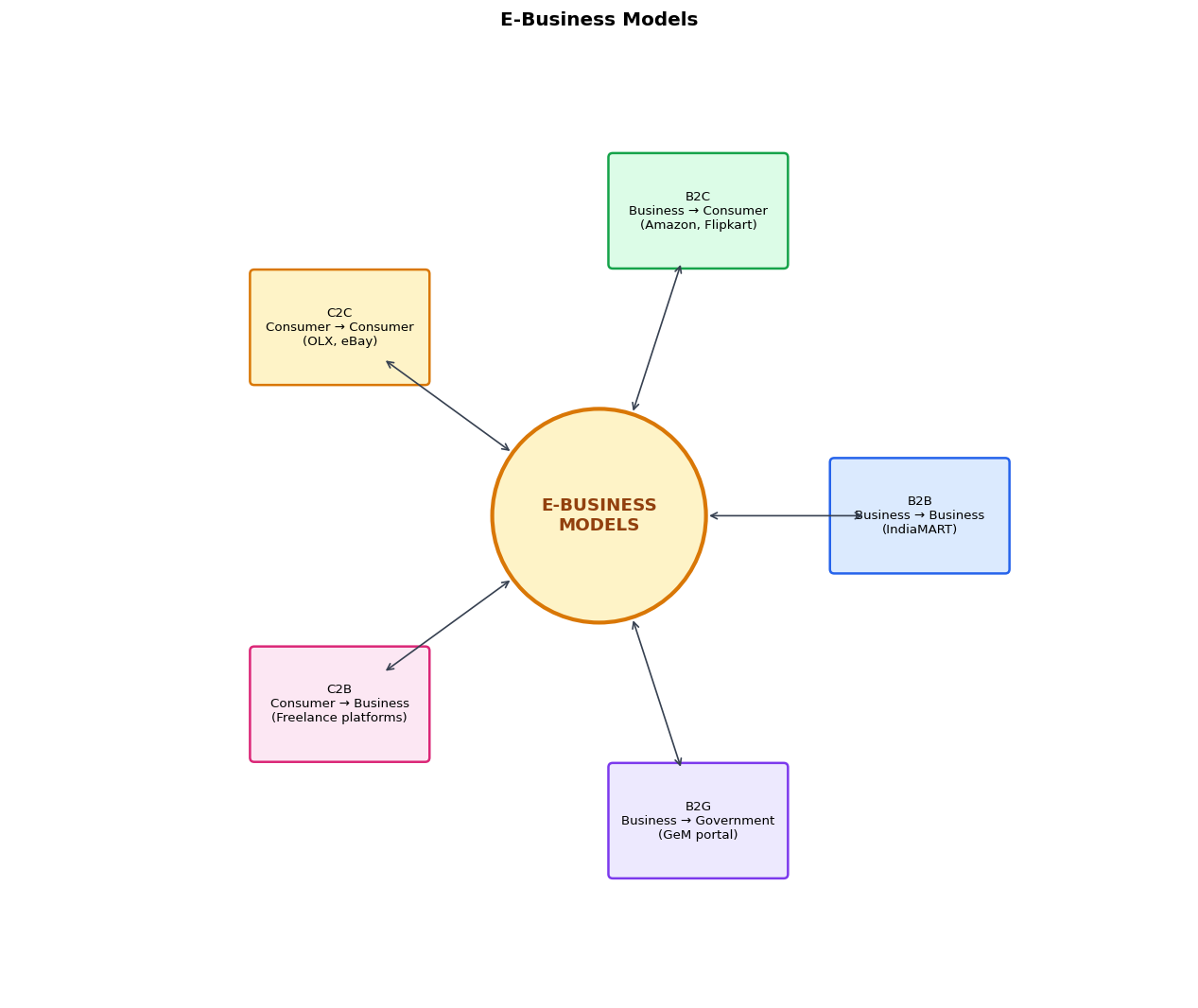
Study the e-business models diagram and answer:

Emerging Modes of Business figure
  1. Amazon and Flipkart are examples of which e-business model?
    AB2B
    BB2C
    CC2C
    DC2B
  2. Which is a famous example of C2C in India?
    AOLX
    BAmazon
    CGeM portal
    DIndiaMART
  3. Explain the various e-business models and provide an Indian example for each.
Show answersHide answers
1. Option 2 — B2C
2. Option 1 — OLX
3. E-business models differ by who is buying and who is selling. B2B (Business-to-Business) — businesses transacting with other businesses; volume usually large; relationship-driven; example: IndiaMART connects manufacturers with distributors. B2C (Business-to-Consumer) — businesses selling directly to consumers; the most visible form of e-commerce; major platforms: Amazon, Flipkart, Myntra, Nykaa. Lower transaction values but very high volume. C2C (Consumer-to-Consumer) — consumers selling to other consumers via platforms like OLX (used goods), eBay (auctions), Etsy (handcrafted). Platform takes a fee. C2B — consumers offering products/services to businesses (freelance platforms, influencer marketing). B2G — government tenders and procurement (GeM — Government e-Marketplace). Each type has different dynamics: B2B emphasises relationships and bulk; B2C emphasises brand and customer experience; C2C emphasises trust and platform reputation. India has seen explosive growth across all types post-2010.
Q57 51 Marks

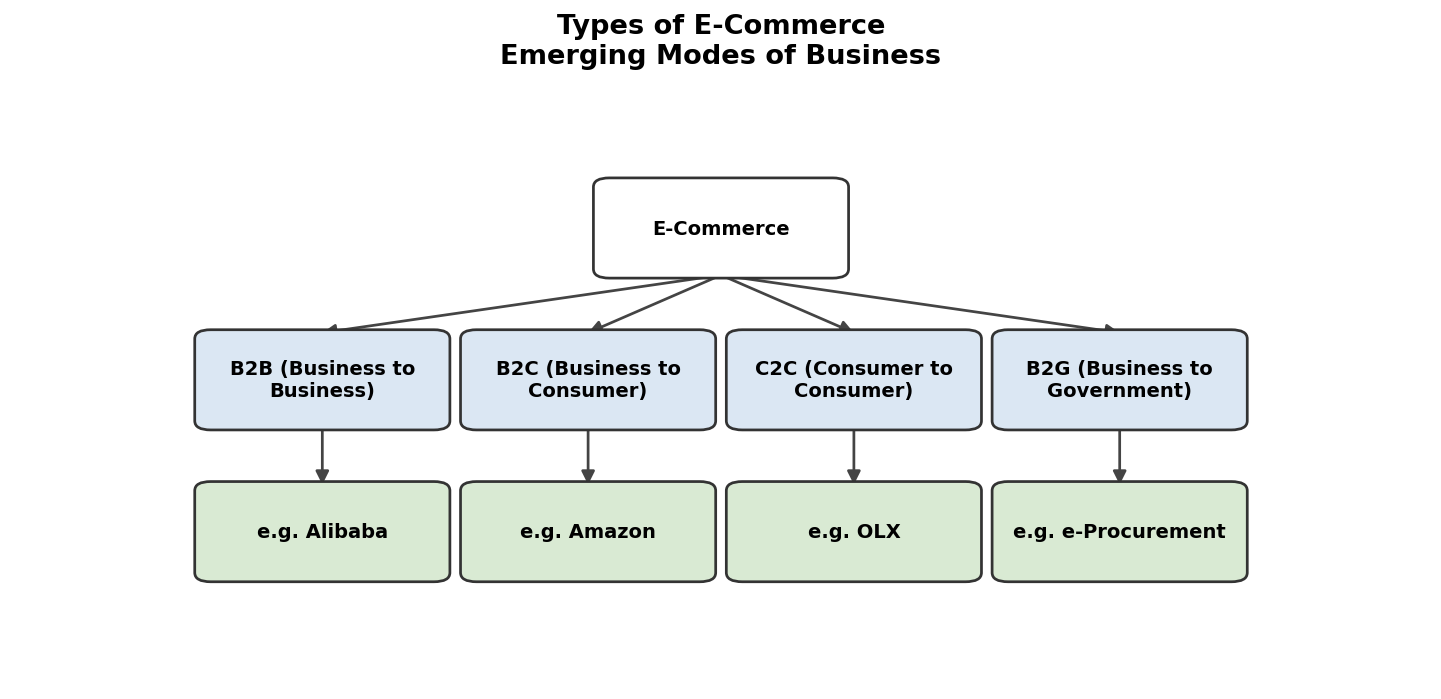
Based on the given diagram, answer the following:

Emerging Modes of Business figure
  1. Which type of e-commerce involves transactions between two businesses?
    AB2C
    BC2C
    CB2B
    DB2G
  2. OLX is an example of which type of e-commerce shown in the diagram?
    AB2B
    BB2C
    CB2G
    DC2C
  3. Explain the meaning of B2G e-commerce with the help of an example.
  4. How does B2C e-commerce benefit consumers compared to traditional shopping?
  5. Which of the following is NOT an online payment mechanism?
    ANet Banking
    Be-Wallet
    CCheque Payment at Store
    DUPI
  6. What is the key difference between a credit card and a debit card as a payment mechanism in e-commerce?
  7. Paytm and Google Pay are examples of which payment mechanism shown in the diagram?
    ANet Banking
    BUPI
    Ce-Wallets
    DCredit Card
  8. Why is 'Cash on Delivery' considered a popular payment option in India despite being an offline method?
  9. Which of the following best describes the relationship between e-business and e-commerce?
    AE-commerce is broader than e-business
    BE-business and e-commerce are the same
    CE-business is broader and includes e-commerce
    DE-commerce includes e-procurement and e-learning
  10. Name any two activities that are part of e-business but NOT part of e-commerce.
  11. E-Collaboration in e-business refers to:
    ASelling products online to consumers
    BConducting joint projects and sharing information with partners online
    CPurchasing goods from online suppliers
    DTraining employees through internet-based programs
  12. Distinguish between e-business and traditional business on the basis of 'formation' and 'physical presence'.
  13. Which type of outsourcing involves high-end knowledge-based work such as research and analysis?
    ABPO
    BLPO
    CKPO
    DIT Outsourcing
  14. Explain the concept of Business Process Outsourcing (BPO) and state any two advantages it offers to a business.
  15. Call centres and data entry services are examples of which type of outsourcing?
    AKPO
    BLPO
    CBPO
    DNone of the above
  16. Differentiate between BPO and KPO on the basis of nature of work and skill requirement.
  17. Distinguish between B2C and B2G e-commerce with one example each.
  18. What is the main advantage of C2C e-commerce for individual sellers?
  19. Which of the following is NOT an online payment mechanism shown in the diagram?
    ANet Banking
    Be-Wallet
    CCheque Payment
    DUPI
  20. What is the key difference between a credit card and a debit card as a payment mechanism?
    ACredit card is linked directly to the bank account; debit card allows buy now, pay later
    BDebit card is linked directly to the bank account; credit card allows buy now, pay later
    CBoth are linked to bank accounts
    DCredit card can only be used offline
  21. Name any two e-wallet services mentioned in the diagram and explain how an e-wallet works.
  22. Why is 'Cash on Delivery' still considered an important payment mechanism in India despite the availability of digital payment options?
  23. E-Commerce is a part of E-Business. Which of the following best describes their relationship?
    AE-Business and E-Commerce are the same thing
    BE-Commerce is broader than E-Business
    CE-Business is broader than E-Commerce
    DE-Business only refers to e-procurement
  24. What does e-tailing refer to in the context of e-commerce shown in the diagram?
    AOnline banking services
    BRetail trade conducted over the internet
    CElectronic tax filing
    DBusiness-to-government transactions
  25. How does e-procurement benefit a business? Explain with reference to the diagram.
  26. Explain the significance of e-collaboration as a component of e-business.
  27. Which of the following is an example of front-office BPO as shown in the diagram?
    APayroll Processing
    BLegal Research
    CCustomer Support Call Centre
    DFinancial Analysis
  28. How is KPO different from BPO? Use the diagram to support your answer.
    AKPO involves low-skill routine tasks; BPO involves high-skill knowledge work
    BKPO involves high-skill knowledge-based work like R&D; BPO involves routine processes like data entry
    CKPO and BPO are the same type of outsourcing
    DBPO involves legal services; KPO involves call centres
  29. What is outsourcing? Why do companies prefer to outsource certain business processes?
  30. Identify one advantage and one limitation of outsourcing for a business firm.
  31. In which year did e-commerce transactions first exceed ₹50,000 crore according to the bar chart?
    A2020
    B2021
    C2022
    D2023
  32. What was the approximate increase in e-commerce transaction value between 2019 and 2023?
    A₹40,000 crore
    B₹59,000 crore
    C₹74,000 crore
    D₹30,000 crore
  33. Identify any two factors that could have contributed to the rapid growth in e-commerce transactions as shown in the bar chart.
  34. State any two limitations of e-business that a consumer should be aware of despite the growing trend shown in the chart.
  35. Which of the following is NOT a type of e-commerce shown in the diagram?
    AB2B
    BC2B
    CB2C
    DC2C
  36. Which of the following is an example of an e-Wallet as shown in the diagram?
    AVisa
    BBHIM
    CPaytm
    DNet Banking
  37. What is the main advantage of Cash on Delivery (COD) as a payment mechanism in e-commerce?
  38. Which payment mechanism shown in the diagram does NOT require internet banking credentials?
    ANet Banking
    BCredit/Debit Cards
    CCash on Delivery
    DUPI
  39. Name any two security concerns associated with online payment mechanisms shown in the diagram.
  40. According to the diagram, which component of e-business includes e-tailing?
    AE-Procurement
    BE-Finance
    CE-Commerce
    DE-HR
  41. How is e-business broader in scope than e-commerce? Explain with reference to the diagram.
  42. Which of the following is NOT a component of e-business as shown in the diagram?
    AE-Procurement
    BE-Logistics
    CE-Finance
    DE-HR
  43. State one benefit of E-Procurement as indicated in the diagram.
  44. Which type of outsourcing shown in the diagram requires highly specialised domain knowledge?
    ABPO
    BLPO
    CKPO
    DAll of the above equally
  45. Differentiate between BPO and KPO as shown in the diagram.
  46. According to the diagram, which of the following is an advantage of outsourcing?
    AIncreased operational complexity
    BFocus on core business activities
    CHigher employee retention
    DReduced product quality
  47. Give one example each of BPO and KPO services as shown in the diagram and explain why companies prefer outsourcing these services.
  48. Which type of outsourcing involves delegating high-end knowledge-based tasks such as research and financial consulting?
    ABusiness Process Outsourcing (BPO)
    BLegal Process Outsourcing (LPO)
    CKnowledge Process Outsourcing (KPO)
    DManufacturing Process Outsourcing
  49. Payroll processing is shown as a service under which type of outsourcing in the diagram?
    AKnowledge Process Outsourcing (KPO)
    BLegal Process Outsourcing (LPO)
    CManufacturing Outsourcing
    DBusiness Process Outsourcing (BPO)
  50. Distinguish between Business Process Outsourcing (BPO) and Knowledge Process Outsourcing (KPO) on the basis of the nature of work involved.
  51. State any two benefits that a company can gain by outsourcing its business processes to external agencies.
  52. Which of the following is NOT shown as an online payment mechanism in the diagram?
    ANet Banking
    BDigital Wallets
    CBarter Exchange
    DCredit / Debit Cards
  53. UPI-based payments are shown as a sub-type of which payment mechanism in the diagram?
    ANet Banking
    BCredit / Debit Cards
    CCash on Delivery
    DDigital Wallets
  54. Why is Cash on Delivery (COD) considered a popular payment option in e-commerce in India despite the availability of digital payment methods?
  55. Identify and explain any one major security risk associated with online payment mechanisms used in e-business.
Show answersHide answers
1. Option 3 — B2B
2. Option 4 — C2C
3. B2G (Business to Government) refers to e-commerce transactions between businesses and government agencies. For example, e-Procurement portals where businesses submit tenders or supply goods/services to government departments online.
4. B2C e-commerce benefits consumers by offering 24/7 availability, a wider range of products, convenience of shopping from home, easy price comparison, and doorstep delivery, unlike traditional shopping which is limited by store hours and location.
5. Option 3 — Cheque Payment at Store
6. A credit card allows the buyer to purchase goods on credit and pay later, while a debit card directly deducts the amount from the buyer's bank account at the time of transaction. Credit cards offer a 'buy now, pay later' facility whereas debit cards require sufficient balance in the account.
7. Option 3 — e-Wallets
8. Cash on Delivery is popular in India because many consumers lack credit/debit cards or are hesitant to share financial details online due to security concerns. It builds trust as payment is made only after receiving the product, making it suitable for first-time online buyers and those in areas with limited digital banking access.
9. Option 3 — E-business is broader and includes e-commerce
10. Two activities that are part of e-business but not e-commerce are: (1) E-Procurement — sourcing raw materials or services online from suppliers, and (2) E-Learning — providing online training and education to employees or customers.
11. Option 2 — Conducting joint projects and sharing information with partners online
12. Formation: E-business requires setting up a website and digital infrastructure, which is relatively easier and less expensive than traditional business that requires physical premises, licenses, and significant capital investment. Physical Presence: E-business operates virtually without a physical storefront, allowing global reach, whereas traditional business requires a physical location such as a shop or office, limiting its geographic reach.
13. Option 3 — KPO
14. BPO refers to the practice of contracting specific business processes or operations to a third-party service provider. Advantages: (1) Cost Reduction — businesses save on infrastructure, recruitment, and training costs by outsourcing routine tasks. (2) Focus on Core Activities — by outsourcing non-core functions like data entry or customer support, businesses can concentrate on their primary business activities and strategic goals.
15. Option 3 — BPO
16. Nature of Work: BPO involves routine, repetitive, and standardized tasks such as data entry, payroll processing, and customer support. KPO involves complex, high-end knowledge-based tasks such as market research, financial analysis, and legal consulting. Skill Requirement: BPO requires basic skills and can be performed with limited specialized knowledge. KPO requires highly qualified professionals with domain expertise, analytical ability, and advanced knowledge in specific fields.
17. B2C (Business to Consumer) involves transactions between a business and individual consumers, e.g., Amazon. B2G (Business to Government) involves transactions between a business and government agencies, e.g., online submission of government tenders.
18. C2C e-commerce allows individual sellers to reach a wider audience without setting up a physical store, enabling them to sell used or new goods directly to other consumers at low cost through online platforms.
19. Option 3 — Cheque Payment
20. Option 2 — Debit card is linked directly to the bank account; credit card allows buy now, pay later
21. Two e-wallet services are Paytm and PhonePe. An e-wallet is a digital wallet where users preload money from their bank account and use it to make payments online or at stores without entering bank details each time.
22. Cash on Delivery is important because many customers in India lack trust in online payment systems, do not have bank accounts or cards, or prefer to inspect goods before paying. It also caters to rural areas with limited internet or banking access.
23. Option 3 — E-Business is broader than E-Commerce
24. Option 2 — Retail trade conducted over the internet
25. E-procurement allows businesses to purchase raw materials, goods, and services online. As shown in the diagram, it reduces procurement costs by eliminating intermediaries, speeds up the purchasing process, enables comparison of suppliers, and allows 24x7 ordering, thereby improving efficiency.
26. E-collaboration enables businesses and individuals to work together on joint projects using the internet, regardless of geographic location. It facilitates sharing of resources, knowledge, and expertise in real time, reducing costs associated with travel and physical meetings, and improving productivity and innovation.
27. Option 3 — Customer Support Call Centre
28. Option 2 — KPO involves high-skill knowledge-based work like R&D; BPO involves routine processes like data entry
29. Outsourcing refers to the practice of contracting out certain business functions or processes to external agencies or third parties instead of performing them in-house. Companies prefer outsourcing to reduce costs, access specialized expertise, focus on core competencies, improve efficiency, and benefit from time-zone advantages when outsourcing to other countries.
30. Advantage: Outsourcing reduces operational costs and allows the firm to focus on its core business activities by delegating non-core functions to specialists. Limitation: Outsourcing may lead to loss of confidentiality of sensitive business data and can create dependency on the outsourcing partner, which may affect quality control.
31. Option 3 — 2022
32. Option 2 — ₹59,000 crore
33. Two factors contributing to rapid growth in e-commerce transactions are: (1) Increased internet and smartphone penetration, making online shopping accessible to a larger population. (2) The COVID-19 pandemic (2020-21) accelerated the shift to online shopping as physical stores were closed and consumers preferred contactless transactions.
34. Two limitations of e-business for consumers are: (1) Security and privacy risks — online transactions are vulnerable to hacking, phishing, and identity theft, putting consumers' financial and personal data at risk. (2) Inability to physically inspect products — consumers cannot touch, feel, or try products before purchasing, which may lead to dissatisfaction if the product does not match expectations.
35. Option 2 — C2B
36. Option 3 — Paytm
37. The main advantage of Cash on Delivery (COD) is that it builds trust among customers who are hesitant to share financial information online. Customers pay only when they physically receive the product, reducing the risk of fraud.
38. Option 3 — Cash on Delivery
39. Two security concerns associated with online payment mechanisms are: (1) Phishing attacks — fraudsters trick users into revealing their card or banking credentials through fake websites or emails. (2) Data theft/hacking — sensitive financial data such as card numbers or account details may be stolen by hackers during online transactions.
40. Option 3 — E-Commerce
41. E-business is broader than e-commerce because it encompasses all business activities conducted over the internet, including not just buying and selling (e-commerce) but also e-procurement, e-communication, e-HR (recruitment and training), and e-finance (online banking and trading). E-commerce is just one component of e-business.
42. Option 2 — E-Logistics
43. One benefit of E-Procurement as indicated in the diagram is that it reduces supply chain costs. By procuring goods and services online, businesses can compare prices from multiple suppliers, automate ordering processes, and eliminate paperwork, thereby reducing overall procurement costs.
44. Option 3 — KPO
45. BPO (Business Process Outsourcing) involves outsourcing routine, rule-based business processes such as customer support, data entry, and payroll processing. These tasks require limited specialised knowledge. KPO (Knowledge Process Outsourcing) involves outsourcing high-value, knowledge-intensive tasks such as research and analysis, financial services, and medical transcription. KPO requires advanced expertise and domain-specific knowledge, making it more complex than BPO.
46. Option 2 — Focus on core business activities
47. Example of BPO: Customer Support (call centres). Example of KPO: Research and Analysis. Companies prefer outsourcing these services primarily for cost reduction — they can hire skilled professionals in countries with lower labour costs. Additionally, outsourcing allows companies to focus their internal resources and management attention on their core competencies and strategic activities, improving overall efficiency and competitiveness.
48. Option 3 — Knowledge Process Outsourcing (KPO)
49. Option 4 — Business Process Outsourcing (BPO)
50. BPO involves outsourcing routine, rule-based business processes such as customer support and payroll processing that require limited decision-making. KPO, on the other hand, involves outsourcing high-end, knowledge-intensive tasks such as research, analytics, and financial consulting that require specialized expertise and significant judgment.
51. Two benefits of outsourcing are: (1) Cost Reduction — Companies can reduce operational costs by outsourcing to regions where labour and infrastructure costs are lower. (2) Focus on Core Competencies — By delegating non-core activities to specialists, a company can concentrate its resources and management attention on its primary business functions, improving overall efficiency and competitiveness.
52. Option 3 — Barter Exchange
53. Option 4 — Digital Wallets
54. Cash on Delivery (COD) is popular in India because a large segment of the population lacks access to banking facilities or digital payment tools. Additionally, many customers are hesitant to share their financial details online due to security concerns. COD builds trust as customers pay only after physically receiving the product, making it a preferred option especially in semi-urban and rural areas.
55. One major security risk is Phishing — fraudsters create fake websites or send deceptive emails that mimic legitimate e-commerce or banking platforms to trick users into entering their confidential payment details such as card numbers, passwords, or OTPs. Once obtained, this information is misused to carry out unauthorized transactions, leading to financial loss for the customer. To counter this, businesses use SSL encryption, two-factor authentication, and educate users to verify website authenticity before making payments.

Q58 4 Marks

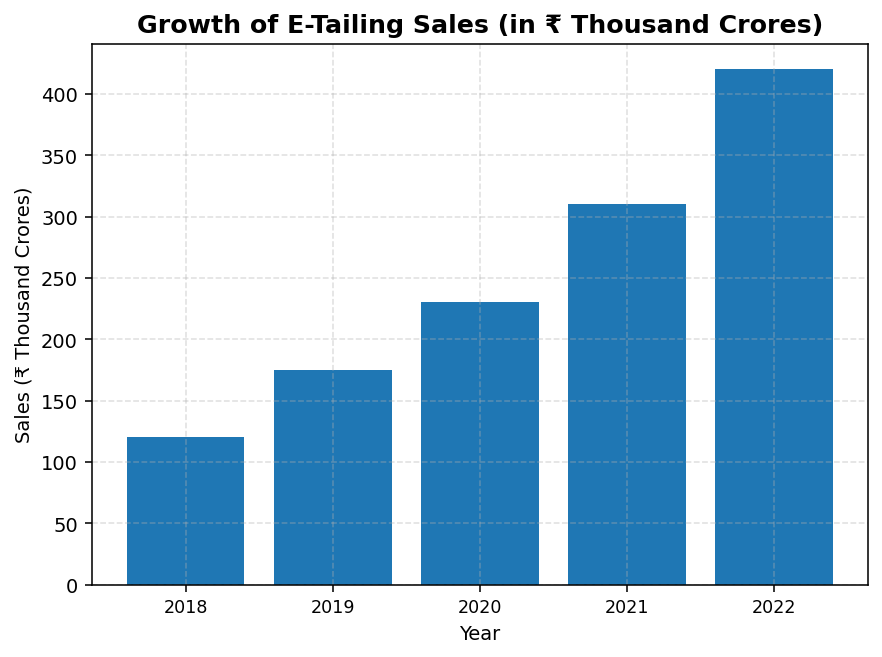
Based on the given chart, answer the following:

Emerging Modes of Business figure
  1. In which year did e-tailing sales show the highest absolute increase compared to the previous year?
    A2019
    B2020
    C2021
    D2022
  2. What was the total e-tailing sales recorded in the years 2020 and 2021 combined?
    A₹480 Thousand Crores
    B₹540 Thousand Crores
    C₹405 Thousand Crores
    D₹350 Thousand Crores
  3. What is e-tailing? How does it differ from traditional retailing?
  4. Based on the trend shown in the chart, identify one major reason for the consistent growth in e-tailing sales and one limitation of e-tailing that businesses must address.
  5. In which year did e-commerce revenue first exceed ₹400 crore according to the chart?
    A2019
    B2020
    C2021
    D2022
  6. What trend does the chart show for traditional commerce revenue between 2020 and 2022? Suggest one reason for this trend.
  7. What was the approximate difference between e-commerce and traditional commerce revenue in 2022?
    A₹110 crore
    B₹210 crore
    C₹110 crore deficit for e-commerce
    D₹110 crore surplus for e-commerce
  8. State any two limitations of e-business that may prevent traditional commerce from declining further despite the growth shown in the chart.
Show answersHide answers
1. Option 4 — 2022
2. Option 2 — ₹540 Thousand Crores
3. E-tailing (electronic retailing) refers to the sale of goods and services directly to consumers through the internet. It is a form of B2C e-commerce. Difference from Traditional Retailing: E-tailing operates through websites/apps without a physical store, is available 24/7, has a global reach, and offers home delivery. Traditional retailing requires a physical store, operates during fixed hours, has a limited geographic reach, and customers must visit in person to purchase goods.
4. Reason for Growth: The consistent growth in e-tailing sales can be attributed to the rapid increase in internet penetration and smartphone usage, making online shopping more accessible and convenient for a larger population. Limitation: A major limitation of e-tailing is the lack of personal touch and inability of customers to physically inspect products before purchase, which can lead to dissatisfaction, high return rates, and reduced consumer trust, especially for high-value items.
5. Option 3 — 2021
6. The chart shows a declining trend in traditional commerce revenue between 2020 and 2022, falling from ₹490 crore to ₹470 crore. One reason for this trend is the rapid shift of consumers towards online shopping (e-commerce), accelerated by the COVID-19 pandemic which forced businesses and consumers to adopt digital platforms for buying and selling goods and services.
7. Option 4 — ₹110 crore surplus for e-commerce
8. Two limitations of e-business that support the continued relevance of traditional commerce are: (1) Low personal touch — e-business lacks the personal interaction and physical inspection of products that many customers prefer, especially for high-value items like jewellery or clothing. (2) Digital divide and lack of internet access — a significant portion of the population, especially in rural areas, lacks reliable internet connectivity or digital literacy, making traditional commerce their preferred mode of shopping.

Make a full Business Studies paper on Emerging Modes of Business.

Pick the question mix, set the marks, hit generate. You get a ready-to-print paper with an answer key.

Generate your paper — free