Private, Public and Global Enterprises — Important Questions
59 questions
With answersCBSE format
SUMMARY: This chapter discusses the different forms of business enterprises in the private, public, and global sectors, highlighting their characteristics, advantages, and limitations. KEY TOPICS: Private sector enterprises, public sector enterprises, global enterprises, joint ventures, public-private partnership, multinational corporations, government companies, departmental undertakings, statutory corporations, features of global enterprises.
Which of the following is a Departmental Undertaking in India?
ASBI
BIndian Railways
CReliance
DTCS
Check answerHide answer
Correct answer: Option 2 — Indian Railways
Q31 Mark
A statutory corporation is created by:
AGovernment order
BSpecial Act of Parliament
CRoyal charter
DHindu Law
Check answerHide answer
Correct answer: Option 2 — Special Act of Parliament
Q41 Mark
A Government Company is registered under:
ACooperative Societies Act
BCompanies Act
CPartnership Act
DHindu Law
Check answerHide answer
Correct answer: Option 2 — Companies Act
Q51 Mark
A multinational corporation is one that:
AOperates in one country
BOperates in multiple countries
CHas only domestic capital
DIs small in size
Check answerHide answer
Correct answer: Option 2 — Operates in multiple countries
Q61 Mark
Which of the following is a characteristic of private sector enterprises?
AOwned and managed by the government
BProfit motive is the primary objective
CFunded by public taxes
DOperates under strict government regulations
Check answerHide answer
Correct answer: Option 2 — Profit motive is the primary objective
Q71 Mark
What is a key feature of public sector enterprises?
AThey are owned by private individuals
BThey aim to provide services to the public
CThey operate for profit maximization
DThey are governed by private laws
Check answerHide answer
Correct answer: Option 2 — They aim to provide services to the public
Q81 Mark
Which of the following is an example of a government company?
AReliance Industries
BIndian Oil Corporation
CTata Consultancy Services
DInfosys
Check answerHide answer
Correct answer: Option 2 — Indian Oil Corporation
Q91 Mark
What is the main advantage of a public-private partnership (PPP)?
AComplete government control
BShared resources and risks
CHigher taxation for citizens
DReduced competition
Check answerHide answer
Correct answer: Option 2 — Shared resources and risks
Q101 Mark
Which type of enterprise is characterized by joint ownership and management by two or more parties?
AGovernment company
BStatutory corporation
CJoint venture
DDepartmental undertaking
Check answerHide answer
Correct answer: Option 3 — Joint venture
Q111 Mark
Multinational corporations (MNCs) primarily operate in how many countries?
AOne
BTwo
CMultiple
DNone
Check answerHide answer
Correct answer: Option 3 — Multiple
Q121 Mark
Which of the following is NOT a feature of global enterprises?
AOperate in multiple countries
BHave a centralized management structure
CEngage in international trade
DAdapt to local markets
Check answerHide answer
Correct answer: Option 2 — Have a centralized management structure
Q131 Mark
What is a significant limitation of private sector enterprises?
ALack of innovation
BLimited access to capital
CFocus on profit over social welfare
DGovernment interference
Check answerHide answer
Correct answer: Option 3 — Focus on profit over social welfare
Q141 Mark
Which of the following is an example of a statutory corporation?
ABharat Heavy Electricals Limited (BHEL)
BState Bank of India
CIndian Railways
DOil and Natural Gas Corporation (ONGC)
Check answerHide answer
Correct answer: Option 3 — Indian Railways
Q151 Mark
In which type of enterprise does the government have complete ownership and control?
APrivate limited company
BPublic limited company
CGovernment company
DJoint venture
Check answerHide answer
Correct answer: Option 3 — Government company
Short Answer Questions10 questions
Q163 Marks
Define public sector and state any three of its features.
View sample solutionHide solution
Public sector consists of those enterprises owned managed and controlled by the central or state governments. Features: (i) government ownership (51%+ shareholding); (ii) public service motive — though profit-making is also encouraged; (iii) financed by government budget; (iv) accountable to legislature and public; (v) often holds monopoly or strategic role (railways, defence, atomic energy); (vi) bound by government policies and rules; (vii) employees often follow government service rules.
Q173 Marks
Distinguish between Departmental Undertaking and Statutory Corporation.
View sample solutionHide solution
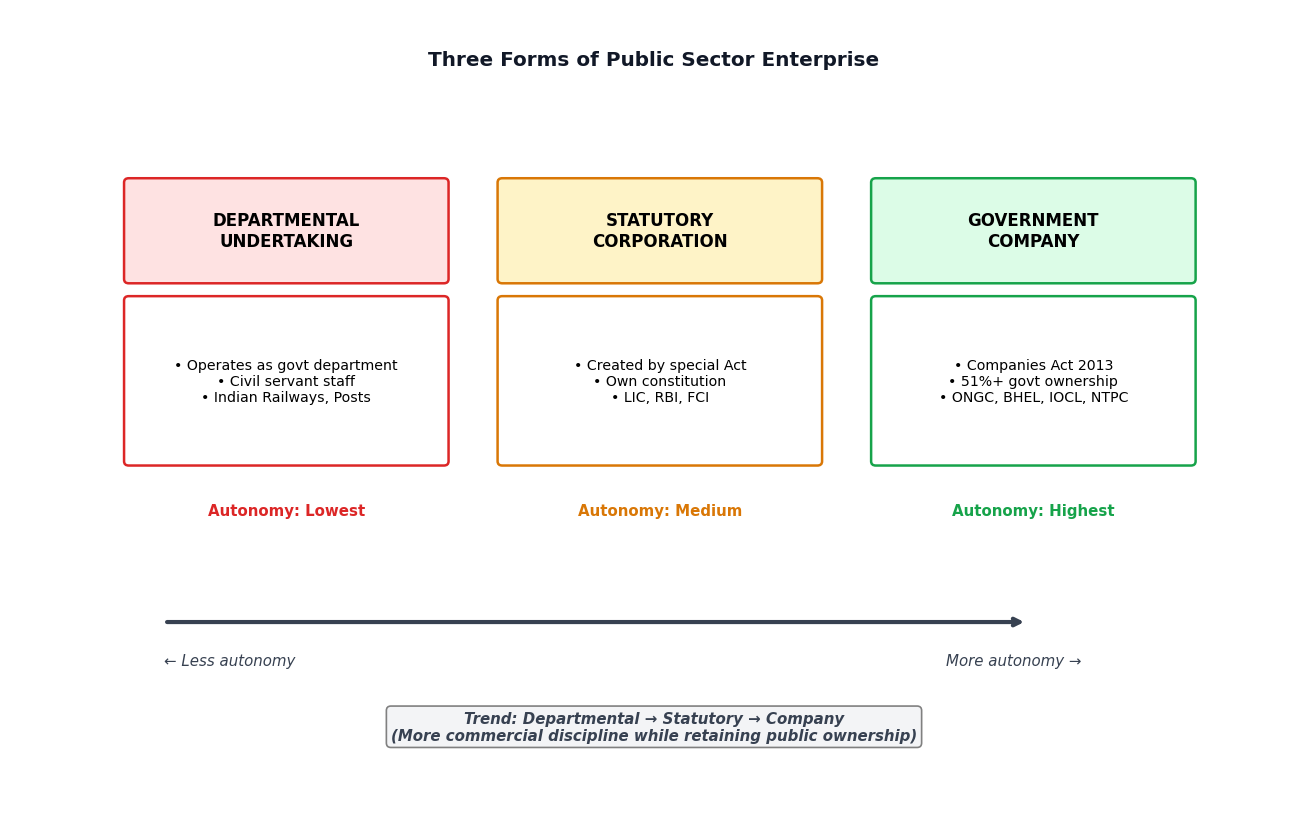
DEPARTMENTAL UNDERTAKING — operates as a department of the government; financed from government budget; staff are civil servants; subject to full ministerial and parliamentary control; examples: Indian Railways, Posts. STATUTORY CORPORATION — created by special Act of Parliament/State Legislature; has its own constitution per the Act; financially independent; staff are not civil servants but corporation employees; greater autonomy than departmental but still subject to public accountability; examples: LIC, RBI, Indian Airlines (now merged), Food Corporation of India.
Q183 Marks
What is a Government Company and how does it differ from a private company?
View sample solutionHide solution
A Government Company is one in which not less than 51% of the paid-up share capital is held by central or state government(s) jointly or individually. Registered under Companies Act 2013 like any other company but with special provisions. Differs from private company: (1) at least 51% government ownership vs 100% private; (2) accountable to government and through it to Parliament; (3) subject to CAG audit; (4) its annual report is laid before Parliament. Examples: ONGC, BHEL, IOCL, GAIL.
Q193 Marks
List any three roles played by public sector enterprises in the Indian economy.
View sample solutionHide solution
(1) Development of infrastructure — roads, railways, power, telecommunications, ports. (2) Strategic and defence-critical industries — atomic energy, space, defence (HAL, BEL, ISRO). (3) Balanced regional development — establishing industries in backward areas. (4) Import substitution — reducing import dependence (BHEL replaces foreign machinery). (5) Public welfare — affordable housing, food security (FCI), banking inclusion (PSBs). (6) Employment generation. (7) Setting price benchmarks in critical sectors (oil, steel). Public sector laid the foundation of India's industrial base after independence.
Q203 Marks
What is a multinational corporation (MNC) and what are its features?
View sample solutionHide solution
An MNC is a corporation that owns or controls production of goods or services in one or more countries other than its home country. Features: (1) Large size and scale of operations — billions in turnover; (2) International network — production marketing or sales in multiple countries; (3) Centralised management at global headquarters with local subsidiaries; (4) Sophisticated technology and R&D; (5) Strong brand identity and global marketing; (6) Substantial financial strength; (7) Political and economic influence in host countries; (8) Expertise in cross-border tax and regulatory navigation. Examples: Apple, Google, Microsoft, Toyota, Coca-Cola, Tata Group.
Q213 Marks
What are the main characteristics of private sector enterprises?
View sample solutionHide solution
Private sector enterprises are owned and managed by private individuals or groups. They aim to earn profits, have more flexibility in decision-making, and are driven by market competition.
Q223 Marks
Define public sector enterprises and provide two examples.
View sample solutionHide solution
Public sector enterprises are owned and operated by the government to provide services to the public. Examples include Indian Railways and Bharat Heavy Electricals Limited (BHEL).
Q233 Marks
What is a joint venture, and why do companies engage in it?
View sample solutionHide solution
A joint venture is a business arrangement where two or more parties agree to pool their resources for a specific project or business activity. Companies engage in joint ventures to share risks, resources, and expertise.
Q243 Marks
Explain the concept of public-private partnership (PPP).
View sample solutionHide solution
Public-private partnership (PPP) is a collaborative agreement between government entities and private sector companies to finance, build, and operate projects. This model aims to leverage private sector efficiency while serving public interests.
Q253 Marks
What are multinational corporations (MNCs), and what is their significance?
View sample solutionHide solution
Multinational corporations (MNCs) are companies that operate in multiple countries, often with a centralized head office. They are significant for their role in global trade, investment, and technology transfer.
Long Answer Questions6 questions
Q266 Marks
Discuss the various forms of public sector enterprises in India with examples.
View sample solutionHide solution
Public sector enterprises in India take three principal forms: (1) DEPARTMENTAL UNDERTAKINGS — run as departments of the government; financed from government budget; staff are civil servants. Examples: Indian Railways (Ministry of Railways), Posts (Department of Posts), Defence production. Advantages: tight government control, public accountability. Disadvantages: bureaucratic delays, lack of commercial flexibility. (2) STATUTORY CORPORATIONS — created by a special Act of Parliament or State Legislature with its own charter. Greater autonomy than departmental, separate from civil service. Examples: LIC, FCI, RBI, ONGC (was a corporation before becoming a company). (3) GOVERNMENT COMPANIES — registered under Companies Act 2013 with 51%+ government shareholding. Most flexible form combining commercial discipline with government oversight. Examples: ONGC, BHEL, GAIL, IOCL, SBI (PSB), NTPC. The Government has been gradually disinvesting and corporatising departmental and statutory undertakings to inject commercial efficiency.
Q276 Marks
Explain the concept of disinvestment and discuss its objectives in India.
View sample solutionHide solution
Disinvestment refers to the sale of a portion of government-held shares in public sector enterprises (PSUs) to private parties or to the public. It can be partial (government retains majority) or full (privatisation). Objectives: (1) Raise revenue — to fund developmental schemes and reduce fiscal deficit. (2) Improve efficiency — private/public ownership often leads to better commercial management. (3) Reduce government burden — manage fewer enterprises. (4) Promote share ownership — wider public participation in PSUs. (5) Modernise — bring private capital and technology. (6) Reduce political interference. Methods: (a) IPO/FPO of PSU shares; (b) Strategic sale to a single buyer; (c) Cross-holding sale to other PSUs; (d) Buyback of shares; (e) Listing of unlisted PSUs. Notable disinvestments in India: Maruti, BALCO, Hindustan Zinc, IPCL, Air India. Disinvestment is a key tool in fiscal management and economic reform.
Q286 Marks
Discuss the role and importance of MNCs in modern global economy.
View sample solutionHide solution
MNCs play a major role in the global economy: (1) Foreign direct investment (FDI) — bring capital, technology, and know-how to host countries; help bridge investment gaps. (2) Employment — create jobs in host countries (Maruti gave India millions of automotive jobs). (3) Technology transfer — introduce advanced production methods and skills. (4) Improvement in quality and standards — set global benchmarks for product quality and processes. (5) Foreign exchange — exports from host country branches generate forex. (6) Tax revenue — corporate tax paid in host countries. (7) Linkages with domestic firms — supply chain creates ancillary businesses. CRITICISMS: (1) Profit repatriation — sending profits to home country drains forex. (2) Crowding out local firms — superior MNC capability can wipe out smaller domestic competitors. (3) Cultural dominance — global brands erode local culture. (4) Tax avoidance — using transfer pricing and havens. (5) Excessive influence on host government policies. India's IT/ITES sector and automotive industry have benefited enormously from MNC investment.
Q296 Marks
Distinguish between public sector private sector and global enterprises.
View sample solutionHide solution
PUBLIC SECTOR — owned and controlled by central/state government; objective is welfare and strategic importance along with profit; accountable to Parliament/legislature; financed by government budget or borrowing; examples: Indian Railways, ONGC, SBI, LIC. PRIVATE SECTOR — owned by private individuals/groups; profit-maximising objective; accountable to shareholders; financed by promoter equity, public issue, debt; examples: Tata, Reliance, Infosys, HDFC. GLOBAL/MNC ENTERPRISES — owned (often by private interests) but operate across multiple countries; have global headquarters and local subsidiaries; serve global markets; examples: Apple, Google, Toyota, Coca-Cola. The three sectors complement each other: public sector handles strategic and welfare areas; private sector drives competitive markets and innovation; global enterprises bring international scale, capital, and technology. India's economic policy since 1991 has actively encouraged all three with appropriate liberalisation.
Q306 Marks
Explain the changing role of public sector in India after liberalisation 1991.
View sample solutionHide solution
Pre-1991 — public sector was the 'commanding heights' of the economy: dominant in steel, banking, insurance, telecom, oil, infrastructure. Strict licensing, restrictions on private and foreign capital. Post-1991 LIBERALISATION: (1) DEREGULATION — most sectors opened to private participation. (2) DISINVESTMENT — government partially sold PSU stakes. (3) PRIVATISATION — selling controlling stake to private parties (e.g., BALCO, Air India, Maruti). (4) PUBLIC-PRIVATE PARTNERSHIPS (PPP) — joint development of infrastructure (Delhi Metro, ports, highways). (5) FOCUS ON STRATEGIC AND PUBLIC GOOD SECTORS — defence, railways, atomic energy, public banking inclusion (Jan Dhan, MUDRA). (6) IMPROVED COMMERCIAL DISCIPLINE — corporatisation of departmental undertakings. (7) NAVRATNA AND MAHARATNA STATUS — more autonomy for top-performing PSUs. (8) ENVIRONMENTAL AND SOCIAL ROLE — implementing green energy, rural electrification. Today public sector is leaner but more strategic — focused on areas where private sector under-invests or social welfare is paramount.
Q316 Marks
Compare departmental undertakings and statutory corporations with the help of a table.
Assertion–Reason Questions8 questions
Q321 Mark
Assertion (A): Public sector enterprises are owned by the government.
Reason (R): The government holds majority equity (51% or more) in such enterprises.
Show explanationHide explanation
Correct answer: Option 1 —
Both A and R are true, and R is the correct explanation of A.
Q331 Mark
Assertion (A): Indian Railways is a departmental undertaking.
Reason (R): It operates as a department of the central government with civil servant staff.
Show explanationHide explanation
Correct answer: Option 1 —
Both A and R are true, and R is the correct explanation of A.
Q341 Mark
Assertion (A): A Government Company is registered under the Companies Act.
Reason (R): It must follow most provisions applicable to public companies but with special provisions for government ownership.
Show explanationHide explanation
Correct answer: Option 1 —
Both A and R are true, and R is the correct explanation of A.
Q351 Mark
Assertion (A): Disinvestment helps the government raise revenue.
Reason (R): Sale of PSU shares brings in cash that can be used for development or fiscal deficit reduction.
Show explanationHide explanation
Correct answer: Option 1 —
Both A and R are true, and R is the correct explanation of A.
Q361 Mark
Assertion (A): MNCs bring foreign direct investment to host countries.
Reason (R): FDI brings capital technology and know-how that benefits the host country's economy.
Show explanationHide explanation
Correct answer: Option 1 —
Both A and R are true, and R is the correct explanation of A.
Q371 Mark
Assertion (A): Private sector enterprises are primarily owned and operated by private individuals or organizations.
Reason (R): They aim to earn profit and are driven by market competition.
Show explanationHide explanation
Correct answer: Option 1 —
Both A and R are true, and R is the correct explanation of A.
Q381 Mark
Assertion (A): Public sector enterprises are established to provide services to the public.
Reason (R): They are funded and managed by private individuals.
Show explanationHide explanation
Correct answer: Option 4 —
A is false, but R is true.
Q391 Mark
Assertion (A): A joint venture is a type of partnership where two or more parties agree to pool their resources for a specific task.
Reason (R): Joint ventures are typically formed for a limited time and for a specific project.
Show explanationHide explanation
Correct answer: Option 1 —
Both A and R are true, and R is the correct explanation of A.
Statement-Based Questions8 questions
Q401 Mark
Statement 1: Public sector has three forms: departmental statutory and government company.
Statement 2: Each form differs in degree of government control and commercial autonomy.
Show answerHide answer
Correct answer: Option 1 —
Both statements are true.
Q411 Mark
Statement 1: Private sector enterprises aim to maximise profit.
Statement 2: They are accountable to their shareholders and customers.
Show answerHide answer
Correct answer: Option 1 —
Both statements are true.
Q421 Mark
Statement 1: Liberalisation of 1991 opened up the Indian economy.
Statement 2: It reduced licensing increased private participation and welcomed FDI.
Show answerHide answer
Correct answer: Option 1 —
Both statements are true.
Q431 Mark
Statement 1: MNCs may repatriate profits to their home country.
Statement 2: This causes outflow of foreign exchange from the host country.
Show answerHide answer
Correct answer: Option 1 —
Both statements are true.
Q441 Mark
Statement 1: Public sector plays strategic roles in defence and atomic energy.
Statement 2: These sectors are too critical to leave to private profit-driven motives.
Show answerHide answer
Correct answer: Option 1 —
Both statements are true.
Q451 Mark
Statement 1: Private sector enterprises are owned and managed by government entities.
Statement 2: Public sector enterprises aim to provide services to the public and are owned by the government.
Show answerHide answer
Correct answer: Option 3 —
Only Statement 2 is true.
Q461 Mark
Statement 1: Joint ventures involve two or more parties coming together for a specific project while sharing profits and losses.
Statement 2: Multinational corporations operate in multiple countries but are managed from a single country.
Show answerHide answer
Correct answer: Option 1 —
Both statements are true.
Q471 Mark
Statement 1: Government companies are established under the Companies Act and are owned by the government.
Statement 2: Statutory corporations are created by an act of Parliament and operate independently of government control.
Show answerHide answer
Correct answer: Option 2 —
Only Statement 1 is true.
Case Study / Passage Questions4 questions
Q483 Marks
India's oil and gas sector has both public and private players. ONGC (Oil and Natural Gas Corporation) is a Government Company while Reliance Industries is a private sector giant. Both extract crude oil and gas, refine it, and distribute petroleum products.
ONGC is part of the:
APublic
BPrivate
CCooperative
DMultinational
ONGC's specific form is:
AGovernment Company
BDepartmental Undertaking
CStatutory Corporation
DPrivate Limited
Compare ONGC and Reliance in terms of ownership, governance, and objectives.
Show answersHide answers
1. Option 1 — Public
2. Option 1 — Government Company
3. ONGC and Reliance illustrate the public-private comparison in India's strategic sector. ONGC: (1) Government Company — 51%+ owned by central government; (2) registered under Companies Act 2013 with special provisions for public sector; (3) accountable to Parliament; (4) audited by CAG (Comptroller and Auditor General); (5) social objectives along with commercial; (6) employees often follow government service rules; (7) capital investments approved by government. RELIANCE: (1) public limited company in private sector; (2) listed on NSE/BSE; (3) accountable to shareholders only; (4) audited by independent CAs; (5) profit-maximising; (6) commercial flexibility in employment; (7) capital decisions by board. CONTRAST IN OIL: ONGC focuses on UPSTREAM (exploration and extraction); Reliance on DOWNSTREAM (refining and petrochemicals). India needs both — ONGC for sovereignty over natural resources; Reliance for efficiency and innovation. Modern Indian policy is to encourage healthy competition and use ONGC for strategic reasons (energy security) while letting private players drive efficiency.
Q493 Marks
Air India was originally a private airline (founded 1932 as Tata Airlines) nationalised in 1953. Loss-making for years, the government decided to privatise it. After several attempts, in 2022 Air India was sold to Tata Sons for ₹18000 crore — bringing it back to its original owners.
The 2022 sale of Air India to Tata Sons is an example of:
APrivatisation
BNationalisation
CMergers
DAcquisition
The main objectives of disinvestment include:
ATo increase taxes
BTo raise revenue and improve efficiency
CTo create more PSUs
DTo restrict competition
Explain the disinvestment process and its objectives using the Air India case.
Show answersHide answers
1. Option 1 — Privatisation
2. Option 2 — To raise revenue and improve efficiency
3. Air India's privatisation in 2022 is a textbook case of disinvestment. CONTEXT: Air India had been loss-making for years (₹70000 crore accumulated losses); government bailouts could not turn it around; bureaucratic decision-making slowed commercial flexibility. PROCESS: Government issued an Expression of Interest in 2017 (failed); successful bid in 2021 by Tata Sons (₹18000 crore for 100% stake including ₹15300 crore debt). Tata took over the airline in January 2022. OBJECTIVES OF DISINVESTMENT: (1) RAISE REVENUE — for fiscal deficit reduction; (2) IMPROVE EFFICIENCY — private management often more commercial; (3) FOCUS GOVERNMENT on core areas; (4) INTRODUCE COMPETITION; (5) WIDER PUBLIC OWNERSHIP. METHODS USED: strategic sale to single buyer (Tata) with controlling stake. POST-PRIVATISATION: Tata has invested in fleet renewal, ticketing system upgrade, employee training. The 2022 sale is also seen as a SYMBOLIC return — Tata's legacy in aviation goes back to Air India's founding. Future expected: Air India to become a major Asian carrier through merger with Vistara (Tata's other airline).
Q503 Marks
Toyota Motor Corporation (TMC) Japan entered India in 1997 through a joint venture with Kirloskar Group — Toyota Kirloskar Motor (TKM) with 89% Toyota and 11% Kirloskar ownership. Toyota brought hybrid technology, lean manufacturing, and global brand. TKM employs 6500+ Indians and has been a major player in Indian car market.
A multinational corporation operates in:
AOne country
BMultiple countries
CNo country
DGovernment
Toyota brings to India through TKM:
ABringing capital and technology
BHiring local employees
CSetting up subsidiaries
DAll of these
Discuss Toyota's entry into India and the impact on host country.
Show answersHide answers
1. Option 2 — Multiple countries
2. Option 4 — All of these
3. Toyota Kirloskar Motor exemplifies MNC entry into India. ENTRY MODE: Joint Venture (JV) — common when foreign company wants local market access without full ownership; provides political comfort and local knowledge. CONTRIBUTIONS TO INDIA: (1) FDI — billions of dollars invested in plants in Bidadi (Karnataka) and surrounding areas. (2) TECHNOLOGY — Toyota Production System (TPS) considered world-best in lean manufacturing; introduced to Indian auto industry. (3) JOBS — direct employment for 6500+, indirect through ancillary suppliers. (4) EXPORTS — TKM exports to neighbouring countries. (5) ANCILLARY DEVELOPMENT — hundreds of Indian suppliers became Toyota-grade. (6) BRAND — Toyota's reputation for quality raised industry standards. (7) GREEN TECHNOLOGY — hybrid Camry and Innova hybrids in India. CHALLENGES FOR MNC IN INDIA: (a) tough competition from Maruti Suzuki, Tata, Mahindra; (b) regulatory complexity; (c) BS6 emission norms; (d) shifting consumer preferences. POSITIVE IMPACT ON HOST: technology transfer, jobs, FDI, foreign exchange. CRITICISM: profit repatriation, dependence on imports, cultural homogenisation. India's policy under FDI in automobile sector (100% under automatic route) has welcomed MNCs, leading to globally-competitive Indian auto industry.
Q514 Marks
Departmental undertakings are the oldest and most traditional form of public sector enterprises in India. They are established as departments of the government and function under the direct control and supervision of a ministry. The Post and Telegraph Department, Railways, and All India Radio are classic examples. These enterprises are financed through government budgets and their revenues are deposited into the government treasury. Employees working in departmental undertakings are government servants and are subject to government rules and regulations. While these enterprises ensure accountability and control, they often suffer from lack of flexibility, bureaucratic delays, and inefficiency. The primary objective of departmental undertakings is not profit-making but providing essential services to the public at affordable rates.
Which of the following is an example of a departmental undertaking?
ASteel Authority of India
BIndian Railways
CInfosys
DReliance Industries
What is the primary objective of departmental undertakings?
AMaximising profit
BCompeting with private sector
CProviding essential services to the public at affordable rates
DAttracting foreign investment
Mention any two limitations of departmental undertakings.
Employees of departmental undertakings are treated as:
APrivate employees
BContract workers
CGovernment servants
DShareholders
Show answersHide answers
1. Option 2 — Indian Railways
2. Option 3 — Providing essential services to the public at affordable rates
3. Two limitations of departmental undertakings are: (1) Lack of flexibility in operations due to rigid government rules and procedures. (2) Bureaucratic delays and inefficiency in decision-making and service delivery.
4. Option 3 — Government servants
Table-Based Questions4 questions
Q523 Marks
Three forms of public sector enterprise in India:
Form
Created by
Examples
Autonomy
Departmental Undertaking
Government order
Indian Railways, Posts
Lowest
Statutory Corporation
Special Act of Parliament
LIC, FCI, RBI
Medium
Government Company
Companies Act 2013 with 51%+ govt ownership
ONGC, BHEL, IOCL, NTPC
Highest
Indian Railways is a:
ADepartmental
BStatutory Corporation
CGovernment Company
DAll same
LIC was created as a:
AGovernment Company
BDepartmental
CStatutory
DCooperative
Why has the government been converting departmental undertakings into Government Companies?
Show answersHide answers
1. Option 1 — Departmental
2. Option 3 — Statutory
3. Three forms of public sector vary in autonomy and operational flexibility. DEPARTMENTAL UNDERTAKINGS — operate as departments of government; staff are civil servants; tightest control; least flexibility. Examples: Indian Railways, Department of Posts, Defence production. Suitable when commercial considerations are secondary to public service. STATUTORY CORPORATIONS — created by special Act of Parliament/Legislature with own constitution; greater autonomy than departmental but still public-accountable. Examples: LIC (Life Insurance Corporation Act 1956), RBI (RBI Act 1934), FCI (Food Corporations Act 1964). Suitable for activities needing commercial discipline but also social objectives. GOVERNMENT COMPANIES — registered under Companies Act 2013; most flexible; can be 'corporatised' to inject commercial discipline. Examples: ONGC, BHEL, IOCL, NTPC, GAIL, PSBs. Modern policy is moving FROM departmental TO statutory TO company forms — converting old departments into Government Companies for better commercial performance while maintaining public ownership.
Q533 Marks
Compare public sector private sector and global enterprises:
Strategic sectors like defence are typically managed by:
APublic sector
BPrivate sector
CGlobal enterprise
DAll equally
MNCs bring to host countries:
ACapital
BTechnology
CBrand
DAll of these
Why does India encourage all three types of enterprise rather than favouring one?
Show answersHide answers
1. Option 1 — Public sector
2. Option 4 — All of these
3. All three types coexist in the modern Indian economy. PUBLIC SECTOR is essential for: strategic and defence-critical industries (HAL, DRDO, ISRO); welfare and equity (PSBs for financial inclusion, FCI for food security); infrastructure (railways, airports, ports); regulating natural monopolies. PRIVATE SECTOR drives: efficiency and innovation; competitive markets; technology adoption; entrepreneurship. GLOBAL ENTERPRISES bring: foreign investment; technology; global standards; export earnings. Each has strengths and weaknesses. POST-1991 INDIA balanced these by liberalisation: opening sectors to private and foreign investment; gradually disinvesting non-strategic PSUs; encouraging PPPs for infrastructure; maintaining public sector role in strategic and welfare areas. Modern India has world-class private firms (Infosys, Reliance, TCS) that compete globally; strategic public firms (ONGC, ISRO) that serve national needs; and major MNC presence (Toyota, Microsoft, Samsung, Amazon) that brings global standards. The mix has worked: India's economy has grown from ~$300 billion in 1991 to ~$3.7 trillion in 2024.
Q546 Marks
Compare the three forms of public sector enterprises by autonomy and operational features.
Form
Autonomy
Examples
Departmental Undertaking
Lowest
? Indian Railways, Posts
Statutory Corporation
Medium
? LIC, RBI, FCI
Government Company
Highest
? ONGC, BHEL, IOCL
Q556 Marks
Discuss the roles and contributions of public sector private sector and global enterprises.
Sector
Strength
Indian Examples
Public
? Strategic + welfare
? ONGC, IOCL, ISRO
Private
? Efficiency + innovation
? Tata, Reliance, Infosys
Global (MNC)
? Global scale + technology
? Toyota, Apple, Samsung
Picture-Based Questions4 questions
Q563 Marks
Study the three forms of public sector enterprise and answer:
Which form has the LOWEST autonomy?
ADepartmental Undertaking
BStatutory Corporation
CGovernment Company
DAll same
A Statutory Corporation like LIC is created by:
ACompanies Act 2013
BGovernment order
CSpecial Act of Parliament
DCooperative Act
Explain the three forms of public sector enterprise with examples and the trend in India.
Show answersHide answers
1. Option 1 — Departmental Undertaking
2. Option 3 — Special Act of Parliament
3. Three forms of public sector vary in autonomy and operational flexibility. (1) DEPARTMENTAL UNDERTAKINGS — operate as departments of government; staff are civil servants; tightest control; least flexibility. Examples: Indian Railways, Department of Posts. Suitable when commercial considerations are secondary to public service. (2) STATUTORY CORPORATIONS — created by special Act of Parliament/Legislature with own constitution; greater autonomy than departmental but still publicly accountable. Examples: LIC, RBI, FCI. Suitable for activities needing commercial discipline but also social objectives. (3) GOVERNMENT COMPANIES — registered under Companies Act 2013; most flexible; can be 'corporatised' to inject commercial discipline. Examples: ONGC, BHEL, IOCL, NTPC, GAIL. Modern policy is moving FROM departmental TO statutory TO company forms — converting old departments into Government Companies for better commercial performance while maintaining public ownership.
Q574 Marks
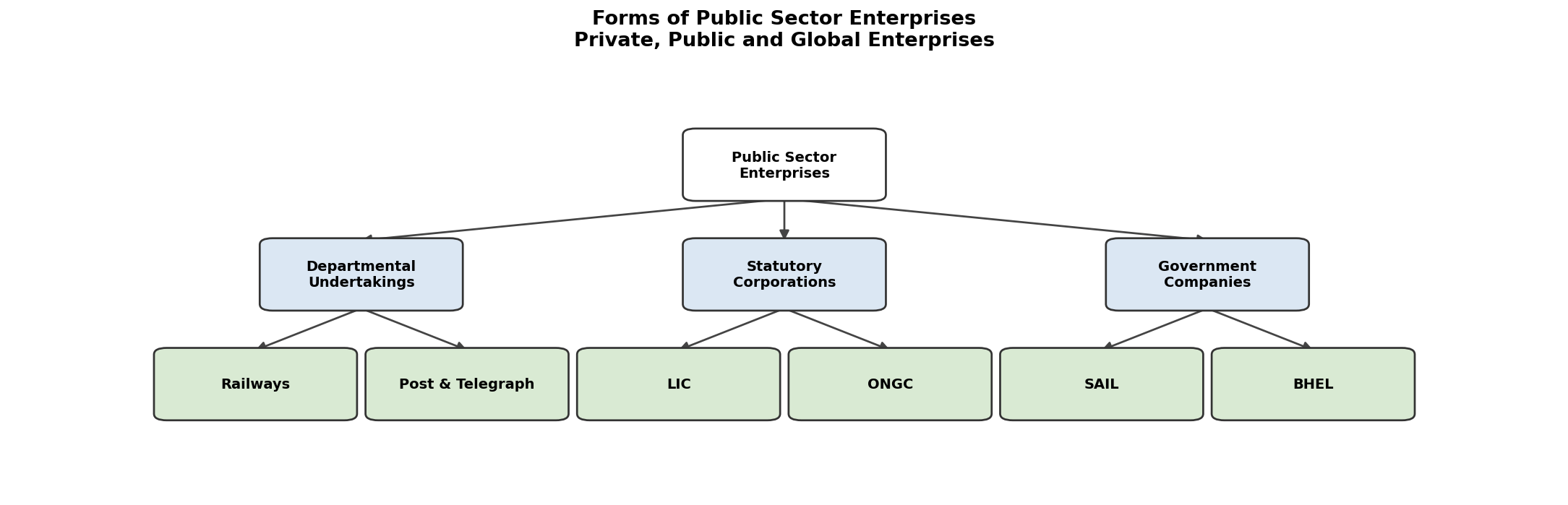
Based on the given diagram showing the classification of Public Sector Enterprises, answer the following:
Which of the following is a Departmental Undertaking as shown in the diagram?
ALIC
BSAIL
CRailways
DBHEL
How many main forms of Public Sector Enterprises are shown in the diagram?
ATwo
BThree
CFour
DFive
Distinguish between a Statutory Corporation and a Government Company based on their formation.
State one advantage of Departmental Undertakings over other forms of public sector enterprises.
Show answersHide answers
1. Option 3 — Railways
2. Option 2 — Three
3. A Statutory Corporation is created by a special Act of Parliament or State Legislature, while a Government Company is registered under the Companies Act, 2013, with at least 51% of its paid-up share capital held by the government.
4. Departmental Undertakings are subject to direct parliamentary control, ensuring greater accountability and transparency in their operations.
Q584 Marks
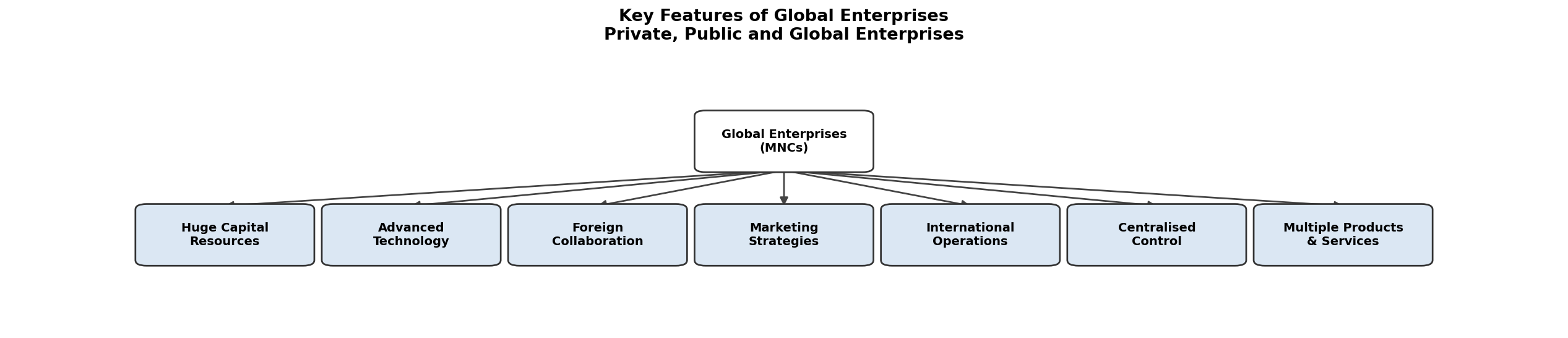
Based on the given diagram showing the features of Global (Multinational) Enterprises, answer the following:
Which of the following is NOT a feature of Global Enterprises as shown in the diagram?
AHuge Capital Resources
BCentralised Control
CLimited to Domestic Market
DAdvanced Technology
What does 'Foreign Collaboration' as a feature of Global Enterprises mean?
Which feature of Global Enterprises refers to the use of sophisticated and up-to-date production methods?
ACentralised Control
BAdvanced Technology
CMarketing Strategies
DHuge Capital Resources
Explain how 'Centralised Control' is a characteristic feature of Global Enterprises.
Show answersHide answers
1. Option 3 — Limited to Domestic Market
2. Foreign Collaboration means that Global Enterprises enter into agreements with firms in other countries for technology transfer, production, or marketing, enabling them to expand their operations and gain access to new markets and resources.
3. Option 2 — Advanced Technology
4. In Global Enterprises, the parent company exercises centralised control over all its subsidiaries and branches operating in different countries. Major decisions regarding finance, policy, and strategy are taken at the headquarters, ensuring uniformity and coordination across all operations worldwide.
Q594 Marks
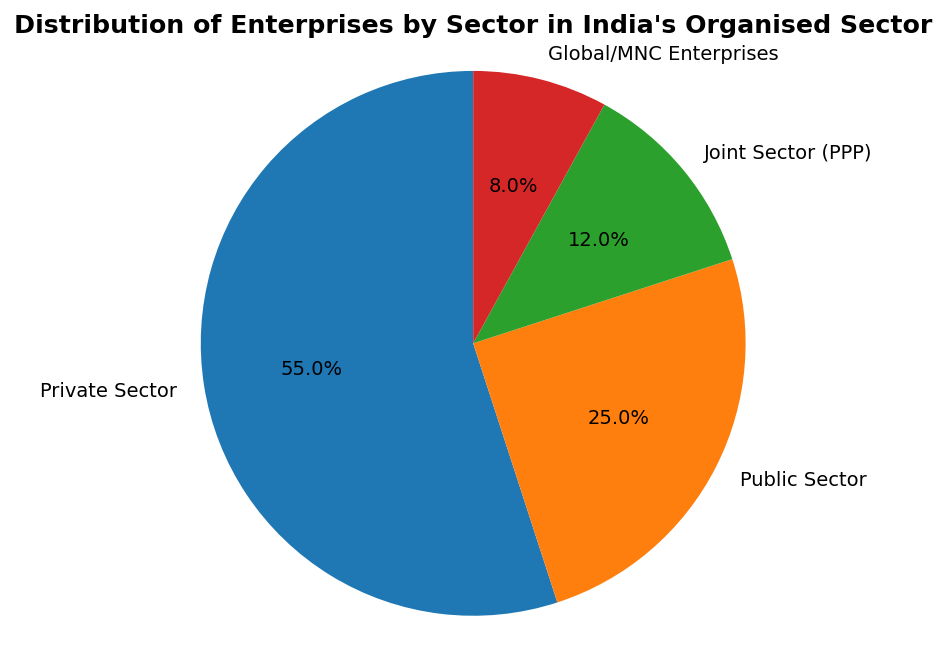
Based on the given pie chart showing the approximate distribution of enterprises in India's organised sector by ownership type, answer the following:
According to the pie chart, which sector has the largest share of enterprises in India's organised sector?
APublic Sector
BJoint Sector (PPP)
CPrivate Sector
DGlobal/MNC Enterprises
What percentage of enterprises in the organised sector are represented by Global/MNC Enterprises as per the chart?
A25%
B12%
C55%
D8%
What is meant by Public-Private Partnership (PPP) as shown in the chart? Give one example.
Calculate the combined percentage share of Public Sector and Joint Sector (PPP) enterprises from the chart.
Show answersHide answers
1. Option 3 — Private Sector
2. Option 4 — 8%
3. Public-Private Partnership (PPP) is a collaborative arrangement between the government (public sector) and private enterprises to jointly undertake projects, share resources, risks, and profits. Example: Delhi Metro Rail Corporation (DMRC) is a joint venture between the Government of India and the Delhi Government.