SUMMARY: The chapter "Wave Optics" in Class 12 Physics explores the wave nature of light and its various phenomena. KEY TOPICS: Huygens' principle, interference of light, Young's double-slit experiment, diffraction, polarization, coherent sources, intensity distribution, Brewster's law, thin film interference, resolving power of optical instruments.
Diffraction is most pronounced when the aperture is:
AMuch larger than wavelength
BComparable to wavelength
CMuch smaller than wavelength
DIndependent of wavelength
Check answerHide answer
Correct answer: Option 2 — Comparable to wavelength
Q41 Mark
For constructive interference the path difference must be:
AEven multiple of λ/2
BOdd multiple of λ/2
CInteger multiple of λ
DInteger multiple of λ/4
Check answerHide answer
Correct answer: Option 3 — Integer multiple of λ
Q51 Mark
Polarization confirms that light is a:
AParticle
BLongitudinal wave
CTransverse wave
DQuantum
Check answerHide answer
Correct answer: Option 3 — Transverse wave
Short Answer Questions5 questions
Q63 Marks
State Huygens' principle.
View sample solutionHide solution
Huygens' principle: each point on a wavefront acts as a source of secondary wavelets. The new wavefront at a later instant is the surface tangent to all these secondary wavelets. This principle explains the laws of reflection refraction and the propagation of light. It is the foundation of wave optics.
Q73 Marks
Define interference of light. Distinguish between constructive and destructive interference.
View sample solutionHide solution
Interference is the superposition of two or more coherent light waves resulting in a new wave pattern with regions of higher and lower intensity than each individual wave. Constructive interference: waves arrive in phase (path difference = integer λ); amplitudes add giving bright fringes. Destructive interference: waves arrive out of phase (path difference = (n + 1/2)λ); amplitudes cancel giving dark fringes. Coherence (constant phase relationship) is essential.
Q83 Marks
Calculate the wavelength of light if the fringe width in Young's experiment is 0.5 mm with slit separation 1 mm and screen distance 1 m.
View sample solutionHide solution
Fringe width β = λD/d. Solve for λ: λ = β d/D = (0.5 × 10⁻³)(1 × 10⁻³)/1 = 5 × 10⁻⁷ m = 500 nm. This is in the green-blue range — typical of sodium yellow light or blue-green region.
Q93 Marks
What is diffraction? When is it most prominent?
View sample solutionHide solution
Diffraction is the bending of light around obstacles or through narrow apertures spreading into the geometric shadow region. It arises from the wave nature of light. Most prominent when the aperture/obstacle size is comparable to the wavelength of light. Visible light (~500 nm) shows diffraction noticeably only with very narrow slits/objects (microscopic) — that's why we don't usually 'see around corners' as we hear sound (sound has ~m wavelengths comparable to everyday objects).
Q103 Marks
Define polarization of light and give one method to polarize unpolarized light.
View sample solutionHide solution
Polarization is the restriction of the direction of vibration of the electric field of a transverse wave to a particular plane. Unpolarized light has E vibrating randomly in all transverse directions; plane-polarized light has E vibrating in only one. Method 1: pass through a polarizer (Polaroid) which absorbs vibrations along all directions except one. Method 2: reflect off a non-metallic surface at Brewster's angle (tan θ_B = n₂/n₁). Method 3: scattering of sunlight by atmosphere produces partially polarized blue sky.
Long Answer Questions6 questions
Q116 Marks
Derive the formula for fringe width in Young's double slit experiment.
View sample solutionHide solution
In Young's experiment two coherent sources S₁ and S₂ separated by distance d produce interference on a screen at distance D. For a point P at distance y from the central maximum: Path difference Δ = S₂P − S₁P. Using the geometry (D ≫ d): Δ ≈ d sin θ ≈ d × (y/D) = yd/D. Constructive interference (bright fringe): Δ = nλ ⇒ y_n = nλD/d. Destructive interference (dark fringe): Δ = (n + 1/2)λ ⇒ y_n = (n + 1/2)λD/d. Distance between consecutive bright (or dark) fringes — fringe width β = y_(n+1) − y_n = λD/d.
Q126 Marks
Discuss diffraction at a single slit and derive the position of the first minimum.
View sample solutionHide solution
In single-slit diffraction light passing through a slit of width a shows a central bright fringe with wider angular extent than the slit and successively narrower secondary maxima on either side. Using Huygens' principle the slit can be considered as many secondary sources. For destructive interference (minima): all wavelets cancel in pairs. The first minimum occurs when the path difference between waves from the slit's edges is λ: a sin θ = λ ⇒ sin θ = λ/a. For small angles: θ ≈ λ/a. The angular width of the central bright fringe = 2λ/a. Smaller slit (a) gives broader diffraction. Resolution of optical instruments is limited by diffraction.
Q136 Marks
In Young's double slit experiment monochromatic light of wavelength 6000 Å is used with slit separation 0.5 mm. The screen is 1 m away. Find (i) fringe width, (ii) distance of 5th bright fringe from central maximum.
View sample solutionHide solution
λ = 6000 Å = 6 × 10⁻⁷ m. d = 0.5 × 10⁻³ m. D = 1 m. (i) Fringe width β = λD/d = (6 × 10⁻⁷)(1)/(0.5 × 10⁻³) = 1.2 × 10⁻³ m = 1.2 mm. (ii) Position of nth bright fringe: y_n = nβ. So y_5 = 5 × 1.2 = 6 mm from the central maximum.
Q146 Marks
Discuss Brewster's law and its applications.
View sample solutionHide solution
Brewster's law: when unpolarized light is incident on a non-metallic surface at a particular angle (Brewster's angle θ_B) the reflected light is completely plane-polarized perpendicular to the plane of incidence. Mathematical form: tan θ_B = n₂/n₁ where n₂ is the refractive index of the second medium. At this angle reflected and refracted rays are mutually perpendicular. For air-glass: tan θ_B = 1.5 ⇒ θ_B ≈ 57°. Applications: polarized sunglasses cut horizontally polarized glare from water and roads; photographers use polarizing filters; LCD displays.
Q156 Marks
Derive the conditions for constructive and destructive interference in Young's double slit experiment.
View sample solutionHide solution
Two coherent sources S₁ and S₂ produce waves that meet at a point P on the screen. Path difference Δ = S₂P − S₁P. Resultant amplitude A = A₁ cos(ωt) + A₂ cos(ωt + 2πΔ/λ). Phase difference φ = 2πΔ/λ. Constructive interference (maximum amplitude): A = A_max when φ = 2nπ ⇒ Δ = nλ (n = 0 1 2 ...). Destructive (minimum): A = A_min when φ = (2n + 1)π ⇒ Δ = (n + 1/2)λ. Intensity I = I_max cos²(φ/2) — varies from I_max (bright) to 0 (dark) cosine-squared with phase. The bright and dark fringes alternate equally spaced with fringe width β = λD/d.
Q166 Marks
Differentiate between interference and diffraction in tabular form on five features.
Assertion–Reason Questions5 questions
Q171 Mark
Assertion (A): Two independent light bulbs cannot produce a steady interference pattern.
Reason (R): The phase difference between independent sources changes randomly so any interference pattern is averaged out.
Show explanationHide explanation
Correct answer: Option 1 —
Both A and R are true, and R is the correct explanation of A.
Q181 Mark
Assertion (A): Diffraction is observed only through narrow apertures comparable to the wavelength.
Reason (R): For wide apertures (a ≫ λ) the diffraction angle is so small that the bending is imperceptible.
Show explanationHide explanation
Correct answer: Option 1 —
Both A and R are true, and R is the correct explanation of A.
Q191 Mark
Assertion (A): Polarization confirms the wave nature and transverse character of light.
Reason (R): Only transverse waves can be polarized — longitudinal waves cannot.
Show explanationHide explanation
Correct answer: Option 1 —
Both A and R are true, and R is the correct explanation of A.
Q201 Mark
Assertion (A): The fringe width in Young's experiment is independent of fringe order.
Reason (R): β = λD/d does not depend on n; consecutive fringes are equally spaced.
Show explanationHide explanation
Correct answer: Option 1 —
Both A and R are true, and R is the correct explanation of A.
Q211 Mark
Assertion (A): Huygens' principle explains the propagation of light through obstacles.
Reason (R): Each point on the wavefront acts as a source of secondary wavelets — bending around obstacles is naturally explained.
Show explanationHide explanation
Correct answer: Option 1 —
Both A and R are true, and R is the correct explanation of A.
Statement-Based Questions5 questions
Q221 Mark
Statement 1: Each point on a wavefront acts as a source of secondary wavelets.
Statement 2: The new wavefront is the envelope of these wavelets.
Show answerHide answer
Correct answer: Option 1 —
Both statements are true.
Q231 Mark
Statement 1: Constructive interference occurs at path difference = nλ.
Correct answer: Option 1 —
Both statements are true.
Q241 Mark
Statement 1: Diffraction is the bending of light around obstacles.
Statement 2: Diffraction limits the resolution of optical instruments.
Show answerHide answer
Correct answer: Option 1 —
Both statements are true.
Q251 Mark
Statement 1: Polarization is a property of transverse waves.
Statement 2: Light is a transverse wave so it can be polarized.
Show answerHide answer
Correct answer: Option 1 —
Both statements are true.
Q261 Mark
Statement 1: In Young's experiment the central fringe is bright.
Statement 2: The central fringe corresponds to zero path difference for both wavelengths in white light.
Show answerHide answer
Correct answer: Option 1 —
Both statements are true.
Case Study / Passage Questions3 questions
Q273 Marks
In Young's double-slit experiment two slits 0.5 mm apart are illuminated by light of wavelength 600 nm. The interference pattern is observed on a screen 1.5 m away. A student computes the fringe width and the position of the 5th bright fringe.
The fringe width β = λD/d equals:
A0.6 mm
B1.8 mm
C3.0 mm
D6.0 mm
Bright fringes correspond to:
AConstructive interference
BDestructive interference
CBoth
DNeither
Compute the position of the 5th bright fringe.
Show answersHide answers
1. Option 2 — 1.8 mm
2. Option 1 — Constructive interference
3. Fringe width: β = λD/d = (600 × 10⁻⁹)(1.5)/(0.5 × 10⁻³) = (900 × 10⁻⁹)/(5 × 10⁻⁴) = 1.8 × 10⁻³ m = 1.8 mm. The 5th bright fringe is at y₅ = 5β = 9 mm from central maximum. Bright fringes: path difference = nλ → constructive interference (waves in phase). Dark fringes: path difference = (n + ½)λ → destructive interference. The pattern requires monochromatic coherent light — Young's classic experiment proved the wave nature of light.
Q283 Marks
A single slit of width 0.2 mm is illuminated by laser light of wavelength 632 nm. The diffraction pattern is observed on a screen 2 m away. A student computes the angular and linear width of the central maximum.
The half-angular width of the central maximum (sinθ ≈ λ/a) equals:
A3.16 × 10⁻³ rad
B6.32 × 10⁻³ rad
C9.48 × 10⁻³ rad
D12.6 × 10⁻³ rad
The central maximum width is:
ASame as the slit width
BHalf the slit width
CTwice that of secondary maxima
DInversely proportional to wavelength
Compute the linear width on the screen.
Show answersHide answers
1. Option 2 — 6.32 × 10⁻³ rad
2. Option 3 — Twice that of secondary maxima
3. For single-slit diffraction first minimum at sinθ = λ/a = (632 × 10⁻⁹)/(0.2 × 10⁻³) = 3.16 × 10⁻³ rad ≈ θ for small angles. The full width of central maximum (between first minima) is 2θ = 6.32 × 10⁻³ rad. Linear width on screen: w = 2θD = 6.32 × 10⁻³ × 2 = 12.6 × 10⁻³ m = 12.6 mm. The central maximum is twice as wide as secondary maxima — this asymmetry distinguishes single-slit diffraction from double-slit interference.
Q293 Marks
A beam of unpolarised light strikes a glass surface (n = 1.5) from air. A student wants to find the angle at which the reflected light is completely plane-polarised (Brewster's angle).
Brewster's angle for the air-glass interface equals:
A33.7°
B45°
C56.3°
D60°
The reflected light at Brewster's angle is plane-polarised:
AVertical
BHorizontal
CBoth vertical and horizontal
DNeither
Why does only the reflected light become polarised at Brewster's angle?
Show answersHide answers
1. Option 3 — 56.3°
2. Option 2 — Horizontal
3. Brewster's law: tanθ_B = n₂/n₁ = 1.5/1 = 1.5 → θ_B = arctan(1.5) ≈ 56.3°. At this angle the reflected ray is 100% plane-polarised perpendicular to the plane of incidence (parallel to surface). The component parallel to plane of incidence is fully transmitted into the glass. This principle is used in polaroid sunglasses to reduce glare from horizontal surfaces (water roads). At Brewster's angle the reflected and refracted rays are mutually perpendicular.
Table-Based Questions3 questions
Q303 Marks
Compare interference vs. diffraction:
Property
Interference (YDSE)
Diffraction (Single Slit)
Source
Two coherent sources
Wavefront from slit
Fringe spacing
β = λD/d (uniform)
Variable (central max wider)
Central maximum
Same width as others
Twice the width of others
Intensity
Equal for all bright fringes
Decreases away from centre
Number of fringes
Many
Few
Cause
Path difference = nλ
Path difference = nλ at minima
Which has central maximum twice as wide as others?
AYDSE
BSingle slit
CBoth
DNeither
In single-slit diffraction the intensity is:
ASame intensity
BDecreasing intensity from centre
CRandom
DConstant
Why does YDSE practically combine interference and diffraction?
Show answersHide answers
1. Option 2 — Single slit
2. Option 2 — Decreasing intensity from centre
3. Interference results from superposition of waves from a finite number of coherent sources (here two slits) — gives uniformly spaced fringes of equal intensity. Diffraction results from superposition of secondary wavelets from a single wide slit — gives a bright central maximum twice as wide as secondary maxima with rapidly decreasing intensity. Both phenomena require coherence and similar-order wavelength to slit dimensions. In real YDSE the slits are also wide so the pattern is interference-modulated diffraction (envelope).
Q313 Marks
Polarisation methods and their products:
Method
Mechanism
Product
Reflection
At Brewster's angle
Reflected ray fully polarised
Refraction
At Brewster's angle
Partial polarisation
Selective absorption
Polaroid film
Transmitted ray polarised
Scattering
Sunlight in atmosphere
Scattered light partially polarised
Double refraction
Calcite crystal
Two rays each polarised
Which methods can produce polarised light?
AReflection
BRefraction
CSelective absorption
DAll of these
At Brewster's angle which ray is fully polarised?
AReflected
BRefracted
CBoth
DNeither
How do polaroid sunglasses reduce glare?
Show answersHide answers
1. Option 4 — All of these
2. Option 1 — Reflected
3. Polaroid filters work by selectively absorbing one polarisation direction transmitting the other — used in sunglasses LCD screens 3D glasses. Brewster reflection produces fully polarised reflected light only at one specific angle. Scattering polarisation is why the sky appears polarised — useful in photography (polarising filters reduce glare and darken sky). Double refraction in calcite splits unpolarised light into two perpendicularly polarised rays — used in optical devices like Nicol prisms.
Q326 Marks
In Young's double-slit experiment, slit separation d = 0.4 mm, screen distance D = 1.2 m, wavelength λ = 600 nm. Compute (i) the fringe width, (ii) the position of the 4th bright fringe, (iii) the new fringe width if the experiment is immersed in water (n = 4/3).
Quantity
Symbol
Value
Slit separation
d
0.4 mm
Screen distance
D
1.2 m
Wavelength
λ
600 nm
Picture-Based Questions1 question
Q333 Marks
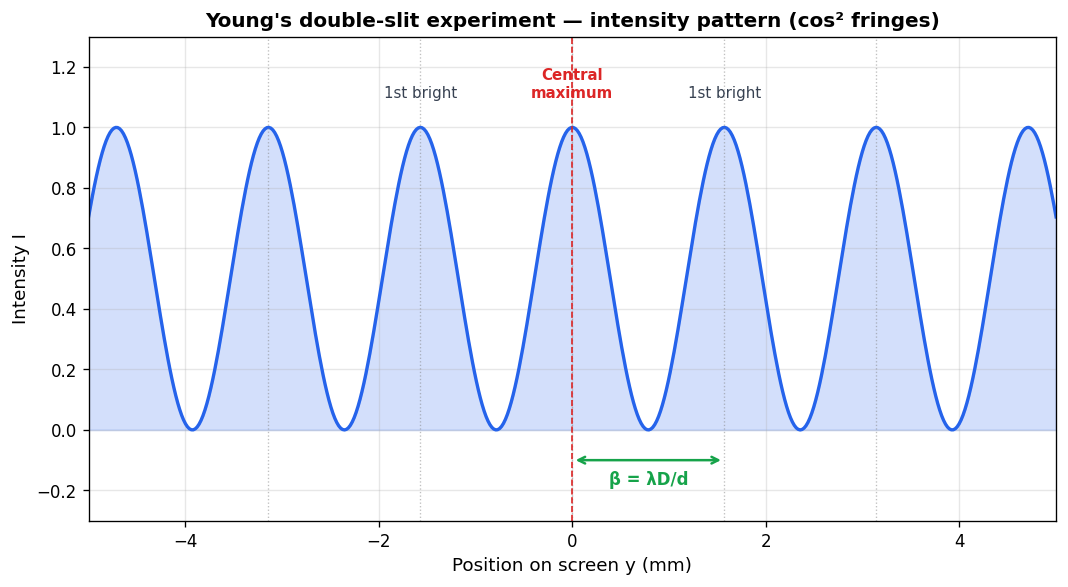
Study the Young's double-slit intensity pattern and answer:
The fringe width in YDSE is:
Aλ/d
BλD/d
Cλd/D
DλD
Bright fringes occur where:
APath difference = nλ
BPath difference = (n+1/2)λ
CPhase difference = π
DPath difference = 0 only
Explain what determines the fringe spacing.
Show answersHide answers
1. Option 2 — λD/d
2. Option 1 — Path difference = nλ
3. In Young's double-slit experiment, two coherent light sources produce a pattern of alternating bright and dark fringes on a screen. The fringe width β = λD/d depends on the wavelength λ, screen distance D, and slit separation d. Bright fringes occur at points where the path difference is nλ (constructive interference, integer n); dark fringes at (n + ½)λ (destructive interference). Intensity: I = 4I₀cos²(πyd/(λD)) where I₀ is the intensity from a single slit and y is the distance from the central maximum. All bright fringes have the same intensity — distinguishing interference from single-slit diffraction (which has decreasing fringe intensity). Used to measure wavelengths and confirm wave nature of light.