SUMMARY: The chapter on Human Reproduction in Class 12 Biology explores the structure, function, and processes involved in human reproductive systems. KEY TOPICS: male reproductive system, female reproductive system, gametogenesis, menstrual cycle, fertilization, implantation, pregnancy, parturition, lactation, reproductive health.
Correct answer: Option 3 — Ampulla of fallopian tube
Q41 Mark
Implantation of the embryo occurs in:
AOvary
BFallopian tube
CUterus
DCervix
Check answerHide answer
Correct answer: Option 3 — Uterus
Q51 Mark
The hormone responsible for milk ejection is:
AProlactin
BOxytocin
CEstrogen
DProgesterone
Check answerHide answer
Correct answer: Option 2 — Oxytocin
Short Answer Questions5 questions
Q63 Marks
Differentiate between spermatogenesis and oogenesis.
Q73 Marks
What is the menstrual cycle? Describe its phases briefly.
Q83 Marks
Explain the structure of a sperm.
Q93 Marks
What is parturition? Mention the hormones involved.
Q103 Marks
Describe the role of the placenta in human reproduction.
Long Answer Questions6 questions
Q116 Marks
Describe the male reproductive system of human with a labelled diagram.
Q126 Marks
Explain the female reproductive system of human with a labelled diagram.
Q136 Marks
Describe the menstrual cycle and its hormonal regulation.
Q146 Marks
Explain spermatogenesis with a labelled diagram.
Q156 Marks
Describe the events from fertilisation to parturition in human female.
Q166 Marks
Differentiate between spermatogenesis and oogenesis in tabular form on five features.
Assertion–Reason Questions5 questions
Q171 Mark
Assertion (A): LH surge triggers ovulation.
Reason (R): A sudden rise in LH causes the rupture of the Graafian follicle.
Show explanationHide explanation
Correct answer: Option 1 —
Both A and R are true, and R is the correct explanation of A.
Q181 Mark
Assertion (A): The corpus luteum secretes progesterone.
Reason (R): Progesterone maintains the endometrium for implantation.
Show explanationHide explanation
Correct answer: Option 1 —
Both A and R are true, and R is the correct explanation of A.
Q191 Mark
Assertion (A): The placenta is a temporary endocrine organ.
Reason (R): It secretes hormones essential for pregnancy.
Show explanationHide explanation
Correct answer: Option 1 —
Both A and R are true, and R is the correct explanation of A.
Q201 Mark
Assertion (A): Spermatogenesis occurs in seminiferous tubules.
Reason (R): Sertoli cells provide nourishment to developing sperms.
Show explanationHide explanation
Correct answer: Option 1 —
Both A and R are true, and R is the correct explanation of A.
Q211 Mark
Assertion (A): Oogenesis begins during foetal life in females.
Reason (R): The ovaries already contain primary oocytes at birth.
Show explanationHide explanation
Correct answer: Option 1 —
Both A and R are true, and R is the correct explanation of A.
Statement-Based Questions5 questions
Q221 Mark
Statement 1: Menarche is the onset of menstruation.
Statement 2: Menopause is the cessation of menstruation.
Show answerHide answer
Correct answer: Option 1 —
Both statements are true.
Q231 Mark
Statement 1: Cleavage divisions occur during the journey of the zygote.
Statement 2: They convert the zygote into a multicellular blastocyst.
Show answerHide answer
Correct answer: Option 1 —
Both statements are true.
Q241 Mark
Statement 1: The mammary glands produce milk.
Statement 2: Lactation is initiated by prolactin.
Show answerHide answer
Correct answer: Option 1 —
Both statements are true.
Q251 Mark
Statement 1: hCG is secreted by the placenta.
Statement 2: It is the basis of pregnancy tests.
Show answerHide answer
Correct answer: Option 1 —
Both statements are true.
Q261 Mark
Statement 1: Testes lie outside the abdominal cavity.
Statement 2: Spermatogenesis requires a temperature lower than body temperature.
Show answerHide answer
Correct answer: Option 1 —
Both statements are true.
Case Study / Passage Questions4 questions
Q273 Marks
A 22-year-old woman maintains a calendar of her menstrual cycle. Her cycle lasts 28 days. Day 1 marks the beginning of menstruation and ovulation occurs around day 14. The teacher uses her chart to explain the four phases of the cycle and the role of FSH LH estrogen and progesterone.
Ovulation in a 28-day cycle typically occurs on:
ADay 1
BDay 7
CDay 14
DDay 28
A surge of which hormone triggers ovulation?
AFSH
BLH
CEstrogen
DProgesterone
Describe the hormonal changes during the four phases of the menstrual cycle.
Show answersHide answers
1. Option 3 — Day 14
2. Option 2 — LH
3. The menstrual cycle has four phases — menstrual (1-5 days), follicular/proliferative (6-13 days), ovulatory (around day 14) and luteal/secretory (15-28 days). FSH stimulates follicle growth in the follicular phase. The growing follicle secretes estrogen which thickens the endometrium. A surge in LH around day 14 triggers ovulation. The remaining follicle becomes the corpus luteum and secretes progesterone in the luteal phase.
Q283 Marks
A 28-year-old woman conceives after several months of trying. The doctor confirms the pregnancy by detecting hCG in her urine. Over the next 9 months the embryo implants in the uterus the placenta develops and provides nutrition and exchange of gases until the baby is born by parturition.
Pregnancy tests detect which hormone in urine?
AFSH
BLH
ChCG
DProgesterone
Implantation of the embryo occurs in the:
AOvary
BFallopian tube
CUterus
DVagina
Explain the role of the placenta in human pregnancy.
Show answersHide answers
1. Option 3 — hCG
2. Option 3 — Uterus
3. After fertilisation the zygote undergoes cleavage divisions while travelling down the fallopian tube. By day 5-6 it forms a blastocyst that implants in the uterine endometrium. The trophoblast invades the endometrium and develops into the placenta. The placenta secretes hCG which maintains the corpus luteum and progesterone production essential for sustaining pregnancy. Estrogen, progesterone, hCG and human placental lactogen are the major pregnancy hormones.
Q293 Marks
The male reproductive system consists of various organs that play a crucial role in the production and delivery of sperm. The primary components include the testes, where spermatogenesis occurs, and the penis, which facilitates the delivery of sperm during copulation. The testes are located in the scrotum, which maintains an optimal temperature for sperm production. The epididymis stores and matures sperm before ejaculation. Accessory glands such as the seminal vesicles and prostate gland contribute fluids to form semen, which nourishes and transports sperm. Understanding these components is essential for comprehending male fertility and reproductive health.
What is the primary function of the testes in the male reproductive system?
AProduction of testosterone
BSpermatogenesis
CStorage of sperm
DFormation of semen
Explain the role of the epididymis in male reproduction.
Which accessory gland contributes fluids to semen?
APituitary gland
BSeminal vesicles
CAdrenal gland
DThyroid gland
Show answersHide answers
1. Option 2 — Spermatogenesis
2. The epididymis stores and matures sperm produced in the testes.
3. Option 2 — Seminal vesicles
Q303 Marks
The female reproductive system is complex and involves several structures that work together for reproduction. Key components include the ovaries, fallopian tubes, uterus, and vagina. Ovaries are responsible for producing ova and hormones such as estrogen and progesterone. The menstrual cycle, which averages 28 days, prepares the uterus for potential implantation of a fertilized egg. Ovulation occurs around the midpoint of the cycle, releasing an ovum into the fallopian tube. If fertilization occurs, the embryo travels to the uterus for implantation, where it can develop into a fetus.
What hormones are primarily produced by the ovaries?
ATestosterone and hCG
BEstrogen and progesterone
CInsulin and glucagon
DFSH and LH
Describe the process of ovulation in the menstrual cycle.
What is the significance of the fallopian tubes in female reproduction?
Show answersHide answers
1. Option 2 — Estrogen and progesterone
2. Ovulation is the release of an ovum from the ovary, occurring around the midpoint of the menstrual cycle.
3. The fallopian tubes are the site where fertilization typically occurs, allowing the sperm to meet the ovum.
Table-Based Questions4 questions
Q313 Marks
Study the table of male and female reproductive structures and answer:
Structure
Sex
Function
Testis
Male
Sperm and testosterone production
Seminiferous tubule
Male
Spermatogenesis
Ovary
Female
Ovum and estrogen production
Fallopian tube
Female
Site of fertilisation
Uterus
Female
Implantation and embryo development
The site of sperm production is the:
ATestis
BOvary
CUterus
DVagina
Fertilisation in humans takes place in the:
AOvary
BUterus
CVagina
DFallopian tube
Trace the path of a sperm from its site of production to the site of fertilisation.
Show answersHide answers
1. Option 1 — Testis
2. Option 4 — Fallopian tube
3. The male reproductive system consists of testes (sperm and testosterone production), accessory ducts (epididymis, vas deferens), accessory glands (seminal vesicles, prostate, bulbourethral) and the penis. The female system consists of ovaries (ovum and estrogen/progesterone production), fallopian tubes (site of fertilisation), uterus (implantation and pregnancy) and vagina. Fertilisation typically occurs in the ampulla of the fallopian tube and the embryo implants in the uterus.
Q326 Marks
Identify the dominant hormone and key event in each phase of the menstrual cycle.
Phase
Days
Dominant hormone
Key event
Menstrual
1-5
?
?
Follicular
6-13
?
?
Ovulatory
14
?
?
Luteal
15-28
?
?
Q336 Marks
What is the average duration of the menstrual cycle in days according to the data provided?
Cycle Phase
Average Duration (Days)
Menstrual Phase
5
Follicular Phase
14
Ovulation
1
Luteal Phase
14
Q342 Marks
Study the following data and answer the questions below:
Hormone
Source
Function
Estrogen
Ovaries
Regulates menstrual cycle
Progesterone
Corpus Luteum
Maintains pregnancy
Testosterone
Testes
Sperm production
LH
Pituitary Gland
Triggers ovulation
Which hormone is responsible for triggering ovulation?
What is the source of Progesterone?
Show answersHide answers
1.
2.
Picture-Based Questions4 questions
Q353 Marks
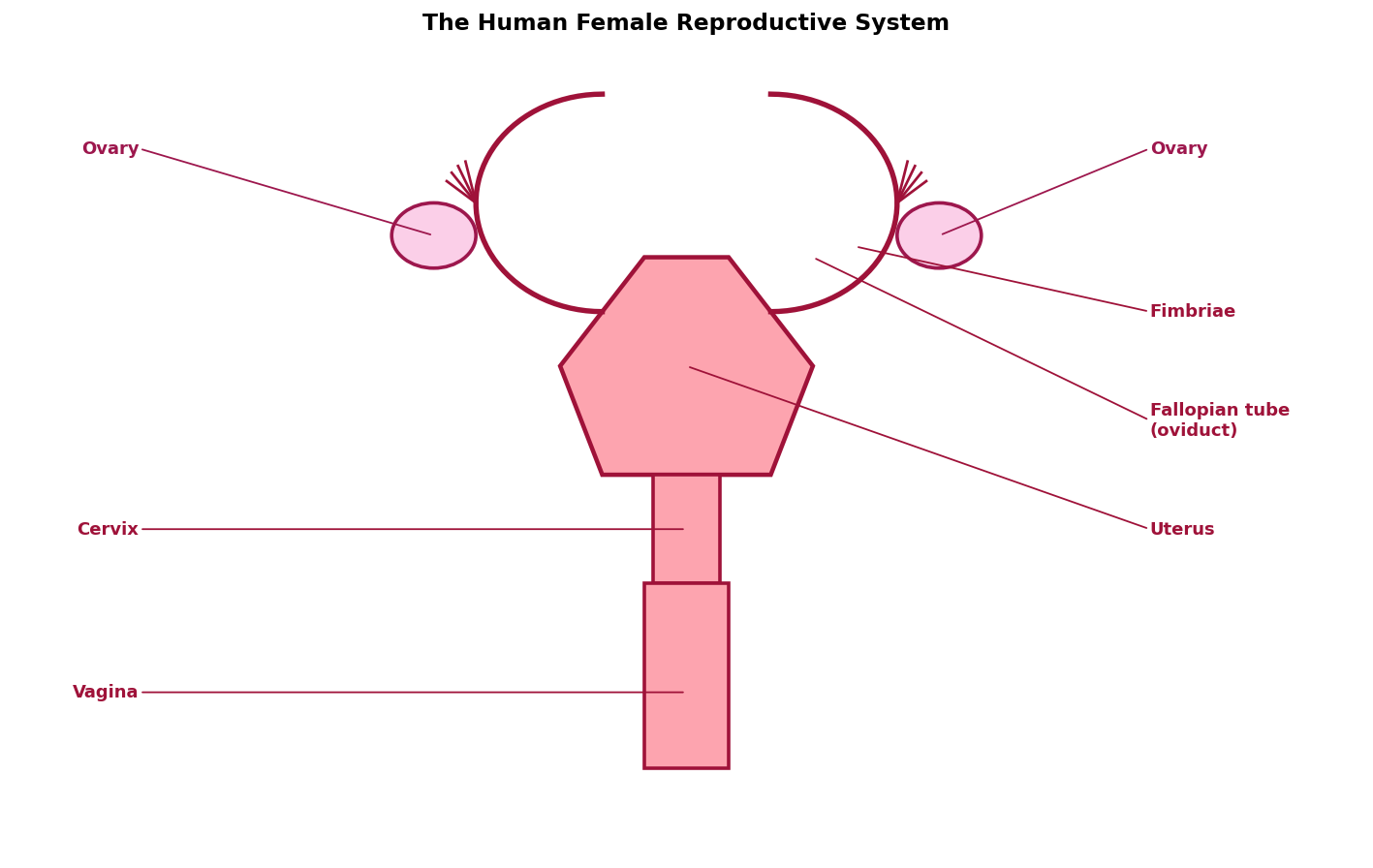
Study the diagram of the human female reproductive system and answer:
Fertilisation in humans normally occurs in the:
AOvary
BFallopian tube
CUterus
DVagina
The finger-like projections at the open end of the fallopian tube are called:
AOvary
BFimbriae
CUterus
DCervix
Describe the structure and function of the major organs of the human female reproductive system.
Show answersHide answers
1. Option None
2. Option None
3. The human female reproductive system consists of a pair of ovaries (where ova and female sex hormones are produced) a pair of fallopian tubes where fertilisation takes place a muscular uterus where the embryo implants and develops a cervix and a vagina. Fimbriae at the open end of the fallopian tube help collect the ovum after ovulation.
Q363 Marks
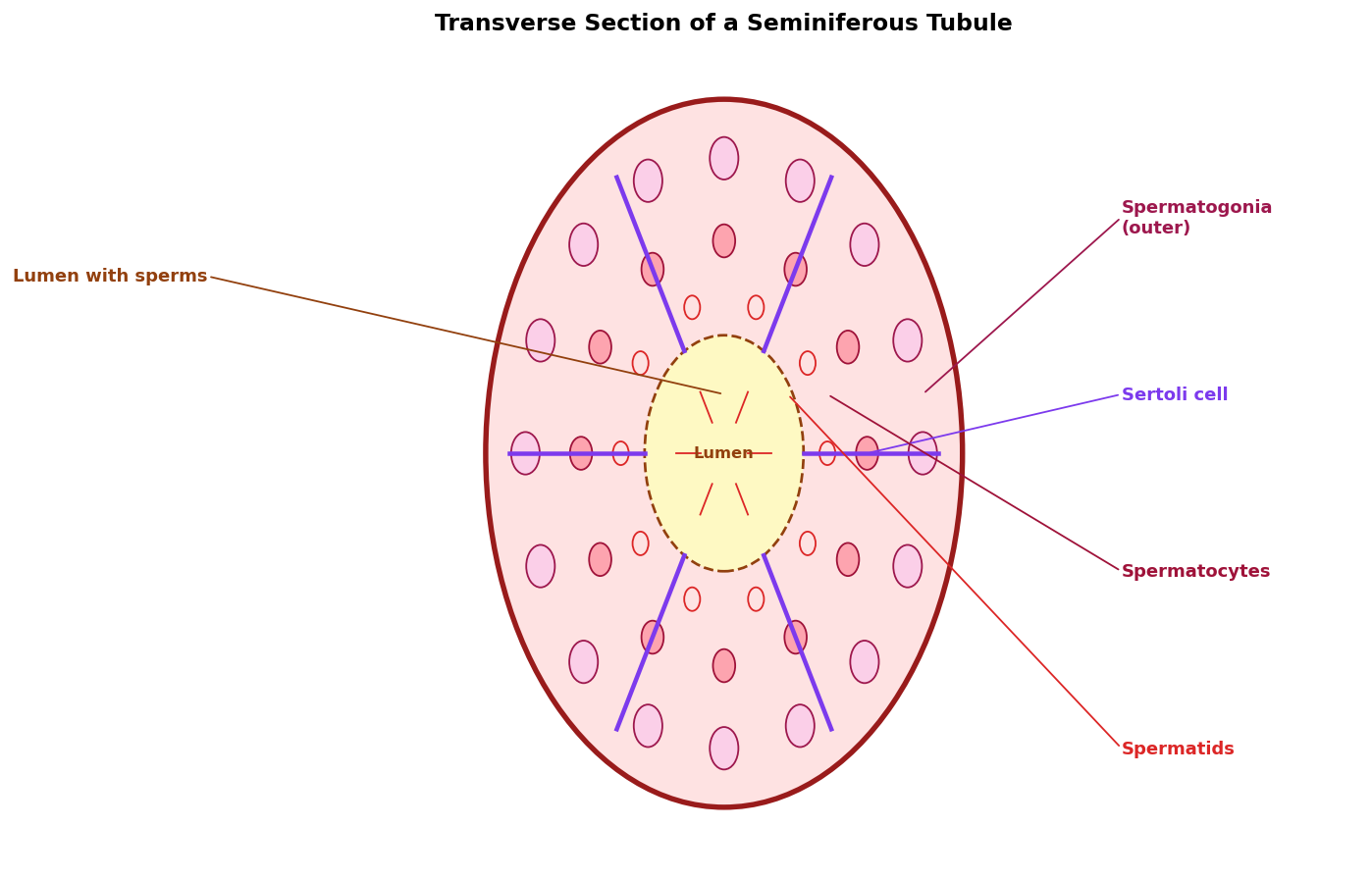
Study the T.S. of a seminiferous tubule and answer:
The seminiferous tubule produces:
ASperms
BOocytes
CHormones only
DBile
The cells that nourish the developing sperms are the:
ALeydig cells
BSertoli cells
CSpermatogonia
DSpermatozoa
Describe the structure and function of a seminiferous tubule.
Show answersHide answers
1. Option None
2. Option None
3. Seminiferous tubules are highly coiled tubules in the testes where sperm production occurs. The wall is lined with germinal epithelium consisting of spermatogonia which by mitosis and meiosis form spermatocytes spermatids and finally spermatozoa released into the lumen. Sertoli cells provide nutrition and support to developing sperms. Leydig cells lie outside the tubule and secrete testosterone.
Q373 Marks
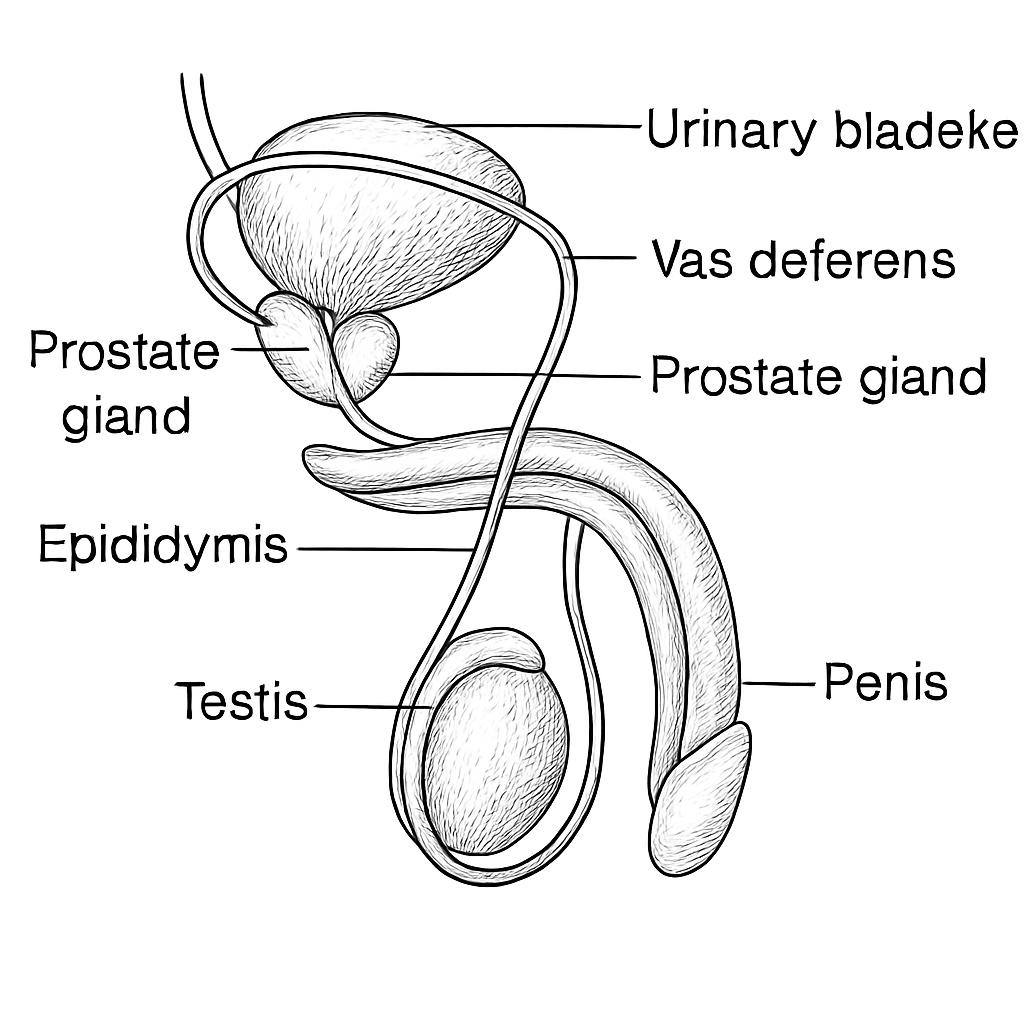
Based on the given diagram of the male reproductive system, answer the following:
What is the function of the testes?
Which structure stores sperm before ejaculation?
ASeminal vesicles
BEpididymis
CProstate gland
DVas deferens
Identify the structure labeled 'A' in the diagram.
Show answersHide answers
1. The testes produce sperm and hormones, primarily testosterone.
2. Option 2 — Epididymis
3. Epididymis
Q383 Marks
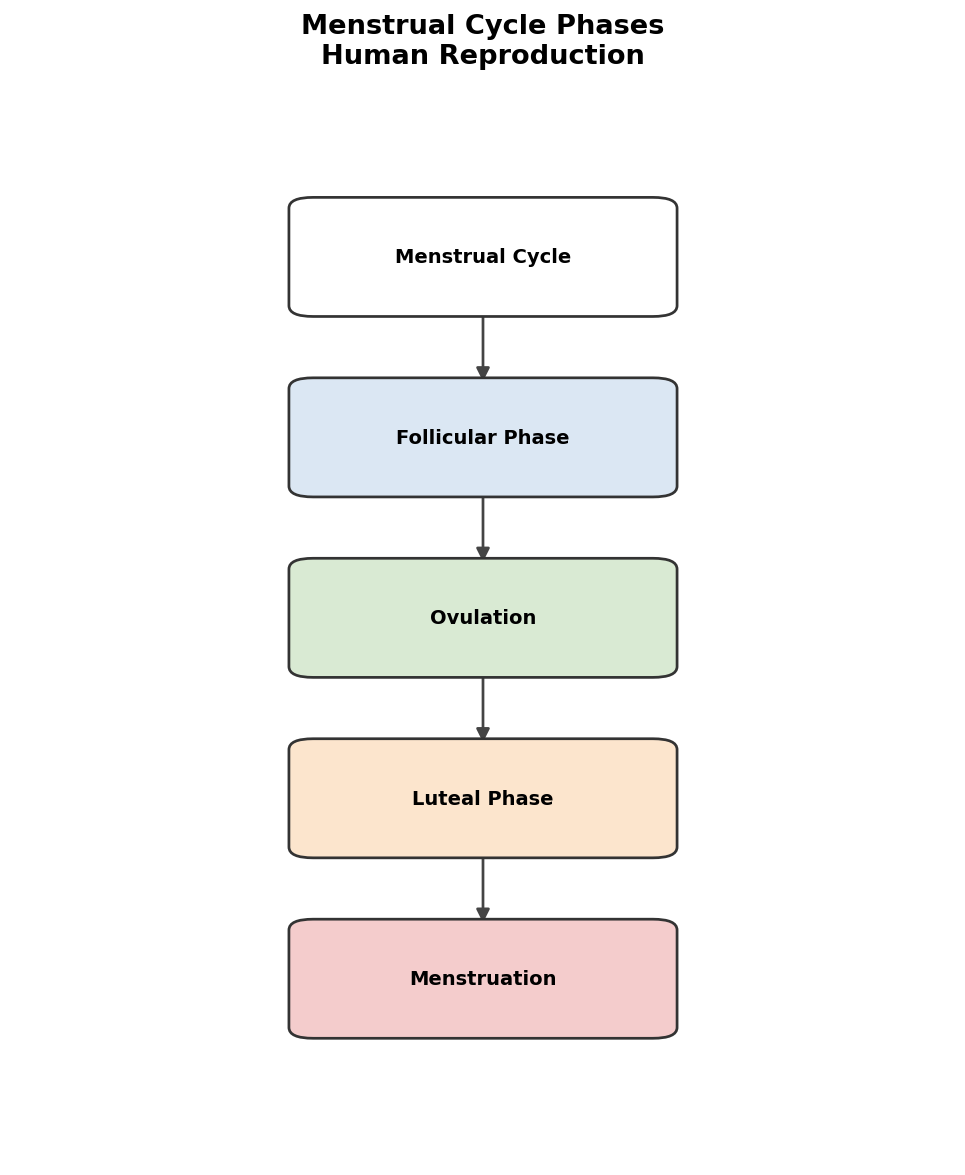
Based on the given flowchart of the menstrual cycle, answer the following:
What hormone primarily regulates the follicular phase?