Skip to content
TestMacher
Chapter 16 · Class 11 Economics

Use of Statistical Tools (Statistics for Economics) — Important Questions

59 questions With answers CBSE format

SUMMARY: This chapter focuses on the application of statistical tools in analyzing economic data and understanding economic phenomena.
KEY TOPICS: measures of central tendency, measures of dispersion, correlation, index numbers, time series analysis, graphical representation of data, frequency distribution, sampling methods, data interpretation, statistical inference

Q1 1 Mark

The Human Development Index is an example of a:

APrice index
BComposite index
CQuantity index
DSimple aggregative index
Check answerHide answer
Correct answer: Option 2 — Composite index
Q2 1 Mark

The most appropriate statistical tool to study the inter-dependence between two variables is:

AMean
BMedian
CCorrelation
DMode
Check answerHide answer
Correct answer: Option 3 — Correlation
Q3 1 Mark

When income distribution is studied graphically, the best tool is:

ABar diagram
BLorenz curve
CPie chart
DHistogram
Check answerHide answer
Correct answer: Option 2 — Lorenz curve
Q4 1 Mark

The deflator used to convert nominal GDP into real GDP is a type of:

AWage index
BPrice index
CQuantity index
DProduction index
Check answerHide answer
Correct answer: Option 2 — Price index
Q5 1 Mark

To analyse seasonal fluctuations in agricultural prices, the suitable tool is:

AScatter diagram
BTime-series analysis
CPie chart
DBar chart
Check answerHide answer
Correct answer: Option 2 — Time-series analysis
Q6 1 Mark

Which measure of central tendency is most affected by extreme values in a data set?

AMedian
BMode
CMean
DGeometric Mean
Check answerHide answer
Correct answer: Option 3 — Mean
Q7 1 Mark

If the mean of 5 observations is 10 and one observation of value 10 is removed, what is the new mean?

A10
B8
C12
D9
Check answerHide answer
Correct answer: Option 1 — 10
Q8 1 Mark

Which of the following is NOT a measure of dispersion?

ARange
BStandard Deviation
CMedian
DQuartile Deviation
Check answerHide answer
Correct answer: Option 3 — Median
Q9 1 Mark

The coefficient of correlation always lies between:

A0 and 1
B-1 and 0
C-1 and +1
D-2 and +2
Check answerHide answer
Correct answer: Option 3 — -1 and +1
Q10 1 Mark

A Laspeyre's Price Index uses which year's quantities as weights?

ACurrent year
BBase year
CAverage of base and current year
DAny convenient year
Check answerHide answer
Correct answer: Option 2 — Base year
Q11 1 Mark

In a frequency distribution, the class with the highest frequency is called the:

AMedian class
BModal class
CMean class
DCumulative class
Check answerHide answer
Correct answer: Option 2 — Modal class
Q12 1 Mark

If Karl Pearson's coefficient of correlation between two variables X and Y is -0.9, it indicates:

AStrong positive correlation
BWeak negative correlation
CStrong negative correlation
DNo correlation
Check answerHide answer
Correct answer: Option 3 — Strong negative correlation
Q13 1 Mark

Which graphical method is most appropriate for representing the trend in a time series of national income over 10 years?

APie chart
BBar diagram
CLine graph
DHistogram
Check answerHide answer
Correct answer: Option 3 — Line graph
Q14 1 Mark

In stratified random sampling, the population is divided into groups called:

AClusters
BStrata
CBlocks
DSegments
Check answerHide answer
Correct answer: Option 2 — Strata
Q15 1 Mark

The standard deviation of a data set is 6 and its mean is 30. The coefficient of variation (CV) is:

A5%
B180%
C20%
D24%
Check answerHide answer
Correct answer: Option 3 — 20%
Q16 3 Marks

State any two ways statistical tools are used in economic analysis.

View sample solutionHide solution
(i) Measures of central tendency and dispersion summarise large datasets on incomes, prices or output into comparable aggregates. (ii) Correlation and index numbers identify relationships between variables (e.g. income and consumption) and track changes over time (e.g. CPI-based inflation), informing policy.
Q17 3 Marks

How is CPI used to compute real income?

View sample solutionHide solution
Real income = (Nominal income × 100) / CPI. By dividing nominal income by the CPI and multiplying by 100 we remove the effect of changes in the general price level, giving a measure of the purchasing power of that income in base-period prices.
Q18 3 Marks

How can a Lorenz curve help in policy-making?

View sample solutionHide solution
By visualising how income (or wealth) is distributed across the population, the Lorenz curve helps policy-makers gauge the degree of inequality and the impact of redistributive measures (progressive taxes, subsidies, welfare transfers). Movement of the curve closer to the 45° line over time indicates reduced inequality.
Q19 3 Marks

Why is correlation useful in economic analysis?

View sample solutionHide solution
Correlation quantifies the strength and direction of association between economic variables — e.g. between interest rates and investment, or inflation and unemployment — helping economists test theoretical relationships, build forecasting models, and design policy interventions.
Q20 3 Marks

Outline the basic steps of a statistical project.

View sample solutionHide solution
(i) Define the objective clearly. (ii) Design the data collection — decide primary/secondary sources, sampling method, questionnaire. (iii) Collect and tabulate data. (iv) Analyse using appropriate tools (central tendency, dispersion, correlation, index numbers). (v) Interpret results and draw conclusions. (vi) Present findings in tables, graphs and a written report.
Q21 3 Marks

What is the arithmetic mean and how is it calculated for ungrouped data?

View sample solutionHide solution
The arithmetic mean is the sum of all observations divided by the total number of observations. For ungrouped data, it is calculated as Mean = ΣX / N, where ΣX is the sum of all values and N is the number of observations. It is the most commonly used measure of central tendency.
Q22 3 Marks

Define median and explain when it is preferred over the arithmetic mean.

View sample solutionHide solution
The median is the middle value of a dataset when observations are arranged in ascending or descending order. It is preferred over the arithmetic mean when the data contains extreme values or outliers, as the median is not affected by such values. For example, in income distribution data, the median gives a more representative central value.
Q23 3 Marks

What is a frequency distribution and why is it useful in statistical analysis?

View sample solutionHide solution
A frequency distribution is a table that organizes data into classes or intervals and shows the number of observations (frequency) falling in each class. It is useful because it summarizes large datasets in a compact form, making it easier to identify patterns, trends, and the spread of data. It forms the basis for further statistical calculations.
Q24 3 Marks

Distinguish between range and standard deviation as measures of dispersion.

View sample solutionHide solution
Range is the simplest measure of dispersion, calculated as the difference between the highest and lowest values in a dataset. Standard deviation, on the other hand, measures the average deviation of each observation from the mean, taking all values into account. Standard deviation is a more reliable and comprehensive measure as it is not affected by just the extreme values.
Q25 3 Marks

What is the coefficient of variation and what does it indicate?

View sample solutionHide solution
The coefficient of variation (CV) is a relative measure of dispersion calculated as CV = (Standard Deviation / Mean) × 100. It expresses dispersion as a percentage of the mean, making it useful for comparing the variability of two or more datasets with different units or means. A lower CV indicates greater consistency or uniformity in the data.
Q26 6 Marks

Explain how statistical tools are applied in everyday economic analysis.

View sample solutionHide solution
Statistical tools are used at every step of economic reasoning: (i) Measures of central tendency summarise average household income, average output per worker, average wage; (ii) Dispersion measures capture inequality (standard deviation of income, Lorenz curve, Gini); (iii) Correlation helps test theoretical relationships (income-consumption link, price-quantity demanded); (iv) Index numbers track changes in price levels (CPI, WPI), production (IIP) and living costs; (v) Time-series analysis of GDP, inflation and employment guides fiscal and monetary policy; (vi) Sample surveys (NSSO) provide timely insight into employment, expenditure, healthcare usage without the cost of a full census; (vii) Graphical tools (histograms, pie charts, bar diagrams, Lorenz curves) communicate complex data to policy-makers and the public. In short, statistical tools transform raw economic observations into actionable knowledge, and the choice of tool depends on the question being asked.
Q27 6 Marks

Describe how you would analyse monthly household expenditure data for a city using statistical tools.

View sample solutionHide solution
Step-by-step: (1) Define objective — e.g. study the central tendency and dispersion of monthly expenditure. (2) Collect primary data via a stratified random sample of, say, 100 households across income strata; use a pretested questionnaire. Alternatively, use NSSO Consumer Expenditure data as a secondary source. (3) Organise data — tabulate expenditure in class intervals (e.g. 0-5000, 5000-10000,...). (4) Present data — plot a histogram and pie-chart showing expenditure shares on food, housing, etc. (5) Compute mean expenditure and the median — comparing them reveals skewness. (6) Compute standard deviation and coefficient of variation to measure dispersion. (7) Draw a Lorenz curve of expenditure against cumulative households to study inequality. (8) If another variable (income) is available, compute correlation with expenditure. (9) Write up findings — interpret the numbers in economic terms, highlight limitations of the sample, and present recommendations for policy (subsidy targeting, welfare schemes).
Q28 6 Marks

Explain how CPI is used to convert nominal wages into real wages with a numerical example.

View sample solutionHide solution
Real wage = (Nominal wage × 100) / CPI. CPI measures the cost of a fixed basket relative to a base year set at 100. If CPI rises, the purchasing power of a rupee falls. Example: Ravi's nominal monthly wage in 2020 was ₹20 000 (CPI 2020 = 100). In 2024 his wage is ₹26 000 (CPI 2024 = 130). Nominal wage rose 30%, but real wage in 2020-prices = (26 000 × 100) / 130 = ₹20 000. So his real wage has not changed — the nominal rise was just compensation for inflation. Government DA (dearness allowance) uses the same idea: periodic adjustments are granted so that the real wage is protected. This conversion also underlies the difference between nominal and real GDP — an economy may 'grow' in nominal terms due to inflation while real output is stagnant.
Q29 6 Marks

Outline the stages of conducting a small statistical project on unemployment in your locality.

View sample solutionHide solution
Stages: (1) Define the problem — measure the prevalence of unemployment among working-age residents of the locality. (2) Review existing data — NSSO PLFS, state employment reports — to fix definitions and to calibrate expectations. (3) Design the sample — a systematic random sample of 50 households by ward; decide on rotation groups if the study is longitudinal. (4) Design the questionnaire — cover age, education, current activity, hours of work last week, willingness to work. Pretest on a pilot of 5 households and refine. (5) Collect data — train enumerators, schedule visits and call-backs. (6) Tabulate and classify — by age, education, gender; compute unemployment rate, worker-population ratio, labour-force participation rate. (7) Analyse with statistical tools — measures of central tendency for duration of unemployment, dispersion to compare sub-groups, bar charts and pie charts. (8) Interpret results — state reliability, sampling and non-sampling errors, compare with national figures. (9) Report — title, methodology, tables, charts, conclusions and policy suggestions. This mimics how large-scale surveys like PLFS are conducted professionally.
Q30 6 Marks

Explain, with examples, how a combination of statistical tools can be used to study a key economic issue such as inflation.

View sample solutionHide solution
Studying inflation with statistics uses a combination of tools: (1) Collection of data — retail prices of a basket of goods and services are collected monthly from representative markets (NSO for CPI, Office of the Economic Adviser for WPI). (2) Classification and weighting — items are grouped into categories (food, fuel, housing, etc.) with weights derived from household expenditure surveys. (3) Index construction — using Laspeyres-type weighting to compute CPI / WPI; sub-indices track category inflation. (4) Central tendency — year-on-year or month-on-month % change gives a headline inflation rate. (5) Dispersion — standard deviation of inflation across cities or categories shows how uneven price pressures are. (6) Correlation — correlation of CPI with money-supply growth or oil prices informs causes. (7) Graphical presentation — line charts of CPI and WPI over time; bar charts for category-wise inflation. (8) Interpretation — monetary-policy committees use these to set the repo rate. The example illustrates that no single tool is enough; central tendency, dispersion, correlation, index numbers and graphical methods work together to build a complete picture.
Q31 6 Marks

Explain the concept of arithmetic mean as a measure of central tendency. Discuss its merits and demerits with suitable examples from economic data.

View sample solutionHide solution
The arithmetic mean is the most commonly used measure of central tendency. It is calculated by summing all the values in a dataset and dividing by the total number of observations. For example, if the monthly incomes of five workers are ₹5000, ₹6000, ₹7000, ₹8000, and ₹9000, the arithmetic mean income = (5000+6000+7000+8000+9000)/5 = ₹7000. Merits of arithmetic mean include: it is easy to calculate and understand, it uses all values in the dataset, it is suitable for further algebraic treatment, and it provides a single representative value. Demerits include: it is highly affected by extreme values (outliers), it cannot be used for open-ended frequency distributions, it may give a value that does not exist in the data (e.g., 2.5 children), and it can be misleading when the data is skewed. In economics, while calculating average income or average price, the arithmetic mean is widely used, but care must be taken when extreme values are present as they can distort the true picture of the data.
Q32 1 Mark

Assertion (A): Statistical tools are essential for evidence-based economic policy.

Reason (R): Quantitative evidence makes decisions more objective than reliance on opinion or anecdote.

Show explanationHide explanation
Correct answer: Option 1 — Both A and R are true, and R is the correct explanation of A.
Q33 1 Mark

Assertion (A): Correlation helps identify the relationship between economic variables.

Reason (R): It quantifies both the direction and the strength of the association between two variables.

Show explanationHide explanation
Correct answer: Option 1 — Both A and R are true, and R is the correct explanation of A.
Q34 1 Mark

Assertion (A): A statistical project is only as good as the data it uses.

Reason (R): Wrong or biased data produce conclusions that can mislead, no matter how sophisticated the analysis.

Show explanationHide explanation
Correct answer: Option 1 — Both A and R are true, and R is the correct explanation of A.
Q35 1 Mark

Assertion (A): Dividing nominal income by the CPI and multiplying by 100 gives real income.

Reason (R): This removes the effect of the general price level on the money value of income.

Show explanationHide explanation
Correct answer: Option 1 — Both A and R are true, and R is the correct explanation of A.
Q36 1 Mark

Assertion (A): Graphical methods are a useful complement to statistical analysis.

Reason (R): Diagrams often convey patterns and comparisons to the reader more quickly than tables.

Show explanationHide explanation
Correct answer: Option 1 — Both A and R are true, and R is the correct explanation of A.
Q37 1 Mark

Assertion (A): The arithmetic mean is affected by extreme values in a data set.

Reason (R): The arithmetic mean is calculated by summing all values and dividing by the number of observations, making it sensitive to outliers.

Show explanationHide explanation
Correct answer: Option 1 — Both A and R are true, and R is the correct explanation of A.
Q38 1 Mark

Assertion (A): Median is the best measure of central tendency for open-ended frequency distributions.

Reason (R): Median divides the distribution into two equal halves and does not require the actual values of extreme items for its calculation.

Show explanationHide explanation
Correct answer: Option 1 — Both A and R are true, and R is the correct explanation of A.
Q39 1 Mark

Assertion (A): Standard deviation is an absolute measure of dispersion.

Reason (R): Coefficient of variation is used to compare variability between two series with different units or means.

Show explanationHide explanation
Correct answer: Option 2 — Both A and R are true, but R is not the correct explanation of A.
Q40 1 Mark

Statement 1: Statistical tools are used throughout economic research.

Statement 2: The choice of tool depends on the nature of the data and the question being asked.

Show answerHide answer
Correct answer: Option 1 — Both statements are true.
Q41 1 Mark

Statement 1: The NSO releases key Indian economic data.

Statement 2: The RBI supplements this with financial and monetary statistics.

Show answerHide answer
Correct answer: Option 1 — Both statements are true.
Q42 1 Mark

Statement 1: Sampling techniques are useful when the population is very large.

Statement 2: Every statistical enquiry in India is based on a full census of the population.

Show answerHide answer
Correct answer: Option 3 — Only Statement 2 is true.
Q43 1 Mark

Statement 1: Data interpretation is as important as data collection.

Statement 2: The reliability of conclusions depends on the accurate interpretation of the numbers.

Show answerHide answer
Correct answer: Option 1 — Both statements are true.
Q44 1 Mark

Statement 1: Dividing nominal income by CPI and multiplying by 100 yields real income.

Statement 2: This adjustment removes the influence of changes in the general price level.

Show answerHide answer
Correct answer: Option 1 — Both statements are true.
Q45 1 Mark

Statement 1: The arithmetic mean is affected by extreme values in a data set.

Statement 2: The median is also affected by extreme values in a data set.

Show answerHide answer
Correct answer: Option 2 — Only Statement 1 is true.
Q46 1 Mark

Statement 1: Standard deviation is the square root of variance.

Statement 2: A higher standard deviation indicates less dispersion in the data.

Show answerHide answer
Correct answer: Option 2 — Only Statement 1 is true.
Q47 1 Mark

Statement 1: A correlation coefficient of +1 indicates a perfect positive correlation between two variables.

Statement 2: A correlation coefficient of 0 indicates a perfect negative correlation between two variables.

Show answerHide answer
Correct answer: Option 2 — Only Statement 1 is true.
Q48 3 Marks
A student is preparing a project on 'distribution of household expenditure in her locality'. She has already collected data on monthly expenditure of 100 households.
  1. Which tools will summarise the typical household expenditure?
    AMean and median
    BCPI
    CCorrelation coefficient
    DGini ratio only
  2. Which tools will summarise the variability of expenditure?
    ARange and standard deviation
    BCPI
    CLaspeyres index
    DRank correlation
  3. Outline the analysis she should perform with these tools.
Show answersHide answers
1. Option 1 — Mean and median
2. Option 1 — Range and standard deviation
3. Start with descriptive tables, histograms and a pie-chart of share spent on major heads. Compute mean and median to locate typical expenditure; report SD and coefficient of variation. Plot a Lorenz curve to visualise inequality. Comment on the skewness and discuss policy implications (e.g. the typical household spends 40% of income on food).
Q49 3 Marks
Ravi's monthly nominal salary rose from ₹30 000 in 2015 (CPI = 112) to ₹45 000 in 2024 (CPI = 156). He wonders whether his real purchasing power has improved.
  1. Ravi's 2024 real wage at 2012 prices is approximately:
    A₹26 786
    B₹28 846
    C₹30 000
    D₹45 000
  2. His 2015 real wage at 2012 prices is approximately:
    A₹26 786
    B₹28 846
    C₹30 000
    D₹45 000
  3. Compute and interpret Ravi's real wage growth.
Show answersHide answers
1. Option 2 — ₹28 846
2. Option 1 — ₹26 786
3. 2024 real wage = (45 000 × 100) / 156 ≈ ₹28 846. 2015 real wage = (30 000 × 100) / 112 ≈ ₹26 786. Ravi's real wage has risen from ₹26 786 to ₹28 846 — a modest real improvement of about 7.7%. Most of his 50% nominal rise was just compensation for inflation.
Q50 3 Marks
A Class 11 student wants to conduct a small project on unemployment in her locality. She plans to survey 30 households and collect data on age, education, and current work status.
  1. Her data-collection method is best described as:
    ACensus
    BSample survey
    CPilot survey
    DOpinion poll
  2. Which summary statistic is most relevant for the unemployment objective?
    AArithmetic mean
    BMedian
    CUnemployment rate (%)
    DLorenz curve
  3. Outline the key steps of the project.
Show answersHide answers
1. Option 2 — Sample survey
2. Option 3 — Unemployment rate (%)
3. Steps: (i) define unemployment using PLFS / NSSO conventions; (ii) design a short questionnaire; (iii) sample 30 households representatively; (iv) classify adults into employed / unemployed / not in labour force; (v) compute unemployment rate = (unemployed / labour force) × 100; (vi) cross-tabulate by age and education; (vii) present with bar charts; (viii) discuss limitations of a small sample. The project mimics a professional survey while being feasible for a student.
Q51 4 Marks
A statistics teacher asked students to analyze the monthly income (in ₹) of 10 families in a village: 2000, 3000, 4000, 5000, 6000, 7000, 8000, 9000, 10000, and 50000. The students calculated the arithmetic mean and found it to be ₹10,400. However, one student pointed out that this value does not truly represent the data because of the extreme value of ₹50,000. The teacher then asked them to calculate the median, which turned out to be ₹6,500. The teacher explained that measures of central tendency help summarize a large set of data into a single representative value, but the choice of measure depends on the nature and distribution of the data.
  1. Which measure of central tendency is least affected by extreme values?
    AArithmetic Mean
    BMedian
    CMode
    DGeometric Mean
  2. What is the median of the given income data: 2000, 3000, 4000, 5000, 6000, 7000, 8000, 9000, 10000, 50000?
    A₹5,500
    B₹6,000
    C₹6,500
    D₹7,000
  3. Why is the arithmetic mean considered a poor representative of the income data in this passage? Explain briefly.
  4. Name the type of data distribution where one or more extreme values distort the mean significantly.
    ANormal Distribution
    BSymmetric Distribution
    CSkewed Distribution
    DUniform Distribution
Show answersHide answers
1. Option 2 — Median
2. Option 3 — ₹6,500
3. The arithmetic mean is pulled upward by the extreme value of ₹50,000, making it ₹10,400, which is higher than 9 out of 10 families' incomes. It does not truly represent the typical income of the families, making it a poor measure in this skewed distribution.
4. Option 3 — Skewed Distribution
Q52 3 Marks

Study the statistical tool and typical application mapping:

ToolTypical economic application
Arithmetic meanAverage household income
Standard deviation / CVInequality across regions
Lorenz curveIncome / wealth inequality
CorrelationRelationship between income and consumption
CPI / WPITracking inflation
  1. Which tool best captures income inequality?
    AArithmetic mean
    BLorenz curve
    CCorrelation
    DCPI
  2. Which tool is used to track price changes over time?
    AArithmetic mean
    BStandard deviation
    CCPI / WPI
    DCorrelation
  3. Why is a combination of statistical tools typically needed?
Show answersHide answers
1. Option 2 — Lorenz curve
2. Option 3 — CPI / WPI
3. No single tool does everything. Combining them — central tendency, dispersion, inequality, correlation, index numbers — gives a comprehensive picture of the economic phenomenon under study. A good analyst picks the smallest set of tools that answers the questions posed.
Q53 3 Marks

Study the poverty-line data and answer:

YearRural poverty %Urban poverty %All India %
1993-9450.131.845.3
2004-0541.825.737.2
2011-1225.713.721.9
  1. Between 1993-94 and 2011-12 the all-India poverty rate fell by approximately:
    A10 ppt
    BAbout 15 ppt
    CAbout 23 ppt
    DAbout 30 ppt
  2. Which region saw a larger absolute drop in poverty?
    ARural
    BUrban
    CBoth equal
    DCannot say
  3. Which statistical tools would you use to analyse poverty data like this?
Show answersHide answers
1. Option 3 — About 23 ppt
2. Option 1 — Rural
3. Descriptive tables, bar diagrams and time-series charts show the decline. Central tendency summarises levels; dispersion measures — say the rural-urban gap — illustrate inequality; CPI converts nominal expenditure to real; Lorenz curves visualise inequality. Together they build a clear picture of poverty reduction and its remaining challenges.
Q54 3 Marks

Study the following frequency distribution data and answer the questions below:

Class IntervalFrequency (f)
0 - 105
10 - 2010
20 - 3020
30 - 409
40 - 506
  1. Calculate the mean of the given frequency distribution.
  2. Identify the modal class and calculate the mode using the formula.
  3. Which measure of central tendency is most appropriate when the distribution is skewed?
Show answersHide answers
1. Mean = Σfx / Σf. Midpoints: 5,15,25,35,45. Σfx = 5×5 + 10×15 + 20×25 + 9×35 + 6×45 = 25+150+500+315+270 = 1260. Σf = 50. Mean = 1260/50 = 25.2
2. Modal class = 20-30 (highest frequency = 20). Mode = L + [(f1-f0)/(2f1-f0-f2)] × h = 20 + [(20-10)/(40-10-9)] × 10 = 20 + [10/21] × 10 = 20 + 4.76 = 24.76
3. Median is most appropriate for skewed distributions as it is not affected by extreme values.
Q55 3 Marks

Study the following data on runs scored by two batsmen and answer the questions below:

BatsmanMean RunsStandard Deviation
Batsman A5010
Batsman B505
  1. Calculate the Coefficient of Variation (CV) for both batsmen.
  2. Which batsman is more consistent and why?
  3. Coefficient of Variation is used to compare:
Show answersHide answers
1. CV = (SD/Mean) × 100. CV of A = (10/50) × 100 = 20%. CV of B = (5/50) × 100 = 10%.
2. Batsman B is more consistent because his CV (10%) is lower than Batsman A's CV (20%). A lower CV indicates less relative variability and hence greater consistency.
3. Coefficient of Variation is used to compare the relative dispersion (variability) of two or more series.
Q56 3 Marks

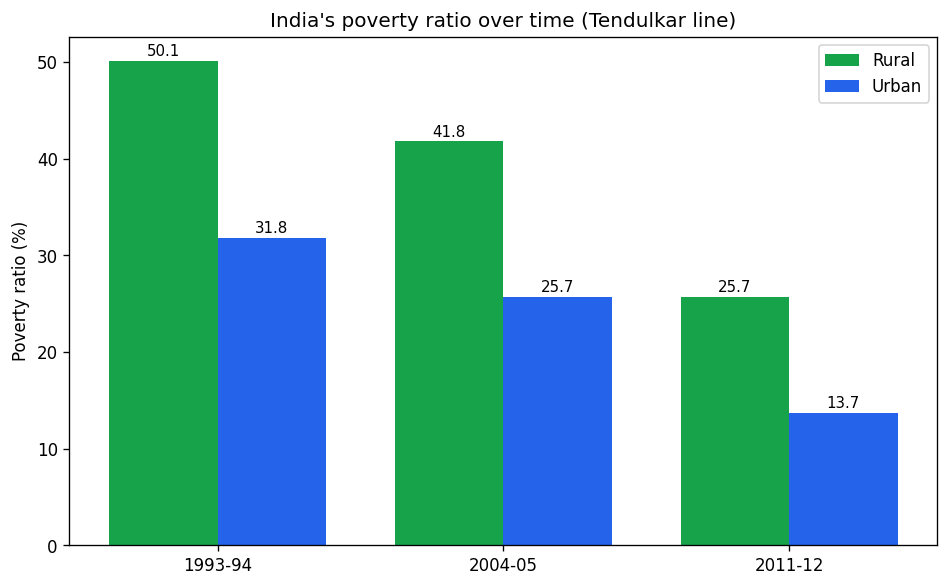
Study the poverty-ratio trend and answer:

Use of Statistical Tools (Statistics for Economics) figure
  1. Which region saw a larger absolute fall in poverty between 1993-94 and 2011-12?
    ARural
    BUrban
    CBoth fell equally
    DCannot say
  2. The 2011-12 all-India poverty ratio (Tendulkar) is closest to:
    AAround 14%
    BAround 22%
    CAround 45%
    DAround 50%
  3. State two factors that contributed to the decline in poverty over this period.
Show answersHide answers
1. Option 1 — Rural
2. Option 2 — Around 22%
3. Sustained GDP growth after 1991 raised employment and wages; targeted welfare programmes (PDS, MGNREGA, NRLM, ICDS) improved food security and rural livelihoods; agricultural support through MSP stabilised farm incomes. Together these raised millions out of poverty, although rural poverty still remains higher than urban.
Q57 4 Marks

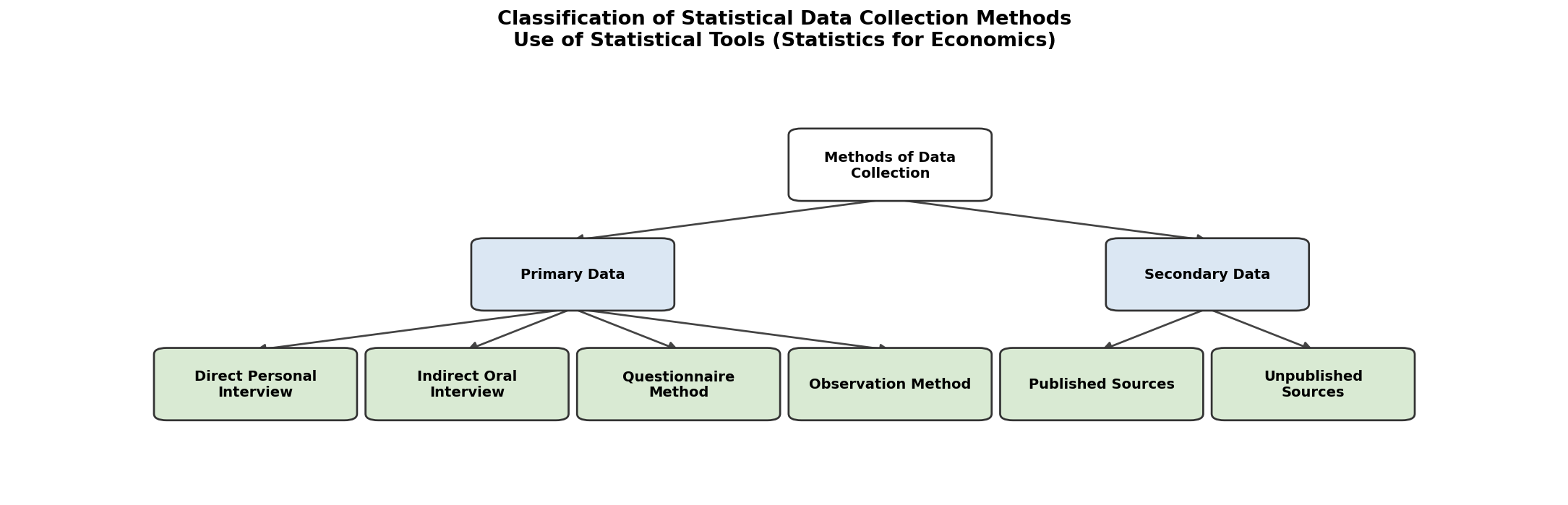
Based on the given diagram, answer the following:

Use of Statistical Tools (Statistics for Economics) figure
  1. Which of the following is a method of collecting Primary Data?
    APublished Sources
    BUnpublished Sources
    CDirect Personal Interview
    DGovernment Reports
  2. What is the key difference between Primary Data and Secondary Data?
  3. Which method of primary data collection is most suitable when the area of investigation is very large and informants are scattered?
    ADirect Personal Interview
    BObservation Method
    CQuestionnaire Method
    DIndirect Oral Interview
  4. Give one example each of a Published Source and an Unpublished Source of Secondary Data.
  5. Which measure of central tendency is most affected by extreme values (outliers)?
    AMode
    BMedian
    CArithmetic Mean
    DRange
  6. Differentiate between Measures of Central Tendency and Measures of Dispersion.
  7. Which measure of dispersion is considered the most reliable and widely used in statistical analysis?
    ARange
    BMean Deviation
    CLorenz Curve
    DStandard Deviation
  8. What is the Lorenz Curve used for in economic analysis?
Show answersHide answers
1. Option 3 — Direct Personal Interview
2. Primary Data is collected for the first time by the investigator for a specific purpose, while Secondary Data is data that has already been collected and published or recorded by someone else.
3. Option 3 — Questionnaire Method
4. Published Source: Reports published by the Reserve Bank of India (RBI) or Census of India. Unpublished Source: Records maintained by a private firm or an individual researcher's notes.
5. Option 3 — Arithmetic Mean
6. Measures of Central Tendency (Mean, Median, Mode) describe the central or typical value of a dataset, showing where data tends to cluster. Measures of Dispersion (Range, Mean Deviation, Standard Deviation) describe the spread or variability of data around the central value, indicating how scattered the data is.
7. Option 4 — Standard Deviation
8. The Lorenz Curve is a graphical measure of dispersion used to represent the inequality in the distribution of income or wealth in an economy. It plots the cumulative percentage of income against the cumulative percentage of the population. The farther the Lorenz Curve is from the line of equal distribution (diagonal), the greater the inequality.

Q58 4 Marks

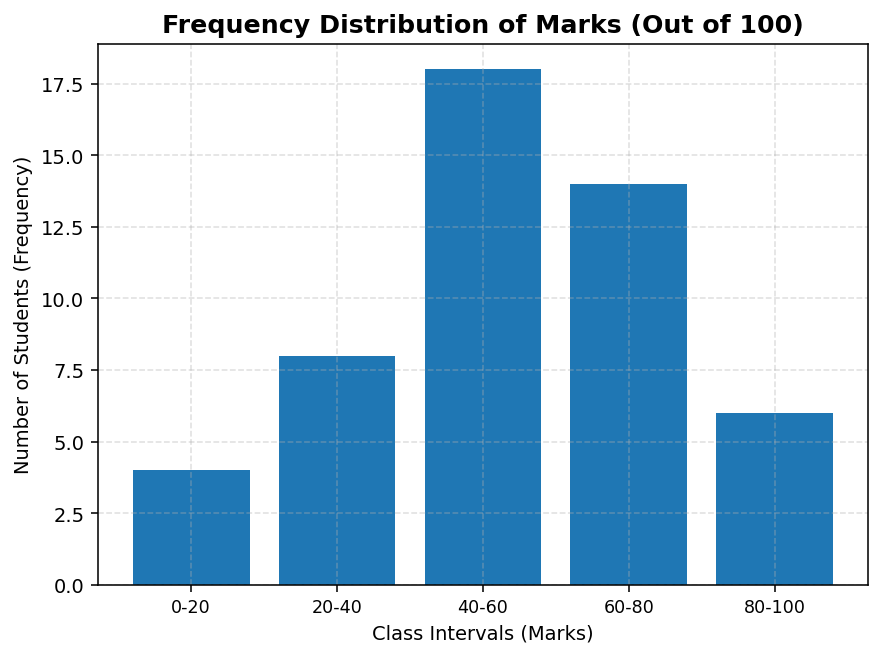
Based on the given chart showing the frequency distribution of marks obtained by 50 students, answer the following:

Use of Statistical Tools (Statistics for Economics) figure
  1. Which class interval has the highest frequency?
    A20-40
    B40-60
    C60-80
    D80-100
  2. What is the modal class of the given frequency distribution?
  3. Calculate the cumulative frequency for the class interval up to 60 marks.
  4. What percentage of students scored more than 60 marks?
    A28%
    B30%
    C40%
    D50%
Show answersHide answers
1. Option 2 — 40-60
2. The modal class is 40-60 because it has the highest frequency (18 students).
3. Cumulative frequency up to 60 = 4 + 8 + 18 = 30 students.
4. Option 3 — 40%
Q59 4 Marks

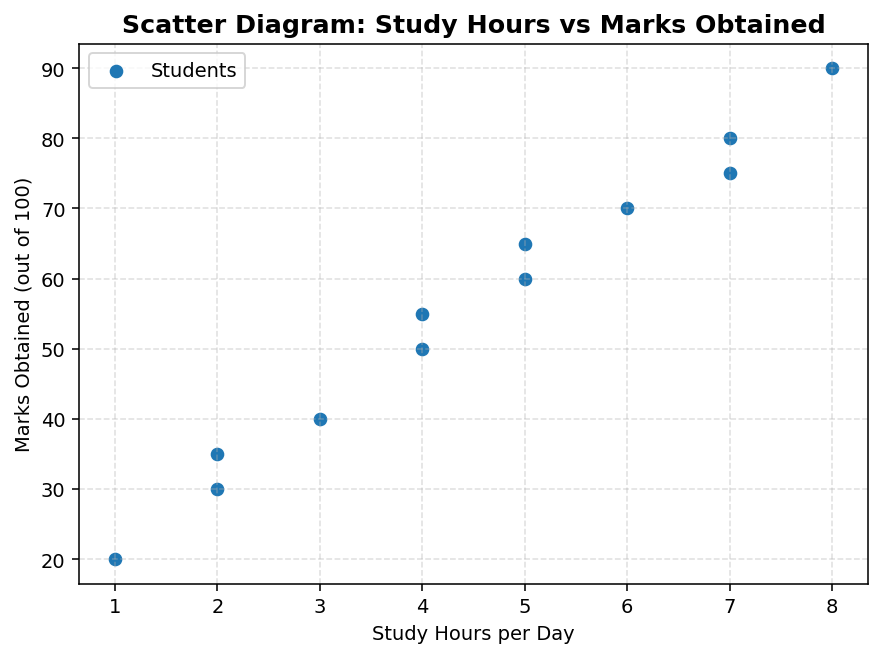
Based on the given scatter diagram showing the relationship between study hours and marks obtained by students, answer the following:

Use of Statistical Tools (Statistics for Economics) figure
  1. What type of correlation is indicated by the scatter diagram?
    ANegative Correlation
    BZero Correlation
    CPositive Correlation
    DNo Relationship
  2. Define correlation and state its significance in statistical analysis.
  3. If the correlation coefficient (r) for the above data is approximately +0.98, what does this value indicate?
    AWeak positive correlation
    BNo correlation
    CStrong negative correlation
    DStrong positive correlation
  4. Can we conclude causation from the scatter diagram alone? Justify your answer.
Show answersHide answers
1. Option 3 — Positive Correlation
2. Correlation is a statistical measure that describes the degree and direction of the linear relationship between two variables. Its significance lies in helping economists and researchers understand how two variables move together, enabling prediction and informed decision-making.
3. Option 4 — Strong positive correlation
4. No, we cannot conclude causation from a scatter diagram alone. Correlation only shows the degree of association between two variables; it does not prove that one variable causes the other. Other factors (like intelligence, teaching quality) may also affect marks.

Make a full Economics paper on Use of Statistical Tools (Statistics for Economics).

Pick the question mix, set the marks, hit generate. You get a ready-to-print paper with an answer key.

Generate your paper — free