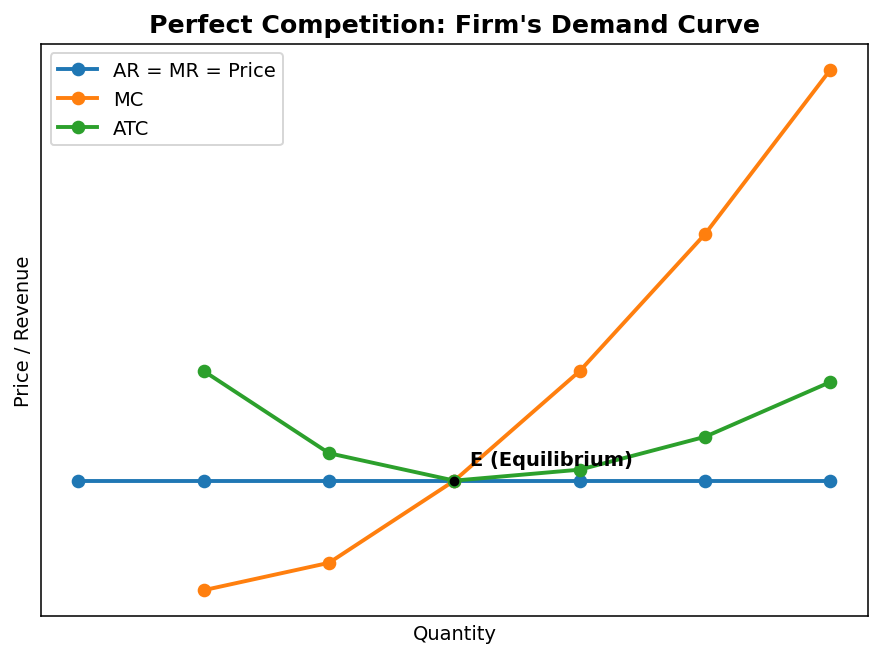
Under perfect competition, the demand curve faced by an individual firm is:
Market Forms (Microeconomics) — Important Questions
SUMMARY: The chapter "Market Forms" in Class 11 Economics explores different types of market structures and their characteristics in microeconomics.
KEY TOPICS: Perfect competition, monopoly, monopolistic competition, oligopoly, market equilibrium, price determination, barriers to entry, product differentiation, market power, price discrimination.
Which of the following is NOT a characteristic of monopolistic competition?
Check answerHide answer
In a monopoly market, the firm is a price maker because:
Check answerHide answer
Price discrimination by a monopolist refers to:
Check answerHide answer
In which market form does a firm have the highest degree of market power?
Check answerHide answer
Under perfect competition, in the long run, firms earn:
Check answerHide answer
Which of the following best describes an oligopoly market structure?
Check answerHide answer
Barriers to entry in a monopoly market can arise due to which of the following?
Check answerHide answer
A firm in monopolistic competition faces a demand curve that is:
Check answerHide answer
In market equilibrium under perfect competition, price is determined by:
Check answerHide answer
What is meant by perfect competition? State any two essential conditions for a perfectly competitive market.
View sample solutionHide solution
Define monopoly. How does a monopolist differ from a firm in perfect competition in terms of price determination?
View sample solutionHide solution
What is product differentiation? How does it play a role in monopolistic competition?
View sample solutionHide solution
Explain the concept of 'price discrimination' as practised under monopoly.
View sample solutionHide solution
What are barriers to entry? Why are they significant in a monopoly market?
View sample solutionHide solution
Distinguish between oligopoly and monopolistic competition on the basis of the number of sellers and interdependence among firms.
View sample solutionHide solution
How is market equilibrium determined under perfect competition?
View sample solutionHide solution
Why is the demand curve facing a perfectly competitive firm perfectly elastic, while the demand curve facing a monopolist is downward sloping?
View sample solutionHide solution
Explain why firms in monopolistic competition earn only normal profits in the long run despite product differentiation.
View sample solutionHide solution
What is market power? How does the degree of market power differ between a monopoly and an oligopoly?
View sample solutionHide solution
Compare perfect competition and monopoly market structures with the help of a table on five features.
Differentiate between monopoly and monopolistic competition in tabular form on five features.
Compare monopolistic competition and oligopoly with the help of a table.
Explain the main characteristics of perfect competition. How does a perfectly competitive firm become a price taker rather than a price maker?
View sample solutionHide solution
What is monopoly? Discuss the main sources of monopoly power and explain how barriers to entry help a monopolist maintain its position in the market.
View sample solutionHide solution
Distinguish between perfect competition and monopolistic competition. How does product differentiation play a key role in monopolistic competition?
View sample solutionHide solution
Assertion (A): In perfect competition, a single firm has no control over the price of the product.
Reason (R): In perfect competition, there are a large number of buyers and sellers dealing in homogeneous products, so each firm is a price taker.
Show explanationHide explanation
Assertion (A): A monopolist always earns supernormal profits in the long run.
Reason (R): In monopoly, high barriers to entry prevent new firms from entering the market and competing away the profits.
Show explanationHide explanation
Assertion (A): Under monopolistic competition, firms produce differentiated products.
Reason (R): Product differentiation allows firms under monopolistic competition to have some degree of market power and face a downward sloping demand curve.
Show explanationHide explanation
Assertion (A): In perfect competition, firms earn only normal profits in the long run.
Reason (R): In the long run under perfect competition, free entry and exit of firms eliminates supernormal profits and losses.
Show explanationHide explanation
Assertion (A): A monopolist can fix both the price and quantity of output simultaneously.
Reason (R): A monopolist faces a downward sloping demand curve and can only choose either price or quantity, not both independently.
Show explanationHide explanation
Assertion (A): Price discrimination is commonly practised under perfect competition.
Reason (R): Price discrimination requires market power, which is absent in perfect competition as firms are price takers.
Show explanationHide explanation
Assertion (A): Under oligopoly, the actions of one firm significantly affect the other firms in the market.
Reason (R): Oligopoly is characterised by a few large firms with interdependence, where each firm's pricing and output decisions impact rivals.
Show explanationHide explanation
Assertion (A): In monopolistic competition, firms earn supernormal profits in the long run.
Reason (R): Under monopolistic competition, free entry of new firms in the long run competes away supernormal profits, leaving firms with only normal profits.
Show explanationHide explanation
Statement 1: In perfect competition, a single firm has the power to influence the market price of the product.
Statement 2: In perfect competition, there are a large number of buyers and sellers dealing in a homogeneous product.
Show answerHide answer
Statement 1: A monopolist is a price maker who can set the price of the product in the market.
Statement 2: Under monopoly, there are no barriers to entry for new firms.
Show answerHide answer
Statement 1: Product differentiation is a key feature of monopolistic competition.
Statement 2: Under monopolistic competition, firms have no control over price due to the presence of many competitors.
Show answerHide answer
Statement 1: In oligopoly, there are only a few large sellers who are interdependent in their pricing decisions.
Statement 2: Oligopoly is characterised by free entry and exit of firms in the long run.
Show answerHide answer
Statement 1: Price discrimination refers to charging different prices from different consumers for the same product.
Statement 2: Price discrimination is commonly practised under perfect competition.
Show answerHide answer
Statement 1: Under perfect competition, the demand curve faced by an individual firm is perfectly elastic.
Statement 2: Under monopoly, the demand curve faced by the firm is also perfectly elastic.
Show answerHide answer
Statement 1: In monopolistic competition, firms earn only normal profits in the long run due to free entry and exit.
Statement 2: In monopolistic competition, firms can earn supernormal profits in the long run because of product differentiation.
Show answerHide answer
Statement 1: High barriers to entry are a characteristic feature of monopoly markets.
Statement 2: Barriers to entry in monopoly can include patents, licences, and control over key raw materials.
Show answerHide answer
-
In a perfectly competitive market, the demand curve faced by an individual firm is:ADownward slopingBUpward slopingCPerfectly elastic (horizontal)DPerfectly inelastic (vertical)
-
Which of the following is NOT a feature of perfect competition?AHomogeneous productsBLarge number of buyers and sellersCProduct differentiationDFree entry and exit
-
Why do firms in perfect competition earn only normal profits in the long run?
-
How is the market price determined in a perfectly competitive market?
Show answersHide answers
-
A monopolist is described as a 'price maker' because:AIt accepts the market price as givenBIt has the power to set the price of its productCIt competes with many sellersDIt sells homogeneous products
-
Which of the following is an example of a barrier to entry in a monopoly?AHomogeneous productsBPerfect knowledgeCPatents and legal restrictionsDLarge number of sellers
-
What is the profit-maximizing condition for a monopolist?
-
Why can a monopolist earn supernormal profits even in the long run?
Show answersHide answers
-
Which of the following best describes monopolistic competition?ASingle seller with no close substitutesBFew sellers with interdependent pricingCMany sellers with differentiated productsDMany sellers with identical products
-
Product differentiation in monopolistic competition can be based on:AIdentical quality and packagingBBrand name, design, and after-sale servicesCHomogeneous raw materials onlyDGovernment-fixed prices
-
How does monopolistic competition differ from perfect competition?
-
What happens to supernormal profits earned by firms in monopolistic competition in the long run?
Show answersHide answers
-
Which of the following is the most distinctive feature of oligopoly?ALarge number of sellersBMutual interdependence among firmsCHomogeneous products onlyDPerfect knowledge of market
-
Price rigidity in oligopoly means:APrices change frequently due to competitionBFirms set prices equal to marginal costCFirms avoid changing prices to prevent price warsDGovernment fixes the price for all firms
-
Explain the concept of mutual interdependence in oligopoly with an example.
-
What is a cartel, and how does it function in an oligopolistic market?
Show answersHide answers
Observe the following table showing characteristics of different market forms and answer the questions below:
| Feature | Perfect Competition | Monopoly | Monopolistic Competition | Oligopoly |
|---|---|---|---|---|
| Number of Sellers | Very Large | One | Many | Few |
| Product Type | Homogeneous | Unique | Differentiated | Homogeneous/Differentiated |
| Entry Barriers | None | Very High | Low | High |
| Price Control | None (Price Taker) | Full | Some | Significant |
| Examples | Agricultural Markets | Railways (Public) | Soap, Toothpaste | Steel, Automobiles |
-
In which market form does a firm have NO control over price and acts as a price taker?
-
Which market form is characterized by a few sellers selling either homogeneous or differentiated products with high entry barriers?
-
Distinguish between product differentiation in monopolistic competition and the product nature in perfect competition. Why does product differentiation give firms some degree of market power?
Show answersHide answers
The following table shows the price and output data for a firm under perfect competition. Observe the data and answer:
| Output (Units) | Market Price (₹) | Total Revenue (₹) | Marginal Revenue (₹) |
|---|---|---|---|
| 1 | 50 | 50 | 50 |
| 2 | 50 | 100 | 50 |
| 3 | 50 | 150 | 50 |
| 4 | 50 | 200 | 50 |
| 5 | 50 | 250 | 50 |
The following table shows the demand schedule faced by a monopolist. Study the data and answer the questions:
| Output (Units) | Price (₹) | Total Revenue (₹) | Marginal Revenue (₹) |
|---|---|---|---|
| 1 | 100 | 100 | 100 |
| 2 | 90 | 180 | 80 |
| 3 | 80 | 240 | 60 |
| 4 | 70 | 280 | 40 |
| 5 | 60 | 300 | 20 |
| 6 | 50 | 300 | 0 |
The table below compares the equilibrium conditions across different market forms. Analyse the data and answer:
| Market Form | Price vs MC at Equilibrium | AR vs AC at Long-Run Equilibrium | Profit Condition |
|---|---|---|---|
| Perfect Competition | P = MC | AR = AC | Normal Profit Only |
| Monopoly | P > MC | AR > AC (possible) | Supernormal Profit Possible |
| Monopolistic Competition | P > MC | AR = AC | Normal Profit Only |
| Oligopoly | P > MC | AR ≥ AC | Supernormal Profit Possible |
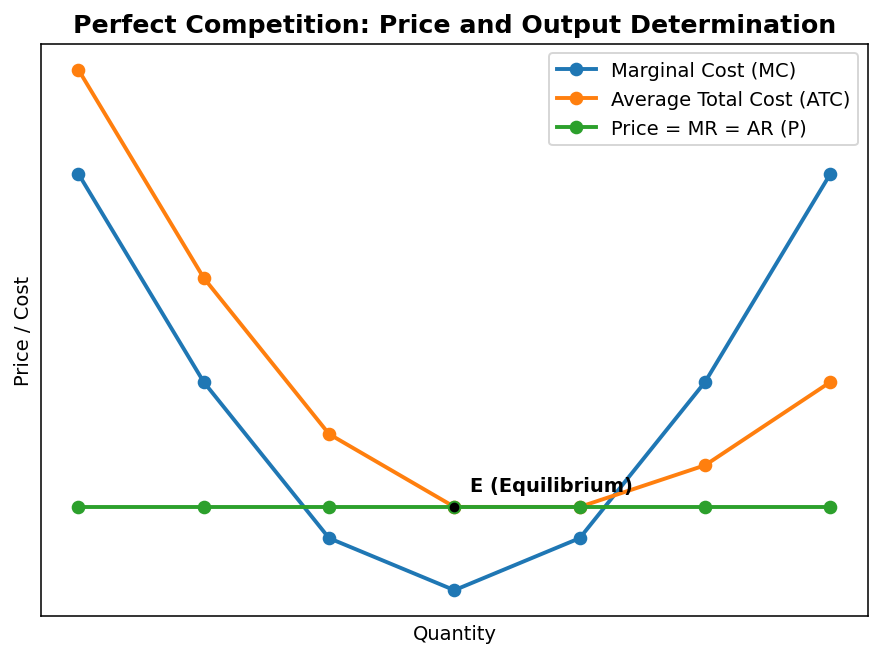
Based on the given graph, answer the following:
-
In perfect competition, the demand curve faced by an individual firm is:ADownward slopingBUpward slopingCPerfectly elastic (horizontal)DPerfectly inelastic (vertical)
-
At the equilibrium point E shown in the graph, which condition is satisfied?APrice > Marginal CostBPrice = Marginal CostCPrice < Marginal CostDMarginal Cost = Average Fixed Cost
-
What does the graph indicate about the firm's profit or loss at equilibrium point E, where Price equals the minimum of ATC?
-
In the long run under perfect competition, why do supernormal profits disappear?
-
At the profit-maximising output Q*=4 in the graph, which condition is met?AMR = ARBMC = ACCMR = MCDAR = AC
-
In the graph, the monopolist charges a price P*=50 while AC at Q*=4 is 27. What does this indicate?AThe firm is making a lossBThe firm is earning normal profit onlyCThe firm is earning supernormal (abnormal) profitDThe firm is at break-even point
-
Why does the Marginal Revenue (MR) curve lie below the Average Revenue (AR) curve in a monopoly market?
-
Can a monopolist earn supernormal profits in the long run? Give a reason.
-
In monopolistic competition, the demand curve faced by a firm is:APerfectly elasticBPerfectly inelasticCDownward sloping but relatively elasticDUpward sloping
-
From the graph, at Q*=3, Price = 55 and AC = 30. What is the supernormal profit per unit earned by the firm?ARs. 10BRs. 25CRs. 30DRs. 55
-
What will happen to the supernormal profits shown in this graph in the long run under monopolistic competition?
-
How does product differentiation give a firm in monopolistic competition some degree of market power?
Show answersHide answers
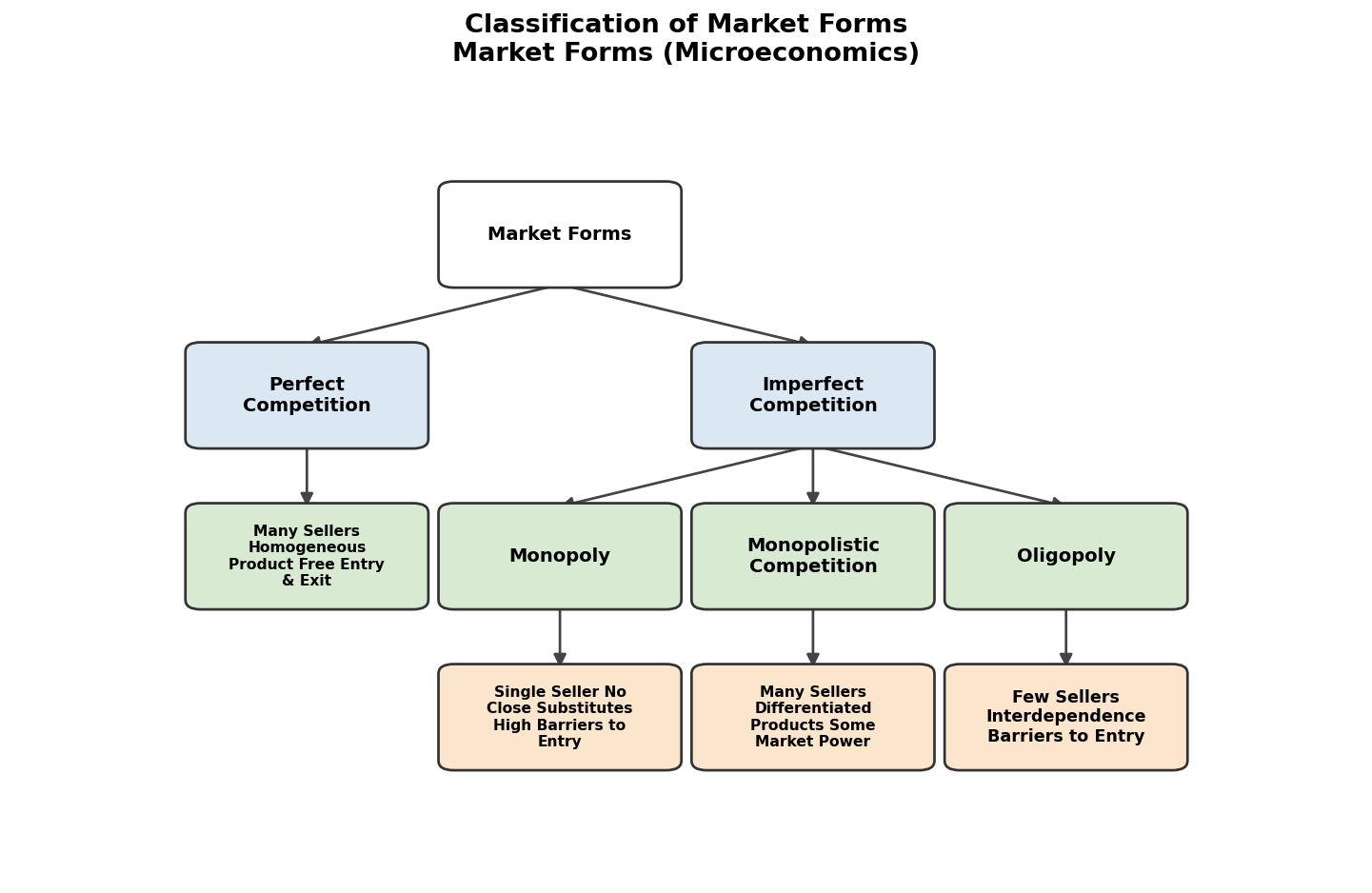
Based on the given diagram, answer the following:
-
Which of the following is NOT a feature of perfect competition as shown in the diagram?AHomogeneous productBFree entry and exitCProduct differentiationDMany sellers
-
According to the diagram, which market form is characterised by a single seller with no close substitutes and high barriers to entry?AOligopolyBMonopolistic CompetitionCPerfect CompetitionDMonopoly
-
Explain the concept of 'interdependence' shown as a feature of oligopoly in the diagram.
-
How does monopolistic competition differ from perfect competition in terms of product characteristics?
-
Which of the following is a necessary condition for price discrimination to be practised by a monopolist, as shown in the diagram?AHomogeneous product sold in all marketsBMarkets must be separable with no possibility of resaleCSame price elasticity of demand in all marketsDFree entry of new firms into the market
-
According to the diagram, in third-degree price discrimination, the monopolist charges a higher price in the market with:AMore elastic demandBLess elastic (inelastic) demandCPerfectly elastic demandDZero elasticity of demand
-
Give one real-life example of third-degree price discrimination and explain why it qualifies as price discrimination.
-
Why is price discrimination only possible under monopoly and not under perfect competition?
Show answersHide answers
Based on the given graph showing price and quantity relationship in a perfectly competitive market, answer the following:
-
In a perfectly competitive market, why is the firm's demand curve (AR) a horizontal straight line?AThe firm has market power to set pricesBThe firm is a price taker and must accept the market priceCThe firm produces differentiated productsDThe firm faces a downward sloping demand curve
-
At equilibrium point E in the graph, which condition is satisfied?AAR > MCBMC > MRCMC = MR = AR = PriceDATC > AR
-
What does the point where ATC is at its minimum and equals AR (Price) indicate about the firm's profit?
-
In the long run under perfect competition, what happens to economic (supernormal) profits?AThey increase due to higher demandBThey are eliminated due to free entry of new firmsCThey remain constant as firms are price takersDThey decrease only if the government intervenes
Show answersHide answers
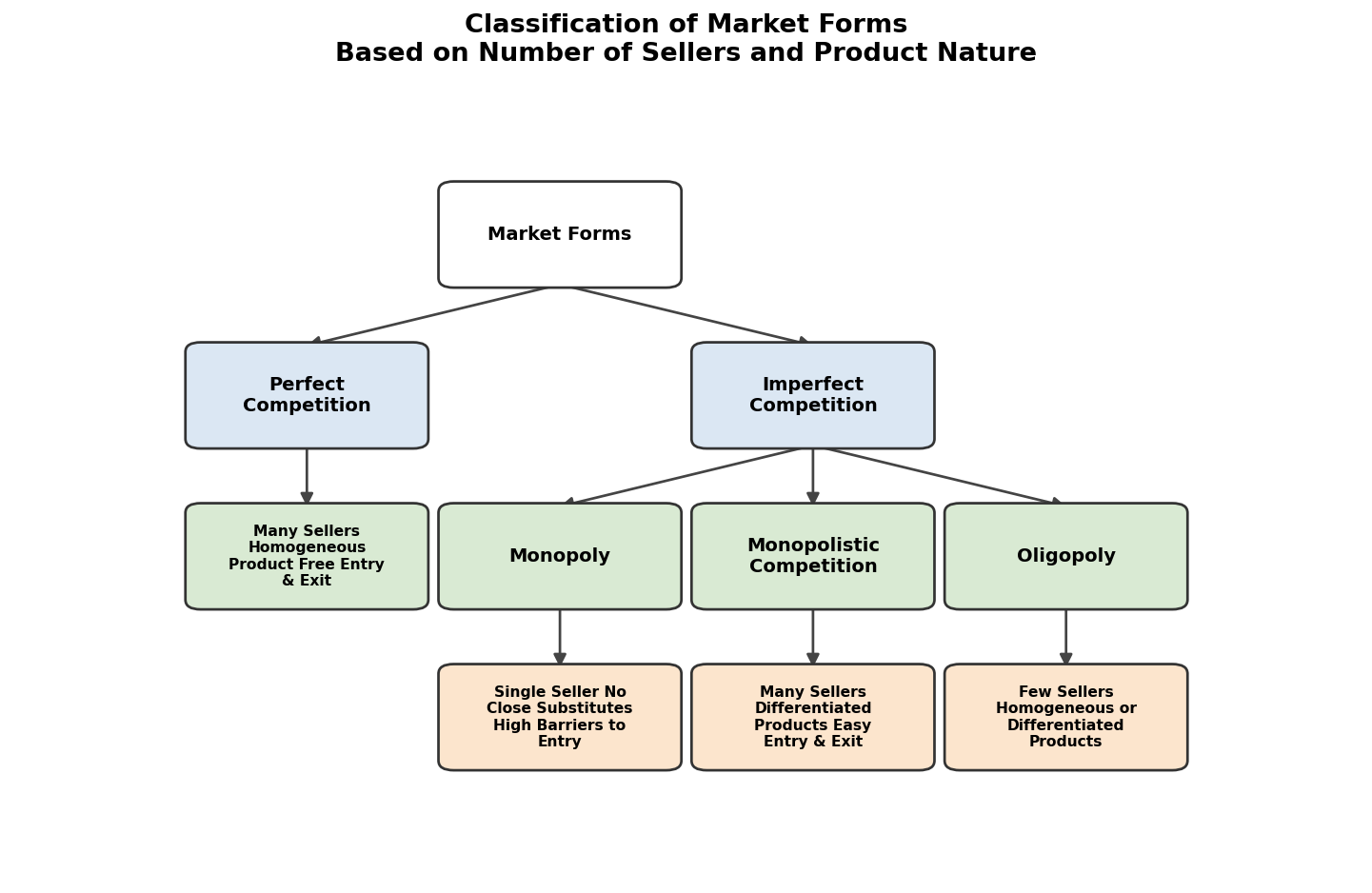
Based on the given flowchart showing the classification of market forms, answer the following:
-
According to the flowchart, which market form is characterised by a single seller with no close substitutes and high barriers to entry?APerfect CompetitionBMonopolistic CompetitionCMonopolyDOligopoly
-
How does monopolistic competition differ from perfect competition as shown in the flowchart?
-
Which of the following is NOT a feature of oligopoly as indicated in the flowchart?AFew sellers dominate the marketBProducts can be homogeneous or differentiatedCLarge number of buyers and sellersDMutual interdependence among firms
-
Give one real-world example each for monopoly and oligopoly from the Indian economy.
Show answersHide answers
Make a full Economics paper on Market Forms (Microeconomics).
Pick the question mix, set the marks, hit generate. You get a ready-to-print paper with an answer key.
Generate your paper — free