Some Basic Concepts of Chemistry — Important Questions
56 questions
With answersCBSE format
SUMMARY: This chapter introduces fundamental concepts of chemistry, including the mole concept, stoichiometry, and the laws of chemical combination. KEY TOPICS: matter and its classification, laws of chemical combination, Dalton's atomic theory, atomic and molecular masses, mole concept, molar mass, percentage composition, empirical and molecular formula, stoichiometry, limiting reagent
What is the total number of moles in 10 grams of water (H₂O)?
A0.56 moles
B0.55 moles
C0.45 moles
D0.50 moles
Check answerHide answer
Correct answer: Option 4 — 0.50 moles
Q71 Mark
Which of the following is a postulate of Dalton's atomic theory?
AAtoms can be created and destroyed.
BAll atoms of a given element are identical.
CAtoms are indivisible in chemical reactions.
DAtoms can change into other elements.
Check answerHide answer
Correct answer: Option 2 — All atoms of a given element are identical.
Q81 Mark
If 2 moles of NaCl are dissolved in water, how many grams of NaCl are present? (Molar mass of NaCl = 58.5 g/mol)
A117 g
B58.5 g
C29.25 g
D145 g
Check answerHide answer
Correct answer: Option 1 — 117 g
Q91 Mark
What is the empirical formula of a compound that contains 40% carbon, 6.67% hydrogen, and 53.33% oxygen by mass?
AC₂H₆O
BC₃H₈O₃
CC₁H₂O
DC₄H₁₀O₄
Check answerHide answer
Correct answer: Option 3 — C₁H₂O
Q101 Mark
According to the law of conservation of mass, during a chemical reaction:
AMass is created.
BMass is destroyed.
CMass remains constant.
DMass can change forms.
Check answerHide answer
Correct answer: Option 3 — Mass remains constant.
Q111 Mark
What is the percentage composition of hydrogen in water (H₂O)?
A11.2%
B16.7%
C33.3%
D22.2%
Check answerHide answer
Correct answer: Option 2 — 16.7%
Q121 Mark
In a reaction where 4 moles of A react with 2 moles of B, what is the limiting reagent if 3 moles of A and 2 moles of B are available?
AA
BB
CBoth A and B
DNeither A nor B
Check answerHide answer
Correct answer: Option 2 — B
Q131 Mark
The molar mass of a compound is defined as:
AThe mass of one molecule of the compound.
BThe mass of one mole of the compound in grams.
CThe mass of one atom of the compound.
DThe mass of the compound in kilograms.
Check answerHide answer
Correct answer: Option 2 — The mass of one mole of the compound in grams.
Q141 Mark
Which of the following correctly represents the law of definite proportions?
ADifferent samples of a compound have different compositions.
BA compound always contains the same elements in the same proportions by mass.
CMass is neither created nor destroyed in a chemical reaction.
DThe total mass of reactants equals the total mass of products.
Check answerHide answer
Correct answer: Option 2 — A compound always contains the same elements in the same proportions by mass.
Q151 Mark
If the empirical formula of a compound is CH₂ and its molar mass is 42 g/mol, what is its molecular formula?
AC₃H₆
BC₂H₄
CC₄H₈
DC₆H₁₂
Check answerHide answer
Correct answer: Option 1 — C₃H₆
Short Answer Questions10 questions
Q163 Marks
Define the mole and state the value of Avogadro's number.
View sample solutionHide solution
A mole is the amount of a substance that contains as many entities (atoms, molecules, ions) as the number of atoms in 12 g of carbon-12. Avogadro's number = 6.022 × 10²³ entities per mole.
Q173 Marks
Calculate the number of moles in 22 g of CO₂.
View sample solutionHide solution
Molar mass of CO₂ = 12 + 2(16) = 44 g/mol. Number of moles = mass/molar mass = 22/44 = 0.5 mol.
Q183 Marks
Differentiate between molarity and molality.
View sample solutionHide solution
Molarity (M) = moles of solute per litre of solution; depends on temperature. Molality (m) = moles of solute per kilogram of solvent; independent of temperature. Molality is preferred for studies involving temperature changes.
Q193 Marks
Calculate the mass percent of nitrogen in NH₃.
View sample solutionHide solution
Molar mass NH₃ = 14 + 3 = 17 g/mol. Mass of N = 14 g. Mass percent = (14/17) × 100 = 82.35%.
Q203 Marks
State the law of conservation of mass.
View sample solutionHide solution
In any chemical change matter is neither created nor destroyed; the total mass of reactants equals the total mass of products. Stated by Antoine Lavoisier in 1789.
Q213 Marks
What is Dalton's atomic theory and how does it explain the nature of matter?
View sample solutionHide solution
Dalton's atomic theory states that matter is composed of indivisible atoms, which cannot be created or destroyed. It explains that atoms of the same element are identical in mass and properties, while atoms of different elements differ in mass and properties, leading to the formation of compounds through chemical combinations.
Q223 Marks
Define the term 'molar mass' and explain its significance in chemistry.
View sample solutionHide solution
Molar mass is the mass of one mole of a substance, expressed in grams per mole (g/mol). It is significant because it allows chemists to convert between the mass of a substance and the number of moles, facilitating stoichiometric calculations in chemical reactions.
Q233 Marks
Explain the difference between empirical formula and molecular formula with examples.
View sample solutionHide solution
The empirical formula represents the simplest whole-number ratio of atoms in a compound, while the molecular formula shows the actual number of atoms of each element in a molecule. For example, the empirical formula of hydrogen peroxide is HO, while its molecular formula is H₂O₂.
Q243 Marks
What is the law of definite proportions? Provide an example to illustrate it.
View sample solutionHide solution
The law of definite proportions states that a chemical compound always contains its component elements in fixed ratio by mass. For instance, water (H₂O) always consists of 2 grams of hydrogen for every 16 grams of oxygen, regardless of its source.
Q253 Marks
How do you determine the limiting reagent in a chemical reaction?
View sample solutionHide solution
To determine the limiting reagent, calculate the number of moles of each reactant and compare the mole ratios required by the balanced chemical equation. The reactant that produces the least amount of product is the limiting reagent.
Long Answer Questions6 questions
Q266 Marks
A compound contains 40% C, 6.67% H and 53.33% O by mass. Find its empirical formula. If its molar mass is 180 g/mol, find the molecular formula.
View sample solutionHide solution
Convert to moles per 100 g: C = 40/12 = 3.33, H = 6.67/1 = 6.67, O = 53.33/16 = 3.33. Divide by smallest (3.33): C = 1, H = 2, O = 1. Empirical formula CH₂O (mass 30). Molecular mass/empirical mass = 180/30 = 6. Molecular formula = C₆H₁₂O₆ (glucose).
Q276 Marks
Calculate the molarity of a solution prepared by dissolving 4 g of NaOH in 250 mL of solution.
View sample solutionHide solution
Molar mass NaOH = 23 + 16 + 1 = 40 g/mol. Moles of NaOH = 4/40 = 0.1 mol. Volume = 250 mL = 0.25 L. Molarity = moles/volume = 0.1/0.25 = 0.4 M.
Q286 Marks
Balance the chemical equation and calculate the mass of CO₂ produced when 2.4 g of carbon burns completely in oxygen.
View sample solutionHide solution
Balanced equation: C + O₂ → CO₂. Moles of C = 2.4/12 = 0.2 mol. From 1:1 stoichiometry, moles of CO₂ produced = 0.2 mol. Mass of CO₂ = 0.2 × 44 = 8.8 g.
Q296 Marks
Define limiting reagent. In the reaction N₂ + 3H₂ → 2NH₃ if 28 g of N₂ reacts with 9 g of H₂ identify the limiting reagent.
View sample solutionHide solution
Limiting reagent is the reactant that gets consumed first and limits product formation. Moles N₂ = 28/28 = 1 mol; Moles H₂ = 9/2 = 4.5 mol. From stoichiometry 1 mol N₂ needs 3 mol H₂. We have 4.5 mol H₂ which can react with 4.5/3 = 1.5 mol N₂, but we only have 1 mol N₂. Therefore N₂ is the limiting reagent.
Q306 Marks
Differentiate between accuracy and precision with examples.
View sample solutionHide solution
Accuracy: closeness of measured value to true value. Precision: closeness of repeated measurements to each other. Example: True mass = 5.00 g. Measurements (a) 4.95, 4.97, 4.96 → precise but if true is 5.00 only fairly accurate. (b) 4.50, 5.50, 5.00 → accurate on average but not precise. Good experiments aim for both high accuracy and precision.
Q316 Marks
Differentiate between accuracy and precision in tabular form with one example each.
Assertion–Reason Questions8 questions
Q321 Mark
Assertion (A): One mole of any substance contains 6.022 × 10²³ entities.
Reason (R): The mole is defined to contain Avogadro's number of particles equal to atoms in 12 g of carbon-12.
Show explanationHide explanation
Correct answer: Option 1 —
Both A and R are true, and R is the correct explanation of A.
Q331 Mark
Assertion (A): The molar mass of water is 18 g/mol.
Reason (R): Sum of atomic masses: 2(1) + 16 = 18 g/mol.
Show explanationHide explanation
Correct answer: Option 1 —
Both A and R are true, and R is the correct explanation of A.
Q341 Mark
Assertion (A): A balanced chemical equation obeys the law of conservation of mass.
Reason (R): The same number of atoms of each element appears on both sides of the equation.
Show explanationHide explanation
Correct answer: Option 1 —
Both A and R are true, and R is the correct explanation of A.
Q351 Mark
Assertion (A): The number of significant figures in 0.00250 is three.
Reason (R): Leading zeros are not significant but trailing zeros after a decimal point are.
Show explanationHide explanation
Correct answer: Option 1 —
Both A and R are true, and R is the correct explanation of A.
Q361 Mark
Assertion (A): Molarity changes with temperature whereas molality does not.
Reason (R): Volume of solution depends on temperature whereas mass of solvent does not.
Show explanationHide explanation
Correct answer: Option 1 —
Both A and R are true, and R is the correct explanation of A.
Q371 Mark
Assertion (A): The empirical formula of a compound represents the simplest whole-number ratio of atoms in the compound.
Reason (R): The molecular formula of a compound can be a multiple of its empirical formula.
Show explanationHide explanation
Correct answer: Option 1 —
Both A and R are true, and R is the correct explanation of A.
Q381 Mark
Assertion (A): Dalton's atomic theory states that atoms are indivisible and indestructible.
Reason (R): Modern chemistry has shown that atoms can be split into smaller particles.
Show explanationHide explanation
Correct answer: Option 3 —
A is true, but R is false.
Q391 Mark
Assertion (A): The law of definite proportions states that a chemical compound contains its component elements in fixed ratio by mass.
Reason (R): This law is applicable to all chemical reactions regardless of the conditions.
Show explanationHide explanation
Correct answer: Option 3 —
A is true, but R is false.
Statement-Based Questions8 questions
Q401 Mark
Statement 1: One mole contains 6.022 × 10²³ entities.
Statement 2: One mole of any gas at STP occupies 22.4 L.
Show answerHide answer
Correct answer: Option 1 —
Both statements are true.
Q411 Mark
Statement 1: The empirical formula gives the simplest whole-number ratio of atoms.
Statement 2: The molecular formula is always equal to the empirical formula.
Show answerHide answer
Correct answer: Option 1 —
Both statements are true.
Q421 Mark
Statement 1: Mass percent of an element = (mass of element/molar mass of compound) × 100.
Statement 2: Sum of mass percents of all elements in a compound equals 100%.
Show answerHide answer
Correct answer: Option 1 —
Both statements are true.
Q431 Mark
Statement 1: The limiting reagent determines the maximum yield of a reaction.
Statement 2: The excess reagent is the one not fully consumed.
Show answerHide answer
Correct answer: Option 1 —
Both statements are true.
Q441 Mark
Statement 1: Molarity is expressed in mol/L.
Statement 2: Molality is expressed in mol/kg.
Show answerHide answer
Correct answer: Option 1 —
Both statements are true.
Q451 Mark
Statement 1: The law of conservation of mass states that mass can be created or destroyed in a chemical reaction.
Statement 2: Dalton's atomic theory includes the idea that atoms of different elements can combine in simple whole-number ratios to form compounds.
Show answerHide answer
Correct answer: Option 3 —
Only Statement 2 is true.
Q461 Mark
Statement 1: The molar mass of a substance is the mass of one mole of its entities measured in grams.
Statement 2: The percentage composition of a compound is calculated by dividing the mass of the compound by the total mass of all its elements.
Show answerHide answer
Correct answer: Option 1 —
Both statements are true.
Q471 Mark
Statement 1: Stoichiometry involves the calculation of reactants and products in chemical reactions based on balanced equations.
Statement 2: The molecular formula of a compound always represents the empirical formula as well.
Show answerHide answer
Correct answer: Option 2 —
Only Statement 1 is true.
Case Study / Passage Questions3 questions
Q483 Marks
A chemistry student weighs 22 g of dry ice (solid CO₂) in the laboratory and wants to determine how many molecules and moles of CO₂ are present. The teacher reminds the student that the molar mass of CO₂ is 44 g/mol and Avogadro's number is 6.022 × 10²³ /mol.
The number of moles of CO₂ in 22 g equals:
A0.25
B0.5
C1.0
D2.0
The number of molecules of CO₂ in 22 g is approximately:
A3.011 × 10²³
B6.022 × 10²³
C1.204 × 10²⁴
D2.408 × 10²⁴
Compute the total number of atoms (C + O) present in 22 g of CO₂.
Show answersHide answers
1. Option 2 — 0.5
2. Option 1 — 3.011 × 10²³
3. Number of moles = mass/molar mass = 22/44 = 0.5 mol. Number of molecules = moles × Avogadro's number = 0.5 × 6.022 × 10²³ = 3.011 × 10²³. Each CO₂ molecule has 1 C atom and 2 O atoms so the total number of atoms = 3 × 3.011 × 10²³ = 9.033 × 10²³.
Q493 Marks
A laboratory burns 4 g of methane (CH₄) completely in oxygen according to CH₄ + 2O₂ → CO₂ + 2H₂O. Compute the moles of CH₄ burnt the moles and mass of O₂ required and the moles of CO₂ produced.
The number of moles of CH₄ in 4 g equals:
A0.125
B0.25
C0.5
D1.0
The mass of O₂ required to burn 4 g of CH₄ is:
A8 g
B16 g
C32 g
D64 g
Compute the masses of CO₂ and H₂O produced.
Show answersHide answers
1. Option 2 — 0.25
2. Option 2 — 16 g
3. Moles CH₄ = 4/16 = 0.25 mol. From stoichiometry: O₂ = 2 × 0.25 = 0.5 mol; mass = 0.5 × 32 = 16 g. CO₂ produced = 0.25 mol; mass = 0.25 × 44 = 11 g. H₂O produced = 0.5 mol; mass = 0.5 × 18 = 9 g.
Q503 Marks
A small fertiliser plant produces ammonia by N₂(g) + 3H₂(g) → 2NH₃(g). On a particular day 28 g of N₂ is mixed with 9 g of H₂. The chemical engineer needs to determine the limiting reagent and the maximum mass of NH₃ that can be produced.
The limiting reagent is:
AN₂
BH₂
CBoth are equal
DCannot decide
The maximum mass of NH₃ that can be produced equals:
A17 g
B34 g
C51 g
D68 g
Compute the moles of unreacted H₂.
Show answersHide answers
1. Option 1 — N₂
2. Option 2 — 34 g
3. Moles N₂ = 28/28 = 1; moles H₂ = 9/2 = 4.5. Stoichiometric ratio: 1 mol N₂ needs 3 mol H₂. We have 1 mol N₂ and 4.5 mol H₂ so H₂ is in excess; N₂ is the limiting reagent. Max NH₃ = 2 × 1 = 2 mol = 2 × 17 = 34 g.
Table-Based Questions4 questions
Q513 Marks
Study the table of common substances and their molar masses, then answer:
Substance
Formula
Molar mass (g/mol)
Water
H₂O
18
Carbon dioxide
CO₂
44
Methane
CH₄
16
Ammonia
NH₃
17
Glucose
C₆H₁₂O₆
180
The number of moles in 90 g of water (H₂O) equals:
A1 mol
B2 mol
C5 mol
D10 mol
The mass of 0.5 mol of glucose (C₆H₁₂O₆) is:
A90 g
B180 g
C360 g
D540 g
Calculate the number of molecules in 0.5 mol of glucose.
Show answersHide answers
1. Option 3 — 5 mol
2. Option 1 — 90 g
3. Number of moles = mass/molar mass. For 90 g H₂O: 90/18 = 5 mol. For 0.5 mol glucose: 0.5 × 180 = 90 g. The mole concept allows us to convert between mass moles and number of particles using the molar mass and Avogadro's number.
Q523 Marks
Study the percentage compositions of three compounds and identify their formulas:
Compound
%C
%H
%O
A
40
6.7
53.3
B
52.2
13.0
34.8
C
38.7
9.7
51.6
The empirical formula of compound A is:
ACH₂O
BC₂H₄O
CCH₃O
DC₂H₆O
Two compounds with the same empirical formula must have the:
ASame molecular formula
BSame empirical formula
CSame molar mass
DAlways identical
Determine the empirical formula of compound C.
Show answersHide answers
1. Option 1 — CH₂O
2. Option 2 — Same empirical formula
3. For compound A: ratio C:H:O = (40/12) : (6.7/1) : (53.3/16) = 3.33 : 6.7 : 3.33 = 1 : 2 : 1. Empirical formula CH₂O. The molecular formula could be CH₂O, C₂H₄O₂ (acetic acid), C₆H₁₂O₆ (glucose) etc — all share the empirical formula but differ in molar mass.
Q536 Marks
Compute the number of moles, the number of molecules and the total number of atoms present in each sample.
Sample
Mass (g)
Molar mass (g/mol)
H₂O
18
18
CO₂
22
44
CaCO₃
10
100
Q545 Marks
From the percentage composition find the empirical formula of compound X. If its molar mass is 180 g/mol find the molecular formula.
Element
% by mass
C
40.00
H
6.67
O
53.33
Picture-Based Questions2 questions
Q553 Marks
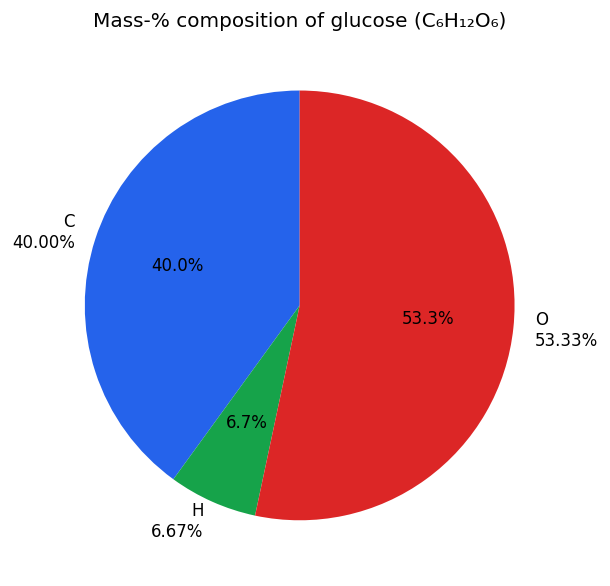
Study the pie chart showing the mass-% composition of glucose (C₆H₁₂O₆) and answer:
The mass percentage of carbon in glucose is approximately:
A40%
B50%
C53.33%
D60%
Based on the percentages, the empirical formula of glucose is:
ACHO
BCH₂O
CCH₂O₂
DC₂H₆O
Derive the empirical formula step-by-step and obtain the molecular formula given molar mass = 180 g/mol.
Show answersHide answers
1. Option 1 — 40%
2. Option 2 — CH₂O
3. Convert percentages to moles per 100 g: C = 40/12 = 3.33 mol; H = 6.67/1 = 6.67 mol; O = 53.33/16 = 3.33 mol. Divide by smallest (3.33) to get C : H : O = 1 : 2 : 1, giving the empirical formula CH₂O. Since the molar mass of glucose is 180 g/mol and the empirical mass is 30, the molecular formula is (CH₂O)₆ = C₆H₁₂O₆.
Q563 Marks
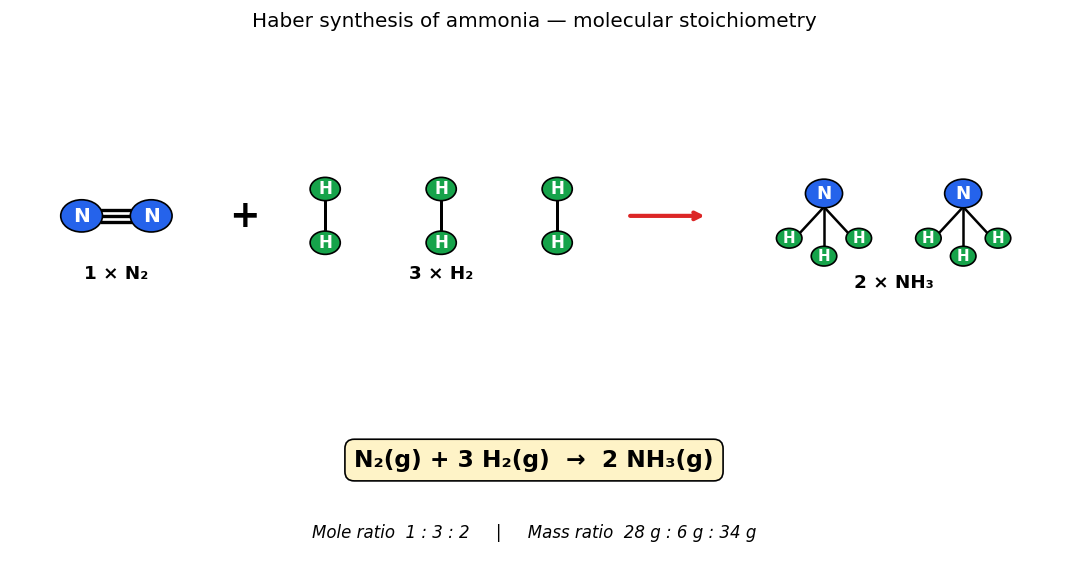
Study the molecular diagram of the Haber process N₂ + 3H₂ → 2NH₃ and answer:
The mole ratio N₂ : H₂ : NH₃ shown by the diagram is:
A1 : 1 : 1
B1 : 2 : 3
C1 : 3 : 2
D2 : 3 : 1
If 28 g of N₂ reacts with sufficient H₂, the mass of NH₃ produced is:
A17 g
B34 g
C51 g
D68 g
If 28 g N₂ is mixed with 9 g H₂, identify the limiting reagent and the maximum mass of NH₃ formed.
Show answersHide answers
1. Option 3 — 1 : 3 : 2
2. Option 2 — 34 g
3. From the balanced equation 1 mol N₂ + 3 mol H₂ → 2 mol NH₃. Mass ratio: 28 g N₂ : 6 g H₂ : 34 g NH₃. If the supply is 28 g N₂ and 9 g H₂, moles of N₂ = 1, moles of H₂ = 4.5. Stoichiometric H₂ requirement = 3 mol; we have 4.5 mol, so H₂ is in excess and N₂ is the limiting reagent. Maximum NH₃ produced = 2 × 1 = 2 mol = 34 g; 1.5 mol (3 g) of H₂ remains unreacted.