Classification of Elements and Periodicity in Properties — Important Questions
56 questions
With answersCBSE format
SUMMARY: This chapter discusses the organization of elements in the periodic table and the periodic trends in their properties. KEY TOPICS: Modern periodic law, periodic table, periodic trends, atomic radius, ionization enthalpy, electron gain enthalpy, electronegativity, valency, anomalies of periodic trends.
The element with the highest electronegativity is:
AOxygen
BFluorine
CChlorine
DNitrogen
Check answerHide answer
Correct answer: Option 2 — Fluorine
Q21 Mark
Across a period from left to right atomic radius generally:
AIncreases
BDecreases
CRemains constant
DFirst increases then decreases
Check answerHide answer
Correct answer: Option 2 — Decreases
Q31 Mark
Down a group ionization energy generally:
AIncreases
BDecreases
CRemains constant
DHas no trend
Check answerHide answer
Correct answer: Option 2 — Decreases
Q41 Mark
The d-block elements are also called:
AAlkali metals
BHalogens
CTransition metals
DNoble gases
Check answerHide answer
Correct answer: Option 3 — Transition metals
Q51 Mark
The most metallic character among the following is in:
ALi
BNa
CK
DCs
Check answerHide answer
Correct answer: Option 4 — Cs
Q61 Mark
Which of the following elements has the largest atomic radius?
AFluorine
BOxygen
CLithium
DSodium
Check answerHide answer
Correct answer: Option 4 — Sodium
Q71 Mark
What is the trend in electron gain enthalpy as you move from left to right across a period?
AIncreases
BDecreases
CRemains constant
DVaries randomly
Check answerHide answer
Correct answer: Option 1 — Increases
Q81 Mark
Which of the following elements has the highest ionization enthalpy?
ABoron
BCarbon
CNitrogen
DOxygen
Check answerHide answer
Correct answer: Option 3 — Nitrogen
Q91 Mark
The modern periodic law states that the properties of elements are a periodic function of their:
AMass number
BAtomic number
CMolecular weight
DDensity
Check answerHide answer
Correct answer: Option 2 — Atomic number
Q101 Mark
Which of the following elements is most likely to gain an electron?
ASodium
BChlorine
CMagnesium
DPotassium
Check answerHide answer
Correct answer: Option 2 — Chlorine
Q111 Mark
As you move down a group in the periodic table, the electronegativity of the elements generally:
AIncreases
BDecreases
CRemains the same
DFluctuates
Check answerHide answer
Correct answer: Option 2 — Decreases
Q121 Mark
Which of the following pairs of elements exhibits an anomaly in the trend of ionization energy?
ABeryllium and Boron
BNitrogen and Oxygen
CMagnesium and Aluminum
DCarbon and Silicon
Check answerHide answer
Correct answer: Option 2 — Nitrogen and Oxygen
Q131 Mark
The valency of an element is determined by:
AThe number of protons
BThe number of neutrons
CThe number of electrons in the outermost shell
DThe total number of electrons
Check answerHide answer
Correct answer: Option 3 — The number of electrons in the outermost shell
Q141 Mark
Which of the following elements has the lowest electronegativity?
AFrancium
BRubidium
CPotassium
DLithium
Check answerHide answer
Correct answer: Option 1 — Francium
Q151 Mark
In which group of the periodic table would you find the most reactive metals?
AGroup 1
BGroup 2
CGroup 13
DGroup 17
Check answerHide answer
Correct answer: Option 1 — Group 1
Short Answer Questions10 questions
Q163 Marks
Define ionization energy and state its trend across a period.
View sample solutionHide solution
Ionization energy is the minimum energy required to remove the most loosely bound electron from a gaseous neutral atom. Across a period from left to right ionization energy generally increases (with some exceptions) due to increasing nuclear charge and decreasing atomic radius.
Q173 Marks
Why is the second ionization energy of an element always greater than the first?
View sample solutionHide solution
Removing the second electron requires more energy because the resulting cation has a higher effective nuclear charge attracting the remaining electrons more strongly. Also less electron-electron repulsion makes it harder to remove an electron.
Q183 Marks
State the modern periodic law.
View sample solutionHide solution
The properties of elements are a periodic function of their atomic numbers (Henry Moseley 1913). This replaced Mendeleev's earlier law based on atomic masses and resolved several anomalies.
Q193 Marks
Why is the atomic radius of a cation smaller than that of its parent atom?
View sample solutionHide solution
When a cation is formed an electron is removed reducing electron-electron repulsion. Sometimes the outermost shell is completely lost. Both effects cause the remaining electrons to be drawn closer to the nucleus reducing the radius.
Q203 Marks
Differentiate between electron affinity and electronegativity.
View sample solutionHide solution
Electron affinity is the energy released when a gaseous neutral atom gains an electron to form a gaseous anion (an absolute value). Electronegativity is the relative tendency of an atom in a covalent bond to attract shared electrons (a relative scale e.g. Pauling).
Q213 Marks
What is the significance of the periodic table in understanding element properties?
View sample solutionHide solution
The periodic table organizes elements based on their atomic number and electron configuration, allowing for the prediction of chemical behavior and trends in properties such as atomic radius, ionization energy, and electronegativity.
Q223 Marks
Explain the trend of atomic radius as you move down a group in the periodic table.
View sample solutionHide solution
As you move down a group in the periodic table, the atomic radius increases due to the addition of electron shells, which outweighs the effect of increased nuclear charge, leading to a larger size of the atoms.
Q233 Marks
Describe how ionization energy changes across a period and provide a reason for this trend.
View sample solutionHide solution
Ionization energy generally increases across a period from left to right due to increasing nuclear charge, which holds the electrons more tightly, making them harder to remove.
Q243 Marks
What is electron gain enthalpy, and how does it vary across a period?
View sample solutionHide solution
Electron gain enthalpy is the energy change when an electron is added to a neutral atom. It generally becomes more negative across a period as the effective nuclear charge increases, attracting additional electrons more strongly.
Q253 Marks
Why do noble gases have high ionization energies compared to other elements?
View sample solutionHide solution
Noble gases have high ionization energies because they have a complete valence shell, making them stable and requiring significantly more energy to remove an electron compared to elements with incomplete shells.
Long Answer Questions6 questions
Q266 Marks
Explain the periodic trends in atomic radius, ionization energy, electron affinity and electronegativity across a period and down a group.
View sample solutionHide solution
Across a period (L → R): atomic radius decreases (more nuclear pull on same shell). Ionization energy increases (harder to remove e⁻). Electron affinity becomes more negative — atoms attract electrons more strongly. Electronegativity increases. Down a group: atomic radius increases (extra shells outweigh added charge). Ionization energy decreases (outer e⁻ farther from nucleus). Electron affinity generally decreases (less attraction). Electronegativity decreases.
Q276 Marks
Discuss Mendeleev's contributions to the development of the periodic table and list two limitations.
View sample solutionHide solution
Mendeleev (1869) arranged elements in order of increasing atomic mass into rows where elements with similar properties fell in the same column. His foresight: he left gaps for undiscovered elements and predicted their properties (e.g. eka-silicon = germanium) — most predictions were verified. Limitations: (i) position of hydrogen (resembles both alkali metals and halogens) was unclear; (ii) some pairs like Te-I were placed out of atomic-mass order to preserve property similarity revealing that mass was not the right organizing principle.
Q286 Marks
Classify the elements into s p d and f blocks based on the orbital being filled and give one example of each.
View sample solutionHide solution
s-block: outermost electron enters s orbital. Examples: Group 1 (Na 3s¹) and Group 2 (Mg 3s²). p-block: outermost electron enters p orbital. Examples: Groups 13–18 (e.g. C 2p²; Cl 3p⁵). d-block: penultimate shell d-orbital is filled. Examples: transition metals (Fe 3d⁶ 4s²). f-block: anti-penultimate shell f-orbital is filled. Examples: lanthanoids and actinoids (Ce 4f¹ 5d¹ 6s²).
Q296 Marks
Explain the diagonal relationship using Li-Mg or Be-Al pair.
View sample solutionHide solution
Diagonal relationship: certain second-period elements show similarity to third-period elements diagonally below them. Example: Li and Mg. Both have similar atomic and ionic sizes; both are hard metals with relatively high melting points; both react with N₂ to form nitrides; both burn in air to form oxides (not peroxides like other alkali metals); both have similar ionic mobility. Reason: comparable ionic charge density and electronegativity.
Q306 Marks
Compare and contrast the modern periodic table with Mendeleev's periodic table.
View sample solutionHide solution
Both classify elements into periods and groups with similar elements in same group. Differences: (a) Basis: Modern uses atomic number Z while Mendeleev used atomic mass. (b) Number of groups: Modern has 18 (1-18 numbering) Mendeleev had 8 (with subgroups A and B). (c) Modern table accommodates noble gases as group 18 not present originally. (d) Position of H is still ambiguous in both. (e) Modern table separates s p d f blocks distinctly enabling easier prediction of valence-shell configuration.
Q316 Marks
Differentiate between metals and non-metals in tabular form.
Assertion–Reason Questions8 questions
Q321 Mark
Assertion (A): Atomic radius decreases across a period.
Reason (R): Effective nuclear charge increases as we move left to right pulling electrons closer.
Show explanationHide explanation
Correct answer: Option 1 —
Both A and R are true, and R is the correct explanation of A.
Q331 Mark
Assertion (A): Ionization energy decreases down a group.
Reason (R): Outer electrons are farther from the nucleus and screened by inner electrons making them easier to remove.
Show explanationHide explanation
Correct answer: Option 1 —
Both A and R are true, and R is the correct explanation of A.
Q341 Mark
Assertion (A): Metallic character increases down a group.
Reason (R): Atoms become larger and outer electrons are loosely held — more easily lost.
Show explanationHide explanation
Correct answer: Option 1 —
Both A and R are true, and R is the correct explanation of A.
Q351 Mark
Assertion (A): The electron affinity of fluorine is less negative than that of chlorine.
Reason (R): Fluorine's small size leads to high electron-electron repulsion when adding an electron despite higher nuclear charge.
Show explanationHide explanation
Correct answer: Option 1 —
Both A and R are true, and R is the correct explanation of A.
Q361 Mark
Assertion (A): Noble gases have very high ionization energies.
Reason (R): Noble gases have stable closed-shell electronic configurations making electron removal energetically unfavourable.
Show explanationHide explanation
Correct answer: Option 1 —
Both A and R are true, and R is the correct explanation of A.
Q371 Mark
Assertion (A): The atomic radius of elements increases as you move down a group in the periodic table.
Reason (R): This is due to the addition of new electron shells, which outweighs the increase in nuclear charge.
Show explanationHide explanation
Correct answer: Option 1 —
Both A and R are true, and R is the correct explanation of A.
Q381 Mark
Assertion (A): Ionization energy generally increases across a period from left to right.
Reason (R): This is because the effective nuclear charge increases, making it harder to remove an electron.
Show explanationHide explanation
Correct answer: Option 1 —
Both A and R are true, and R is the correct explanation of A.
Q391 Mark
Assertion (A): Electronegativity decreases down a group in the periodic table.
Reason (R): This is due to the increased distance between the nucleus and the valence electrons, reducing the nucleus's pull on bonding electrons.
Show explanationHide explanation
Correct answer: Option 1 —
Both A and R are true, and R is the correct explanation of A.
Statement-Based Questions8 questions
Q401 Mark
Statement 1: Atomic radius decreases across a period.
Statement 2: Atomic radius increases down a group.
Show answerHide answer
Correct answer: Option 1 —
Both statements are true.
Q411 Mark
Statement 1: Ionization energy increases across a period.
Statement 2: Ionization energy decreases down a group.
Show answerHide answer
Correct answer: Option 1 —
Both statements are true.
Q421 Mark
Statement 1: Fluorine has the highest electronegativity.
Statement 2: Caesium has the lowest electronegativity among naturally occurring stable elements.
Show answerHide answer
Correct answer: Option 1 —
Both statements are true.
Q431 Mark
Statement 1: Group 1 elements are alkali metals.
Statement 2: Group 17 elements are halogens.
Show answerHide answer
Correct answer: Option 1 —
Both statements are true.
Q441 Mark
Statement 1: The modern periodic law is based on atomic number.
Statement 2: Mendeleev's periodic law was based on atomic mass.
Show answerHide answer
Correct answer: Option 1 —
Both statements are true.
Q451 Mark
Statement 1: The periodic table is organized based on increasing atomic mass.
Statement 2: Elements in the same group have similar chemical properties.
Show answerHide answer
Correct answer: Option 2 —
Only Statement 1 is true.
Q461 Mark
Statement 1: The atomic radius generally increases down a group.
Statement 2: Ionization enthalpy decreases down a group.
Show answerHide answer
Correct answer: Option 1 —
Both statements are true.
Q471 Mark
Statement 1: Electron gain enthalpy is always positive for non-metals.
Statement 2: Noble gases have a complete valence shell and do not readily gain electrons.
Show answerHide answer
Correct answer: Option 3 —
Only Statement 2 is true.
Case Study / Passage Questions3 questions
Q483 Marks
A chemistry student compares the atomic radii ionization energies and electronegativities of the alkali metals (Li Na K Rb Cs) and the halogens (F Cl Br I) to identify periodic trends down each group.
Down the alkali metal group atomic radius:
AIncreases
BDecreases
CRemains constant
DNo trend
Down the halogen group ionization energy:
AIncreases
BDecreases
CRemains constant
DNo trend
Why does F have higher electronegativity but Cl has higher (more negative) electron affinity?
Show answersHide answers
1. Option 1 — Increases
2. Option 2 — Decreases
3. Down a group atomic radius increases (more electron shells outweigh added nuclear charge). Ionization energy decreases (outer electrons are farther from the nucleus and more screened). Electronegativity decreases. So Li > Cs in IE and electronegativity but Cs > Li in atomic radius. Among halogens F has the highest electronegativity but Cl has the most negative electron affinity.
Q493 Marks
In NaCl crystal structure the cation Na⁺ has radius 102 pm and the anion Cl⁻ has radius 181 pm. The student wonders why Na⁺ is much smaller than the parent Na atom (radius 186 pm) while Cl⁻ is larger than the parent Cl atom (radius 99 pm).
A cation is generally:
ASmaller than its atom
BLarger than its atom
CSame as its atom
DCannot decide
An anion is generally:
ASmaller than its atom
BLarger than its atom
CSame as its atom
DCannot decide
Explain the difference in size of Na vs Na⁺ and Cl vs Cl⁻.
Show answersHide answers
1. Option 1 — Smaller than its atom
2. Option 2 — Larger than its atom
3. When Na loses an electron the outermost 3s shell is removed and the resulting Na⁺ has only 2 shells; effective nuclear charge is also slightly higher per electron — both effects shrink the radius. When Cl gains an electron electron-electron repulsion increases and the effective nuclear charge per electron decreases — both effects expand the anion.
Q503 Marks
A student notices that the first ionization energy of nitrogen (1402 kJ/mol) is unexpectedly higher than that of oxygen (1314 kJ/mol) although ionization energies normally increase across a period.
The reason for higher IE of N than O is:
AHalf-filled p subshell stability
BFull d subshell stability
CSmaller atomic radius
DHigher nuclear charge
The first IE of Be is _______ than that of B because of full 2s subshell stability.
ALower
BHigher
CSame
DCannot decide
Explain the half-filled and fully-filled stability rule.
Show answersHide answers
1. Option 1 — Half-filled p subshell stability
2. Option 2 — Higher
3. Half-filled (e.g. p³ in N) and fully-filled (e.g. p⁶ in Ne) subshells have extra stability due to symmetric distribution and exchange energy. So removing an electron from N (p³) requires more energy than from O (p⁴). Similarly Be (2s² fully-filled) > B (2s²2p¹) in IE because removing a 2p electron from B is easier than removing a 2s electron from Be.
Table-Based Questions4 questions
Q513 Marks
Study the trends in atomic radius across period 2:
Element
Atomic number
Atomic radius (pm)
Li
3
152
Be
4
111
B
5
88
C
6
77
N
7
74
O
8
66
F
9
64
Across period 2 atomic radius:
AIncreases
BDecreases
CRemains constant
DNo trend
The reason for the trend is:
AIncreased nuclear charge
BIncreased shells
CBoth
DNeither
State and explain the trend in atomic radius across period 3.
Show answersHide answers
1. Option 2 — Decreases
2. Option 1 — Increased nuclear charge
3. Across a period the principal quantum number stays the same but nuclear charge increases pulling the same outer shell closer. So atomic radius decreases. The trend is: Li > Be > B > C > N > O > F. Going down a group adds new shells outweighing nuclear charge — radius increases.
Q523 Marks
Study the trends in ionization energy across period 2:
Element
IE₁ (kJ/mol)
Li
520
Be
899
B
801
C
1086
N
1402
O
1314
F
1681
Ne
2080
Which element has the highest first ionization energy?
ALi
BB
CN
DNe
The anomalies in the trend correspond to:
ABe > B
BN > O
CBoth
DNeither
Compare the IE values of Mg and Al and explain.
Show answersHide answers
1. Option 4 — Ne
2. Option 3 — Both
3. Generally IE increases across a period due to increasing nuclear charge. Two anomalies: (i) Be > B because removing a 2p electron from B is easier than a 2s electron from Be (full 2s subshell). (ii) N > O because half-filled p³ in N is more stable than p⁴ in O. Both anomalies reflect subshell-stability effects.
Q536 Marks
Identify the trends in atomic radius and first ionisation energy across period 3 and explain anomalies (e.g., Mg vs Al).
Element
Atomic radius (pm)
IE₁ (kJ/mol)
Na
186
496
Mg
160
738
Al
143
578
Si
118
786
P
110
1012
S
104
1000
Cl
99
1251
Ar
71
1521
Q545 Marks
Identify the block (s, p, d, f) and group of each element from its electronic configuration.
Element
Atomic number
Configuration (last shells)
Mg
12
[Ne] 3s²
Cl
17
[Ne] 3s² 3p⁵
Fe
26
[Ar] 3d⁶ 4s²
Cu
29
[Ar] 3d¹⁰ 4s¹
Ce
58
[Xe] 4f¹ 5d¹ 6s²
Picture-Based Questions2 questions
Q553 Marks
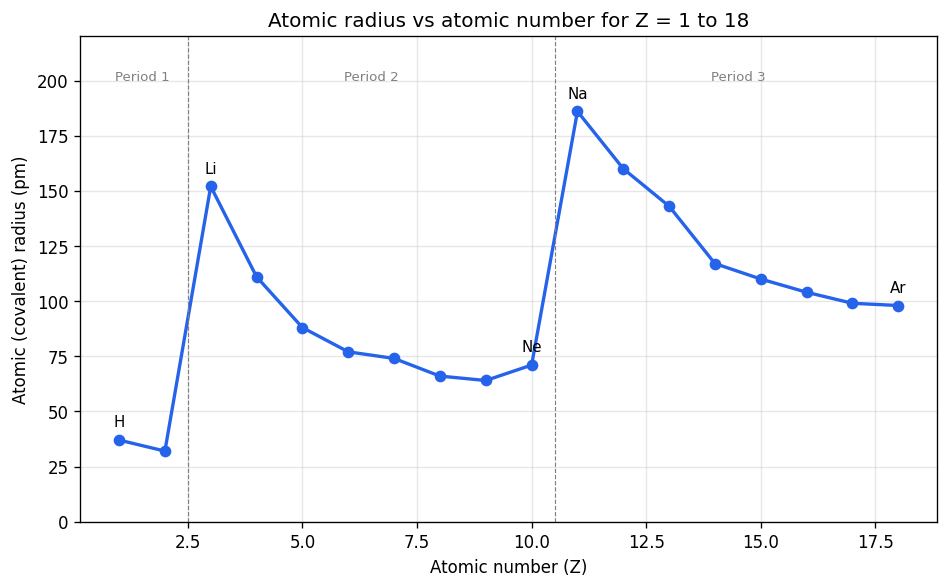
Study the variation of atomic radius with atomic number for Z = 1–18 and answer:
Across a period (e.g. Li to Ne) atomic radius:
AIncreases
BDecreases
CRemains constant
DNo definite trend
Down a group (e.g. Li → Na) atomic radius:
ADecreases
BIncreases
CRemains constant
DHas no trend
Explain the periodic trends shown by the graph in terms of effective nuclear charge and shells.
Show answersHide answers
1. Option 2 — Decreases
2. Option 2 — Increases
3. Across a period the principal quantum number is unchanged but the effective nuclear charge increases — outer electrons are pulled closer, so atomic radius decreases. Down a group, addition of a new shell outweighs the increase in nuclear charge, and atomic radius increases. The zigzag in the plot reflects the abrupt jump in radius as a new period begins (e.g. Li after Ne, Na after Ar).
Q563 Marks
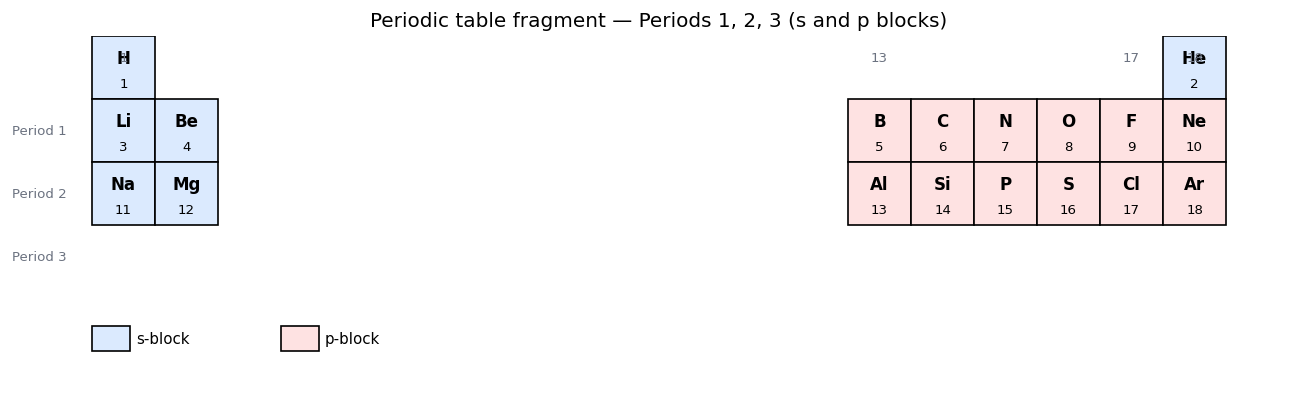
Study the periodic-table fragment for periods 1–3 and answer:
Sodium (Na, Z = 11) belongs to which block of the periodic table?
As-block
Bp-block
Cd-block
Df-block
Group 18 (the rightmost column) elements He, Ne, Ar are called:
AHalogens
BAlkali metals
CNoble gases
DAlkaline earth metals
Define s-block and p-block in terms of electron filling and identify the family names of groups 1, 2, 17, 18.
Show answersHide answers
1. Option 1 — s-block
2. Option 3 — Noble gases
3. The block of an element is determined by the orbital that receives its highest-energy electron. s-block: groups 1 and 2 (filling s orbitals — Li, Be, Na, Mg, etc.). p-block: groups 13–18 (filling p orbitals — B through Ne, Al through Ar). d-block (transition metals) and f-block (lanthanoids/actinoids) appear in periods 4 and beyond. Group 1 are alkali metals, group 2 alkaline earths, group 17 halogens, group 18 noble gases.