SUMMARY: The chapter on Equilibrium in Class 11 Chemistry explores the concept of equilibrium in chemical reactions, including the dynamic nature of equilibrium and the factors affecting it. KEY TOPICS: dynamic equilibrium, equilibrium constant, Le Chatelier's principle, homogeneous and heterogeneous equilibria, factors affecting equilibrium, applications of equilibrium, reaction quotient, relationship between Kp and Kc, common ion effect, solubility product.
Which of the following factors does NOT affect the position of equilibrium?
AChange in temperature
BChange in concentration
CChange in pressure
DPresence of a catalyst
Check answerHide answer
Correct answer: Option 4 — Presence of a catalyst
Q81 Mark
In a reaction at equilibrium, if the concentration of reactants is increased, according to Le Chatelier's principle, the equilibrium will shift towards:
AThe products
BThe reactants
CNo shift
DBoth sides equally
Check answerHide answer
Correct answer: Option 1 — The products
Q91 Mark
For the reaction N2(g) + 3H2(g) ⇌ 2NH3(g), what will happen if the volume of the container is decreased?
AEquilibrium shifts to the left
BEquilibrium shifts to the right
CNo change in equilibrium
DEquilibrium becomes unstable
Check answerHide answer
Correct answer: Option 2 — Equilibrium shifts to the right
Q101 Mark
The relationship between K_p and K_c for a reaction is given by which of the following equations?
AK_p = K_c (RT)^(Δn)
BK_p = K_c / (RT)^(Δn)
CK_p = K_c + (RT)^(Δn)
DK_p = K_c - (RT)^(Δn)
Check answerHide answer
Correct answer: Option 1 — K_p = K_c (RT)^(Δn)
Q111 Mark
Which of the following is true regarding homogeneous equilibria?
AAll reactants and products are in different phases
BAll reactants and products are in the same phase
COnly solids are involved
DOnly gases are involved
Check answerHide answer
Correct answer: Option 2 — All reactants and products are in the same phase
Q121 Mark
What effect does adding a common ion have on the solubility of a salt?
AIncreases solubility
BDecreases solubility
CNo effect on solubility
DChanges the pH of the solution
Check answerHide answer
Correct answer: Option 2 — Decreases solubility
Q131 Mark
In the equilibrium constant expression, which of the following is excluded?
AGases
BSolids
CLiquids
DAqueous solutions
Check answerHide answer
Correct answer: Option 2 — Solids
Q141 Mark
Which of the following statements about dynamic equilibrium is correct?
AThe concentrations of reactants and products are equal
BThe rate of the forward reaction equals the rate of the reverse reaction
CThe reaction has stopped
DOnly products are present
Check answerHide answer
Correct answer: Option 2 — The rate of the forward reaction equals the rate of the reverse reaction
Q151 Mark
Which of the following reactions is an example of a heterogeneous equilibrium?
Define chemical equilibrium and state its key feature.
View sample solutionHide solution
Chemical equilibrium is the state in a reversible reaction at which the rates of the forward and reverse reactions become equal so that concentrations of reactants and products remain constant. It is dynamic — molecules continuously interconvert at equal rates.
Q173 Marks
Write the expression for K_c for the reaction N₂(g) + 3H₂(g) ⇌ 2NH₃(g).
View sample solutionHide solution
K_c = [NH₃]²/([N₂][H₂]³). Concentrations are taken at equilibrium expressed in mol/L. Units of K_c here are (mol/L)⁻² since Δn = 2 − 4 = −2.
Q182 Marks
State Le Chatelier's principle.
View sample solutionHide solution
If a system at equilibrium is subjected to a change in concentration temperature or pressure the equilibrium shifts in the direction that opposes the change tending to restore equilibrium.
Q192 Marks
Define pH and calculate the pH of a 0.001 M HCl solution.
View sample solutionHide solution
pH = −log₁₀[H⁺]. For 0.001 M HCl (a strong acid that dissociates completely): [H⁺] = 10⁻³. pH = −log(10⁻³) = 3.
Q203 Marks
Distinguish between a strong acid and a weak acid.
View sample solutionHide solution
Strong acid: dissociates completely in water (e.g. HCl HNO₃) — high K_a — high [H⁺]. Weak acid: dissociates only partially (e.g. CH₃COOH HCN) — small K_a — low [H⁺]. Weak acids exist in equilibrium with their conjugate base in solution.
Q213 Marks
What is dynamic equilibrium in the context of chemical reactions?
View sample solutionHide solution
Dynamic equilibrium refers to a state in a reversible chemical reaction where the rate of the forward reaction equals the rate of the reverse reaction, resulting in constant concentrations of reactants and products over time.
Q223 Marks
Explain the significance of the equilibrium constant (K) in a chemical reaction.
View sample solutionHide solution
The equilibrium constant (K) quantifies the ratio of the concentrations of products to reactants at equilibrium for a given reaction at a specific temperature. A larger K value indicates a greater concentration of products at equilibrium, while a smaller K suggests more reactants are present.
Q233 Marks
What is the difference between homogeneous and heterogeneous equilibria?
View sample solutionHide solution
Homogeneous equilibrium occurs when all reactants and products are in the same phase (e.g., all gases), while heterogeneous equilibrium involves reactants and products in different phases (e.g., a solid and a gas).
Q243 Marks
Describe Le Chatelier's principle and its application in predicting the effect of changes in concentration on equilibrium.
View sample solutionHide solution
Le Chatelier's principle states that if an external change is applied to a system at equilibrium, the system will adjust to counteract that change and restore a new equilibrium. For example, increasing the concentration of reactants will shift the equilibrium position towards the products.
Q253 Marks
How does temperature affect the position of equilibrium in an exothermic reaction?
View sample solutionHide solution
In an exothermic reaction, increasing the temperature shifts the equilibrium position to the left, favoring the reactants, as the system absorbs the added heat. Conversely, lowering the temperature shifts the equilibrium to the right, favoring the formation of products.
Long Answer Questions6 questions
Q265 Marks
For the reaction H₂(g) + I₂(g) ⇌ 2HI(g) at equilibrium the concentrations are [H₂] = 0.5 M, [I₂] = 0.5 M and [HI] = 1.5 M. Calculate K_c.
View sample solutionHide solution
K_c = [HI]²/([H₂][I₂]) = (1.5)²/((0.5)(0.5)) = 2.25/0.25 = 9. Δn = 2 − 2 = 0 so K_c is dimensionless. The high value indicates the equilibrium favours HI formation.
Q275 Marks
Apply Le Chatelier's principle to predict the effect of (i) increasing temperature, (ii) increasing pressure, (iii) adding more H₂ on the equilibrium N₂ + 3H₂ ⇌ 2NH₃ + heat.
View sample solutionHide solution
(i) Forward reaction is exothermic; increasing T shifts equilibrium backwards (favours reactants). (ii) 4 mol gas → 2 mol gas; increasing P shifts equilibrium forward (fewer moles of gas). (iii) Adding more H₂ shifts equilibrium forward consuming H₂ to form more NH₃.
Q285 Marks
Calculate the pH of (i) 0.1 M HCl (ii) 0.001 M NaOH.
View sample solutionHide solution
(i) HCl is a strong acid: [H⁺] = 0.1 M = 10⁻¹. pH = −log(10⁻¹) = 1. (ii) NaOH is a strong base: [OH⁻] = 10⁻³. pOH = 3. pH = 14 − pOH = 11.
Q295 Marks
Calculate the K_a of acetic acid given that its 0.1 M solution has pH = 2.87.
View sample solutionHide solution
pH = 2.87 ⇒ [H⁺] = 10^(−2.87) ≈ 1.35 × 10⁻³ M. For HA ⇌ H⁺ + A⁻ at equilibrium: [H⁺] = [A⁻] ≈ 1.35 × 10⁻³ M; [HA] ≈ 0.1 − 1.35 × 10⁻³ ≈ 0.0987 M (often approximated as 0.1). K_a = [H⁺][A⁻]/[HA] ≈ (1.35 × 10⁻³)²/0.1 = 1.82 × 10⁻⁵ ≈ 1.8 × 10⁻⁵ — matches the textbook value.
Q305 Marks
Define a buffer solution and explain how an acidic buffer of CH₃COOH and CH₃COONa works.
View sample solutionHide solution
Buffer: a solution that resists pH changes when small amounts of acid or base are added. Acidic buffer: weak acid + its salt with a strong base. Mechanism in CH₃COOH/CH₃COONa: when H⁺ is added, the conjugate base CH₃COO⁻ neutralizes it: CH₃COO⁻ + H⁺ → CH₃COOH. When OH⁻ is added, the weak acid CH₃COOH neutralizes it: CH₃COOH + OH⁻ → CH₃COO⁻ + H₂O. The buffer pH is given by Henderson-Hasselbalch: pH = pK_a + log([salt]/[acid]).
Q316 Marks
Compare physical equilibrium and chemical equilibrium with the help of a table.
Assertion–Reason Questions8 questions
Q321 Mark
Assertion (A): Equilibrium is a dynamic state.
Reason (R): At equilibrium the forward and backward reactions continue at equal rates rather than stopping.
Show explanationHide explanation
Correct answer: Option 1 —
Both A and R are true, and R is the correct explanation of A.
Q331 Mark
Assertion (A): The equilibrium constant changes with temperature.
Reason (R): For an exothermic reaction K_c decreases with rising temperature; for an endothermic reaction K_c increases.
Show explanationHide explanation
Correct answer: Option 1 —
Both A and R are true, and R is the correct explanation of A.
Q341 Mark
Assertion (A): The pH of pure water at 25°C is 7.
Reason (R): At 25°C [H⁺] = [OH⁻] = 10⁻⁷ M and pH = −log(10⁻⁷) = 7.
Show explanationHide explanation
Correct answer: Option 1 —
Both A and R are true, and R is the correct explanation of A.
Q351 Mark
Assertion (A): Adding CH₃COONa decreases the dissociation of CH₃COOH.
Reason (R): The common acetate ion shifts the equilibrium of CH₃COOH dissociation backward by Le Chatelier.
Show explanationHide explanation
Correct answer: Option 1 —
Both A and R are true, and R is the correct explanation of A.
Q361 Mark
Assertion (A): A precipitate forms when ionic product exceeds K_sp.
Reason (R): If Q_ip > K_sp the system is supersaturated and precipitates ions to attain equilibrium.
Show explanationHide explanation
Correct answer: Option 1 —
Both A and R are true, and R is the correct explanation of A.
Q371 Mark
Assertion (A): The equilibrium constant (K) for a reaction is the same regardless of the initial concentrations of the reactants and products.
Reason (R): The equilibrium constant is determined only by the temperature of the system.
Show explanationHide explanation
Correct answer: Option 1 —
Both A and R are true, and R is the correct explanation of A.
Q381 Mark
Assertion (A): Le Chatelier's principle states that if a system at equilibrium is subjected to a change in concentration, pressure, or temperature, the system will adjust to counteract the change.
Reason (R): This adjustment helps to restore the equilibrium state of the system.
Show explanationHide explanation
Correct answer: Option 1 —
Both A and R are true, and R is the correct explanation of A.
Q391 Mark
Assertion (A): In a homogeneous equilibrium, all reactants and products are in the same phase.
Reason (R): This means that the equilibrium constant expression only includes concentrations of gaseous and aqueous species.
Show explanationHide explanation
Correct answer: Option 2 —
Both A and R are true, but R is not the correct explanation of A.
Statement-Based Questions8 questions
Q401 Mark
Statement 1: A large K_c indicates that the equilibrium favours products.
Statement 2: A small K_c indicates that the equilibrium favours reactants.
Show answerHide answer
Correct answer: Option 1 —
Both statements are true.
Q411 Mark
Statement 1: Increasing pressure favours the side with fewer moles of gas.
Statement 2: Increasing temperature favours the endothermic direction.
Show answerHide answer
Correct answer: Option 1 —
Both statements are true.
Q421 Mark
Statement 1: At 25°C pH + pOH = 14.
Statement 2: Acidic solutions have pH < 7 and basic solutions have pH > 7.
Show answerHide answer
Correct answer: Option 1 —
Both statements are true.
Q431 Mark
Statement 1: An acidic buffer is a mixture of a weak acid and its salt with a strong base.
Statement 2: A basic buffer is a mixture of a weak base and its salt with a strong acid.
Show answerHide answer
Correct answer: Option 1 —
Both statements are true.
Q441 Mark
Statement 1: The conjugate base of a strong acid is a weak base.
Statement 2: The conjugate acid of a strong base is a weak acid.
Show answerHide answer
Correct answer: Option 1 —
Both statements are true.
Q451 Mark
Statement 1: The equilibrium constant Kc is temperature dependent.
Statement 2: Le Chatelier's principle states that if a system at equilibrium is subjected to a change in concentration, pressure, or temperature, the system will adjust to counteract that change.
Show answerHide answer
Correct answer: Option 1 —
Both statements are true.
Q461 Mark
Statement 1: In a homogeneous equilibrium, all reactants and products are in the same phase.
Statement 2: The reaction quotient Q can be used to predict the direction in which a reaction will proceed to reach equilibrium.
Show answerHide answer
Correct answer: Option 1 —
Both statements are true.
Q471 Mark
Statement 1: The common ion effect decreases the solubility of a salt in a solution that contains a common ion.
Statement 2: The solubility product (Ksp) is a constant that applies only to gases at equilibrium.
Show answerHide answer
Correct answer: Option 2 —
Only Statement 1 is true.
Case Study / Passage Questions3 questions
Q483 Marks
In the Haber-Bosch process ammonia is manufactured by N₂(g) + 3H₂(g) ⇌ 2NH₃(g) + heat. A factory engineer must choose conditions of pressure and temperature that maximise the yield of NH₃ at acceptable economic costs.
Increasing pressure shifts the equilibrium:
AForward
BBackward
CNo effect
DCannot decide
Increasing temperature ____________ the yield of NH₃:
AIncreases
BDecreases
CRemains constant
DCannot decide
Why is a moderate (not extreme) temperature used in the Haber process?
Show answersHide answers
1. Option 1 — Forward
2. Option 2 — Decreases
3. Forward reaction: 4 mol gas → 2 mol gas (fewer gas moles). High pressure favours forward direction (more NH₃). Forward reaction is exothermic so high T shifts backward (less NH₃). Compromise: industrial process uses ~200 atm and ~450°C with iron catalyst to balance yield against rate. Lower T gives higher yield but slower reaction.
Q493 Marks
Human blood is buffered to maintain pH between 7.35 and 7.45. A medical chemistry student wants to compute the [H⁺] in blood and identify the buffer system that keeps the pH stable.
The [H⁺] in blood at pH 7.4 is approximately:
A10⁻⁵ M
B10⁻⁷ M
C~4 × 10⁻⁸ M
D10⁻⁹ M
The major buffer in blood is the:
ABicarbonate
BPhosphate
CAcetate
DCitrate
Explain how the bicarbonate buffer maintains blood pH near 7.4.
Show answersHide answers
1. Option 3 — ~4 × 10⁻⁸ M
2. Option 1 — Bicarbonate
3. At pH 7.4: [H⁺] = 10⁻⁷·⁴ ≈ 4 × 10⁻⁸ M. Major buffer in blood: H₂CO₃/HCO₃⁻ (carbonic acid/bicarbonate) which neutralises both excess acid and base. CO₂ + H₂O ⇌ H₂CO₃ ⇌ H⁺ + HCO₃⁻. Phosphate and protein buffers also contribute. pH below 7.35 is acidosis; above 7.45 is alkalosis — both are dangerous.
Q503 Marks
A chemistry student studies the equilibrium AgCl(s) ⇌ Ag⁺(aq) + Cl⁻(aq) for which K_sp = 1.8 × 10⁻¹⁰. The student wants to compute the molar solubility of AgCl in pure water and predict whether a precipitate forms when 0.001 M AgNO₃ is mixed with 0.001 M NaCl.
The molar solubility of AgCl in pure water is approximately:
A1.34 × 10⁻⁵ M
B1.34 × 10⁻⁴ M
C1.8 × 10⁻⁵ M
D1.8 × 10⁻¹⁰ M
On mixing 0.001 M AgNO₃ with 0.001 M NaCl in equal volumes:
AYes precipitate forms
BNo precipitate forms
CCannot decide
DReaches saturation
Compute the solubility of AgCl in 0.01 M NaCl (the common-ion effect).
Show answersHide answers
1. Option 1 — 1.34 × 10⁻⁵ M
2. Option 1 — Yes precipitate forms
3. Solubility: K_sp = [Ag⁺][Cl⁻] = s² ⇒ s = √(1.8 × 10⁻¹⁰) ≈ 1.34 × 10⁻⁵ M. Mixing test: after dilution [Ag⁺] = [Cl⁻] = 5 × 10⁻⁴ M. Q_ip = (5 × 10⁻⁴)² = 2.5 × 10⁻⁷. Since Q_ip > K_sp the system is supersaturated and AgCl precipitates until equilibrium is restored.
Table-Based Questions4 questions
Q513 Marks
Study the equilibrium constants of three reactions:
Reaction
K_c at 298 K
Direction favoured
H₂ + I₂ ⇌ 2HI
54
Forward (products)
N₂ + 3H₂ ⇌ 2NH₃
6.0 × 10⁵
Forward (products)
H₂O ⇌ H⁺ + OH⁻
1.0 × 10⁻¹⁴
Backward (reactants)
CaCO₃ ⇌ CaO + CO₂
1.4 × 10⁻¹⁵
Backward (reactants)
Which direction is favoured for K_c = 6 × 10⁵?
AForward
BBackward
CEither
DCannot decide
A K_c < 1 indicates that the equilibrium lies on the side of the:
AReactants
BProducts
CBoth equal
DCannot decide
Predict the direction in which the system H₂O ⇌ H⁺ + OH⁻ predominates at 25°C.
Show answersHide answers
1. Option 1 — Forward
2. Option 1 — Reactants
3. Magnitude of K_c indicates the position of equilibrium. K_c >> 1 means products predominate; K_c << 1 means reactants predominate; K_c ≈ 1 means significant amounts of both. K_c does not reveal the rate of reaction — only the equilibrium composition. K_c depends on T but not on concentrations.
Q523 Marks
Study the pH and pOH of common solutions at 25°C:
Solution
[H⁺] (M)
pH
pOH
0.1 M HCl
0.1
1
13
0.01 M HCl
0.01
2
12
Pure water
1.0 × 10⁻⁷
7
7
0.01 M NaOH
1.0 × 10⁻¹²
12
2
0.1 M NaOH
1.0 × 10⁻¹³
13
1
The pH of 0.01 M NaOH is:
A1
B7
C12
D13
Sum of pH and pOH at 25°C is always:
A7
B14
C1
D0
Compute the pH of 0.001 M NaOH and verify pH + pOH = 14.
Show answersHide answers
1. Option 3 — 12
2. Option 2 — 14
3. At 25°C: K_w = [H⁺][OH⁻] = 10⁻¹⁴ ⇒ pH + pOH = 14. For pure water [H⁺] = [OH⁻] = 10⁻⁷ M giving pH = 7. Acidic: pH < 7. Basic: pH > 7. The relation pH + pOH = 14 is temperature-dependent — at higher T K_w is larger so neutral pH < 7.
Q535 Marks
For the equilibrium 2SO₂(g) + O₂(g) ⇌ 2SO₃(g), compute K_c if at equilibrium [SO₂] = 0.4 M, [O₂] = 0.5 M and [SO₃] = 0.8 M.
Species
Equilibrium concentration (M)
SO₂
0.4
O₂
0.5
SO₃
0.8
Q545 Marks
Calculate the pH and pOH of each solution at 25°C.
Solution
(a) 0.1 M HCl
(b) 0.001 M HCl
(c) 0.01 M NaOH
(d) 0.001 M NaOH
(e) Pure water
Picture-Based Questions2 questions
Q553 Marks
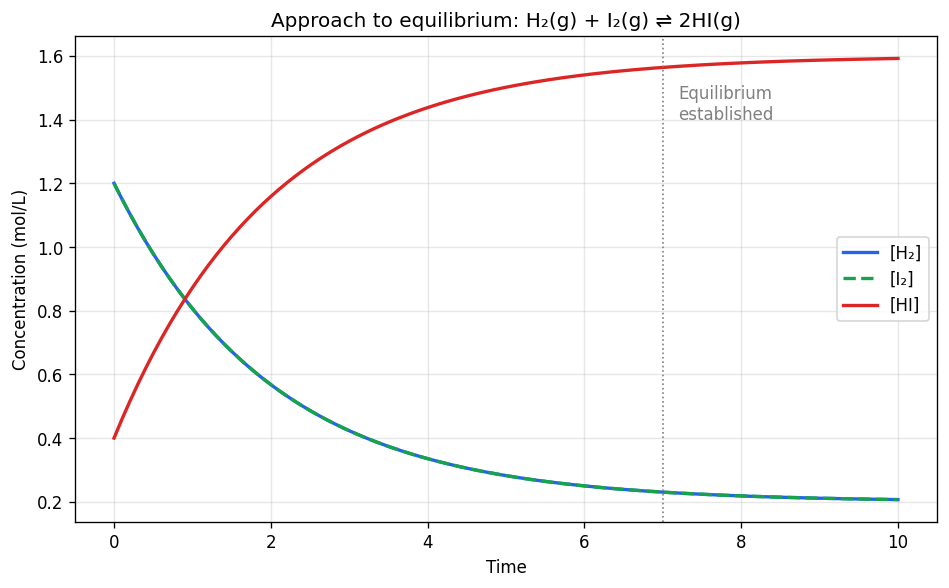
Study the concentration-vs-time plot for H₂(g) + I₂(g) ⇌ 2HI(g) and answer:
At the equilibrium region of the graph:
AForward rate exceeds backward rate
BBackward rate exceeds forward rate
CForward and backward rates are equal
DBoth rates are zero
Chemical equilibrium is best described as:
AStatic — molecular motion has stopped
BDynamic — forward and backward reactions continue at equal rates
COne-sided — only forward reaction occurs
DReversed permanently in the backward direction
Explain why concentrations remain constant after equilibrium is reached even though the reaction has not stopped.
Show answersHide answers
1. Option 3 — Forward and backward rates are equal
2. Option 2 — Dynamic — forward and backward reactions continue at equal rates
3. As the reaction proceeds, [H₂] and [I₂] decrease while [HI] increases. The forward rate (proportional to [H₂][I₂]) decreases while the backward rate (proportional to [HI]²) increases until the two rates become equal — this is equilibrium. After this point the concentrations remain constant (the plateaus on the graph) but the reactions continue at equal rates — equilibrium is dynamic, not static. The equilibrium constant K_c = [HI]²/([H₂][I₂]) at the plateau values.
Q563 Marks
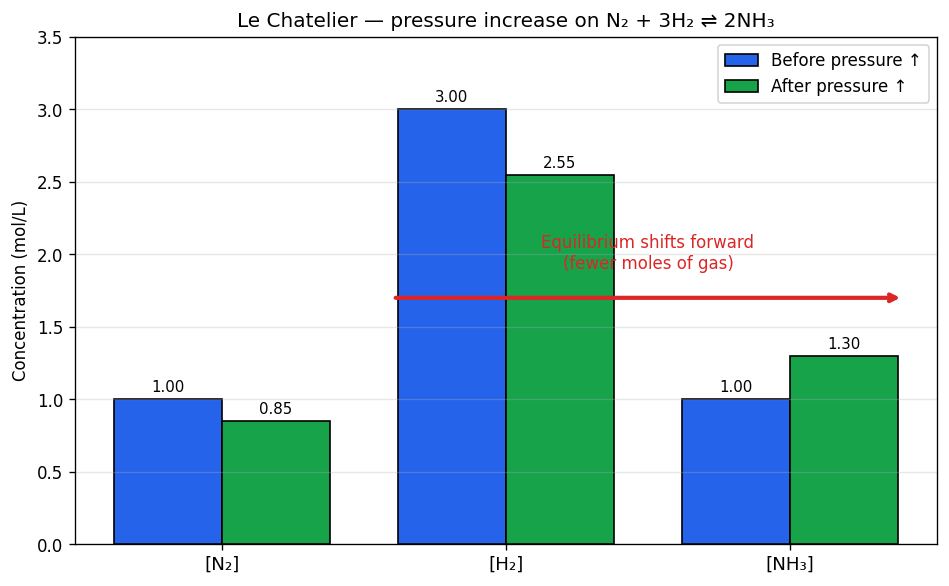
Study the Le Chatelier shift on increasing pressure for N₂ + 3H₂ ⇌ 2NH₃ and answer:
On increasing pressure, the equilibrium shifts in the:
AForward direction
BBackward direction
CNo shift
DReaction stops
The reason for the forward shift on pressure increase is:
ANumber of moles of gas is the same on both sides
BNumber of moles of gas is fewer on the product side (4 → 2)
CReaction is exothermic
DK_c does not depend on pressure
State Le Chatelier's principle and apply it to explain the industrial use of high pressure in the Haber process.
Show answersHide answers
1. Option 1 — Forward direction
2. Option 2 — Number of moles of gas is fewer on the product side (4 → 2)
3. Le Chatelier's principle: a system at equilibrium responds to a disturbance by shifting in a direction that opposes the change. Increasing pressure compresses the system; the system responds by shifting toward the side with fewer moles of gas (reducing the total moles and therefore the pressure). For N₂(g) + 3H₂(g) ⇌ 2NH₃(g) the forward reaction goes from 4 mol of gas to 2 mol of gas, so high pressure favours NH₃ formation. This is exploited in the Haber process where ~200 atm is used industrially to push the equilibrium toward NH₃.