Organic Chemistry - Some Basic Principles and Techniques — Important Questions
56 questions
With answersCBSE format
SUMMARY: This chapter introduces the fundamental principles and techniques of organic chemistry, including the classification and nomenclature of organic compounds. KEY TOPICS: IUPAC nomenclature, classification of organic compounds, isomerism, purification techniques, qualitative analysis, hybridization, resonance, inductive effect, hyperconjugation, reaction intermediates.
Which of the following compounds is classified as an alkane?
AC₃H₈
BC₂H₄
CC₄H₁₀
DC₅H₆
Check answerHide answer
Correct answer: Option 3 — C₄H₁₀
Q71 Mark
What is the IUPAC name for the compound with the formula C₅H₁₂?
APentane
BButane
CHexane
DPropane
Check answerHide answer
Correct answer: Option 1 — Pentane
Q81 Mark
Which type of isomerism is exhibited by butanol and isobutanol?
AGeometric isomerism
BStructural isomerism
COptical isomerism
DFunctional isomerism
Check answerHide answer
Correct answer: Option 2 — Structural isomerism
Q91 Mark
In the context of hybridization, what is the hybridization of the carbon atom in ethylene (C₂H₄)?
Asp
Bsp²
Csp³
Dd²sp³
Check answerHide answer
Correct answer: Option 2 — sp²
Q101 Mark
Which of the following statements about resonance is true?
AResonance structures can differ in the number of atoms present.
BResonance structures represent the same molecule with different electron arrangements.
CResonance structures can be isolated as separate entities.
DResonance does not affect the stability of the molecule.
Check answerHide answer
Correct answer: Option 2 — Resonance structures represent the same molecule with different electron arrangements.
Q111 Mark
What is the main characteristic of the inductive effect in organic compounds?
AIt is a permanent effect due to the electronegativity of atoms.
BIt is a temporary effect caused by the movement of electrons.
CIt only occurs in cyclic compounds.
DIt is the result of hydrogen bonding.
Check answerHide answer
Correct answer: Option 1 — It is a permanent effect due to the electronegativity of atoms.
Q121 Mark
Which of the following compounds exhibits hyperconjugation?
AEthylene
BPropene
CTert-butyl carbocation
DCyclohexane
Check answerHide answer
Correct answer: Option 3 — Tert-butyl carbocation
Q131 Mark
What is the IUPAC name for the compound with the structure CH₃-CH(CH₃)-CH₂-CHO?
A3-Methylbutanal
B2-Methylbutanal
CButanal
DPentanal
Check answerHide answer
Correct answer: Option 1 — 3-Methylbutanal
Q141 Mark
Which of the following is a purification technique used in organic chemistry?
AElectrolysis
BDistillation
CFiltration
DChromatography
Check answerHide answer
Correct answer: Option 2 — Distillation
Q151 Mark
Which type of isomerism involves the same molecular formula but different spatial arrangements?
AStructural isomerism
BGeometric isomerism
CFunctional isomerism
DChain isomerism
Check answerHide answer
Correct answer: Option 2 — Geometric isomerism
Short Answer Questions10 questions
Q163 Marks
Differentiate between an electrophile and a nucleophile.
View sample solutionHide solution
Electrophile: an electron-poor species that seeks electrons (e.g. H⁺ NO₂⁺ Br⁺ SO₃ AlCl₃). Nucleophile: an electron-rich species that donates an electron pair (e.g. OH⁻ CN⁻ NH₃ H₂O). They attack opposite-charged regions in organic reactions.
Q173 Marks
What is the inductive effect? Give one example.
View sample solutionHide solution
Inductive effect (I-effect): the polarization of a σ bond due to the difference in electronegativity of bonded atoms which is transmitted along a chain. −I effect (electron-withdrawing): NO₂ CN COOH X. +I effect (electron-donating): alkyl groups CH₃ C₂H₅. Example: in CH₃Cl the chlorine pulls electron density toward itself making the C-Cl bond polar.
Q183 Marks
Define IUPAC nomenclature and write the IUPAC name of CH₃-CH(OH)-CH₃.
View sample solutionHide solution
IUPAC nomenclature is a systematic way of naming organic compounds based on the longest carbon chain functional groups and substituents. CH₃-CH(OH)-CH₃ has 3 carbons with an OH on C2 — propan-2-ol (or 2-propanol).
Q193 Marks
Write the structures of two functional isomers of C₃H₈O.
View sample solutionHide solution
Two functional isomers of C₃H₈O: (i) propan-1-ol CH₃-CH₂-CH₂-OH (an alcohol). (ii) methoxyethane CH₃-O-CH₂-CH₃ (an ether). Both have the same molecular formula but different functional groups.
Q203 Marks
What is hyperconjugation? In which compound is it observed?
View sample solutionHide solution
Hyperconjugation is the stabilizing interaction between σ-bonding electrons (typically C-H of an alkyl group) adjacent to a π-system or empty orbital. It explains the relative stability of carbocations alkyl radicals and alkenes. Example: tert-butyl carbocation is most stable because of 9 α-hydrogens contributing hyperconjugation.
Q213 Marks
What is isomerism? Explain the two main types of isomerism with examples.
View sample solutionHide solution
Isomerism is the phenomenon where compounds have the same molecular formula but different structural or spatial arrangements. The two main types are structural isomerism, exemplified by butanol (C₄H₁₀O) which can exist as n-butanol and isobutanol, and stereoisomerism, such as cis-trans isomers in alkenes like 2-butene.
Q223 Marks
Define hybridization and explain the hybridization state of carbon in ethylene (C₂H₄).
View sample solutionHide solution
Hybridization is the concept of mixing atomic orbitals to form new hybrid orbitals suitable for the pairing of electrons to form chemical bonds. In ethylene (C₂H₄), carbon undergoes sp² hybridization, resulting in three sp² hybrid orbitals and one unhybridized p orbital for π-bonding.
Q233 Marks
What are the main steps involved in the purification of organic compounds?
View sample solutionHide solution
The main steps in the purification of organic compounds include extraction, where the desired compound is separated from impurities; distillation, which separates components based on boiling points; and recrystallization, which purifies solid compounds by dissolving them and allowing them to crystallize out of solution.
Q243 Marks
Explain the concept of resonance and its significance in organic chemistry.
View sample solutionHide solution
Resonance is the phenomenon where a molecule can be represented by two or more valid Lewis structures, known as resonance structures, which contribute to the overall hybrid structure. It is significant because it helps explain the stability and reactivity of molecules, such as benzene, which is more stable due to resonance stabilization.
Q253 Marks
What is the difference between primary, secondary, and tertiary alcohols? Provide examples.
View sample solutionHide solution
Primary alcohols have the hydroxyl group (-OH) attached to a carbon that is bonded to only one other carbon (e.g., ethanol). Secondary alcohols have the -OH group on a carbon bonded to two other carbons (e.g., isopropanol). Tertiary alcohols have the -OH on a carbon bonded to three other carbons (e.g., tert-butanol).
Long Answer Questions6 questions
Q265 Marks
Explain the rules of IUPAC nomenclature with at least three example compounds.
View sample solutionHide solution
Rules: (1) Identify the longest carbon chain containing the principal functional group — this is the parent. (2) Number the chain to give the lowest locants to the principal functional group. (3) Name substituents as prefixes with their locants in alphabetical order. (4) Use suffix for the principal functional group (e.g. -ol, -al, -oic acid). Examples: CH₃-CH₂-CH₂-OH = propan-1-ol. CH₃-CH(CH₃)-COOH = 2-methylpropanoic acid. CH₃-CH=CH-CHO = but-2-enal.
Q275 Marks
Explain the four types of organic reactions with one example each.
View sample solutionHide solution
(1) Substitution: one atom/group replaces another. CH₄ + Cl₂ → CH₃Cl + HCl. (2) Addition: atoms add across a multiple bond. CH₂=CH₂ + Br₂ → CH₂Br-CH₂Br. (3) Elimination: a small molecule is lost. CH₃-CH₂-OH (with H₂SO₄ Δ) → CH₂=CH₂ + H₂O. (4) Rearrangement: atoms rearrange within the molecule. Pinacol rearrangement converts 1,2-diols to ketones.
Q285 Marks
Discuss the four electronic effects in organic chemistry: inductive resonance hyperconjugation and electromeric.
View sample solutionHide solution
Inductive: σ-bond polarization due to electronegativity differences; transmitted through chain; weakens with distance. Resonance: delocalization of π-electrons through conjugated systems leading to alternative electron distributions; stabilises molecules. Hyperconjugation: stabilizing interaction of σC-H electrons with adjacent π or empty orbital. Electromeric: complete transfer of π-electrons to one atom of a double bond in the presence of an attacking reagent — temporary effect.
Q295 Marks
Define structural and stereoisomerism. Give one example of each kind.
View sample solutionHide solution
Structural (constitutional) isomerism: same molecular formula different connectivity. Types: chain (butane vs isobutane); position (1-propanol vs 2-propanol); functional (ethanol vs dimethyl ether); metamerism. Stereoisomerism: same connectivity but different spatial arrangement. Types: geometric (cis-but-2-ene vs trans-but-2-ene) and optical (enantiomers like (R)- and (S)-lactic acid).
Q305 Marks
Explain how the inductive effect determines the relative acidity of formic acetic and propionic acids.
View sample solutionHide solution
All three are weak carboxylic acids: HCOOH > CH₃COOH > CH₃CH₂COOH in acidity. The alkyl groups (CH₃ CH₃CH₂) are electron-donating (+I). They destabilize the conjugate base (RCOO⁻) by adding electron density making dissociation less favourable. Formic acid (no alkyl) gives the most stable conjugate base making it the strongest. Adding more alkyl groups further reduces acidity.
Q316 Marks
Differentiate between homolytic and heterolytic bond fission in tabular form.
Assertion–Reason Questions8 questions
Q321 Mark
Assertion (A): The IUPAC name of CH₃COOH is ethanoic acid.
Reason (R): A 2-carbon carboxylic acid is named by replacing the final -e of the parent alkane (ethane) with -oic acid.
Show explanationHide explanation
Correct answer: Option 1 —
Both A and R are true, and R is the correct explanation of A.
Q331 Mark
Assertion (A): Benzene has equal C-C bond lengths.
Reason (R): Resonance delocalises π-electrons over the entire ring giving a bond order of 1.5 for each C-C bond.
Show explanationHide explanation
Correct answer: Option 1 —
Both A and R are true, and R is the correct explanation of A.
Q341 Mark
Assertion (A): Trichloroacetic acid is stronger than acetic acid.
Reason (R): The three Cl atoms exert a strong −I effect that stabilises the conjugate base by withdrawing electron density.
Show explanationHide explanation
Correct answer: Option 1 —
Both A and R are true, and R is the correct explanation of A.
Q351 Mark
Assertion (A): The tert-butyl carbocation is more stable than the methyl carbocation.
Reason (R): The 9 α-hydrogens in tert-butyl carbocation provide hyperconjugative stabilization which methyl carbocation lacks.
Show explanationHide explanation
Correct answer: Option 1 —
Both A and R are true, and R is the correct explanation of A.
Q361 Mark
Assertion (A): Compounds with the same molecular formula but different structures are called isomers.
Reason (R): Different connectivity or spatial arrangement leads to different physical and chemical properties.
Show explanationHide explanation
Correct answer: Option 1 —
Both A and R are true, and R is the correct explanation of A.
Q371 Mark
Assertion (A): The IUPAC name of C₆H₅OH is phenol.
Reason (R): Phenol is classified as an aromatic alcohol due to the presence of a hydroxyl group attached to a benzene ring.
Show explanationHide explanation
Correct answer: Option 1 —
Both A and R are true, and R is the correct explanation of A.
Q381 Mark
Assertion (A): Isomers have different physical and chemical properties.
Reason (R): Isomers differ in their structural arrangement, which affects their interactions and reactivity.
Show explanationHide explanation
Correct answer: Option 1 —
Both A and R are true, and R is the correct explanation of A.
Q391 Mark
Assertion (A): The inductive effect is a permanent effect in organic compounds.
Reason (R): The inductive effect arises from the electronegativity difference between atoms, leading to a permanent dipole.
Show explanationHide explanation
Correct answer: Option 1 —
Both A and R are true, and R is the correct explanation of A.
Statement-Based Questions8 questions
Q401 Mark
Statement 1: The functional group of an alcohol is -OH.
Statement 2: The functional group of a carboxylic acid is -COOH.
Show answerHide answer
Correct answer: Option 1 —
Both statements are true.
Q411 Mark
Statement 1: Substitution reactions are typical of saturated compounds.
Statement 2: Addition reactions are typical of unsaturated compounds.
Show answerHide answer
Correct answer: Option 1 —
Both statements are true.
Q421 Mark
Statement 1: An electrophile attacks the electron-rich centre of a molecule.
Statement 2: A nucleophile attacks the electron-poor centre of a molecule.
Show answerHide answer
Correct answer: Option 1 —
Both statements are true.
Q431 Mark
Statement 1: Resonance involves delocalization of π electrons.
Statement 2: Inductive effect involves polarization of σ bonds.
Show answerHide answer
Correct answer: Option 1 —
Both statements are true.
Q441 Mark
Statement 1: Geometric isomerism arises from restricted rotation about a double bond.
Statement 2: Optical isomerism arises from the presence of a chiral centre.
Show answerHide answer
Correct answer: Option 1 —
Both statements are true.
Q451 Mark
Statement 1: The IUPAC name of CH3-CH2-CH2-CHO is butanal.
Statement 2: Isomerism can occur in compounds with the same molecular formula but different structural formulas.
Show answerHide answer
Correct answer: Option 1 —
Both statements are true.
Q461 Mark
Statement 1: The inductive effect is a permanent effect due to the electronegativity of atoms in a molecule.
Statement 2: Hybridization involves the mixing of atomic orbitals to form new hybrid orbitals.
Show answerHide answer
Correct answer: Option 1 —
Both statements are true.
Q471 Mark
Statement 1: The functional group of a ketone is -COOH.
Statement 2: The IUPAC name for CH3-CO-CH3 is propan-2-one.
Show answerHide answer
Correct answer: Option 3 —
Only Statement 2 is true.
Case Study / Passage Questions3 questions
Q483 Marks
A laboratory chemist is given an unknown organic liquid that smells like vinegar and reacts with NaHCO₃ producing CO₂. The chemist suspects it contains a carboxylic acid group.
The functional group present is:
AAlcohol
BAldehyde
CCarboxylic acid
DEster
The structure of this group is:
A−OH
B−CHO
C−COOH
D−COOR
Why does an alcohol not release CO₂ from NaHCO₃ but a carboxylic acid does?
Show answersHide answers
1. Option 3 — Carboxylic acid
2. Option 3 — −COOH
3. Carboxylic acids react with NaHCO₃ to release CO₂ — a characteristic test (other classes do not). Vinegar smell suggests acetic acid CH₃COOH. The −COOH group has both a C=O and an O-H giving acidic character through the resonance-stabilised carboxylate ion COO⁻. Alcohols (−OH) do not release CO₂ from NaHCO₃; aldehydes (−CHO) give different reactions.
Q493 Marks
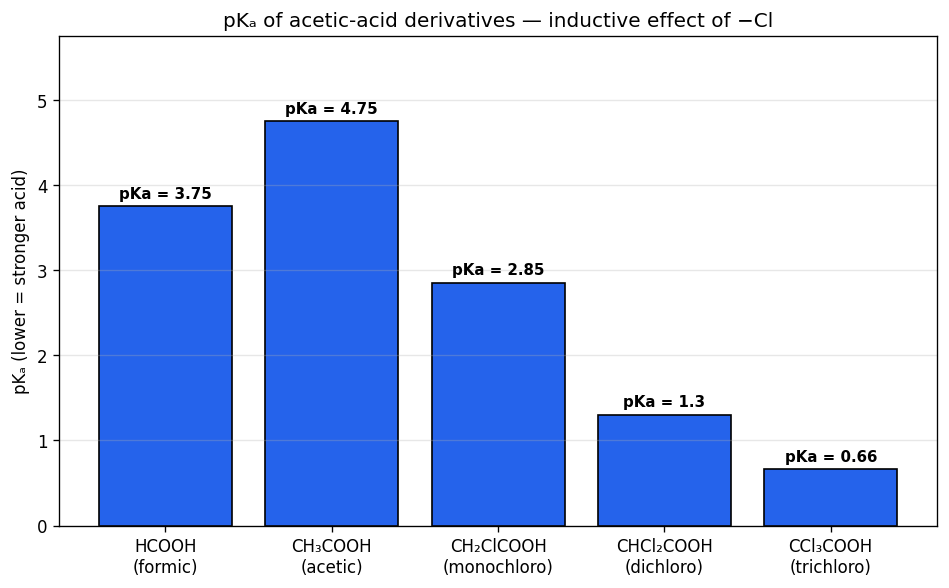
A student compares the acidities of HCOOH (formic acid pKa 3.75) CH₃COOH (acetic 4.75) and CCl₃COOH (trichloroacetic 0.66). The student must explain the trend in terms of inductive effects.
The strongest acid in the list is:
AHCOOH
BCH₃COOH
CCCl₃COOH
DAll equal
The −I effect of Cl atoms ____________ the conjugate base:
AStabilises
BDestabilises
CNo effect
DCannot decide
Compare the acidity of CHCl₂COOH and CH₂ClCOOH using the inductive effect.
Show answersHide answers
1. Option 3 — CCl₃COOH
2. Option 1 — Stabilises
3. Lower pKa = stronger acid. Order of acidity: CCl₃COOH (0.66) > HCOOH (3.75) > CH₃COOH (4.75). Three Cl atoms exert strong −I effect withdrawing electron density and stabilising the conjugate carboxylate anion. CH₃ exerts +I effect destabilising the carboxylate. So acidity increases as electron-withdrawing groups are added near the −COOH.
Q503 Marks
Benzene is unusually stable compared to a hypothetical 1 3 5-cyclohexatriene (with alternating single and double bonds). The resonance/delocalisation energy is approximately 150 kJ/mol making benzene resistant to addition reactions and prefer substitution.
The resonance stabilisation energy of benzene is approximately:
A150 kJ/mol
B300 kJ/mol
C75 kJ/mol
D1500 kJ/mol
Benzene preferentially undergoes:
AAddition
BSubstitution
CElimination
DRearrangement
Why does benzene undergo substitution rather than addition?
Show answersHide answers
1. Option 1 — 150 kJ/mol
2. Option 2 — Substitution
3. In benzene the 6 π electrons are delocalised over the entire ring giving every C-C bond order 1.5 (intermediate between single and double). This delocalisation lowers the energy by about 150 kJ/mol relative to a hypothetical localised structure. Substitution preserves the aromatic ring — and hence the stabilisation — whereas addition would destroy it. So benzene undergoes electrophilic aromatic substitution rather than addition.
Table-Based Questions4 questions
Q513 Marks
Study the IUPAC names and structures of common organic compounds:
Compound
Structural formula
IUPAC name
Methanol
CH₃OH
Methanol
Acetaldehyde
CH₃CHO
Ethanal
Acetone
CH₃COCH₃
Propan-2-one
Acetic acid
CH₃COOH
Ethanoic acid
Diethyl ether
CH₃CH₂OCH₂CH₃
Ethoxyethane
The IUPAC name of CH₃CHO (acetaldehyde) is:
AMethanol
BEthanol
CEthanal
DMethanal
The IUPAC name of acetone is:
APropan-2-ol
BPropan-2-one
CPropanal
DPropanoic acid
Write the IUPAC names of CH₃-CH(OH)-CH₃ and CH₃-CH₂-CHO.
Show answersHide answers
1. Option 3 — Ethanal
2. Option 2 — Propan-2-one
3. IUPAC nomenclature follows systematic rules: identify the longest carbon chain containing the principal functional group; number the chain to give the lowest locant to the principal group; name substituents as prefixes with locants in alphabetical order. Aldehyde suffix -al; ketone -one; carboxylic acid -oic acid; alcohol -ol; ether -oxy- (or -O- in the prefix style).
Q523 Marks
Study the inductive and resonance effects in organic compounds:
Group
Effect
Type
−CH₃
+I
Electron-donating
−NO₂
−I and −R
Electron-withdrawing
−Cl
−I and weak +R
Net electron-withdrawing
−OCH₃
+R weak −I
Net electron-donating
−COOH
−R and −I
Electron-withdrawing
The methyl group −CH₃ ____________ electrons:
ADonates
BWithdraws
CNo effect
DCannot decide
−NO₂ is an example of:
AElectron-donating
BElectron-withdrawing
CBoth
DNeither
Predict whether toluene (C₆H₅-CH₃) is more or less reactive toward electrophilic substitution than benzene.
Show answersHide answers
1. Option 1 — Donates
2. Option 2 — Electron-withdrawing
3. Electron-donating groups (+I/+R) destabilise carbocations adjacent to them and increase electron density on aromatic rings (activate toward electrophilic substitution; ortho/para-direct). Electron-withdrawing groups (−I/−R) stabilise carbocations far from them and decrease aromatic electron density (deactivate; meta-direct). The net effect is the sum of inductive and resonance contributions.
Q536 Marks
Write the IUPAC name of each compound from its structure.
Compound
(a) CH₃-CH₂-CH₂-OH
(b) CH₃-CH(OH)-CH₃
(c) CH₃-CHO
(d) CH₃-COOH
(e) CH₃-CO-CH₃
(f) CH₂=CH-CH₃
Q545 Marks
Identify the type of isomerism in each pair of compounds.
Pair
Compounds
(a)
Butane vs Isobutane
(b)
Propan-1-ol vs Propan-2-ol
(c)
Ethanol vs Methoxymethane
(d)
cis-but-2-ene vs trans-but-2-ene
Picture-Based Questions2 questions
Q553 Marks
Study the pKₐ values of acetic-acid derivatives and answer:
The strongest acid (lowest pKₐ) in the chart is:
AHCOOH
BCH₃COOH
CCH₂ClCOOH
DCCl₃COOH
The trend in acidity (increasing with more Cl substituents) is best explained by:
AResonance (+R) effect of −Cl
BInductive (−I) effect of −Cl stabilising the conjugate base
CSteric crowding by −Cl groups
DHydrogen bonding with the −Cl groups
Explain why acidity increases as Cl substitution increases on acetic acid using the inductive effect.
Show answersHide answers
1. Option 4 — CCl₃COOH
2. Option 2 — Inductive (−I) effect of −Cl stabilising the conjugate base
3. Each −Cl is electronegative and exerts a −I (inductive) effect, withdrawing electron density through the σ-framework. This stabilises the conjugate base (carboxylate, RCOO⁻) by spreading the negative charge over a wider region. A more stable conjugate base means greater dissociation of the parent acid, hence lower pKₐ and higher acidity. Adding more −Cl groups amplifies the effect: CCl₃COOH (3 × −Cl) is much stronger than CH₂ClCOOH (1 × −Cl). The +I effect of −CH₃ in acetic acid does the opposite, weakening the acid relative to formic acid.
Q563 Marks
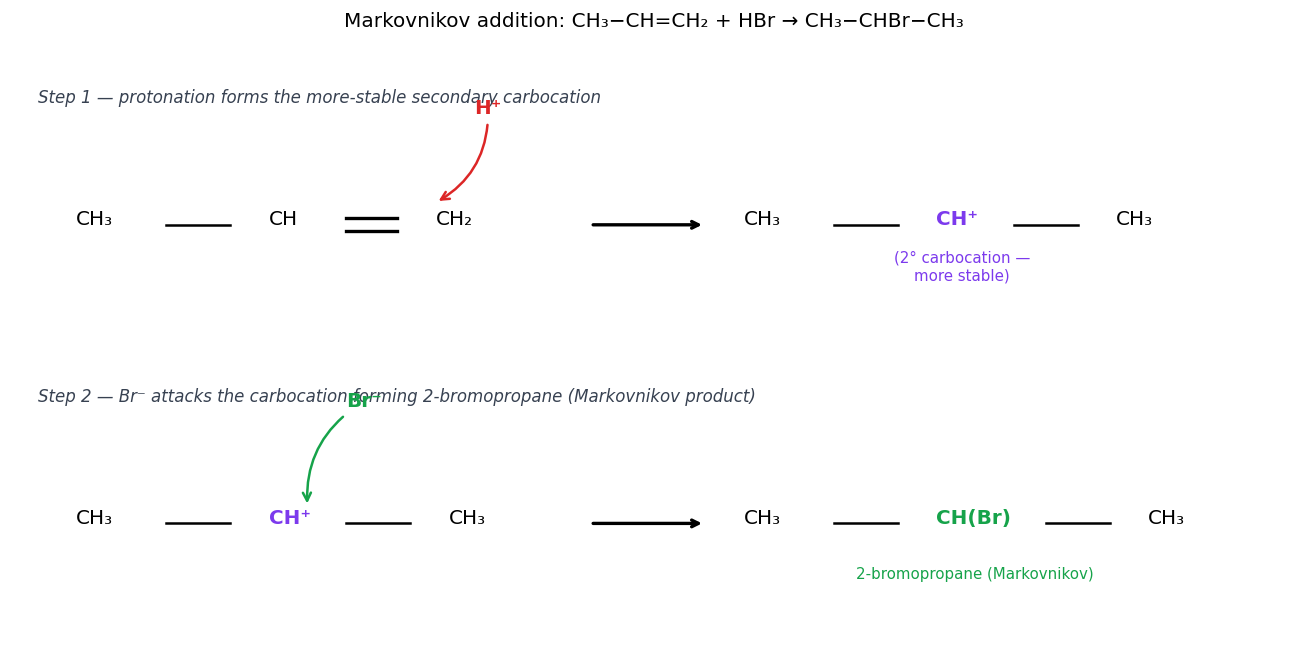
Study the two-step Markovnikov mechanism for HBr addition to propene and answer:
The major product of the reaction is:
A1-bromopropane (CH₃CH₂CH₂Br)
B2-bromopropane (CH₃CHBrCH₃)
C1,2-dibromopropane
DPropan-1-ol
The intermediate formed in step 1 is the more stable:
APrimary (1°) carbocation
BSecondary (2°) carbocation
CTertiary (3°) carbocation
DMethyl carbocation
State Markovnikov's rule and explain the mechanism in terms of carbocation stability.
Show answersHide answers
1. Option 2 — 2-bromopropane (CH₃CHBrCH₃)
2. Option 2 — Secondary (2°) carbocation
3. Markovnikov's rule: when HX adds to an asymmetric alkene, the H attaches to the carbon with more H atoms and X to the carbon with fewer H atoms. The mechanistic explanation is carbocation stability: in step 1, H⁺ adds to the terminal CH₂ (more H), generating a secondary carbocation at the central carbon (rather than a less-stable primary one at the terminal). The Br⁻ then attacks this 2° carbocation in step 2, giving 2-bromopropane as the major product. With a peroxide initiator the mechanism switches to a free-radical chain and the regioselectivity reverses (anti-Markovnikov, giving 1-bromopropane) — but only with HBr, not HCl or HI.