SUMMARY: The chapter on Redox Reactions in Class 11 Chemistry explores the concepts of oxidation and reduction, their applications, and the balancing of redox reactions. KEY TOPICS: oxidation, reduction, oxidizing agents, reducing agents, oxidation number, balancing redox reactions, redox reactions in terms of electron transfer, redox reactions in terms of oxidation number, applications of redox reactions, electrochemical cells
In the reaction Zn + CuSO₄ → ZnSO₄ + Cu the oxidising agent is:
AZn
BCu
CCu²⁺ (in CuSO₄)
DSO₄²⁻
Check answerHide answer
Correct answer: Option 3 — Cu²⁺ (in CuSO₄)
Q41 Mark
The oxidation number of S in H₂SO₄ is:
A+2
B+4
C+6
D+8
Check answerHide answer
Correct answer: Option 3 — +6
Q51 Mark
A disproportionation reaction is one in which the same species is:
AOnly oxidised
BOnly reduced
CBoth oxidised and reduced
DNeither
Check answerHide answer
Correct answer: Option 3 — Both oxidised and reduced
Q61 Mark
Which of the following statements correctly describes a reducing agent?
AIt gains electrons during a reaction.
BIt loses electrons during a reaction.
CIt increases the oxidation number of another substance.
DIt decreases the oxidation number of another substance.
Check answerHide answer
Correct answer: Option 2 — It loses electrons during a reaction.
Q71 Mark
In the reaction 2Fe₂O₃ + 3C → 4Fe + 3CO₂, which element is oxidized?
AIron (Fe)
BCarbon (C)
COxygen (O)
DNone of the above
Check answerHide answer
Correct answer: Option 2 — Carbon (C)
Q81 Mark
What is the oxidation number of chlorine in NaClO₃?
A+1
B+5
C-1
D0
Check answerHide answer
Correct answer: Option 2 — +5
Q91 Mark
Which of the following reactions is a redox reaction?
AH₂ + Cl₂ → 2HCl
BNaOH + HCl → NaCl + H₂O
C2Mg + O₂ → 2MgO
DCaCO₃ → CaO + CO₂
Check answerHide answer
Correct answer: Option 3 — 2Mg + O₂ → 2MgO
Q101 Mark
In a redox reaction, if the oxidation number of an element decreases, what process has occurred?
AOxidation
BReduction
CDisproportionation
DCombustion
Check answerHide answer
Correct answer: Option 2 — Reduction
Q111 Mark
Which of the following is an example of a disproportionation reaction?
A2H₂O₂ → 2H₂O + O₂
BFe + CuSO₄ → FeSO₄ + Cu
CZn + 2AgNO₃ → Zn(NO₃)₂ + 2Ag
DC + O₂ → CO₂
Check answerHide answer
Correct answer: Option 1 — 2H₂O₂ → 2H₂O + O₂
Q121 Mark
In the electrochemical cell, the anode is where which process occurs?
AReduction
BOxidation
CNeutralization
DCombustion
Check answerHide answer
Correct answer: Option 2 — Oxidation
Q131 Mark
What is the role of an oxidizing agent in a redox reaction?
AIt gets reduced and gains electrons.
BIt gets oxidized and loses electrons.
CIt remains unchanged during the reaction.
DIt increases the temperature of the reaction.
Check answerHide answer
Correct answer: Option 1 — It gets reduced and gains electrons.
Q141 Mark
In the reaction 2K + Cl₂ → 2KCl, which element is reduced?
APotassium (K)
BChlorine (Cl)
CBoth K and Cl
DNone of the above
Check answerHide answer
Correct answer: Option 2 — Chlorine (Cl)
Q151 Mark
What is the oxidation number of nitrogen in NH₄⁺?
A-3
B+3
C+1
D0
Check answerHide answer
Correct answer: Option 1 — -3
Short Answer Questions10 questions
Q162 Marks
Define oxidation and reduction in terms of electron transfer.
View sample solutionHide solution
Oxidation: loss of electrons by a species (oxidation number increases). Reduction: gain of electrons (oxidation number decreases). The two always occur together — one species is oxidised while another is reduced.
Q173 Marks
Calculate the oxidation number of nitrogen in NH₃ NO₂ and HNO₃.
View sample solutionHide solution
NH₃: H = +1; sum = 0 ⇒ N + 3(+1) = 0 ⇒ N = −3. NO₂: O = −2; sum = 0 ⇒ N + 2(−2) = 0 ⇒ N = +4. HNO₃: H = +1 O = −2; sum = 0 ⇒ +1 + N + 3(−2) = 0 ⇒ N = +5.
Q183 Marks
Identify the oxidising and reducing agents in: 2H₂(g) + O₂(g) → 2H₂O(l).
View sample solutionHide solution
H goes from 0 in H₂ to +1 in H₂O (oxidised) — H₂ is the reducing agent. O goes from 0 in O₂ to −2 in H₂O (reduced) — O₂ is the oxidising agent.
Q193 Marks
What is a disproportionation reaction? Give one example.
View sample solutionHide solution
A disproportionation reaction is one in which the same element in a particular oxidation state is simultaneously oxidised and reduced. Example: 3Cl₂ + 6NaOH → 5NaCl + NaClO₃ + 3H₂O. Cl(0) is reduced to Cl(−1) and oxidised to Cl(+5).
Q203 Marks
Why is the oxidation number of an element in its elemental form taken as zero?
View sample solutionHide solution
In an element atoms are bonded only to identical atoms which have equal electronegativity. Electrons are shared equally so no atom acquires partial charge. Thus the oxidation number is zero by convention.
Q213 Marks
What is the role of an oxidizing agent in a redox reaction?
View sample solutionHide solution
An oxidizing agent is a substance that gains electrons during a redox reaction and is thereby reduced. It facilitates the oxidation of another substance by accepting electrons from it.
Q223 Marks
Explain how to determine the oxidation number of an element in a compound.
View sample solutionHide solution
To determine the oxidation number of an element in a compound, assign oxidation states based on a set of rules, such as the oxidation number of free elements is zero, the sum of oxidation numbers in a neutral compound is zero, and specific rules for common ions.
Q233 Marks
What is meant by balancing redox reactions?
View sample solutionHide solution
Balancing redox reactions involves ensuring that the number of electrons lost in oxidation equals the number of electrons gained in reduction. This can be done using the half-reaction method or the oxidation number method.
Q243 Marks
Describe the difference between oxidation and reduction in terms of oxidation numbers.
View sample solutionHide solution
In terms of oxidation numbers, oxidation refers to an increase in oxidation number, indicating a loss of electrons, while reduction refers to a decrease in oxidation number, indicating a gain of electrons.
Q253 Marks
What is a half-reaction in the context of redox reactions?
View sample solutionHide solution
A half-reaction is an equation that shows either the oxidation or reduction process separately. It details the transfer of electrons and allows for the balancing of redox reactions by focusing on one process at a time.
Long Answer Questions6 questions
Q265 Marks
Balance the redox equation MnO₄⁻ + Fe²⁺ → Mn²⁺ + Fe³⁺ in acidic medium using the half-reaction method.
Define oxidation and reduction in three different ways: (i) classical (ii) electron-transfer (iii) oxidation number.
View sample solutionHide solution
(i) Classical: oxidation = addition of oxygen or removal of hydrogen; reduction = removal of oxygen or addition of hydrogen. (ii) Electron-transfer: oxidation = loss of electrons; reduction = gain of electrons (mnemonic OIL RIG). (iii) Oxidation number: oxidation = increase in O.N.; reduction = decrease in O.N. The three definitions are equivalent in the cases where they all apply.
Cr goes from +6 to +3 (reduction); I from −1 to 0 (oxidation). Reduction half: Cr₂O₇²⁻ + 14H⁺ + 6e⁻ → 2Cr³⁺ + 7H₂O. Oxidation half: 2I⁻ → I₂ + 2e⁻; multiply by 3: 6I⁻ → 3I₂ + 6e⁻. Add: Cr₂O₇²⁻ + 14H⁺ + 6I⁻ → 2Cr³⁺ + 3I₂ + 7H₂O.
Q295 Marks
Identify the oxidising and reducing agents in 2KMnO₄ + 16HCl → 2KCl + 2MnCl₂ + 5Cl₂ + 8H₂O.
View sample solutionHide solution
Mn: +7 in KMnO₄ → +2 in MnCl₂ (reduced) — KMnO₄ is the oxidising agent. Cl: −1 in HCl → 0 in Cl₂ (oxidised) — HCl is the reducing agent (with respect to the Cl₂ formation; some Cl⁻ remains as KCl/MnCl₂ which is unaffected).
Q305 Marks
Discuss the redox reactions in galvanic cells using the Daniell cell as an example.
View sample solutionHide solution
In a Daniell cell: Zn electrode in ZnSO₄ solution; Cu electrode in CuSO₄ solution; salt bridge connects the two half-cells. At the anode (oxidation): Zn → Zn²⁺ + 2e⁻. At the cathode (reduction): Cu²⁺ + 2e⁻ → Cu. Net cell reaction: Zn + Cu²⁺ → Zn²⁺ + Cu. Electrons flow externally from Zn to Cu generating an EMF (≈ 1.10 V at standard conditions). Salt bridge maintains charge balance.
Q316 Marks
Differentiate between oxidation and reduction in tabular form on five features.
Assertion–Reason Questions8 questions
Q321 Mark
Assertion (A): Oxidation involves loss of electrons.
Reason (R): An atom that loses electrons becomes more positively charged — its oxidation number increases.
Show explanationHide explanation
Correct answer: Option 1 —
Both A and R are true, and R is the correct explanation of A.
Q331 Mark
Assertion (A): Oxidation and reduction always occur together.
Reason (R): Electrons released by an oxidising species must be accepted by a reducing species in the same reaction.
Show explanationHide explanation
Correct answer: Option 1 —
Both A and R are true, and R is the correct explanation of A.
Q341 Mark
Assertion (A): Cl₂ undergoes disproportionation in alkaline medium.
Reason (R): Some Cl atoms are oxidised to Cl(+5) (in ClO₃⁻) while others are reduced to Cl(−1) (in Cl⁻).
Show explanationHide explanation
Correct answer: Option 1 —
Both A and R are true, and R is the correct explanation of A.
Q351 Mark
Assertion (A): The oxidation number of oxygen in H₂O₂ is −1.
Reason (R): In peroxide ion (O₂²⁻) the two oxygens share a single bond and divide the −2 charge equally giving −1 each.
Show explanationHide explanation
Correct answer: Option 1 —
Both A and R are true, and R is the correct explanation of A.
Q361 Mark
Assertion (A): Zinc is a stronger reducing agent than copper.
Reason (R): The standard reduction potential of Zn²⁺/Zn is more negative than that of Cu²⁺/Cu so Zn is more easily oxidised.
Show explanationHide explanation
Correct answer: Option 1 —
Both A and R are true, and R is the correct explanation of A.
Q371 Mark
Assertion (A): Oxidizing agents gain electrons during a redox reaction.
Reason (R): Oxidizing agents are defined as substances that cause oxidation by accepting electrons.
Show explanationHide explanation
Correct answer: Option 1 —
Both A and R are true, and R is the correct explanation of A.
Q381 Mark
Assertion (A): The oxidation number of carbon in CH₄ is -4.
Reason (R): In CH₄, carbon is bonded to four hydrogen atoms, each contributing +1, making the oxidation number of carbon -4.
Show explanationHide explanation
Correct answer: Option 1 —
Both A and R are true, and R is the correct explanation of A.
Q391 Mark
Assertion (A): Balancing redox reactions can be done using the half-reaction method.
Reason (R): The half-reaction method separates oxidation and reduction processes, making it easier to balance electrons.
Show explanationHide explanation
Correct answer: Option 1 —
Both A and R are true, and R is the correct explanation of A.
Statement-Based Questions8 questions
Q401 Mark
Statement 1: The oxidation number of an element in its elemental form is zero.
Statement 2: The sum of oxidation numbers in a neutral molecule is zero.
Show answerHide answer
Correct answer: Option 1 —
Both statements are true.
Q411 Mark
Statement 1: Hydrogen typically has oxidation number +1 (except in metal hydrides where it is −1).
Statement 2: Oxygen typically has oxidation number −2 (except in peroxides −1 and superoxides −1/2).
Show answerHide answer
Correct answer: Option 1 —
Both statements are true.
Q421 Mark
Statement 1: A disproportionation reaction has the same species being both oxidised and reduced.
Statement 2: An example is the reaction of chlorine with cold dilute alkali.
Show answerHide answer
Correct answer: Option 1 —
Both statements are true.
Q431 Mark
Statement 1: In an electrochemical cell oxidation occurs at the anode.
Statement 2: Reduction occurs at the cathode.
Show answerHide answer
Correct answer: Option 1 —
Both statements are true.
Q441 Mark
Statement 1: Half-reactions must balance both atoms and charges.
Statement 2: The number of electrons lost in the oxidation half equals the number gained in the reduction half.
Show answerHide answer
Correct answer: Option 1 —
Both statements are true.
Q451 Mark
Statement 1: Oxidizing agents gain electrons during a redox reaction.
Statement 2: Reducing agents lose electrons during a redox reaction.
Show answerHide answer
Correct answer: Option 1 —
Both statements are true.
Q461 Mark
Statement 1: The oxidation number of oxygen in peroxides is -1.
Statement 2: The oxidation number of chlorine in NaCl is +1.
Show answerHide answer
Correct answer: Option 2 —
Only Statement 1 is true.
Q471 Mark
Statement 1: In a redox reaction, the substance that is oxidized is called the reducing agent.
Statement 2: Oxidation involves the gain of electrons.
Show answerHide answer
Correct answer: Option 2 —
Only Statement 1 is true.
Case Study / Passage Questions3 questions
Q483 Marks
In the blast furnace iron is extracted by reducing Fe₂O₃ with carbon monoxide: Fe₂O₃(s) + 3CO(g) → 2Fe(l) + 3CO₂(g). A metallurgist wants to identify the oxidising and reducing agents and the changes in oxidation states.
The oxidising agent is:
AFe₂O₃
BCO
CFe
DCO₂
The reducing agent is:
AFe₂O₃
BCO
CFe
DCO₂
Compute the change in oxidation number for Fe and C in this reaction.
Show answersHide answers
1. Option 1 — Fe₂O₃
2. Option 2 — CO
3. Fe in Fe₂O₃: +3 → 0 in Fe (reduced). C in CO: +2 → +4 in CO₂ (oxidised). The species that gets reduced is the oxidising agent (Fe₂O₃); the species that gets oxidised is the reducing agent (CO). Each Fe gains 3 electrons; each C loses 2 electrons. Stoichiometry: 6 electrons transferred per molecule of Fe₂O₃.
Q493 Marks
When chlorine gas is passed through cold dilute alkali it undergoes disproportionation: Cl₂(g) + 2NaOH(aq) → NaCl(aq) + NaOCl(aq) + H₂O. A chemistry student wants to compute the oxidation states of chlorine in each species and identify the reduction and oxidation halves.
Disproportionation is the reaction in which:
ASame species both oxidised and reduced
BSame species only reduced
CSame species only oxidised
DTwo species oxidised
The oxidation states of Cl in NaCl and NaOCl are:
A−1 and +1
B−1 and +5
C0 and −1
D0 and +5
Identify the oxidation states of Cl in NaCl and NaClO₃ when chlorine reacts with hot concentrated alkali.
Show answersHide answers
1. Option 1 — Same species both oxidised and reduced
2. Option 1 — −1 and +1
3. In Cl₂: O.N. = 0 (elemental form). In NaCl: Na = +1 so Cl = −1 (reduced). In NaOCl: O = −2 Na = +1 so Cl = +1 (oxidised). One Cl atom of Cl₂ was reduced to −1 and the other was oxidised to +1 — a classic disproportionation. In hot concentrated alkali Cl is disproportionated further to Cl⁻ and ClO₃⁻ (+5).
Q503 Marks
In a standard Daniell cell zinc and copper electrodes are dipped in 1 M solutions of their respective sulphates and connected by a salt bridge. Standard reduction potentials: E°(Zn²⁺/Zn) = −0.76 V; E°(Cu²⁺/Cu) = +0.34 V. The student wants to compute the cell EMF and identify the anode and cathode.
Anode (where oxidation occurs) is:
AZn
BCu
CBoth
DNeither
The standard cell EMF E°_cell equals:
A1.10 V
B−1.10 V
C0.42 V
D−0.42 V
Predict the direction of electron flow in the external circuit and the role of the salt bridge.
Show answersHide answers
1. Option 1 — Zn
2. Option 1 — 1.10 V
3. E°_cell = E°_cathode − E°_anode = E°(Cu²⁺/Cu) − E°(Zn²⁺/Zn) = 0.34 − (−0.76) = +1.10 V. Positive E°_cell means the spontaneous direction has Zn → Zn²⁺ at the anode and Cu²⁺ → Cu at the cathode. Net reaction: Zn(s) + Cu²⁺(aq) → Zn²⁺(aq) + Cu(s). Electrons flow externally from Zn to Cu.
Table-Based Questions4 questions
Q513 Marks
Study the oxidation states of nitrogen in various compounds:
Compound
Oxidation state of N
NH₃
−3
N₂
0
NO
+2
NO₂
+4
HNO₃
+5
N₂O
+1
The oxidation state of N in HNO₃ is:
A−3
B+3
C+5
D0
The full range of oxidation states of nitrogen spans:
AFrom −3 to +5
BFrom 0 to +5
CFrom +1 to +5
DFrom +5 to −3
Compute the oxidation state of N in NH₄NO₃ (a compound with two nitrogen environments).
Show answersHide answers
1. Option 3 — +5
2. Option 1 — From −3 to +5
3. Nitrogen exhibits oxidation states from −3 (NH₃) to +5 (HNO₃) — a span of 8. The variability arises from N's 5 valence electrons (2s² 2p³) which can lose all 5 (giving +5) or accept 3 to fill 2p (giving −3). Intermediate states correspond to partial loss/gain.
Q523 Marks
Study the standard reduction potentials and predict spontaneity:
Half-reaction
E° (V)
F₂ + 2e⁻ → 2F⁻
+2.87
Cl₂ + 2e⁻ → 2Cl⁻
+1.36
Cu²⁺ + 2e⁻ → Cu
+0.34
H⁺ + e⁻ → ½H₂
0.00
Zn²⁺ + 2e⁻ → Zn
−0.76
Li⁺ + e⁻ → Li
−3.04
The strongest oxidising agent in the table is:
AF₂
BCl₂
CCu²⁺
DLi⁺
The strongest reducing agent is:
ALi
BZn
CCu
DF₂
Predict whether Cu can reduce Zn²⁺ to Zn.
Show answersHide answers
1. Option 1 — F₂
2. Option 1 — Li
3. More positive E° = stronger oxidising agent (more readily reduced). F₂ at +2.87 V is the strongest oxidiser. More negative E° = stronger reducing agent (more readily oxidised). Li at −3.04 V is the strongest reducer. The standard hydrogen electrode (E° = 0) is the reference. Reactions are spontaneous when E°_cell = E°_cathode − E°_anode > 0.
Q535 Marks
Calculate the oxidation state of the central atom in each compound.
Compound
KMnO₄
K₂Cr₂O₇
H₂SO₄
HNO₃
NH₃
Q546 Marks
Balance the redox equation MnO₄⁻ + Fe²⁺ → Mn²⁺ + Fe³⁺ in acidic medium using the half-reaction method.
Half-reaction
Type
MnO₄⁻ → Mn²⁺
Reduction
Fe²⁺ → Fe³⁺
Oxidation
Picture-Based Questions2 questions
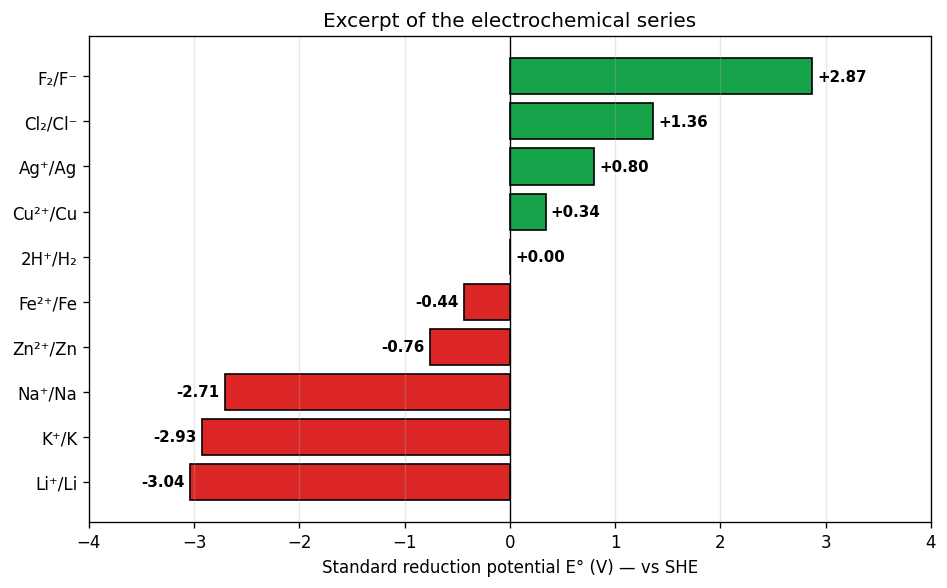
Q553 Marks
Study the electrochemical series and answer:
The strongest reducing agent shown in the series is:
ALi
BNa
CZn
DCu
The strongest oxidising agent shown in the series is:
AF₂
BCl₂
CCu²⁺
DAg⁺
Predict whether Zn can reduce Cu²⁺ to Cu and calculate the standard cell EMF.
Show answersHide answers
1. Option 1 — Li
2. Option 1 — F₂
3. More negative E° = species more easily oxidised (better reducing agent). Li (−3.04 V) is therefore the strongest reducer. More positive E° = species more easily reduced (better oxidising agent). F₂ (+2.87 V) is therefore the strongest oxidiser. To predict whether Zn (E° = −0.76 V) can reduce Cu²⁺ (E° = +0.34 V): E°_cell = E°_cathode − E°_anode = +0.34 − (−0.76) = +1.10 V > 0, so the reaction Zn + Cu²⁺ → Zn²⁺ + Cu is spontaneous. This is the Daniell-cell reaction.
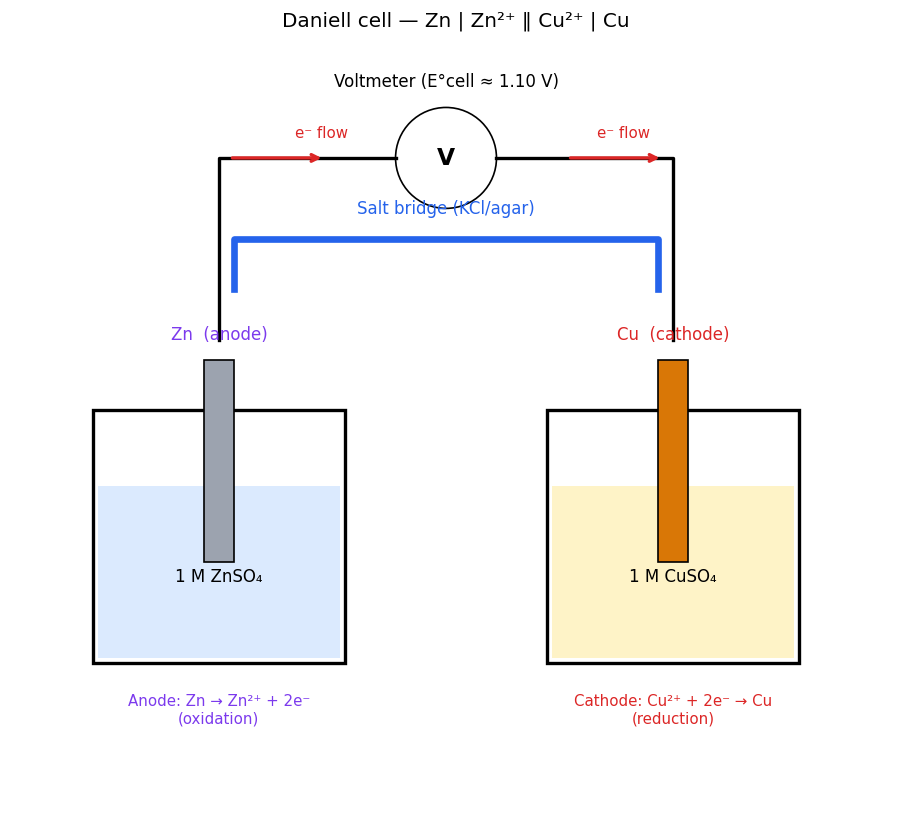
Q563 Marks
Study the Daniell cell schematic and answer:
The reaction occurring at the anode is:
AZn (oxidation)
BCu (oxidation)
CZn (reduction)
DCu (reduction)
Electrons flow:
AFrom Cu to Zn through the salt bridge
BFrom Zn to Cu through the external circuit
CFrom Cu to Zn through the external circuit
DNo flow at all
Explain the role of the salt bridge in the Daniell cell.
Show answersHide answers
1. Option 1 — Zn (oxidation)
2. Option 2 — From Zn to Cu through the external circuit
3. In the Daniell cell, Zn is oxidised at the anode (Zn → Zn²⁺ + 2e⁻) and Cu²⁺ is reduced at the cathode (Cu²⁺ + 2e⁻ → Cu). Electrons flow from Zn (more negative E°) to Cu (more positive E°) through the external wire — driving the voltmeter reading. Inside the solution, ions migrate through the salt bridge to maintain electrical neutrality: anions (Cl⁻ or SO₄²⁻) move toward the Zn half-cell to neutralise the buildup of Zn²⁺, and cations (K⁺ or Na⁺) move toward the Cu half-cell to neutralise the depletion of Cu²⁺. Without the salt bridge, charge buildup would stop the reaction immediately.