Chemical Bonding and Molecular Structure — Important Questions
56 questions
With answersCBSE format
SUMMARY: This chapter explores the concepts of chemical bonding and the structure of molecules, focusing on how atoms combine to form compounds. KEY TOPICS: Ionic bond, covalent bond, Lewis structures, VSEPR theory, hybridization, molecular orbital theory, bond parameters, polar and nonpolar molecules, hydrogen bonding, resonance.
Which type of hybridization is observed in the central atom of phosphorus pentachloride (PCl₅)?
Asp
Bsp²
Csp³
Dsp³d
Check answerHide answer
Correct answer: Option 4 — sp³d
Q101 Mark
The bond length in a molecule is primarily influenced by which of the following factors?
AElectronegativity
BBond order
CMolecular weight
DTemperature
Check answerHide answer
Correct answer: Option 2 — Bond order
Q111 Mark
Which of the following statements is true regarding polar molecules?
AThey have equal sharing of electrons.
BThey have a net dipole moment.
CThey cannot form hydrogen bonds.
DThey are always gases at room temperature.
Check answerHide answer
Correct answer: Option 2 — They have a net dipole moment.
Q121 Mark
What is the hybridization of the nitrogen atom in the ammonium ion (NH₄⁺)?
Asp
Bsp²
Csp³
Dsp³d
Check answerHide answer
Correct answer: Option 3 — sp³
Q131 Mark
Which of the following pairs of atoms would most likely form an ionic bond?
ACarbon and oxygen
BSodium and chlorine
CHydrogen and nitrogen
DBromine and iodine
Check answerHide answer
Correct answer: Option 2 — Sodium and chlorine
Q141 Mark
In molecular orbital theory, which of the following statements is correct for the N₂ molecule?
AIt has a bond order of 1.
BIt has a bond order of 2.
CIt has a bond order of 3.
DIt has no bond order.
Check answerHide answer
Correct answer: Option 3 — It has a bond order of 3.
Q151 Mark
Which of the following correctly describes a covalent bond?
ATransfer of electrons between atoms
BSharing of electron pairs between atoms
CFormation of cations and anions
DAttraction between oppositely charged ions
Check answerHide answer
Correct answer: Option 2 — Sharing of electron pairs between atoms
Short Answer Questions10 questions
Q163 Marks
Define ionic bond and give one example.
View sample solutionHide solution
Ionic bond is the electrostatic attraction between oppositely charged ions formed by complete transfer of one or more electrons from a less electronegative atom to a more electronegative one. Example: NaCl — Na transfers an electron to Cl forming Na⁺ and Cl⁻.
Q173 Marks
State the octet rule and one of its limitations.
View sample solutionHide solution
Octet rule: atoms tend to gain lose or share electrons to achieve a stable configuration of 8 valence electrons. Limitations: incomplete octet (BF₃ has 6 around B); expanded octet (SF₆ has 12 around S); odd-electron molecules (NO has 7 around N).
Q183 Marks
Predict the shape of NH₃ using VSEPR theory.
View sample solutionHide solution
NH₃ has 3 bonding pairs and 1 lone pair on N (4 electron-pair regions = sp³). The lone pair causes tetrahedral arrangement to distort to a trigonal pyramidal shape with H-N-H bond angle ≈ 107° (less than the regular 109.5°).
Q193 Marks
Differentiate between sigma (σ) and pi (π) bonds.
View sample solutionHide solution
σ bond: formed by head-on (axial) overlap of orbitals; cylindrically symmetric about the bond axis; stronger; formed in single double or triple bonds. π bond: formed by lateral (sideways) overlap of p orbitals; electron density above and below bond axis; weaker than σ; formed only in double or triple bonds.
Q203 Marks
Define hydrogen bond and explain why ice floats on water.
View sample solutionHide solution
Hydrogen bond: a weak attractive force between a hydrogen atom bonded to a highly electronegative atom (F O N) and a lone pair on another such atom. In ice each H₂O molecule forms 4 hydrogen bonds in a tetrahedral arrangement creating an open hexagonal lattice that is less dense than liquid water — hence ice floats.
Q213 Marks
What is a covalent bond and how does it differ from an ionic bond?
View sample solutionHide solution
A covalent bond is formed when two atoms share one or more pairs of electrons, while an ionic bond is formed when one atom transfers electrons to another, resulting in the attraction between positively and negatively charged ions.
Q223 Marks
Explain the concept of resonance with an example.
View sample solutionHide solution
Resonance refers to the phenomenon where a molecule can be represented by two or more valid Lewis structures that differ only in the placement of electrons. An example is the ozone molecule (O₃), which can be represented by two resonance structures.
Q233 Marks
What is hybridization and how does it affect molecular geometry?
View sample solutionHide solution
Hybridization is the mixing of atomic orbitals to form new hybrid orbitals that are used to form covalent bonds. It affects molecular geometry by determining the arrangement of bonds around a central atom, such as sp³ hybridization leading to a tetrahedral shape.
Q243 Marks
Describe the VSEPR theory and its application in predicting molecular shapes.
View sample solutionHide solution
The VSEPR (Valence Shell Electron Pair Repulsion) theory states that the shape of a molecule is determined by the repulsion between electron pairs in the valence shell of the central atom. It helps predict molecular shapes like linear, trigonal planar, or tetrahedral based on the number of bonding and lone pairs.
Q253 Marks
What are bond parameters, and why are they important in chemical bonding?
View sample solutionHide solution
Bond parameters include bond length, bond angle, and bond energy, which are crucial for understanding the strength and stability of chemical bonds. They help predict molecular behavior and reactivity.
Long Answer Questions6 questions
Q266 Marks
Explain the formation of σ and π bonds in ethene (C₂H₄) using sp² hybridization.
View sample solutionHide solution
In ethene each C is sp² hybridized: one s + two p orbitals mix to form three sp² orbitals at 120°. Two sp² orbitals form σ bonds with H atoms and one sp² with the other C. The unhybridized 2p_z orbital on each C overlaps laterally to form a π bond. Net: C=C has 1 σ + 1 π. C-H bonds are σ. Geometry: planar around each C (sp²) with H-C-H ≈ 120°.
Q276 Marks
Apply VSEPR theory to predict the shape of (a) BF₃ (b) H₂O (c) PCl₅.
View sample solutionHide solution
(a) BF₃: B has 3 bonding pairs no lone pair; 3 e-pair regions; sp²; trigonal planar; F-B-F = 120°. (b) H₂O: O has 2 bonding pairs and 2 lone pairs; 4 e-pair regions; sp³; bent (V-shaped); H-O-H ≈ 104.5°. (c) PCl₅: P has 5 bonding pairs no lone pair; sp³d; trigonal bipyramidal; 3 equatorial Cl at 120° and 2 axial at 90°.
Q286 Marks
Compare the bond angles and shapes of CH₄ NH₃ and H₂O.
View sample solutionHide solution
All three have sp³ hybridization on the central atom. CH₄: 4 bonding pairs no lone pairs → tetrahedral 109.5°. NH₃: 3 bonding pairs 1 lone pair → trigonal pyramidal ~107°. H₂O: 2 bonding pairs 2 lone pairs → bent ~104.5°. Lone pairs occupy more space than bonding pairs decreasing the bond angle as the number of lone pairs increases.
Q296 Marks
Define resonance and explain it in carbonate ion (CO₃²⁻).
View sample solutionHide solution
Resonance: when a single Lewis structure cannot describe a molecule the actual structure is a hybrid (resonance hybrid) of two or more equivalent structures (resonance contributors). For CO₃²⁻ three equivalent Lewis structures place the C=O double bond on each of the three oxygen atoms in turn. The actual structure has all three C-O bonds equivalent with bond order = 4/3 (between single and double). Resonance lowers energy by delocalizing electrons.
Q306 Marks
Discuss the molecular orbital theory description of O₂ and explain its paramagnetism.
View sample solutionHide solution
O₂ has 16 electrons. MO configuration: σ1s² σ*1s² σ2s² σ*2s² σ2pz² π2px² π2py² π*2px¹ π*2py¹. Bond order = (10 − 6)/2 = 2 corresponding to a double bond. The two unpaired electrons in degenerate antibonding π* orbitals make O₂ paramagnetic — a remarkable success of MO theory which Lewis/VB approaches cannot easily explain.
Q316 Marks
Differentiate between sigma and pi bond in tabular form on five features.
Assertion–Reason Questions8 questions
Q321 Mark
Assertion (A): A covalent bond is formed by sharing of electrons between two atoms.
Reason (R): Sharing electrons allows each atom to attain a stable noble-gas configuration without complete electron transfer.
Show explanationHide explanation
Correct answer: Option 1 —
Both A and R are true, and R is the correct explanation of A.
Q331 Mark
Assertion (A): The H-O-H bond angle in water is less than 109.5°.
Reason (R): The two lone pairs on oxygen occupy more space than bonding pairs and compress the H-O-H angle.
Show explanationHide explanation
Correct answer: Option 1 —
Both A and R are true, and R is the correct explanation of A.
Q341 Mark
Assertion (A): The carbon in CH₄ is sp³ hybridized.
Reason (R): Mixing one s orbital with three p orbitals gives four equivalent sp³ hybrid orbitals directed towards corners of a tetrahedron.
Show explanationHide explanation
Correct answer: Option 1 —
Both A and R are true, and R is the correct explanation of A.
Q351 Mark
Assertion (A): The boiling point of water is unusually high compared to H₂S.
Reason (R): Water molecules form extensive hydrogen bonds while H₂S does not.
Show explanationHide explanation
Correct answer: Option 1 —
Both A and R are true, and R is the correct explanation of A.
Q361 Mark
Assertion (A): O₂ is paramagnetic.
Reason (R): O₂ has two unpaired electrons in degenerate π* antibonding orbitals as predicted by MO theory.
Show explanationHide explanation
Correct answer: Option 1 —
Both A and R are true, and R is the correct explanation of A.
Q371 Mark
Assertion (A): Ionic bonds are formed between metals and nonmetals.
Reason (R): Ionic bonds involve the transfer of electrons from one atom to another.
Show explanationHide explanation
Correct answer: Option 1 —
Both A and R are true, and R is the correct explanation of A.
Q381 Mark
Assertion (A): Covalent bonds can form between two atoms of the same element.
Reason (R): Atoms of the same element have identical electronegativities, leading to equal sharing of electrons.
Show explanationHide explanation
Correct answer: Option 1 —
Both A and R are true, and R is the correct explanation of A.
Q391 Mark
Assertion (A): The VSEPR theory predicts the shape of molecules based on electron pair repulsion.
Reason (R): VSEPR stands for Valence Shell Electron Pair Repulsion, which explains molecular geometry.
Show explanationHide explanation
Correct answer: Option 1 —
Both A and R are true, and R is the correct explanation of A.
Statement-Based Questions8 questions
Q401 Mark
Statement 1: Ionic bonds form between metals and non-metals.
Statement 2: Covalent bonds form between two non-metals.
Show answerHide answer
Correct answer: Option 1 —
Both statements are true.
Q411 Mark
Statement 1: sp hybridization gives a linear geometry.
Statement 2: sp² hybridization gives a trigonal planar geometry.
Show answerHide answer
Correct answer: Option 1 —
Both statements are true.
Q421 Mark
Statement 1: Lone pair–bonding pair repulsion is greater than bonding pair–bonding pair repulsion.
Statement 2: Lone pair–lone pair repulsion is the greatest of all.
Show answerHide answer
Correct answer: Option 1 —
Both statements are true.
Q431 Mark
Statement 1: Hydrogen bonding raises the boiling points of water and ammonia.
Statement 2: Hydrogen bonding stabilizes the secondary structure of proteins.
Show answerHide answer
Correct answer: Option 1 —
Both statements are true.
Q441 Mark
Statement 1: Bond order of N₂ is 3.
Statement 2: Bond order of O₂ is 2.
Show answerHide answer
Correct answer: Option 1 —
Both statements are true.
Q451 Mark
Statement 1: Covalent bonds involve the transfer of electrons between atoms.
Statement 2: Ionic bonds involve the sharing of electrons between atoms.
Show answerHide answer
Correct answer: Option 4 —
Both statements are false.
Q461 Mark
Statement 1: Lewis structures are used to represent the arrangement of electrons in a molecule.
Statement 2: VSEPR theory predicts the molecular geometry based on electron pair repulsion.
Show answerHide answer
Correct answer: Option 1 —
Both statements are true.
Q471 Mark
Statement 1: Hybridization can lead to the formation of sigma and pi bonds.
Statement 2: Molecular orbital theory suggests that atomic orbitals combine to form molecular orbitals.
Show answerHide answer
Correct answer: Option 1 —
Both statements are true.
Case Study / Passage Questions3 questions
Q483 Marks
A student is studying the polarity of H₂O and CO₂ and is puzzled why H₂O is polar (μ = 1.85 D) while CO₂ has μ = 0 even though both contain polar bonds.
The shape of CO₂ molecule is:
ALinear
BBent
CTrigonal pyramidal
DTetrahedral
Even though C=O bonds are polar CO₂ is overall:
APolar
BNon-polar
CIonic
DCannot decide
Explain why H₂O is polar but CO₂ is not.
Show answersHide answers
1. Option 1 — Linear
2. Option 2 — Non-polar
3. In CO₂ (linear O=C=O) the two C=O bond dipoles are equal and opposite cancelling out; net dipole moment = 0. In H₂O (bent angle 104.5°) the two O-H bond dipoles do NOT cancel; they add to give a net dipole pointing from H side to O side. Polarity depends on both bond polarity and molecular geometry.
Q493 Marks
A student is asked to identify the hybridisation of each carbon in the molecule CH₃-CH=CH-C≡CH. The teacher reminds the student that hybridisation is determined by the number of σ bonds and lone pairs (steric number) on each atom.
The hybridisation of the five carbons (left to right) is:
Asp³ sp² sp² sp sp
Bsp³ sp³ sp³ sp sp
Csp² sp³ sp² sp sp
Dsp³ sp² sp³ sp² sp
Around each sp² carbon the geometry is:
ALinear
BTrigonal planar
CTetrahedral
DBent
Predict the bond angles at each carbon.
Show answersHide answers
1. Option 1 — sp³ sp² sp² sp sp
2. Option 2 — Trigonal planar
3. In CH₃-CH=CH-C≡CH: C1 has 4 σ bonds (sp³); C2 = C3 each has 3 σ bonds + 1 π bond (sp²); C4 has 2 σ bonds + 2 π bonds (sp); C5 has 2 σ bonds + 2 π bonds (sp). The order is sp³ sp² sp² sp sp. Bond angles: ≈ 109.5° at sp³ ≈ 120° at sp² and 180° at sp.
Q503 Marks
A student notices that water (b.p. 100°C) has a much higher boiling point than H₂S (b.p. −60°C) despite H₂S having a higher molar mass. The teacher relates this to differences in intermolecular forces.
The reason for the higher boiling point of water is:
AStronger London forces
BHydrogen bonding
CHigher density
DHigher heat capacity
The intermolecular force responsible is the:
AHydrogen bond
BIonic bond
CCovalent bond
DMetallic bond
Why does HF have a higher boiling point than HCl despite HCl's higher molar mass?
Show answersHide answers
1. Option 2 — Hydrogen bonding
2. Option 1 — Hydrogen bond
3. Hydrogen bonding requires H bonded to a highly electronegative atom (F O N) creating a strong dipole-dipole attraction with another such atom. H₂O has extensive hydrogen bonding raising boiling point dramatically. H₂S has only weak London dispersion forces (S is not electronegative enough to support H-bonds) so it boils at much lower temperature despite higher molar mass.
Table-Based Questions4 questions
Q513 Marks
Study the molecular shapes via VSEPR theory:
Molecule
Bonding pairs
Lone pairs
Shape
CH₄
4
0
Tetrahedral
NH₃
3
1
Trigonal pyramidal
H₂O
2
2
Bent
BF₃
3
0
Trigonal planar
SF₆
6
0
Octahedral
The shape of NH₃ is:
ATetrahedral
BTrigonal pyramidal
CBent
DLinear
The bond angle in CH₄ is:
A109.5°
B107°
C104.5°
D90°
Why does the bond angle decrease from CH₄ to NH₃ to H₂O?
Show answersHide answers
1. Option 2 — Trigonal pyramidal
2. Option 1 — 109.5°
3. VSEPR theory predicts shapes by minimizing repulsion among electron pairs. Total electron pairs (bonding + lone) determines the parent geometry; lone pairs distort it slightly. Lone pairs occupy more space than bonding pairs reducing bond angles: CH₄ (no LP) 109.5° → NH₃ (1 LP) 107° → H₂O (2 LP) 104.5°.
Q523 Marks
Study the bond orders and magnetic properties of homonuclear diatomic molecules:
Molecule
Bond order
Unpaired electrons
Magnetic property
H₂
1
0
Diamagnetic
He₂
0
0
Does not exist
N₂
3
0
Diamagnetic
O₂
2
2
Paramagnetic
F₂
1
0
Diamagnetic
Ne₂
0
0
Does not exist
The bond order of N₂ is:
A1
B2
C3
D4
O₂ is:
ADiamagnetic
BParamagnetic
CBoth
DNeither
Why does He₂ not exist while H₂ does?
Show answersHide answers
1. Option 3 — 3
2. Option 2 — Paramagnetic
3. Bond order = (bonding − antibonding)/2. Bond order zero means no bond — so He₂ and Ne₂ do not exist. O₂ has 2 unpaired electrons in degenerate π* orbitals making it paramagnetic — a triumph of MO theory which Lewis/VB theories struggled to predict.
Q536 Marks
Apply VSEPR theory to determine the shape, hybridisation and bond angle of each molecule.
Molecule
Bonding pairs
Lone pairs
BF₃
3
0
CH₄
4
0
NH₃
3
1
H₂O
2
2
SF₆
6
0
PCl₅
5
0
Q546 Marks
Compute the bond order and identify magnetic property of each diatomic molecule using molecular orbital theory.
Molecule
Total electrons
H₂
2
He₂
4
N₂
14
O₂
16
F₂
18
Picture-Based Questions2 questions
Q553 Marks
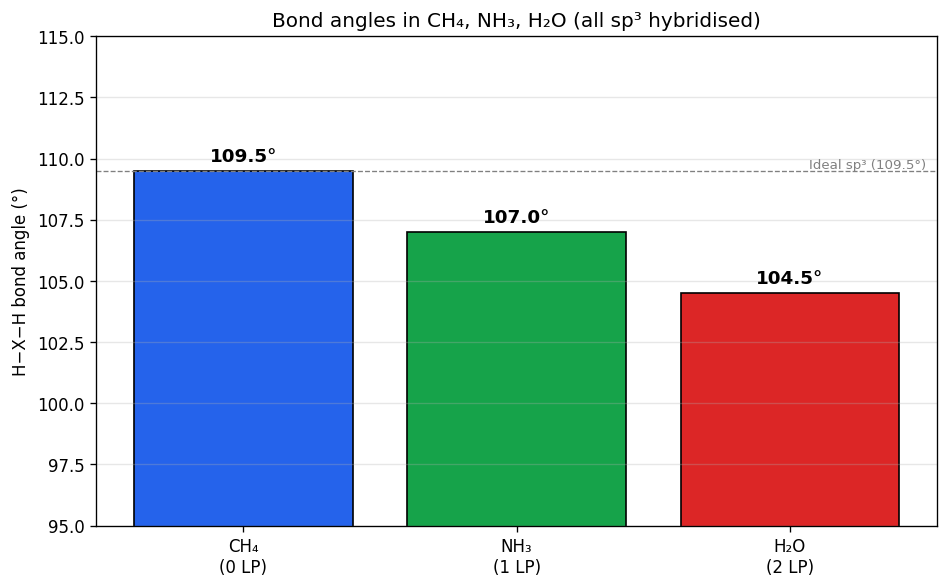
Study the bar chart of bond angles in CH₄, NH₃ and H₂O and answer:
The molecule with the smallest H−X−H bond angle is:
ACH₄
BNH₃
CH₂O
DAll equal
The order of repulsion among electron pairs (where lp = lone pair, bp = bonding pair) is:
Abp–bp = lp–lp
Blp–lp > lp–bp > bp–bp
Cbp–bp > lp–bp > lp–lp
DAll repulsions are equal
Apply VSEPR theory to explain the bond-angle trend CH₄ > NH₃ > H₂O.
Show answersHide answers
1. Option 3 — H₂O
2. Option 2 — lp–lp > lp–bp > bp–bp
3. All three molecules have sp³ hybridisation on the central atom, so the ideal tetrahedral angle is 109.5°. CH₄ has 4 bonding pairs and no lone pair, giving the ideal 109.5°. NH₃ has 3 bonding pairs and 1 lone pair — the lone pair occupies more space, compressing the H−N−H angle to ≈107°. H₂O has 2 bonding pairs and 2 lone pairs — the two lone pairs further compress the H−O−H angle to ≈104.5°. Lone pair–lone pair repulsion is the strongest, hence the largest compression in H₂O.
Q563 Marks
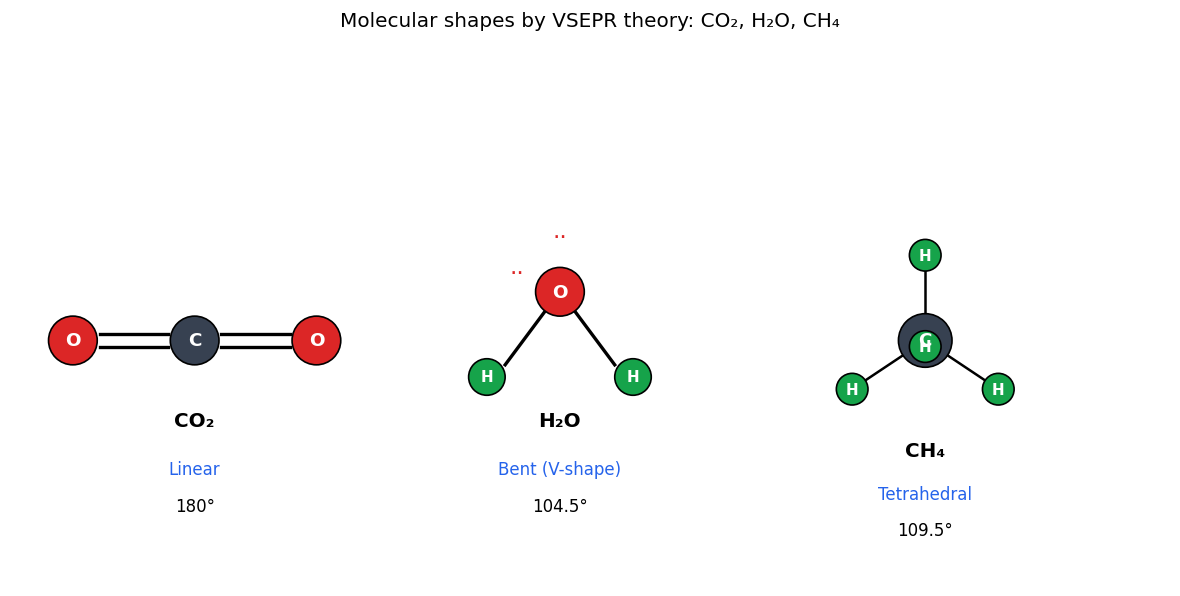
Study the three molecular structures (CO₂, H₂O, CH₄) and answer:
Even though it contains polar bonds, the molecule with zero dipole moment is:
ACO₂
BH₂O
CCH₄
DAll polar
The hybridisation of the central atom in both H₂O and CH₄ is:
Asp
Bsp²
Csp³
Dsp³d
Explain why CO₂ and CH₄ are non-polar but H₂O is highly polar.
Show answersHide answers
1. Option 1 — CO₂
2. Option 3 — sp³
3. Polarity depends on bond polarity AND molecular geometry. CO₂ is linear (180°): the two C=O bond dipoles are equal and opposite, so they cancel — net dipole moment is zero, hence non-polar despite polar bonds. H₂O is bent (104.5°): the two O−H dipoles add to give a net dipole pointing from H to O — highly polar. CH₄ is tetrahedral (109.5°) with four equivalent C−H bonds whose dipoles cancel by symmetry — non-polar.