SUMMARY: This chapter explores the fundamental concepts of atomic structure, including the historical development of atomic models and the quantum mechanical model of the atom. KEY TOPICS: Dalton's atomic theory, Thomson's model, Rutherford's model, Bohr's model, quantum mechanical model, atomic orbitals, quantum numbers, electronic configuration, Heisenberg's uncertainty principle, Pauli exclusion principle.
The maximum number of electrons in the L shell (n = 2) is:
A2
B4
C6
D8
Check answerHide answer
Correct answer: Option 4 — 8
Q21 Mark
The shape of the s orbital is:
ASpherical
BDumbbell
CDouble dumbbell
DPyramidal
Check answerHide answer
Correct answer: Option 1 — Spherical
Q31 Mark
The principal quantum number indicates:
AShape of orbital
BSize of orbital
COrientation of orbital
DSpin of electron
Check answerHide answer
Correct answer: Option 2 — Size of orbital
Q41 Mark
The electronic configuration of chromium (Cr Z = 24) is:
A[Ar] 3d⁴ 4s²
B[Ar] 3d⁵ 4s¹
C[Ar] 3d⁶ 4s⁰
D[Ar] 4s² 3d⁴
Check answerHide answer
Correct answer: Option 2 — [Ar] 3d⁵ 4s¹
Q51 Mark
Heisenberg's uncertainty principle is significant for:
AMacroscopic objects
BMicroscopic particles
CBoth
DNeither
Check answerHide answer
Correct answer: Option 2 — Microscopic particles
Q61 Mark
Which of the following statements is true according to Dalton's atomic theory?
AAtoms are indivisible and indestructible.
BAtoms of different elements are identical.
CAtoms can be created or destroyed in chemical reactions.
DAtoms can change into other elements during reactions.
Check answerHide answer
Correct answer: Option 1 — Atoms are indivisible and indestructible.
Q71 Mark
What is the main feature of Thomson's model of the atom?
AAtoms are mostly empty space.
BElectrons are embedded in a positively charged sphere.
CElectrons orbit the nucleus in fixed paths.
DAtoms consist of a nucleus surrounded by protons and neutrons.
Check answerHide answer
Correct answer: Option 2 — Electrons are embedded in a positively charged sphere.
Q81 Mark
In Rutherford's gold foil experiment, what was concluded about the structure of the atom?
AAtoms have a uniform density.
BMost of the atom's mass is concentrated in a small nucleus.
CElectrons are located in fixed orbits around the nucleus.
DAtoms contain only protons and electrons.
Check answerHide answer
Correct answer: Option 2 — Most of the atom's mass is concentrated in a small nucleus.
Q91 Mark
Which quantum number describes the orientation of an orbital?
APrincipal quantum number (n)
BAzimuthal quantum number (l)
CMagnetic quantum number (m_l)
DSpin quantum number (m_s)
Check answerHide answer
Correct answer: Option 3 — Magnetic quantum number (m_l)
Q101 Mark
According to Bohr's model, which of the following is true about electron orbits?
AElectrons can exist in any orbit.
BElectrons can only occupy certain allowed orbits.
CElectrons are stationary in their orbits.
DElectrons emit energy in all orbits.
Check answerHide answer
Correct answer: Option 2 — Electrons can only occupy certain allowed orbits.
Q111 Mark
What does the Pauli exclusion principle state?
ANo two electrons can have the same set of quantum numbers.
BElectrons prefer to occupy the lowest energy orbitals first.
CElectrons can exist in multiple states simultaneously.
DElectrons are attracted to protons in the nucleus.
Check answerHide answer
Correct answer: Option 1 — No two electrons can have the same set of quantum numbers.
Q121 Mark
Which of the following quantum numbers can have a value of 0?
APrincipal quantum number (n)
BAzimuthal quantum number (l)
CMagnetic quantum number (m_l)
DSpin quantum number (m_s)
Check answerHide answer
Correct answer: Option 2 — Azimuthal quantum number (l)
Q131 Mark
The shape of the p orbital can be described as:
ASpherical
BDumbbell-shaped
CDouble dumbbell-shaped
DLinear
Check answerHide answer
Correct answer: Option 2 — Dumbbell-shaped
Q141 Mark
What is the maximum number of electrons that can be accommodated in the n=3 shell?
A2
B8
C18
D32
Check answerHide answer
Correct answer: Option 3 — 18
Q151 Mark
Which of the following elements has the electronic configuration 1s² 2s² 2p⁶ 3s² 3p⁶ 4s² 3d⁵?
AIron (Fe)
BManganese (Mn)
CChromium (Cr)
DCopper (Cu)
Check answerHide answer
Correct answer: Option 2 — Manganese (Mn)
Short Answer Questions10 questions
Q163 Marks
State Pauli's exclusion principle.
View sample solutionHide solution
No two electrons in an atom can have all four quantum numbers identical. Each orbital can hold a maximum of two electrons with opposite spins.
Q173 Marks
State Hund's rule of maximum multiplicity.
View sample solutionHide solution
Electrons occupy degenerate (equal-energy) orbitals singly with parallel spins before pairing begins. This minimizes electron-electron repulsion and maximizes total spin.
Q183 Marks
Calculate the energy of an electron in the second Bohr orbit of a hydrogen atom.
View sample solutionHide solution
Energy of nth orbit: Eₙ = −13.6/n² eV. For n = 2: E₂ = −13.6/4 = −3.4 eV. The negative sign indicates bound state.
Q193 Marks
Write the four quantum numbers and their permitted values.
View sample solutionHide solution
Principal n = 1, 2, 3, ... (positive integers). Azimuthal l = 0 to n − 1. Magnetic mₗ = −l to +l (integer values). Spin mₛ = +1/2 or −1/2.
Q203 Marks
What is the maximum number of electrons that can occupy the M shell?
View sample solutionHide solution
Capacity = 2n². For n = 3 (M shell) max = 2(3²) = 18 electrons. Distributed as 3s² 3p⁶ 3d¹⁰ = 18.
Q213 Marks
Explain Dalton's atomic theory and its significance in the development of atomic models.
View sample solutionHide solution
Dalton's atomic theory proposed that matter is composed of indivisible atoms, which are unique to each element. It laid the groundwork for modern chemistry by introducing the idea that chemical reactions involve the rearrangement of these atoms, leading to the formulation of the law of conservation of mass.
Q223 Marks
Describe Thomson's model of the atom and its limitations.
View sample solutionHide solution
Thomson's model, often referred to as the 'plum pudding model', suggested that atoms are composed of a positively charged 'soup' with negatively charged electrons embedded within it. Its limitations include the inability to explain the results of Rutherford's gold foil experiment, which indicated a dense nucleus.
Q233 Marks
What was Rutherford's contribution to the atomic model?
View sample solutionHide solution
Rutherford's gold foil experiment led to the discovery of the atomic nucleus, demonstrating that atoms consist of a small, dense, positively charged center surrounded by electrons. This challenged the previous models and introduced the concept of a nuclear atom.
Q243 Marks
How does Bohr's model differ from Rutherford's model of the atom?
View sample solutionHide solution
Bohr's model introduced the idea of quantized energy levels for electrons, suggesting that electrons orbit the nucleus in fixed paths or shells. This was a significant advancement over Rutherford's model, which did not account for the stability of electron orbits.
Q253 Marks
Define the term 'atomic orbital' and its significance in quantum mechanics.
View sample solutionHide solution
An atomic orbital is a region in an atom where there is a high probability of finding an electron. It is significant in quantum mechanics as it describes the behavior of electrons in atoms, replacing the idea of fixed orbits with probability distributions.
Long Answer Questions6 questions
Q266 Marks
Explain Bohr's model of the hydrogen atom and derive the energy of the nth orbit.
View sample solutionHide solution
Postulates: (1) electron moves in stable circular orbits without radiating energy; (2) angular momentum mvr = nh/(2π); (3) energy is absorbed/emitted only when electron jumps between orbits. From classical mechanics + quantization: rₙ = n² · (h²/(4π²me²k)) and Eₙ = −2π²me⁴k²/(n²h²) which simplifies to Eₙ = −13.6/n² eV for hydrogen. Negative sign indicates bound electron.
Q276 Marks
Write the electronic configurations of Na (Z = 11), Cl (Z = 17), Cu (Z = 29).
View sample solutionHide solution
Na (11): 1s² 2s² 2p⁶ 3s¹ → [Ne] 3s¹. Cl (17): 1s² 2s² 2p⁶ 3s² 3p⁵ → [Ne] 3s² 3p⁵. Cu (29): 1s² 2s² 2p⁶ 3s² 3p⁶ 3d¹⁰ 4s¹ → [Ar] 3d¹⁰ 4s¹ (anomalous; extra stability of fully-filled 3d).
Q286 Marks
Discuss the dual nature of electromagnetic radiation with two examples each for wave and particle nature.
View sample solutionHide solution
Light shows wave nature in (i) interference (Young's double-slit) and (ii) diffraction (single-slit). Particle nature is evident in (i) photoelectric effect (Einstein 1905) and (ii) Compton scattering. de Broglie extended duality to matter: λ = h/p. Both natures coexist depending on the experiment — wave-particle complementarity.
Q296 Marks
Calculate the wavelength of an electron moving with velocity 2 × 10⁶ m/s. (h = 6.626 × 10⁻³⁴ Js, mₑ = 9.1 × 10⁻³¹ kg)
Explain Aufbau principle Pauli exclusion principle and Hund's rule. Apply them to write the configuration of Fe (Z = 26).
View sample solutionHide solution
Aufbau: orbitals fill in increasing energy order (1s 2s 2p 3s 3p 4s 3d 4p ...). Pauli: max 2 electrons per orbital with opposite spins. Hund: electrons fill degenerate orbitals singly first. For Fe (26): 1s² 2s² 2p⁶ 3s² 3p⁶ 4s² 3d⁶. The 3d⁶ has 4 unpaired electrons by Hund's rule.
Q316 Marks
Compare orbit (Bohr) and orbital (quantum mechanical) with the help of a table.
Assertion–Reason Questions8 questions
Q321 Mark
Assertion (A): Electrons in Bohr's stationary orbits do not radiate energy.
Reason (R): Bohr postulated that only orbits with quantized angular momentum mvr = nh/(2π) are allowed; in such orbits the electron does not emit radiation.
Show explanationHide explanation
Correct answer: Option 1 —
Both A and R are true, and R is the correct explanation of A.
Q331 Mark
Assertion (A): An orbital can hold at most two electrons.
Reason (R): Per Pauli's principle two electrons in the same orbital must have opposite spins so all four quantum numbers cannot be identical.
Show explanationHide explanation
Correct answer: Option 1 —
Both A and R are true, and R is the correct explanation of A.
Q341 Mark
Assertion (A): Electrons singly occupy degenerate orbitals before pairing.
Reason (R): Single occupancy with parallel spins minimizes electron-electron repulsion and gives maximum total spin.
Show explanationHide explanation
Correct answer: Option 1 —
Both A and R are true, and R is the correct explanation of A.
Q351 Mark
Assertion (A): The position and momentum of an electron cannot be measured simultaneously to arbitrary precision.
Reason (R): The act of measuring position disturbs the electron's momentum (and vice versa) at quantum scale leading to a fundamental limit Δx · Δp ≥ h/(4π).
Show explanationHide explanation
Correct answer: Option 1 —
Both A and R are true, and R is the correct explanation of A.
Q361 Mark
Assertion (A): Macroscopic objects do not show wave nature.
Reason (R): Their de Broglie wavelength λ = h/(mv) is far too small to be detected — much smaller than any practical reference scale.
Show explanationHide explanation
Correct answer: Option 1 —
Both A and R are true, and R is the correct explanation of A.
Q371 Mark
Assertion (A): Dalton's atomic theory states that atoms are indivisible and indestructible.
Reason (R): Modern physics has shown that atoms can be split into smaller particles.
Show explanationHide explanation
Correct answer: Option 3 —
A is true, but R is false.
Q381 Mark
Assertion (A): Thomson's model of the atom is often referred to as the 'plum pudding model'.
Reason (R): This model accurately describes the arrangement of electrons and protons in an atom.
Show explanationHide explanation
Correct answer: Option 2 —
Both A and R are true, but R is not the correct explanation of A.
Q391 Mark
Assertion (A): Rutherford's gold foil experiment led to the discovery of the nucleus.
Reason (R): This experiment demonstrated that most of the atom's mass is concentrated in a small central region.
Show explanationHide explanation
Correct answer: Option 1 —
Both A and R are true, and R is the correct explanation of A.
Statement-Based Questions8 questions
Q401 Mark
Statement 1: The principal quantum number n indicates the size of the orbital.
Statement 2: The azimuthal quantum number l indicates the shape of the orbital.
Show answerHide answer
Correct answer: Option 1 —
Both statements are true.
Q411 Mark
Statement 1: s orbitals are spherically symmetric.
Statement 2: p orbitals are dumbbell-shaped.
Show answerHide answer
Correct answer: Option 1 —
Both statements are true.
Q421 Mark
Statement 1: Heisenberg's uncertainty principle is a consequence of the wave nature of matter.
Statement 2: The orbital concept replaces the classical idea of fixed electronic orbits.
Show answerHide answer
Correct answer: Option 1 —
Both statements are true.
Q431 Mark
Statement 1: The Aufbau principle says orbitals are filled in order of increasing energy.
Statement 2: Half-filled and fully-filled orbitals have extra stability.
Show answerHide answer
Correct answer: Option 1 —
Both statements are true.
Q441 Mark
Statement 1: The photoelectric effect demonstrates the particle nature of light.
Statement 2: Einstein explained it using the photon hypothesis E = hν.
Show answerHide answer
Correct answer: Option 1 —
Both statements are true.
Q451 Mark
Statement 1: Dalton's atomic theory states that atoms are indivisible and indestructible.
Statement 2: Thomson's model of the atom introduced the concept of a positively charged 'pudding' with negatively charged electrons embedded in it.
Show answerHide answer
Correct answer: Option 1 —
Both statements are true.
Q461 Mark
Statement 1: Rutherford's model of the atom proposed that electrons revolve around the nucleus in fixed orbits.
Statement 2: Bohr's model improved upon Rutherford's by introducing quantized energy levels for electrons.
Show answerHide answer
Correct answer: Option 3 —
Only Statement 2 is true.
Q471 Mark
Statement 1: The quantum mechanical model of the atom describes electrons as particles with definite paths.
Statement 2: Quantum numbers are used to describe the properties of atomic orbitals and the electrons in those orbitals.
Show answerHide answer
Correct answer: Option 2 —
Only Statement 1 is true.
Case Study / Passage Questions3 questions
Q483 Marks
A laboratory observes the line spectrum of hydrogen and identifies four lines in the visible region forming the Balmer series — the famous H_α H_β H_γ H_δ lines. The teacher asks students to determine the energies of the corresponding photons and the transitions involved.
The visible lines of the hydrogen spectrum belong to the:
ALyman
BBalmer
CPaschen
DBrackett
The lower energy level for the Balmer series is:
An = 1
Bn = 2
Cn = 3
Dn = 4
Compute the wavelength of the H_α line using the Rydberg formula.
Show answersHide answers
1. Option 2 — Balmer
2. Option 2 — n = 2
3. Balmer series corresponds to transitions from n ≥ 3 to n = 2. H_α is n = 3 → 2 (red 656 nm); H_β is n = 4 → 2 (blue-green 486 nm); H_γ is n = 5 → 2; H_δ is n = 6 → 2. Energy of photon = hc/λ; for H_α: E = (6.626 × 10⁻³⁴)(3 × 10⁸)/(656 × 10⁻⁹) ≈ 3.03 × 10⁻¹⁹ J.
Q493 Marks
A metal with work function φ = 2.0 eV is illuminated by light of wavelength 400 nm. A student wants to determine the kinetic energy of the ejected photoelectrons and to find the threshold wavelength of the metal.
The maximum kinetic energy of the ejected photoelectrons is:
A1.1 eV
B2.0 eV
C3.1 eV
D4.2 eV
The threshold wavelength of the metal is approximately:
A310 nm
B400 nm
C620 nm
D1240 nm
Why does light below the threshold frequency fail to eject electrons regardless of intensity?
Show answersHide answers
1. Option 1 — 1.1 eV
2. Option 3 — 620 nm
3. Photon energy E = hc/λ = 1240/400 = 3.1 eV. KE_max = E − φ = 3.1 − 2.0 = 1.1 eV. Threshold wavelength corresponds to KE = 0: λ_th = hc/φ = 1240/2.0 = 620 nm. Light of longer wavelength than λ_th cannot eject electrons regardless of intensity — this confirmed the photon hypothesis.
Q503 Marks
A student is asked to assign quantum numbers to the last electron of nitrogen (Z = 7) and to verify the configuration follows Aufbau Pauli and Hund's rules.
The electronic configuration of nitrogen is:
A1s² 2s² 2p³
B1s² 2s² 2p⁶
C1s² 2s² 2p²
D2s² 2p⁵
The number of unpaired electrons in nitrogen's ground state is:
A1
B2
C3
D4
Write a possible set of quantum numbers (n l mₗ mₛ) for the last electron of nitrogen.
Show answersHide answers
1. Option 1 — 1s² 2s² 2p³
2. Option 3 — 3
3. Nitrogen (Z = 7) has configuration 1s² 2s² 2p³. By Hund's rule the three 2p electrons occupy the three degenerate p orbitals singly with parallel spins giving 3 unpaired electrons. Quantum numbers for the last electron: n = 2 l = 1 mₗ = +1 (or 0 or −1) mₛ = +1/2.
Table-Based Questions4 questions
Q513 Marks
Study the four quantum numbers and their permitted values:
Quantum number
Symbol
Permitted values
Indicates
Principal
n
1, 2, 3, ...
Size of orbital
Azimuthal
l
0 to (n − 1)
Shape of orbital
Magnetic
mₗ
−l to +l
Orientation
Spin
mₛ
+1/2 or −1/2
Spin direction
The principal quantum number n indicates the:
ASize
BShape
COrientation
DSpin
For l = 2 (d sublevel) the number of orbitals (values of mₗ) is:
A1
B3
C5
D7
Determine the maximum number of electrons in the n = 3 shell.
Show answersHide answers
1. Option 1 — Size
2. Option 3 — 5
3. For l = 2: mₗ takes values −2 −1 0 +1 +2 — five orbitals (the five d orbitals). Each orbital can hold 2 electrons so a complete d subshell holds 10 electrons. The four quantum numbers uniquely identify each electron and no two electrons in an atom can have all four identical (Pauli's rule).
Q523 Marks
Study the electronic configurations of selected elements and their unpaired electrons:
Element
Z
Configuration
Unpaired electrons
H
1
1s¹
1
C
6
1s² 2s² 2p²
2
N
7
1s² 2s² 2p³
3
O
8
1s² 2s² 2p⁴
2
F
9
1s² 2s² 2p⁵
1
Ne
10
1s² 2s² 2p⁶
0
The number of unpaired electrons in nitrogen is:
A1
B2
C3
D4
Which element in the table has zero unpaired electrons?
AHydrogen
BCarbon
COxygen
DNeon
Why does N have 3 unpaired electrons but O only 2?
Show answersHide answers
1. Option 3 — 3
2. Option 4 — Neon
3. Across the second period (Li to Ne) the 2s and 2p orbitals fill up. By Hund's rule unpaired electrons increase up to half-filled (N = 3) then decrease as pairing begins. Ne has all paired electrons and is hence diamagnetic and chemically inert.
Q536 Marks
Write the electronic configurations of the listed elements and identify the number of unpaired electrons in each.
Element
Atomic number
Na
11
Cl
17
Cr
24
Cu
29
Fe
26
Mn
25
Q545 Marks
Compute the maximum number of electrons in each shell using the formula 2n², and the number of orbitals using the formula n².
Shell
n
Max orbitals (n²)
Max electrons (2n²)
K
1
?
?
L
2
?
?
M
3
?
?
N
4
?
?
Picture-Based Questions2 questions
Q553 Marks
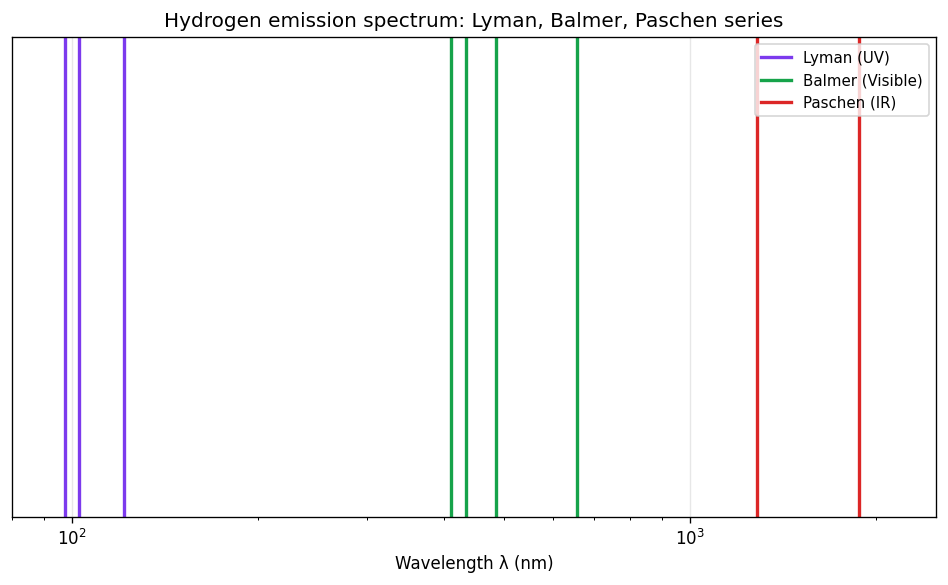
Study the line spectrum of atomic hydrogen and answer:
The lines visible to the naked eye lie in the:
ALyman series
BBalmer series
CPaschen series
DBrackett series
The Balmer series corresponds to electronic transitions terminating at:
An = 1
Bn = 2
Cn = 3
Dn = 4
Use the Rydberg formula to compute the wavelength of the Hα line (n = 3 → 2).
Show answersHide answers
1. Option 2 — Balmer series
2. Option 2 — n = 2
3. By Rydberg's formula 1/λ = R_H (1/n₁² − 1/n₂²) with n₁ = 2 and n₂ = 3 for the Hα line: 1/λ = 1.097 × 10⁷ × (1/4 − 1/9) = 1.097 × 10⁷ × (5/36) = 1.524 × 10⁶ m⁻¹, giving λ ≈ 656 nm — the characteristic red Hα line. The Lyman series (n₁ = 1) is in the UV and the Paschen series (n₁ = 3) is in the IR.
Q563 Marks
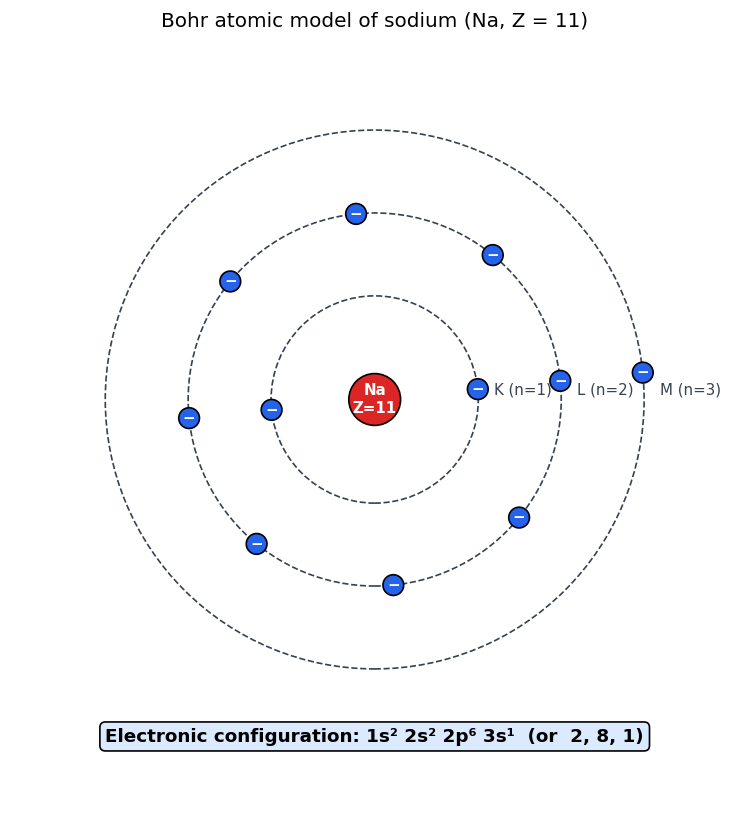
Study the Bohr atomic model of sodium (Na, Z = 11) and answer:
The distribution of electrons across the K, L, M shells of Na is:
A2 in K, 8 in L, 1 in M
B2 in K, 1 in L, 8 in M
C8 in K, 2 in L, 1 in M
D11 in K only
The maximum number of electrons that can be accommodated in the L shell (n = 2) is:
A2
B8
C18
D32
State the rule for the maximum number of electrons in a shell and use it to explain Na's chemical reactivity.
Show answersHide answers
1. Option 1 — 2 in K, 8 in L, 1 in M
2. Option 2 — 8
3. The maximum number of electrons in any shell with principal quantum number n is 2n². For n = 1 (K): 2 electrons; for n = 2 (L): 8; for n = 3 (M): 18. The Na atom has 11 electrons distributed as 2 + 8 + 1, giving the configuration 1s² 2s² 2p⁶ 3s¹. The single 3s electron — held weakly by the nuclear charge through the inner core — is easily lost, explaining Na's reactivity and the formation of Na⁺ in ionic compounds.