SUMMARY: The chapter on Hydrocarbons in Class 11 Chemistry explores the classification, properties, and reactions of hydrocarbons, which are compounds composed solely of carbon and hydrogen. KEY TOPICS: Alkanes, alkenes, alkynes, isomerism, nomenclature of hydrocarbons, preparation of hydrocarbons, physical properties of hydrocarbons, chemical reactions of hydrocarbons, uses of hydrocarbons, environmental effects of hydrocarbons.
Correct answer: Option 2 — Addition of HX to asymmetric alkenes
Q31 Mark
The name of the compound CH₃-CH=CH-CH₃ is:
APropene
BBut-1-ene
CBut-2-ene
DButyne
Check answerHide answer
Correct answer: Option 3 — But-2-ene
Q41 Mark
Benzene undergoes which type of reactions most readily?
AAddition
BSubstitution
CElimination
DPolymerization
Check answerHide answer
Correct answer: Option 2 — Substitution
Q51 Mark
The IUPAC name of acetylene is:
AEthene
BEthyne
CPropyne
DMethane
Check answerHide answer
Correct answer: Option 2 — Ethyne
Q61 Mark
Which of the following is a characteristic property of alkenes?
AThey are saturated hydrocarbons
BThey undergo addition reactions easily
CThey have a higher boiling point than alkanes
DThey are less reactive than alkanes
Check answerHide answer
Correct answer: Option 2 — They undergo addition reactions easily
Q71 Mark
What is the IUPAC name for the compound with the formula C₅H₁₂?
APentane
BButane
CHexane
DPropane
Check answerHide answer
Correct answer: Option 1 — Pentane
Q81 Mark
Which of the following compounds is an alkyne?
AC₂H₄
BC₃H₆
CC₄H₈
DC₄H₆
Check answerHide answer
Correct answer: Option 4 — C₄H₆
Q91 Mark
What type of isomerism is exhibited by butene (C₄H₈)?
AStructural isomerism
BGeometric isomerism
COptical isomerism
DChain isomerism
Check answerHide answer
Correct answer: Option 2 — Geometric isomerism
Q101 Mark
Which of the following statements about hydrocarbons is true?
AAll hydrocarbons are soluble in water
BHydrocarbons can be classified into aromatic and aliphatic
COnly alkanes are saturated hydrocarbons
DAlkynes have single bonds only
Check answerHide answer
Correct answer: Option 2 — Hydrocarbons can be classified into aromatic and aliphatic
Q111 Mark
Which reaction involves the addition of hydrogen to an alkene?
AHydration
BHydrogenation
CDehydrogenation
DHalogenation
Check answerHide answer
Correct answer: Option 2 — Hydrogenation
Q121 Mark
What is the general formula for cycloalkanes?
ACₙH₂ₙ₊₂
BCₙH₂ₙ
CCₙH₂ₙ₋₂
DCₙH₂ₙ₊₁
Check answerHide answer
Correct answer: Option 2 — CₙH₂ₙ
Q131 Mark
Which of the following is a common use of hydrocarbons?
AAs a solvent in chemical reactions
BAs a food preservative
CAs a source of vitamins
DAs a catalyst in reactions
Check answerHide answer
Correct answer: Option 1 — As a solvent in chemical reactions
Q141 Mark
What is the main environmental concern associated with the combustion of hydrocarbons?
AOzone layer depletion
BGreenhouse gas emissions
CSoil erosion
DWater pollution
Check answerHide answer
Correct answer: Option 2 — Greenhouse gas emissions
Q151 Mark
Which of the following hydrocarbons has the highest boiling point?
AC₄H₁₀
BC₆H₁₄
CC₈H₁₈
DC₂H₆
Check answerHide answer
Correct answer: Option 3 — C₈H₁₈
Short Answer Questions10 questions
Q162 Marks
Write the general formulas of alkanes alkenes and alkynes.
View sample solutionHide solution
Alkanes (saturated open chain): CₙH₂ₙ₊₂. Alkenes (one C=C double bond): CₙH₂ₙ. Alkynes (one C≡C triple bond): CₙH₂ₙ₋₂. The reduction of two H atoms each time adds one degree of unsaturation.
Q173 Marks
State Markovnikov's rule with an example.
View sample solutionHide solution
Markovnikov's rule: in the addition of HX to an asymmetric alkene the H adds to the carbon with more H atoms (less-substituted) and X adds to the carbon with fewer H (more-substituted) — yielding the more stable carbocation. Example: CH₃-CH=CH₂ + HBr → CH₃-CHBr-CH₃ (2-bromopropane) as the major product.
Q183 Marks
Differentiate between aromatic and aliphatic hydrocarbons.
View sample solutionHide solution
Aromatic hydrocarbons contain at least one benzene ring or similar conjugated planar ring with delocalised π electrons (e.g. benzene toluene). Aliphatic hydrocarbons are open-chain or cyclic non-aromatic structures (e.g. methane ethene cyclohexane).
Q193 Marks
What is the peroxide effect (Kharasch effect)? Give one example.
View sample solutionHide solution
Peroxide effect: in the presence of a peroxide initiator (e.g. benzoyl peroxide) the addition of HBr to an asymmetric alkene proceeds via a free-radical mechanism giving the anti-Markovnikov product. Example: CH₃-CH=CH₂ + HBr (peroxide) → CH₃-CH₂-CH₂Br (1-bromopropane). The effect is observed only with HBr not HCl or HI.
Q203 Marks
Write the structures of cis-but-2-ene and trans-but-2-ene.
View sample solutionHide solution
Both have the formula CH₃-CH=CH-CH₃. cis-but-2-ene: the two CH₃ groups on the same side of the C=C double bond. trans-but-2-ene: the two CH₃ groups on opposite sides. They differ in melting point and boiling point because the geometric arrangement affects molecular packing.
Q213 Marks
What are the main characteristics of alkanes?
View sample solutionHide solution
Alkanes are saturated hydrocarbons with single bonds between carbon atoms. They have the general formula CnH2n+2, are typically non-polar, and exhibit low reactivity, primarily undergoing combustion and substitution reactions.
Q223 Marks
Explain the concept of isomerism in hydrocarbons.
View sample solutionHide solution
Isomerism in hydrocarbons refers to the existence of compounds with the same molecular formula but different structural arrangements. This can include structural isomers, which differ in connectivity, and stereoisomers, which differ in spatial orientation.
Q233 Marks
Describe the process of hydrogenation of alkenes.
View sample solutionHide solution
Hydrogenation of alkenes involves the addition of hydrogen (H2) across the double bond of an alkene, converting it into an alkane. This reaction typically requires a catalyst, such as platinum, palladium, or nickel, and is used in the production of saturated fats from unsaturated oils.
Q243 Marks
What is the significance of the IUPAC nomenclature system for hydrocarbons?
View sample solutionHide solution
The IUPAC nomenclature system provides a standardized method for naming hydrocarbons, ensuring that each compound has a unique and descriptive name. This system helps in identifying the structure, functional groups, and the number of carbon atoms in the molecule, facilitating clear communication among chemists.
Q253 Marks
List two physical properties of hydrocarbons and explain their significance.
View sample solutionHide solution
Two physical properties of hydrocarbons are boiling point and solubility. The boiling point increases with molecular weight due to stronger van der Waals forces, affecting their state at room temperature. Hydrocarbons are generally non-polar and insoluble in water, which influences their behavior in environmental contexts.
Long Answer Questions6 questions
Q265 Marks
Explain the mechanism of free-radical chlorination of methane.
Discuss the structure of benzene and explain its aromatic character.
View sample solutionHide solution
Benzene C₆H₆ is a planar 6-membered ring with each carbon sp² hybridized. Each C contributes 1 unhybridized p_z electron forming a delocalised π system above and below the ring plane. All C-C bond lengths are equal (139 pm — between single 154 pm and double 134 pm). Aromaticity criteria (Huckel's rule): planar cyclic conjugated with (4n + 2) π electrons. For n = 1: 6 π electrons satisfies the rule. This delocalisation gives benzene extra stability of about 150 kJ/mol (resonance energy) and explains its preference for substitution over addition.
Q285 Marks
Explain the addition of HBr to propene with and without peroxides.
View sample solutionHide solution
Without peroxide (ionic mechanism, Markovnikov): HBr adds as H⁺ + Br⁻; H⁺ adds first forming the more stable secondary carbocation CH₃-CH⁺-CH₃ (rather than primary). Br⁻ then attacks giving 2-bromopropane CH₃-CHBr-CH₃ as the major product. With peroxide (radical mechanism, anti-Markovnikov): the peroxide initiates a free-radical chain. Br· adds first to the terminal carbon (giving a more stable secondary alkyl radical) and then the radical abstracts H from HBr giving 1-bromopropane CH₃-CH₂-CH₂Br. The peroxide effect is observed only with HBr.
Q295 Marks
Write the laboratory preparation of ethyne and discuss two of its important reactions.
View sample solutionHide solution
Preparation: CaC₂ + 2H₂O → C₂H₂ + Ca(OH)₂ (calcium carbide reacts with water at room temperature to liberate ethyne gas). Reactions: (i) Hydrogenation: C₂H₂ + 2H₂ (Ni catalyst) → C₂H₆ (ethane). (ii) Hydration (Kucherov reaction): C₂H₂ + H₂O (HgSO₄/H₂SO₄) → CH₃CHO (acetaldehyde via vinyl alcohol intermediate). (iii) Polymerisation: 3 C₂H₂ (red hot Cu) → C₆H₆ (benzene).
Q305 Marks
Compare the chemical properties of alkanes alkenes and alkynes.
View sample solutionHide solution
Alkanes: relatively unreactive (saturated paraffins); undergo free-radical substitution (e.g. halogenation) and combustion. Alkenes: more reactive due to π electrons; undergo electrophilic addition (with HX H₂O Br₂) and oxidation (KMnO₄) and polymerization. Alkynes: more reactive than alkenes; undergo addition twice (one π at a time) and have characteristic acidic terminal C-H bond (pK_a ≈ 25) — terminal alkynes form metal acetylides with strong bases.
Q316 Marks
Differentiate between alkanes, alkenes and alkynes in tabular form on five points.
Assertion–Reason Questions8 questions
Q321 Mark
Assertion (A): Alkanes are relatively unreactive.
Reason (R): Alkanes have only strong σ bonds (C-C and C-H) and no π electrons or polar bonds for electrophilic or nucleophilic attack.
Show explanationHide explanation
Correct answer: Option 1 —
Both A and R are true, and R is the correct explanation of A.
Reason (R): The π electrons in C=C are loosely held and act as a source of electrons for electrophiles.
Show explanationHide explanation
Correct answer: Option 1 —
Both A and R are true, and R is the correct explanation of A.
Q341 Mark
Assertion (A): Addition of HBr to propene without peroxide gives 2-bromopropane as the major product.
Reason (R): The reaction proceeds through the more stable secondary carbocation intermediate giving the Markovnikov product.
Show explanationHide explanation
Correct answer: Option 1 —
Both A and R are true, and R is the correct explanation of A.
Q351 Mark
Assertion (A): Benzene undergoes substitution rather than addition.
Reason (R): Substitution preserves the aromatic π system whereas addition would destroy the resonance stabilisation.
Show explanationHide explanation
Correct answer: Option 1 —
Both A and R are true, and R is the correct explanation of A.
Q361 Mark
Assertion (A): Terminal alkynes are weakly acidic.
Reason (R): The terminal C-H bond involves a sp carbon which has high s-character making the C-H bond more polarised toward C — the proton is more easily removed.
Show explanationHide explanation
Correct answer: Option 1 —
Both A and R are true, and R is the correct explanation of A.
Q371 Mark
Assertion (A): Alkanes have a general formula of CnH2n+2.
Reason (R): This formula represents the saturated nature of alkanes with single bonds only.
Show explanationHide explanation
Correct answer: Option 1 —
Both A and R are true, and R is the correct explanation of A.
Q381 Mark
Assertion (A): Isomers of alkenes can have different physical properties.
Reason (R): Isomers differ in their structural arrangement, affecting boiling and melting points.
Show explanationHide explanation
Correct answer: Option 1 —
Both A and R are true, and R is the correct explanation of A.
Q391 Mark
Assertion (A): Cycloalkanes are a type of alkene.
Reason (R): Cycloalkanes contain carbon atoms arranged in a ring structure with single bonds.
Show explanationHide explanation
Correct answer: Option 4 —
A is false, but R is true.
Statement-Based Questions8 questions
Q401 Mark
Statement 1: The general formula of alkanes is CₙH₂ₙ₊₂.
Statement 2: Alkanes are saturated hydrocarbons.
Show answerHide answer
Correct answer: Option 1 —
Both statements are true.
Q411 Mark
Statement 1: cis and trans isomers exist for but-2-ene.
Statement 2: Geometric isomerism requires two different groups on each carbon of the double bond.
Show answerHide answer
Correct answer: Option 1 —
Both statements are true.
Q421 Mark
Statement 1: Markovnikov's rule applies to ionic addition of HX to asymmetric alkenes.
Statement 2: The peroxide effect reverses the regioselectivity of HBr addition.
Show answerHide answer
Correct answer: Option 1 —
Both statements are true.
Q431 Mark
Statement 1: Benzene has 6 π electrons in a planar conjugated ring satisfying Hückel's 4n + 2 rule.
Statement 2: Benzene has substantial resonance stabilisation energy.
Show answerHide answer
Correct answer: Option 1 —
Both statements are true.
Q441 Mark
Statement 1: Alkynes can add HX twice giving a geminal dihalide.
Statement 2: Hydration of alkynes gives carbonyl compounds via the enol intermediate.
Show answerHide answer
Correct answer: Option 1 —
Both statements are true.
Q451 Mark
Statement 1: Alkenes have the general formula CₙH₂ₙ.
Statement 2: Alkanes are saturated hydrocarbons.
Show answerHide answer
Correct answer: Option 1 —
Both statements are true.
Q461 Mark
Statement 1: Isomerism can occur in alkenes due to the presence of double bonds.
Statement 2: All isomers have the same physical and chemical properties.
Show answerHide answer
Correct answer: Option 3 —
Only Statement 2 is true.
Q471 Mark
Statement 1: The boiling point of alkanes increases with an increase in molecular weight.
Statement 2: Alkynes are more reactive than alkenes due to the presence of triple bonds.
Show answerHide answer
Correct answer: Option 1 —
Both statements are true.
Case Study / Passage Questions3 questions
Q483 Marks
Natural gas (mostly methane CH₄) is burnt in air for cooking and heating. The combustion is exothermic releasing 890 kJ per mole of CH₄: CH₄(g) + 2O₂(g) → CO₂(g) + 2H₂O(l) ΔH = −890 kJ.
The number of moles of O₂ required to burn 1 mol CH₄ is:
A1 mol
B2 mol
C3 mol
D4 mol
An exothermic reaction is:
AHeat-releasing
BHeat-absorbing
CNo heat change
DCannot decide
Calculate the heat released when 8 g of CH₄ is burnt.
Show answersHide answers
1. Option 2 — 2 mol
2. Option 1 — Heat-releasing
3. For 16 g (1 mol) of CH₄: 2 mol O₂ = 64 g; CO₂ = 44 g; H₂O = 36 g. Heat released = 890 kJ/mol. For 8 g (0.5 mol) CH₄: heat = 0.5 × 890 = 445 kJ. Combustion reactions of hydrocarbons release energy because C-H and C-C bonds are weaker than the C=O and O-H bonds in the products.
Q493 Marks
Polyethylene a common plastic is made by polymerising ethylene C₂H₄ under high pressure with a peroxide initiator. n CH₂=CH₂ → −[CH₂-CH₂]_n−. The student is asked to compute the molar mass of polyethylene with n = 10000 and to identify whether the polymerisation is addition or condensation.
The polymerisation of ethylene to polyethylene is:
AAddition
BCondensation
CBoth
DNeither
The molar mass of polyethylene with n = 10000 monomer units (each 28 g/mol) is:
A28000
B140000
C280000
D560000
Identify two other common addition polymers in everyday life.
Show answersHide answers
1. Option 1 — Addition
2. Option 3 — 280000
3. Addition polymerisation: monomer units add together without loss of any small molecule. Condensation: a small molecule (e.g. H₂O) is eliminated during each linkage. Polyethylene from ethylene is addition because no atoms are lost. Molar mass: 10000 × 28 = 280000 g/mol. Polyethylene chains can be linear (HDPE) or branched (LDPE) determining material properties.
Q503 Marks
Crude petroleum is separated by fractional distillation into fractions like LPG petrol kerosene diesel etc. Higher hydrocarbons are sometimes broken into smaller useful ones by catalytic cracking — producing octane-grade petrol from heavier residues.
Breaking large hydrocarbons into smaller ones is called:
ADistillation
BCracking
CReforming
DPolymerisation
The aim of catalytic reforming and cracking is to:
AIncrease octane number
BMake plastics
CCool engines
DIncrease fuel cost
Why does branched alkane have a higher octane number than its straight-chain isomer?
Show answersHide answers
1. Option 2 — Cracking
2. Option 1 — Increase octane number
3. Cracking converts heavy hydrocarbons (e.g. C₁₅H₃₂) into lighter ones (e.g. C₈H₁₆ + C₇H₁₆) using high temperature and a zeolite catalyst. Reforming rearranges straight-chain alkanes into branched isomers and aromatics raising the octane number. Both processes increase the yield of high-quality fuels from a given barrel of crude. By-products include alkenes used to make plastics.
Table-Based Questions4 questions
Q513 Marks
Study the general formulas and reactivity of hydrocarbon classes:
Class
General formula
Key reactions
Alkane
CₙH₂ₙ₊₂
Substitution and combustion
Alkene
CₙH₂ₙ
Addition and oxidation
Alkyne
CₙH₂ₙ₋₂
Addition (twice) and acidity at terminal C-H
Cycloalkane
CₙH₂ₙ
Substitution similar to alkanes
Aromatic
(varies, contains C₆H₅−)
Electrophilic substitution
Alkanes preferentially undergo:
ASubstitution
BAddition
CElimination
DRearrangement
Alkenes preferentially undergo:
ASubstitution
BAddition
CBoth
DNeither
Why do aromatic compounds prefer substitution to addition?
Show answersHide answers
1. Option 1 — Substitution
2. Option 2 — Addition
3. Saturated hydrocarbons (alkanes) have only single bonds — strong σ bonds — so they only undergo substitution (e.g. free-radical halogenation) and combustion. Unsaturated (alkenes/alkynes) have π electrons that are loosely held — they undergo electrophilic addition. Aromatic compounds (with delocalised π electrons) prefer substitution to preserve their stability.
Q523 Marks
Study the reactions of ethyne (acetylene) and their products:
Reagent
Product (after one or two equiv.)
Type
H₂ (Pd/BaSO₄)
CH₂=CH₂ (ethene)
Selective hydrogenation
H₂ excess (Ni)
C₂H₆ (ethane)
Full hydrogenation
HBr (1 equiv)
CH₂=CHBr (vinyl bromide)
Addition
H₂O (HgSO₄/H₂SO₄)
CH₃CHO (acetaldehyde)
Hydration via enol
3 C₂H₂ (red-hot Cu)
C₆H₆ (benzene)
Cyclic trimerisation
The product of hydration of acetylene is:
AEthene
BEthane
CVinyl bromide
DAcetaldehyde
Three molecules of acetylene combine over red-hot Cu to give benzene by:
ACyclic dimerisation
BCyclic trimerisation
CPolymerisation
DSubstitution
What happens when acetylene is treated with HBr in the absence of peroxide?
Show answersHide answers
1. Option 4 — Acetaldehyde
2. Option 2 — Cyclic trimerisation
3. Acetylene undergoes addition reactions like alkenes — but two equivalents can be added because of two π bonds. Hydration with HgSO₄/H₂SO₄ proceeds via the enol intermediate (CH₂=CHOH) which tautomerises to acetaldehyde (CH₃CHO). The Reppe synthesis of benzene from three acetylenes is industrial and demonstrates the trimerisation route to aromatic compounds.
Q535 Marks
Compute the moles of CO₂ and H₂O produced when each hydrocarbon undergoes complete combustion in O₂.
Hydrocarbon
Formula
(a) Methane
CH₄
(b) Ethane
C₂H₆
(c) Propane
C₃H₈
(d) Ethene
C₂H₄
Q546 Marks
Predict the major product of each addition reaction (apply Markovnikov's rule where applicable).
Reactant
Reagent
(a) Propene
HBr (no peroxide)
(b) Propene
HBr (peroxide)
(c) Propene
H₂O / H⁺
(d) Ethene
Br₂
(e) Acetylene
H₂ (Pd/BaSO₄)
Picture-Based Questions2 questions
Q553 Marks
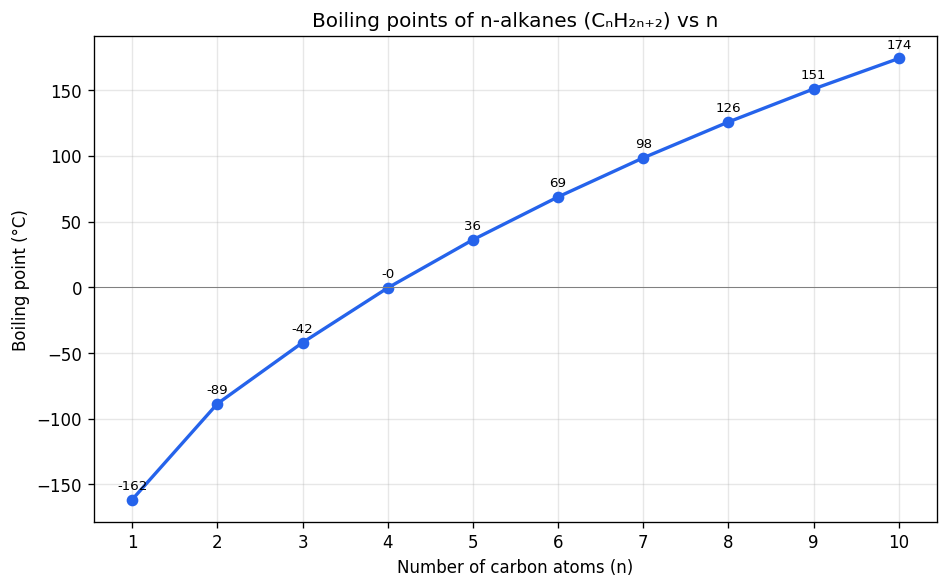
Study the variation of boiling point of n-alkanes with carbon number and answer:
As the number of carbon atoms in the n-alkane increases, the boiling point:
AIncreases
BDecreases
CRemains constant
DHas no trend
The trend is best explained by:
AHydrogen bonding
BIonic interactions
CIncreasing London (dispersion) forces with chain length
DDecreasing covalent bond strength
Why do boiling points of n-alkanes rise with chain length, and how does branching affect this?
Show answersHide answers
1. Option 1 — Increases
2. Option 3 — Increasing London (dispersion) forces with chain length
3. n-Alkanes are non-polar molecules — their only intermolecular force is the London (dispersion) force, which arises from instantaneous induced dipoles. Larger molecules have more electrons and a larger surface area, which increases the polarisability and thus the strength of the dispersion force. Stronger intermolecular forces require more thermal energy to overcome — boiling point rises with chain length. Branched isomers (e.g. iso-butane vs n-butane) have lower boiling points than their straight-chain isomers because branching reduces surface contact between molecules.
Q563 Marks
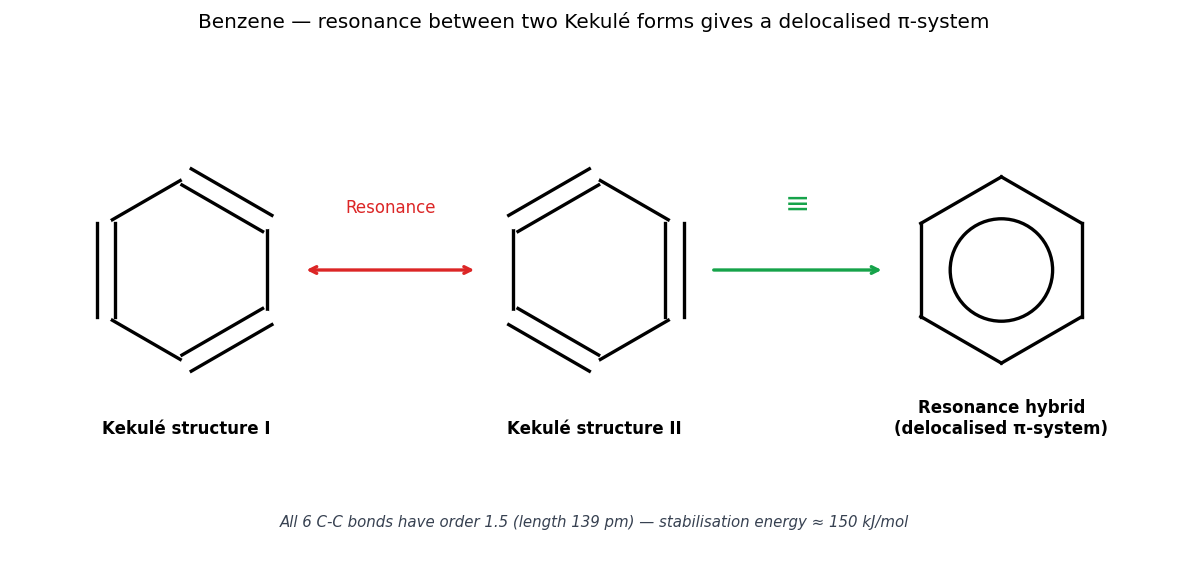
Study the resonance representation of benzene and answer:
The actual C-C bond structure in benzene is:
A3 single + 3 double bonds (alternating)
B6 equivalent bonds of order 1.5
C6 single bonds
D6 double bonds
Benzene preferentially undergoes:
AAddition reactions
BSubstitution reactions
CPolymerisation
DFree-radical halogenation
Explain why benzene preferentially undergoes substitution rather than addition, in terms of resonance stabilisation.
Show answersHide answers
1. Option 2 — 6 equivalent bonds of order 1.5
2. Option 2 — Substitution reactions
3. In each Kekulé structure benzene appears to have alternating single (154 pm) and double (134 pm) bonds, but X-ray data show all six C−C bonds are identical at 139 pm — between single and double. This is explained by resonance: the actual molecule is a hybrid of the two Kekulé structures, with the six π electrons delocalised over all six carbons. The inner circle in the hybrid notation represents this delocalised π-cloud. Resonance gives benzene ~150 kJ/mol of extra stabilisation — making it resistant to addition (which would destroy the aromatic π-system) and favouring electrophilic substitution (which preserves it). This is why benzene reacts with Br₂ (in presence of FeBr₃) to give bromobenzene rather than 1,2-dibromocyclohexadiene.