Neural Control and Coordination — Important Questions
52 questions
With answersCBSE format
SUMMARY: This chapter focuses on the structure and function of the human nervous system and how it coordinates various physiological processes. KEY TOPICS: Neuron structure, synapse, central nervous system, peripheral nervous system, reflex action, sensory reception, transmission of nerve impulse, brain structure, spinal cord, autonomic nervous system.
The central nervous system is composed of which two main structures?
ABrain and spinal cord
BBrain and peripheral nerves
CSpinal cord and sensory organs
DBrain and autonomic nerves
Check answerHide answer
Correct answer: Option 1 — Brain and spinal cord
Q101 Mark
What type of neuron carries signals away from the central nervous system?
ASensory neuron
BMotor neuron
CInterneuron
DAssociative neuron
Check answerHide answer
Correct answer: Option 2 — Motor neuron
Q111 Mark
Which part of the brain is primarily responsible for coordination and balance?
ACerebrum
BCerebellum
CMedulla oblongata
DThalamus
Check answerHide answer
Correct answer: Option 2 — Cerebellum
Q121 Mark
In a reflex arc, which component is responsible for processing the sensory information?
AEffector
BReceptor
CInterneuron
DMotor neuron
Check answerHide answer
Correct answer: Option 3 — Interneuron
Q131 Mark
What is the role of neurotransmitters in the nervous system?
ATo protect neurons from damage
BTo transmit signals across synapses
CTo generate electrical impulses
DTo form the myelin sheath
Check answerHide answer
Correct answer: Option 2 — To transmit signals across synapses
Q141 Mark
Which structure in the brain is involved in regulating body temperature and hunger?
AHypothalamus
BCerebrum
CCerebellum
DMedulla oblongata
Check answerHide answer
Correct answer: Option 1 — Hypothalamus
Q151 Mark
What is the primary role of sensory neurons?
ATo connect different parts of the nervous system
BTo transmit signals from the brain to muscles
CTo carry signals from sensory receptors to the central nervous system
DTo process information in the brain
Check answerHide answer
Correct answer: Option 3 — To carry signals from sensory receptors to the central nervous system
Short Answer Questions10 questions
Q163 Marks
Differentiate between sympathetic and parasympathetic nervous systems.
Q173 Marks
What is a reflex action? Give an example.
Q183 Marks
Explain the structure of a neuron with a diagram.
Q193 Marks
Describe the parts of the human brain briefly.
Q203 Marks
What is a synapse? Mention its types.
Q213 Marks
Differentiate between sympathetic and parasympathetic nervous systems.
Q223 Marks
What is a reflex action? Give an example.
Q233 Marks
Explain the structure of a neuron with a diagram.
Q243 Marks
Describe the parts of the human brain briefly.
Q253 Marks
What is a synapse? Mention its types.
Long Answer Questions6 questions
Q266 Marks
Describe the structure of the human brain with a labelled diagram.
Q276 Marks
Explain the mechanism of generation and conduction of a nerve impulse.
Q286 Marks
Discuss the structure and function of the human eye with a labelled diagram.
Q296 Marks
Explain the structure and function of the human ear with a diagram.
Q306 Marks
Describe the autonomic nervous system and its divisions.
Q316 Marks
Describe the structure of the human brain with a labelled diagram.
Assertion–Reason Questions8 questions
Q321 Mark
Assertion (A): Myelin sheath increases the speed of nerve impulse conduction.
Reason (R): It allows saltatory conduction at the nodes of Ranvier.
Show explanationHide explanation
Correct answer: Option 1 —
Both A and R are true, and R is the correct explanation of A.
Q331 Mark
Assertion (A): Neurons are excitable cells.
Reason (R): They generate and conduct electrical impulses called action potentials.
Show explanationHide explanation
Correct answer: Option 1 —
Both A and R are true, and R is the correct explanation of A.
Q341 Mark
Assertion (A): Reflex actions are involuntary.
Reason (R): They occur without conscious control.
Show explanationHide explanation
Correct answer: Option 1 —
Both A and R are true, and R is the correct explanation of A.
Q351 Mark
Assertion (A): The cerebellum maintains body balance.
Reason (R): It coordinates voluntary muscle movements.
Show explanationHide explanation
Correct answer: Option 1 —
Both A and R are true, and R is the correct explanation of A.
Q361 Mark
Assertion (A): The blind spot has no photoreceptors.
Reason (R): No image is formed when light falls on the blind spot.
Show explanationHide explanation
Correct answer: Option 1 —
Both A and R are true, and R is the correct explanation of A.
Q371 Mark
Assertion (A): Myelin sheath increases the speed of nerve impulse conduction.
Reason (R): It allows saltatory conduction at the nodes of Ranvier.
Show explanationHide explanation
Correct answer: Option 1 —
Both A and R are true, and R is the correct explanation of A.
Q381 Mark
Assertion (A): Neurons are excitable cells.
Reason (R): They generate and conduct electrical impulses called action potentials.
Show explanationHide explanation
Correct answer: Option 1 —
Both A and R are true, and R is the correct explanation of A.
Q391 Mark
Assertion (A): Reflex actions are involuntary.
Reason (R): They occur without conscious control.
Show explanationHide explanation
Correct answer: Option 1 —
Both A and R are true, and R is the correct explanation of A.
Statement-Based Questions8 questions
Q401 Mark
Statement 1: Statement I: Action potential is an all-or-none response.
Statement 2: Statement II: It propagates without decrement along the axon.
Show answerHide answer
Correct answer: Option 1 —
Both statements are true.
Q411 Mark
Statement 1: Statement I: Neurotransmitters are released at the synapse.
Statement 2: Statement II: They diffuse across the cleft and bind to receptors on the next neuron.
Show answerHide answer
Correct answer: Option 1 —
Both statements are true.
Q421 Mark
Statement 1: Statement I: The medulla controls breathing and heart rate.
Statement 2: Statement II: It is part of the brain stem.
Show answerHide answer
Correct answer: Option 1 —
Both statements are true.
Q431 Mark
Statement 1: Statement I: Cones are responsible for colour vision.
Statement 2: Statement II: Rods are responsible for vision in dim light.
Show answerHide answer
Correct answer: Option 1 —
Both statements are true.
Q441 Mark
Statement 1: Statement I: The cochlea is involved in hearing.
Statement 2: Statement II: It contains hair cells that detect sound vibrations.
Show answerHide answer
Correct answer: Option 1 —
Both statements are true.
Q451 Mark
Statement 1: Action potential is an all-or-none response.
Statement 2: It propagates without decrement along the axon.
Show answerHide answer
Correct answer: Option 1 —
Both statements are true.
Q461 Mark
Statement 1: Neurotransmitters are released at the synapse.
Statement 2: They diffuse across the cleft and bind to receptors on the next neuron.
Show answerHide answer
Correct answer: Option 1 —
Both statements are true.
Q471 Mark
Statement 1: The medulla controls breathing and heart rate.
Statement 2: It is part of the brain stem.
Show answerHide answer
Correct answer: Option 1 —
Both statements are true.
Case Study / Passage Questions2 questions
Q483 Marks
A child accidentally touches a hot stove and immediately withdraws her hand even before she feels the pain. The teacher uses this example to illustrate the spinal reflex arc — sensory neuron integrating centre in the spinal cord and motor neuron — that bypasses the brain to give a quick protective response.
The integrating centre for a spinal reflex is the:
ABrain
BSpinal cord
CHeart
DLiver
The reflex arc may include:
ASensory neuron
BMotor neuron
CInter-neuron
DAll of these
Describe the components of a reflex arc with the example of the withdrawal reflex.
Show answersHide answers
1. Option 2 — Spinal cord
2. Option 4 — All of these
3. A reflex action is an automatic, rapid and stereotyped response to a stimulus that protects the body from harm. The path of impulses constitutes the reflex arc consisting of a receptor, sensory neuron, interneuron in the CNS, motor neuron and effector. Spinal reflexes (like the knee jerk) bypass the brain so that response is initiated faster than perception of pain.
Q493 Marks
A class learns about the human eye. The teacher explains that the retina has two types of photoreceptors — rods that function in dim light and cones that detect colour in bright light. She shows that during night driving rod cells are more active and that vitamin A deficiency leads to night blindness.
Vision in dim light is mainly due to:
ARods
BCones
CBoth equally
DNeither
Night blindness is caused by deficiency of:
AVitamin A
BVitamin C
CVitamin D
DVitamin K
Distinguish between rods and cones and explain how vitamin A deficiency causes night blindness.
Show answersHide answers
1. Option 1 — Rods
2. Option 1 — Vitamin A
3. Rods contain the visual pigment rhodopsin which is highly sensitive to dim light but does not distinguish colours. Cones contain three types of iodopsin pigments sensitive to red, green and blue light enabling colour vision in bright light. Vitamin A is a precursor of retinal — a component of rhodopsin and iodopsin. Its deficiency reduces pigment regeneration causing night blindness.
Table-Based Questions2 questions
Q503 Marks
Study the table comparing the two divisions of the autonomic nervous system:
Effect on
Sympathetic
Parasympathetic
Heart rate
Increases
Decreases
Pupil
Dilates
Constricts
Salivation
Decreases
Increases
Bronchi
Dilates
Constricts
Digestion
Slows
Stimulates
The fight-or-flight response is mediated by the:
ASympathetic
BParasympathetic
CBoth
DNeither
The parasympathetic system causes the heart rate to:
AIncreases
BDecreases
CNo effect
DReverses
Compare the actions of sympathetic and parasympathetic systems on heart, pupil and digestion.
Show answersHide answers
1. Option 1 — Sympathetic
2. Option 2 — Decreases
3. The autonomic nervous system controls involuntary functions through two antagonistic divisions. The sympathetic division prepares the body for fight or flight by increasing heart rate, dilating pupils and bronchi and slowing digestion. The parasympathetic division promotes rest and digest functions by slowing heart rate, constricting pupils and stimulating digestive activity. The two divisions usually have opposite effects to maintain homeostasis.
Q516 Marks
Compare the sympathetic and parasympathetic divisions of the autonomic nervous system.
Effect on
Sympathetic
Parasympathetic
Heart rate
?
?
Pupil
?
?
Salivation
?
?
Bronchi
?
?
Digestion
?
?
Picture-Based Questions1 question
Q524 Marks
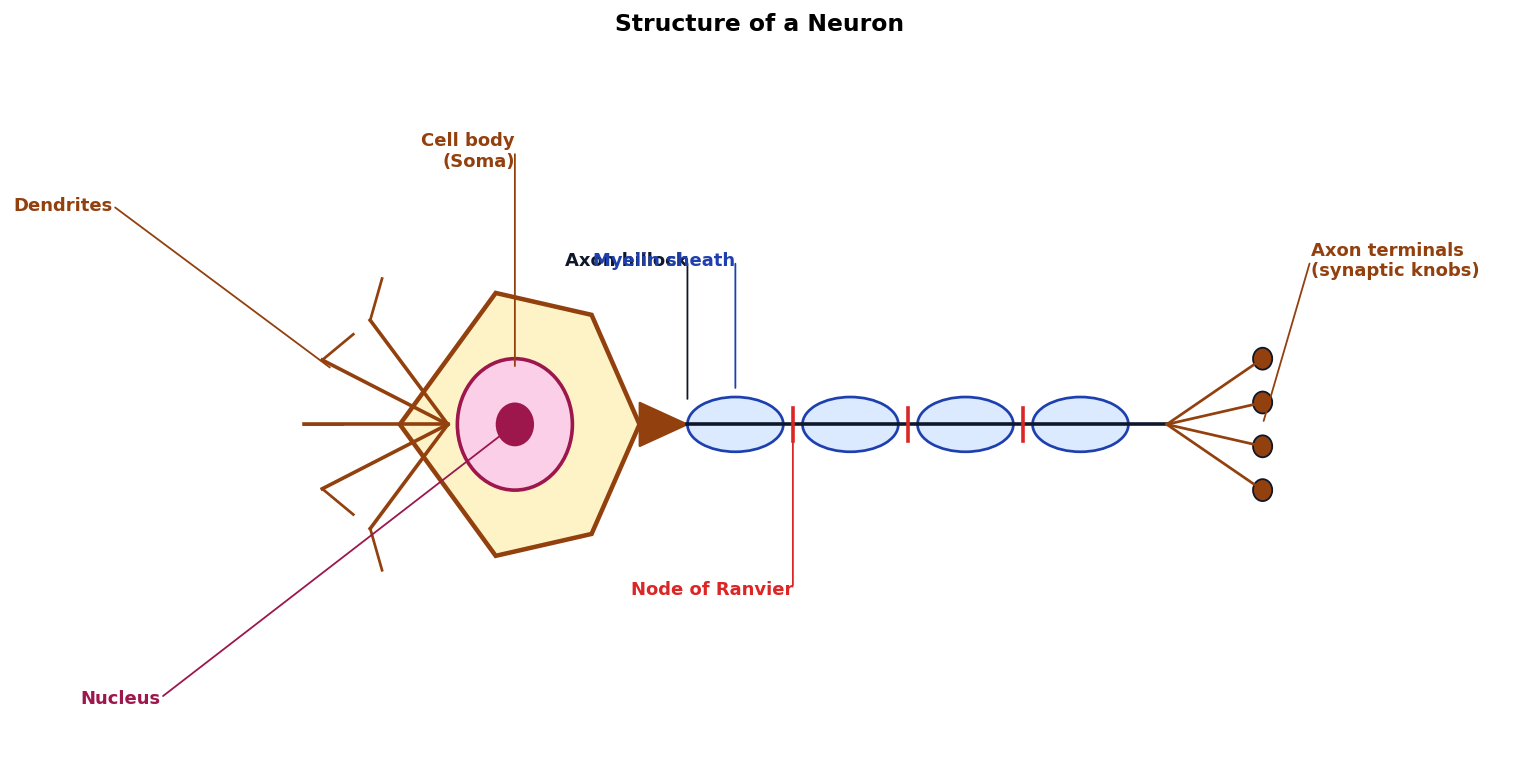
Study the labelled diagram of a neuron and answer:
The longest part of a neuron that conducts impulses away from the cell body is the:
ADendrite
BCell body
CAxon
DSynapse
The myelin sheath around the axon enables:
AFaster impulse conduction
BSlower impulse conduction
CStops impulse
DReverses direction
Describe the structure of a neuron and explain how the myelin sheath speeds up nerve impulse conduction.
Show answersHide answers
1. Option 3 — Axon
2. Option 1 — Faster impulse conduction
3. A neuron has dendrites that receive impulses a cell body containing the nucleus and a single long axon. The axon is wrapped in a myelin sheath interrupted by nodes of Ranvier. The myelin sheath insulates the axon and allows saltatory conduction making impulse transmission much faster.