Photosynthesis in Higher Plants — Important Questions
53 questions
With answersCBSE format
SUMMARY: This chapter explores the process of photosynthesis in higher plants, detailing the mechanisms and factors affecting it. KEY TOPICS: photosynthetic pigments, light reaction, Calvin cycle, C4 pathway, CAM plants, photophosphorylation, factors affecting photosynthesis, chloroplast structure, photorespiration, electron transport chain.
Correct answer: Option 2 — Chlorophyll b and carotenoids
Q61 Mark
Which of the following is a primary photosynthetic pigment in plants?
AChlorophyll a
BCarotenoids
CXanthophylls
DChlorophyll b
Check answerHide answer
Correct answer: Option 1 — Chlorophyll a
Q71 Mark
What is the main purpose of the light-dependent reactions in photosynthesis?
ATo produce glucose
BTo convert light energy into chemical energy
CTo fix carbon dioxide
DTo release oxygen
Check answerHide answer
Correct answer: Option 2 — To convert light energy into chemical energy
Q81 Mark
In which part of the chloroplast does the Calvin cycle occur?
AThylakoid membrane
BStroma
COuter membrane
DInner membrane
Check answerHide answer
Correct answer: Option 2 — Stroma
Q91 Mark
Which of the following factors does NOT affect the rate of photosynthesis?
ALight intensity
BTemperature
CSoil pH
DCarbon dioxide concentration
Check answerHide answer
Correct answer: Option 3 — Soil pH
Q101 Mark
What is the role of RuBisCO in the Calvin cycle?
ATo produce ATP
BTo fix carbon dioxide
CTo transport electrons
DTo synthesize chlorophyll
Check answerHide answer
Correct answer: Option 2 — To fix carbon dioxide
Q111 Mark
Which of the following statements about C4 plants is true?
AThey primarily use the Calvin cycle for carbon fixation.
BThey have a unique pathway to minimize photorespiration.
CThey thrive in cool, moist environments.
DThey do not require sunlight for photosynthesis.
Check answerHide answer
Correct answer: Option 2 — They have a unique pathway to minimize photorespiration.
Q121 Mark
What is photophosphorylation?
AThe process of converting light energy into ATP
BThe process of fixing carbon dioxide
CThe breakdown of glucose
DThe synthesis of chlorophyll
Check answerHide answer
Correct answer: Option 1 — The process of converting light energy into ATP
Q131 Mark
Which of the following is a characteristic of CAM plants?
AThey open their stomata during the day.
BThey fix carbon dioxide at night.
CThey are adapted to wet environments.
DThey do not undergo photosynthesis.
Check answerHide answer
Correct answer: Option 2 — They fix carbon dioxide at night.
Q141 Mark
Which component of the electron transport chain is responsible for the production of ATP?
APhotosystem I
BPhotosystem II
CATP synthase
DNADP+
Check answerHide answer
Correct answer: Option 3 — ATP synthase
Q151 Mark
What is the main consequence of photorespiration?
AIncreased glucose production
BDecreased efficiency of photosynthesis
CIncreased oxygen production
DDecreased water loss
Check answerHide answer
Correct answer: Option 2 — Decreased efficiency of photosynthesis
Short Answer Questions10 questions
Q163 Marks
Differentiate between cyclic and non-cyclic photophosphorylation.
Q173 Marks
What is photorespiration? Why is it considered a wasteful process?
Q183 Marks
Distinguish between C3 and C4 plants.
Q193 Marks
What is Kranz anatomy? In which plants is it found?
Q203 Marks
Explain the role of light in photosynthesis.
Q213 Marks
Differentiate between cyclic and non-cyclic photophosphorylation.
Q223 Marks
What is photorespiration? Why is it considered a wasteful process?
Q233 Marks
Distinguish between C3 and C4 plants.
Q243 Marks
What is Kranz anatomy? In which plants is it found?
Q253 Marks
Explain the role of light in photosynthesis.
Long Answer Questions6 questions
Q266 Marks
Describe the light-dependent reactions of photosynthesis with a diagram.
Q276 Marks
Explain the Calvin cycle (C3 pathway) with a labelled diagram.
Q286 Marks
Describe the C4 pathway (Hatch-Slack cycle) of carbon fixation.
Q296 Marks
Discuss the factors affecting the rate of photosynthesis.
Q306 Marks
Explain the process of chemiosmosis in chloroplasts.
Q316 Marks
Describe the light-dependent reactions of photosynthesis with a diagram.
Assertion–Reason Questions8 questions
Q321 Mark
Assertion (A): C4 plants are more efficient at carbon fixation than C3 plants.
Reason (R): C4 plants lack photorespiration and have a CO2 concentrating mechanism.
Show explanationHide explanation
Correct answer: Option 1 —
Both A and R are true, and R is the correct explanation of A.
Q331 Mark
Assertion (A): Chlorophyll a is the primary pigment in photosynthesis.
Reason (R): Other pigments are accessory and pass energy to chlorophyll a.
Show explanationHide explanation
Correct answer: Option 1 —
Both A and R are true, and R is the correct explanation of A.
Q341 Mark
Assertion (A): Photolysis of water occurs during light reaction.
Reason (R): It releases oxygen as a by-product.
Show explanationHide explanation
Correct answer: Option 1 —
Both A and R are true, and R is the correct explanation of A.
Q351 Mark
Assertion (A): RuBisCO has both carboxylase and oxygenase activity.
Reason (R): At higher temperatures and lower CO2 it acts as oxygenase.
Show explanationHide explanation
Correct answer: Option 1 —
Both A and R are true, and R is the correct explanation of A.
Q361 Mark
Assertion (A): Light reactions occur in thylakoids.
Reason (R): Thylakoid membranes contain chlorophyll and electron transport components.
Show explanationHide explanation
Correct answer: Option 1 —
Both A and R are true, and R is the correct explanation of A.
Q371 Mark
Assertion (A): C4 plants are more efficient at carbon fixation than C3 plants.
Reason (R): C4 plants lack photorespiration and have a CO2 concentrating mechanism.
Show explanationHide explanation
Correct answer: Option 1 —
Both A and R are true, and R is the correct explanation of A.
Q381 Mark
Assertion (A): Chlorophyll a is the primary pigment in photosynthesis.
Reason (R): Other pigments are accessory and pass energy to chlorophyll a.
Show explanationHide explanation
Correct answer: Option 1 —
Both A and R are true, and R is the correct explanation of A.
Q391 Mark
Assertion (A): Photolysis of water occurs during light reaction.
Reason (R): It releases oxygen as a by-product.
Show explanationHide explanation
Correct answer: Option 1 —
Both A and R are true, and R is the correct explanation of A.
Statement-Based Questions8 questions
Q401 Mark
Statement 1: Statement I: ATP and NADPH are produced in light reaction.
Statement 2: Statement II: They are used in the dark reaction to fix CO2.
Show answerHide answer
Correct answer: Option 1 —
Both statements are true.
Q411 Mark
Statement 1: Statement I: Granum is a stack of thylakoids.
Statement 2: Statement II: Multiple grana are interconnected by stroma lamellae.
Show answerHide answer
Correct answer: Option 1 —
Both statements are true.
Q421 Mark
Statement 1: Statement I: Photosynthesis converts light energy into chemical energy.
Statement 2: Statement II: The chemical energy is stored in carbohydrates.
Show answerHide answer
Correct answer: Option 1 —
Both statements are true.
Q431 Mark
Statement 1: Statement I: C4 plants have bundle sheath cells with chloroplasts.
Statement 2: Statement II: These chloroplasts contain RuBisCO and carry out the Calvin cycle.
Show answerHide answer
Correct answer: Option 1 —
Both statements are true.
Q441 Mark
Statement 1: Statement I: Photosynthesis depends on temperature.
Statement 2: Statement II: Enzymes involved in dark reaction are temperature sensitive.
Show answerHide answer
Correct answer: Option 1 —
Both statements are true.
Q451 Mark
Statement 1: ATP and NADPH are produced in light reaction.
Statement 2: They are used in the dark reaction to fix CO2.
Show answerHide answer
Correct answer: Option 1 —
Both statements are true.
Q461 Mark
Statement 1: Granum is a stack of thylakoids.
Statement 2: Multiple grana are interconnected by stroma lamellae.
Show answerHide answer
Correct answer: Option 1 —
Both statements are true.
Q471 Mark
Statement 1: Photosynthesis converts light energy into chemical energy.
Statement 2: The chemical energy is stored in carbohydrates.
Show answerHide answer
Correct answer: Option 1 —
Both statements are true.
Case Study / Passage Questions2 questions
Q483 Marks
Robin Hill in 1937 demonstrated that isolated chloroplasts when illuminated in the presence of an electron acceptor liberate oxygen and reduce the acceptor. This proved that the oxygen evolved during photosynthesis comes from water and not from carbon dioxide. The experiment formed the basis for our understanding of the light reaction.
The oxygen released in photosynthesis comes from:
ACarbon dioxide
BWater
CGlucose
DMineral salts
The light reactions of photosynthesis occur in the:
AStroma
BThylakoid membrane
COuter membrane
DCytoplasm
Outline the main events of the light reaction of photosynthesis.
Show answersHide answers
1. Option 2 — Water
2. Option 2 — Thylakoid membrane
3. Light reactions split water into hydrogen ions, electrons and oxygen by photolysis. The released electrons are passed through Photosystem II and Photosystem I generating ATP and NADPH. Oxygen is liberated as a by-product. ATP and NADPH are then used in the dark reactions (Calvin cycle) to fix CO2 into carbohydrates in the stroma.
Q493 Marks
An agriculture student notes that maize and sugarcane (C4 plants) grow faster and use water more efficiently than wheat and rice (C3 plants) in hot tropical climates. The teacher explains the special Kranz anatomy of C4 plants and the role of PEP carboxylase in concentrating CO2 in the bundle sheath cells.
The Calvin cycle in C4 plants takes place in:
AMesophyll cells
BBundle sheath cells
CBoth
DNeither
The first CO2 fixing enzyme in C4 plants is:
ARuBisCO
BPEP carboxylase
CDNA polymerase
DHexokinase
Explain how C4 plants overcome photorespiration.
Show answersHide answers
1. Option 2 — Bundle sheath cells
2. Option 2 — PEP carboxylase
3. C4 plants have an adaptation called Kranz anatomy in which the bundle sheath cells contain large chloroplasts and surround the vascular bundles. Mesophyll cells initially fix CO2 to oxaloacetate (a 4-carbon compound) using PEP carboxylase. The 4-carbon acid is then transported to bundle sheath cells where it releases CO2 for the Calvin cycle. This concentrates CO2 around RuBisCO and reduces photorespiration making C4 plants more efficient in hot dry climates.
Table-Based Questions3 questions
Q503 Marks
Study the table on photosynthetic pigments and answer:
Pigment
Colour absorbed
Role
Chlorophyll a
Blue-violet & red
Primary photosynthetic pigment
Chlorophyll b
Blue & orange
Accessory
Carotenoids
Blue & green
Accessory + photoprotection
Phycobilins
Yellow & green
Accessory in red algae
The primary photosynthetic pigment is:
AChlorophyll a
BChlorophyll b
CCarotenoids
DPhycobilins
Carotenoids in chloroplasts function in:
APhotosynthesis only
BPhotoprotection only
CBoth photosynthesis and photoprotection
DEnergy storage
Distinguish between primary and accessory photosynthetic pigments.
Show answersHide answers
1. Option 1 — Chlorophyll a
2. Option 3 — Both photosynthesis and photoprotection
3. Chlorophyll a is the only pigment that converts light energy into chemical energy and is therefore the primary pigment. All other pigments are accessory and pass their absorbed energy to chlorophyll a. Carotenoids additionally protect chlorophyll from photo-oxidation by quenching free radicals. Together the pigments broaden the spectrum of light usable for photosynthesis.
Q516 Marks
Compare photosynthesis and aerobic respiration.
Feature
Photosynthesis
Aerobic respiration
Site
?
?
Raw materials
?
?
Products
?
?
Energy
?
?
Time
?
?
Q526 Marks
Compare C3 and C4 plants.
Feature
C3 plants
C4 plants
First stable product
?
?
CO2 acceptor
?
?
Primary enzyme
?
?
Kranz anatomy
?
?
Photorespiration
?
?
Picture-Based Questions1 question
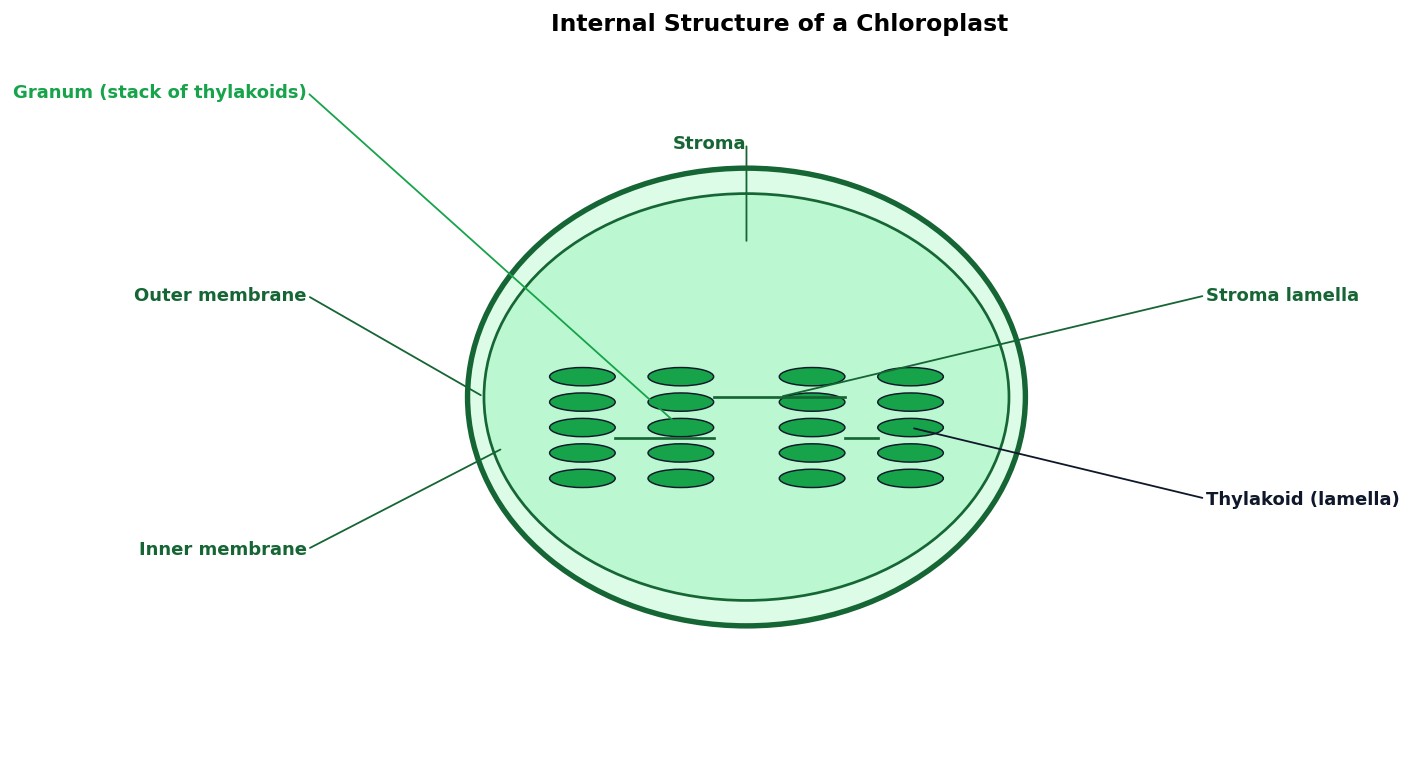
Q534 Marks
Study the labelled diagram of a chloroplast and answer:
A stack of thylakoid discs is called a:
AStroma
BGranum
COuter membrane
DInner membrane
The Calvin cycle (dark reactions) takes place in the:
AOuter membrane
BInner membrane
CStroma
DThylakoid membrane
Describe the structure of a chloroplast and explain where the light and dark reactions occur.
Show answersHide answers
1. Option 2 — Granum
2. Option 3 — Stroma
3. A chloroplast is a double-membrane plastid. The stroma contains stacks of thylakoids called grana connected by stroma lamellae. Thylakoid membranes house chlorophyll where light reactions occur. The stroma contains enzymes for the Calvin cycle.