Breathing and Exchange of Gases — Important Questions
54 questions
With answersCBSE format
SUMMARY: This chapter focuses on the mechanisms of breathing and the exchange of gases in humans and other organisms. KEY TOPICS: human respiratory system, mechanism of breathing, exchange of gases, transport of gases, regulation of respiration, respiratory volumes and capacities, disorders of the respiratory system, oxygen dissociation curve, carbon dioxide transport, respiratory pigments.
Explain the mechanism of inspiration and expiration.
Q193 Marks
Describe the transport of oxygen in the blood.
Q203 Marks
What is the Bohr effect?
Q213 Marks
Differentiate between breathing and respiration.
Q223 Marks
What is vital capacity? How is it calculated?
Q233 Marks
Explain the mechanism of inspiration and expiration.
Q243 Marks
Describe the transport of oxygen in the blood.
Q253 Marks
What is the Bohr effect?
Long Answer Questions6 questions
Q266 Marks
Describe the human respiratory system with a labelled diagram.
Q276 Marks
Explain the mechanism of breathing and the regulation of respiration.
Q286 Marks
Discuss the transport of oxygen and carbon dioxide in blood.
Q296 Marks
Explain the various respiratory volumes and capacities.
Q306 Marks
Discuss the disorders of the respiratory system: asthma, emphysema, and occupational respiratory disorders.
Q316 Marks
Describe the human respiratory system with a labelled diagram.
Assertion–Reason Questions8 questions
Q321 Mark
Assertion (A): Haemoglobin is the oxygen-carrying pigment in blood.
Reason (R): It binds oxygen reversibly.
Show explanationHide explanation
Correct answer: Option 1 —
Both A and R are true, and R is the correct explanation of A.
Q331 Mark
Assertion (A): The diaphragm is involved in breathing.
Reason (R): Its contraction increases thoracic volume during inspiration.
Show explanationHide explanation
Correct answer: Option 1 —
Both A and R are true, and R is the correct explanation of A.
Q341 Mark
Assertion (A): Alveoli are the sites of gaseous exchange.
Reason (R): They have thin walls and rich blood supply.
Show explanationHide explanation
Correct answer: Option 1 —
Both A and R are true, and R is the correct explanation of A.
Q351 Mark
Assertion (A): The respiratory rhythm centre is located in the medulla oblongata.
Reason (R): It controls the rate and depth of breathing.
Show explanationHide explanation
Correct answer: Option 1 —
Both A and R are true, and R is the correct explanation of A.
Q361 Mark
Assertion (A): Smoking causes emphysema.
Reason (R): It damages the alveolar walls and reduces the gas exchange surface.
Show explanationHide explanation
Correct answer: Option 1 —
Both A and R are true, and R is the correct explanation of A.
Q371 Mark
Assertion (A): Haemoglobin is the oxygen-carrying pigment in blood.
Reason (R): It binds oxygen reversibly.
Show explanationHide explanation
Correct answer: Option 1 —
Both A and R are true, and R is the correct explanation of A.
Q381 Mark
Assertion (A): The diaphragm is involved in breathing.
Reason (R): Its contraction increases thoracic volume during inspiration.
Show explanationHide explanation
Correct answer: Option 1 —
Both A and R are true, and R is the correct explanation of A.
Q391 Mark
Assertion (A): Alveoli are the sites of gaseous exchange.
Reason (R): They have thin walls and rich blood supply.
Show explanationHide explanation
Correct answer: Option 1 —
Both A and R are true, and R is the correct explanation of A.
Statement-Based Questions8 questions
Q401 Mark
Statement 1: Statement I: O2 dissociation curve is sigmoid.
Statement 2: Statement II: It shifts to the right under increased CO2 or decreased pH.
Show answerHide answer
Correct answer: Option 1 —
Both statements are true.
Q411 Mark
Statement 1: Statement I: Respiration is regulated by the medulla.
Statement 2: Statement II: Pneumotaxic centre in pons can also influence respiratory rate.
Show answerHide answer
Correct answer: Option 1 —
Both statements are true.
Q421 Mark
Statement 1: Statement I: Tidal volume is around 500 mL.
Statement 2: Statement II: It is the air volume during normal quiet breathing.
Show answerHide answer
Correct answer: Option 1 —
Both statements are true.
Q431 Mark
Statement 1: Statement I: Asthma involves inflammation of bronchi.
Statement 2: Statement II: It causes wheezing and difficulty in breathing.
Show answerHide answer
Correct answer: Option 1 —
Both statements are true.
Q441 Mark
Statement 1: Statement I: Larynx is also called the voice box.
Statement 2: Statement II: It contains vocal cords that vibrate to produce sound.
Show answerHide answer
Correct answer: Option 1 —
Both statements are true.
Q451 Mark
Statement 1: O2 dissociation curve is sigmoid.
Statement 2: It shifts to the right under increased CO2 or decreased pH.
Show answerHide answer
Correct answer: Option 1 —
Both statements are true.
Q461 Mark
Statement 1: Respiration is regulated by the medulla.
Statement 2: Pneumotaxic centre in pons can also influence respiratory rate.
Show answerHide answer
Correct answer: Option 1 —
Both statements are true.
Q471 Mark
Statement 1: Tidal volume is around 500 mL.
Statement 2: It is the air volume during normal quiet breathing.
Show answerHide answer
Correct answer: Option 1 —
Both statements are true.
Case Study / Passage Questions2 questions
Q483 Marks
A young patient is rushed to the hospital with severe shortness of breath and wheezing after exposure to dust. The doctor diagnoses an asthma attack — inflammation and constriction of the bronchi — and administers a salbutamol inhaler that relaxes the bronchial smooth muscle.
The site of constriction during asthma is the:
ATrachea
BBronchi
CAlveoli
DPleura
Asthma is best classified as:
AAllergic bronchospasm
BTuberculosis
CPneumonia
DLung cancer
Discuss the causes, symptoms and management of asthma.
Show answersHide answers
1. Option 2 — Bronchi
2. Option 1 — Allergic bronchospasm
3. Asthma is a chronic inflammatory disease of the airways characterised by reversible bronchoconstriction. Common triggers include allergens, dust, cold air, exercise and infections. The narrowed airways cause wheezing, breathlessness and chest tightness. Treatment involves bronchodilators (like salbutamol) for acute relief and inhaled corticosteroids for long-term control of inflammation.
Q493 Marks
A climbing team ascends Mt. Everest. Above 5500 m the partial pressure of oxygen falls to about half of sea-level value. Climbers experience breathlessness, headache and fatigue. Their respiratory rate increases and their bone marrow produces more red blood cells over weeks of acclimatisation.
At high altitude the parameter that decreases is:
AO2 partial pressure
BCO2 partial pressure
CN2 partial pressure
DTotal pressure
Acclimatisation increases the number of:
AWBC
BRBC
CPlatelets
DAll
Explain the physiological adjustments that help humans acclimatise to high altitude.
Show answersHide answers
1. Option 1 — O2 partial pressure
2. Option 2 — RBC
3. At high altitude the partial pressure of oxygen falls although the percentage of oxygen in air remains 21 percent. Less oxygen reaches the blood causing hypoxia. To compensate the body increases breathing rate heart rate and over weeks the kidneys release erythropoietin which stimulates RBC production. This raises the haemoglobin level and improves oxygen carrying capacity. Acclimatisation typically takes 2 to 3 weeks.
Table-Based Questions4 questions
Q503 Marks
Study the table on respiratory volumes and capacities and answer:
Volume/Capacity
Definition
Approximate value
Tidal volume
Air during normal breathing
500 mL
IRV
Forcibly inspired beyond TV
2500-3000 mL
ERV
Forcibly expired beyond TV
1000-1100 mL
Residual volume
Air left in lungs after maximum expiration
1100-1200 mL
Vital capacity
TV + IRV + ERV
3500-4500 mL
The tidal volume in a healthy adult is approximately:
A500 mL
B1500 mL
C3500 mL
D5500 mL
Vital capacity equals:
ATV + IRV
BTV + ERV
CTV + IRV + ERV
DIRV + ERV
Define vital capacity and explain its clinical importance.
Show answersHide answers
1. Option 1 — 500 mL
2. Option 3 — TV + IRV + ERV
3. Pulmonary volumes and capacities help in assessing lung health. Tidal volume is the volume during normal breathing. Inspiratory and expiratory reserve volumes represent additional inhalation/exhalation capacity. Residual volume cannot be expelled and prevents alveolar collapse. Vital capacity (TV + IRV + ERV) and total lung capacity are useful diagnostic indicators.
Q516 Marks
Match each respiratory volume/capacity with its definition and approximate value.
Term
Definition
Approx value
Tidal Volume
?
?
IRV
?
?
ERV
?
?
Residual Volume
?
?
Vital Capacity
?
?
Q526 Marks
Which gas has the highest partial pressure in the alveoli according to the table?
Gas
Partial Pressure (mmHg)
Oxygen (O2)
104
Carbon Dioxide (CO2)
40
Nitrogen (N2)
568
Q532 Marks
Study the following data and answer the questions below:
Respiratory Volume/Capacity
Definition
Approximate Value (L)
Tidal Volume
Volume of air inhaled or exhaled in a normal breath
0.5
Vital Capacity
Maximum amount of air that can be exhaled after a maximum inhalation
4.5
Residual Volume
Volume of air remaining in the lungs after maximum exhalation
1.2
What is the approximate value of Vital Capacity?
Which respiratory volume is defined as the volume of air remaining in the lungs after maximum exhalation?
Show answersHide answers
1.
2.
Picture-Based Questions1 question
Q544 Marks
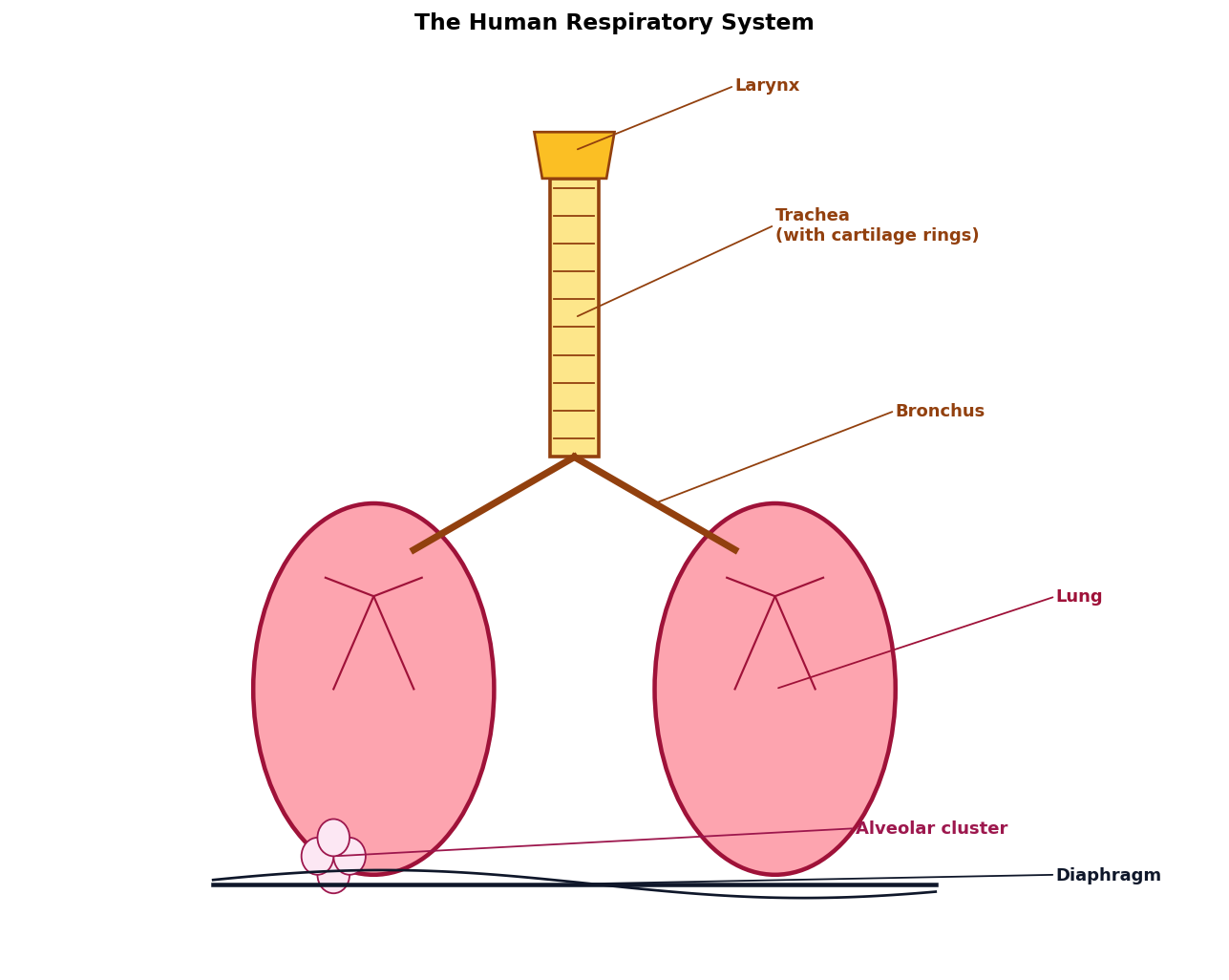
Study the schematic of the human respiratory system and answer:
The actual exchange of gases takes place at the:
ATrachea
BBronchi
CBronchioles
DAlveoli
The dome-shaped muscle below the lungs that brings about breathing is the:
ALarynx
BPharynx
CTrachea
DDiaphragm
Describe the human respiratory system and explain the mechanism of breathing.
Show answersHide answers
1. Option 4 — Alveoli
2. Option 4 — Diaphragm
3. Air enters through the nostrils through the pharynx and larynx and into the trachea. The trachea divides into bronchi which branch into bronchioles ending in alveoli. Thin-walled alveoli with rich capillary supply are the actual site of gaseous exchange. Breathing is brought about by the diaphragm and intercostal muscles.