SUMMARY: The chapter "Animal Kingdom" in Class 11 Biology provides an overview of the classification of animals based on various criteria and characteristics. KEY TOPICS: classification of animals, levels of organization, symmetry, diploblastic and triploblastic organization, coelom, segmentation, notochord, phylum Porifera, phylum Cnidaria, phylum Platyhelminthes, phylum Annelida, phylum Arthropoda, phylum Mollusca, phylum Echinodermata, phylum Chordata.
Which of the following is a member of phylum Porifera?
AHydra
BSycon
CPlanaria
DEarthworm
Check answerHide answer
Correct answer: Option 2 — Sycon
Q21 Mark
Nematocysts are characteristic of:
APorifera
BCoelenterata
CPlatyhelminthes
DAnnelida
Check answerHide answer
Correct answer: Option 2 — Coelenterata
Q31 Mark
Which of the following is a pseudocoelomate?
AEarthworm
BAscaris
CHydra
DSycon
Check answerHide answer
Correct answer: Option 2 — Ascaris
Q41 Mark
Open circulatory system is found in:
AAnnelida
BArthropoda
CChordata
DEchinodermata
Check answerHide answer
Correct answer: Option 2 — Arthropoda
Q51 Mark
Notochord is present in:
AMollusca
BEchinodermata
CChordata
DArthropoda
Check answerHide answer
Correct answer: Option 3 — Chordata
Q61 Mark
Which of the following characteristics is NOT typical of phylum Cnidaria?
APresence of a coelom
BRadial symmetry
CNematocysts
DDiploblastic organization
Check answerHide answer
Correct answer: Option 1 — Presence of a coelom
Q71 Mark
What type of body symmetry is exhibited by organisms in phylum Echinodermata?
ABilateral symmetry
BRadial symmetry
CAsymmetry
DSpherical symmetry
Check answerHide answer
Correct answer: Option 2 — Radial symmetry
Q81 Mark
Which of the following phyla is characterized by a segmented body plan?
APhylum Mollusca
BPhylum Annelida
CPhylum Cnidaria
DPhylum Porifera
Check answerHide answer
Correct answer: Option 2 — Phylum Annelida
Q91 Mark
Which of the following is a defining feature of organisms in phylum Platyhelminthes?
APresence of a coelom
BTriploblastic organization
CFlat body shape
DJointed appendages
Check answerHide answer
Correct answer: Option 3 — Flat body shape
Q101 Mark
Which of the following statements about phylum Arthropoda is true?
AThey have a notochord.
BThey possess an exoskeleton made of chitin.
CThey are all aquatic.
DThey exhibit radial symmetry.
Check answerHide answer
Correct answer: Option 2 — They possess an exoskeleton made of chitin.
Q111 Mark
What type of body organization is found in organisms of phylum Porifera?
ATriploblastic
BDiploblastic
CAcoelomate
DNone of the above
Check answerHide answer
Correct answer: Option 4 — None of the above
Q121 Mark
Which of the following is a characteristic feature of the phylum Chordata?
APresence of a notochord
BRadial symmetry
CExoskeleton
DTentacles
Check answerHide answer
Correct answer: Option 1 — Presence of a notochord
Q131 Mark
Which of the following organisms is classified as a coelomate?
APlanaria
BEarthworm
CRoundworm
DHydra
Check answerHide answer
Correct answer: Option 2 — Earthworm
Q141 Mark
In which phylum would you find organisms that exhibit a water vascular system?
APhylum Mollusca
BPhylum Echinodermata
CPhylum Annelida
DPhylum Cnidaria
Check answerHide answer
Correct answer: Option 2 — Phylum Echinodermata
Q151 Mark
Which of the following features is associated with diploblastic organisms?
AThree germ layers
BTwo germ layers
CPresence of a coelom
DSegmentation
Check answerHide answer
Correct answer: Option 2 — Two germ layers
Short Answer Questions10 questions
Q163 Marks
Differentiate between diploblastic and triploblastic animals.
Q173 Marks
What are the distinguishing features of phylum Echinodermata?
Q183 Marks
Explain the difference between coelomate and pseudocoelomate with examples.
Q193 Marks
List three characteristics of phylum Chordata.
Q203 Marks
What is metameric segmentation? Give an example.
Q213 Marks
What are the main characteristics of phylum Porifera?
View sample solutionHide solution
Phylum Porifera, commonly known as sponges, are characterized by their porous body structure, lack of true tissues, and a simple body plan. They have specialized cells called choanocytes that help in filter feeding and water circulation.
Q223 Marks
Describe the body symmetry found in phylum Cnidaria.
View sample solutionHide solution
Phylum Cnidaria exhibits radial symmetry, meaning their body parts are arranged around a central axis. This allows them to interact with their environment from all directions, which is advantageous for their predatory lifestyle.
Q233 Marks
What is the significance of the notochord in phylum Chordata?
View sample solutionHide solution
The notochord is a flexible rod-like structure that provides support and defines the primitive axis of the body. It is crucial for the development of the vertebral column in vertebrates and plays a role in the organization of the nervous system.
Q243 Marks
Explain the concept of segmentation in animals and provide an example.
View sample solutionHide solution
Segmentation refers to the division of the body into repetitive segments or sections. An example of segmented animals is found in phylum Annelida, such as earthworms, which have bodies divided into distinct segments that allow for greater flexibility and movement.
Q253 Marks
What are the key features of phylum Mollusca?
View sample solutionHide solution
Phylum Mollusca is characterized by a soft body, often protected by a hard shell, a muscular foot for locomotion, and a mantle that secretes the shell. They also possess a radula, a unique feeding organ used to scrape food.
Long Answer Questions6 questions
Q266 Marks
Describe the salient features of phylum Arthropoda with examples.
Q276 Marks
Compare and contrast the various classes of vertebrates.
Q286 Marks
Discuss the levels of body organisation found in animals with examples.
Q296 Marks
Explain the salient features of phylum Mollusca with examples.
Q306 Marks
Describe the basis of classification of animals: symmetry, body cavity, and segmentation.
Q316 Marks
Differentiate between coelomate and pseudocoelomate animals in tabular form with two examples each.
Assertion–Reason Questions8 questions
Q321 Mark
Assertion (A): Sponges have a cellular level of organisation.
Reason (R): They have specialised cells but no tissues.
Show explanationHide explanation
Correct answer: Option 1 —
Both A and R are true, and R is the correct explanation of A.
Q331 Mark
Assertion (A): Echinoderms are exclusively marine.
Reason (R): They have a calcareous endoskeleton and water vascular system.
Show explanationHide explanation
Correct answer: Option 1 —
Both A and R are true, and R is the correct explanation of A.
Q341 Mark
Assertion (A): Aves have hollow bones.
Reason (R): Hollow bones reduce body weight for flight.
Show explanationHide explanation
Correct answer: Option 1 —
Both A and R are true, and R is the correct explanation of A.
Q351 Mark
Assertion (A): Mammals have hair and mammary glands.
Reason (R): These are diagnostic features of class Mammalia.
Show explanationHide explanation
Correct answer: Option 1 —
Both A and R are true, and R is the correct explanation of A.
Q361 Mark
Assertion (A): Arthropoda is the largest phylum in the animal kingdom.
Reason (R): Arthropods are found in nearly every habitat on earth.
Show explanationHide explanation
Correct answer: Option 1 —
Both A and R are true, and R is the correct explanation of A.
Statement 2: Phylum Cnidaria is characterized by the presence of a true coelom.
Show answerHide answer
Correct answer: Option 4 —
Both statements are false.
Q461 Mark
Statement 1: All animals in phylum Platyhelminthes are triploblastic.
Statement 2: Flatworms are classified under phylum Platyhelminthes.
Show answerHide answer
Correct answer: Option 2 —
Only Statement 1 is true.
Q471 Mark
Statement 1: Phylum Annelida includes segmented worms.
Statement 2: Annelids possess a pseudocoelom.
Show answerHide answer
Correct answer: Option 3 —
Only Statement 2 is true.
Case Study / Passage Questions4 questions
Q483 Marks
A zoology lab provides students with preserved specimens of an earthworm and a cockroach. They observe that the earthworm has a cylindrical metameric body whereas the cockroach has a segmented body covered with a chitinous exoskeleton and jointed legs. They are asked to assign each to its phylum.
The earthworm is placed in phylum:
AAnnelida
BArthropoda
CMollusca
DEchinodermata
The cockroach is placed in phylum:
AAnnelida
BArthropoda
CMollusca
DChordata
Differentiate Annelida and Arthropoda using two distinct criteria.
Show answersHide answers
1. Option 1 — Annelida
2. Option 2 — Arthropoda
3. Phylum Annelida includes segmented worms with a true coelom and a closed circulatory system. Phylum Arthropoda is the largest phylum of animals — its members have a chitinous exoskeleton, jointed appendages and an open circulatory system. Both show metameric segmentation but arthropods additionally show cephalisation and tagmatisation.
Q493 Marks
A coastal study group finds a starfish in a tide pool. The starfish exhibits radial symmetry, has a calcareous endoskeleton with spines and moves slowly with the help of tube feet powered by a water vascular system. The teacher uses it to introduce phylum Echinodermata.
The adult starfish shows which type of symmetry?
ABilateral
BRadial
CAsymmetrical
DSpherical
Locomotion in echinoderms uses the:
AClosed circulatory system
BTracheal system
CWater vascular system
DOpen circulatory system
Describe the salient features of phylum Echinodermata that distinguish it from other invertebrate phyla.
Show answersHide answers
1. Option 2 — Radial
2. Option 3 — Water vascular system
3. Echinoderms are exclusively marine and triploblastic with a true coelom. Adults exhibit radial symmetry though larvae are bilaterally symmetric. They have a calcareous endoskeleton of plates or ossicles and a unique water vascular system that operates the tube feet used for locomotion, feeding and respiration.
Q503 Marks
The Animal Kingdom is a vast and diverse group of organisms that can be classified based on various criteria such as body symmetry, levels of organization, and the presence of specialized structures. Animals can be broadly categorized into two main groups: invertebrates and vertebrates. Invertebrates, which lack a backbone, include phyla such as Porifera, Cnidaria, and Arthropoda. Porifera, commonly known as sponges, exhibit a simple body plan with no true tissues or organs. In contrast, Cnidarians, such as jellyfish and corals, possess specialized cells called cnidocytes for capturing prey. The classification continues with more complex organisms like Platyhelminthes, which are flatworms, and Annelida, which are segmented worms. Each phylum exhibits unique characteristics that contribute to the overall diversity of the Animal Kingdom.
Which phylum is known for having specialized cells called cnidocytes?
APorifera
BCnidaria
CPlatyhelminthes
DAnnelida
What is the primary distinction between invertebrates and vertebrates?
Which phylum includes segmented worms?
APorifera
BAnnelida
CMollusca
DEchinodermata
Show answersHide answers
1. Option 2 — Cnidaria
2. Invertebrates lack a backbone, while vertebrates possess a backbone.
3. Option 2 — Annelida
Q513 Marks
The classification of animals is based on several criteria, including body symmetry and the presence of a coelom. Animals can exhibit bilateral symmetry, where the body can be divided into two equal halves, or radial symmetry, where body parts are arranged around a central axis. Additionally, animals can be classified as diploblastic or triploblastic based on the number of germ layers they possess. Diploblastic animals, such as those in the phylum Cnidaria, have two germ layers: ectoderm and endoderm. On the other hand, triploblastic animals, which include most higher animals, have three germ layers: ectoderm, mesoderm, and endoderm. The presence of a coelom, a body cavity lined with mesoderm, further distinguishes these animals.
What type of symmetry do animals with body parts arranged around a central axis exhibit?
ABilateral symmetry
BRadial symmetry
CAsymmetry
DNone of the above
Define diploblastic animals.
What is a coelom?
Show answersHide answers
1. Option 2 — Radial symmetry
2. Diploblastic animals are those that have two germ layers: ectoderm and endoderm.
3. A coelom is a body cavity lined with mesoderm.
Table-Based Questions4 questions
Q523 Marks
Study the table on body cavity in major animal phyla and answer:
Phylum
Body cavity
Symmetry
Example
Porifera
Absent
Asymmetric/Radial
Sycon
Coelenterata
Absent
Radial
Hydra
Platyhelminthes
Absent (acoelomate)
Bilateral
Planaria
Aschelminthes
Pseudocoelom
Bilateral
Ascaris
Annelida
True coelom
Bilateral
Earthworm
Pseudocoelomates are best represented by:
APorifera
BCoelenterata
CPlatyhelminthes
DAschelminthes
The first group of animals with a true coelom is:
APorifera
BCoelenterata
CAnnelida
DPlatyhelminthes
Explain the evolutionary significance of the coelom in animal classification.
Show answersHide answers
1. Option 4 — Aschelminthes
2. Option 3 — Annelida
3. A coelom is a fluid-filled cavity between the body wall and the digestive tube and is lined entirely by mesoderm. Acoelomates have no body cavity (Platyhelminthes). Pseudocoelomates have a cavity that is not entirely lined by mesoderm (Aschelminthes). Coelomates have a true coelom (Annelida onwards). The development of a coelom allows organ specialisation and efficient circulation.
Q536 Marks
Identify the body cavity type and symmetry for each animal phylum.
Phylum
Body cavity?
Symmetry?
Porifera
?
?
Coelenterata
?
?
Platyhelminthes
?
?
Aschelminthes
?
?
Annelida
?
?
Arthropoda
?
?
Echinodermata
?
?
Q546 Marks
Which phylum exhibits bilateral symmetry and is triploblastic in organization?
Phylum
Symmetry
Body Organization
Platyhelminthes
Bilateral
Triploblastic
Cnidaria
Radial
Diploblastic
Q553 Marks
Study the following data and answer the questions below:
Phylum
Coelom
Segmentation
Annelida
True Coelom
Segmented
Arthropoda
True Coelom
Segmented
Mollusca
True Coelom
Non-segmented
Which phylum is segmented and has a true coelom?
Identify the phylum that is non-segmented.
How many phyla listed have a true coelom?
Show answersHide answers
1.
2.
3.
Picture-Based Questions4 questions
Q562 Marks
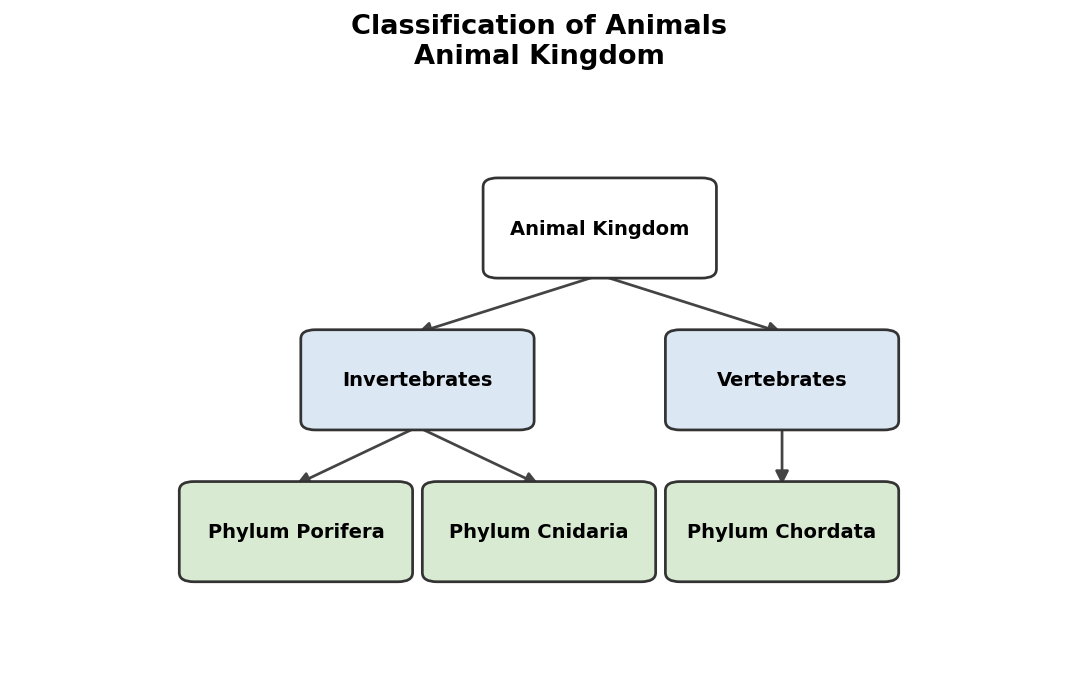
Based on the given diagram of the classification of animals, answer the following:
Which group does Phylum Cnidaria belong to?
AInvertebrates
BVertebrates
CMammals
DReptiles
Name one characteristic feature of Invertebrates.
Show answersHide answers
1. Option 1 — Invertebrates
2. Lack of a backbone
Q572 Marks
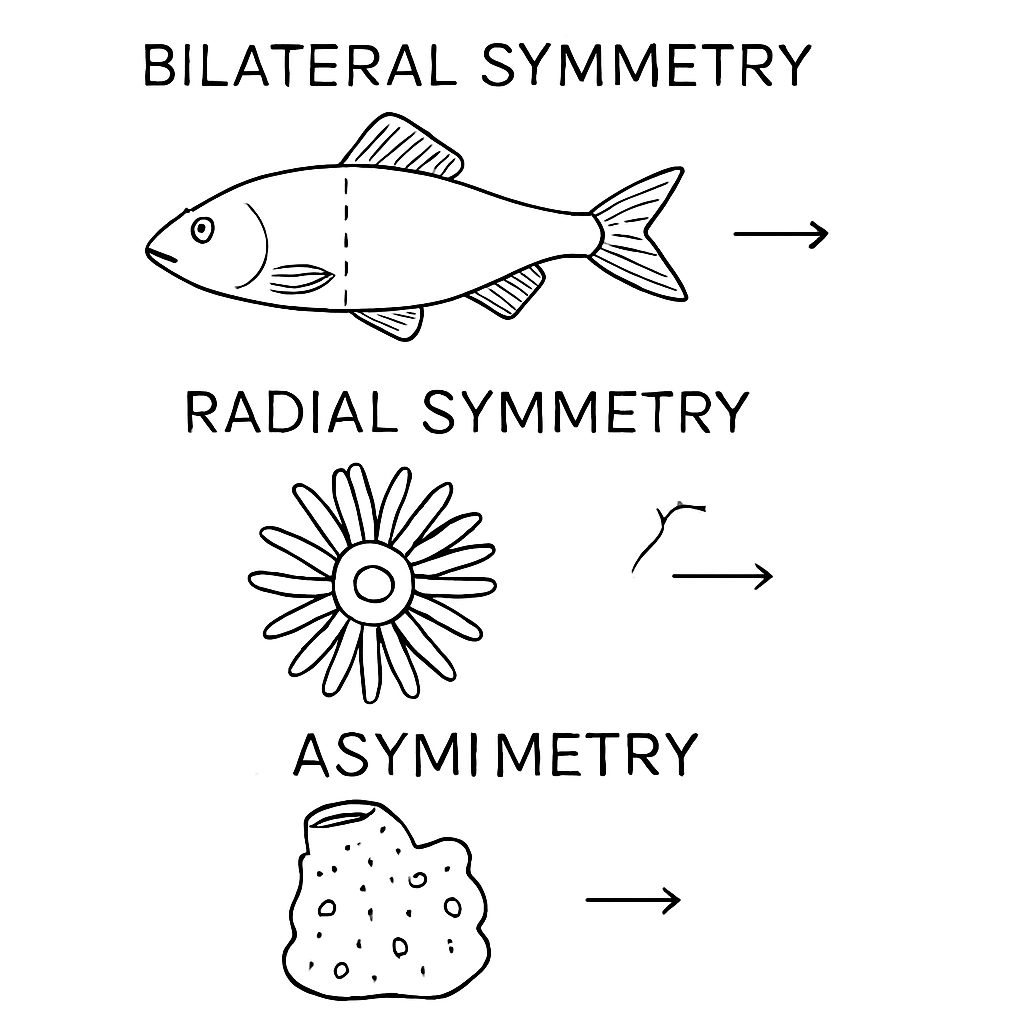
Based on the given diagram of body symmetry in animals, answer the following:
What type of symmetry does a butterfly exhibit?
ARadial Symmetry
BBilateral Symmetry
CAsymmetrical
DNone of the above
Define radial symmetry.
Show answersHide answers
1. Option 2 — Bilateral Symmetry
2. Body parts arranged around a central axis.
Q582 Marks
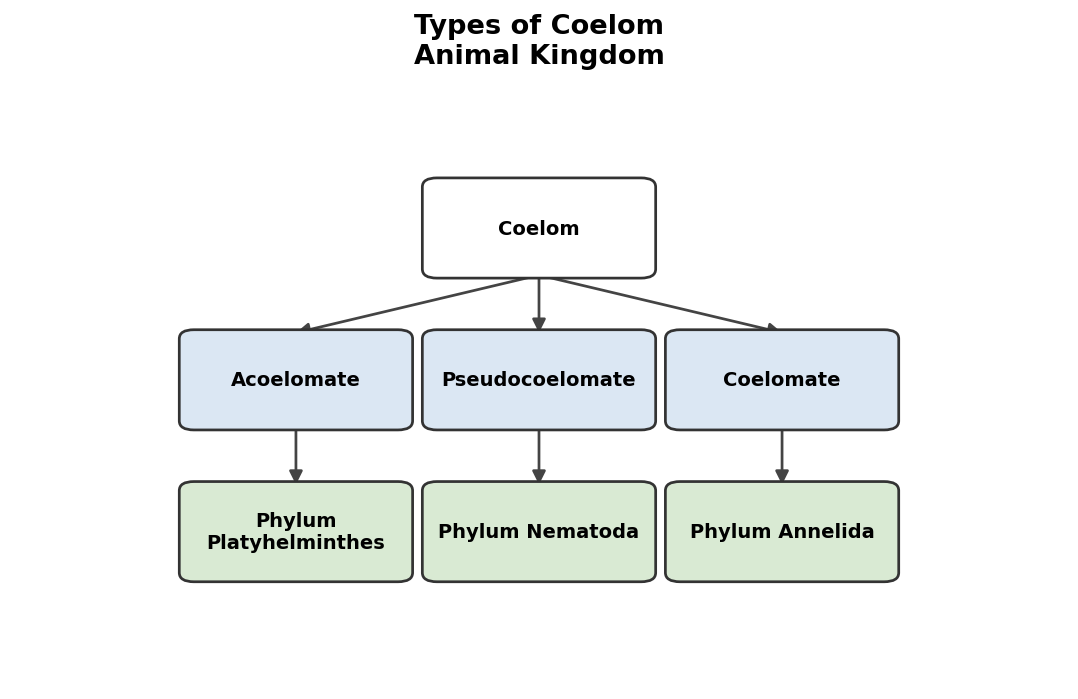
Based on the given diagram of coelom types, answer the following:
Which phylum is an example of acoelomate?
APhylum Annelida
BPhylum Nematoda
CPhylum Platyhelminthes
DPhylum Mollusca
What is a pseudocoelomate?
Show answersHide answers
1. Option 3 — Phylum Platyhelminthes
2. An organism with a body cavity not completely lined by mesoderm.
Q592 Marks
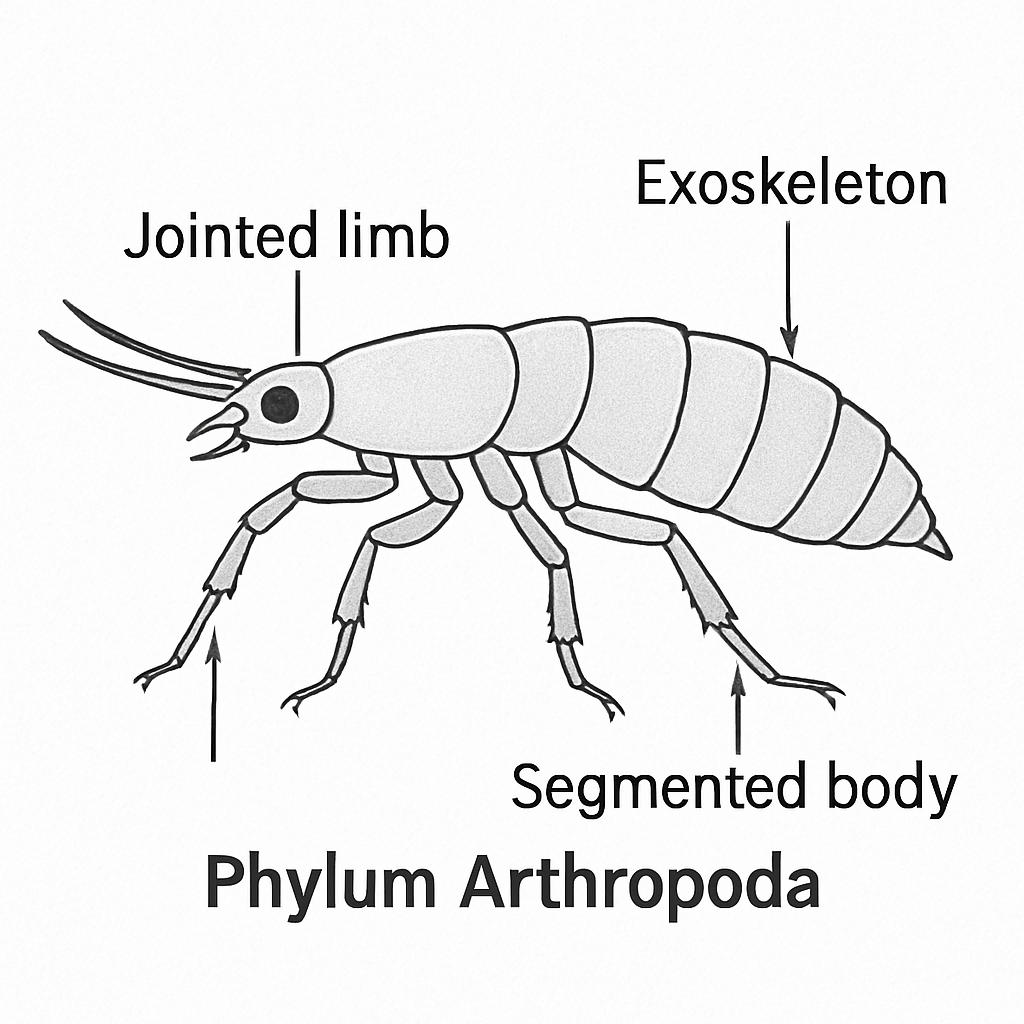
Based on the given diagram of the phylum Arthropoda, answer the following:
What is a key feature of Phylum Arthropoda?
ANotochord
BExoskeleton
CRadial Symmetry
DTriploblastic
List one example of an organism from Phylum Arthropoda.