SUMMARY: This chapter explores the composition and functions of body fluids and the mechanisms of circulation in humans and other animals. KEY TOPICS: blood composition, blood groups, coagulation of blood, lymph, human circulatory system, structure of heart, cardiac cycle, ECG, double circulation, regulation of cardiac activity, disorders of circulatory system
Describe the structure of human heart with a labelled diagram.
Q276 Marks
Explain the cardiac cycle and the conduction system of the heart.
Q286 Marks
Discuss the composition and functions of blood.
Q296 Marks
Explain the lymphatic system and its functions.
Q306 Marks
Describe disorders of the circulatory system: hypertension, coronary artery disease, and heart failure.
Q316 Marks
Describe the structure of human heart with a labelled diagram.
Assertion–Reason Questions8 questions
Q321 Mark
Assertion (A): Mammals have a four-chambered heart.
Reason (R): Four chambers prevent mixing of oxygenated and deoxygenated blood.
Show explanationHide explanation
Correct answer: Option 1 —
Both A and R are true, and R is the correct explanation of A.
Q331 Mark
Assertion (A): Lymph is a clear fluid that drains into blood.
Reason (R): It contains lymphocytes and absorbed fats.
Show explanationHide explanation
Correct answer: Option 1 —
Both A and R are true, and R is the correct explanation of A.
Q341 Mark
Assertion (A): Blood is a connective tissue.
Reason (R): It has a fluid matrix called plasma.
Show explanationHide explanation
Correct answer: Option 1 —
Both A and R are true, and R is the correct explanation of A.
Q351 Mark
Assertion (A): The SA node initiates the heart beat.
Reason (R): It generates electrical impulses spontaneously.
Show explanationHide explanation
Correct answer: Option 1 —
Both A and R are true, and R is the correct explanation of A.
Q361 Mark
Assertion (A): An ECG records electrical activity of the heart.
Reason (R): It is used to diagnose heart abnormalities.
Show explanationHide explanation
Correct answer: Option 1 —
Both A and R are true, and R is the correct explanation of A.
Q371 Mark
Assertion (A): Mammals have a four-chambered heart.
Reason (R): Four chambers prevent mixing of oxygenated and deoxygenated blood.
Show explanationHide explanation
Correct answer: Option 1 —
Both A and R are true, and R is the correct explanation of A.
Q381 Mark
Assertion (A): Lymph is a clear fluid that drains into blood.
Reason (R): It contains lymphocytes and absorbed fats.
Show explanationHide explanation
Correct answer: Option 1 —
Both A and R are true, and R is the correct explanation of A.
Q391 Mark
Assertion (A): Blood is a connective tissue.
Reason (R): It has a fluid matrix called plasma.
Show explanationHide explanation
Correct answer: Option 1 —
Both A and R are true, and R is the correct explanation of A.
Statement-Based Questions8 questions
Q401 Mark
Statement 1: Statement I: Plasma is the liquid component of blood.
Statement 2: Statement II: It contains 90-92% water and 6-8% proteins.
Show answerHide answer
Correct answer: Option 1 —
Both statements are true.
Q411 Mark
Statement 1: Statement I: Erythrocytes lack a nucleus in mammals.
Statement 2: Statement II: This increases the surface area for oxygen transport.
Show answerHide answer
Correct answer: Option 1 —
Both statements are true.
Q421 Mark
Statement 1: Statement I: Platelets help in blood clotting.
Statement 2: Statement II: They release factors that initiate the clotting cascade.
Show answerHide answer
Correct answer: Option 1 —
Both statements are true.
Q431 Mark
Statement 1: Statement I: Diastole is the relaxation phase of the heart.
Statement 2: Statement II: Systole is the contraction phase.
Show answerHide answer
Correct answer: Option 1 —
Both statements are true.
Q441 Mark
Statement 1: Statement I: Rh factor is an antigen on RBCs.
Statement 2: Statement II: A Rh negative mother carrying a Rh positive baby may face complications.
Show answerHide answer
Correct answer: Option 1 —
Both statements are true.
Q451 Mark
Statement 1: Plasma is the liquid component of blood.
Statement 2: It contains 90-92% water and 6-8% proteins.
Show answerHide answer
Correct answer: Option 1 —
Both statements are true.
Q461 Mark
Statement 1: Erythrocytes lack a nucleus in mammals.
Statement 2: This increases the surface area for oxygen transport.
Show answerHide answer
Correct answer: Option 1 —
Both statements are true.
Q471 Mark
Statement 1: Platelets help in blood clotting.
Statement 2: They release factors that initiate the clotting cascade.
Show answerHide answer
Correct answer: Option 1 —
Both statements are true.
Case Study / Passage Questions4 questions
Q483 Marks
A 55-year-old man is rushed to the emergency room with severe chest pain radiating to his left arm. An ECG reveals ST-elevation. The cardiologist diagnoses a myocardial infarction caused by a blocked coronary artery and the patient is given thrombolytic drugs and undergoes coronary angioplasty.
The vessels that supply the heart muscle are the:
AAorta
BPulmonary artery
CCoronary artery
DVena cava
Electrical activity of the heart is recorded by:
AEEG
BECG
CEMG
DEOG
Explain the cause, ECG changes and emergency treatment of myocardial infarction.
Show answersHide answers
1. Option 3 — Coronary artery
2. Option 2 — ECG
3. A myocardial infarction (heart attack) occurs when blood supply to part of the heart muscle is blocked usually by atherosclerotic plaque rupture in a coronary artery. The deprived heart muscle dies releasing markers like troponin into the blood. ECG shows ST-segment elevation. Treatment includes thrombolytic agents to dissolve the clot and angioplasty to reopen the artery. Risk factors include smoking, hypertension, diabetes and high cholesterol.
Q493 Marks
A trauma patient with blood group O Rh-negative needs an emergency transfusion. The hospital blood bank checks compatibility and decides which donor blood is safe. They explain to the relatives why O Rh-negative is called the universal donor and AB Rh-positive the universal recipient.
The universal donor blood group is:
AA
BB
CAB
DO
The universal recipient blood group is:
AA
BB
CAB
DO
Explain why O Rh-negative is the universal donor and AB Rh-positive is the universal recipient.
Show answersHide answers
1. Option 4 — O
2. Option 3 — AB
3. Blood group O has neither A nor B antigens on its RBCs so transfused O blood will not be attacked by anti-A or anti-B antibodies in the recipient. AB blood lacks both antibodies in plasma so it can receive any blood without an antibody reaction. The Rh factor adds another layer — Rh-negative individuals develop anti-Rh antibodies on exposure so Rh-negative blood is considered safer for emergency transfusion.
Q503 Marks
Blood is a vital fluid in the human body, composed of various components including red blood cells, white blood cells, platelets, and plasma. Red blood cells are responsible for transporting oxygen from the lungs to the body's tissues and returning carbon dioxide to be exhaled. White blood cells play a crucial role in the immune system, protecting the body against infections. Platelets are essential for blood clotting, preventing excessive bleeding when injuries occur. Plasma, the liquid portion of blood, contains water, electrolytes, nutrients, hormones, and waste products. Understanding the composition of blood is essential for diagnosing and treating various medical conditions.
What is the primary function of red blood cells?
ATransporting nutrients
BTransporting oxygen
CFighting infections
DClotting blood
Explain the role of platelets in the circulatory system.
Which component of blood is primarily responsible for immune response?
APlasma
BRed blood cells
CWhite blood cells
DPlatelets
Show answersHide answers
1. Option 2 — Transporting oxygen
2. Platelets are essential for blood clotting, helping to prevent excessive bleeding when injuries occur.
3. Option 3 — White blood cells
Q513 Marks
The human circulatory system is a complex network that includes the heart, blood vessels, and blood. The heart, a muscular organ, pumps blood throughout the body, ensuring that oxygen and nutrients reach every cell. The circulatory system operates on a double circulation mechanism, consisting of the pulmonary circuit, which carries deoxygenated blood to the lungs for oxygenation, and the systemic circuit, which delivers oxygenated blood to the rest of the body. The cardiac cycle describes the sequence of events that occur during one heartbeat, including the contraction and relaxation of the heart chambers. Understanding this system is crucial for recognizing cardiovascular health and disorders.
What are the two circuits involved in double circulation?
APulmonary and systemic
BOxygenated and deoxygenated
CArterial and venous
DCoronary and systemic
Describe the cardiac cycle.
What is the primary function of the heart in the circulatory system?
AFiltering blood
BPumping blood
CProducing hormones
DTransporting nutrients
Show answersHide answers
1. Option 1 — Pulmonary and systemic
2. The cardiac cycle describes the sequence of events that occur during one heartbeat, including the contraction and relaxation of the heart chambers.
3. Option 2 — Pumping blood
Table-Based Questions4 questions
Q523 Marks
Study the table on ABO blood group system and answer:
Blood group
Antigen on RBC
Antibody in plasma
Can donate to
Can receive from
A
A
anti-B
A, AB
A, O
B
B
anti-A
B, AB
B, O
AB
A and B
None
AB
All
O
None
anti-A and anti-B
All
O
The blood group with both antigens but no antibodies is:
AA
BB
CAB
DO
A patient with blood group A can safely receive blood from groups:
AA
BB
CAB
DO
Explain the inheritance and clinical importance of the ABO blood group system.
Show answersHide answers
1. Option 3 — AB
2. Option 1 — A
3. The ABO blood group system is determined by the presence of A and B antigens on the surface of RBCs. The corresponding antibodies are present in the plasma against the antigens absent on RBCs. Mismatched transfusion causes agglutination and haemolysis. Safe transfusion requires that the donor's RBC antigens are not attacked by the recipient's plasma antibodies.
Q536 Marks
Identify the antigen on RBCs and antibody in plasma for each ABO blood group.
Blood group
Antigen on RBC
Antibody in plasma
A
?
?
B
?
?
AB
?
?
O
?
?
Q546 Marks
What is the average percentage of plasma proteins in human blood based on the following data?
Component
Percentage
Albumin
55
Globulins
38
Fibrinogen
7
Q553 Marks
Study the following data and answer the questions below:
Blood Group
Antigen on RBC
Antibody in Plasma
A
A
Anti-B
B
B
Anti-A
AB
A and B
None
O
None
Anti-A and Anti-B
Which blood group has no antigens on RBC?
What antibodies are present in blood group A?
Identify the blood group that can receive blood from all other groups.
Show answersHide answers
1.
2.
3.
Picture-Based Questions1 question
Q564 Marks
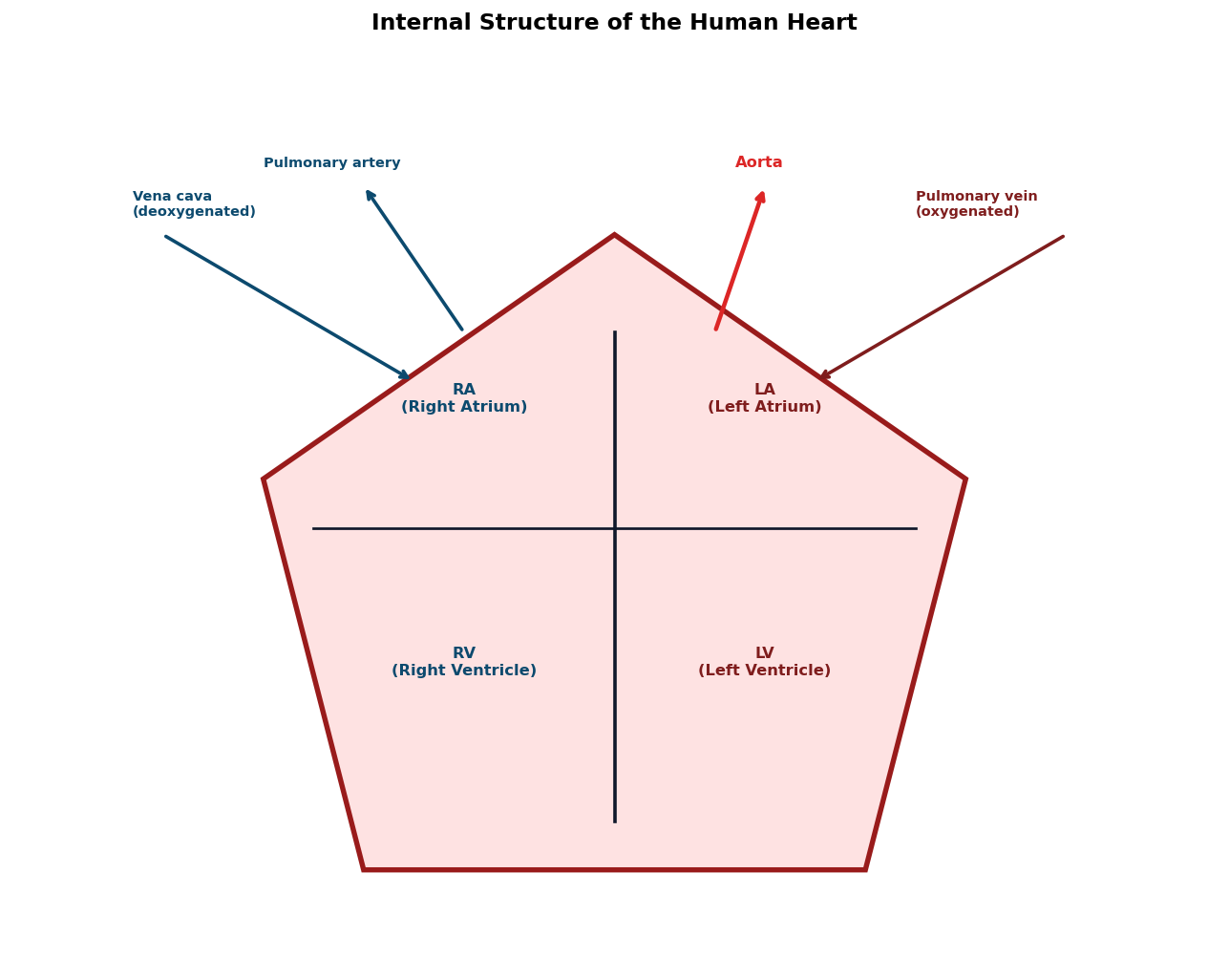
Study the schematic of the human heart and answer:
The number of chambers in the human heart is:
A2
B3
C4
D5
Oxygenated blood is carried from the lungs to the heart by the:
AAorta
BPulmonary artery
CVena cava
DPulmonary vein
Describe the structure of the human heart and trace the flow of blood through it.
Show answersHide answers
1. Option 3 — 4
2. Option 4 — Pulmonary vein
3. The human heart is a four-chambered organ. Deoxygenated blood enters the right atrium via the vena cava goes to the right ventricle and is pumped to the lungs through the pulmonary artery. Oxygenated blood enters the left atrium via the pulmonary vein goes to the left ventricle and is pumped to the body through the aorta.