SUMMARY: The chapter "Biological Classification" in Class 11 Biology discusses the systematic categorization of living organisms into groups based on their similarities and differences. KEY TOPICS: Five Kingdom Classification, Monera, Protista, Fungi, Plantae, Animalia, Viruses, Viroids, Lichens, Criteria for Classification
Which of the following organisms is classified under the kingdom Animalia?
AMushroom
BEuglena
CParamecium
DLion
Check answerHide answer
Correct answer: Option 4 — Lion
Q111 Mark
Lichens are a symbiotic association between which two organisms?
AFungi and bacteria
BAlgae and fungi
CPlants and fungi
DBacteria and viruses
Check answerHide answer
Correct answer: Option 2 — Algae and fungi
Q121 Mark
Which of the following is a characteristic feature of the kingdom Plantae?
AHeterotrophic nutrition
BPresence of chloroplasts
CUnicellular organization
DAbsence of cell walls
Check answerHide answer
Correct answer: Option 2 — Presence of chloroplasts
Q131 Mark
The classification of organisms into five kingdoms is based on which of the following criteria?
AHabitat
BCell structure
CReproductive methods
DSize and shape
Check answerHide answer
Correct answer: Option 2 — Cell structure
Q141 Mark
Which of the following is a characteristic of the kingdom Monera?
AMulticellular organisms
BEukaryotic cells
CProkaryotic cells
DPhotosynthetic only
Check answerHide answer
Correct answer: Option 3 — Prokaryotic cells
Q151 Mark
Which of the following groups is known for having no defined nucleus?
AFungi
BProtista
CMonera
DPlantae
Check answerHide answer
Correct answer: Option 3 — Monera
Short Answer Questions10 questions
Q163 Marks
Differentiate between archaebacteria and eubacteria.
Q173 Marks
What are the salient features of Kingdom Protista?
Q183 Marks
Distinguish between viruses, viroids, and prions.
Q193 Marks
Why are lichens considered good indicators of pollution?
Q203 Marks
Mention any three economic importance of fungi.
Q213 Marks
What are the main characteristics of the kingdom Monera?
View sample solutionHide solution
The kingdom Monera consists of prokaryotic organisms, which lack a defined nucleus and membrane-bound organelles. They are unicellular and can be autotrophic or heterotrophic, including bacteria and cyanobacteria.
Q223 Marks
Explain the role of cyanobacteria in the ecosystem.
View sample solutionHide solution
Cyanobacteria, also known as blue-green algae, play a crucial role in the ecosystem by performing photosynthesis, thus producing oxygen and serving as a primary producer in aquatic environments. They also contribute to nitrogen fixation, enriching soil fertility.
Q233 Marks
What are the distinguishing features of fungi compared to plants?
View sample solutionHide solution
Fungi are heterotrophic organisms that absorb nutrients from their surroundings, whereas plants are autotrophic and produce their own food through photosynthesis. Additionally, fungi have cell walls made of chitin, while plants have cell walls made of cellulose.
Q243 Marks
Describe the significance of viruses in biological classification.
View sample solutionHide solution
Viruses are significant in biological classification as they exhibit characteristics of both living and non-living entities. They cannot reproduce independently and require a host cell for replication, leading to debates about their classification in the biological hierarchy.
Q253 Marks
What criteria are used for the classification of living organisms?
View sample solutionHide solution
The classification of living organisms is based on several criteria, including morphological, anatomical, physiological, and genetic characteristics. These criteria help in grouping organisms that share similar traits and evolutionary histories.
Long Answer Questions6 questions
Q266 Marks
Explain the five-kingdom classification proposed by Whittaker. Mention the basis of classification.
Q276 Marks
Describe the four classes of fungi with examples and their distinguishing features.
Q286 Marks
Discuss the salient features and economic importance of Kingdom Monera.
Q296 Marks
Explain the structure and reproduction of viruses with a diagram.
Q306 Marks
Compare and contrast the major groups of Protista with examples.
Q316 Marks
Compare archaebacteria and eubacteria with the help of a table.
Assertion–Reason Questions8 questions
Q321 Mark
Assertion (A): Mycoplasma can survive without oxygen.
Reason (R): Mycoplasma lack a cell wall and are the smallest known living cells.
Show explanationHide explanation
Correct answer: Option 1 —
Both A and R are true, and R is the correct explanation of A.
Q331 Mark
Assertion (A): Lichens are good pollution indicators.
Reason (R): They cannot grow in polluted areas due to their sensitivity to SO2.
Show explanationHide explanation
Correct answer: Option 1 —
Both A and R are true, and R is the correct explanation of A.
Q341 Mark
Assertion (A): Bacteria are placed in Kingdom Monera.
Reason (R): They are prokaryotic organisms with no true nucleus.
Show explanationHide explanation
Correct answer: Option 1 —
Both A and R are true, and R is the correct explanation of A.
Q351 Mark
Assertion (A): Viruses are obligate parasites.
Reason (R): They reproduce only inside a host cell.
Show explanationHide explanation
Correct answer: Option 1 —
Both A and R are true, and R is the correct explanation of A.
Q361 Mark
Assertion (A): Slime moulds are placed under Protista.
Reason (R): Their body forms an aggregation called plasmodium.
Show explanationHide explanation
Correct answer: Option 1 —
Both A and R are true, and R is the correct explanation of A.
Q371 Mark
Assertion (A): Fungi are classified under the kingdom Fungi due to their heterotrophic mode of nutrition.
Reason (R): Fungi absorb nutrients from their surroundings through external digestion.
Show explanationHide explanation
Correct answer: Option 1 —
Both A and R are true, and R is the correct explanation of A.
Q381 Mark
Assertion (A): All members of the kingdom Plantae are autotrophic.
Reason (R): Some plants, like parasitic plants, do not perform photosynthesis.
Show explanationHide explanation
Correct answer: Option 3 —
A is true, but R is false.
Q391 Mark
Assertion (A): Viruses are considered living organisms.
Reason (R): Viruses can reproduce independently in a suitable host.
Show explanationHide explanation
Correct answer: Option 4 —
A is false, but R is true.
Statement-Based Questions8 questions
Q401 Mark
Statement 1: Archaebacteria differ from other bacteria in cell wall structure.
Statement 2: They live in extreme habitats like hot springs and salty areas.
Show answerHide answer
Correct answer: Option 1 —
Both statements are true.
Q411 Mark
Statement 1: Fungi are heterotrophic organisms.
Statement 2: They can be saprophytes, parasites, or symbionts.
Show answerHide answer
Correct answer: Option 1 —
Both statements are true.
Q421 Mark
Statement 1: Viruses contain either DNA or RNA.
Statement 2: Viruses are crystalline outside the host cell.
Show answerHide answer
Correct answer: Option 1 —
Both statements are true.
Q431 Mark
Statement 1: Diatoms have indestructible cell walls.
Statement 2: Their walls are made of silica which forms diatomaceous earth.
Show answerHide answer
Correct answer: Option 1 —
Both statements are true.
Q441 Mark
Statement 1: Lichens are symbiotic associations of algae and fungi.
Statement 2: The algal partner is called mycobiont.
Show answerHide answer
Correct answer: Option 1 —
Both statements are true.
Q451 Mark
Statement 1: Monera includes both prokaryotic and eukaryotic organisms.
Statement 2: All members of the kingdom Protista are unicellular.
Show answerHide answer
Correct answer: Option 3 —
Only Statement 2 is true.
Q461 Mark
Statement 1: Fungi reproduce only sexually.
Statement 2: Plantae are autotrophic organisms.
Show answerHide answer
Correct answer: Option 2 —
Only Statement 1 is true.
Q471 Mark
Statement 1: Viruses can replicate independently outside a host cell.
Statement 2: Viroids are infectious agents that consist solely of RNA.
Show answerHide answer
Correct answer: Option 3 —
Only Statement 2 is true.
Case Study / Passage Questions4 questions
Q483 Marks
A student collects pond water and observes it under a microscope. She finds rod-shaped bacteria, single-celled algae such as Chlamydomonas, an amoeba and a few bread mould threads contaminating one slide. The teacher asks her to assign each organism to its kingdom in the five-kingdom classification.
The rod-shaped bacteria belong to:
AMonera
BProtista
CFungi
DPlantae
Chlamydomonas is placed in:
APlantae
BProtista
CFungi
DAnimalia
Justify the placement of bread mould in the kingdom Fungi.
Show answersHide answers
1. Option 1 — Monera
2. Option 2 — Protista
3. Whittaker's five-kingdom classification groups organisms based on cell structure (prokaryotic or eukaryotic), body organisation (unicellular or multicellular) and mode of nutrition. Bacteria are placed in Monera (prokaryotic). Single-celled eukaryotes like Chlamydomonas and amoeba are in Protista. Bread mould is a fungus placed in Fungi.
Q493 Marks
A team of ecologists surveys lichens growing on tree trunks in two cities — one industrial and one rural. They find a rich growth of crustose and foliose lichens in the rural area but almost no lichens in the industrial city. The team concludes that air pollution is responsible for the difference.
Lichens are a symbiotic association of:
AAlgae and bacteria
BAlgae and fungi
CBacteria and fungi
DTwo algae
Lichens are particularly sensitive to which atmospheric pollutant?
AO3
BSO2
CN2
DO2
Explain why lichens make excellent biological indicators of air pollution.
Show answersHide answers
1. Option 2 — Algae and fungi
2. Option 2 — SO2
3. Lichens are mutualistic associations of a fungus (mycobiont) and an alga or cyanobacterium (phycobiont). They absorb water and minerals directly from the atmosphere so they are very sensitive to gaseous pollutants like sulphur dioxide. Their absence in industrial areas is therefore used as a biological indicator of pollution.
Q503 Marks
The Five Kingdom Classification system categorizes living organisms into five distinct groups: Monera, Protista, Fungi, Plantae, and Animalia. Monera includes prokaryotic organisms such as bacteria, which lack a defined nucleus. Protista consists of eukaryotic microorganisms, including algae and protozoa. Fungi are primarily decomposers, characterized by their cell walls made of chitin. Plantae encompasses multicellular organisms that perform photosynthesis, while Animalia includes multicellular organisms that are heterotrophic. This classification helps in understanding the evolutionary relationships and ecological roles of different organisms.
Which kingdom includes prokaryotic organisms?
AFungi
BMonera
CPlantae
DAnimalia
What is the primary characteristic of Fungi?
Which kingdom includes organisms that perform photosynthesis?
AMonera
BAnimalia
CPlantae
DFungi
Show answersHide answers
1. Option 2 — Monera
2. Fungi are primarily decomposers and have cell walls made of chitin.
3. Option 3 — Plantae
Q513 Marks
Viruses and viroids are unique entities that challenge traditional biological classification. Viruses are acellular and consist of genetic material surrounded by a protein coat. They cannot reproduce independently and require a host cell for replication. Viroids, on the other hand, are even simpler, consisting solely of a short strand of RNA without a protein coat. Both viruses and viroids are known to cause diseases in plants and animals, leading to significant impacts on agriculture and health. Their classification remains a topic of debate among scientists.
What is the main difference between viruses and viroids?
AViruses have RNA, viroids do not.
BViruses have a protein coat, viroids do not.
CViroids can reproduce independently, viruses cannot.
DBoth are cellular organisms.
Explain the role of viruses in biological classification.
What type of diseases do viruses and viroids cause?
Show answersHide answers
1. Option 2 — Viruses have a protein coat, viroids do not.
2. Viruses challenge traditional classification as they are acellular and require a host for replication.
3. They cause diseases in plants and animals.
Table-Based Questions4 questions
Q523 Marks
Study the table comparing the five kingdoms and answer the questions:
Kingdom
Cell type
Body
Nutrition
Monera
Prokaryote
Unicellular
Auto/Heterotroph
Protista
Eukaryote
Unicellular
Auto/Heterotroph
Fungi
Eukaryote
Multicellular
Heterotroph (saprotrophic)
Plantae
Eukaryote
Multicellular
Autotroph
Animalia
Eukaryote
Multicellular
Heterotroph (holozoic)
The only kingdom of prokaryotes is:
AMonera
BProtista
CFungi
DPlantae
Multicellular autotrophs are placed in:
APlantae
BAnimalia
CFungi
DProtista
Compare Plantae and Fungi based on body organisation and mode of nutrition.
Show answersHide answers
1. Option 1 — Monera
2. Option 1 — Plantae
3. Whittaker used the criteria of cell structure, body complexity, mode of nutrition and reproduction to separate the five kingdoms. Monera contains all prokaryotes. Protista holds eukaryotic unicellular organisms. Fungi are heterotrophic decomposers. Plants are multicellular autotrophs and animals are multicellular heterotrophs that ingest food.
Q536 Marks
Identify the kingdom for each organism and state the basis of classification.
Organism
Kingdom?
Bacteria
?
Amoeba
?
Mushroom
?
Mango
?
Tiger
?
Q546 Marks
Which kingdom includes organisms that are unicellular and prokaryotic?
Kingdom
Cell Type
Examples
Monera
Unicellular, Prokaryotic
Bacteria, Cyanobacteria
Fungi
Multicellular, Eukaryotic
Mushrooms, Yeast
Q553 Marks
Study the following data and answer the questions below:
Kingdom
Characteristics
Examples
Protista
Eukaryotic, mostly unicellular
Amoeba, Paramecium
Fungi
Eukaryotic, multicellular, heterotrophic
Mushrooms, Molds
Plantae
Eukaryotic, multicellular, autotrophic
Mosses, Ferns
What type of organisms does the kingdom Protista primarily consist of?
Which kingdom is characterized by heterotrophic nutrition?
List one example of a multicellular organism from the kingdom Plantae.
Show answersHide answers
1.
2.
3.
Picture-Based Questions4 questions
Q563 Marks
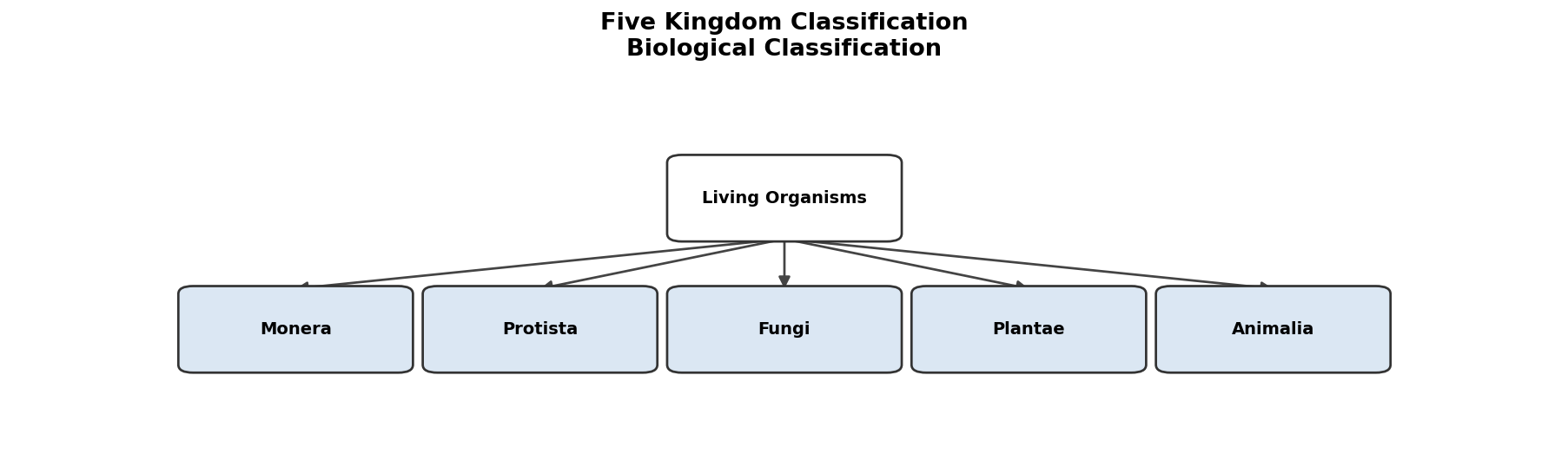
Based on the given flowchart of the Five Kingdom Classification, answer the following:
How many kingdoms are represented in the flowchart?
A3
B4
C5
D6
Name one kingdom that includes unicellular organisms.
Which kingdom is primarily made up of multicellular organisms?
AFungi
BMonera
CProtista
DAnimalia
Show answersHide answers
1. Option 3 — 5
2. Monera
3. Option 4 — Animalia
Q573 Marks
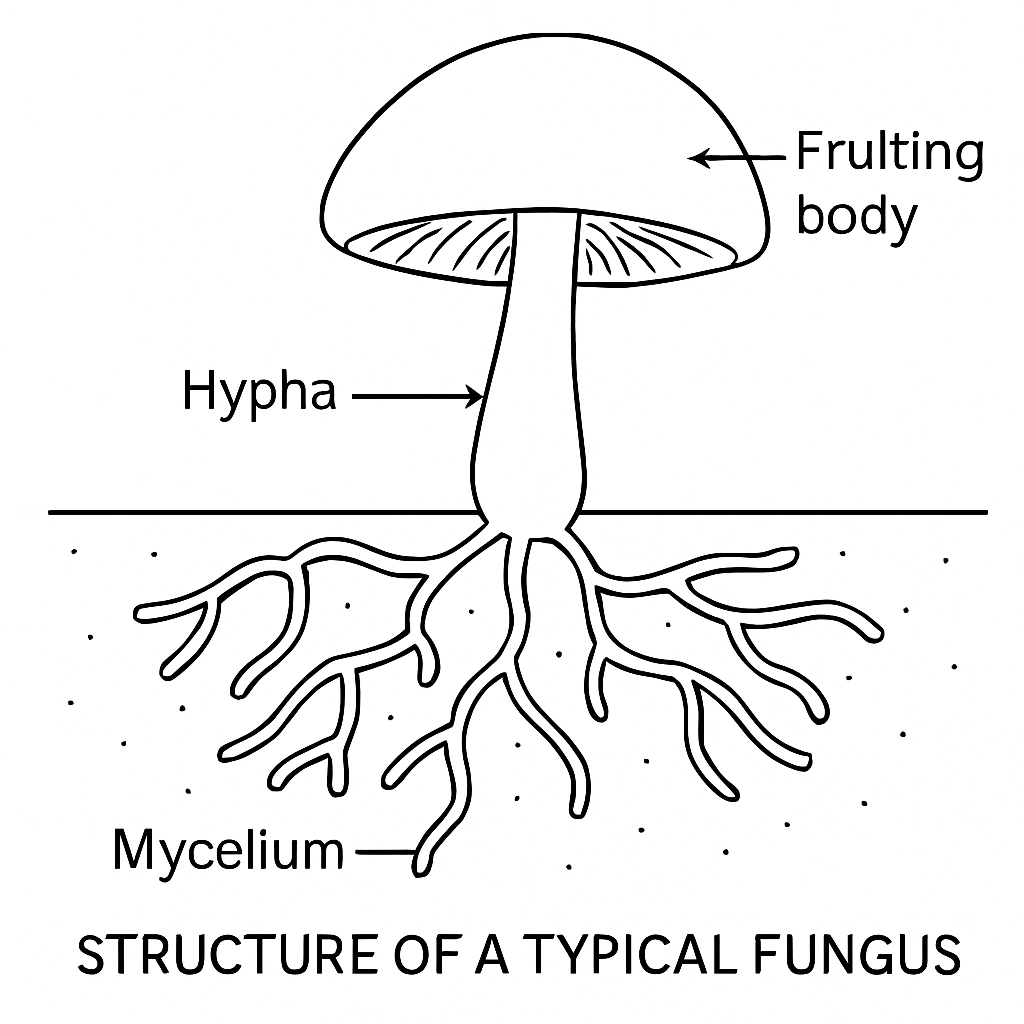
Based on the given diagram of Fungi, answer the following:
What is the main body structure of fungi called?
Which part of the fungus is responsible for reproduction?
AHyphae
BMycelium
CFruiting body
DSpores
Fungi are primarily classified as which type of organism?
AProkaryotic
BEukaryotic
CMulticellular only
DUnicellular only
Show answersHide answers
1. Mycelium
2. Option 3 — Fruiting body
3. Option 2 — Eukaryotic
Q583 Marks
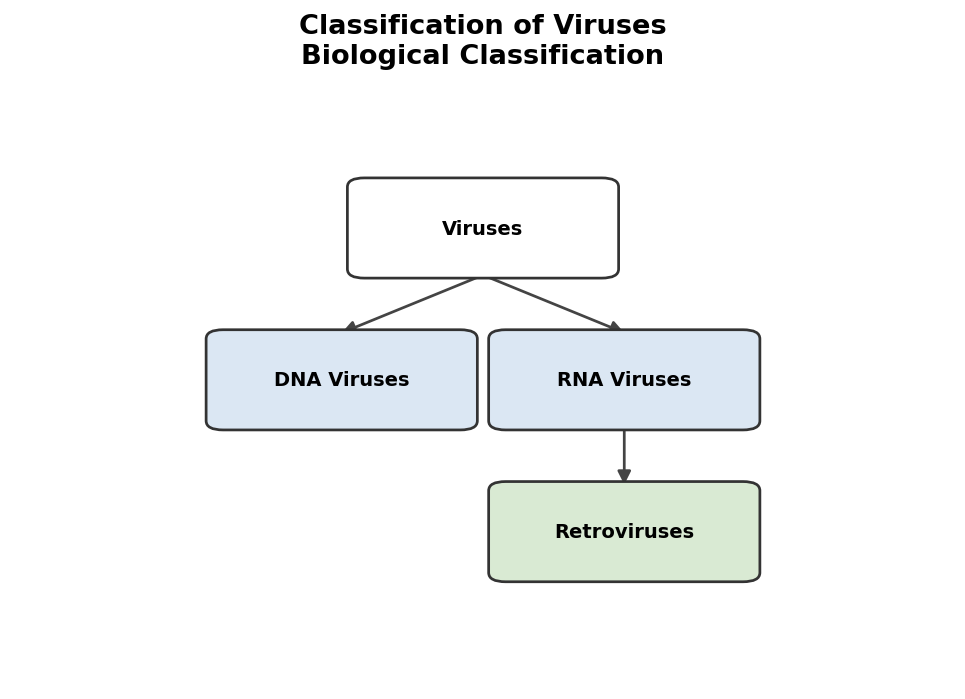
Based on the given flowchart of the classification of Viruses, answer the following:
What are the two main types of viruses classified in the flowchart?
ABacteria and Fungi
BDNA and RNA
CProkaryotic and Eukaryotic
DPlant and Animal
What type of virus is classified under RNA viruses?
ABacteriophage
BRetroviruses
CHerpesvirus
DAdenovirus
Name a characteristic feature of retroviruses.
Show answersHide answers
1. Option 2 — DNA and RNA
2. Option 2 — Retroviruses
3. They reverse transcribe RNA into DNA.
Q593 Marks
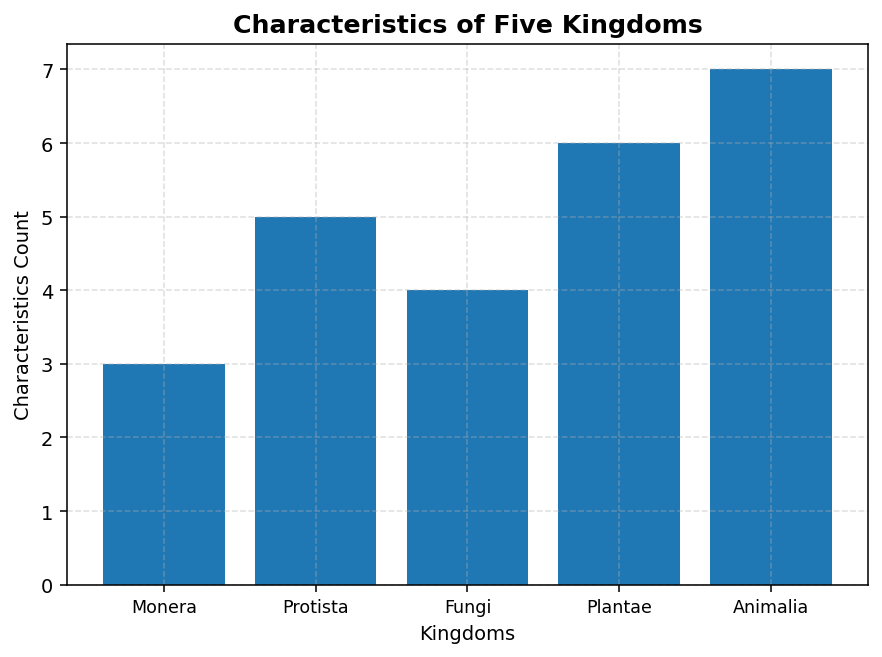
Based on the given chart of the characteristics of the kingdoms, answer the following:
Which kingdom has the highest number of characteristics?
AMonera
BFungi
CPlantae
DAnimalia
How many characteristics does the Protista kingdom have?
Which kingdom has fewer characteristics than Plantae but more than Fungi?