SUMMARY: This chapter provides an in-depth understanding of the cell as the fundamental unit of life, exploring its structure, types, and functions. KEY TOPICS: cell theory, prokaryotic cells, eukaryotic cells, cell membrane structure, cell organelles, nucleus, mitochondria, endoplasmic reticulum, Golgi apparatus, lysosomes.
Differentiate between prokaryotic and eukaryotic cells.
Q173 Marks
What is the structure of plasma membrane according to the fluid mosaic model?
Q183 Marks
Why are mitochondria called semi-autonomous organelles?
Q193 Marks
Describe the structure and function of the nucleus.
Q203 Marks
What are the functions of the Golgi apparatus?
Q213 Marks
What is the cell theory and who proposed it?
View sample solutionHide solution
The cell theory states that all living organisms are composed of cells, and that the cell is the basic unit of life. It was proposed by scientists Matthias Schleiden, Theodor Schwann, and Rudolf Virchow in the 19th century.
Q223 Marks
List the main differences between prokaryotic and eukaryotic cells in terms of genetic material.
View sample solutionHide solution
Prokaryotic cells have their genetic material in a single circular DNA molecule that is not enclosed in a nucleus, while eukaryotic cells have multiple linear DNA molecules contained within a membrane-bound nucleus.
Q233 Marks
What role do lysosomes play in a cell?
View sample solutionHide solution
Lysosomes are membrane-bound organelles that contain digestive enzymes. They are responsible for breaking down waste materials and cellular debris, thus playing a crucial role in cellular cleanup and recycling.
Q243 Marks
Explain the structure and function of the endoplasmic reticulum (ER).
View sample solutionHide solution
The endoplasmic reticulum (ER) is a network of membranous tubules and sacs. It is divided into rough ER, which has ribosomes for protein synthesis, and smooth ER, which is involved in lipid synthesis and detoxification processes.
Q253 Marks
What is the significance of the fluid mosaic model in understanding cell membranes?
View sample solutionHide solution
The fluid mosaic model describes the cell membrane as a flexible structure with various proteins embedded in or attached to a bilayer of phospholipids. This model highlights the dynamic nature of the membrane and its role in cell communication and transport.
Long Answer Questions6 questions
Q266 Marks
Describe the structure of mitochondria with a labelled diagram and mention its functions.
Q276 Marks
Compare and contrast the structure of plant and animal cells with diagrams.
Q286 Marks
Discuss the structure of chloroplast and explain its role in photosynthesis.
Q296 Marks
Describe the structure and function of the endoplasmic reticulum and Golgi apparatus.
Q306 Marks
Explain the cell theory and modern interpretation of it.
Q316 Marks
Differentiate between plant cell and animal cell in tabular form on at least five features.
Assertion–Reason Questions8 questions
Q321 Mark
Assertion (A): Lysosomes are called suicidal bags of the cell.
Reason (R): They contain hydrolytic enzymes that digest cell components.
Show explanationHide explanation
Correct answer: Option 1 —
Both A and R are true, and R is the correct explanation of A.
Q331 Mark
Assertion (A): Ribosomes are the site of protein synthesis.
Reason (R): They are made of ribosomal RNA and proteins.
Show explanationHide explanation
Correct answer: Option 1 —
Both A and R are true, and R is the correct explanation of A.
Q341 Mark
Assertion (A): Plant cells have a cell wall.
Reason (R): The cell wall is made of cellulose and gives shape to the cell.
Show explanationHide explanation
Correct answer: Option 1 —
Both A and R are true, and R is the correct explanation of A.
Q351 Mark
Assertion (A): Mitochondria have their own DNA.
Reason (R): They are believed to have evolved from free-living prokaryotes.
Show explanationHide explanation
Correct answer: Option 1 —
Both A and R are true, and R is the correct explanation of A.
Q361 Mark
Assertion (A): Centrosomes are found in animal cells.
Reason (R): They organise microtubules during cell division.
Show explanationHide explanation
Correct answer: Option 1 —
Both A and R are true, and R is the correct explanation of A.
Q371 Mark
Assertion (A): Cell theory states that all living organisms are composed of cells.
Reason (R): Cell theory was formulated by Schleiden and Schwann in the 19th century.
Show explanationHide explanation
Correct answer: Option 1 —
Both A and R are true, and R is the correct explanation of A.
Q381 Mark
Assertion (A): Prokaryotic cells lack a true nucleus.
Reason (R): Prokaryotic cells have their genetic material dispersed in the cytoplasm.
Show explanationHide explanation
Correct answer: Option 1 —
Both A and R are true, and R is the correct explanation of A.
Q391 Mark
Assertion (A): The cell membrane is selectively permeable.
Reason (R): The cell membrane allows certain substances to pass while blocking others.
Show explanationHide explanation
Correct answer: Option 1 —
Both A and R are true, and R is the correct explanation of A.
Statement-Based Questions8 questions
Q401 Mark
Statement 1: Cell wall is present in plant cells.
Statement 2: It provides structural support to the cell.
Show answerHide answer
Correct answer: Option 1 —
Both statements are true.
Q411 Mark
Statement 1: Endoplasmic reticulum is of two types: rough and smooth.
Statement 2: Rough ER has ribosomes attached to it.
Show answerHide answer
Correct answer: Option 1 —
Both statements are true.
Q421 Mark
Statement 1: Ribosomes are found both in prokaryotes and eukaryotes.
Statement 2: They are 70S in prokaryotes and 80S in eukaryotes.
Show answerHide answer
Correct answer: Option 1 —
Both statements are true.
Q431 Mark
Statement 1: Chloroplasts contain chlorophyll.
Statement 2: Chlorophyll captures light energy for photosynthesis.
Show answerHide answer
Correct answer: Option 1 —
Both statements are true.
Q441 Mark
Statement 1: The nucleolus is the site of ribosome synthesis.
Statement 2: It is a non-membrane bound structure inside the nucleus.
Show answerHide answer
Correct answer: Option 1 —
Both statements are true.
Q451 Mark
Statement 1: Prokaryotic cells lack a true nucleus.
Statement 2: Eukaryotic cells have membrane-bound organelles.
Show answerHide answer
Correct answer: Option 1 —
Both statements are true.
Q461 Mark
Statement 1: The cell membrane is selectively permeable.
Statement 2: The Golgi apparatus is involved in protein synthesis.
Show answerHide answer
Correct answer: Option 3 —
Only Statement 2 is true.
Q471 Mark
Statement 1: Mitochondria are known as the powerhouse of the cell.
Statement 2: Lysosomes are involved in energy production.
Show answerHide answer
Correct answer: Option 2 —
Only Statement 1 is true.
Case Study / Passage Questions2 questions
Q483 Marks
A student observes a leaf cell of Hydrilla under a microscope and sees small green discs streaming around the central vacuole. She identifies them as chloroplasts and prepares another slide of an animal cheek cell where chloroplasts are absent. She links this difference to the modes of nutrition of plants and animals.
Chloroplasts are typically present in:
APlant cell
BAnimal cell
CBoth
DNeither
The site of photosynthesis is the:
AMitochondria
BNucleus
CChloroplast
DLysosome
Describe the structure of a chloroplast and explain why it is called a semi-autonomous organelle.
Show answersHide answers
1. Option 1 — Plant cell
2. Option 3 — Chloroplast
3. Chloroplasts are double-membrane bound plastids containing chlorophyll. The inner membrane encloses the stroma where dark reactions occur. Inside the stroma are stacks of thylakoids called grana that house the photosystems for light reactions. Chloroplasts are semi-autonomous because they have their own DNA and ribosomes — supporting the endosymbiotic theory.
Q493 Marks
A student examines prepared slides of a bacterial cell, an Amoeba and a moss cell. She lists the structures present in each — the bacterium has a nucleoid but no nucleus while Amoeba and moss have membrane-bound nuclei. The moss cell additionally has a cell wall and chloroplasts.
Which of the cells observed is prokaryotic?
ABacterium
BAmoeba
CMoss cell
DAll three
A cell wall made of cellulose is found in:
ABacterium
BMoss cell
CAmoeba
DAll three
Differentiate between prokaryotic and eukaryotic cells with two examples each.
Show answersHide answers
1. Option 1 — Bacterium
2. Option 2 — Moss cell
3. Prokaryotic cells lack a true membrane-bound nucleus and other membrane-bound organelles. They have a single circular DNA in the nucleoid region. Eukaryotic cells have a true nucleus and various membrane-bound organelles such as mitochondria, ER, Golgi and lysosomes. Plant eukaryotes additionally have a cellulose cell wall and chloroplasts.
Table-Based Questions3 questions
Q503 Marks
Study the table comparing plant and animal cells and answer:
Feature
Plant cell
Animal cell
Cell wall
Present (cellulose)
Absent
Plastids
Present
Absent
Centrioles
Absent
Present
Vacuole
Large central
Small or absent
Lysosomes
Rare
Common
A structure unique to plant cells is the:
ACell wall
BMitochondria
CRibosome
DNucleus
Centrioles are characteristically present in:
ALysosome
BCentriole
CPlastid
DVacuole
Compare plant and animal cells with respect to four structural differences.
Show answersHide answers
1. Option 1 — Cell wall
2. Option 2 — Centriole
3. Plant and animal cells share most organelles but differ in some structural features. Plant cells have a rigid cellulose cell wall, plastids (including chloroplasts) and a large central vacuole. Animal cells lack these but possess centrioles which organise the spindle during cell division and have prominent lysosomes for intracellular digestion.
Q516 Marks
Match each cell organelle with its primary function.
Organelle
Function?
Nucleus
?
Mitochondrion
?
Chloroplast
?
Ribosome
?
Endoplasmic reticulum
?
Golgi body
?
Lysosome
?
Vacuole
?
Q526 Marks
Compare plant and animal cells with respect to the listed features.
Feature
Plant cell
Animal cell
Cell wall
?
?
Plastids
?
?
Centrioles
?
?
Vacuole
?
?
Lysosomes
?
?
Picture-Based Questions2 questions
Q534 Marks
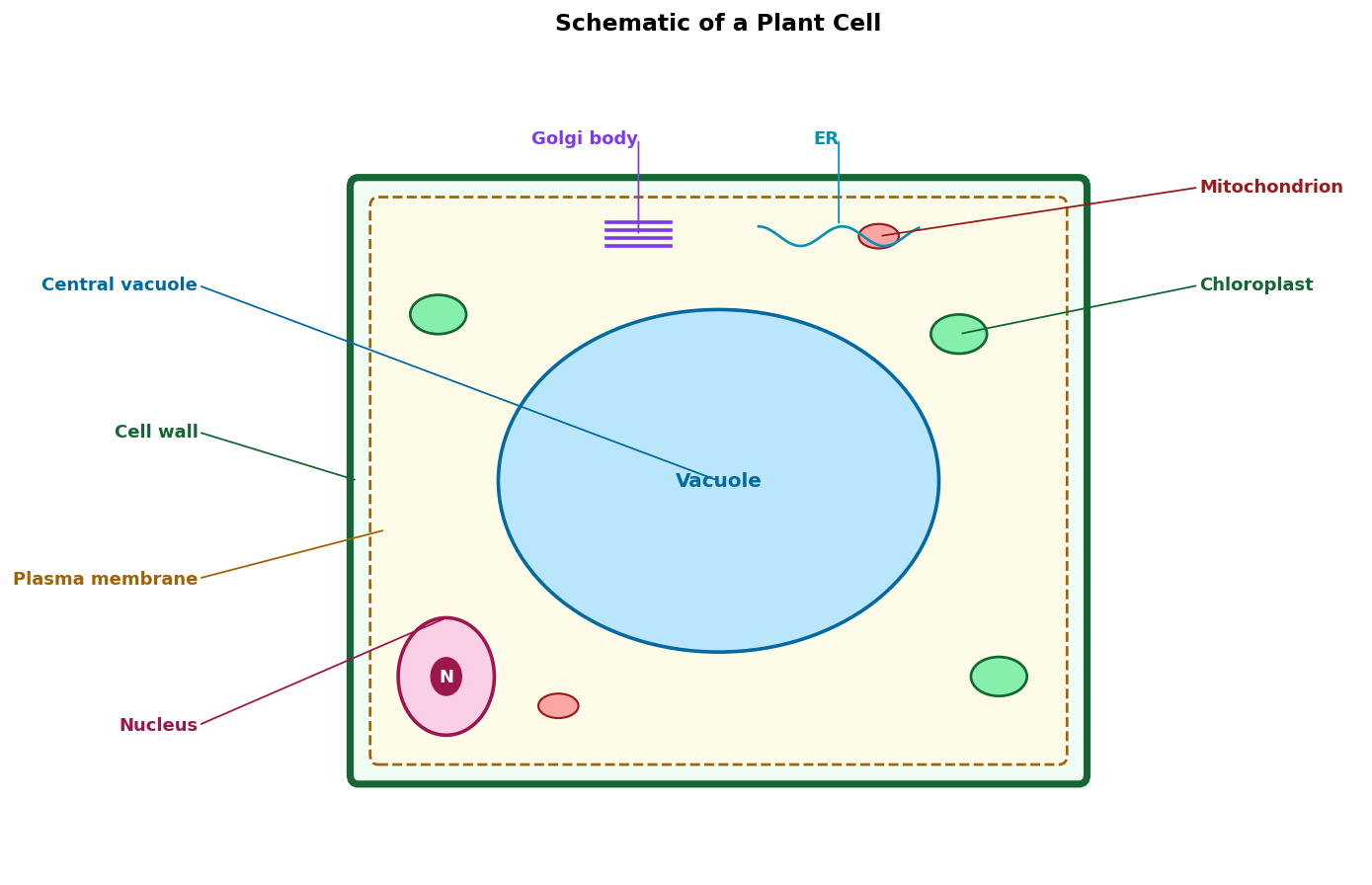
Study the labelled diagram of a plant cell and answer:
Which structure is present in the plant cell but ABSENT in an animal cell?
ACell wall
BCentriole
CLysosome
DCilia
The site of photosynthesis in the cell is the:
ANucleus
BChloroplast
CMitochondrion
DVacuole
Compare the structure of a plant cell with that of an animal cell.
Show answersHide answers
1. Option 1 — Cell wall
2. Option 2 — Chloroplast
3. A typical plant cell has a rigid cellulose cell wall. Inside are membrane-bound organelles including a true nucleus chloroplasts mitochondria endoplasmic reticulum Golgi body and a large central vacuole. Plant cells lack centrioles and prominent lysosomes.
Q544 Marks
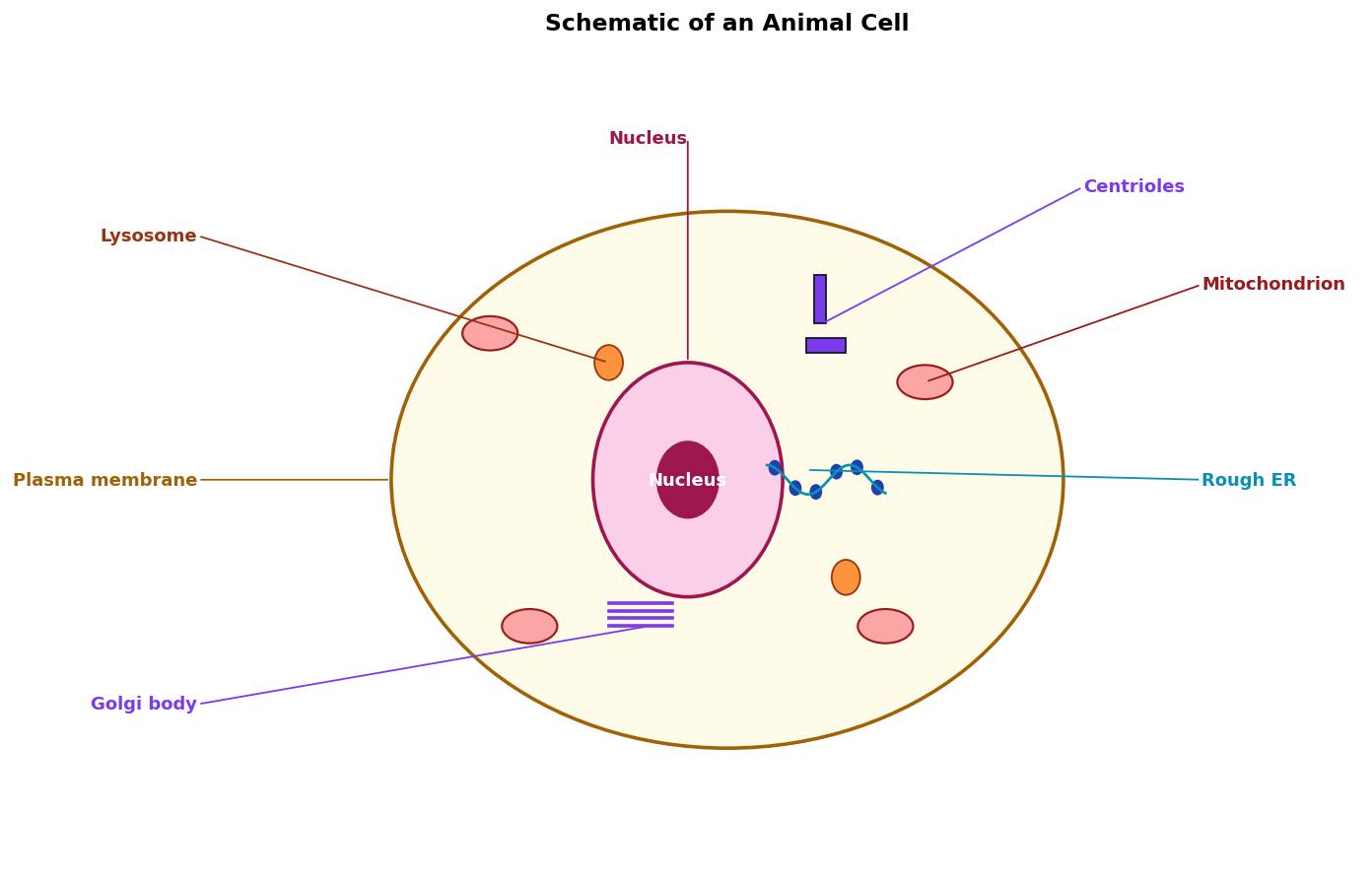
Study the labelled diagram of an animal cell and answer:
The outer covering of an animal cell is the:
ACell wall
BPlasma membrane
CTonoplast
DCuticle
The structure that organises spindle fibres during cell division is the:
AMitochondrion
BCentriole
CRibosome
DNucleus
Describe the salient features of an animal cell and contrast it with a plant cell.
Show answersHide answers
1. Option 2 — Plasma membrane
2. Option 2 — Centriole
3. Animal cells lack a cell wall and have only a plasma membrane. They contain a nucleus mitochondria ER Golgi body lysosomes and ribosomes. Centrioles are characteristic of animal cells and organise the spindle apparatus during cell division.