Cell Cycle and Cell Division — Important Questions
52 questions
With answersCBSE format
SUMMARY: This chapter focuses on the process of cell cycle and cell division, explaining the stages and significance of these biological processes. KEY TOPICS: cell cycle phases, interphase, mitosis, meiosis, cytokinesis, significance of cell division, regulation of cell cycle, checkpoints, G1 phase, S phase, G2 phase
The number of meiotic divisions required to produce 100 pollen grains is:
A25
B50
C100
D400
Check answerHide answer
Correct answer: Option 25
Q21 Mark
The longest phase of the cell cycle is:
AG1 phase
BS phase
CG2 phase
DInterphase
Check answerHide answer
Correct answer: Option 4 — Interphase
Q31 Mark
DNA replication occurs during:
AG1 phase
BS phase
CG2 phase
DM phase
Check answerHide answer
Correct answer: Option 2 — S phase
Q41 Mark
Crossing over occurs during:
ALeptotene
BZygotene
CPachytene
DDiplotene
Check answerHide answer
Correct answer: Option 3 — Pachytene
Q51 Mark
The number of meiotic divisions required to produce 100 pollen grains is:
A25
B50
C100
D400
Check answerHide answer
Correct answer: Option 1 — 25
Q61 Mark
The chromosomes are clearly visible during:
AInterphase
BProphase
CMetaphase
DTelophase
Check answerHide answer
Correct answer: Option 3 — Metaphase
Q71 Mark
Which phase of the cell cycle is characterized by the synthesis of DNA?
AG1 phase
BS phase
CG2 phase
DM phase
Check answerHide answer
Correct answer: Option 2 — S phase
Q81 Mark
What is the primary purpose of cytokinesis?
ATo replicate DNA
BTo divide the cytoplasm
CTo condense chromosomes
DTo align chromosomes at the equatorial plane
Check answerHide answer
Correct answer: Option 2 — To divide the cytoplasm
Q91 Mark
During which phase do cells check for DNA damage before proceeding to mitosis?
AG1 phase
BS phase
CG2 phase
DM phase
Check answerHide answer
Correct answer: Option 3 — G2 phase
Q101 Mark
Which checkpoint is crucial for ensuring that all chromosomes are properly attached to the spindle apparatus?
AG1 checkpoint
BG2 checkpoint
CM checkpoint
DS checkpoint
Check answerHide answer
Correct answer: Option 3 — M checkpoint
Q111 Mark
What is the significance of the G1 phase in the cell cycle?
ADNA synthesis occurs
BCell growth and preparation for DNA replication
CChromosome separation
DCytoplasm division
Check answerHide answer
Correct answer: Option 2 — Cell growth and preparation for DNA replication
Q121 Mark
Which of the following statements about meiosis is true?
AIt results in diploid cells
BIt involves two rounds of cell division
CIt occurs in somatic cells
DIt produces genetically identical cells
Check answerHide answer
Correct answer: Option 2 — It involves two rounds of cell division
Q131 Mark
What is the main outcome of mitosis?
AProduction of gametes
BGenetic variation
CTwo identical daughter cells
DCell growth
Check answerHide answer
Correct answer: Option 3 — Two identical daughter cells
Q141 Mark
Which phase of the cell cycle is the shortest?
AG1 phase
BS phase
CG2 phase
DM phase
Check answerHide answer
Correct answer: Option 4 — M phase
Q151 Mark
In which phase do homologous chromosomes undergo crossing over?
AProphase I of meiosis
BMetaphase I of meiosis
CAnaphase I of meiosis
DTelophase I of meiosis
Check answerHide answer
Correct answer: Option 1 — Prophase I of meiosis
Short Answer Questions10 questions
Q163 Marks
Differentiate between mitosis and meiosis.
Q173 Marks
Describe the events of prophase I of meiosis.
Q183 Marks
What is the significance of meiosis?
Q193 Marks
Define the cell cycle and mention its phases.
Q203 Marks
What is cytokinesis? How does it differ in plant and animal cells?
Q213 Marks
Differentiate between mitosis and meiosis.
Q223 Marks
Describe the events of prophase I of meiosis.
Q233 Marks
What is the significance of meiosis?
Q243 Marks
Define the cell cycle and mention its phases.
Q253 Marks
What is cytokinesis? How does it differ in plant and animal cells?
Long Answer Questions6 questions
Q266 Marks
Describe the various stages of mitosis with diagrams.
Q276 Marks
Discuss the stages of meiosis I in detail.
Q286 Marks
Explain the cell cycle and its regulation.
Q296 Marks
Compare and contrast mitosis and meiosis with diagrams.
Q306 Marks
Discuss the significance of mitosis and meiosis in living organisms.
Q316 Marks
Describe the various stages of mitosis with diagrams.
Assertion–Reason Questions8 questions
Q321 Mark
Assertion (A): Meiosis maintains the chromosome number.
Reason (R): It produces haploid gametes from diploid parent cells.
Show explanationHide explanation
Correct answer: Option 1 —
Both A and R are true, and R is the correct explanation of A.
Q331 Mark
Assertion (A): Mitosis produces two genetically identical daughter cells.
Reason (R): There is no recombination during mitosis.
Show explanationHide explanation
Correct answer: Option 1 —
Both A and R are true, and R is the correct explanation of A.
Q341 Mark
Assertion (A): Cytokinesis follows karyokinesis.
Reason (R): Cytokinesis divides the cytoplasm after the nucleus has divided.
Show explanationHide explanation
Correct answer: Option 1 —
Both A and R are true, and R is the correct explanation of A.
Q351 Mark
Assertion (A): Crossing over leads to genetic variation.
Reason (R): It involves exchange of chromosomal segments between non-sister chromatids of homologous chromosomes.
Show explanationHide explanation
Correct answer: Option 1 —
Both A and R are true, and R is the correct explanation of A.
Q361 Mark
Assertion (A): Cells in G0 phase are metabolically active.
Reason (R): They have exited the cell cycle but continue to function.
Show explanationHide explanation
Correct answer: Option 1 —
Both A and R are true, and R is the correct explanation of A.
Q371 Mark
Assertion (A): Meiosis maintains the chromosome number.
Reason (R): It produces haploid gametes from diploid parent cells.
Show explanationHide explanation
Correct answer: Option 1 —
Both A and R are true, and R is the correct explanation of A.
Q381 Mark
Assertion (A): Mitosis produces two genetically identical daughter cells.
Reason (R): There is no recombination during mitosis.
Show explanationHide explanation
Correct answer: Option 1 —
Both A and R are true, and R is the correct explanation of A.
Q391 Mark
Assertion (A): Cytokinesis follows karyokinesis.
Reason (R): Cytokinesis divides the cytoplasm after the nucleus has divided.
Show explanationHide explanation
Correct answer: Option 1 —
Both A and R are true, and R is the correct explanation of A.
Statement-Based Questions8 questions
Q401 Mark
Statement 1: Statement I: Synapsis is the pairing of homologous chromosomes during prophase I.
Statement 2: Statement II: It is essential for crossing over to occur.
Show answerHide answer
Correct answer: Option 1 —
Both statements are true.
Q411 Mark
Statement 1: Statement I: Anaphase is marked by separation of sister chromatids.
Statement 2: Statement II: This separation is brought about by spindle fibres.
Show answerHide answer
Correct answer: Option 1 —
Both statements are true.
Q421 Mark
Statement 1: Statement I: Mitosis occurs in somatic cells.
Statement 2: Statement II: Meiosis occurs in germ cells.
Show answerHide answer
Correct answer: Option 1 —
Both statements are true.
Q431 Mark
Statement 1: Statement I: Chiasmata are the visible sites of crossing over.
Statement 2: Statement II: They are first seen during diplotene stage.
Show answerHide answer
Correct answer: Option 1 —
Both statements are true.
Q441 Mark
Statement 1: Statement I: In plant cells cytokinesis occurs by cell plate formation.
Statement 2: Statement II: In animal cells cytokinesis occurs by cleavage furrow.
Show answerHide answer
Correct answer: Option 1 —
Both statements are true.
Q451 Mark
Statement 1: Synapsis is the pairing of homologous chromosomes during prophase I.
Statement 2: It is essential for crossing over to occur.
Show answerHide answer
Correct answer: Option 1 —
Both statements are true.
Q461 Mark
Statement 1: Anaphase is marked by separation of sister chromatids.
Statement 2: This separation is brought about by spindle fibres.
Show answerHide answer
Correct answer: Option 1 —
Both statements are true.
Q471 Mark
Statement 1: Mitosis occurs in somatic cells.
Statement 2: Meiosis occurs in germ cells.
Show answerHide answer
Correct answer: Option 1 —
Both statements are true.
Case Study / Passage Questions2 questions
Q483 Marks
A student observes the dividing cells in an onion root tip. He notes the chromosomes condensing, lining up at the equator and then separating into two daughter nuclei. The teacher asks him to identify the phase he is observing and to estimate how long the cell spends in interphase compared to mitosis.
Chromosomes lining up at the equator is characteristic of:
AProphase
BMetaphase
CAnaphase
DTelophase
Most of the cell cycle is spent in:
AInterphase
BMitosis
CCytokinesis
DAll equal
Describe the events of mitosis briefly.
Show answersHide answers
1. Option 2 — Metaphase
2. Option 1 — Interphase
3. Mitosis is divided into prophase, metaphase, anaphase and telophase. Prophase shows chromosome condensation and disappearance of the nuclear envelope. In metaphase chromosomes align at the equator. In anaphase sister chromatids separate to opposite poles. Telophase shows chromosome decondensation and nuclear envelope reformation. Cytokinesis follows to divide the cytoplasm.
Q493 Marks
A teacher explains that without meiosis the chromosome number would double each generation. She tells students that human gametes have 23 chromosomes and the zygote has 46. They are asked to explain how meiosis maintains the species chromosome number and how it generates variation.
The number of chromosomes in a human gamete is:
A46
B23
C92
D2
Crossing over takes place during which sub-stage of prophase I?
APachytene
BZygotene
CDiplotene
DDiakinesis
Explain the significance of meiosis in maintaining chromosome number and producing variation.
Show answersHide answers
1. Option 2 — 23
2. Option 1 — Pachytene
3. Meiosis is a reductional division that halves the chromosome number from diploid to haploid. It also creates new combinations of alleles through crossing over (in prophase I) and independent assortment of homologous chromosomes (in metaphase I). These two events generate genetic variation among gametes which is the basis of evolution by natural selection.
Table-Based Questions2 questions
Q503 Marks
Study the table comparing mitosis and meiosis and answer:
Feature
Mitosis
Meiosis
Nuclear divisions
One
Two
Daughter cells
Two diploid
Four haploid
Crossing over
Absent
Present in prophase I
Pairing of homologues
Absent
Present
Site
Somatic cells
Germ cells
The number of cells produced at the end of meiosis is:
ATwo
BThree
CFour
DEight
Crossing over occurs in:
AMitosis
BMeiosis
CBoth
DNeither
Compare mitosis and meiosis with reference to chromosome number, recombination and biological function.
Show answersHide answers
1. Option 3 — Four
2. Option 2 — Meiosis
3. Mitosis produces two genetically identical diploid daughter cells from a parent cell — useful in growth, repair and asexual reproduction. Meiosis produces four genetically diverse haploid cells from a diploid parent cell — used in gamete formation. The differences in number of divisions, daughter cells and recombination events reflect the distinct biological roles of the two processes.
Q516 Marks
Compare mitosis and meiosis with respect to the listed features.
Feature
Mitosis
Meiosis
Nuclear divisions
?
?
Daughter cells
?
?
Crossing over
?
?
Pairing of homologues
?
?
Site
?
?
Picture-Based Questions1 question
Q524 Marks
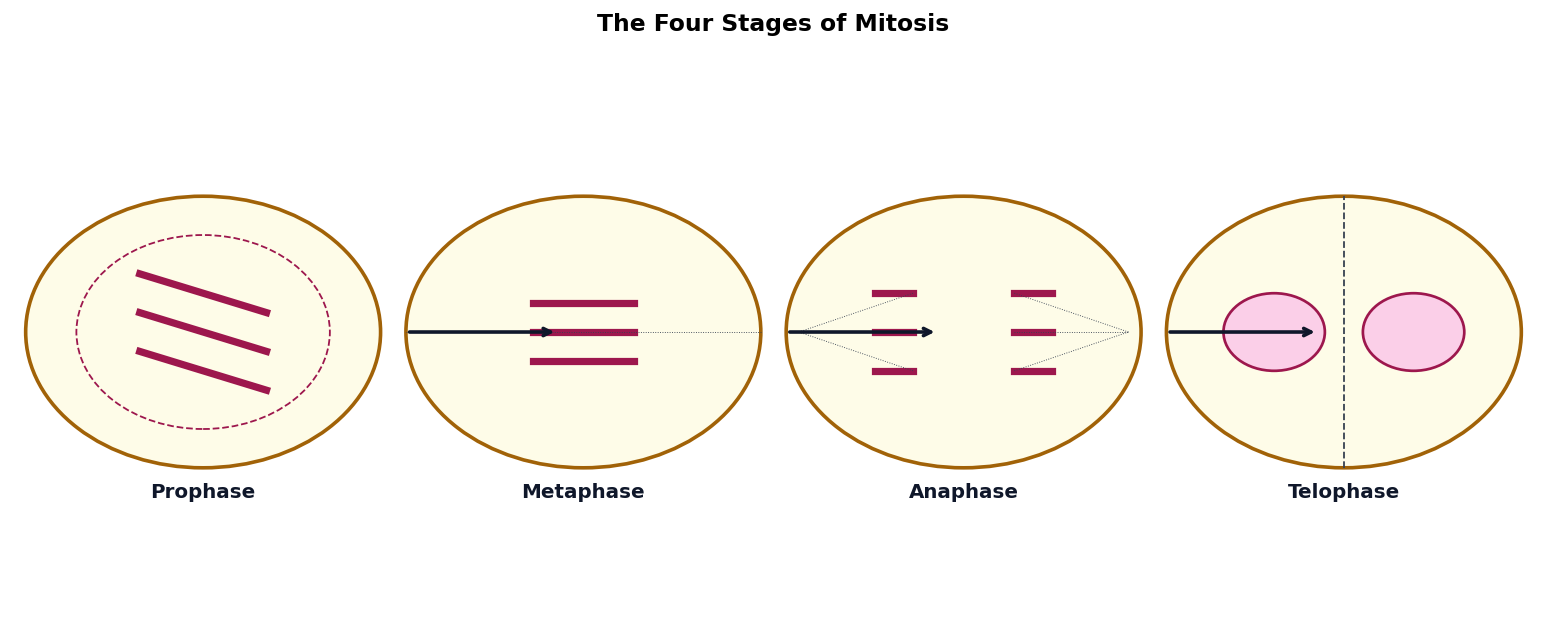
Study the four stages of mitosis and answer:
Chromosomes line up at the equatorial plate during:
AProphase
BMetaphase
CAnaphase
DTelophase
Sister chromatids separate and move to opposite poles during:
AProphase
BMetaphase
CAnaphase
DTelophase
Describe the four stages of mitosis with the key event in each.
Show answersHide answers
1. Option 2 — Metaphase
2. Option 3 — Anaphase
3. Mitosis has four stages. Prophase - chromosomes condense and the spindle forms. Metaphase - chromosomes line up at the equator. Anaphase - sister chromatids separate to opposite poles. Telophase - nuclei reform and cytokinesis begins.