SUMMARY: The chapter "Issue of Debentures" in Class 12 Accountancy focuses on the accounting treatment and procedures involved in the issuance of debentures by a company. KEY TOPICS: Types of debentures, issue of debentures at par, premium, and discount, interest on debentures, redemption of debentures, journal entries for issue of debentures, debenture trust deed, debenture holders.
In the case of redeemable debentures, the company is obligated to repay the principal amount at which of the following?
AAt the end of the financial year
BAt a fixed date specified at the time of issue
CWhenever it chooses
DAt the discretion of the debenture holders
Check answerHide answer
Correct answer: Option 2 — At a fixed date specified at the time of issue
Q91 Mark
What is the primary purpose of a debenture trust deed?
ATo outline the terms of the debenture issue
BTo provide a guarantee for the debenture holders
CTo specify the interest rate on debentures
DTo determine the redemption process
Check answerHide answer
Correct answer: Option 1 — To outline the terms of the debenture issue
Q101 Mark
Which type of debenture can be converted into equity shares at the option of the holder?
ANon-Convertible Debenture
BConvertible Debenture
CRedeemable Debenture
DSecured Debenture
Check answerHide answer
Correct answer: Option 2 — Convertible Debenture
Q111 Mark
What is the accounting treatment for interest on debentures?
AIt is recorded as an expense in the Profit and Loss Account
BIt is added to the debenture account
CIt is credited to the Capital Reserve Account
DIt is shown as a liability on the balance sheet
Check answerHide answer
Correct answer: Option 1 — It is recorded as an expense in the Profit and Loss Account
Q121 Mark
If a company issues debentures at a discount, how is the discount treated in the books?
ADebited to the Profit and Loss Account
BCredited to the Debenture Account
CDebited to the Discount on Debentures Account
DIgnored in the accounting records
Check answerHide answer
Correct answer: Option 3 — Debited to the Discount on Debentures Account
Q131 Mark
Which of the following statements is true regarding debenture holders?
AThey are the owners of the company
BThey have voting rights in the company
CThey are creditors of the company
DThey are entitled to dividends
Check answerHide answer
Correct answer: Option 3 — They are creditors of the company
Q141 Mark
What is the maximum period for which a debenture can be issued?
A1 year
B5 years
C10 years
DNo maximum limit defined
Check answerHide answer
Correct answer: Option 4 — No maximum limit defined
Q151 Mark
In the case of a company issuing debentures, which of the following is a legal document that outlines the rights of debenture holders?
AMemorandum of Association
BArticles of Association
CDebenture Trust Deed
DShareholder Agreement
Check answerHide answer
Correct answer: Option 3 — Debenture Trust Deed
Short Answer Questions10 questions
Q163 Marks
Distinguish between shares and debentures.
View sample solutionHide solution
Shares — units of OWNERSHIP; shareholders are owners of the company; receive dividend (variable) only if declared; have voting rights (equity); risk and return higher; rank last in liquidation. Debentures — units of DEBT; debenture holders are creditors of the company; receive fixed interest (paid even if no profit — charged to P&L); no voting rights; rank ahead of shareholders in liquidation; can be secured against company assets. Companies use both: equity for permanent capital, debentures for fixed-cost long-term funds.
Q173 Marks
Explain the various types of debentures.
View sample solutionHide solution
(1) On security: Secured (charged on company assets) vs Unsecured (general claim only). (2) On convertibility: Convertible (can be converted to shares — fully or partially) vs Non-convertible. (3) On registration: Registered (in company books — interest sent to registered holder) vs Bearer (negotiable like cash). (4) On redemption: Redeemable (repaid at maturity) vs Irredeemable (not repaid in normal course — rare in India). (5) On priority: First mortgage debentures (priority on assets) vs Second mortgage. The choice affects interest rate, marketability, and security to investors.
Q183 Marks
How is interest on debentures treated?
View sample solutionHide solution
Interest on debentures is a CHARGE against profit (not an appropriation) — it must be paid even if there is no profit, similar to interest on a loan. Treatment: (1) Debenture Interest A/c Dr (with gross interest); To Bank A/c (after TDS deduction); To TDS A/c (tax deducted at source). (2) Debenture Interest is then transferred to P&L A/c Dr; To Debenture Interest A/c. Tax (TDS) is deposited with government. Interest is calculated on FACE VALUE (not on issue price) at the coupon rate.
Q193 Marks
Explain methods of redemption of debentures.
View sample solutionHide solution
Methods of redemption: (1) Lump sum at maturity — entire debenture amount paid on the maturity date; simple but creates large cash outflow. (2) Annual instalments — fixed annual amount over the life; smoother cash flow. (3) Purchase from open market — company buys back debentures at market price (may be at discount) when funds permit; may save interest. (4) Conversion into shares — convertible debentures are converted as per terms. SEBI rules require Debenture Redemption Reserve (DRR) of 10% of debentures redeemable value created out of profits before redemption.
Q203 Marks
What is Debenture Redemption Reserve (DRR) and why is it required?
View sample solutionHide solution
DRR is a reserve created out of profits available for dividend before debentures are redeemed. As per Companies Act and SEBI guidelines: 10% of the value of debentures to be redeemed must be transferred to DRR. Purpose: protect debenture holders by ensuring funds are set aside for redemption rather than distributed as dividends. Once redemption is complete the DRR balance can be transferred to General Reserve. Some entities (banks, NBFCs, listed companies issuing privately placed debentures) are exempt; the rule applies primarily to publicly issued debentures.
Q213 Marks
What are the key features of convertible debentures?
View sample solutionHide solution
Convertible debentures are debentures that can be converted into equity shares after a specified period. They typically offer lower interest rates compared to non-convertible debentures due to the added benefit of conversion.
Q223 Marks
Define the term 'debenture trust deed'.
View sample solutionHide solution
A debenture trust deed is a legal document that outlines the terms and conditions of the debenture issue. It includes details about the rights of debenture holders, interest payment schedules, and the obligations of the issuing company.
Q233 Marks
What is the accounting treatment for issuing debentures at a premium?
View sample solutionHide solution
When debentures are issued at a premium, the premium amount is credited to a separate account called 'Securities Premium Account'. The journal entry includes debentures being credited at par value and the premium being credited to the securities premium account.
Q243 Marks
Explain the concept of 'interest on debentures'.
View sample solutionHide solution
Interest on debentures is the cost of borrowing that a company pays to debenture holders. It is usually paid at a fixed rate and is a charge against the profits of the company, impacting the net income available to shareholders.
Q253 Marks
What is the significance of a debenture holder in a company?
View sample solutionHide solution
A debenture holder is a creditor of the company who lends money in exchange for debentures. They have a right to receive fixed interest payments and the repayment of principal at maturity, but they do not have voting rights in the company.
Long Answer Questions6 questions
Q266 Marks
M/s Sun Ltd issues 10000 9% Debentures of ₹100 each at par. Pass journal entries for: (i) application 100% received; (ii) allotment; (iii) interest for the year; (iv) interest paid (TDS @10%).
View sample solutionHide solution
(i) Bank A/c Dr 1000000 (10000 × 100); To Debenture Application A/c 1000000. (Being application money received.) (ii) Debenture Application A/c Dr 1000000; To 9% Debentures A/c 1000000. (Being debentures allotted.) (iii) Annual interest = 10000 × 100 × 9% = ₹90000. Debenture Interest A/c Dr 90000; To Debenture Holders A/c 81000 (after TDS); To TDS Payable A/c 9000. (Being interest accrued with TDS.) (iv) Debenture Holders A/c Dr 81000; To Bank A/c 81000. (Being net interest paid.) TDS Payable A/c Dr 9000; To Bank A/c 9000. (Being TDS deposited with government.) Year-end transfer: P&L A/c Dr 90000; To Debenture Interest A/c 90000.
Q276 Marks
M/s Lite Ltd issues 5000 9% debentures of ₹100 each at a discount of 6%. The discount is to be written off over the 6-year life of debentures. Pass journal entries for issue and the first year's writing off.
View sample solutionHide solution
Issue at discount of 6%: issue price = 100 − 6 = ₹94. (i) Bank A/c Dr 470000 (5000 × 94); Discount on Issue of Debentures A/c Dr 30000 (5000 × 6); To 9% Debentures A/c 500000 (face value). (Being debentures issued at 6% discount.) The discount is a deferred charge — written off proportionately over 6 years. Annual write-off = 30000 / 6 = ₹5000. Year 1: P&L A/c Dr 5000; To Discount on Issue of Debentures A/c 5000. (Being discount on issue written off.) After 6 years discount account closes. Issue at premium: opposite — Bank received ₹100 for every ₹100 face value PLUS premium credited to Securities Premium A/c.
Q286 Marks
Discuss the methods of issue of debentures with a numerical example.
View sample solutionHide solution
Methods: (1) For cash — debentures issued in exchange for money. Example: 1000 × ₹100 debentures for cash → Bank A/c Dr 100000; To Debentures A/c 100000. (2) For consideration other than cash — issued to vendors of assets in lieu of payment. Example: machine purchased for ₹500000 paid by 5000 debentures of ₹100. Machinery A/c Dr 500000; To Debentures A/c 500000. (3) As collateral security — debentures issued as additional security to a loan; entries: nominal entry only or No journal entry treating debentures as a contingent issue. The choice depends on the company's funding need and the lender's security requirement.
Q296 Marks
Explain the redemption of debentures by purchase in the open market.
View sample solutionHide solution
Open market purchase: company buys back its own debentures from the market when funds permit and prices are favourable. (1) Purchase: Investment in Own Debentures A/c Dr; To Bank A/c (with purchase price). (2) Cancellation: 9% Debentures A/c Dr (face value); To Investment in Own Debentures A/c (purchase price); difference goes to either Capital Reserve (if purchased at discount — gain) or P&L A/c (if at premium — loss). Example: Buy 100 debentures of ₹100 each at ₹95: cost 9500; cancellation entry — 9% Debentures A/c Dr 10000; To Investment in Own Debentures A/c 9500; To Capital Reserve A/c 500. The company saves 5% per debenture. This method is faster than annual instalments.
Q306 Marks
M/s Sun Ltd issues 1000 9% debentures of ₹100 each redeemable at par after 5 years. The company creates 10% DRR. Pass journal entries for issue and redemption (assume DRR is built up over time before redemption).
View sample solutionHide solution
Issue: Bank A/c Dr 100000; To 9% Debentures A/c 100000. (Being debentures issued at par.) DRR creation: Required DRR = 10% × 100000 = ₹10000. Spread over 5 years or built fully before redemption. Annual transfer: P&L Appropriation A/c Dr 2000 (over 5 years); To DRR A/c 2000. Redemption (year 5): 9% Debentures A/c Dr 100000; To Debenture Holders A/c 100000. Debenture Holders A/c Dr 100000; To Bank A/c 100000. (Being debentures redeemed at par.) Transfer DRR back: DRR A/c Dr 10000; To General Reserve A/c 10000. (Being DRR transferred to General Reserve after redemption.)
Q316 Marks
Compare shares and debentures with the help of a table on at least five features.
Assertion–Reason Questions8 questions
Q321 Mark
Assertion (A): A debenture is a long-term debt instrument.
Reason (R): Debenture holders are creditors of the company and receive a fixed interest.
Show explanationHide explanation
Correct answer: Option 1 —
Both A and R are true, and R is the correct explanation of A.
Q331 Mark
Assertion (A): Interest on debentures is a charge against profit not an appropriation.
Reason (R): Interest must be paid even when the company has no profit; it is similar to interest on a loan.
Show explanationHide explanation
Correct answer: Option 1 —
Both A and R are true, and R is the correct explanation of A.
Q341 Mark
Assertion (A): A Debenture Redemption Reserve protects debenture holders.
Reason (R): The reserve ensures that funds are set aside for redemption rather than distributed as dividend.
Show explanationHide explanation
Correct answer: Option 1 —
Both A and R are true, and R is the correct explanation of A.
Q351 Mark
Assertion (A): Convertible debentures can be converted into equity shares.
Reason (R): Conversion provides debenture holders with potential capital appreciation in addition to fixed interest.
Show explanationHide explanation
Correct answer: Option 1 —
Both A and R are true, and R is the correct explanation of A.
Q361 Mark
Assertion (A): Discount on issue of debentures is written off over the life of the debentures.
Reason (R): The discount represents an additional cost of borrowing that should be amortised over the period of benefit.
Show explanationHide explanation
Correct answer: Option 1 —
Both A and R are true, and R is the correct explanation of A.
Q371 Mark
Assertion (A): Debentures can be issued at a premium to attract investors.
Reason (R): Issuing at a premium increases the funds raised for the company.
Show explanationHide explanation
Correct answer: Option 1 —
Both A and R are true, and R is the correct explanation of A.
Q381 Mark
Assertion (A): Interest on debentures is payable only if the company makes a profit.
Reason (R): Interest on debentures is a fixed charge and must be paid regardless of profit.
Show explanationHide explanation
Correct answer: Option 4 —
A is false, but R is true.
Q391 Mark
Assertion (A): A debenture trust deed outlines the rights of debenture holders.
Reason (R): The trust deed serves as a legal contract between the company and the debenture holders.
Show explanationHide explanation
Correct answer: Option 1 —
Both A and R are true, and R is the correct explanation of A.
Statement-Based Questions8 questions
Q401 Mark
Statement 1: Debentures are debt and shares are ownership.
Correct answer: Option 1 —
Both statements are true.
Q411 Mark
Statement 1: Debentures can be secured or unsecured convertible or non-convertible.
Statement 2: The choice affects interest rate and marketability.
Show answerHide answer
Correct answer: Option 1 —
Both statements are true.
Q421 Mark
Statement 1: Debentures may be issued for cash for non-cash consideration or as collateral security.
Statement 2: Each method has different accounting treatment.
Show answerHide answer
Correct answer: Option 1 —
Both statements are true.
Q431 Mark
Statement 1: Redemption can be by lump sum instalments open market purchase or conversion.
Statement 2: The method depends on company finances and the terms of issue.
Show answerHide answer
Correct answer: Option 1 —
Both statements are true.
Q441 Mark
Statement 1: A Debenture Redemption Reserve must be created before redemption.
Statement 2: DRR is set at 10% of debentures redeemable value.
Show answerHide answer
Correct answer: Option 1 —
Both statements are true.
Q451 Mark
Statement 1: Debentures can only be issued at par value.
Statement 2: Debentures can be issued at a premium or discount depending on market conditions.
Show answerHide answer
Correct answer: Option 2 —
Only Statement 1 is true.
Q461 Mark
Statement 1: Interest on debentures is paid before tax.
Statement 2: Debenture holders are considered part owners of the company.
Show answerHide answer
Correct answer: Option 3 —
Only Statement 2 is true.
Q471 Mark
Statement 1: A debenture trust deed outlines the rights of debenture holders.
Statement 2: Debenture holders do not have voting rights in a company.
Show answerHide answer
Correct answer: Option 1 —
Both statements are true.
Case Study / Passage Questions4 questions
Q483 Marks
M/s Sun Ltd issues 10000 9% debentures of ₹100 each at par on 1 April 2023 redeemable at par after 5 years. Annual interest is paid half-yearly. The TDS rate on debenture interest is 10%.
Interest on debentures is treated as:
ACharge against profit
BAppropriation of profit
CReserve transfer
DOptional
Total annual interest payable on the debentures is:
A₹45000
B₹90000
C₹50000
D₹100000
Pass journal entries for issue and one year of interest payment.
Show answersHide answers
1. Option 1 — Charge against profit
2. Option 2 — ₹90000
3. Annual interest = Face value × rate = 10000 × 100 × 9% = ₹90000. Half-yearly interest = ₹45000 paid in two instalments. Journal entries (annual): (1) Bank A/c Dr (10000 × 100) 1000000; To Debenture Application 1000000. (2) Debenture Application A/c Dr 1000000; To 9% Debentures A/c 1000000. (3) Annual interest accrual: Debenture Interest A/c Dr 90000; To Debenture Holders A/c 81000 (after TDS); To TDS Payable A/c 9000. (4) Payment: Debenture Holders A/c Dr 81000; To Bank A/c 81000. TDS Payable A/c Dr 9000; To Bank A/c 9000. Year-end: P&L A/c Dr 90000; To Debenture Interest A/c 90000.
Q493 Marks
M/s Lite Ltd issues 5000 9% debentures of ₹100 each at a discount of 6% on 1 April 2023. The debentures are redeemable at par after 6 years. The discount on issue must be written off over the life of the debentures.
The issue price per debenture is:
A₹100
B₹94
C₹106
D₹6
Discount on issue of debentures is treated as:
AAsset
BLiability
CNegative reserve
DDeferred charge written off over life
Pass journal entries for issue and the first year's write-off.
Show answersHide answers
1. Option 2 — ₹94
2. Option 4 — Deferred charge written off over life
3. Issue at 6% discount: Issue price = 100 − 6 = ₹94. Total face value = 5000 × 100 = ₹500000; Total discount = 5000 × 6 = ₹30000. Annual write-off = 30000 / 6 years = ₹5000 per year. Journal entries (issue): Bank A/c Dr 470000; Discount on Issue of Debentures A/c Dr 30000; To 9% Debentures A/c 500000. (Being debentures issued at 6% discount.) Year 1 write-off: P&L A/c Dr 5000; To Discount on Issue of Debentures A/c 5000. (Being discount written off proportionately.) After 6 years discount account closes — total ₹30000 written off. The discount is shown as a reduction from Reserves and Surplus on the balance sheet (or under Other Non-current Assets if amortised).
Q503 Marks
M/s Crown Ltd had issued 1000 8% debentures of ₹100 each redeemable at par after 5 years. As per Companies Act it must create a Debenture Redemption Reserve (DRR) at 10% of debentures redeemable value before redemption. The company decides to redeem all debentures on the maturity date.
The DRR amount required is:
A₹10000
B₹50000
C₹100000
D₹0
DRR is created from:
AOut of capital
BOut of profits available for dividend
CFrom cash balance
DFrom reserves any source
Compute DRR and pass entries for the redemption.
Show answersHide answers
1. Option 1 — ₹10000
2. Option 2 — Out of profits available for dividend
3. Required DRR = 10% × Total face value = 10% × 1000 × 100 = ₹10000. DRR can be built up over time before redemption. Common practice: build over the life of the debentures, transferring part of profit to DRR each year. For 5-year life, DRR transfer = 10000 / 5 = ₹2000 per year. Journal: P&L Appropriation A/c Dr 2000; To DRR A/c 2000. (Being DRR contribution from profit.) Redemption (year 5): 8% Debentures A/c Dr 100000; To Debenture Holders A/c 100000. Debenture Holders A/c Dr 100000; To Bank A/c 100000. (Being debentures redeemed.) After redemption: DRR A/c Dr 10000; To General Reserve A/c 10000. (Being DRR transferred to General Reserve since redemption is complete.) The purpose of DRR is to ensure funds are set aside for redemption rather than distributed as dividends.
Q514 Marks
Debentures are a popular means of raising funds for companies. They are essentially a type of debt instrument that companies issue to borrow money from the public. When a company issues debentures, it promises to pay a fixed rate of interest to the debenture holders at specified intervals. The principal amount is usually repaid at the end of the debenture's term. Debentures can be issued at par, at a premium, or at a discount. The terms of the debenture issue, including the interest rate and redemption conditions, are specified in a document known as the debenture trust deed. This document outlines the rights of debenture holders and the obligations of the company. Understanding the accounting treatment for debentures is crucial for accurate financial reporting and compliance with legal requirements.
What is a debenture?
Which document outlines the rights of debenture holders?
ADebenture Trust Deed
BShareholder Agreement
CCompany Bylaws
DFinancial Statement
What are the three ways debentures can be issued?
AAt par, at a premium, or at a discount
BAt face value, at market value, or at book value
CAs secured, unsecured, or convertible
DAs equity, debt, or hybrid
Why is understanding the accounting treatment for debentures important?
Show answersHide answers
1. A debenture is a type of debt instrument that companies issue to borrow money from the public.
2. Option 1 — Debenture Trust Deed
3. Option 1 — At par, at a premium, or at a discount
4. It is crucial for accurate financial reporting and compliance with legal requirements.
Table-Based Questions4 questions
Q523 Marks
Compare types of debentures:
Type
Distinction
Example
Secured vs Unsecured
Charged on assets vs general claim
Mortgage debentures vs simple debentures
Convertible vs Non-convertible
Can be converted to shares vs cannot
FCD/PCD vs NCD
Registered vs Bearer
Registered in books vs negotiable
Indian companies issue registered
Redeemable vs Irredeemable
Repaid at maturity vs not repaid normally
Most are redeemable
First mortgage vs Second mortgage
Priority on assets
First has higher security
A debenture that can be converted into equity shares is:
AConvertible
BNon-convertible
CBoth
DNeither
A debenture backed by mortgage on assets is:
ASecured
BUnsecured
CConvertible
DBearer
Why does the choice of debenture type affect the interest rate?
Show answersHide answers
1. Option 1 — Convertible
2. Option 1 — Secured
3. Debentures can be classified by various features. Secured debentures are charged on specific assets and have priority on those assets in liquidation; unsecured (also called naked) debentures have a general claim only. Convertible debentures (FCD/PCD — Fully/Partly Convertible) can be converted to shares per agreed terms, giving holders potential capital appreciation. Non-Convertible Debentures (NCDs) stay as debt. Registered debentures are registered in company books — interest sent to registered holder. Bearer debentures are negotiable — whoever holds them gets the interest. Most Indian companies issue registered debentures. The choice of type affects the interest rate (more secure types have lower rates) and marketability.
Q533 Marks
Methods of issue of debentures and their accounting:
Method
Description
Accounting
For cash
Issued for cash payment
Bank A/c Dr; To Debentures A/c
For non-cash consideration
Issued to vendor in lieu of payment for asset
Asset A/c Dr; To Debentures A/c
As collateral security
Issued as additional security to a loan
Nominal entry only; no real exchange
At par
Face value = issue price
Bank = Debentures
At premium
Issue price > face value
Bank = Debentures + Premium
At discount
Issue price < face value
Bank + Discount = Debentures
For non-cash consideration the entry is:
ABank A/c Dr To Debentures A/c
BAsset A/c Dr To Debentures A/c
CLoan A/c Dr To Debentures A/c
DNo entry
Issue at premium credits the Securities Premium A/c.
AYes
BNo
CSometimes
DOptional
Compare the three methods of issue and their accounting impact.
Show answersHide answers
1. Option 2 — Asset A/c Dr To Debentures A/c
2. Option 1 — Yes
3. Debentures can be issued for cash for non-cash consideration (e.g. to vendors of assets) or as collateral security. The accounting depends on the method: cash issue is a simple Bank-to-Debenture transfer; non-cash uses the Asset acquired as the debit; collateral often involves only a nominal entry since no real exchange of value happens. Premium and discount affect the bank receipt vs face value: premium is credited to Securities Premium A/c (under Section 52); discount is a deferred charge written off over the life of the debentures. The choice depends on the company's circumstances and the market's perception of its credit worthiness.
Q546 Marks
M/s Sun Ltd issues 10000 9% debentures of ₹100 each at par on 1 April 2023 redeemable after 5 years. Compute annual interest and pass entries (TDS @10%).
Quantity
Value
Debentures issued
10000
Face value per debenture
₹100
Coupon rate
9%
Issue price
at par
Redemption period
5 years
TDS rate
10%
Q556 Marks
M/s Lite Ltd issues 5000 9% debentures of ₹100 each at a discount of 6% redeemable after 6 years. Pass journal entries for issue and the first year's writing off.
Quantity
Value
Debentures issued
5000
Face value
₹100
Discount
6%
Issue price
₹94
Life
6 years
Annual write-off
? ₹5000
Picture-Based Questions3 questions
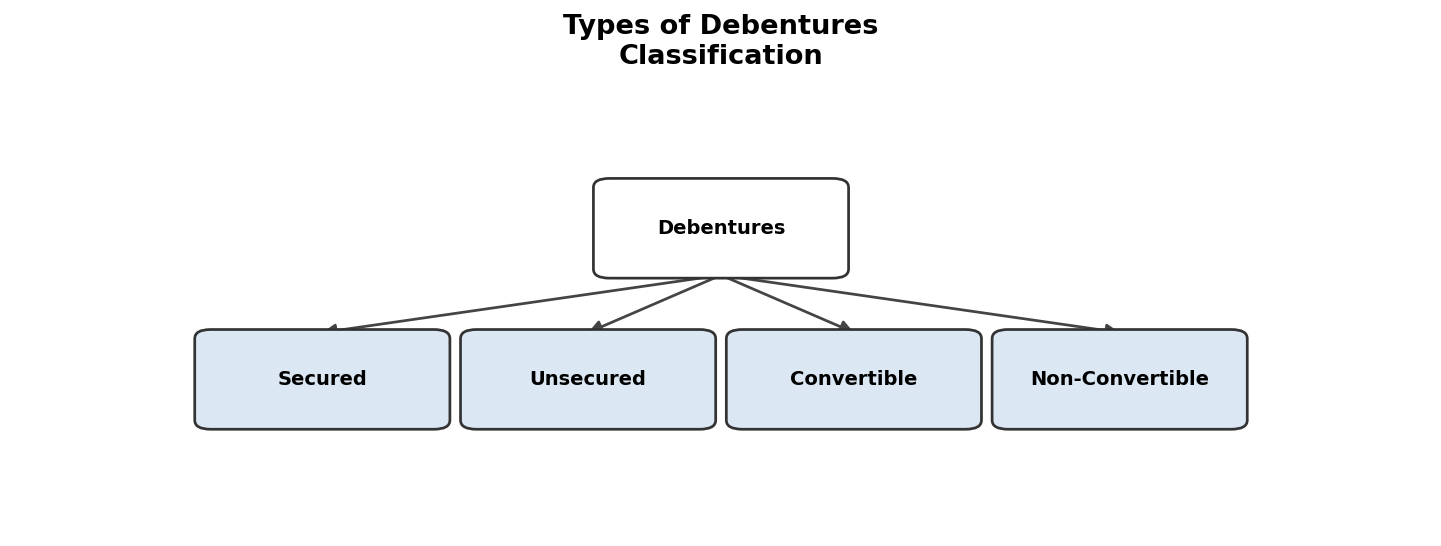
Q562 Marks
Based on the given flowchart, answer the following:
What type of debenture is not backed by any collateral?
ASecured
BUnsecured
CConvertible
DNon-Convertible
Name one type of secured debenture.
What is one method of redeeming debentures before maturity?
AAt Maturity
BBy Purchase
CBy Conversion
DNone of the above
Explain the term 'redemption at maturity'.
Show answersHide answers
1. Option 2 — Unsecured
2. Mortgage Debenture
3. Option 2 — By Purchase
4. Repayment of the principal amount on the due date.
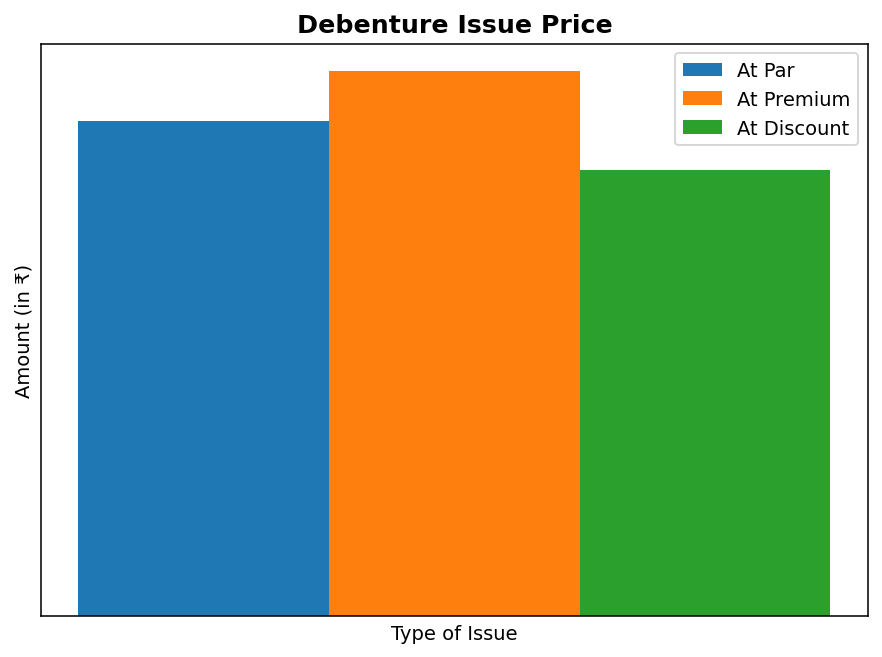
Q572 Marks
Based on the given chart, answer the following:
Which type of debenture is issued at ₹110?
AAt Par
BAt Premium
CAt Discount
DNone of the above
What is the issue price of debentures at discount?
Which type of debenture has the highest interest payment?
ASecured Debentures
BUnsecured Debentures
CConvertible Debentures
DNon-Convertible Debentures
What percentage of interest is paid on Non-Convertible Debentures?
Show answersHide answers
1. Option 2 — At Premium
2. ₹90
3. Option 1 — Secured Debentures
4. 10%
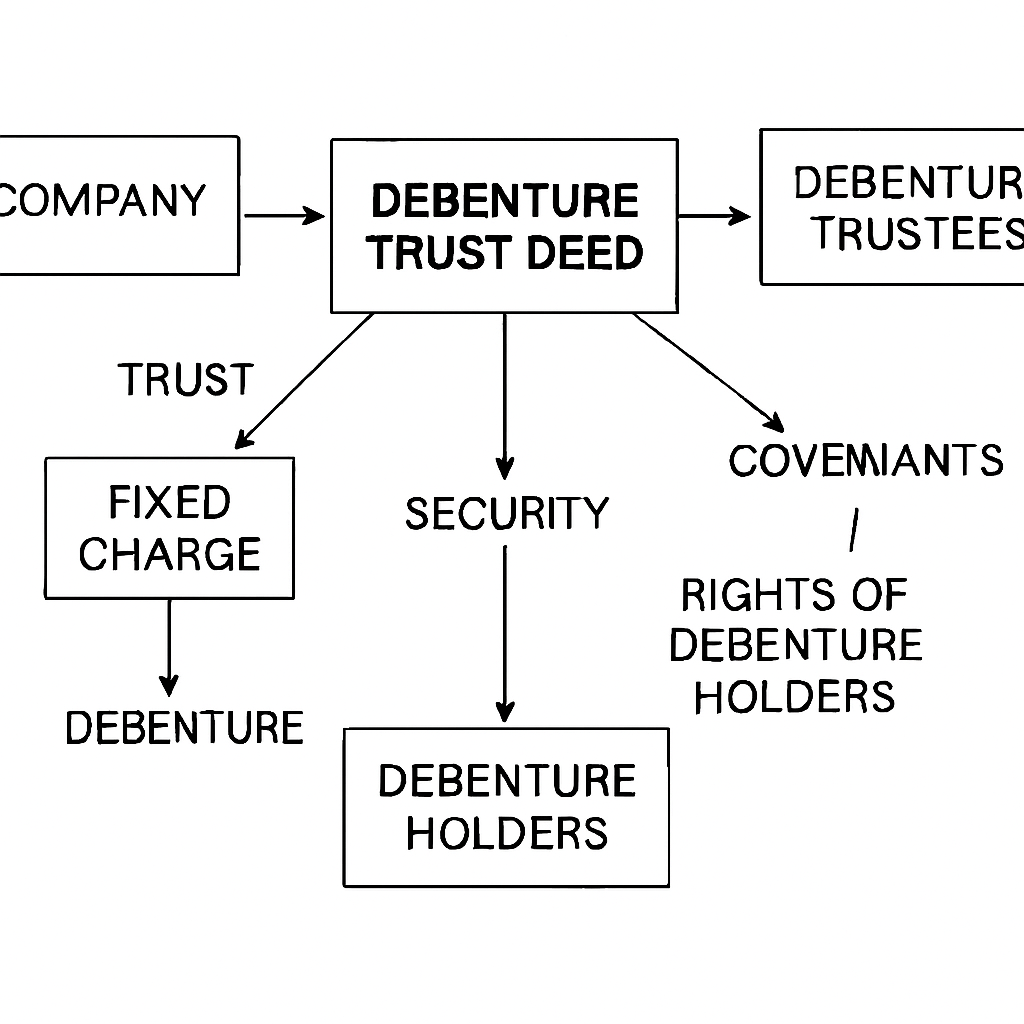
Q582 Marks
Based on the given diagram of a debenture trust deed, answer the following:
What is the primary purpose of a debenture trust deed?
Which party is typically responsible for managing the trust deed?