Financial Statements of a Company — Important Questions
58 questions
With answersCBSE format
SUMMARY: This chapter focuses on the preparation and presentation of financial statements of a company as per the prescribed format in the Companies Act, 2013. KEY TOPICS: Balance Sheet, Statement of Profit and Loss, Notes to Accounts, Schedule III of Companies Act 2013, Financial Statement Analysis, Share Capital, Reserves and Surplus, Non-current Liabilities, Current Liabilities, Assets.
Schedule III of the Companies Act 2013 prescribes the format for:
AIncome Tax Return
BBalance Sheet and P&L
CGST Returns
DAudit Report
Check answerHide answer
Correct answer: Option 2 — Balance Sheet and P&L
Q21 Mark
The Balance Sheet of a company is prepared in:
AHorizontal form only
BVertical form
CT-form
DBoth horizontal and vertical
Check answerHide answer
Correct answer: Option 2 — Vertical form
Q31 Mark
Provision for tax in the P&L is shown:
ABefore profit before tax
BAfter profit before tax
CAbove sales
DNot shown
Check answerHide answer
Correct answer: Option 2 — After profit before tax
Q41 Mark
Reserves and Surplus is shown under:
AEquity and Liabilities
BAssets
CBoth
DNeither
Check answerHide answer
Correct answer: Option 1 — Equity and Liabilities
Q51 Mark
Notes to accounts are prepared:
AOptional
BMandatory under Companies Act 2013
COnly for foreign companies
DRandom
Check answerHide answer
Correct answer: Option 2 — Mandatory under Companies Act 2013
Q61 Mark
What is the primary purpose of the Statement of Profit and Loss?
ATo show the financial position of a company
BTo summarize revenue and expenses over a period
CTo detail the cash flows of a company
DTo present the company's assets and liabilities
Check answerHide answer
Correct answer: Option 2 — To summarize revenue and expenses over a period
Q71 Mark
Which of the following is classified as a non-current liability?
AAccounts Payable
BBank Overdraft
CLong-term Borrowings
DAccrued Expenses
Check answerHide answer
Correct answer: Option 3 — Long-term Borrowings
Q81 Mark
In which section of the Balance Sheet would you find 'Share Capital'?
AAssets
BEquity
CLiabilities
DExpenses
Check answerHide answer
Correct answer: Option 2 — Equity
Q91 Mark
The total of current liabilities is found in which part of the Balance Sheet?
AEquity and Liabilities
BNon-current Assets
CCurrent Assets
DShareholder's Equity
Check answerHide answer
Correct answer: Option 1 — Equity and Liabilities
Q101 Mark
Which of the following is NOT included in the Notes to Accounts?
AAccounting Policies
BContingent Liabilities
CShareholder's Equity
DRelated Party Transactions
Check answerHide answer
Correct answer: Option 3 — Shareholder's Equity
Q111 Mark
What does 'Reserves and Surplus' represent in the Balance Sheet?
ATotal liabilities of the company
BAccumulated profits not distributed as dividends
CCurrent assets available for use
DInvestments made by shareholders
Check answerHide answer
Correct answer: Option 2 — Accumulated profits not distributed as dividends
Q121 Mark
Which of the following is true regarding the format of financial statements as per Schedule III?
AIt allows for flexibility in presentation
BIt is mandatory for all companies to follow
CIt is optional for listed companies
DIt is only applicable to private companies
Check answerHide answer
Correct answer: Option 2 — It is mandatory for all companies to follow
Q131 Mark
How are 'Current Assets' defined in the context of financial statements?
AAssets that are expected to be converted into cash within one year
BAssets that are held for more than one year
CAssets that are not easily liquidated
DAssets that are used in the production process
Check answerHide answer
Correct answer: Option 1 — Assets that are expected to be converted into cash within one year
Q141 Mark
Which of the following is an example of a current liability?
ABonds Payable
BDeferred Tax Liabilities
CShort-term Loans
DLong-term Debt
Check answerHide answer
Correct answer: Option 3 — Short-term Loans
Q151 Mark
The 'Statement of Profit and Loss' includes which of the following components?
AAssets and Liabilities
BRevenue and Expenses
CCash Flow and Equity
DCurrent and Non-current Assets
Check answerHide answer
Correct answer: Option 2 — Revenue and Expenses
Short Answer Questions10 questions
Q163 Marks
Explain the components of financial statements as per Companies Act 2013.
View sample solutionHide solution
As per Section 129 and Schedule III of Companies Act 2013 the financial statements of a company comprise: (1) Balance Sheet — financial position as at year-end; (2) Statement of P&L — financial performance for the year; (3) Cash Flow Statement — cash inflows and outflows; (4) Statement of Changes in Equity — for Ind AS-compliant entities; (5) Notes to Accounts — disclosures supporting the figures; (6) Auditor's Report — opinion on the truth and fairness of statements; (7) Director's Report — narrative of operations and management commentary. Together they give a comprehensive view of the company's financial health.
Q173 Marks
List the major heads on the Equity and Liabilities side of a company's balance sheet.
View sample solutionHide solution
Per Schedule III: (1) SHAREHOLDERS' FUNDS — Share Capital and Reserves & Surplus; (2) Share Application Money Pending Allotment; (3) NON-CURRENT LIABILITIES — Long-term Borrowings Deferred Tax Liabilities Long-term Provisions Other Long-term Liabilities; (4) CURRENT LIABILITIES — Short-term Borrowings Trade Payables Other Current Liabilities Short-term Provisions. Total Equity and Liabilities equals Total Assets. Each main head has supporting notes giving sub-classifications and details.
Q183 Marks
List the major heads on the Assets side of a company's balance sheet.
View sample solutionHide solution
(1) NON-CURRENT ASSETS — Property Plant and Equipment (PPE) and Intangible Assets; Capital Work-in-Progress; Intangible Assets under development; Investments; Long-term Loans and Advances; Other Non-current Assets. (2) CURRENT ASSETS — Inventories; Trade Receivables; Cash and Cash Equivalents; Short-term Loans and Advances; Other Current Assets. Each is supported by notes. Total Assets = Total Equity and Liabilities maintains the accounting equation.
Q193 Marks
Distinguish between current and non-current assets.
View sample solutionHide solution
Non-current assets: held for use over multiple operating cycles; expected benefit period > 12 months; valued at cost less accumulated depreciation. Examples: land, buildings, plant, machinery, long-term investments, goodwill. Current assets: held for short-term use; expected to be realised in cash within 12 months or one operating cycle whichever is longer. Examples: inventories, trade receivables (debtors), cash, short-term investments, prepaid expenses. The split helps users assess solvency (long-term) vs liquidity (short-term).
Q203 Marks
Explain the format of the Statement of Profit and Loss.
View sample solutionHide solution
As per Schedule III the P&L is presented vertically: I. Revenue from Operations + II. Other Income = Total Revenue. III. Less: Cost of Materials Consumed; Purchases; Changes in Inventories; Employee Benefit Expenses; Finance Costs; Depreciation and Amortisation; Other Expenses = Total Expenses. IV. Profit before Exceptional & Extraordinary Items and Tax (I+II)−III. V. Less: Exceptional Items. VI. Less: Extraordinary Items. VII. Less: Tax. VIII. Profit/(Loss) for the year. IX. Earnings per share (basic and diluted). The format separates operating from non-operating and recurring from non-recurring items for clearer analysis.
Q213 Marks
What is the purpose of the Notes to Accounts in financial statements?
View sample solutionHide solution
The Notes to Accounts provide additional information and explanations regarding the items in the financial statements, enhancing clarity and understanding for users. They include accounting policies, details of significant estimates, and breakdowns of specific line items.
Q223 Marks
Define 'Reserves and Surplus' as it appears in the balance sheet of a company.
View sample solutionHide solution
Reserves and Surplus refer to the portion of profits that are retained in the company rather than distributed as dividends. This includes retained earnings and various reserves created for specific purposes, reflecting the company's financial health.
Q233 Marks
What is Schedule III of the Companies Act 2013?
View sample solutionHide solution
Schedule III of the Companies Act 2013 provides the format for the preparation of financial statements, including the balance sheet and statement of profit and loss, ensuring consistency and transparency in reporting by companies in India.
Q243 Marks
How are 'Share Capital' and 'Reserves and Surplus' different in the context of a balance sheet?
View sample solutionHide solution
Share Capital represents the funds raised by a company through the issuance of shares, while Reserves and Surplus are profits retained in the business after dividends are paid. Share Capital is a liability to shareholders, whereas Reserves and Surplus reflect accumulated profits.
Q253 Marks
What are non-current liabilities, and can you give two examples?
View sample solutionHide solution
Non-current liabilities are obligations that a company expects to settle beyond one year. Examples include long-term loans and bonds payable, which are crucial for understanding a company's long-term financial commitments.
Long Answer Questions6 questions
Q266 Marks
Prepare the balance sheet of M/s Solar Ltd as at 31 March 2024 from the following information using Schedule III format: Equity Share Capital ₹500000; Reserves and Surplus ₹150000; Long-term Borrowings ₹200000; Trade Payables ₹50000; Property Plant and Equipment (net) ₹600000; Inventories ₹100000; Trade Receivables ₹120000; Cash ₹80000.
View sample solutionHide solution
Balance Sheet of M/s Solar Ltd as at 31 March 2024 (Schedule III). I. EQUITY AND LIABILITIES — (1) Shareholders' Funds: Share Capital 500000 + Reserves & Surplus 150000 = 650000; (2) Non-current Liabilities: Long-term Borrowings 200000; (3) Current Liabilities: Trade Payables 50000. Total = ₹900000. II. ASSETS — (1) Non-current Assets: PPE (net) 600000; (2) Current Assets: Inventories 100000 + Trade Receivables 120000 + Cash 80000 = 300000. Total = ₹900000. Both sides equal ₹900000 — balance sheet balances. Notes to accounts would detail share capital break-up, types of reserves, nature of long-term borrowings, etc.
Q276 Marks
Discuss the importance of Notes to Accounts and major disclosures.
View sample solutionHide solution
Notes to Accounts are integral to financial statements. They provide: (1) Significant accounting policies — methods of depreciation, inventory valuation, revenue recognition, foreign currency. (2) Detailed break-up of figures shown only as totals on the face of the statements (e.g., share capital break-up, types of reserves, classes of inventories). (3) Contingent liabilities — pending litigation, guarantees, claims not yet provided for. (4) Commitments — capital expenditure commitments, operating lease commitments. (5) Related party transactions — with directors, key management, subsidiaries. (6) Earnings per share computation. (7) Segment reporting (if applicable). Without notes the financial statements would be unintelligible — they are mandatory under Section 129 of Companies Act 2013.
Q286 Marks
Prepare the Statement of P&L of M/s Lite Ltd for the year ended 31 March 2024: Revenue from Operations ₹800000; Other Income ₹20000; Cost of Materials ₹350000; Employee Benefits ₹150000; Finance Costs ₹30000; Depreciation ₹50000; Other Expenses ₹80000; Tax @25%.
View sample solutionHide solution
Statement of P&L for the year ended 31 March 2024 (Schedule III): I. Revenue from Operations 800000; II. Other Income 20000; Total Revenue 820000. III. Total Expenses: Cost of Materials 350000 + Employee Benefits 150000 + Finance Costs 30000 + Depreciation 50000 + Other Expenses 80000 = 660000. IV. Profit before Tax 820000 − 660000 = 160000. V. Tax @25% × 160000 = 40000. VI. Profit for the year = 160000 − 40000 = ₹120000. EPS (assuming 10000 shares of ₹10 each) = 120000 / 10000 = ₹12. The vertical format clearly separates revenues from expenses and shows profit at each stage.
Q296 Marks
Explain the difference between trial balance and balance sheet.
View sample solutionHide solution
Trial Balance — list of all ledger account balances at a date showing debit and credit columns; checks ARITHMETICAL accuracy; not part of financial statements; preliminary working tool. Includes nominal accounts (revenues and expenses). Balance Sheet — formal statement of FINANCIAL POSITION as at a date; lists assets liabilities and equity; final output of accounting cycle; shared with stakeholders. Excludes nominal accounts (those are in P&L). Trial balance is internal; balance sheet is external. Balance sheet must follow Schedule III format; trial balance has no prescribed format. Both verify the dual aspect (debits = credits in TB; assets = liabilities + equity in BS) but serve different purposes.
Q306 Marks
Discuss the various methods of presentation of financial statements and their requirements.
View sample solutionHide solution
Companies Act 2013 prescribes Schedule III as the format. Two methods: (1) Vertical format — modern, used by all companies; equity & liabilities on top, assets below; subtotals at each level. Better for analysis. (2) Horizontal format — older T-format with assets on right and liabilities/capital on left; rarely used now. Indian companies must use vertical format. Ind AS-compliant entities (large companies) use Statement of Financial Position (Ind AS 1) similar to vertical format with additional disclosures. Other requirements: comparative figures of previous year on the face of every statement; notes referenced from the face; rounding off to nearest thousand or lakh as per company size.
Q316 Marks
What are the key components of a Balance Sheet as per Schedule III of the Companies Act, 2013, and how do they reflect the financial position of a company?
View sample solutionHide solution
The key components of a Balance Sheet as per Schedule III include Assets, Liabilities, and Equity. Assets are divided into non-current and current assets, while liabilities are categorized into non-current and current liabilities. Equity includes share capital and reserves. These components collectively provide a snapshot of a company's financial position at a specific point in time, indicating what the company owns and owes, and the residual interest of the shareholders.
Assertion–Reason Questions8 questions
Q321 Mark
Assertion (A): Schedule III prescribes the format of company balance sheet and P&L.
Reason (R): Schedule III is part of the Companies Act 2013 and ensures uniformity in presentation.
Show explanationHide explanation
Correct answer: Option 1 —
Both A and R are true, and R is the correct explanation of A.
Q331 Mark
Assertion (A): Notes to Accounts are integral to financial statements.
Reason (R): Without notes the financial statements would lack the detail needed to understand the figures.
Show explanationHide explanation
Correct answer: Option 1 —
Both A and R are true, and R is the correct explanation of A.
Q341 Mark
Assertion (A): Trade payables of less than 12 months are classified as current liabilities.
Reason (R): Current assets and liabilities relate to the operating cycle of the business or 12 months whichever is longer.
Show explanationHide explanation
Correct answer: Option 1 —
Both A and R are true, and R is the correct explanation of A.
Q351 Mark
Assertion (A): Equity Share Capital is part of Shareholders' Funds.
Reason (R): It represents owners' contribution that ranks last in liquidation but earns the residual profits.
Show explanationHide explanation
Correct answer: Option 1 —
Both A and R are true, and R is the correct explanation of A.
Q361 Mark
Assertion (A): EPS is required to be disclosed on the face of the Statement of P&L.
Reason (R): EPS helps shareholders assess earnings per equity share basic and diluted.
Show explanationHide explanation
Correct answer: Option 1 —
Both A and R are true, and R is the correct explanation of A.
Q371 Mark
Assertion (A): The Balance Sheet of a company provides information about its financial position at a specific point in time.
Reason (R): The Balance Sheet includes assets, liabilities, and shareholders' equity as per the Companies Act, 2013.
Show explanationHide explanation
Correct answer: Option 1 —
Both A and R are true, and R is the correct explanation of A.
Q381 Mark
Assertion (A): Reserves and Surplus are shown under the head 'Shareholders' Funds' in the Balance Sheet.
Reason (R): Reserves and Surplus represent retained earnings and other reserves available for distribution to shareholders.
Show explanationHide explanation
Correct answer: Option 1 —
Both A and R are true, and R is the correct explanation of A.
Q391 Mark
Assertion (A): Current Liabilities are obligations that a company expects to settle within one year.
Reason (R): Current Liabilities include trade payables, short-term loans, and other liabilities due within the operating cycle.
Show explanationHide explanation
Correct answer: Option 1 —
Both A and R are true, and R is the correct explanation of A.
Statement-Based Questions8 questions
Q401 Mark
Statement 1: Financial statements include Balance Sheet and P&L.
Statement 2: They also include Cash Flow Statement and Notes to Accounts.
Show answerHide answer
Correct answer: Option 1 —
Both statements are true.
Q411 Mark
Statement 1: The Balance Sheet has two sides: Equity and Liabilities and Assets.
Statement 2: The two sides must always be equal.
Show answerHide answer
Correct answer: Option 1 —
Both statements are true.
Q421 Mark
Statement 1: Revenue from Operations is the main source of company income.
Statement 2: Other Income includes interest dividend and gain on sale of investments.
Show answerHide answer
Correct answer: Option 1 —
Both statements are true.
Q431 Mark
Statement 1: Long-term borrowings appear under Non-current Liabilities.
Statement 2: Short-term borrowings due within 12 months appear under Current Liabilities.
Show answerHide answer
Correct answer: Option 1 —
Both statements are true.
Q441 Mark
Statement 1: PPE is classified as a non-current asset.
Statement 2: Inventories trade receivables and cash are current assets.
Show answerHide answer
Correct answer: Option 1 —
Both statements are true.
Q451 Mark
Statement 1: The Statement of Profit and Loss includes both revenue and expenses.
Statement 2: Notes to Accounts provide additional information that is not included in the main financial statements.
Show answerHide answer
Correct answer: Option 1 —
Both statements are true.
Q461 Mark
Statement 1: Reserves and Surplus are classified under Current Liabilities in the Balance Sheet.
Statement 2: Share Capital represents the funds raised by issuing shares to the public.
Show answerHide answer
Correct answer: Option 3 —
Only Statement 2 is true.
Q471 Mark
Statement 1: The Balance Sheet is prepared as per Schedule III of the Companies Act, 2013.
Statement 2: Current Liabilities include long-term borrowings.
Show answerHide answer
Correct answer: Option 2 —
Only Statement 1 is true.
Case Study / Passage Questions4 questions
Q483 Marks
M/s Solar Ltd has the following balances at 31 March 2024: Equity Share Capital ₹500000; Reserves and Surplus ₹150000; Long-term Borrowings ₹200000; Trade Payables ₹50000; Property Plant and Equipment (net) ₹600000; Inventories ₹100000; Trade Receivables ₹120000; Cash ₹80000.
Schedule III prescribes which format for the balance sheet?
AVertical
BHorizontal
CT-form
DRandom
Total Shareholders' Funds is:
A₹650000
B₹500000
C₹150000
D₹900000
Prepare the balance sheet in Schedule III format.
Show answersHide answers
1. Option 1 — Vertical
2. Option 1 — ₹650000
3. Schedule III (Companies Act 2013) prescribes the vertical format. Balance Sheet of M/s Solar Ltd as at 31 March 2024: I. EQUITY AND LIABILITIES — (1) Shareholders' Funds: Share Capital 500000 + Reserves & Surplus 150000 = ₹650000. (2) Non-current Liabilities: Long-term Borrowings 200000. (3) Current Liabilities: Trade Payables 50000. Total Equity & Liabilities = ₹900000. II. ASSETS — (1) Non-current Assets: PPE 600000. (2) Current Assets: Inventories 100000 + Trade Receivables 120000 + Cash 80000 = 300000. Total Assets = ₹900000. Both sides match — balance sheet balances. Notes to Accounts would detail the share capital break-up types of reserves and nature of long-term borrowings.
Q493 Marks
M/s Lite Ltd has the following data for the year ended 31 March 2024: Revenue from Operations ₹800000; Other Income ₹20000; Cost of Materials ₹350000; Employee Benefits ₹150000; Finance Costs ₹30000; Depreciation ₹50000; Other Expenses ₹80000; Tax @25%.
The first line item in the Statement of P&L is:
ATotal Revenue
BProfit before Tax
CTax
DProfit for the year
Profit for the year is:
A₹160000
B₹120000
C₹40000
D₹820000
Prepare the Statement of P&L for the year.
Show answersHide answers
1. Option 1 — Total Revenue
2. Option 2 — ₹120000
3. Statement of P&L for the year ended 31 March 2024 (Schedule III): I. Revenue from Operations 800000. II. Other Income 20000. Total Revenue (I+II) = 820000. III. Total Expenses: Cost of Materials 350000 + Employee Benefits 150000 + Finance Costs 30000 + Depreciation 50000 + Other Expenses 80000 = 660000. IV. Profit before Tax = 820000 − 660000 = ₹160000. V. Tax @25% × 160000 = ₹40000. VI. Profit for the year = 160000 − 40000 = ₹120000. The vertical format separates revenues from expenses and shows profit at each stage. EPS would be disclosed below if share information is available.
Q502 Marks
M/s Bharat Ltd publishes its annual report. The MD asks the CFO why so much detail is given in 'Notes to Accounts' which seem to repeat figures already in the financial statements.
Notes to Accounts are:
AJust supplementary
BIntegral part of financial statements
COptional disclosures
DInternal documents
Explain why Notes to Accounts are integral to financial statements.
Show answersHide answers
1. Option 2 — Integral part of financial statements
2. Notes to Accounts are integral to financial statements per Section 129 of Companies Act 2013. They provide: (1) Significant accounting policies — depreciation method inventory valuation revenue recognition foreign currency. (2) Detailed break-up of figures shown only as totals on the face of the statements (share capital break-up types of reserves classes of inventories). (3) Contingent liabilities — pending litigation guarantees claims not yet provided for. (4) Commitments — capital expenditure commitments operating lease commitments. (5) Related party transactions — with directors key management subsidiaries. (6) Earnings per share computation. (7) Segment reporting (if applicable). Without notes the financial statements would be unintelligible — they explain the figures and reveal the context. They are MANDATORY under Section 129.
Q514 Marks
The financial statements of a company are crucial for providing a clear picture of its financial health. According to the Companies Act, 2013, these statements typically include the Balance Sheet, Statement of Profit and Loss, and Notes to Accounts. The Balance Sheet presents a snapshot of the company's assets, liabilities, and equity at a specific point in time, while the Statement of Profit and Loss summarizes the company's revenues and expenses over a period, showing the net profit or loss. The Notes to Accounts provide additional details and explanations regarding the figures presented in the financial statements, enhancing transparency and aiding stakeholders in making informed decisions.
What are the main components of a company's financial statements as per the Companies Act, 2013?
Which financial statement provides a snapshot of a company's financial position at a specific point in time?
AStatement of Profit and Loss
BBalance Sheet
CCash Flow Statement
DIncome Statement
Why are the Notes to Accounts important in financial statements?
What does the Statement of Profit and Loss summarize?
AAssets and Liabilities
BRevenues and Expenses
CShareholder Equity
DCash Flows
Show answersHide answers
1. Balance Sheet, Statement of Profit and Loss, Notes to Accounts
2. Option 2 — Balance Sheet
3. They provide additional details and explanations regarding the figures presented.
4. Option 2 — Revenues and Expenses
Table-Based Questions4 questions
Q523 Marks
Equity and Liabilities heads on a company's balance sheet (Schedule III):
Head
Sub-head
Examples
Shareholders' Funds
Share Capital + Reserves & Surplus
Equity capital, general reserve, share premium
Share Application Money Pending Allotment
—
Application money in transit
Non-current Liabilities
Long-term Borrowings, Deferred Tax, Long-term Provisions, Other LT Liabilities
Bank loans, debentures, deferred tax
Current Liabilities
Short-term Borrowings, Trade Payables, Other CL, Short-term Provisions
Bank overdraft, creditors, taxes payable
The major heads of Equity and Liabilities side are:
AShareholders' Funds
BNon-current Liabilities
CCurrent Liabilities
DAll of these
Trade payables are classified as Current Liabilities.
AYes
BNo
CSometimes
DOnly with court order
Explain why liabilities are classified into shareholders' funds non-current and current.
Show answersHide answers
1. Option 4 — All of these
2. Option 1 — Yes
3. Schedule III categorises liabilities by nature and timing. Shareholders' Funds represents the owners' stake — share capital plus accumulated reserves. Non-current Liabilities have repayment obligations beyond 12 months — long-term loans debentures bonds and deferred tax. Current Liabilities have repayment within 12 months or one operating cycle — trade payables short-term borrowings other current liabilities and short-term provisions. The classification helps users assess solvency (long-term capital structure) and liquidity (short-term obligations).
Q533 Marks
Assets heads on a company's balance sheet (Schedule III):
Inventories, Trade Receivables, Cash & Cash Equivalents, ST Loans, Other
Stock, debtors, cash, prepaid
Capital Work-in-Progress
—
Building under construction
Intangible Assets under development
—
Software being developed
Land and Building is classified as:
ANon-current
BCurrent
CBoth
DNeither
A building under construction is shown as:
AInventories
BPPE
CCapital WIP
DTrade Receivables
Why are Capital Work-in-Progress and Intangible Assets under Development shown separately?
Show answersHide answers
1. Option 1 — Non-current
2. Option 3 — Capital WIP
3. Schedule III divides assets into non-current and current based on the operating cycle and 12-month criteria. Non-current Assets have benefit period > 12 months: Property Plant and Equipment (tangible long-term physical assets); Intangible Assets (goodwill software patents); Long-term Investments; Long-term Loans and Advances; Other non-current assets. Current Assets have benefit/realisation within 12 months: Inventories; Trade Receivables; Cash and Cash Equivalents; Short-term Loans and Advances; Other Current Assets. Capital Work-in-Progress (CWIP) and Intangible Assets under Development are special categories — assets being constructed/developed but not yet ready for use; shown separately to highlight ongoing investment.
Q546 Marks
Prepare a balance sheet of M/s Solar Ltd as at 31 March 2024 in Schedule III format.
Item
Amount
Equity Share Capital
₹500000
Reserves and Surplus
₹150000
Long-term Borrowings
₹200000
Trade Payables
₹50000
Property Plant and Equipment (net)
₹600000
Inventories
₹100000
Trade Receivables
₹120000
Cash
₹80000
Q556 Marks
Prepare the Statement of P&L of M/s Lite Ltd for the year ended 31 March 2024 in Schedule III format.
Item
Amount
Revenue from Operations
₹800000
Other Income
₹20000
Cost of Materials Consumed
₹350000
Employee Benefits Expense
₹150000
Finance Costs
₹30000
Depreciation
₹50000
Other Expenses
₹80000
Tax rate
25%
Picture-Based Questions3 questions
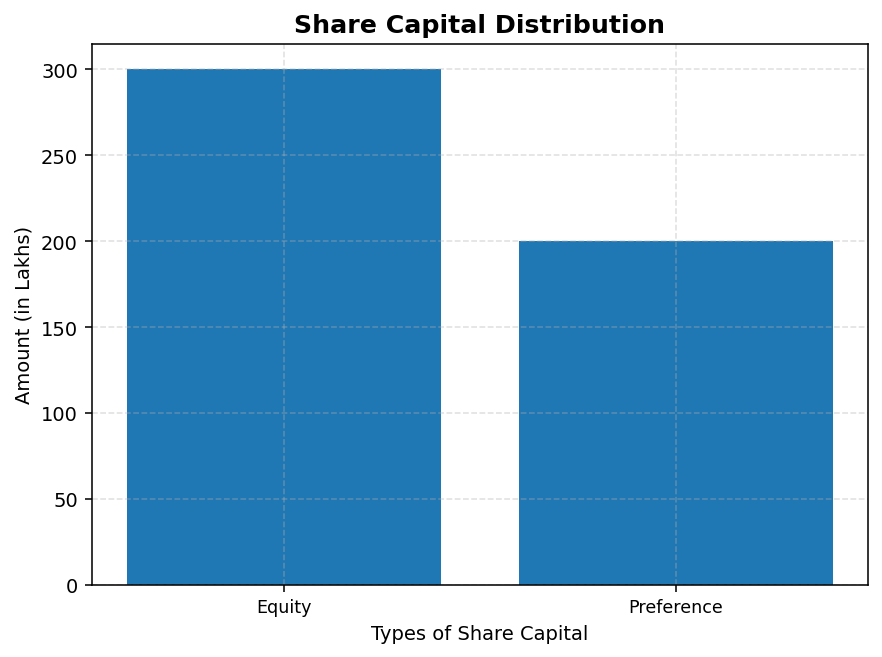
Q563 Marks
Based on the given chart, answer the following:
What is the total amount of share capital represented in the chart?
Which type of share capital has a higher amount?
AEquity Shares
BPreference Shares
CBoth are equal
DNone of the above
What percentage of the total share capital is made up of Equity Shares?
What percentage of the reserves is made up of General Reserve?
A40%
B30%
C20%
D50%
Which reserve has the least proportion in the composition?
AGeneral Reserve
BCapital Reserve
CSurplus
DNone of the above
What is the total percentage represented in the chart?
Show answersHide answers
1. 500 Lakhs
2. Option 1 — Equity Shares
3. 60%
4. Option 1 — 40%
5. Option 3 — Surplus
6. 100%
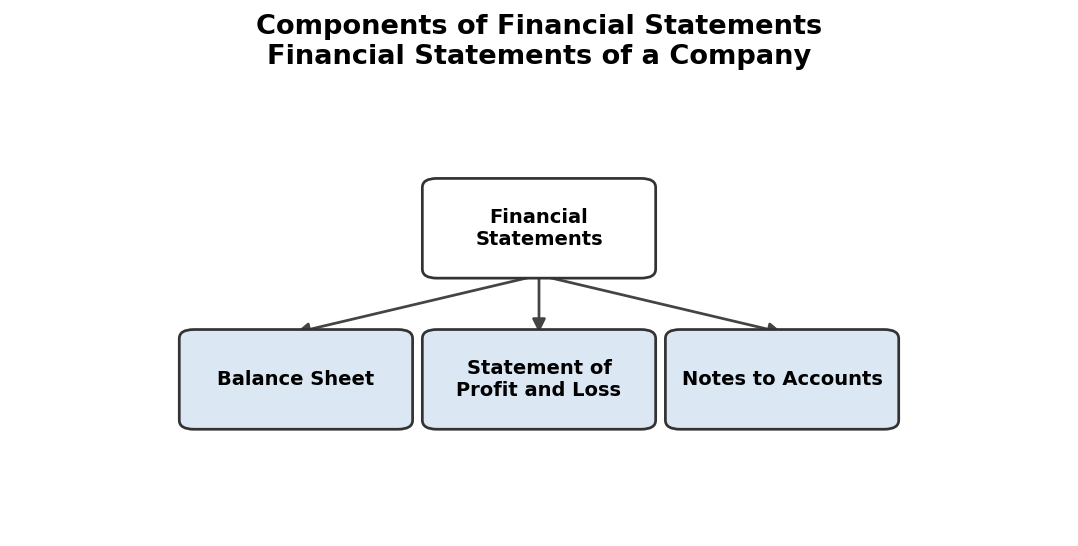
Q573 Marks
Based on the given flowchart, answer the following:
How many main components are identified in the flowchart?
ATwo
BThree
CFour
DFive
What is the primary focus of the flowchart?
Which component is NOT included in the flowchart?
ABalance Sheet
BCash Flow Statement
CStatement of Profit and Loss
DNotes to Accounts
How many types of liabilities are shown in the flowchart?
ATwo
BThree
CFour
DFive
What is an example of Current Liabilities?
Which type of liability is associated with long-term obligations?
ACurrent Liabilities
BNon-current Liabilities
CBoth
DNeither
Show answersHide answers
1. Option 2 — Three
2. Components of Financial Statements
3. Option 2 — Cash Flow Statement
4. Option 3 — Four
5. Short-term Debt
6. Option 2 — Non-current Liabilities
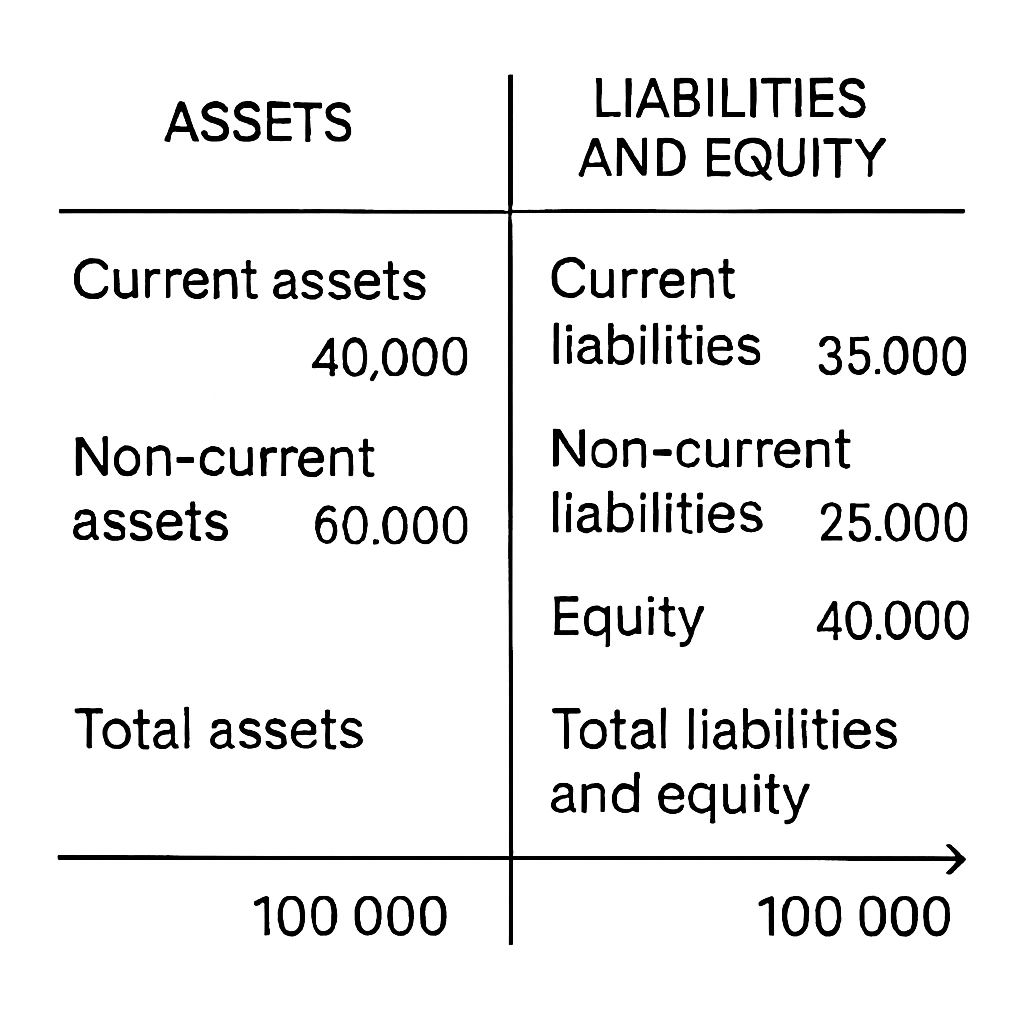
Q583 Marks
Based on the given diagram of the Balance Sheet, answer the following:
What are the two main sections of the Balance Sheet?
AAssets and Liabilities
BIncome and Expenses
CRevenue and Profit
DCash and Bank
What does the Assets section represent?
Which of the following is typically found under Liabilities?