SUMMARY: The chapter on Cash Flow Statement in Class 12 Accountancy focuses on understanding the preparation and analysis of cash flow statements as per the accounting standards. KEY TOPICS: Cash flow from operating activities, cash flow from investing activities, cash flow from financing activities, direct method, indirect method, cash and cash equivalents, non-cash transactions, significance of cash flow statement, preparation of cash flow statement, limitations of cash flow statement.
Which of the following is NOT a component of cash flow from operating activities?
ACash receipts from customers
BCash payments to suppliers
CSale of equipment
DCash payments for operating expenses
Check answerHide answer
Correct answer: Option 3 — Sale of equipment
Q71 Mark
In the cash flow statement, which method involves adjusting net income for changes in working capital?
ADirect method
BIndirect method
CHybrid method
DStandard method
Check answerHide answer
Correct answer: Option 2 — Indirect method
Q81 Mark
Which of the following is considered a cash equivalent?
AShort-term investments
BAccounts receivable
CInventory
DLong-term bonds
Check answerHide answer
Correct answer: Option 1 — Short-term investments
Q91 Mark
Which activity would be classified under cash flow from investing activities?
APayment of wages
BPurchase of machinery
CIssuance of debentures
DPayment of dividends
Check answerHide answer
Correct answer: Option 2 — Purchase of machinery
Q101 Mark
What is the significance of the cash flow statement?
AIt shows the profitability of a company
BIt provides information about cash inflows and outflows
CIt reflects the company's market value
DIt summarizes the equity of the company
Check answerHide answer
Correct answer: Option 2 — It provides information about cash inflows and outflows
Q111 Mark
Which of the following transactions is classified as a non-cash transaction?
AIssuing shares for cash
BAcquisition of assets through a loan
CCash sales to customers
DPayment of cash for expenses
Check answerHide answer
Correct answer: Option 2 — Acquisition of assets through a loan
Q121 Mark
When preparing a cash flow statement using the direct method, which of the following is included?
ANet income
BCash received from customers
CDepreciation expense
DChanges in accounts payable
Check answerHide answer
Correct answer: Option 2 — Cash received from customers
Q131 Mark
Which of the following is NOT a limitation of the cash flow statement?
ADoes not provide information about profitability
BIgnores non-cash transactions
CDoes not reflect future cash flows
DShows only cash transactions
Check answerHide answer
Correct answer: Option 4 — Shows only cash transactions
Q141 Mark
What type of cash flow is generated from the sale of a long-term asset?
AOperating cash flow
BInvesting cash flow
CFinancing cash flow
DNon-operating cash flow
Check answerHide answer
Correct answer: Option 2 — Investing cash flow
Q151 Mark
Which of the following is an example of cash flow from financing activities?
APayment of interest
BSale of investments
CIssuance of shares
DPurchase of inventory
Check answerHide answer
Correct answer: Option 3 — Issuance of shares
Short Answer Questions10 questions
Q163 Marks
Define cash flow statement and state its objectives.
View sample solutionHide solution
Cash Flow Statement is a financial statement that shows the inflow and outflow of cash and cash equivalents during a period classified into three activities — operating investing and financing. Objectives: (1) Provide information about cash receipts and payments; (2) Show how the company has generated and used cash; (3) Help assess liquidity and solvency; (4) Help users predict future cash flows; (5) Show the relationship between profit and cash flow (net profit ≠ cash). Mandatory under AS-3 and Companies Act 2013 for companies above specified threshold.
Q173 Marks
Explain the three activities under which cash flows are classified.
View sample solutionHide solution
OPERATING activities: cash flows from primary revenue-generating activities — receipts from sales of goods/services; payments to suppliers; payments to and on behalf of employees; tax payments. INVESTING activities: cash flows from acquisition and disposal of non-current assets — purchase/sale of fixed assets investments and intangibles; loans given. FINANCING activities: cash flows that result in changes in size and composition of equity and borrowings — issue of shares debentures or borrowings; repayment of debt; payment of dividend interest. The three-way split reveals how the company is funded and where its money is going.
Q183 Marks
Distinguish between direct and indirect methods of preparing cash flow from operating activities.
View sample solutionHide solution
DIRECT METHOD: directly lists major classes of cash receipts and payments (cash from sales cash to suppliers cash to employees etc.). Provides clearer information but requires extensive cash book analysis. Less commonly used. INDIRECT METHOD: starts with net profit before tax and adjusts for: (a) non-cash items (depreciation amortisation); (b) operating items not affecting cash this period (changes in receivables payables inventories); (c) items shown elsewhere (interest dividend gain/loss on sale of fixed assets). More commonly used because it reconciles profit and cash flow. Indian companies typically use indirect method.
Q193 Marks
How is depreciation treated in the cash flow statement under indirect method?
View sample solutionHide solution
Depreciation is a NON-CASH expense — it reduces profit but does not involve cash outflow. Under the indirect method (which starts with net profit before tax) depreciation is ADDED BACK to profit to arrive at cash flow from operating activities. Treatment: Net Profit Before Tax + Depreciation + Amortisation + Loss on sale of fixed assets − Gain on sale of fixed assets ± changes in working capital items = Cash from Operating Activities. The same logic applies to other non-cash items.
Q203 Marks
Explain the treatment of interest paid and dividend paid in cash flow statement.
View sample solutionHide solution
Interest PAID: in case of NON-FINANCIAL companies — treated as FINANCING activity (cash outflow). For financial companies (banks NBFCs) — operating activity. Dividend PAID: always FINANCING activity (cash outflow to equity holders). Interest RECEIVED: NON-FINANCIAL — INVESTING activity; FINANCIAL — operating. Dividend RECEIVED: NON-FINANCIAL — INVESTING activity; FINANCIAL — operating. The rationale: interest and dividends are returns from/on capital — for non-financial companies these are not part of the main business. Indian standard AS-3 specifies these treatments.
Q213 Marks
What are cash and cash equivalents, and why are they important in a cash flow statement?
View sample solutionHide solution
Cash and cash equivalents include cash on hand, demand deposits, and short-term investments that are easily convertible to cash. They are important in a cash flow statement as they represent the liquidity of a company and its ability to meet short-term obligations.
Q223 Marks
Describe the significance of a cash flow statement for stakeholders in a business.
View sample solutionHide solution
A cash flow statement provides stakeholders, such as investors and creditors, with insights into a company's cash generation and usage. It helps assess the company's liquidity, financial health, and ability to generate cash for future growth.
Q233 Marks
What is the difference between cash flow from operating activities and cash flow from investing activities?
View sample solutionHide solution
Cash flow from operating activities refers to cash generated or used in the core business operations, while cash flow from investing activities involves cash transactions for the purchase or sale of long-term assets. Both are essential for understanding a company's overall cash position.
Q243 Marks
Explain how non-cash transactions are reported in a cash flow statement.
View sample solutionHide solution
Non-cash transactions, such as barter exchanges or depreciation, are not included in the cash flow statement as they do not affect cash. However, they may be disclosed in the notes to the financial statements to provide additional context to stakeholders.
Q253 Marks
How do changes in working capital affect the cash flow from operating activities?
View sample solutionHide solution
Changes in working capital, such as increases in accounts receivable or inventory, can decrease cash flow from operating activities, while decreases in these accounts can increase cash flow. This reflects the cash impact of operational efficiency and management of current assets and liabilities.
Long Answer Questions6 questions
Q266 Marks
Calculate Cash from Operating Activities (indirect method) from the following: Net Profit Before Tax ₹100000; Depreciation ₹20000; Loss on Sale of Asset ₹5000; Increase in Trade Receivables ₹15000; Decrease in Inventories ₹10000; Increase in Trade Payables ₹8000; Income Tax Paid ₹25000.
View sample solutionHide solution
Cash from Operating Activities (Indirect Method): Net Profit Before Tax 100000. ADD non-cash items: Depreciation 20000; Loss on sale of asset 5000. = 125000. Adjust for changes in working capital: Less Increase in Trade Receivables 15000; Add Decrease in Inventories 10000; Add Increase in Trade Payables 8000. = 125000 − 15000 + 10000 + 8000 = 128000. Less Income Tax Paid 25000. CASH FROM OPERATING ACTIVITIES = 128000 − 25000 = ₹103000. The adjustments convert accrual-based net profit to cash basis.
Q276 Marks
Compute Cash from Investing Activities from: Purchase of fixed assets ₹120000; Sale of investments ₹30000; Sale of fixed asset for ₹15000 (book value ₹20000); Interest received on investments ₹5000; Purchase of investments ₹40000.
View sample solutionHide solution
Cash from Investing Activities: Outflows — Purchase of fixed assets (120000); Purchase of investments (40000) = (160000). Inflows — Sale of investments 30000; Sale of fixed assets 15000; Interest received 5000 = 50000. NET CASH USED IN INVESTING = 50000 − 160000 = (110000). The loss on sale of fixed asset (book value 20000 − sale 15000 = ₹5000) does NOT enter investing activities directly — it was already added back to profit in operating activities (since it is a non-cash loss). Only the actual cash inflow ₹15000 from the sale enters investing.
Q286 Marks
Compute Cash from Financing Activities from: Proceeds from issue of equity shares ₹200000; Proceeds from debentures issue ₹100000; Repayment of long-term loan ₹50000; Dividend paid ₹40000; Interest paid ₹15000.
View sample solutionHide solution
Cash from Financing Activities: Inflows — Proceeds from issue of shares 200000; Proceeds from debentures 100000 = 300000. Outflows — Repayment of long-term loan (50000); Dividend paid (40000); Interest paid (15000) = (105000). NET CASH FROM FINANCING = 300000 − 105000 = ₹195000. Financing activities reflect changes in equity and long-term borrowings; the firm has raised ₹300000 in capital and used ₹105000 for repayments and distributions netting +₹195000 inflow.
Q296 Marks
Prepare a complete cash flow statement from the following: Operating activities — Net Profit Before Tax ₹150000, Depreciation ₹30000, Increase in receivables ₹25000, Decrease in inventories ₹15000, Tax paid ₹35000. Investing activities — Purchase of fixed assets ₹120000, Sale of investments ₹20000. Financing activities — Issue of shares ₹100000, Repayment of debentures ₹50000, Dividend paid ₹20000.
View sample solutionHide solution
CASH FLOW STATEMENT for the year ended 31 March 2024. (A) Operating: NP Before Tax 150000 + Depreciation 30000 = 180000; Less Increase in Receivables (25000); Add Decrease in Inventories 15000; = 170000. Less Tax paid (35000). Cash from Operating = 135000. (B) Investing: Purchase of fixed assets (120000) + Sale of investments 20000 = (100000). Cash used in Investing = (100000). (C) Financing: Issue of shares 100000 + Repayment of debentures (50000) + Dividend paid (20000) = 30000. Cash from Financing = 30000. Net increase in cash = 135000 − 100000 + 30000 = 65000. Add Opening cash balance + Net increase = Closing cash balance.
Q306 Marks
Explain the format of cash flow statement under indirect method and the treatment of various items.
View sample solutionHide solution
Format under indirect method (AS-3): I. CASH FROM OPERATING ACTIVITIES — start with NP Before Tax; ADD non-cash items (depreciation amortisation goodwill written off loss on sale of fixed asset); SUBTRACT non-operating items already included (gain on sale interest received dividend received); adjust for working capital changes (increase in current assets or decrease in current liabilities = subtract; opposite = add); subtract income tax paid. II. CASH FROM INVESTING — purchases and sales of fixed assets/investments; interest/dividend received (for non-financial companies). III. CASH FROM FINANCING — issue of shares debentures borrowings (inflows); repayment dividend interest paid (outflows). Net change = I + II + III; opening + net change = closing cash and cash equivalents.
Q316 Marks
Differentiate between cash flow statement and fund flow statement in tabular form.
Assertion–Reason Questions8 questions
Q321 Mark
Assertion (A): Cash flows are classified into operating investing and financing activities.
Reason (R): Each category captures cash flows from a different aspect of business operations.
Show explanationHide explanation
Correct answer: Option 1 —
Both A and R are true, and R is the correct explanation of A.
Q331 Mark
Assertion (A): Depreciation is added back to net profit in the indirect method.
Reason (R): Depreciation is a non-cash expense that does not involve outflow of cash.
Show explanationHide explanation
Correct answer: Option 1 —
Both A and R are true, and R is the correct explanation of A.
Q341 Mark
Assertion (A): Interest paid by a non-financial company is shown under financing activities.
Reason (R): Interest paid represents the cost of borrowing — directly related to financing decisions.
Show explanationHide explanation
Correct answer: Option 1 —
Both A and R are true, and R is the correct explanation of A.
Q351 Mark
Assertion (A): Dividend paid is shown under financing activities.
Reason (R): Dividend paid is a return to shareholders related to the financing of the company.
Show explanationHide explanation
Correct answer: Option 1 —
Both A and R are true, and R is the correct explanation of A.
Q361 Mark
Assertion (A): The indirect method reconciles net profit with cash flow.
Reason (R): The indirect method starts with profit and adjusts for non-cash and non-operating items.
Show explanationHide explanation
Correct answer: Option 1 —
Both A and R are true, and R is the correct explanation of A.
Q371 Mark
Assertion (A): Cash flow from operating activities includes cash receipts from customers.
Reason (R): Cash flow from operating activities is derived from the core business operations of a company.
Show explanationHide explanation
Correct answer: Option 1 —
Both A and R are true, and R is the correct explanation of A.
Q381 Mark
Assertion (A): The direct method of preparing a cash flow statement is more commonly used than the indirect method.
Reason (R): The direct method provides a clearer view of cash inflows and outflows.
Show explanationHide explanation
Correct answer: Option 4 —
A is false, but R is true.
Q391 Mark
Assertion (A): Cash equivalents are short-term investments that are easily convertible to cash.
Reason (R): Cash equivalents include items like treasury bills and commercial paper.
Show explanationHide explanation
Correct answer: Option 1 —
Both A and R are true, and R is the correct explanation of A.
Statement-Based Questions8 questions
Q401 Mark
Statement 1: The cash flow statement shows how the firm has generated and used cash.
Statement 2: It complements the P&L Account and Balance Sheet.
Show answerHide answer
Correct answer: Option 1 —
Both statements are true.
Q411 Mark
Statement 1: Cash from operating activities is the primary source of long-term funding.
Statement 2: Insufficient cash from operations indicates underlying business problems.
Show answerHide answer
Correct answer: Option 1 —
Both statements are true.
Q421 Mark
Statement 1: Investing activities reflect long-term capital deployment.
Statement 2: Net negative investing cash flow often indicates capital expansion.
Show answerHide answer
Correct answer: Option 1 —
Both statements are true.
Q431 Mark
Statement 1: Financing activities reflect changes in equity and borrowings.
Statement 2: Net positive financing cash flow indicates the firm has raised more capital than it has returned.
Show answerHide answer
Correct answer: Option 1 —
Both statements are true.
Q441 Mark
Statement 1: Cash equivalents are short-term highly liquid investments.
Statement 2: They include money in bank fixed deposits with maturity less than 3 months.
Show answerHide answer
Correct answer: Option 1 —
Both statements are true.
Q451 Mark
Statement 1: Cash flow from operating activities includes cash received from customers and cash paid to suppliers.
Statement 2: Cash flow from investing activities includes cash transactions for the purchase and sale of fixed assets.
Show answerHide answer
Correct answer: Option 1 —
Both statements are true.
Q461 Mark
Statement 1: The direct method of preparing the cash flow statement is more commonly used than the indirect method.
Statement 2: The indirect method adjusts net income for changes in non-cash items and working capital.
Show answerHide answer
Correct answer: Option 3 —
Only Statement 2 is true.
Q471 Mark
Statement 1: Cash equivalents can include stocks and bonds that are easily convertible to cash.
Statement 2: Cash equivalents must have a maturity of three months or less from the date of acquisition.
Show answerHide answer
Correct answer: Option 2 —
Only Statement 1 is true.
Case Study / Passage Questions4 questions
Q483 Marks
M/s Sundar Stores has these data for FY 2023-24: Net Profit Before Tax ₹100000; Depreciation ₹20000; Loss on Sale of Asset ₹5000; Increase in Trade Receivables ₹15000; Decrease in Inventories ₹10000; Increase in Trade Payables ₹8000; Income Tax Paid ₹25000.
The method described is:
ADirect
BIndirect
CEither
DBoth
Depreciation in indirect method is:
AAdd to net profit
BSubtract from net profit
CNo effect
DGoes to investing
Compute cash from operating activities and explain the adjustments.
Show answersHide answers
1. Option 2 — Indirect
2. Option 1 — Add to net profit
3. Cash from Operating Activities (Indirect Method): Net Profit Before Tax 100000. ADD non-cash items: Depreciation 20000; Loss on sale of asset 5000. = 125000. Adjust for changes in working capital: Less Increase in Trade Receivables 15000; Add Decrease in Inventories 10000; Add Increase in Trade Payables 8000. = 125000 − 15000 + 10000 + 8000 = 128000. Less Income Tax Paid 25000. CASH FROM OPERATING ACTIVITIES = 128000 − 25000 = ₹103000. The adjustments convert accrual-based net profit to cash basis. Logic: depreciation is non-cash (added back); changes in working capital reflect timing differences between earning revenue and receiving cash.
Q493 Marks
M/s Verma Ltd has these investing activities for FY 2023-24: Purchase of Fixed Assets ₹120000; Sale of Investments ₹30000; Sale of Fixed Asset for ₹15000 (book value ₹20000); Interest received on investments ₹5000; Purchase of Investments ₹40000.
Sale of investments is shown under:
AOperating
BInvesting
CFinancing
DOperating + Investing
Purchase of fixed assets represents:
ACash inflow
BCash outflow
CBoth
DNo effect
Compute cash from investing activities and explain treatment of loss on sale.
Show answersHide answers
1. Option 2 — Investing
2. Option 2 — Cash outflow
3. Cash from Investing Activities: Outflows — Purchase of fixed assets (120000); Purchase of investments (40000) = (160000). Inflows — Sale of investments 30000; Sale of fixed assets 15000; Interest received 5000 = 50000. NET CASH USED IN INVESTING = 50000 − 160000 = (110000). Note: The loss on sale of fixed asset (book value 20000 − sale 15000 = ₹5000) does NOT enter investing activities directly — it was already added back to profit in operating activities (since it is a non-cash loss). Only the actual cash inflow ₹15000 from the sale enters investing. Same principle for gain/loss treatment. Investing activities reflect long-term capital deployment — a net negative often indicates capital expansion which is healthy if returns justify it.
Q503 Marks
M/s Pooja Industries has these financing activities for FY 2023-24: Proceeds from issue of equity shares ₹200000; Proceeds from debentures issue ₹100000; Repayment of long-term loan ₹50000; Dividend paid ₹40000; Interest paid ₹15000.
Issue of shares is shown under:
AOperating
BInvesting
CFinancing
DAll
Dividend paid is treated as:
AOutflow
BInflow
CBoth
DNo effect
Compute cash from financing activities and explain treatment of interest and dividend.
Show answersHide answers
1. Option 3 — Financing
2. Option 1 — Outflow
3. Cash from Financing Activities: Inflows — Proceeds from issue of shares 200000; Proceeds from debentures 100000 = 300000. Outflows — Repayment of long-term loan (50000); Dividend paid (40000); Interest paid (15000) = (105000). NET CASH FROM FINANCING = 300000 − 105000 = ₹195000. Financing activities reflect changes in equity and long-term borrowings: the firm has raised ₹300000 in capital and used ₹105000 for repayments and distributions netting +₹195000 inflow. Note: Interest paid is treated as financing (for non-financial companies) per AS-3 — it represents the cost of borrowing directly related to financing decisions. Dividend paid is always financing — it is a return to shareholders related to the financing of the company.
Q513 Marks
The Cash Flow Statement is a financial report that provides a detailed analysis of what happened to a business's cash during a specific period. It breaks down cash flows into three main categories: operating activities, investing activities, and financing activities. Cash flow from operating activities includes cash generated from the core business operations, while cash flow from investing activities reflects cash used for investments in assets and securities. Financing activities show the cash inflows and outflows related to borrowing and equity financing. The statement is crucial for assessing the liquidity and financial health of a business, as it highlights the cash available for operations and investments. Understanding cash flow is essential for stakeholders to make informed decisions regarding the company's financial performance and sustainability.
Which of the following is NOT a category of cash flow activities?
AOperating Activities
BInvesting Activities
CFinancing Activities
DTax Activities
What is the primary purpose of a Cash Flow Statement?
Cash flow from operating activities primarily includes cash generated from which of the following?
AInvestments
BCore business operations
CBorrowing
DEquity financing
Show answersHide answers
1. Option 4 — Tax Activities
2. To provide a detailed analysis of cash inflows and outflows during a specific period.
3. Option 2 — Core business operations
Table-Based Questions4 questions
Q523 Marks
Three activities classification under Cash Flow Statement (AS-3):
Activity
Description
Examples
Operating
Primary revenue-generating
Cash from sales, payments to suppliers/employees, tax paid
Investing
Acquisition/disposal of long-term assets
Purchase/sale of fixed assets/investments
Financing
Changes in equity and borrowings
Issue of shares/debentures, repayment of loans, dividend paid
Issue of debentures is classified as:
AOperating
BInvesting
CFinancing
DOperating + Financing
Purchase of investments is classified as:
AOperating
BInvesting
CFinancing
DOperating + Investing
Why are cash flows classified into three categories?
Show answersHide answers
1. Option 3 — Financing
2. Option 2 — Investing
3. Cash flows are classified into three categories per AS-3 to provide users with useful information about cash generation and use. Operating activities are the main revenue-generating activities — typically the largest source of cash for a healthy business. Investing activities reflect long-term capital deployment — purchases of fixed assets and investments are outflows; sales are inflows. Financing activities reflect changes in equity and long-term debt — raising capital is an inflow; repayment dividend interest are outflows. Net change in cash = Operating + Investing + Financing. The classification reveals how the firm has generated cash (operations vs financing) and what it has done with it (investments vs distributions).
Q533 Marks
Treatment of common items in Cash Flow Statement (Indirect Method):
Item
Treatment
Where shown
Depreciation
Add back to profit
Operating
Loss on sale of asset
Add back
Operating
Gain on sale of asset
Subtract
Operating
Increase in receivables
Subtract
Operating (working capital)
Increase in payables
Add
Operating (working capital)
Interest paid (non-financial co.)
Outflow
Financing
Dividend paid
Outflow
Financing
Interest received
Inflow
Investing
Loss on sale of asset is treated in indirect method by:
AAdd to profit
BSubtract from profit
CNo effect
DGoes to investing
Interest paid by non-financial company is shown under:
AOperating
BInvesting
CFinancing
DEither
Why is loss on sale of asset added back in operating activities?
Show answersHide answers
1. Option 1 — Add to profit
2. Option 3 — Financing
3. Each item has specific treatment in the Cash Flow Statement. Non-cash items (depreciation amortisation goodwill written off) are added back to profit. Gain/loss on sale of fixed assets is non-operating — added back (loss) or subtracted (gain) from profit and the actual cash inflow goes to investing. Working capital changes: increase in current assets or decrease in current liabilities = subtracted (cash used); opposite = added. Interest received is investing; interest paid by non-financial co. is financing; for financial cos. (banks) interest is operating. Dividend paid is always financing. Following these rules ensures the Operating + Investing + Financing = Net change in cash = Closing − Opening cash.
Q546 Marks
Compute Cash from Operating Activities (Indirect Method) from the data of M/s Sundar Stores.
Item
Amount
Net Profit Before Tax
₹100000
Depreciation
₹20000
Loss on Sale of Asset
₹5000
Increase in Trade Receivables
₹15000
Decrease in Inventories
₹10000
Increase in Trade Payables
₹8000
Income Tax Paid
₹25000
Q556 Marks
Compute Cash from Investing Activities and Financing Activities from the data below.
Item
Amount
Purchase of Fixed Assets
₹120000
Sale of Investments
₹30000
Sale of Fixed Asset
₹15000
Interest received
₹5000
Purchase of Investments
₹40000
Issue of equity shares
₹200000
Issue of debentures
₹100000
Repayment of long-term loan
₹50000
Dividend paid
₹40000
Interest paid
₹15000
Picture-Based Questions3 questions
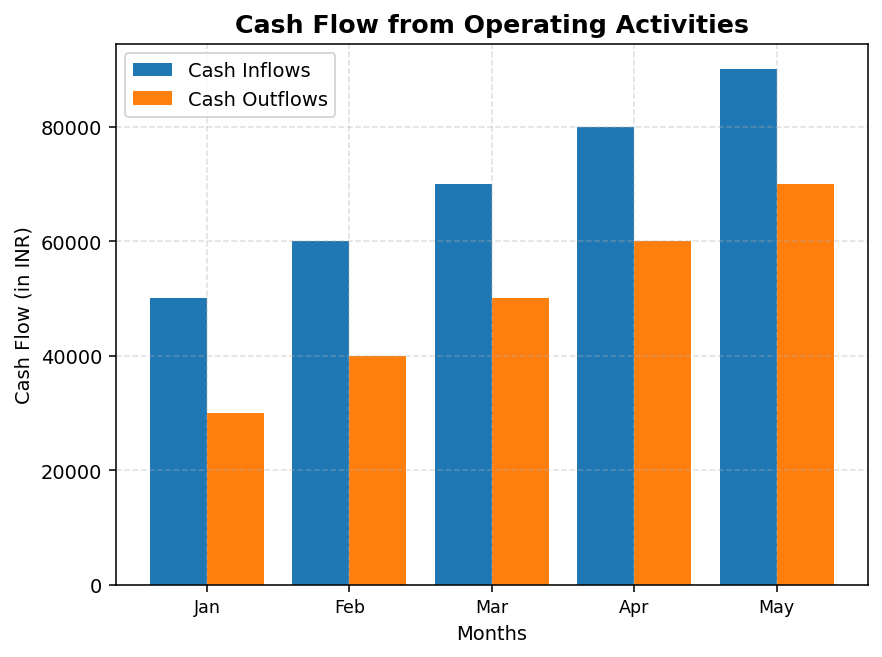
Q562 Marks
Based on the given chart, answer the following:
What is the cash flow from operating activities in March?
AINR 20000
BINR 30000
CINR 40000
DINR 50000
Calculate the total cash inflow for the given months.
Which activity has the highest cash flow in investing activities?
APurchase of Assets
BSale of Assets
CInvestments
DDividends Received
What percentage of cash flow is attributed to 'Sale of Assets'?
Show answersHide answers
1. Option 3 — INR 40000
2. INR 400000
3. Option 1 — Purchase of Assets
4. 30%
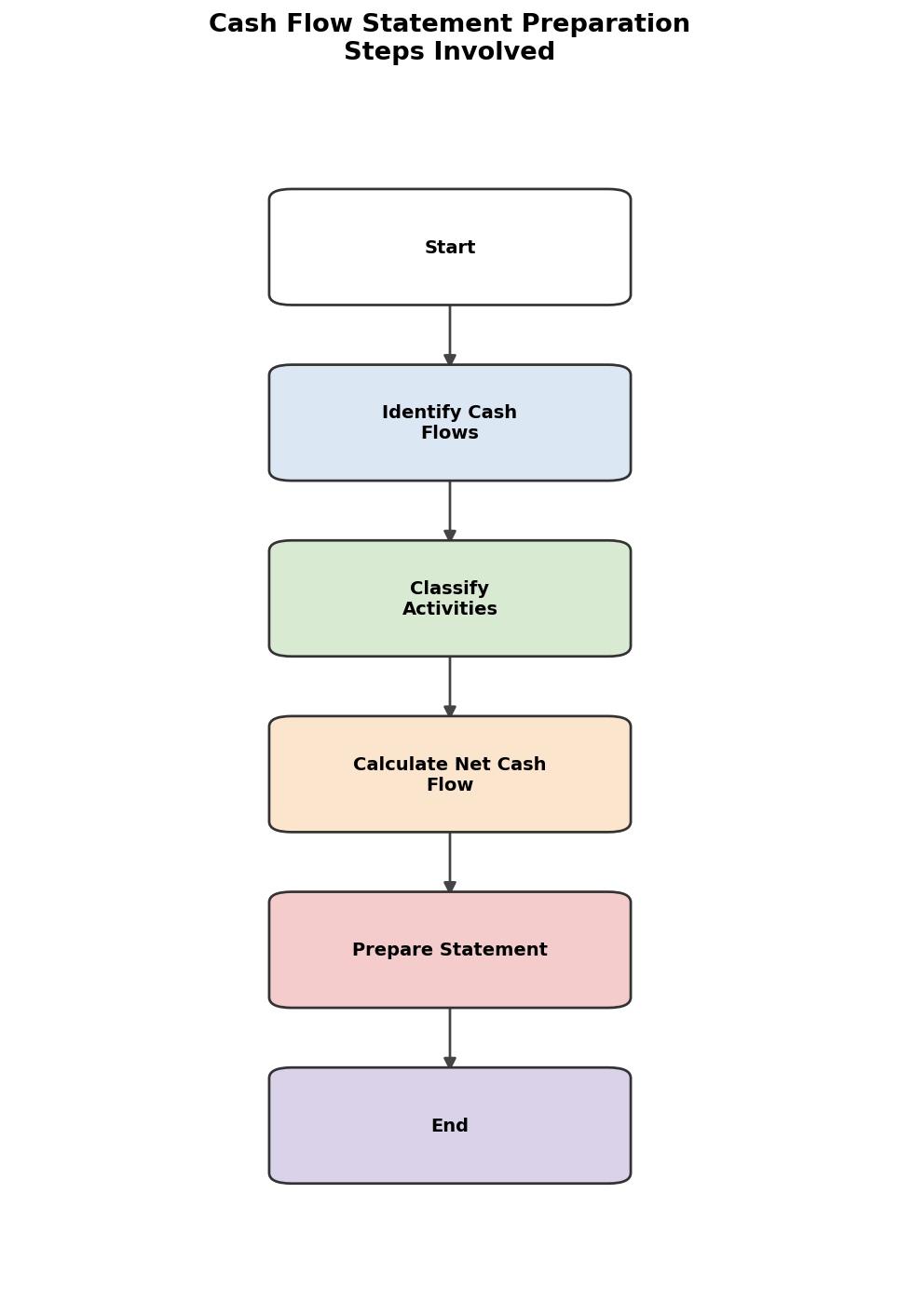
Q572 Marks
Based on the given flowchart, answer the following:
What is the first step in preparing a cash flow statement?
AIdentify Cash Flows
BClassify Activities
CCalculate Net Cash Flow
DPrepare Statement
What is the final step in the preparation of the cash flow statement?
What are the three classifications of cash flows?
AOperating, Investing, Financing
BRevenue, Expense, Profit
CCurrent, Non-current, Equity
DAssets, Liabilities, Equity
Explain the significance of cash flow from financing activities.
Show answersHide answers
1. Option 1 — Identify Cash Flows
2. End
3. Option 1 — Operating, Investing, Financing
4. It shows the cash inflows and outflows related to borrowing and equity financing.
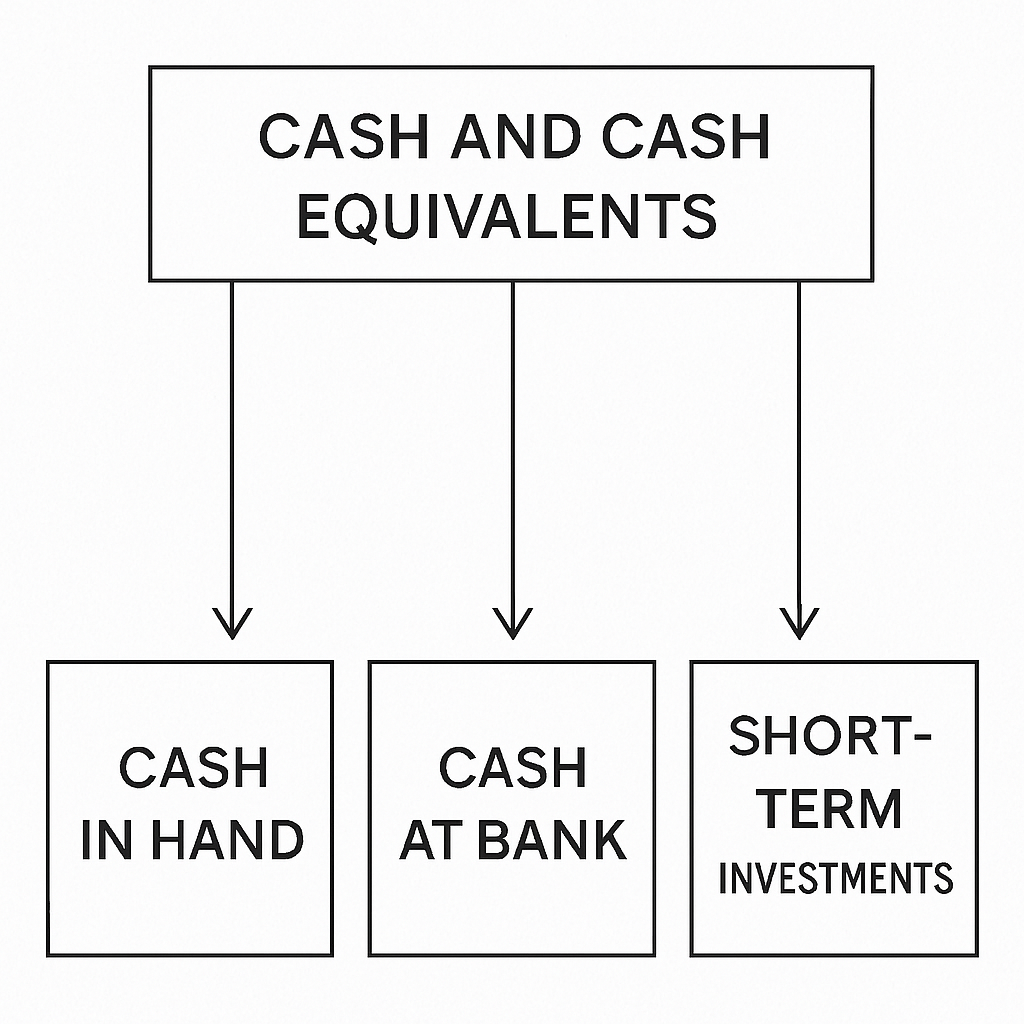
Q582 Marks
Based on the given diagram of cash and cash equivalents, answer the following:
What does cash in hand represent in the cash flow statement?