Dissolution of Partnership Firm — Important Questions
59 questions
With answersCBSE format
SUMMARY: This chapter focuses on the process and accounting treatment involved in the dissolution of a partnership firm. KEY TOPICS: dissolution of partnership, realization account, settlement of liabilities, distribution of assets, treatment of goodwill, partner's loan, partner's capital account, insolvency of partners, Garner vs. Murray rule, preparation of balance sheet.
Correct answer: Option 2 — Termination of business and accounts
Q21 Mark
Realisation Account is prepared on:
AAdmission
BRetirement
CDissolution
DDeath
Check answerHide answer
Correct answer: Option 3 — Dissolution
Q31 Mark
Garner v. Murray decision applies to:
AAdmission of partner
BInsolvency of a partner
CSale of business
DBonus issue
Check answerHide answer
Correct answer: Option 2 — Insolvency of a partner
Q41 Mark
Loss on realisation is borne by partners in:
AEqual ratio
BNew profit-sharing ratio
COld profit-sharing ratio
DCapital ratio
Check answerHide answer
Correct answer: Option 3 — Old profit-sharing ratio
Q51 Mark
The order of payment of the firm's debts on dissolution is governed by:
ASection 48 of the Partnership Act
BSection 4
CSection 1
DSection 30
Check answerHide answer
Correct answer: Option 1 — Section 48 of the Partnership Act
Q61 Mark
What is the primary purpose of preparing a Realisation Account during the dissolution of a partnership firm?
ATo record the assets and liabilities of the firm
BTo determine the profit or loss on the sale of assets
CTo calculate the goodwill of the firm
DTo settle the partners' capital accounts
Check answerHide answer
Correct answer: Option 2 — To determine the profit or loss on the sale of assets
Q71 Mark
In the event of insolvency of a partner, which rule is applied to determine the loss to be borne by the solvent partners?
AGarner v. Murray
BPartnership Act
CCompanies Act
DIncome Tax Act
Check answerHide answer
Correct answer: Option 1 — Garner v. Murray
Q81 Mark
Which of the following accounts is NOT typically prepared during the dissolution of a partnership firm?
ARealisation Account
BCapital Account
CProfit and Loss Account
DCash Account
Check answerHide answer
Correct answer: Option 3 — Profit and Loss Account
Q91 Mark
When distributing the assets of a partnership firm upon dissolution, which of the following is considered first?
APayment of partner's loans
BSettlement of external liabilities
CDistribution of remaining assets to partners
DValuation of goodwill
Check answerHide answer
Correct answer: Option 2 — Settlement of external liabilities
Q101 Mark
Goodwill is treated in the dissolution of a partnership firm as:
AAn asset to be realized
BA liability to be settled
CA fixed cost
DAn expense to be written off
Check answerHide answer
Correct answer: Option 1 — An asset to be realized
Q111 Mark
What is the treatment of a partner's capital account upon dissolution of the firm?
AIt remains unchanged
BIt is closed and settled
CIt is transferred to the Realisation Account
DIt is used to pay off external creditors
Check answerHide answer
Correct answer: Option 2 — It is closed and settled
Q121 Mark
Which of the following statements is true regarding the dissolution of a partnership firm?
AAll partners must agree to dissolve the firm
BA firm can dissolve without any partner's consent
CDissolution is always voluntary
DDissolution does not affect the firm's liabilities
Check answerHide answer
Correct answer: Option 1 — All partners must agree to dissolve the firm
Q131 Mark
In the context of dissolution, the term 'realization' refers to:
AThe process of valuing the firm’s goodwill
BThe conversion of assets into cash
CThe settlement of partner's loans
DThe distribution of profits among partners
Check answerHide answer
Correct answer: Option 2 — The conversion of assets into cash
Q141 Mark
What happens to the partner's loan during the dissolution of the firm?
AIt is ignored
BIt is paid after settling external liabilities
CIt is paid before settling external liabilities
DIt is converted into equity
Check answerHide answer
Correct answer: Option 3 — It is paid before settling external liabilities
Q151 Mark
Which of the following is NOT a step in the dissolution process of a partnership firm?
ARealization of assets
BSettlement of liabilities
CPreparation of a new partnership agreement
DDistribution of remaining assets to partners
Check answerHide answer
Correct answer: Option 3 — Preparation of a new partnership agreement
Short Answer Questions10 questions
Q163 Marks
Distinguish between dissolution of partnership and dissolution of firm.
View sample solutionHide solution
Dissolution of partnership: change in the relationship among partners (e.g., admission, retirement, death, change in profit-sharing ratio); the firm continues but the form changes. Dissolution of firm: termination of the firm's existence; business is closed, assets are realised, liabilities are paid, and any surplus/deficit is shared among partners. Every dissolution of firm involves dissolution of partnership; not every dissolution of partnership leads to dissolution of firm.
Q173 Marks
List the modes of dissolution of a partnership firm under the Partnership Act.
View sample solutionHide solution
Section 39 onwards of the Partnership Act 1932 specifies modes: (1) By agreement (Sec 40) — all partners agree to dissolve. (2) Compulsory dissolution (Sec 41) — by happening of an event making the business unlawful (e.g., war, change of law). (3) On happening of certain contingencies (Sec 42) — expiry of fixed period, completion of venture, death/insolvency of a partner. (4) By notice (Sec 43) — any partner gives written notice in case of partnership at will. (5) By court (Sec 44) — at the suit of a partner on grounds like insanity, permanent incapacity, misconduct.
Q183 Marks
What is Realisation Account and what does it record?
View sample solutionHide solution
Realisation Account is prepared at dissolution to determine the profit or loss on conversion of assets into cash and payment of liabilities. Dr side: book values of all assets (except cash and bank); cash paid for liabilities; expenses of realisation. Cr side: book values of all liabilities; cash received on sale of assets; cash brought by partners (if any). The balancing figure is the profit/loss on realisation transferred to partners' capital accounts in old profit-sharing ratio.
Q193 Marks
Explain the order of payment of debts on dissolution per Section 48 of the Partnership Act.
View sample solutionHide solution
Section 48 specifies the order: (1) external/firm creditors are paid first from realised funds; (2) loans by partners (other than capital) are paid next; (3) partners' capital is paid in proportion to amounts due; (4) any remaining surplus is divided among partners in profit-sharing ratio. If realised funds are insufficient: (a) firm losses are first met from undrawn profits, then capital, then partners contribute personally in profit-sharing ratio. The order ensures fair treatment of external creditors and partners.
Q203 Marks
What is Garner v. Murray rule and when is it applied?
View sample solutionHide solution
Garner v. Murray (1904) rule applies when a partner is insolvent and unable to bring his deficiency. The rule says: (1) Solvent partners must contribute their share of the realisation loss in cash. (2) The deficiency of the insolvent partner is borne by the solvent partners in their CAPITAL RATIO (not profit-sharing ratio). The rationale: capital ratio reflects the relative investment; the loss should fall in proportion to investment. The rule is the default unless the partnership deed specifies otherwise.
Q213 Marks
What is the treatment of goodwill during the dissolution of a partnership firm?
View sample solutionHide solution
Goodwill can be either written off or realized during the dissolution process. If it is to be realized, the partners must agree on its value, and any profit or loss from its realization is shared among the partners according to their profit-sharing ratio.
Q223 Marks
How is the partner's loan treated during the dissolution of a partnership firm?
View sample solutionHide solution
A partner's loan is treated as a liability of the firm and must be settled before distributing the remaining assets to the partners. If there are insufficient assets to cover the loan, the partner may have to bear the loss.
Q233 Marks
What steps are involved in the settlement of liabilities during the dissolution of a partnership firm?
View sample solutionHide solution
The steps include identifying all liabilities, settling them in the order of priority as per the Partnership Act, and using the assets of the firm to pay off these liabilities before distributing any remaining assets to the partners.
Q243 Marks
What is the role of the realization account in the dissolution process?
View sample solutionHide solution
The realization account records the sale of assets and settlement of liabilities during the dissolution of a partnership firm. It helps in determining the profit or loss on realization, which is then distributed among the partners according to their profit-sharing ratio.
Q253 Marks
Explain how assets are distributed among partners after settling liabilities in a dissolved partnership firm.
View sample solutionHide solution
After settling all liabilities, the remaining assets are distributed among the partners in accordance with their capital accounts or profit-sharing ratio. Any surplus or deficit in the capital accounts is adjusted accordingly.
Long Answer Questions6 questions
Q266 Marks
Three partners X Y Z sharing 3:2:1 dissolve their firm. Sundry assets (book value ₹100000) realise ₹85000. Liabilities (book value ₹40000) are paid in full. Realisation expenses ₹3000. Prepare the Realisation Account.
View sample solutionHide solution
Realisation Account: Dr — To Sundry Assets 100000; To Cash (liabilities paid) 40000; To Cash (realisation expenses) 3000; Total 143000. Cr — By Sundry Liabilities 40000; By Cash (assets realised) 85000; By Loss on Realisation transferred to partners' capital (143000 − 125000 = 18000) — X 9000 (3/6) Y 6000 (2/6) Z 3000 (1/6); Total 143000. Both sides balance. The loss of ₹18000 is debited to the partners' capital accounts in old profit-sharing ratio 3:2:1.
Q276 Marks
P and Q are partners sharing 2:1. They dissolve their firm. Capitals: P ₹50000 Q ₹30000. P is insolvent and unable to bring any cash. Loss on realisation is ₹40000. Apply Garner v. Murray rule and determine the final settlement.
View sample solutionHide solution
Step 1: Distribute loss on realisation in profit-sharing ratio (2:1): P 26667; Q 13333. Step 2: After loss debit P's balance = 50000 − 26667 = 23333 (Cr); Q's balance = 30000 − 13333 = 16667 (Cr). Step 3: P is insolvent and has zero personal assets to bring. Apply Garner v. Murray: Q must absorb P's deficiency in CAPITAL RATIO. Q's capital ratio share of P's deficiency = 23333 (P's deficiency to firm = his Cr balance which is unrecoverable). Wait re-derive: actually after step 2 if P has Cr 23333 it means firm OWES P. If P is insolvent it does NOT affect the firm. Q gets 16667 (his share of remaining funds after liabilities and creditors are paid). The Garner v. Murray rule applies when realisation loss makes a partner's capital DEBIT (deficient). Adjusting the example: assume P's capital after loss is debit ₹3333 (insolvent). Then per Garner v. Murray Q absorbs this deficiency in capital ratio (Q only solvent so Q absorbs all 3333). Final settlement: Q gets his capital balance reduced by 3333 = 13334. The illustration shows the rule's mechanics; numerical adjustments depend on actual deficits.
Q286 Marks
Discuss the various accounting entries on dissolution of a partnership firm.
View sample solutionHide solution
Entries on dissolution: (1) Transfer assets to Realisation A/c: Realisation A/c Dr; To Sundry Assets A/c. (2) Transfer liabilities: Sundry Liabilities A/c Dr; To Realisation A/c. (3) Sale of assets: Cash/Bank A/c Dr; To Realisation A/c. (4) Payment of liabilities: Realisation A/c Dr; To Cash/Bank A/c. (5) Realisation expenses: Realisation A/c Dr; To Cash/Bank A/c. (6) Profit/loss on realisation transferred to partners' capital accounts in old ratio. (7) Partners' loans paid off. (8) Partners' capital balances settled — debit balance partners pay to firm; credit balance partners receive. The process closes all accounts of the firm.
Q296 Marks
Explain the difference between Realisation Account and Revaluation Account.
View sample solutionHide solution
Realisation Account: prepared at DISSOLUTION; records actual sale of assets and payment of liabilities; computes profit/loss on conversion of book values to cash. The firm ceases to exist after preparation. Revaluation Account: prepared at ADMISSION RETIREMENT or DEATH; records changes in book values of assets and liabilities to reflect current fair values; the firm continues with the new valuations. Both transfer the resulting profit/loss to partners' capital accounts in old ratio. Revaluation is partial (only affected items); Realisation involves ALL assets and liabilities. Revaluation aims to update book values; Realisation aims to terminate the firm.
Q306 Marks
Discuss the treatment of partner's loan, partner's capital, and the firm's general reserve at dissolution.
View sample solutionHide solution
Partner's loan (loan TO firm BY partner): a separate liability paid AFTER external creditors but BEFORE capital. Entry: Partner's Loan A/c Dr; To Cash A/c. Partner's capital (capital balances): paid LAST after all external creditors and partner loans are paid. Entry: Partners' Capital A/c Dr; To Cash A/c (or vice versa if partner has debit balance). General Reserve: distributed to partners in old profit-sharing ratio BEFORE preparing Realisation Account because reserves are accumulated profits earned by partners. Entry: General Reserve A/c Dr; To Partners' Capital A/c (in old ratio). Accumulated losses are debited to capital accounts. Profit on realisation increases capital; loss decreases it.
Q316 Marks
Differentiate between dissolution of partnership and dissolution of firm in tabular form.
Assertion–Reason Questions8 questions
Q321 Mark
Assertion (A): Dissolution of a firm terminates the partnership business.
Reason (R): All assets are realised liabilities paid and any balance distributed to partners.
Show explanationHide explanation
Correct answer: Option 1 —
Both A and R are true, and R is the correct explanation of A.
Q331 Mark
Assertion (A): Realisation Account computes profit or loss on dissolution.
Reason (R): The account records book values of assets and liabilities and actual cash realised and paid.
Show explanationHide explanation
Correct answer: Option 1 —
Both A and R are true, and R is the correct explanation of A.
Q341 Mark
Assertion (A): Solvent partners absorb an insolvent partner's deficiency in capital ratio.
Reason (R): Capital ratio reflects relative investment hence the loss should fall in proportion to investment.
Show explanationHide explanation
Correct answer: Option 1 —
Both A and R are true, and R is the correct explanation of A.
Q351 Mark
Assertion (A): External creditors are paid before partners' loan and capital.
Reason (R): Section 48 of the Partnership Act specifies the order of priority.
Show explanationHide explanation
Correct answer: Option 1 —
Both A and R are true, and R is the correct explanation of A.
Q361 Mark
Assertion (A): Loss on realisation is shared by partners in their old profit-sharing ratio.
Reason (R): The loss is treated like a normal business loss arising before the firm's closure.
Show explanationHide explanation
Correct answer: Option 1 —
Both A and R are true, and R is the correct explanation of A.
Q371 Mark
Assertion (A): The realization account is prepared to determine the profit or loss on the dissolution of a partnership firm.
Reason (R): The realization account records the sale of assets and payment of liabilities during the dissolution process.
Show explanationHide explanation
Correct answer: Option 1 —
Both A and R are true, and R is the correct explanation of A.
Q381 Mark
Assertion (A): Goodwill is not considered during the dissolution of a partnership firm.
Reason (R): Goodwill is a valuable asset that must be accounted for during the dissolution process.
Show explanationHide explanation
Correct answer: Option 4 —
A is false, but R is true.
Q391 Mark
Assertion (A): Insolvent partners are not required to contribute towards the deficiency in their capital accounts.
Reason (R): Insolvent partners are legally protected from contributing more than their available assets.
Show explanationHide explanation
Correct answer: Option 1 —
Both A and R are true, and R is the correct explanation of A.
Statement-Based Questions8 questions
Q401 Mark
Statement 1: Dissolution can be voluntary or compulsory.
Statement 2: Voluntary modes include agreement and notice; compulsory include change of law and court order.
Show answerHide answer
Correct answer: Option 1 —
Both statements are true.
Q411 Mark
Statement 1: External creditors are paid first.
Statement 2: Then partner loans are paid then partners' capital.
Show answerHide answer
Correct answer: Option 1 —
Both statements are true.
Q421 Mark
Statement 1: An insolvent partner cannot bring cash to cover his deficiency.
Statement 2: Solvent partners absorb the deficiency per Garner v. Murray rule.
Show answerHide answer
Correct answer: Option 1 —
Both statements are true.
Q431 Mark
Statement 1: Surrender value of joint life policy is realised on dissolution.
Statement 2: The amount is shared by all partners in old profit-sharing ratio.
Show answerHide answer
Correct answer: Option 1 —
Both statements are true.
Q441 Mark
Statement 1: General reserve is distributed before preparing the Realisation Account.
Statement 2: Reserves belong to partners and are credited to capital accounts in old ratio.
Show answerHide answer
Correct answer: Option 1 —
Both statements are true.
Q451 Mark
Statement 1: The Realisation Account is prepared to record the assets and liabilities of the partnership firm at the time of dissolution.
Statement 2: The balance in the Realisation Account is transferred to the partners' capital accounts after settling all liabilities.
Show answerHide answer
Correct answer: Option 1 —
Both statements are true.
Q461 Mark
Statement 1: Goodwill is treated as an asset during the dissolution process and is to be realized.
Statement 2: Partners can agree to retain goodwill in the partnership firm even after dissolution.
Show answerHide answer
Correct answer: Option 3 —
Only Statement 2 is true.
Q471 Mark
Statement 1: In the case of insolvency of one partner, the solvent partners are responsible for covering the deficiency.
Statement 2: The Garner vs. Murray rule applies when one partner is insolvent and the other partners are solvent.
Show answerHide answer
Correct answer: Option 1 —
Both statements are true.
Case Study / Passage Questions4 questions
Q483 Marks
X Y and Z are partners sharing 3:2:1. They agree to dissolve the firm on 31 March 2024. Sundry assets (book value ₹150000) realise ₹130000. Sundry liabilities (book value ₹40000) are paid in full. Realisation expenses ₹3000. Capital balances are X ₹60000 Y ₹40000 Z ₹10000.
The account prepared at dissolution to compute profit/loss is:
ARealisation
BRevaluation
CReconstitution
DRealisation A/c Dr
Loss on realisation =
A₹23000 loss
B₹17000 profit
C₹110000 gain
D₹50000 loss
Prepare the Realisation Account and final settlement.
Show answersHide answers
1. Option 1 — Realisation
2. Option 1 — ₹23000 loss
3. Realisation Account: Dr — To Sundry Assets 150000 + To Cash (liabilities paid) 40000 + To Cash (realisation expenses) 3000 = 193000. Cr — By Sundry Liabilities 40000 + By Cash (assets realised) 130000 = 170000. Loss on realisation = 193000 − 170000 = ₹23000. Distribution to partners in old ratio (3:2:1): X 11500; Y 7667; Z 3833. Final settlement: each partner's capital is reduced by his share of loss. X gets 60000 − 11500 = 48500; Y gets 40000 − 7667 = 32333; Z gets 10000 − 3833 = 6167. Total cash needed for partners = 48500 + 32333 + 6167 = ₹87000. Bank balance after liabilities paid = 130000 − 40000 = 90000 + ₹3000 (expenses) — actually adjustments needed. The illustration shows the methodology.
Q493 Marks
P and Q are partners sharing equally. They dissolve their firm. Capital balances after revaluation but before realisation: P ₹50000 Q ₹70000. Realisation loss = ₹100000. P is insolvent and unable to bring any cash. Apply Garner v. Murray rule.
Per Garner v. Murray solvent partner absorbs deficit in:
AProfit-sharing ratio
BCapital ratio
CEqual
DRandom
Settlement when P is insolvent:
AP brings 0 Q absorbs all
BP brings cash Q absorbs nothing
CBoth share equally
DCourt orders
Apply Garner v. Murray and compute final settlement of Q.
Show answersHide answers
1. Option 2 — Capital ratio
2. Option 1 — P brings 0 Q absorbs all
3. Step 1: Distribute realisation loss in profit-sharing ratio (1:1): P gets 50000 loss; Q gets 50000 loss. Step 2: After loss debit P's balance = 50000 − 50000 = 0; Q's balance = 70000 − 50000 = 20000 (Cr). Step 3: But the firm needs to pay realisation expenses or there's a deficiency from P. Adjusting: if P's capital after loss were a debit balance say 5000 then Q would absorb that deficiency in CAPITAL RATIO. Capital ratio of P:Q = 50000:70000 = 5:7. So Q would absorb full 5000 (P's deficiency) since P is insolvent. Q's final settlement = 20000 − 5000 = 15000. Per Garner v. Murray (1904) rule the deficiency of insolvent partner is borne by solvent partners in their CAPITAL RATIO (not profit-sharing ratio) — the rationale is that loss should be in proportion to investment.
Q503 Marks
M/s Suri & Co. is dissolved with these claims at the realisation date: (1) Trade creditors ₹40000; (2) Bank loan ₹60000 (secured); (3) Partner's loan to firm ₹30000; (4) Capital balances P ₹100000 Q ₹50000. Cash realised from assets = ₹150000.
Priority of payment under Section 48 is:
ACapital first then loans
BExternal creditors first then partners' loans then capital
CEqual distribution
DRandom
Among external creditors:
ABank loan secured first — yes
BAll same priority
CCapital before creditors
DRandom
Explain Section 48 priority and apply it to this case.
Show answersHide answers
1. Option 2 — External creditors first then partners' loans then capital
2. Option 1 — Bank loan secured first — yes
3. Section 48 of the Partnership Act 1932 specifies the order of payment of firm debts on dissolution: (1) PAY EXTERNAL CREDITORS FIRST — secured creditors (bank loan with mortgage on assets) before unsecured trade creditors. (2) PAY PARTNERS' LOANS next (partner who lent money to the firm; not to be confused with capital). (3) PAY PARTNERS' CAPITAL (in proportion to amounts due). (4) Any remaining surplus is distributed in profit-sharing ratio. Application to the case: 150000 cash. Pay bank loan 60000 first (secured); then trade creditors 40000; then partner loan 30000. Remaining = 150000 − 130000 = 20000 to capital. P and Q's capitals total 150000 — they get only 20000 out of 150000 = ₹13333 between them (proportionally). The deficit of capital (130000) is the realisation loss borne by partners in profit-sharing ratio.
Q514 Marks
In the process of dissolving a partnership firm, the partners must first settle all liabilities before distributing the remaining assets. The realization account is prepared to record the sale of assets and the payment of liabilities. Any loss or gain from the realization is shared among the partners in their profit-sharing ratio. If the firm has goodwill, it must also be accounted for during the dissolution process. Partners' capital accounts are adjusted based on their respective shares of profits or losses from the realization account. In cases where a partner is insolvent, the remaining partners may have to bear the loss according to the Garner vs. Murray rule, which states that the solvent partners must contribute to cover the loss of the insolvent partner's share.
What is the primary purpose of the realization account during the dissolution of a partnership firm?
ATo record the sale of assets
BTo calculate profits
CTo distribute dividends
DTo prepare the balance sheet
Explain the treatment of goodwill during the dissolution of a partnership firm.
What happens to the realization loss if a partner is insolvent?
AIt is borne by the insolvent partner only
BIt is shared by all partners
CIt is ignored
DIt is carried forward to the next accounting period
Define the Garner vs. Murray rule in the context of partnership dissolution.
Show answersHide answers
1. Option 1 — To record the sale of assets
2. Goodwill must be valued and accounted for during the dissolution process, either by selling it or adjusting it in the partners' capital accounts.
3. Option 2 — It is shared by all partners
4. The Garner vs. Murray rule states that in the case of insolvency of a partner, the solvent partners must bear the loss in proportion to their remaining capital.
Table-Based Questions4 questions
Q523 Marks
Modes of dissolution under Partnership Act 1932:
Mode
Section
Trigger
By agreement
Sec 40
All partners agree
Compulsory
Sec 41
Business becomes unlawful
Contingencies
Sec 42
Expiry of term, completion of venture, death, insolvency
By notice
Sec 43
Notice in partnership at will
By court
Sec 44
Insanity, misconduct, breach of contract
Compulsory dissolution under Partnership Act =
ASec 40
BSec 41
CSec 42
DSec 43
Can a partner unilaterally dissolve a partnership at will?
AYes (any partner can dissolve)
BNo
COnly with court order
DOnly with all partners' consent
Why does the Act provide multiple modes of dissolution?
Show answersHide answers
1. Option 2 — Sec 41
2. Option 1 — Yes (any partner can dissolve)
3. The Partnership Act 1932 specifies five modes of dissolution. Voluntary modes include agreement (Sec 40 — needs all partners' consent) and notice (Sec 43 — partnership at will allows any partner to give notice). Compulsory modes include compulsory dissolution (Sec 41 — when business becomes unlawful), happening of contingencies (Sec 42 — expiry term, completion venture, death, insolvency of any partner), and dissolution by court (Sec 44 — at suit of a partner on grounds like insanity misconduct breach). Each mode triggers the dissolution process: assets are realised liabilities paid and any balance distributed.
Q533 Marks
Section 48 priority of payment of firm's debts:
Priority
Item
Note
1
External creditors (secured first then unsecured)
Highest priority
2
Partners' loans to firm
Section 37 prescribes 6% interest
3
Partners' capital
In proportion to amounts due
4
Surplus (if any)
In profit-sharing ratio
The order specified by Section 48 is:
ALoans first then creditors
BCreditors first then loans
CCapital first
DRandom
Surplus after all debts is distributed in:
AProfit-sharing
BCapital ratio
CEqual
DOld ratio
Why are external creditors paid before partners' loans?
Show answersHide answers
1. Option 2 — Creditors first then loans
2. Option 1 — Profit-sharing
3. The order in Section 48 protects external creditors first because they are not part of the firm and have no other recourse. Within external creditors secured creditors have priority over unsecured. Partners' loans rank after external because partners are 'insiders' to the firm. Partners' capital comes last among debts because capital represents ownership not debt. Surplus (if any) is the firm's profit — distributed in profit-sharing ratio. This order ensures fair treatment of all classes of claimants and is mandatory under the Partnership Act 1932.
Q546 Marks
X Y and Z are partners sharing 3:2:1. They dissolve. Sundry assets ₹150000 realise ₹130000. Liabilities ₹40000 paid. Realisation expenses ₹3000. Prepare the Realisation Account.
Item
Amount
Sundry assets (book value)
₹150000
Liabilities (book value)
₹40000
Sale of assets
₹130000
Liabilities paid
₹40000
Realisation expenses
₹3000
Profit-sharing ratio
3:2:1
Q556 Marks
P and Q are partners sharing equally. They dissolve. Capital balances after revaluation: P ₹50000 Q ₹70000. Realisation loss ₹100000. P is insolvent. Apply Garner v. Murray.
Item
Amount
P's capital before loss
₹50000
Q's capital before loss
₹70000
Realisation loss (total)
₹100000
P's status
Insolvent
Q's status
Solvent
Profit-sharing ratio
1:1
Picture-Based Questions4 questions
Q563 Marks
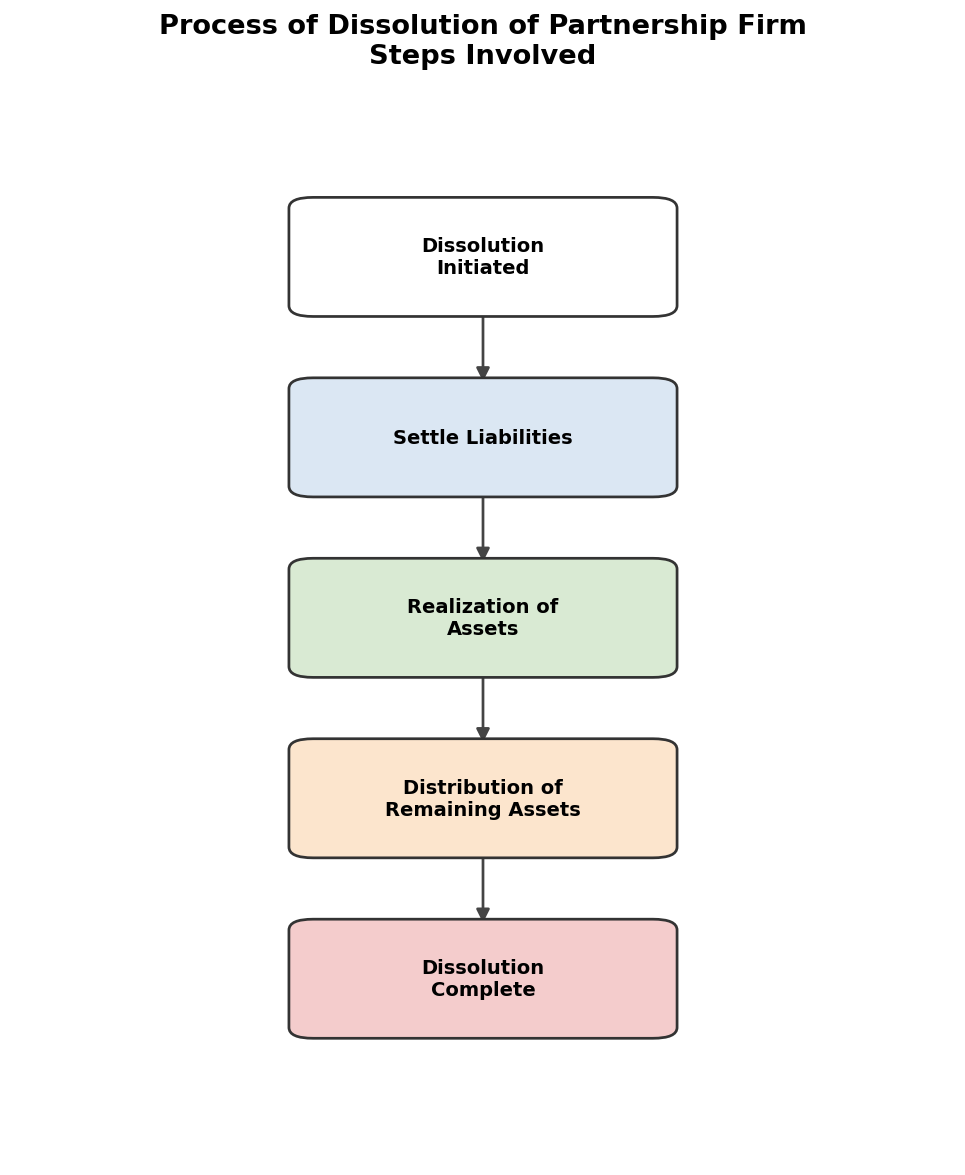
Based on the given flowchart, answer the following:
What is the first step in the dissolution process?
ASettle Liabilities
BRealization of Assets
CDissolution Complete
DDissolution Initiated
What happens after settling liabilities?
ADissolution Complete
BRealization of Assets
CDistribution of Remaining Assets
DDissolution Initiated
Explain the significance of realizing assets in the dissolution process.
What is the first step in the settlement of liabilities?
ASettle Unsecured Liabilities
BIdentify Liabilities
CPrioritize Payments
DLiabilities Settled
What type of liabilities should be settled first?
AUnsecured Liabilities
BSecured Liabilities
CAll Liabilities
DNone of the above
Describe the importance of prioritizing payments in the settlement of liabilities.
Show answersHide answers
1. Option 4 — Dissolution Initiated
2. Option 2 — Realization of Assets
3. Realizing assets is crucial as it converts the firm's assets into cash to settle liabilities.
4. Option 2 — Identify Liabilities
5. Option 2 — Secured Liabilities
6. Prioritizing payments ensures that secured creditors are paid first, reducing the risk of legal actions.
Q573 Marks
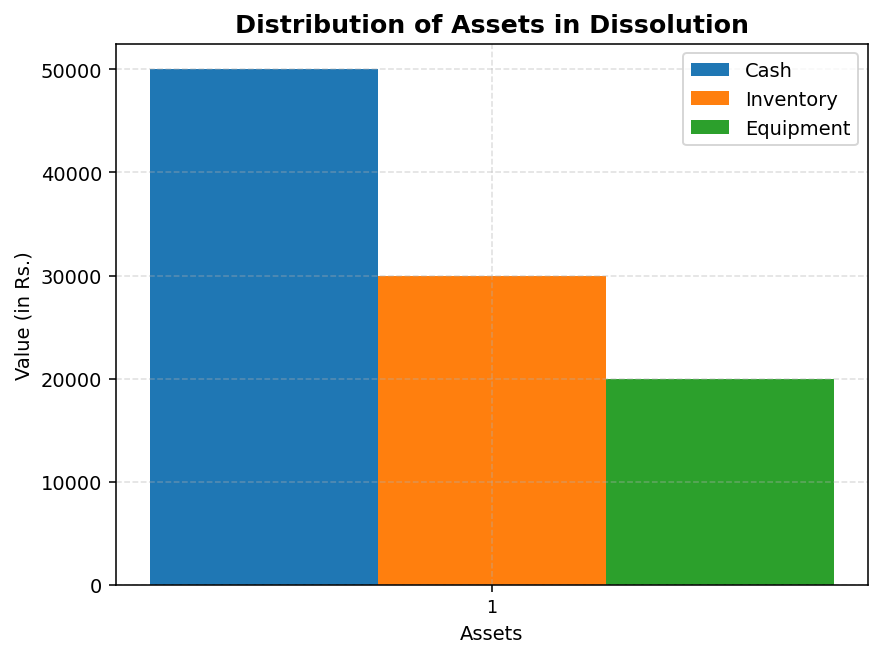
Based on the given chart, answer the following:
Which asset has the highest value?
ACash
BInventory
CEquipment
DNone of the above
What is the total value of assets to be distributed?
If the liabilities are Rs. 80000, how much cash will be left after settling liabilities?
Show answersHide answers
1. Option 1 — Cash
2. The total value is Rs. 100000.
3. Rs. 20000 will be left after settling liabilities.
Q583 Marks
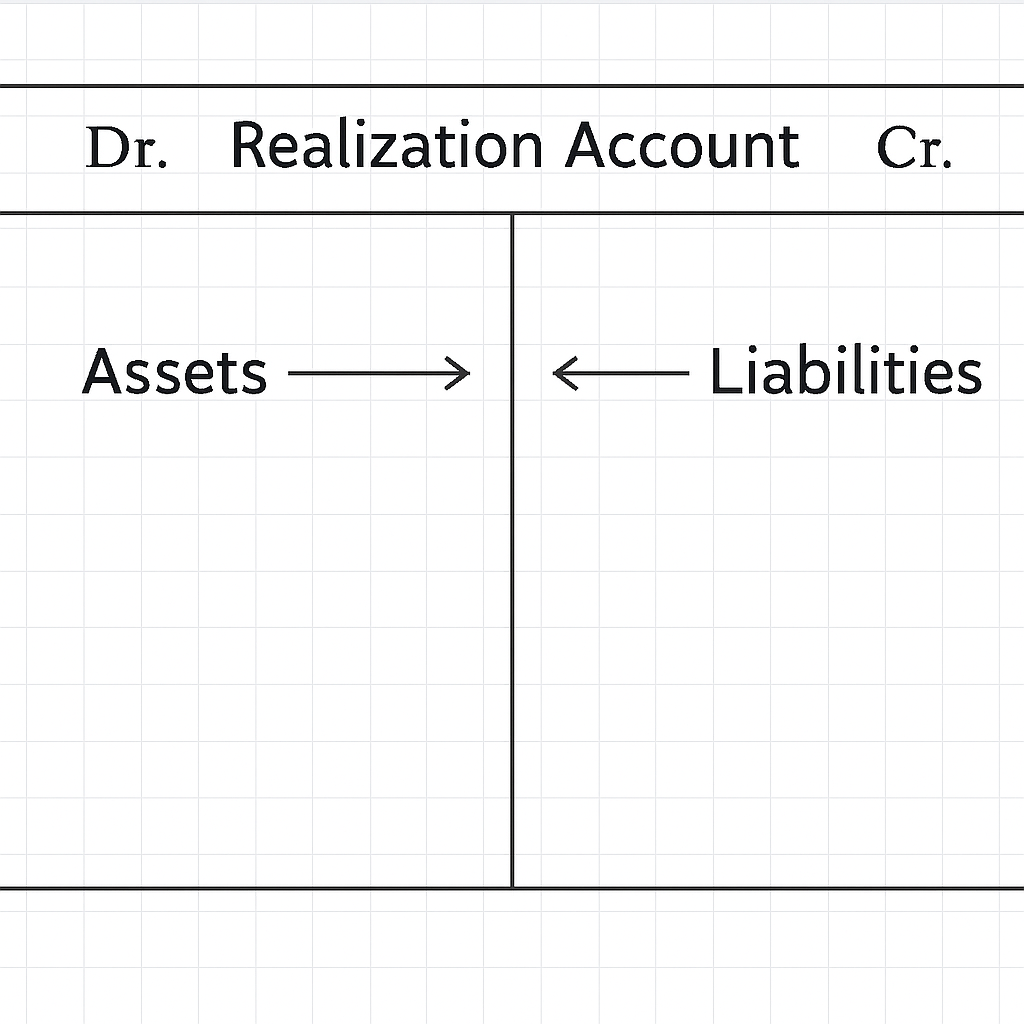
Based on the given diagram of the Realization Account, answer the following:
What is recorded on the debit side of the Realization Account?
AAssets realized
BLiabilities settled
CPartner's capital
DGoodwill
What is the purpose of the Realization Account?
Explain how the balance of the Realization Account is determined.
Show answersHide answers
1. Option 1 — Assets realized
2. The Realization Account is used to record the realization of assets and settlement of liabilities during dissolution.
3. The balance is determined by subtracting total liabilities from total assets realized.
Q593 Marks
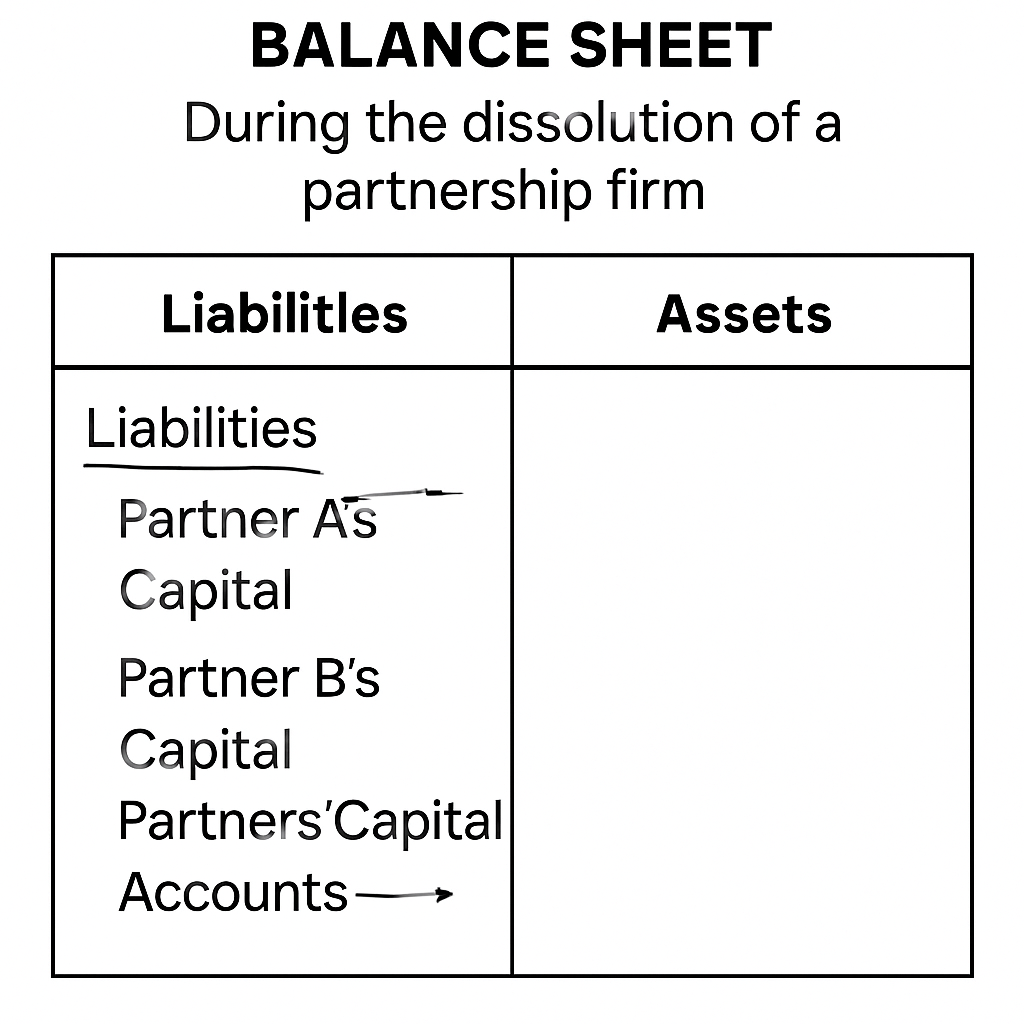
Based on the given diagram of the Balance Sheet during dissolution, answer the following:
What does the Balance Sheet reflect at the time of dissolution?
AOnly assets
BOnly liabilities
CAssets and Liabilities
DOnly partners' capital
How are partners' capital accounts treated in the Balance Sheet during dissolution?
Explain the significance of preparing a Balance Sheet during dissolution.
Show answersHide answers
1. Option 3 — Assets and Liabilities
2. Partners' capital accounts are settled after realizing assets and paying off liabilities.
3. Preparing a Balance Sheet provides a clear view of the financial position of the firm at the time of dissolution.