SUMMARY: This chapter focuses on the concept of strings in Python, including their properties and manipulation techniques. KEY TOPICS: string definition, string indexing, string slicing, string methods, string concatenation, string immutability, escape sequences, string formatting, string comparison, string operations
Which method is used to convert a string to uppercase in Python?
Aupper()
Buppercase()
CtoUpper()
Dup()
Check answerHide answer
Correct answer: Option 1 — upper()
Q21 Mark
The output of "Hello"[1:4] is:
AHel
Bell
Cello
DHello
Check answerHide answer
Correct answer: Option 2 — ell
Q31 Mark
Which method is used to find the length of a string?
Alength()
Blen()
Csize()
Dcount()
Check answerHide answer
Correct answer: Option 2 — len()
Q41 Mark
The output of "abc" * 3 is:
Aabcabcabc
Babc3
Cabc abc abc
DError
Check answerHide answer
Correct answer: Option 1 — abcabcabc
Q51 Mark
Strings in Python are:
AMutable
BImmutable
CBoth
DNeither
Check answerHide answer
Correct answer: Option 2 — Immutable
Q61 Mark
What is the result of the expression 'Python' + 'Programming'?
APythonProgramming
BPython Programming
CPython-Programming
DPython+Programming
Check answerHide answer
Correct answer: Option 2 — Python Programming
Q71 Mark
Which of the following escape sequences represents a newline in a string?
A\t
B\n
C\r
D\b
Check answerHide answer
Correct answer: Option 2 — \n
Q81 Mark
What will be the output of 'Hello, World!'[7:]?
AHello,
BWorld!
CHello
DHello, World!
Check answerHide answer
Correct answer: Option 2 — World!
Q91 Mark
Which method would you use to replace 'cat' with 'dog' in the string 'The cat is here'?
Areplace('cat', 'dog')
Bchange('cat', 'dog')
Cswap('cat', 'dog')
Dupdate('cat', 'dog')
Check answerHide answer
Correct answer: Option 1 — replace('cat', 'dog')
Q101 Mark
What is the output of 'abc'[::-1]?
Aabc
Bcba
Cbac
Dab
Check answerHide answer
Correct answer: Option 2 — cba
Q111 Mark
Which of the following statements about strings in Python is true?
AStrings are mutable.
BStrings can be concatenated using the + operator.
CStrings do not support indexing.
DStrings can only contain letters.
Check answerHide answer
Correct answer: Option 2 — Strings can be concatenated using the + operator.
Q121 Mark
What will be the result of 'A' < 'B'?
ATrue
BFalse
CNone
DError
Check answerHide answer
Correct answer: Option 1 — True
Q131 Mark
Which of the following methods can be used to convert the first character of a string to uppercase?
Acapitalize()
Bupper()
Ctitle()
Dfirst_upper()
Check answerHide answer
Correct answer: Option 1 — capitalize()
Q141 Mark
What does the method 'strip()' do when applied to a string?
ARemoves all characters from the string.
BRemoves leading and trailing whitespace.
CRemoves vowels from the string.
DRemoves punctuation from the string.
Check answerHide answer
Correct answer: Option 2 — Removes leading and trailing whitespace.
Q151 Mark
In Python, which of the following is a valid way to format a string?
A'Hello, {}'.format(name)
B'Hello, %s' % name
Cf'Hello, {name}'
DAll of the above
Check answerHide answer
Correct answer: Option 4 — All of the above
Short Answer Questions10 questions
Q163 Marks
Differentiate between strip() lstrip() and rstrip() string methods.
Q173 Marks
Write Python code to count the number of vowels in a string.
Q183 Marks
Explain the use of split() and join() string methods with one example each.
Q193 Marks
What is string slicing? Give one example.
Q203 Marks
Differentiate between find() and index() string methods.
Q213 Marks
What is string immutability in Python? Provide an example to illustrate your answer.
View sample solutionHide solution
String immutability means that once a string is created in Python, it cannot be changed or modified. For example, if we have a string s = 'Hello', trying to change it to s[0] = 'h' will result in a TypeError.
Q223 Marks
Explain how string concatenation works in Python. Provide a code example.
View sample solutionHide solution
String concatenation in Python is the process of joining two or more strings together using the '+' operator. For example, if we have s1 = 'Hello' and s2 = 'World', then s1 + ' ' + s2 will result in 'Hello World'.
Q233 Marks
What are escape sequences in Python strings? Give two examples.
View sample solutionHide solution
Escape sequences are special character combinations that allow us to include characters in a string that are otherwise difficult to type. For example, '\n' represents a new line and '\t' represents a tab space.
Q243 Marks
Describe the purpose of the format() method in Python strings. Provide an example.
View sample solutionHide solution
The format() method in Python strings is used for string formatting, allowing us to insert variables into a string. For example, 'Hello, {}'.format('World') will output 'Hello, World'.
Q253 Marks
What is string indexing? How would you access the first character of a string in Python?
View sample solutionHide solution
String indexing refers to accessing individual characters in a string using their position, starting from 0. For example, for the string s = 'Python', s[0] will give 'P', the first character.
Long Answer Questions6 questions
Q266 Marks
Differentiate between list and string in Python in tabular form.
Q276 Marks
Compare find() and index() string methods with the help of a table.
Q286 Marks
Differentiate between strip() lstrip() and rstrip() in tabular form.
Q296 Marks
Write a Python program to check if a given string is a palindrome ignoring case.
Q306 Marks
Discuss any five built-in string methods with one example each.
Q316 Marks
Write a Python program to count the frequency of each character in a string.
Assertion–Reason Questions8 questions
Q321 Mark
Assertion (A): Strings are immutable in Python.
Reason (R): Once created their characters cannot be changed in place.
Show explanationHide explanation
Correct answer: Option 1 —
Both A and R are true, and R is the correct explanation of A.
Q331 Mark
Assertion (A): Negative indexing in strings starts from the end.
Reason (R): The last character has index -1.
Show explanationHide explanation
Correct answer: Option 1 —
Both A and R are true, and R is the correct explanation of A.
Q341 Mark
Assertion (A): The * operator can be used to repeat a string.
Reason (R): It is overloaded for sequences in Python.
Show explanationHide explanation
Correct answer: Option 1 —
Both A and R are true, and R is the correct explanation of A.
Q351 Mark
Assertion (A): Strings can be enclosed in single double or triple quotes.
Correct answer: Option 1 —
Both A and R are true, and R is the correct explanation of A.
Q361 Mark
Assertion (A): The 'in' operator checks substring membership.
Reason (R): It returns True if the substring is found.
Show explanationHide explanation
Correct answer: Option 1 —
Both A and R are true, and R is the correct explanation of A.
Q371 Mark
Assertion (A): String slicing can be used to extract a substring from a string.
Reason (R): String slicing uses the syntax string[start:end] to obtain a portion of the string.
Show explanationHide explanation
Correct answer: Option 1 —
Both A and R are true, and R is the correct explanation of A.
Q381 Mark
Assertion (A): The method str.upper() converts all characters in a string to lowercase.
Reason (R): The str.upper() method is designed to convert all characters in a string to uppercase.
Show explanationHide explanation
Correct answer: Option 3 —
A is true, but R is false.
Q391 Mark
Assertion (A): Escape sequences in strings are used to represent special characters.
Reason (R): Escape sequences begin with a backslash and allow for the inclusion of characters that are otherwise difficult to represent.
Show explanationHide explanation
Correct answer: Option 1 —
Both A and R are true, and R is the correct explanation of A.
Statement-Based Questions8 questions
Q401 Mark
Statement 1: Strings can be sliced using the [start:stop:step] syntax.
Statement 2: Negative indices count from the end.
Show answerHide answer
Correct answer: Option 1 —
Both statements are true.
Q411 Mark
Statement 1: String concatenation is done using the + operator.
Statement 2: String repetition uses the * operator.
Show answerHide answer
Correct answer: Option 1 —
Both statements are true.
Q421 Mark
Statement 1: len() returns the length of a string.
Statement 2: It works on any sequence type.
Show answerHide answer
Correct answer: Option 1 —
Both statements are true.
Q431 Mark
Statement 1: The split() method breaks a string into a list.
Statement 2: The join() method joins list items into a string.
Show answerHide answer
Correct answer: Option 1 —
Both statements are true.
Q441 Mark
Statement 1: Escape sequences begin with a backslash.
Statement 2: Examples include \\n for newline and \\t for tab.
Show answerHide answer
Correct answer: Option 1 —
Both statements are true.
Q451 Mark
Statement 1: String indexing in Python starts from 1.
Statement 2: The first character of a string can be accessed using index 0.
Show answerHide answer
Correct answer: Option 2 —
Only Statement 1 is true.
Q461 Mark
Statement 1: Strings in Python are mutable, allowing modification of individual characters.
Statement 2: The string 'hello' can be formatted using f-strings in Python.
Show answerHide answer
Correct answer: Option 3 —
Only Statement 2 is true.
Q471 Mark
Statement 1: The method upper() converts all characters in a string to lowercase.
Statement 2: The method lower() converts all characters in a string to uppercase.
Show answerHide answer
Correct answer: Option 4 —
Both statements are false.
Case Study / Passage Questions4 questions
Q483 Marks
A student is asked to write a Python program to count the number of vowels in a given string. She decides to use a for loop to iterate over each character and a counter variable to keep track of the vowel count. She also wants to handle both uppercase and lowercase vowels.
Which Python function returns the length of a string?
Alen
Blength
Ccount
Dsize
Strings in Python are:
AMutable
BImmutable
COrdered list
DRandom list
Write the complete Python program to count vowels and explain how it handles uppercase letters.
Show answersHide answers
1. Option 1 — len
2. Option 2 — Immutable
3. The Python program is: s = input('Enter string: ').lower(); count = 0; for ch in s: if ch in 'aeiou': count += 1; print('Number of vowels:' count). The lower() method ensures both uppercase and lowercase vowels are counted. The 'in' operator tests membership in the vowel list. We initialise count = 0 then iterate over each character.
Q493 Marks
In Python, a string is a sequence of characters enclosed within single quotes, double quotes, or triple quotes. Strings are immutable, meaning that once a string is created, it cannot be modified. For example, if we have a string 'Hello', we cannot change it to 'Hello World' directly; instead, we would create a new string. Strings can be indexed, allowing access to individual characters using their position. The first character has an index of 0, the second character an index of 1, and so on. Additionally, Python supports string slicing, which enables us to extract a substring from a string by specifying a start and end index. For instance, 'Hello'[1:4] would return 'ell'.
What does it mean that strings are immutable in Python?
What will be the output of the expression 'Hello'[1:4]?
AHello
Bell
CHe
Dlo
What is the index of the first character in a string?
A1
B0
C2
D-1
Show answersHide answers
1. Strings cannot be changed after they are created.
2. Option 2 — ell
3. Option 2 — 0
Q503 Marks
String concatenation in Python is the process of joining two or more strings together using the '+' operator. For example, if we have two strings, 'Hello' and 'World', we can concatenate them as 'Hello' + ' ' + 'World', which results in 'Hello World'. Additionally, Python provides various string methods that allow for manipulation and formatting of strings. For instance, the method .upper() converts all characters in a string to uppercase, while .lower() converts them to lowercase. These methods do not change the original string but return a new string with the desired modifications.
What is the result of concatenating 'Hello' and 'World' with a space in between?
AHelloWorld
BHello World
CHello_World
DHello+World
Explain the purpose of the .upper() method in Python strings.
Does the .lower() method modify the original string?
AYes
BNo
COnly if it is a variable
DIt depends on the string length
Show answersHide answers
1. Option 2 — Hello World
2. .upper() converts all characters in a string to uppercase.
3. Option 2 — No
Q513 Marks
String comparison in Python allows you to check if two strings are equal or if one string is greater than another based on lexicographical order. This means that strings are compared character by character based on their ASCII values. For example, the string 'apple' is less than 'banana' because the ASCII value of 'a' is less than 'b'. Python uses the '==' operator to check for equality and the '<' or '>' operators to compare strings. It is important to note that string comparison is case-sensitive, so 'Apple' and 'apple' are considered different.
How does Python determine the order of strings during comparison?
ABy length of the strings
BBy ASCII values of characters
CBy the first character only
DBy the last character only
What will be the result of comparing 'Apple' and 'apple'?
AEqual
BNot equal
CGreater than
DLess than
What operator is used to check for equality between two strings?
Show answersHide answers
1. Option 2 — By ASCII values of characters
2. Option 2 — Not equal
3. '==' operator is used for equality check.
Table-Based Questions4 questions
Q526 Marks
Predict the output of each string operation.
s = 'Hello World'
Result
len(s)
?
s.upper()
?
s[0:5]
?
s[-1]
?
s.split()
?
'World' in s
?
Q533 Marks
Study the table of common string methods and answer:
Method
Use
Example output
upper()
Uppercase
'hello'.upper() = HELLO
lower()
Lowercase
'Hello'.lower() = hello
strip()
Remove whitespace
' ab '.strip() = ab
split()
Split into list
'a b c'.split() = ['a','b','c']
replace()
Replace substring
'cat'.replace('c','b') = bat
Which method converts a string to uppercase?
Aupper()
Buppercase()
CtoUpper()
Dup()
Which method splits a string into a list?
Ajoin
Bsplit
Cbreak
Ddivide
Discuss any five string methods with one example each.
Show answersHide answers
1. Option 1 — upper()
2. Option 2 — split
3. Strings in Python are immutable so each method returns a new string instead of modifying the original. Common operations include case conversion (upper lower title) whitespace handling (strip lstrip rstrip) splitting/joining (split join) searching (find index in) and replacing (replace). The split() method takes an optional separator (default whitespace).
Q546 Marks
What is the length of the string 'Python Programming' as shown in the table?
String
Length
Python Programming
18
Java Programming
16
Q552 Marks
Study the following data and answer the questions below:
String
Uppercase
Lowercase
hello
HELLO
hello
WORLD
WORLD
world
Python
PYTHON
python
What is the uppercase form of the string 'hello'?
Which string has the same uppercase and lowercase representation?
Show answersHide answers
1.
2.
Picture-Based Questions4 questions
Q563 Marks
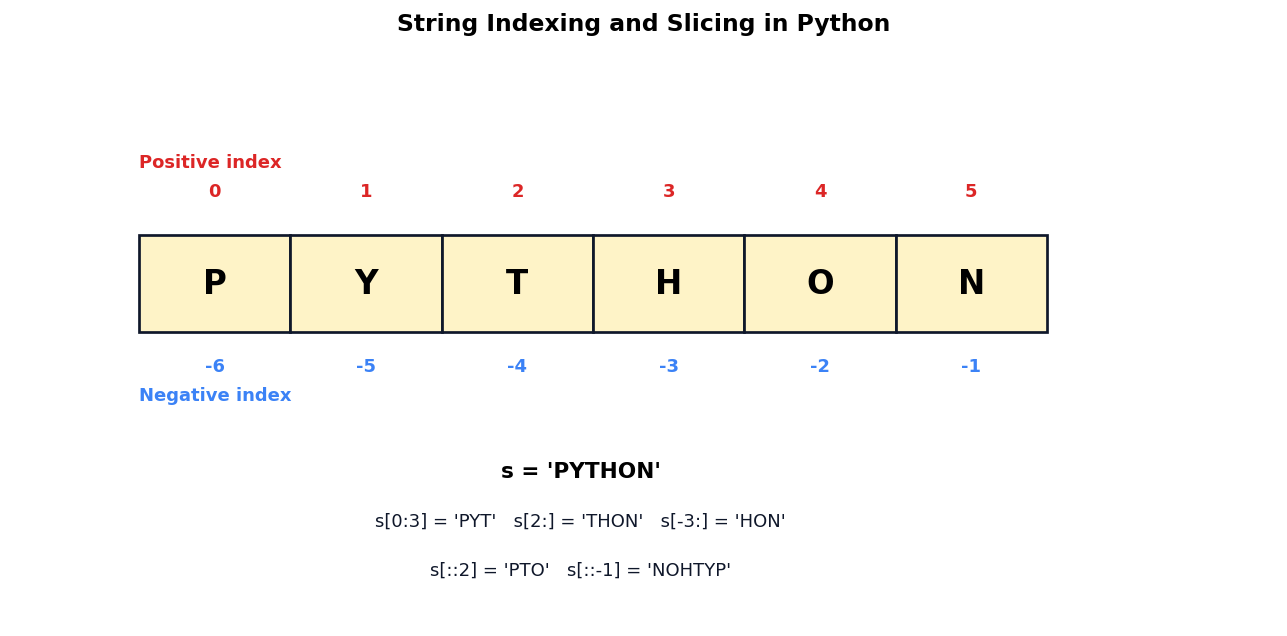
Study the string indexing diagram and answer:
For s = 'PYTHON' what is s[-1]?
AP
BY
CN
DO
For s = 'PYTHON' what is s[0:3]?
APYT
BPYTH
CYTH
DONHT
Explain string indexing and slicing with examples.
Show answersHide answers
1. Option 3 — N
2. Option 1 — PYT
3. Python strings support both positive (0 1 2 ...) and negative (-1 -2 ...) indexing. Slicing uses [start:stop:step] where stop is exclusive. s[0:3] gives the first 3 characters. s[-3:] gives the last 3. s[::-1] reverses the string. Strings are immutable so slicing returns new strings.
Q572 Marks
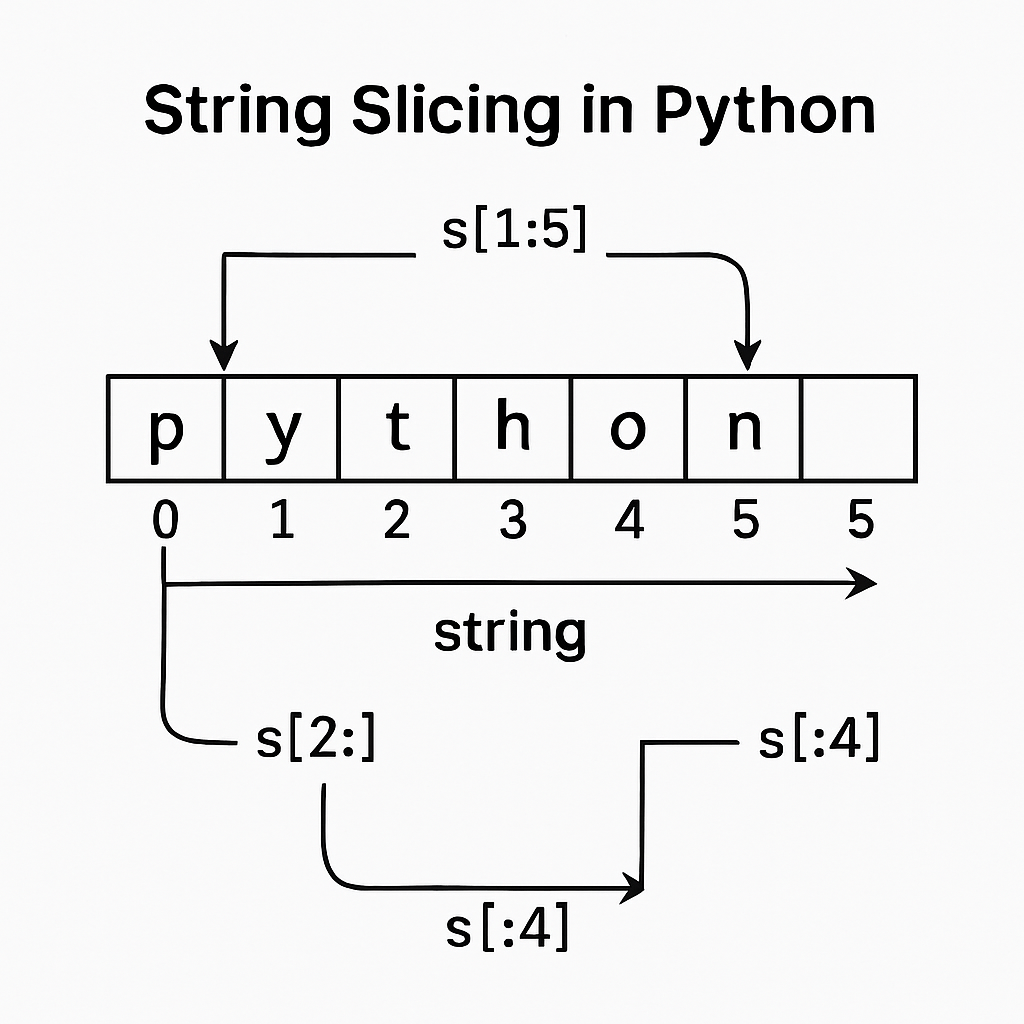
Based on the given diagram of string slicing in Python, answer the following:
What does the slice 'string[1:4]' return?
Astr
Btri
Cing
Ding
Explain the output of 'string[:3]'.
Show answersHide answers
1. Option 3 — ing
2. The output will be the first three characters of the string.
Q582 Marks
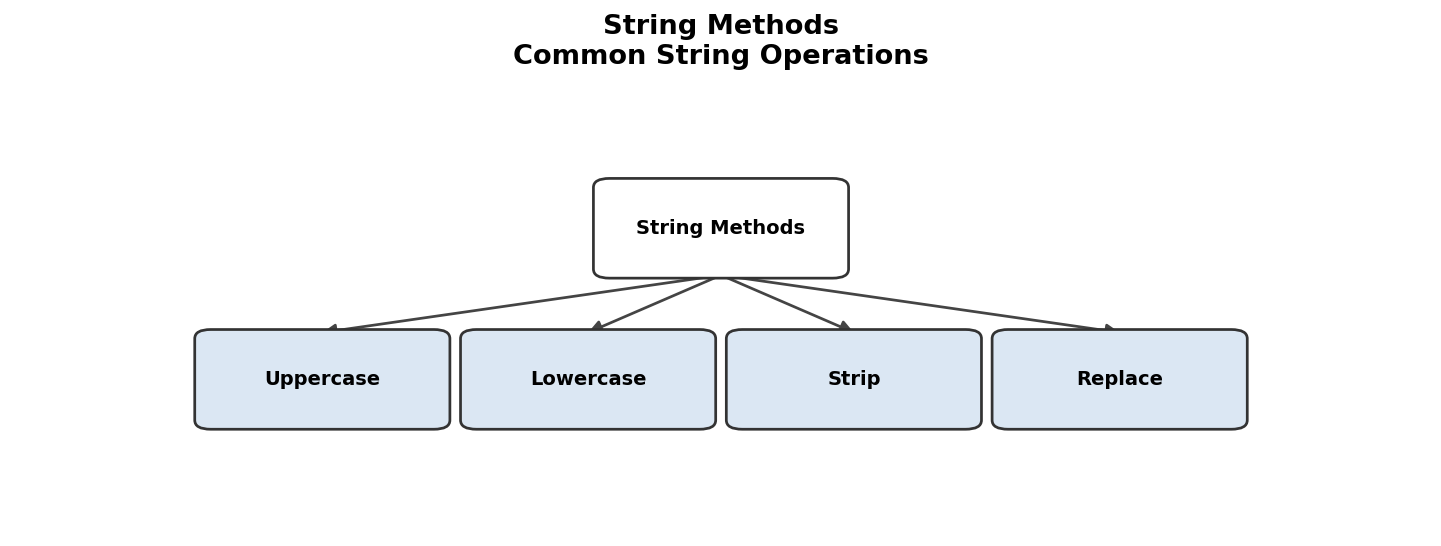
Based on the given flowchart of string methods in Python, answer the following:
Which method would you use to convert a string to lowercase?
AUppercase
BLowercase
CStrip
DReplace
What does the 'strip' method do?
Show answersHide answers
1. Option 2 — Lowercase
2. The 'strip' method removes any leading and trailing whitespace from the string.
Q592 Marks
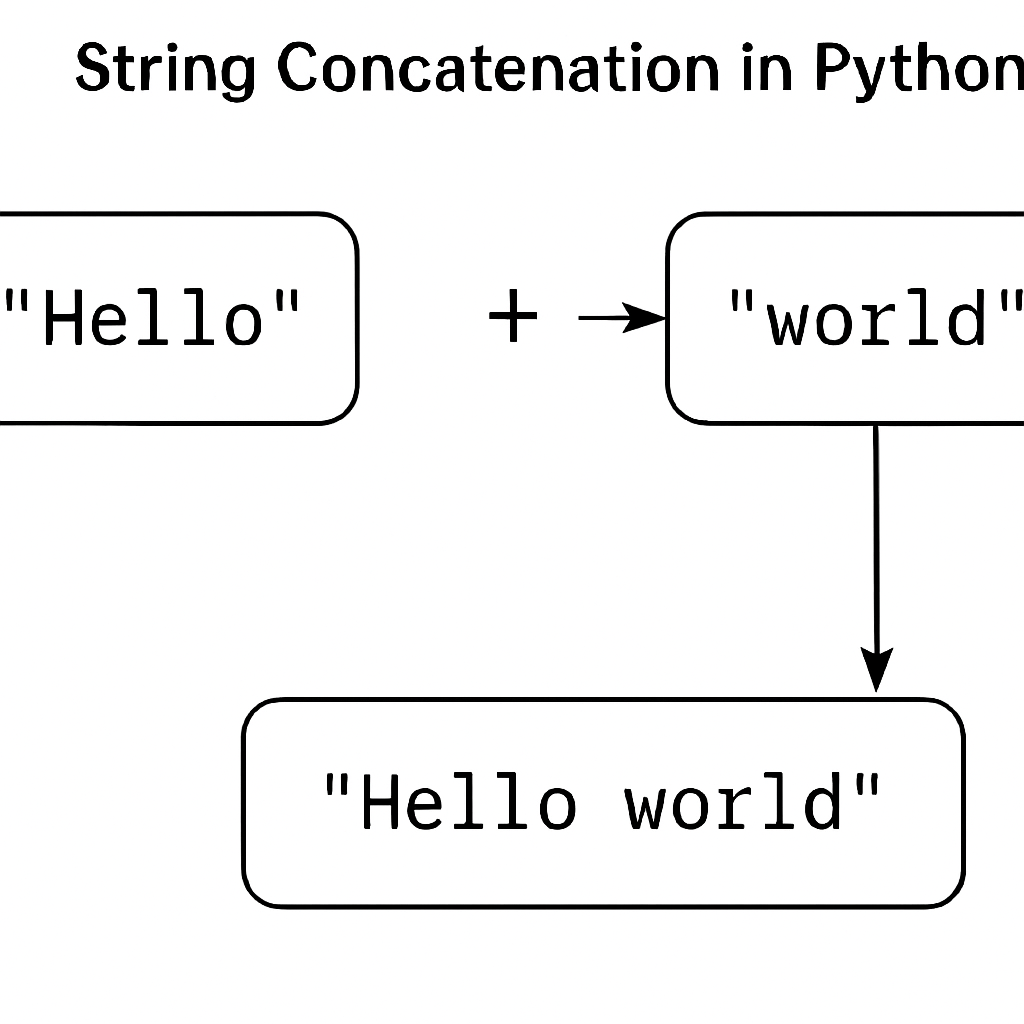
Based on the given diagram showing string concatenation, answer the following:
What is the result of concatenating 'Hello' and 'World'?
AHelloWorld
BHello World
CHello+World
DHello, World!
Describe how string concatenation is performed in Python.
Show answersHide answers
1. Option 2 — Hello World
2. String concatenation is performed using the '+' operator to combine two or more strings.