SUMMARY: This chapter introduces tuples and dictionaries in Python, focusing on their properties, usage, and differences from other data structures. KEY TOPICS: tuples, dictionaries, immutable data types, key-value pairs, accessing elements, iterating over tuples and dictionaries, dictionary methods, tuple operations, nested data structures, applications of tuples and dictionaries
What is the result of the expression (1, 2) + (3, 4)?
A(1, 2, 3, 4)
B(1, 2)(3, 4)
C(1, 2, (3, 4))
DError
Check answerHide answer
Correct answer: Option 1 — (1, 2, 3, 4)
Q131 Mark
Which method would you use to get a list of all values in a dictionary?
Avalues()
Bget_values()
Call_values()
Dlist_values()
Check answerHide answer
Correct answer: Option 1 — values()
Q141 Mark
What happens if you try to change an element of a tuple?
AThe element changes
BA new tuple is created
CAn error is raised
DThe program crashes
Check answerHide answer
Correct answer: Option 3 — An error is raised
Q151 Mark
In a dictionary, what is the purpose of a key?
ATo store values
BTo identify values uniquely
CTo sort the dictionary
DTo create nested dictionaries
Check answerHide answer
Correct answer: Option 2 — To identify values uniquely
Short Answer Questions10 questions
Q163 Marks
Differentiate between list and tuple in Python.
Q173 Marks
Differentiate between tuple and dictionary in Python.
Q183 Marks
Write Python code to count the frequency of each word in a sentence using a dictionary.
Q193 Marks
Explain how to create an empty tuple and an empty dictionary.
Q203 Marks
How do you check if a key exists in a dictionary?
Q213 Marks
What are the main characteristics of tuples in Python?
View sample solutionHide solution
Tuples are immutable data types, meaning once they are created, their elements cannot be changed. They can contain mixed data types and are defined using parentheses, e.g., (1, 'apple', 3.14).
Q223 Marks
How can you access elements in a tuple?
View sample solutionHide solution
Elements in a tuple can be accessed using indexing, similar to lists. For example, if 't' is a tuple, 't[0]' will return the first element of the tuple.
Q233 Marks
What is the purpose of the 'get' method in dictionaries?
View sample solutionHide solution
The 'get' method in dictionaries is used to retrieve the value associated with a specified key. It returns 'None' if the key does not exist, allowing for safer access without raising an error.
Q243 Marks
Explain how to iterate over a dictionary and print its key-value pairs.
View sample solutionHide solution
You can iterate over a dictionary using a for loop. For example, for 'key, value in my_dict.items():', you can print 'key' and 'value' to display each key-value pair in the dictionary.
Q253 Marks
What happens if you try to change an element of a tuple?
View sample solutionHide solution
If you attempt to change an element of a tuple, Python will raise a TypeError, indicating that tuples do not support item assignment due to their immutable nature.
Long Answer Questions6 questions
Q266 Marks
Compare tuple and dictionary with the help of a table on five features.
Q276 Marks
Differentiate between list tuple and dictionary in tabular form on five points.
Q286 Marks
Compare keys() and values() dictionary methods with the help of a table.
Q296 Marks
Write a Python program to convert two parallel lists into a dictionary.
Q306 Marks
Discuss any five built-in dictionary methods with one example each.
Q316 Marks
Write a Python program using a dictionary to store student names as keys and their marks as values then find the topper.
Assertion–Reason Questions8 questions
Q321 Mark
Assertion (A): Tuples are immutable.
Reason (R): They cannot be modified after creation.
Show explanationHide explanation
Correct answer: Option 1 —
Both A and R are true, and R is the correct explanation of A.
Q331 Mark
Assertion (A): Dictionaries are unordered collections.
Reason (R): Items are accessed by key not position.
Show explanationHide explanation
Correct answer: Option 1 —
Both A and R are true, and R is the correct explanation of A.
Q341 Mark
Assertion (A): Dictionary keys must be unique.
Reason (R): Duplicate keys would create ambiguity.
Show explanationHide explanation
Correct answer: Option 1 —
Both A and R are true, and R is the correct explanation of A.
Q351 Mark
Assertion (A): Dictionary keys must be immutable.
Reason (R): Lists cannot be used as dictionary keys.
Show explanationHide explanation
Correct answer: Option 1 —
Both A and R are true, and R is the correct explanation of A.
Q361 Mark
Assertion (A): Tuples can be used as dictionary keys.
Reason (R): They are immutable and hashable.
Show explanationHide explanation
Correct answer: Option 1 —
Both A and R are true, and R is the correct explanation of A.
Q371 Mark
Assertion (A): Tuples can contain elements of different data types.
Reason (R): Dictionaries can only store values of the same data type.
Show explanationHide explanation
Correct answer: Option 3 —
A is true, but R is false.
Q381 Mark
Assertion (A): You can access elements of a tuple using indexing.
Reason (R): Dictionaries use indexing to access their values.
Show explanationHide explanation
Correct answer: Option 3 —
A is true, but R is false.
Q391 Mark
Assertion (A): Dictionaries allow duplicate keys.
Reason (R): Dictionaries store data in key-value pairs.
Show explanationHide explanation
Correct answer: Option 4 —
A is false, but R is true.
Statement-Based Questions8 questions
Q401 Mark
Statement 1: Tuples are faster than lists for iteration.
Statement 2: They have lower memory overhead.
Show answerHide answer
Correct answer: Option 1 —
Both statements are true.
Q411 Mark
Statement 1: Dictionary values can be of any data type.
Statement 2: Keys must be of immutable types like int float string or tuple.
Show answerHide answer
Correct answer: Option 1 —
Both statements are true.
Q421 Mark
Statement 1: Tuples are written using parentheses.
Statement 2: A single-element tuple needs a trailing comma.
Show answerHide answer
Correct answer: Option 1 —
Both statements are true.
Q431 Mark
Statement 1: The get() method retrieves a value for a given key.
Statement 2: It returns None if the key is absent.
Show answerHide answer
Correct answer: Option 1 —
Both statements are true.
Q441 Mark
Statement 1: The items() method returns key-value pairs as a list of tuples.
Statement 2: It is useful for iterating over dictionary entries.
Show answerHide answer
Correct answer: Option 1 —
Both statements are true.
Q451 Mark
Statement 1: Tuples can be modified after their creation.
Statement 2: Dictionaries are mutable data types.
Show answerHide answer
Correct answer: Option 2 —
Only Statement 1 is true.
Q461 Mark
Statement 1: A tuple can contain elements of different data types.
Statement 2: Dictionaries can only have string keys.
Show answerHide answer
Correct answer: Option 1 —
Both statements are true.
Q471 Mark
Statement 1: The length of a tuple can be changed after it is created.
Statement 2: Dictionaries allow for duplicate keys.
Show answerHide answer
Correct answer: Option 4 —
Both statements are false.
Case Study / Passage Questions4 questions
Q483 Marks
A student wants to build a simple phone book using a Python dictionary where contact names are keys and phone numbers are values. She needs to add new contacts search a contact by name update a number and delete a contact.
Which Python data type stores key-value pairs?
AList
BTuple
CDictionary
DSet
Tuples in Python are:
AMutable
BImmutable
CHashable
DBoth immutable and hashable
Write a Python program to implement a phone book with add search update and delete operations.
Show answersHide answers
1. Option 3 — Dictionary
2. Option 4 — Both immutable and hashable
3. phonebook = {} # empty dict. # Add: phonebook['Anil'] = '9876543210'. # Search: print(phonebook.get('Anil' 'Not found')). # Update: phonebook['Anil'] = '9876543211'. # Delete: del phonebook['Anil']. The get() method is preferred over [] for searching because it returns a default if the key is absent. Dictionary keys must be unique and immutable.
Q494 Marks
In Python, tuples are immutable sequences that can hold a variety of data types. Unlike lists, once a tuple is created, its elements cannot be modified, added, or removed. This property makes tuples suitable for storing fixed collections of items. For example, a tuple can be used to store the coordinates of a point in a 2D space, such as (3, 5). On the other hand, dictionaries are mutable data structures that store data in key-value pairs. Each key in a dictionary must be unique, and it allows for fast retrieval of values based on those keys. For instance, a dictionary can be used to map student IDs to their names, enabling quick access to a student's information using their ID as the key.
What is the main characteristic of tuples in Python?
AThey are mutable.
BThey are immutable.
CThey can only hold integers.
DThey can only hold strings.
Explain why dictionaries are preferred for fast data retrieval.
Which of the following is true about the keys in a dictionary?
AKeys can be duplicated.
BKeys must be unique.
CKeys can be mutable.
DKeys can only be strings.
Provide an example of a scenario where a tuple would be more appropriate than a list.
Show answersHide answers
1. Option 2 — They are immutable.
2. Dictionaries use unique keys for each value, allowing for O(1) average time complexity for lookups.
3. Option 2 — Keys must be unique.
4. Storing the geographical coordinates of a location, such as (latitude, longitude).
Q504 Marks
Tuples and dictionaries are essential data structures in Python that serve different purposes. Tuples are often used to group related data together. For instance, a tuple can represent a record, such as a book with attributes like title, author, and year published. Since tuples are immutable, they ensure that the data remains constant throughout the program. In contrast, dictionaries are highly flexible and allow for dynamic data manipulation. They are particularly useful when you need to associate a unique identifier with a value, such as a product ID with its price. The ability to add, update, or delete entries in a dictionary makes it an invaluable tool for managing collections of data.
What type of data structure is best suited for storing a fixed collection of items?
AList
BTuple
CDictionary
DSet
Describe a situation where using a dictionary would be advantageous.
Which of the following statements about tuples is correct?
ATuples can be modified after creation.
BTuples can contain mixed data types.
CTuples cannot be nested.
DTuples are slower than lists.
What is a common application of dictionaries in programming?
Show answersHide answers
1. Option 2 — Tuple
2. When you need to map unique identifiers to values, such as student IDs to student names.
3. Option 2 — Tuples can contain mixed data types.
4. Storing user preferences where each preference is associated with a unique key.
Q514 Marks
In Python, tuples can be created using parentheses, while dictionaries are defined using curly braces. A tuple is defined by placing comma-separated values within parentheses, such as (1, 2, 3). In contrast, a dictionary consists of key-value pairs, separated by colons, like {'name': 'Alice', 'age': 25}. One of the key advantages of using tuples is their ability to serve as keys in dictionaries, as they are hashable. This means that you can use a tuple as a key to access a value in a dictionary, which is not possible with lists. This feature allows for complex data structures, such as dictionaries of tuples, to be easily implemented.
How are tuples created in Python?
AUsing square brackets.
BUsing parentheses.
CUsing curly braces.
DUsing angle brackets.
Explain why tuples can be used as keys in dictionaries.
Which of the following is the correct syntax for a dictionary?
A{'key': 'value'}
B[key: value]
C(key, value)
D<key, value>
Provide an example of a tuple that could be used as a key in a dictionary.
Show answersHide answers
1. Option 2 — Using parentheses.
2. Tuples are hashable and immutable, making them suitable for use as dictionary keys.
3. Option 1 — {'key': 'value'}
4. (1, 'apple')
Table-Based Questions4 questions
Q526 Marks
For dict d = {'a':1, 'b':2, 'c':3}, predict each operation's result.
Operation on d = {'a':1,'b':2,'c':3}
Result
d['a']
?
d['d'] = 4 (then d)
?
d.keys()
?
d.values()
?
d.get('e', 0)
?
Q535 Marks
Predict the output of each tuple operation.
Operation on t = (1, 2, 3, 4)
Result
len(t)
?
t[0]
?
t[-1]
?
t[0:2]
?
t + (5, 6)
?
t * 2
?
Q543 Marks
Study the table comparing list tuple and dictionary and answer:
Feature
List
Tuple
Dictionary
Mutable?
Yes
No
Yes
Ordered?
Yes
Yes
Yes (3.7+)
Indexed by
Position
Position
Key
Syntax
[]
()
{}
Duplicates
Allowed
Allowed
Keys unique
Which is immutable in Python?
AList
BTuple
CDictionary
DAll three
Which uses curly braces { } for syntax?
AList
BTuple
CDictionary
DSet
Compare list tuple and dictionary on five features with one example each.
Show answersHide answers
1. Option 2 — Tuple
2. Option 3 — Dictionary
3. Lists are mutable ordered sequences indexed by position; use [] syntax. Tuples are immutable ordered sequences also indexed by position; use (). Dictionaries are mutable mappings of keys to values indexed by key; use {}. Tuples are faster than lists and can serve as dictionary keys (because they are immutable and hashable). Dictionaries provide O(1) lookup by key.
Q556 Marks
What is the maximum value in the tuple provided in the table?
Tuple Elements
1
5
3
7
2
Picture-Based Questions4 questions
Q563 Marks
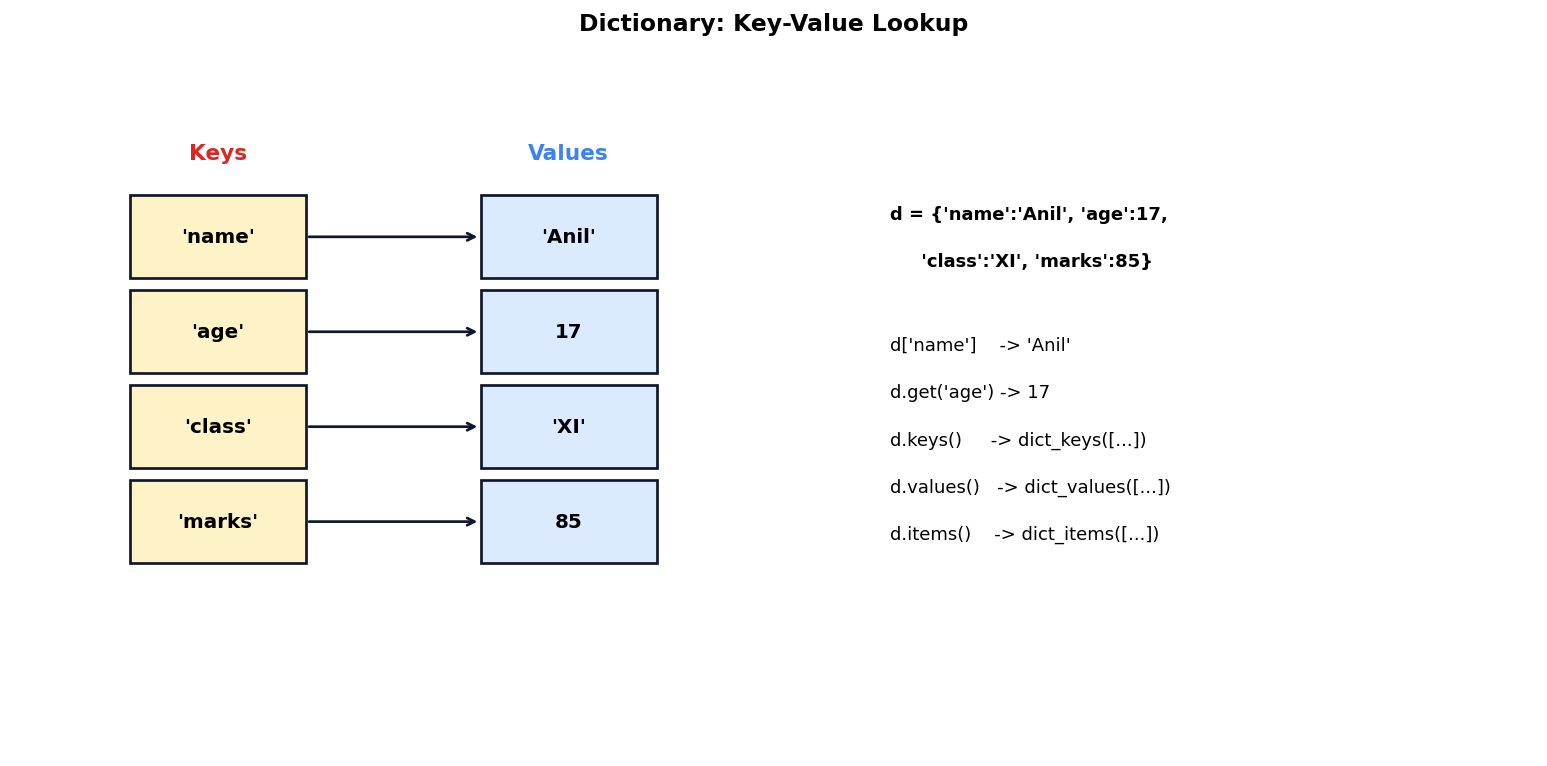
Study the dictionary key-value lookup and answer:
To safely retrieve a value from a dictionary use:
Ad['marks']
Bd.get('marks')
CBoth work
DNeither works
Which method returns key-value pairs as tuples?
Akeys()
Bvalues()
Citems()
Dall()
Discuss the structure of a dictionary in Python with examples of common methods.
Show answersHide answers
1. Option 3 — Both work
2. Option 3 — items()
3. A dictionary stores key-value pairs. Keys must be unique and immutable; values can be any type. Lookup by key is O(1) on average. The get() method is preferred over [] because it returns a default if the key is absent (no KeyError). keys() values() and items() return views over the dictionary.
Q572 Marks
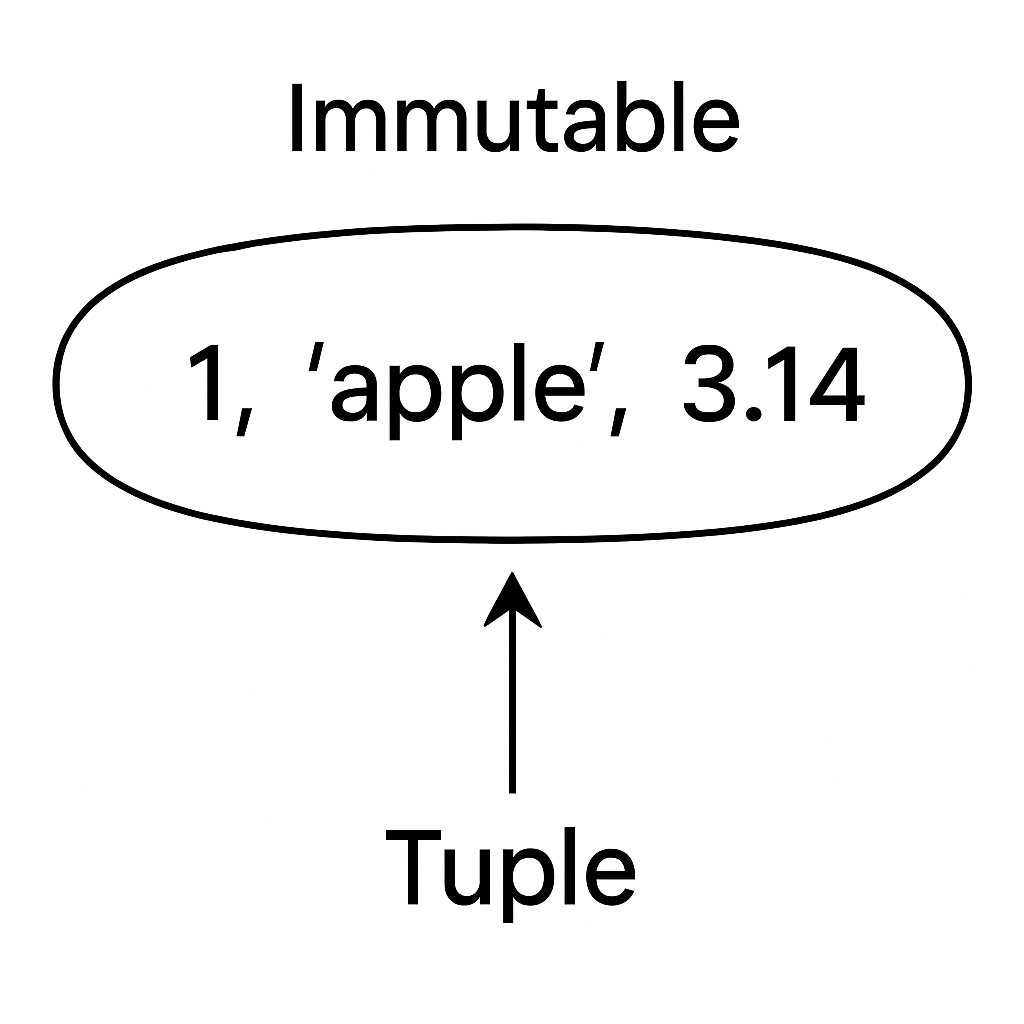
Based on the given diagram of a tuple structure in Python, answer the following:
What is the type of the first element in the tuple?
AInteger
BString
CFloat
DList
Explain why tuples are considered immutable.
Show answersHide answers
1. Option 1 — Integer
2. Tuples cannot be modified after their creation.
Q582 Marks
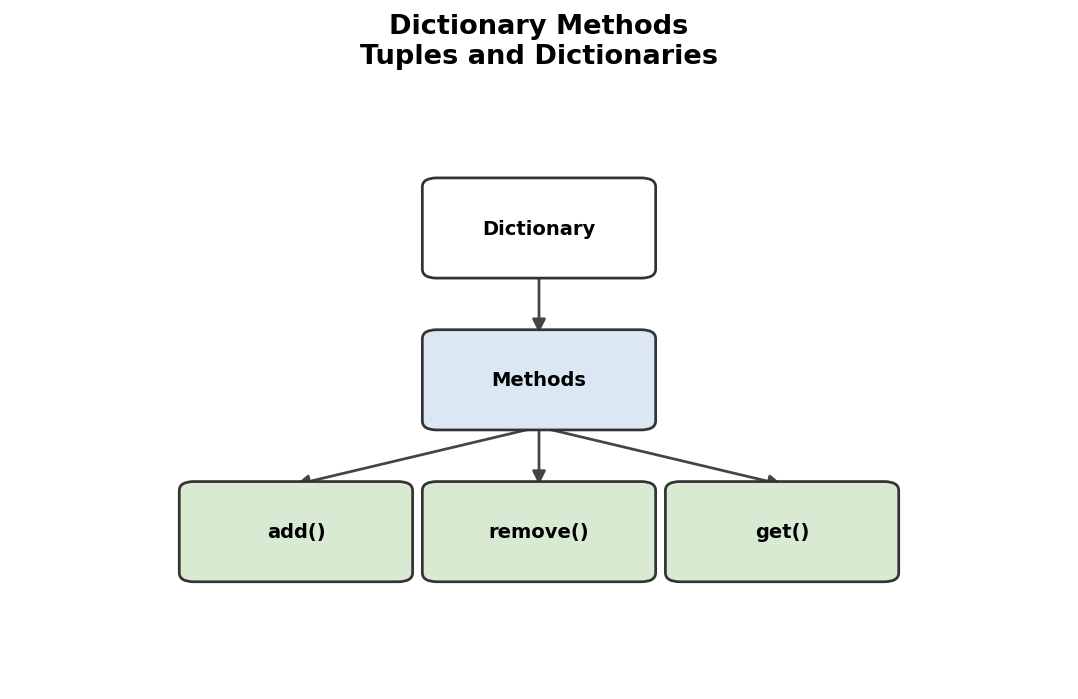
Based on the given flowchart, answer the following:
Which method is used to retrieve a value associated with a key?
Aadd()
Bremove()
Cget()
Dupdate()
What is the purpose of the 'remove()' method?
Show answersHide answers
1. Option 3 — get()
2. To delete a key-value pair from the dictionary.
Q592 Marks
Based on the given chart, answer the following:
Which operation has a time complexity of O(1)?
AAccess
BCount
CAppend
DIndex
What can be inferred about the 'Append' operation for tuples?
Show answersHide answers
1. Option 1 — Access
2. Tuples do not support appending as they are immutable.