SUMMARY: This chapter introduces the concept of lists in Python, a fundamental data structure used to store collections of items. KEY TOPICS: list creation, list indexing, list slicing, list methods, list operations, nested lists, list comprehension, mutable vs immutable types, iterating through lists, applications of lists
Which method adds an element to the end of a list?
Aadd()
Binsert()
Cappend()
Dextend()
Check answerHide answer
Correct answer: Option 3 — append()
Q41 Mark
The output of [1,2,3] + [4,5,6] is:
A[5,7,9]
B[1,2,3,4,5,6]
C[1,2,3]+[4,5,6]
DError
Check answerHide answer
Correct answer: Option 2 — [1,2,3,4,5,6]
Q51 Mark
Which of the following removes the last element of a list?
Aremove()
Bpop()
Cdelete()
Dclear()
Check answerHide answer
Correct answer: Option 2 — pop()
Q61 Mark
What will be the output of the expression my_list = [1, 2, 3]; my_list[1] = 4; my_list?
A[1, 2, 3]
B[1, 4, 3]
C[4, 2, 3]
D[1, 2, 4]
Check answerHide answer
Correct answer: Option 2 — [1, 4, 3]
Q71 Mark
Which of the following methods can be used to insert an element at a specific position in a list?
Aappend()
Binsert()
Cextend()
Dadd()
Check answerHide answer
Correct answer: Option 2 — insert()
Q81 Mark
What is the result of the following code: list1 = [1, 2, 3]; list2 = list1 * 2?
A[1, 2, 3, 1, 2, 3]
B[2, 4, 6]
C[1, 2, 3, 2, 4, 6]
D[1, 2, 3, 1, 2]
Check answerHide answer
Correct answer: Option 1 — [1, 2, 3, 1, 2, 3]
Q91 Mark
Which of the following statements about list slicing is true?
Alist[0:2] returns the first two elements
Blist[1:3] returns the first three elements
Clist[:3] returns the last three elements
Dlist[3:] returns the first three elements
Check answerHide answer
Correct answer: Option 1 — list[0:2] returns the first two elements
Q101 Mark
What will be the output of the following code: my_list = [1, 2, 3]; my_list.append([4, 5])?
A[1, 2, 3, 4, 5]
B[1, 2, 3, [4, 5]]
C[1, 2, 3, 4, 5, 6]
DError: list cannot contain lists
Check answerHide answer
Correct answer: Option 2 — [1, 2, 3, [4, 5]]
Q111 Mark
Which of the following operations will result in a TypeError?
A[1, 2, 3] + [4, 5]
B[1, 2, 3] * 2
C[1, 2, 3] - [1]
D[1, 2, 3][1:2]
Check answerHide answer
Correct answer: Option 3 — [1, 2, 3] - [1]
Q121 Mark
What does the method pop() do when called on a list without any arguments?
ARemoves the first element
BRemoves the last element
CRemoves a specific element
DClears the entire list
Check answerHide answer
Correct answer: Option 2 — Removes the last element
Q131 Mark
Given the list my_list = [1, 2, 3, 4, 5], what will my_list[1:4] return?
A[1, 2, 3]
B[2, 3, 4]
C[3, 4, 5]
D[1, 2, 3, 4]
Check answerHide answer
Correct answer: Option 2 — [2, 3, 4]
Q141 Mark
Which of the following is a characteristic of lists in Python?
ALists are immutable
BLists can contain elements of different data types
CLists are fixed in size
DLists cannot contain other lists
Check answerHide answer
Correct answer: Option 2 — Lists can contain elements of different data types
Q151 Mark
What will be the output of the following code: nested_list = [[1, 2], [3, 4]]; nested_list[0][1]?
A1
B2
C3
D4
Check answerHide answer
Correct answer: Option 2 — 2
Short Answer Questions10 questions
Q163 Marks
Differentiate between append() and extend() methods of a list.
Q173 Marks
Differentiate between remove() and pop() methods of a list.
Q183 Marks
Write Python code to find the maximum element in a list.
Q193 Marks
Explain list slicing with an example.
Q203 Marks
How can you sort a list in descending order in Python?
Q213 Marks
What is a nested list in Python? Provide an example.
View sample solutionHide solution
A nested list is a list that contains other lists as its elements. For example, [[1, 2], [3, 4], [5, 6]] is a nested list where each element is itself a list.
Q223 Marks
How do you access the third element of a list named 'my_list'?
View sample solutionHide solution
You can access the third element of 'my_list' using the index 2, like this: my_list[2]. In Python, list indexing starts from 0.
Q233 Marks
What is list comprehension in Python? Give an example.
View sample solutionHide solution
List comprehension is a concise way to create lists using a single line of code. For example, [x**2 for x in range(5)] generates a list of squares of numbers from 0 to 4: [0, 1, 4, 9, 16].
Q243 Marks
Explain the difference between mutable and immutable types in Python with respect to lists.
View sample solutionHide solution
Mutable types, like lists, can be changed after their creation, allowing for modifications such as adding or removing elements. Immutable types, like tuples, cannot be changed once created, meaning their elements cannot be modified or deleted.
Q253 Marks
How can you iterate through a list using a for loop? Provide a code snippet.
View sample solutionHide solution
You can iterate through a list using a for loop by using the syntax: for item in my_list: print(item). This will print each element in 'my_list' sequentially.
Long Answer Questions6 questions
Q266 Marks
Compare list and tuple in Python with the help of a table on five features.
Q276 Marks
Differentiate between append() and extend() methods of a list in tabular form.
Q286 Marks
Compare remove() and pop() list methods with the help of a table.
Q296 Marks
Write a Python program to find the second largest number in a list.
Q306 Marks
Discuss any five built-in list methods in Python with one example each.
Q316 Marks
Write a Python program to find the sum of all even numbers in a list using a for loop.
Assertion–Reason Questions8 questions
Q321 Mark
Assertion (A): Lists are mutable.
Reason (R): Their elements can be changed after the list is created.
Show explanationHide explanation
Correct answer: Option 1 —
Both A and R are true, and R is the correct explanation of A.
Q331 Mark
Assertion (A): Lists can store elements of different data types.
Reason (R): Python lists are heterogeneous.
Show explanationHide explanation
Correct answer: Option 1 —
Both A and R are true, and R is the correct explanation of A.
Q341 Mark
Assertion (A): len() can be used to find the size of a list.
Reason (R): It returns the count of elements in the list.
Show explanationHide explanation
Correct answer: Option 1 —
Both A and R are true, and R is the correct explanation of A.
Q351 Mark
Assertion (A): The append() method modifies the list in place.
Reason (R): It adds the argument as a single element at the end.
Show explanationHide explanation
Correct answer: Option 1 —
Both A and R are true, and R is the correct explanation of A.
Q361 Mark
Assertion (A): Sorting a list of strings is case-sensitive by default.
Reason (R): Capital letters come before lowercase in ASCII order.
Show explanationHide explanation
Correct answer: Option 1 —
Both A and R are true, and R is the correct explanation of A.
Q371 Mark
Assertion (A): A list in Python can be created using square brackets.
Reason (R): Lists can also be created using the list() constructor.
Show explanationHide explanation
Correct answer: Option 1 —
Both A and R are true, and R is the correct explanation of A.
Q381 Mark
Assertion (A): List indexing in Python starts from 1.
Reason (R): Python uses zero-based indexing for lists.
Show explanationHide explanation
Correct answer: Option 4 —
A is false, but R is true.
Q391 Mark
Assertion (A): List slicing allows you to extract a portion of a list.
Reason (R): Slicing can only be performed on strings, not on lists.
Show explanationHide explanation
Correct answer: Option 3 —
A is true, but R is false.
Statement-Based Questions8 questions
Q401 Mark
Statement 1: Lists in Python are ordered collections.
Statement 2: The position of an element is preserved.
Show answerHide answer
Correct answer: Option 1 —
Both statements are true.
Q411 Mark
Statement 1: Lists support both positive and negative indexing.
Statement 2: Negative indices count from the end.
Show answerHide answer
Correct answer: Option 1 —
Both statements are true.
Q421 Mark
Statement 1: Lists are created using square brackets.
Statement 2: An empty list is denoted by [].
Show answerHide answer
Correct answer: Option 1 —
Both statements are true.
Q431 Mark
Statement 1: The 'in' operator checks element membership.
Statement 2: The 'not in' operator checks for absence.
Show answerHide answer
Correct answer: Option 1 —
Both statements are true.
Q441 Mark
Statement 1: List comprehension is a concise way to create lists.
Statement 2: It uses a for clause inside square brackets.
Show answerHide answer
Correct answer: Option 1 —
Both statements are true.
Q451 Mark
Statement 1: Lists in Python are immutable data structures.
Statement 2: You can change the elements of a list after it has been created.
Show answerHide answer
Correct answer: Option 2 —
Only Statement 1 is true.
Q461 Mark
Statement 1: List slicing allows you to extract a portion of a list.
Statement 2: List slicing can only be done using positive indices.
Show answerHide answer
Correct answer: Option 3 —
Only Statement 2 is true.
Q471 Mark
Statement 1: The append() method adds an element to the end of a list.
Statement 2: The insert() method can add an element at any specified index in a list.
Show answerHide answer
Correct answer: Option 1 —
Both statements are true.
Case Study / Passage Questions1 question
Q483 Marks
A teacher has a list of marks of 5 students stored as marks = [78 65 92 84 55]. She needs to find the average maximum and minimum marks and identify students who scored above average. She decides to use Python list operations and a for loop.
Which function returns the number of elements in the list?
Alen(marks)
Bsize(marks)
Clength(marks)
Dcount(marks)
Lists in Python are:
AMutable
BImmutable
CSet
DTuple
Write a Python program to compute average max min and list students above the average.
Show answersHide answers
1. Option 1 — len(marks)
2. Option 1 — Mutable
3. avg = sum(marks) / len(marks) = 374/5 = 74.8. max(marks) = 92. min(marks) = 55. To find above-average students: above = [m for m in marks if m > avg] which gives [78 92 84]. List comprehensions are concise and Pythonic. Lists support indexing slicing and many built-in functions like sum max min len.
Table-Based Questions2 questions
Q496 Marks
Predict the output of each list operation.
Operation on a = [1, 2, 3]
Result
a.append(4)
?
a.extend([5, 6])
?
a.insert(0, 0)
?
a.remove(3)
?
a.pop()
?
a.sort(reverse=True)
?
Q503 Marks
Study the table of list operations and answer:
Operation
Use
Example
Result
append()
Add at end
[1,2].append(3)
[1,2,3]
extend()
Add multiple
[1,2].extend([3,4])
[1,2,3,4]
insert()
Add at position
[1,3].insert(1,2)
[1,2,3]
remove()
Remove value
[1,2,3].remove(2)
[1,3]
pop()
Remove last
[1,2,3].pop()
[1,2]
Which method adds a single element at the end of the list?
Aappend()
Bextend()
Cadd()
Dinsert()
Which method adds multiple elements to a list?
Aappend()
Bextend()
Cinsert()
Djoin()
Discuss any five list methods in Python with examples.
Show answersHide answers
1. Option 1 — append()
2. Option 2 — extend()
3. Lists support append extend insert remove pop sort reverse len etc. append adds one element; extend adds elements of an iterable. insert places at a specific index. remove deletes by value pop deletes by index. sort sorts in place; sorted() returns a new sorted list. List comprehensions like [x*2 for x in lst] are concise.
Picture-Based Questions1 question
Q513 Marks
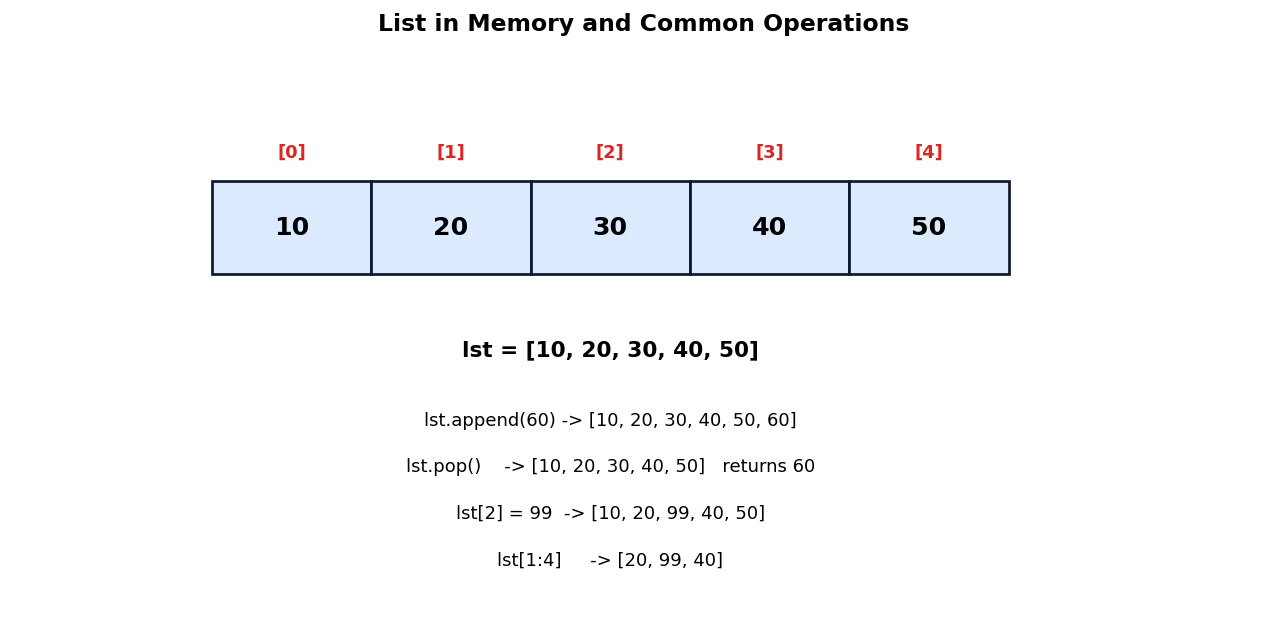
Study the list memory layout and operations and answer:
Which method adds a single element at the end of a list?
Aappend()
Bextend()
Cinsert()
Dpop()
For lst = [10, 20, 99, 40, 50] what is lst[1:4]?
A[10, 20]
B[20, 99, 40]
C[20, 30, 40]
D[10, 20, 99, 40, 50]
Discuss any five list operations in Python with examples.
Show answersHide answers
1. Option 1 — append()
2. Option 2 — [20, 99, 40]
3. Lists are mutable ordered collections in Python. Indexing (positive and negative) gives single elements; slicing returns sublists. append adds one element at end; extend adds multiple; insert at specific index; pop removes by index; remove by value. Lists are heterogeneous and can contain mixed types.