Encoding Schemes and Number Systems — Important Questions
52 questions
With answersCBSE format
SUMMARY: This chapter introduces students to various encoding schemes and number systems used in computer science. KEY TOPICS: binary number system, decimal number system, hexadecimal number system, octal number system, ASCII encoding, Unicode encoding, binary arithmetic, conversion between number systems, BCD (Binary Coded Decimal), Gray code
Which of the following is the hexadecimal representation of decimal 255?
AFF
BF0
CFE
DEF
Check answerHide answer
Correct answer: Option 1 — FF
Q41 Mark
The encoding scheme that uses 16 bits per character to represent characters of all major scripts is:
AASCII
BEBCDIC
CUnicode
DISCII
Check answerHide answer
Correct answer: Option 3 — Unicode
Q51 Mark
The binary equivalent of decimal 13 is:
A1101
B1011
C1110
D1111
Check answerHide answer
Correct answer: Option 1 — 1101
Q61 Mark
What is the binary representation of the decimal number 25?
A11001
B10101
C11101
D10011
Check answerHide answer
Correct answer: Option 1 — 11001
Q71 Mark
Which of the following is a characteristic of the ASCII encoding scheme?
AUses 8 bits per character
BSupports only uppercase letters
CCan represent 256 characters
DIs a variable-length encoding scheme
Check answerHide answer
Correct answer: Option 3 — Can represent 256 characters
Q81 Mark
What is the octal equivalent of the binary number 101110?
A56
B72
C64
D57
Check answerHide answer
Correct answer: Option 1 — 56
Q91 Mark
Which number system uses base 16?
ABinary
BDecimal
CHexadecimal
DOctal
Check answerHide answer
Correct answer: Option 3 — Hexadecimal
Q101 Mark
What is the decimal value of the hexadecimal number 1A?
A26
B30
C28
D24
Check answerHide answer
Correct answer: Option 1 — 26
Q111 Mark
In Binary Coded Decimal (BCD), how is the decimal number 93 represented?
A10010011
B10011001
C11001001
D10010101
Check answerHide answer
Correct answer: Option 2 — 10011001
Q121 Mark
Which of the following correctly converts the binary number 1110 to decimal?
A14
B15
C13
D12
Check answerHide answer
Correct answer: Option 1 — 14
Q131 Mark
What is the Gray code equivalent of the binary number 1011?
A1110
B1001
C1101
D1010
Check answerHide answer
Correct answer: Option 1 — 1110
Q141 Mark
Which of the following statements about the decimal number system is true?
AIt uses base 2
BIt uses base 8
CIt uses base 10
DIt uses base 16
Check answerHide answer
Correct answer: Option 3 — It uses base 10
Q151 Mark
What is the result of adding the binary numbers 1011 and 1101?
A11000
B10100
C10010
D11110
Check answerHide answer
Correct answer: Option 4 — 11110
Short Answer Questions10 questions
Q163 Marks
Convert binary 11010 to decimal showing the conversion steps.
Q173 Marks
Convert decimal 45 to binary showing the conversion steps.
Q183 Marks
Differentiate between ASCII and Unicode with two points.
Q193 Marks
What is the role of the binary number system in computers?
Q203 Marks
Convert hexadecimal 2AF to decimal.
Q213 Marks
What is the octal equivalent of the binary number 101101?
View sample solutionHide solution
The octal equivalent of the binary number 101101 is 55. This is obtained by grouping the binary digits into sets of three from the right and converting each group to its octal representation.
Q223 Marks
Explain the concept of Binary Coded Decimal (BCD).
View sample solutionHide solution
Binary Coded Decimal (BCD) is a class of binary encodings of decimal numbers where each digit of a decimal number is represented by its own binary sequence. For example, the decimal number 45 is represented in BCD as 0100 0101.
Q233 Marks
How do you convert the decimal number 23 to hexadecimal? Show the steps.
View sample solutionHide solution
To convert decimal 23 to hexadecimal, divide the number by 16. 23 divided by 16 gives a quotient of 1 and a remainder of 7. Therefore, 23 in hexadecimal is 17.
Q243 Marks
What is Gray code and why is it used in digital systems?
View sample solutionHide solution
Gray code is a binary numeral system where two successive values differ in only one bit. It is used in digital systems to prevent errors during the transition between values, especially in applications like rotary encoders.
Q253 Marks
Convert the binary number 111001 to octal. Show the conversion steps.
View sample solutionHide solution
To convert binary 111001 to octal, group the binary digits into sets of three from the right: 111 001. Then convert each group: 111 is 7 and 001 is 1. Therefore, the octal equivalent is 71.
Long Answer Questions6 questions
Q266 Marks
Explain the four common number systems (binary octal decimal hexadecimal) and convert decimal 100 to all three other systems.
Q276 Marks
Discuss ASCII Unicode and ISCII encoding schemes with examples and limitations of each.
Q286 Marks
Explain how floating point numbers are represented in a computer (sign mantissa exponent) using IEEE 754 single precision format.
Q296 Marks
Add the binary numbers 10110 and 1101 step by step and verify the result by converting to decimal.
Q306 Marks
Explain 1's complement and 2's complement representation of negative numbers with one example.
Q316 Marks
Differentiate between binary octal and hexadecimal number systems in tabular form.
Assertion–Reason Questions8 questions
Q321 Mark
Assertion (A): Computers use binary number system.
Reason (R): Their digital circuits have only two stable states ON and OFF.
Show explanationHide explanation
Correct answer: Option 1 —
Both A and R are true, and R is the correct explanation of A.
Q331 Mark
Assertion (A): Hexadecimal is more compact than binary.
Reason (R): Each hex digit represents 4 binary bits.
Show explanationHide explanation
Correct answer: Option 1 —
Both A and R are true, and R is the correct explanation of A.
Q341 Mark
Assertion (A): Unicode supports all world languages.
Reason (R): It uses 16 bits per character to represent over 65000 characters.
Show explanationHide explanation
Correct answer: Option 1 —
Both A and R are true, and R is the correct explanation of A.
Q351 Mark
Assertion (A): 2's complement is preferred over 1's complement for representing negative numbers.
Reason (R): 2's complement has only one representation for zero.
Show explanationHide explanation
Correct answer: Option 1 —
Both A and R are true, and R is the correct explanation of A.
Q361 Mark
Assertion (A): The largest 8-bit unsigned binary number is 255.
Reason (R): All eight bits set to 1 give 2^8 minus 1 = 255.
Show explanationHide explanation
Correct answer: Option 1 —
Both A and R are true, and R is the correct explanation of A.
Q371 Mark
Assertion (A): The binary number system uses only two digits: 0 and 1.
Reason (R): The decimal number system uses ten digits from 0 to 9.
Show explanationHide explanation
Correct answer: Option 1 —
Both A and R are true, and R is the correct explanation of A.
Q381 Mark
Assertion (A): ASCII can represent 256 characters.
Reason (R): ASCII uses 7 bits for character representation.
Show explanationHide explanation
Correct answer: Option 3 —
A is true, but R is false.
Q391 Mark
Assertion (A): The octal number system is base 8.
Reason (R): The hexadecimal number system is base 16.
Show explanationHide explanation
Correct answer: Option 1 —
Both A and R are true, and R is the correct explanation of A.
Statement-Based Questions8 questions
Q401 Mark
Statement 1: Each digit in a number system has a positional value.
Statement 2: The positional value depends on the base of the number system.
Show answerHide answer
Correct answer: Option 1 —
Both statements are true.
Q411 Mark
Statement 1: ASCII uses 7 bits per character giving 128 unique characters.
Statement 2: Extended ASCII uses 8 bits per character giving 256 unique characters.
Show answerHide answer
Correct answer: Option 1 —
Both statements are true.
Q421 Mark
Statement 1: Binary number system has only two digits 0 and 1.
Statement 2: Each binary digit is called a bit.
Show answerHide answer
Correct answer: Option 1 —
Both statements are true.
Q431 Mark
Statement 1: Octal number system uses digits 0-7.
Statement 2: Each octal digit represents 3 binary bits.
Show answerHide answer
Correct answer: Option 1 —
Both statements are true.
Q441 Mark
Statement 1: Hexadecimal uses digits 0-9 and letters A-F.
Statement 2: A represents 10 and F represents 15 in decimal.
Show answerHide answer
Correct answer: Option 1 —
Both statements are true.
Q451 Mark
Statement 1: The binary number system can represent negative numbers using two's complement.
Statement 2: The decimal number system is a base-8 number system.
Show answerHide answer
Correct answer: Option 2 —
Only Statement 1 is true.
Q461 Mark
Statement 1: In Unicode encoding, each character can be represented by up to 32 bits.
Statement 2: ASCII can represent more characters than Unicode.
Show answerHide answer
Correct answer: Option 4 —
Both statements are false.
Q471 Mark
Statement 1: Gray code is a binary numeral system where two successive values differ in only one bit.
Statement 2: Binary Coded Decimal (BCD) represents each decimal digit with four binary digits.
Show answerHide answer
Correct answer: Option 1 —
Both statements are true.
Case Study / Passage Questions1 question
Q483 Marks
A student is debugging a program that prints memory addresses in hexadecimal. She sees the values 0x1A 0xFF 0x100 and needs to convert them to decimal to verify the offsets are correct. She also needs to convert decimal 100 to binary octal and hexadecimal to fill the addressing table.
Hexadecimal 0x1A in decimal is:
A16
B17
C26
D32
Hexadecimal 0xFF in binary is:
A11111111
B10101010
C11110000
D11001100
Explain the conversion of decimal 100 to binary octal and hexadecimal showing all steps.
Show answersHide answers
1. Option 3 — 26
2. Option 1 — 11111111
3. To convert hex to decimal multiply each digit by 16 raised to its position power. 0x1A = 1*16 + 10 = 26. 0xFF = 15*16 + 15 = 255. 0x100 = 1*256 = 256. Decimal 100 = 1100100 in binary = 144 in octal = 64 in hexadecimal.
Table-Based Questions3 questions
Q496 Marks
Convert the given decimal numbers to binary octal and hexadecimal.
Decimal
Binary
Octal
Hex
10
?
?
?
25
?
?
?
100
?
?
?
255
?
?
?
512
?
?
?
Q506 Marks
Convert each number across number systems.
From
Number
Decimal
Binary
1010
?
Binary
1101
?
Octal
17
?
Octal
100
?
Hex
FF
?
Hex
1A
?
Q513 Marks
Study the binary conversion table and answer:
Decimal
Binary
Octal
Hex
10
1010
12
A
25
11001
31
19
50
110010
62
32
100
1100100
144
64
255
11111111
377
FF
The maximum value of an 8-bit unsigned binary number is:
A255
B256
C128
D512
Each digit represents 4 binary bits in:
ABinary
BOctal
CHexadecimal
DDecimal
Explain why hexadecimal is preferred over binary for representing large numbers in computing.
Show answersHide answers
1. Option 1 — 255
2. Option 3 — Hexadecimal
3. Computers use binary internally because circuits have two stable states (on/off). Octal and hexadecimal are convenient shorthand: 1 octal digit = 3 binary bits 1 hex digit = 4 binary bits. So binary 11111111 = 8 bits = 2 hex digits = FF. This is why colour codes and memory addresses use hex.
Picture-Based Questions1 question
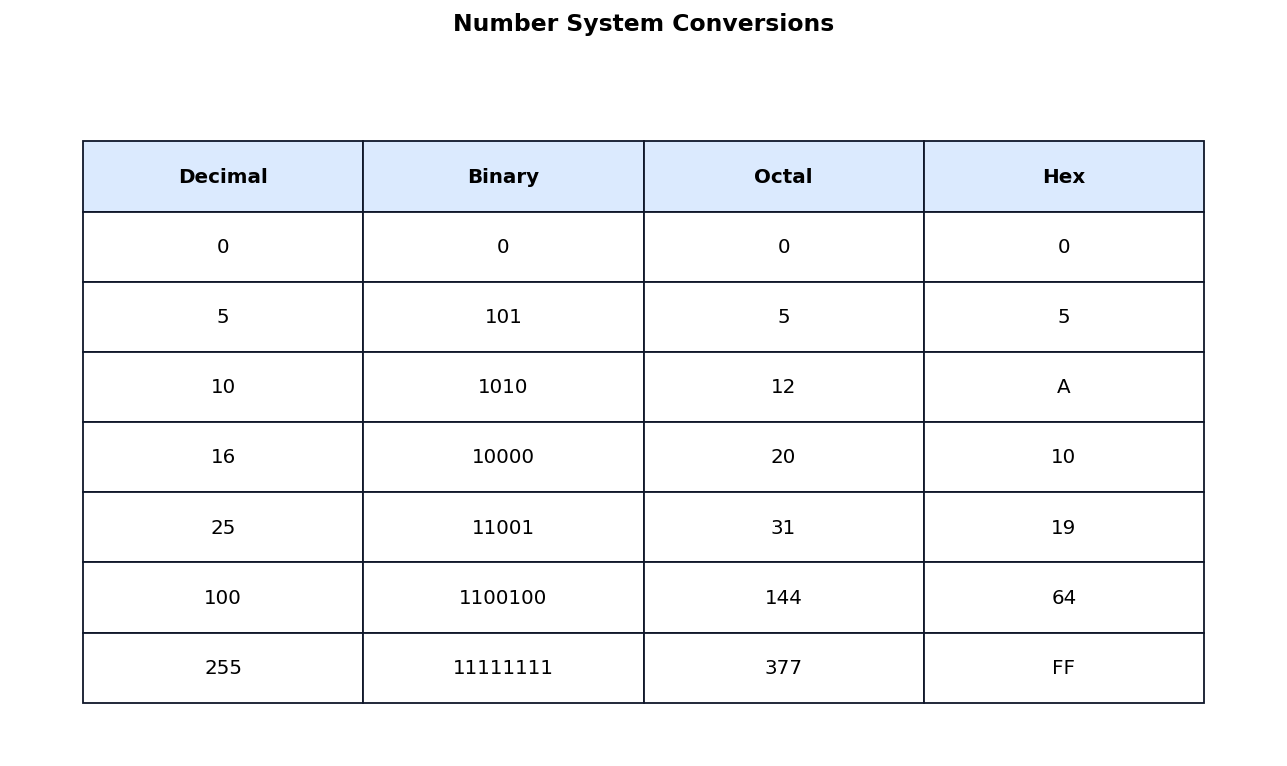
Q523 Marks
Study the number systems conversion table and answer:
Decimal 100 in hexadecimal is:
A64
B100
CFF
D377
Decimal 255 in binary is:
A11111111
B10000000
C11110000
D10101010
Explain why hexadecimal is preferred over binary for representing large numbers.
Show answersHide answers
1. Option 1 — 64
2. Option 1 — 11111111
3. Computers use binary internally because circuits have two stable states. Octal and hexadecimal are convenient shorthand: 1 octal digit = 3 binary bits 1 hex digit = 4 binary bits. Hex is widely used for memory addresses colour codes and machine code.