SUMMARY: This chapter explores the ethical, legal, and societal implications of computing technologies and the responsibilities of computing professionals. KEY TOPICS: cyber ethics, intellectual property rights, privacy concerns, cybercrime, digital divide, freedom of information, software licensing, hacking, ethical hacking, data protection laws
Which of the following is NOT considered intellectual property?
APatent
BCopyright
CTrademark
DHardware
Check answerHide answer
Correct answer: Option 4 — Hardware
Q41 Mark
Free and Open Source Software (FOSS) means:
AFree of cost only
BSource code is available
CBoth free and modifiable source
DOwned by Microsoft
Check answerHide answer
Correct answer: Option 3 — Both free and modifiable source
Q51 Mark
Which of the following is a strong password?
A12345
Bpassword
CP@ssw0rd!23
Dabcdefg
Check answerHide answer
Correct answer: Option 3 — P@ssw0rd!23
Q61 Mark
What is the primary purpose of data protection laws?
ATo promote free access to information
BTo protect personal data from misuse
CTo encourage software piracy
DTo eliminate cybercrime completely
Check answerHide answer
Correct answer: Option 2 — To protect personal data from misuse
Q71 Mark
Which of the following is an example of ethical hacking?
AAccessing a system without permission
BTesting a system's security with authorization
CCreating malware to steal data
DPhishing for personal information
Check answerHide answer
Correct answer: Option 2 — Testing a system's security with authorization
Q81 Mark
What does the term 'digital divide' refer to?
AThe gap between those who have access to digital technology and those who do not
BThe difference in software licensing types
CThe disparity in internet speeds across regions
DThe variation in computer hardware capabilities
Check answerHide answer
Correct answer: Option 1 — The gap between those who have access to digital technology and those who do not
Q91 Mark
Which of the following best describes cyber ethics?
AThe legal framework governing internet usage
BThe moral principles guiding the use of technology
CThe technical standards for software development
DThe financial implications of online businesses
Check answerHide answer
Correct answer: Option 2 — The moral principles guiding the use of technology
Q101 Mark
What is a common consequence of violating intellectual property rights?
AIncreased market competition
BLegal action and financial penalties
CEnhanced brand reputation
DGreater innovation in technology
Check answerHide answer
Correct answer: Option 2 — Legal action and financial penalties
Q111 Mark
Which of the following is NOT a characteristic of software licensing?
ADefines how software can be used
BSpecifies the ownership of the software
CAllows unlimited distribution of software
DMay include restrictions on modification
Check answerHide answer
Correct answer: Option 3 — Allows unlimited distribution of software
Q121 Mark
What is the primary concern regarding privacy in the digital age?
AIncreased social media usage
BData collection and surveillance by organizations
CThe rise of online shopping
DThe availability of free software
Check answerHide answer
Correct answer: Option 2 — Data collection and surveillance by organizations
Q131 Mark
Which of the following actions is considered a cybercrime?
ACreating a website for educational purposes
BUsing a computer to commit fraud
CParticipating in online forums
DDownloading open-source software
Check answerHide answer
Correct answer: Option 2 — Using a computer to commit fraud
Q141 Mark
What is the role of the Freedom of Information Act?
ATo protect personal data from public access
BTo ensure public access to government information
CTo regulate software licensing
DTo prevent cybercrime
Check answerHide answer
Correct answer: Option 2 — To ensure public access to government information
Q151 Mark
Which of the following is a potential risk of hacking?
AImproved system security
BLoss of sensitive data
CIncreased software performance
DEnhanced user experience
Check answerHide answer
Correct answer: Option 2 — Loss of sensitive data
Short Answer Questions10 questions
Q163 Marks
What is digital footprint? Why is it important?
Q173 Marks
Differentiate between freeware and FOSS.
Q183 Marks
Define cyber bullying with one example.
Q193 Marks
List any three good practices for cyber safety.
Q203 Marks
What is e-waste? List two ways to manage it.
Q213 Marks
What are intellectual property rights and why are they important in the context of computing?
View sample solutionHide solution
Intellectual property rights (IPR) are legal rights that grant creators protection for their inventions, designs, and artistic works. In computing, IPR is important to encourage innovation and creativity, ensuring that developers and companies can protect their software and digital content from unauthorized use or reproduction.
Q223 Marks
Explain the concept of ethical hacking and its significance in cybersecurity.
View sample solutionHide solution
Ethical hacking involves authorized attempts to breach a computer system or network to identify vulnerabilities. Its significance lies in helping organizations strengthen their security measures and protect sensitive data from malicious hackers.
Q233 Marks
What is the digital divide and how does it affect access to information technology?
View sample solutionHide solution
The digital divide refers to the gap between individuals who have access to modern information and communication technology and those who do not. This divide affects education, job opportunities, and access to essential services, particularly in underprivileged communities.
Q243 Marks
Define cybercrime and provide two examples of its types.
View sample solutionHide solution
Cybercrime refers to illegal activities conducted via the internet or computer systems. Examples include identity theft, where personal information is stolen for fraudulent purposes, and phishing, where attackers deceive individuals into providing sensitive data through fake emails or websites.
Q253 Marks
What are data protection laws and what purpose do they serve?
View sample solutionHide solution
Data protection laws are regulations that govern the collection, storage, and use of personal data by organizations. They serve to protect individuals' privacy rights and ensure that their data is handled responsibly and securely, preventing misuse and unauthorized access.
Long Answer Questions6 questions
Q266 Marks
Differentiate between freeware FOSS and proprietary software in tabular form.
Q276 Marks
Compare patent copyright and trademark with the help of a table giving examples.
Q286 Marks
Differentiate between hacking and ethical hacking in tabular form.
Q296 Marks
Compare phishing and identity theft with the help of a table.
Q306 Marks
Discuss the various types of cyber crimes with examples.
Q316 Marks
Explain intellectual property rights — patent copyright and trademark — with examples.
Assertion–Reason Questions8 questions
Q321 Mark
Assertion (A): Phishing is a cyber crime.
Reason (R): It tricks users into revealing sensitive information.
Show explanationHide explanation
Correct answer: Option 1 —
Both A and R are true, and R is the correct explanation of A.
Q331 Mark
Assertion (A): Strong passwords mix uppercase lowercase digits and special characters.
Reason (R): They are harder for attackers to guess or brute-force.
Show explanationHide explanation
Correct answer: Option 1 —
Both A and R are true, and R is the correct explanation of A.
Q341 Mark
Assertion (A): FOSS allows users to view modify and redistribute source code.
Reason (R): This promotes collaboration and rapid software improvement.
Show explanationHide explanation
Correct answer: Option 1 —
Both A and R are true, and R is the correct explanation of A.
Q351 Mark
Assertion (A): Plagiarism is a violation of intellectual property.
Reason (R): Using someone's work without permission or credit is unethical.
Show explanationHide explanation
Correct answer: Option 1 —
Both A and R are true, and R is the correct explanation of A.
Reason (R): It requires two independent forms of identification.
Show explanationHide explanation
Correct answer: Option 1 —
Both A and R are true, and R is the correct explanation of A.
Q371 Mark
Assertion (A): Cyber ethics emphasizes the importance of responsible behavior in online environments.
Reason (R): Cyber ethics helps in reducing incidents of cyberbullying and harassment.
Show explanationHide explanation
Correct answer: Option 1 —
Both A and R are true, and R is the correct explanation of A.
Q381 Mark
Assertion (A): Intellectual property rights protect the creators of original works.
Reason (R): These rights allow creators to control the use of their creations and earn recognition.
Show explanationHide explanation
Correct answer: Option 1 —
Both A and R are true, and R is the correct explanation of A.
Q391 Mark
Assertion (A): Privacy concerns are irrelevant in the context of social media.
Reason (R): Users often share personal information on social media platforms without understanding the risks.
Show explanationHide explanation
Correct answer: Option 4 —
A is false, but R is true.
Statement-Based Questions8 questions
Q401 Mark
Statement 1: A patent protects an invention.
Statement 2: It is granted for a fixed term (usually 20 years).
Show answerHide answer
Correct answer: Option 1 —
Both statements are true.
Q411 Mark
Statement 1: Copyright protects original works of authorship.
Statement 2: It applies automatically when a work is created.
Show answerHide answer
Correct answer: Option 1 —
Both statements are true.
Q421 Mark
Statement 1: A trademark protects a brand name or logo.
Statement 2: It distinguishes one company's products from another's.
Show answerHide answer
Correct answer: Option 1 —
Both statements are true.
Q431 Mark
Statement 1: The IT Act 2000 was amended in 2008.
Statement 2: The amendments included provisions on data protection and cyber terrorism.
Show answerHide answer
Correct answer: Option 1 —
Both statements are true.
Q441 Mark
Statement 1: Digital footprint refers to the trail of data left online.
Statement 2: It can be active (posts) or passive (browsing history).
Show answerHide answer
Correct answer: Option 1 —
Both statements are true.
Q451 Mark
Statement 1: Cybercrime includes activities such as identity theft and phishing.
Statement 2: Cyber ethics only concern the behavior of individuals online.
Show answerHide answer
Correct answer: Option 2 —
Only Statement 1 is true.
Q461 Mark
Statement 1: Intellectual property rights are designed to protect the creations of the mind.
Statement 2: Software licensing allows users to modify the software without restrictions.
Show answerHide answer
Correct answer: Option 3 —
Only Statement 2 is true.
Q471 Mark
Statement 1: Privacy concerns in computing are solely related to data storage.
Statement 2: Data protection laws aim to safeguard personal information from unauthorized access.
Show answerHide answer
Correct answer: Option 2 —
Only Statement 1 is true.
Case Study / Passage Questions4 questions
Q483 Marks
A student receives an email claiming to be from her bank asking her to click a link and verify her account details. The email looks official with the bank's logo but the URL in the address bar is unfamiliar. The cyber security awareness session at her school had warned her about such emails.
Such a fake email asking for account details is an example of:
AHacking
BPhishing
CCyber bullying
DIdentity theft
The student should:
AClick the link and provide details
BForward to friends
CDelete the email and report to the bank
DReply with details
Discuss the steps a user should take when receiving a suspected phishing email.
Show answersHide answers
1. Option 2 — Phishing
2. Option 3 — Delete the email and report to the bank
3. Phishing emails try to trick users into revealing sensitive information by impersonating trusted entities. Red flags include urgent language unfamiliar URLs spelling errors and requests for confidential information. The student should not click any link not provide any details delete the email and report it to the bank's official channel. The IT Act 2000 (with 2008 amendment) covers phishing as a cyber offence punishable by imprisonment and fine.
Q493 Marks
In the digital age, the concept of cyber ethics has become increasingly important. Cyber ethics refers to the moral principles that govern the use of computers and the internet. It encompasses issues such as online privacy, intellectual property rights, and the ethical implications of hacking. As technology evolves, so do the ethical dilemmas faced by individuals and organizations. For instance, the rise of social media has raised questions about the ownership of personal data and the responsibilities of companies in protecting user information. Understanding cyber ethics is crucial for computing professionals who must navigate these complex issues in their work.
What does cyber ethics primarily govern?
AMoral principles of internet use
BLegal regulations of software
CTechnical specifications of hardware
DFinancial transactions online
Explain the significance of understanding cyber ethics for computing professionals.
Which of the following is NOT a component of cyber ethics?
AOnline privacy
BIntellectual property rights
CSoftware licensing
DHardware specifications
Show answersHide answers
1. Option 1 — Moral principles of internet use
2. Understanding cyber ethics helps computing professionals navigate moral dilemmas and make responsible decisions regarding technology use.
3. Option 4 — Hardware specifications
Q503 Marks
Intellectual property rights (IPR) are legal rights that grant creators protection for their inventions, literary and artistic works, designs, symbols, names, and images used in commerce. In the realm of computing, IPR is particularly significant as it helps safeguard software and digital content from unauthorized use and reproduction. With the rapid advancement of technology, the enforcement of IPR has become more challenging, especially with the rise of piracy and illegal downloads. Understanding IPR is essential for software developers and content creators to ensure they can protect their work and benefit from their innovations.
What do intellectual property rights protect?
APhysical property
BCreative works and inventions
CFinancial assets
DPersonal data
Discuss the challenges faced in enforcing intellectual property rights in the digital age.
Why is understanding IPR important for software developers?
Show answersHide answers
1. Option 2 — Creative works and inventions
2. Challenges include piracy, illegal downloads, and the difficulty of tracking unauthorized use of digital content.
3. It is important for protecting their work and ensuring they can benefit from their innovations.
Q513 Marks
Privacy concerns have become a major issue in today's digital society. With the increasing amount of personal data being collected by companies, individuals are often unaware of how their information is being used. Data breaches and leaks have further exacerbated these concerns, leading to a demand for stronger data protection laws. Governments and organizations are now focusing on implementing regulations that ensure individuals' privacy rights are respected. Understanding these privacy concerns is essential for both users and computing professionals, as it helps foster trust in technology and promotes responsible data handling practices.
What has led to increased privacy concerns in the digital age?
ALess data collection
BIncreased personal data collection
CDecreased internet usage
DStricter data laws
Why is it important for computing professionals to understand privacy concerns?
What is one outcome of data breaches in relation to privacy?
AIncreased trust in technology
BDemand for stronger data protection laws
CLess data collection
DImproved user experience
Show answersHide answers
1. Option 2 — Increased personal data collection
2. It is important to foster trust in technology and promote responsible data handling practices.
3. Option 2 — Demand for stronger data protection laws
Table-Based Questions4 questions
Q525 Marks
Identify what each cyber concept means.
Term
Definition
Phishing
?
Hacking
?
Identity theft
?
Cyber bullying
?
Plagiarism
?
Q536 Marks
For each scenario identify whether it's a cyber crime / not and which type.
Scenario
Cyber crime?
Type
Sending fake bank email
?
?
Posting embarrassing photos
?
?
Copying paragraphs from internet
?
?
Using cracked software
?
?
Q543 Marks
Study the IPR table and answer:
Type
Protects
Duration in India
Patent
Invention
20 years
Copyright
Original work
Lifetime + 60 years
Trademark
Brand / logo
10 years renewable
Industrial design
Visual design
10 + 5 years
Trade secret
Confidential info
While confidential
Which IPR protects an invention?
APatent
BCopyright
CTrademark
DTrade secret
The duration of patent protection in India is (years):
A10
B15
C20
DLifetime
Discuss the four major types of intellectual property rights with one example each.
Show answersHide answers
1. Option 1 — Patent
2. Option 3 — 20
3. Intellectual property rights protect creations of the mind. Patent protects inventions for a limited time (20 years). Copyright protects original literary musical artistic and software works for the author's lifetime plus 60 years. Trademark protects brand identifiers (logos names). Trade secrets protect confidential business information indefinitely as long as kept secret. Each requires specific legal procedures to register and enforce.
Q556 Marks
Which type of cyber crime is most prevalent according to the data?
Type of Cyber Crime
Number of Incidents
Percentage of Total
Phishing
1500
30%
Malware
1200
24%
Hacking
800
16%
Identity Theft
1000
20%
Other
500
10%
Picture-Based Questions4 questions
Q563 Marks
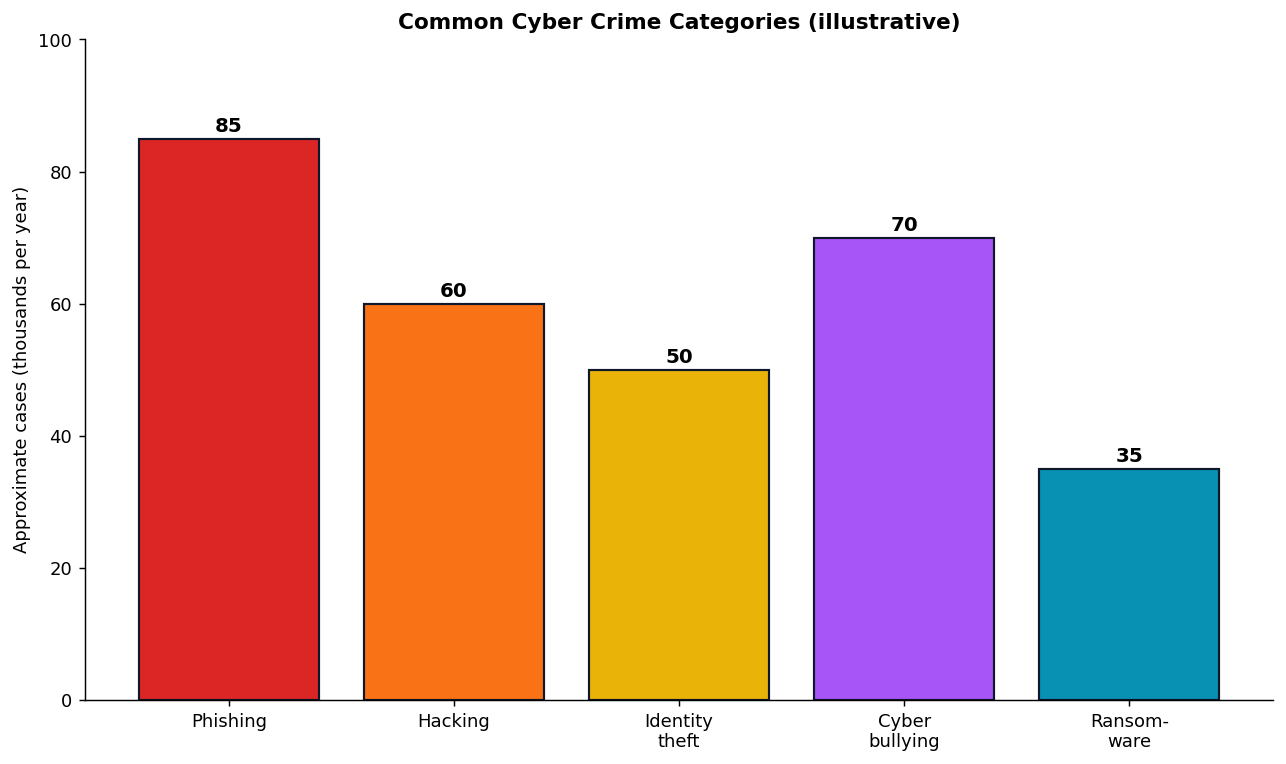
Study the cyber crime category bar chart and answer:
Which of the following has the highest number of cases in the chart?
APhishing
BHacking
CIdentity theft
DRansomware
Which Indian law covers cyber offences?
AIT Act 1995
BIT Act 2000
CIT Act 2008
DIT Act 2015
Discuss any four common cyber crime categories with one example each.
Show answersHide answers
1. Option 1 — Phishing
2. Option 2 — IT Act 2000
3. Cyber crimes are offences committed using or against computer networks. Common types include phishing (fake emails) hacking (unauthorised access) identity theft (impersonation) cyber bullying (online harassment) and ransomware (file encryption for ransom). The IT Act 2000 (with 2008 amendment) is the main Indian law covering these offences.
Q572 Marks
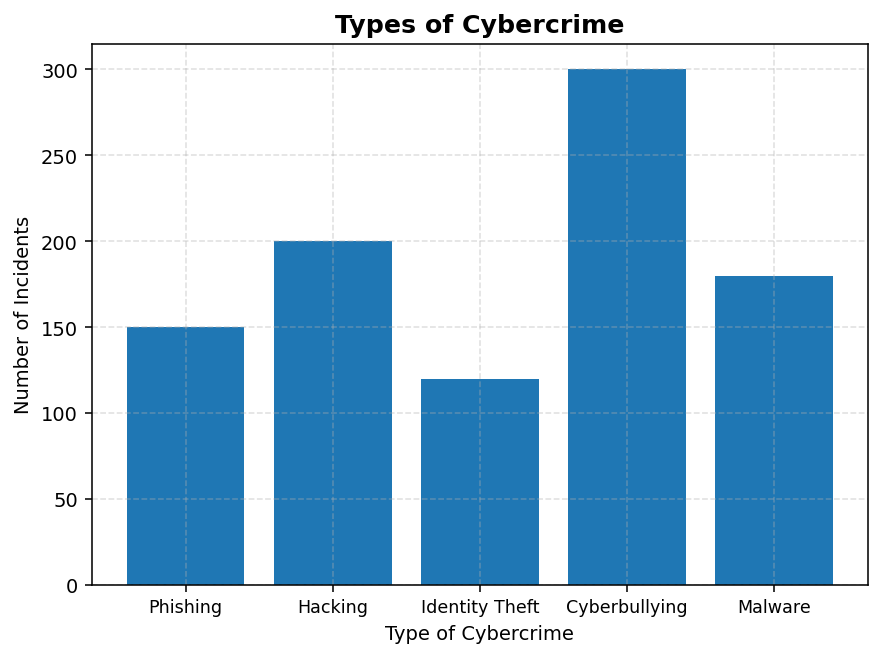
Based on the given chart, answer the following:
Which type of cybercrime has the highest number of incidents?
APhishing
BHacking
CCyberbullying
DMalware
What is the total number of incidents for 'Identity Theft' and 'Malware'?
Show answersHide answers
1. Option 3 — Cyberbullying
2. 300
Q582 Marks
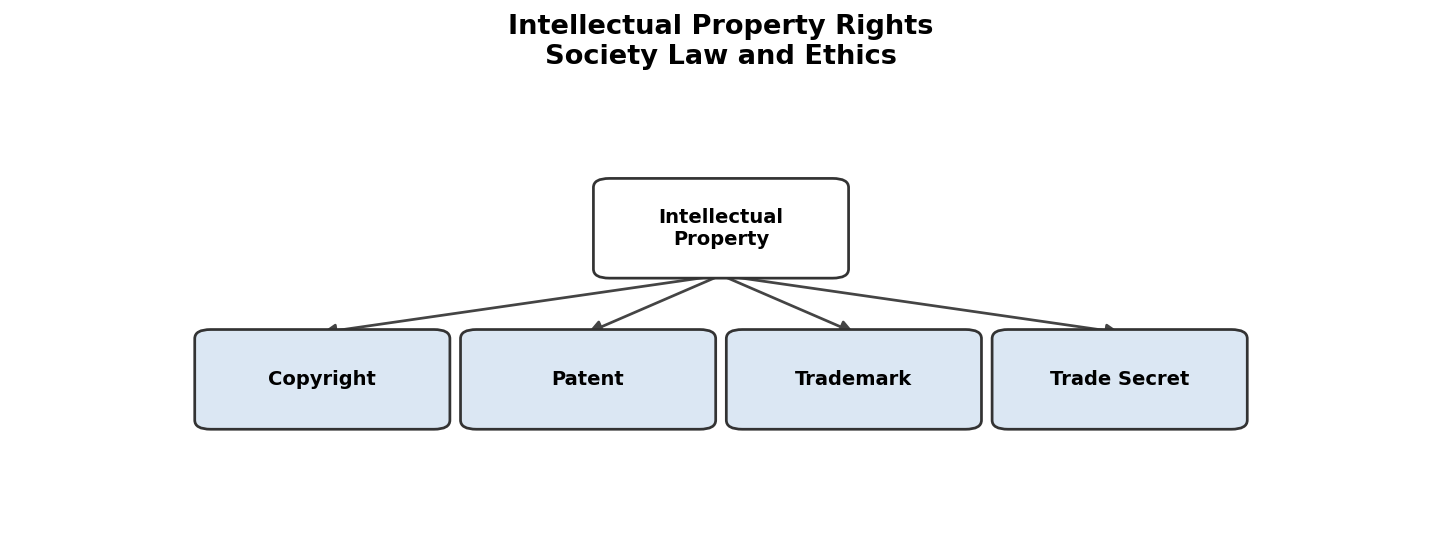
Based on the given flowchart, answer the following:
What type of intellectual property protects inventions?
ACopyright
BPatent
CTrademark
DTrade Secret
List one type of intellectual property that protects brand names.
What is the first step in the ethical hacking process?
AScanning
BGaining Access
CReconnaissance
DCovering Tracks
What is the purpose of 'Covering Tracks' in ethical hacking?
Show answersHide answers
1. Option 2 — Patent
2. Trademark
3. Option 3 — Reconnaissance
4. To hide the evidence of hacking activities
Q592 Marks
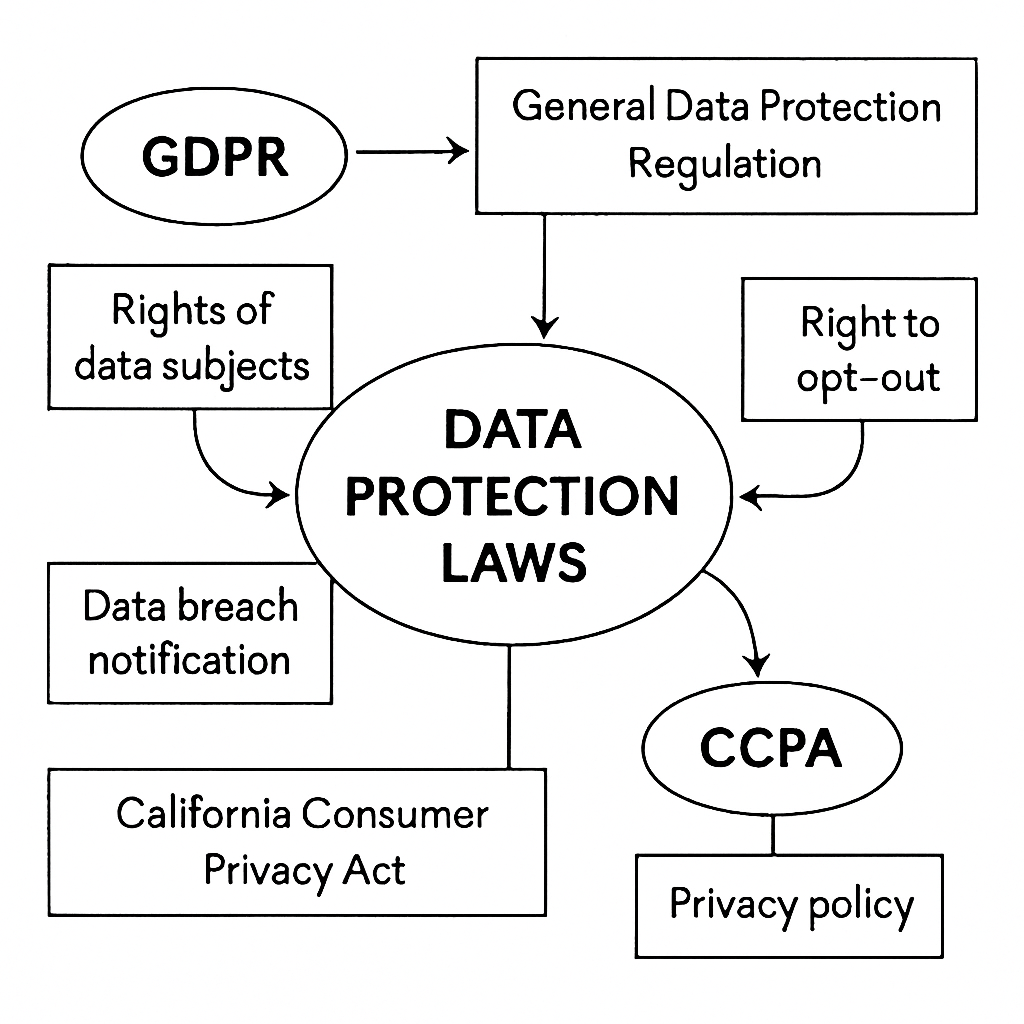
Based on the given diagram of data protection laws, answer the following:
What does GDPR stand for?
AGeneral Data Protection Regulation
BGlobal Data Privacy Regulation
CGeneral Data Privacy Regulation
DGlobal Data Protection Regulation
Name one key feature of CCPA.
Show answersHide answers
1. Option 1 — General Data Protection Regulation
2. Consumer's right to know about personal data collected