SUMMARY: The chapter focuses on the systematic approach to solving computational problems using various methodologies. KEY TOPICS: problem definition, algorithm development, flowcharts, pseudocode, debugging, testing, documentation, stepwise refinement, top-down design, modular programming
Which of the following is the first step in problem solving?
ACoding
BAlgorithm design
CProblem definition
DTesting
Check answerHide answer
Correct answer: Option 3 — Problem definition
Q21 Mark
A flowchart represents a program using:
APseudocode
BSymbols
CCode statements
DTables
Check answerHide answer
Correct answer: Option 2 — Symbols
Q31 Mark
Which of the following is NOT a stage in software development life cycle (SDLC)?
ARequirements analysis
BDesign
CCoding
DMarketing
Check answerHide answer
Correct answer: Option 4 — Marketing
Q41 Mark
A step-by-step description of the solution to a problem is called:
AProgram
BAlgorithm
CFlowchart
DCode
Check answerHide answer
Correct answer: Option 2 — Algorithm
Q51 Mark
Which symbol is used in a flowchart to represent a decision?
ARectangle
BDiamond
COval
DParallelogram
Check answerHide answer
Correct answer: Option 2 — Diamond
Q61 Mark
What is the primary purpose of documentation in programming?
ATo improve code readability
BTo enhance algorithm efficiency
CTo reduce debugging time
DTo increase execution speed
Check answerHide answer
Correct answer: Option 1 — To improve code readability
Q71 Mark
Which of the following best describes 'stepwise refinement'?
ABreaking down a problem into smaller, manageable parts
BCreating a detailed flowchart for a program
CWriting pseudocode for complex algorithms
DTesting individual modules in isolation
Check answerHide answer
Correct answer: Option 1 — Breaking down a problem into smaller, manageable parts
Q81 Mark
In modular programming, what is a module?
AA complete program
BA reusable piece of code that performs a specific task
CA type of algorithm
DA flowchart representation
Check answerHide answer
Correct answer: Option 2 — A reusable piece of code that performs a specific task
Q91 Mark
What is pseudocode primarily used for?
ATo write executable code
BTo outline algorithms in a human-readable format
CTo create flowcharts
DTo document software requirements
Check answerHide answer
Correct answer: Option 2 — To outline algorithms in a human-readable format
Q101 Mark
Which of the following is NOT a benefit of using flowcharts?
AVisual representation of logic
BEasier debugging process
CDirect execution of the program
DClear communication of ideas
Check answerHide answer
Correct answer: Option 3 — Direct execution of the program
Q111 Mark
What is the main goal of debugging?
ATo improve algorithm efficiency
BTo identify and fix errors in the code
CTo enhance user interface design
DTo document the code
Check answerHide answer
Correct answer: Option 2 — To identify and fix errors in the code
Q121 Mark
Which design methodology emphasizes breaking a problem into smaller sub-problems?
ATop-down design
BBottom-up design
CLinear programming
DHeuristic approach
Check answerHide answer
Correct answer: Option 1 — Top-down design
Q131 Mark
What does a flowchart diamond shape represent?
AStart or end of a process
BAn input/output operation
CA decision point
DA process step
Check answerHide answer
Correct answer: Option 3 — A decision point
Q141 Mark
Which of the following is an example of an algorithm?
AA flowchart diagram
BA list of steps to solve a math problem
CA programming language syntax
DA debugging tool
Check answerHide answer
Correct answer: Option 2 — A list of steps to solve a math problem
Q151 Mark
What is the first step in developing an algorithm?
ATesting the algorithm
BDefining the problem clearly
CWriting pseudocode
DCreating a flowchart
Check answerHide answer
Correct answer: Option 2 — Defining the problem clearly
Short Answer Questions10 questions
Q163 Marks
Differentiate between algorithm and flowchart.
Q173 Marks
List the steps of problem solving in computer science.
Q183 Marks
Write an algorithm to find the largest of three numbers.
Q193 Marks
Draw flowchart symbols and explain each.
Q203 Marks
What is pseudocode? Give one example.
Q213 Marks
What is the purpose of debugging in the problem-solving methodology?
View sample solutionHide solution
Debugging is the process of identifying and removing errors or bugs from a program or algorithm. It ensures that the solution works as intended and meets the specified requirements.
Q223 Marks
Explain the concept of stepwise refinement in problem solving.
View sample solutionHide solution
Stepwise refinement is a technique where a complex problem is broken down into smaller, more manageable sub-problems. Each sub-problem is solved individually, leading to a clearer and more structured solution.
Q233 Marks
What is modular programming and why is it important?
View sample solutionHide solution
Modular programming is a software design technique that emphasizes separating a program into distinct modules that can be developed, tested, and maintained independently. This approach enhances code reusability and simplifies debugging.
Q243 Marks
Describe the top-down design approach in algorithm development.
View sample solutionHide solution
Top-down design is a method where the main problem is divided into smaller sub-problems, which are further divided until they are simple enough to be solved. This hierarchical approach helps in organizing the solution logically.
Q253 Marks
What role does documentation play in the problem-solving methodology?
View sample solutionHide solution
Documentation provides a written record of the algorithms, code, and processes used in problem-solving. It aids in understanding, maintaining, and updating the solution over time, especially for future reference.
Long Answer Questions6 questions
Q266 Marks
Explain the steps of problem solving methodology with one example.
Q276 Marks
Write an algorithm and draw a flowchart to compute the factorial of a positive integer.
Q286 Marks
Discuss the importance of testing and debugging in software development.
Q296 Marks
Compare top-down and bottom-up approaches to problem solving with examples.
Q306 Marks
Write a flowchart to find whether a given year is a leap year.
Q316 Marks
Differentiate between algorithm and flowchart in tabular form on five features.
Assertion–Reason Questions8 questions
Q321 Mark
Assertion (A): Algorithm precedes coding in problem solving.
Reason (R): Coding without a clear algorithm leads to bugs and rework.
Show explanationHide explanation
Correct answer: Option 1 —
Both A and R are true, and R is the correct explanation of A.
Q331 Mark
Assertion (A): Flowcharts use diamond shape for decision blocks.
Reason (R): The diamond visually indicates a yes/no branch.
Show explanationHide explanation
Correct answer: Option 1 —
Both A and R are true, and R is the correct explanation of A.
Q341 Mark
Assertion (A): Pseudocode is language independent.
Reason (R): It uses plain English-like statements to describe an algorithm.
Show explanationHide explanation
Correct answer: Option 1 —
Both A and R are true, and R is the correct explanation of A.
Q351 Mark
Assertion (A): Debugging is the process of finding and fixing errors.
Reason (R): It is essential for producing reliable software.
Show explanationHide explanation
Correct answer: Option 1 —
Both A and R are true, and R is the correct explanation of A.
Q361 Mark
Assertion (A): Modular programming makes code easier to maintain.
Reason (R): Each module performs a specific function and can be tested independently.
Show explanationHide explanation
Correct answer: Option 1 —
Both A and R are true, and R is the correct explanation of A.
Q371 Mark
Assertion (A): Stepwise refinement helps in breaking down complex problems into smaller, manageable parts.
Reason (R): This approach allows programmers to focus on one part of the problem at a time, simplifying the development process.
Show explanationHide explanation
Correct answer: Option 1 —
Both A and R are true, and R is the correct explanation of A.
Q381 Mark
Assertion (A): Documentation is not necessary if the code is self-explanatory.
Reason (R): Proper documentation aids in understanding the code and facilitates future modifications.
Show explanationHide explanation
Correct answer: Option 4 —
A is false, but R is true.
Q391 Mark
Assertion (A): Top-down design starts with the main function and breaks it down into sub-functions.
Reason (R): This method allows for a structured approach to problem-solving by defining the overall goal first.
Show explanationHide explanation
Correct answer: Option 1 —
Both A and R are true, and R is the correct explanation of A.
Statement-Based Questions8 questions
Q401 Mark
Statement 1: An algorithm has a finite number of steps.
Statement 2: Each step is well defined and produces a specific output.
Show answerHide answer
Correct answer: Option 1 —
Both statements are true.
Q411 Mark
Statement 1: Flowchart symbols include oval rectangle parallelogram diamond and arrow.
Statement 2: Each symbol has a specific meaning in the flowchart.
Show answerHide answer
Correct answer: Option 1 —
Both statements are true.
Q421 Mark
Statement 1: Logical errors are detected during program execution.
Statement 2: Syntax errors are detected during compilation.
Show answerHide answer
Correct answer: Option 1 —
Both statements are true.
Q431 Mark
Statement 1: SDLC stands for Software Development Life Cycle.
Statement 2: It includes phases like analysis design coding testing and maintenance.
Show answerHide answer
Correct answer: Option 1 —
Both statements are true.
Q441 Mark
Statement 1: Top-down approach starts with overall design and breaks it into modules.
Statement 2: Bottom-up approach starts with small modules and combines them into a complete system.
Show answerHide answer
Correct answer: Option 1 —
Both statements are true.
Q451 Mark
Statement 1: A flowchart is a graphical representation of an algorithm.
Statement 2: Pseudocode is a formal programming language used to write algorithms.
Show answerHide answer
Correct answer: Option 2 —
Only Statement 1 is true.
Q461 Mark
Statement 1: Debugging is the process of identifying and removing errors from a program.
Statement 2: Documentation is unnecessary in programming as long as the code is correct.
Show answerHide answer
Correct answer: Option 3 —
Only Statement 2 is true.
Q471 Mark
Statement 1: Stepwise refinement involves breaking down a problem into smaller, more manageable parts.
Statement 2: Modular programming allows for code reuse and better organization.
Show answerHide answer
Correct answer: Option 1 —
Both statements are true.
Case Study / Passage Questions4 questions
Q483 Marks
A bank is designing the algorithm for an ATM withdrawal feature. The user enters a card and PIN selects the amount and the machine dispenses cash if the account has enough balance. The team must write a clear algorithm and a flowchart before coding.
Which step in problem solving comes BEFORE coding?
ACoding
BTesting
CAlgorithm
DDeployment
Which flowchart symbol is used for a decision (yes/no)?
AOval
BDiamond
CRectangle
DParallelogram
Write the algorithm and draw a flowchart for the ATM withdrawal process.
Show answersHide answers
1. Option 3 — Algorithm
2. Option 2 — Diamond
3. Algorithm: 1) Read card and validate. 2) Read PIN; if wrong increment retry counter (max 3). 3) Read withdrawal amount. 4) Check if amount <= balance and is a multiple of available denominations. 5) If yes deduct dispense cash and print receipt. 6) If no display insufficient funds. 7) Eject card. The flowchart uses oval for start/end rectangle for processes diamond for decisions and parallelogram for input/output.
Q494 Marks
Problem solving methodology in computer science involves a structured approach to tackle computational problems. The first step is problem definition, where the problem is clearly articulated. This is followed by algorithm development, where a step-by-step procedure is created to solve the problem. Flowcharts and pseudocode are often used to visualize and outline the algorithm. Once the algorithm is developed, it undergoes debugging to identify and fix errors. Testing is crucial to ensure that the solution works under various conditions. Documentation is also essential, as it provides insights into the problem-solving process and helps others understand the solution. Techniques like stepwise refinement and top-down design are employed to break down complex problems into manageable parts, while modular programming promotes code reusability and organization.
What is the first step in the problem-solving methodology?
AAlgorithm development
BProblem definition
CDebugging
DTesting
Explain the importance of documentation in problem-solving methodology.
Which technique is used to break down complex problems into manageable parts?
ATop-down design
BFlowcharting
CPseudocode
DDebugging
What role does testing play in the problem-solving methodology?
Show answersHide answers
1. Option 2 — Problem definition
2. Documentation is important as it provides insights into the problem-solving process and helps others understand the solution.
3. Option 1 — Top-down design
4. Testing ensures that the solution works under various conditions and helps identify any remaining issues.
Q504 Marks
In computer science, algorithms are fundamental to problem-solving methodologies. An algorithm is a finite set of well-defined instructions to solve a specific problem. The development of an algorithm often begins with a clear understanding of the problem, followed by creating a sequence of steps that lead to a solution. Flowcharts can be utilized to represent the algorithm visually, making it easier to understand and communicate. Pseudocode, a simplified version of programming code, is another tool that helps in outlining the algorithm without worrying about syntax. After the algorithm is created, it must be tested and debugged to ensure that it functions correctly. This iterative process is crucial for developing efficient and effective solutions.
What is an algorithm?
AA programming language
BA set of instructions to solve a problem
CA type of software
DA hardware component
Describe the role of flowcharts in algorithm development.
Why is debugging important in the problem-solving process?
AIt helps in writing code
BIt identifies and fixes errors
CIt creates flowcharts
DIt documents the process
What is pseudocode and how is it used in algorithm development?
Show answersHide answers
1. Option 2 — A set of instructions to solve a problem
2. Flowcharts represent algorithms visually, making them easier to understand and communicate.
3. Option 2 — It identifies and fixes errors
4. Pseudocode is a simplified version of programming code used to outline algorithms without focusing on syntax.
Q514 Marks
Stepwise refinement is a technique used in problem-solving methodologies to simplify complex problems. This approach involves breaking down a problem into smaller, more manageable sub-problems, which can be solved independently. Each sub-problem is then refined further until it is simple enough to be solved directly. This method not only makes the problem easier to tackle but also helps in organizing the solution logically. Top-down design complements this approach by starting with the main problem and progressively breaking it down into smaller components. This structured approach ensures that all aspects of the problem are addressed systematically, leading to a more efficient solution.
What is the purpose of stepwise refinement?
ATo create flowcharts
BTo simplify complex problems
CTo write documentation
DTo debug algorithms
How does top-down design relate to stepwise refinement?
What advantage does breaking down a problem into sub-problems provide?
AIt makes the problem harder
BIt organizes the solution logically
CIt eliminates the need for documentation
DIt speeds up coding
Explain how stepwise refinement can lead to a more efficient solution.
Show answersHide answers
1. Option 2 — To simplify complex problems
2. Top-down design starts with the main problem and breaks it down into smaller components, complementing the stepwise refinement approach.
3. Option 2 — It organizes the solution logically
4. By breaking down the problem into manageable parts, each can be addressed systematically, leading to a clearer and more efficient solution.
Table-Based Questions4 questions
Q525 Marks
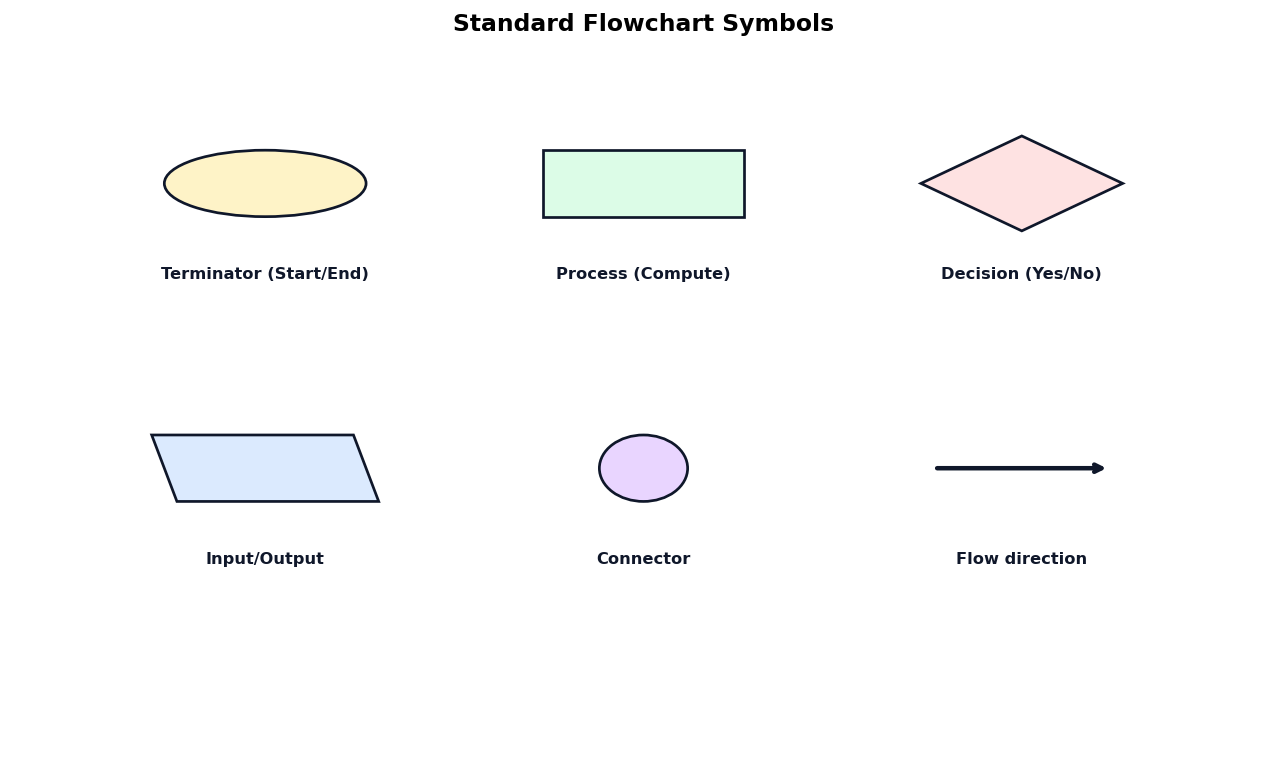
Identify the appropriate flowchart symbol for each task.
Task
Symbol
Start/End
?
Process
?
Decision
?
Input/Output
?
Flow direction
?
Q535 Marks
Match each error type with description.
Error type
Description
Syntax error
?
Run-time error
?
Logical error
?
Compile-time error
?
Semantic error
?
Q545 Marks
Match each programming concept with its description.
Concept
Description
Algorithm
?
Pseudocode
?
Flowchart
?
Program
?
Module
?
Q553 Marks
Study the table of flowchart symbols and answer:
Symbol
Shape
Use
Terminator
Oval
Start / End
Process
Rectangle
Compute / Assign
Decision
Diamond
Yes / No branching
Input/Output
Parallelogram
Read input or print output
Connector
Small circle
Join flow lines
Which symbol is used for the START or END of a flowchart?
AOval
BDiamond
CRectangle
DParallelogram
Which symbol is used for INPUT or OUTPUT?
AOval
BDiamond
CRectangle
DParallelogram
Draw flowchart symbols for terminator process decision input/output and explain each.
Show answersHide answers
1. Option 1 — Oval
2. Option 4 — Parallelogram
3. Flowcharts use a small set of standard symbols recommended by ANSI/ISO. The oval (terminator) marks start and end. The rectangle (process) shows a step. The diamond (decision) shows a branching point with yes/no labels. The parallelogram is for input/output. Connectors are small circles used to avoid crossing arrows. Consistent use of symbols makes flowcharts easy to read.
Picture-Based Questions3 questions
Q563 Marks
Study the standard flowchart symbols legend and answer:
Which symbol marks the START or END of a flowchart?
AOval
BDiamond
CRectangle
DParallelogram
Which symbol is used for a DECISION (yes/no)?
AOval
BDiamond
CRectangle
DParallelogram
Discuss any five standard flowchart symbols and their use.
Show answersHide answers
1. Option 1 — Oval
2. Option 2 — Diamond
3. Flowcharts use a small set of standard symbols recommended by ANSI/ISO. Oval (terminator) marks start and end. Rectangle (process) shows a step. Diamond (decision) shows branching. Parallelogram is for input/output. Connectors are small circles to avoid crossing arrows.
Q576 Marks
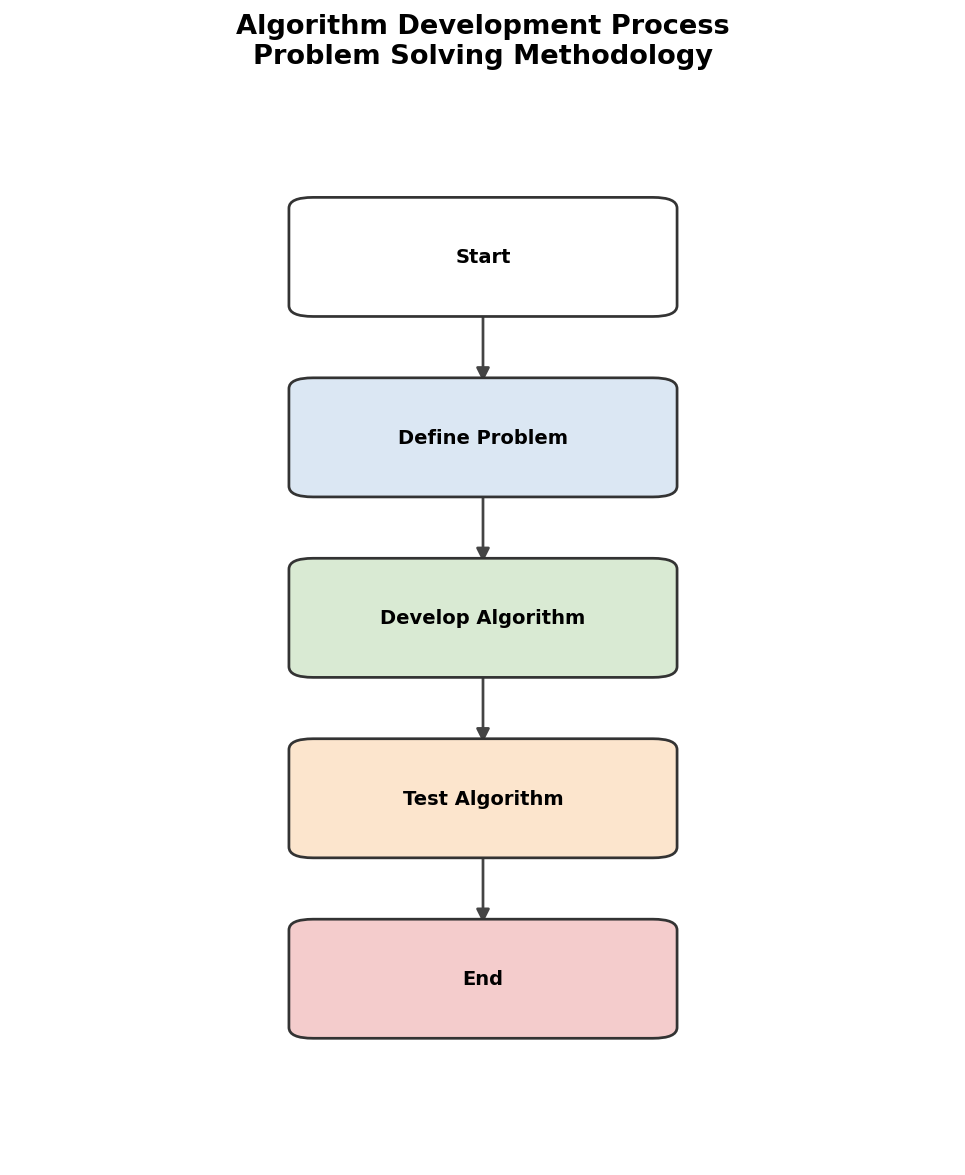
Based on the given flowchart, answer the following:
What is the first step in the algorithm development process?
ADefine Problem
BDevelop Algorithm
CTest Algorithm
DEnd
What follows after defining the problem?
ATest Algorithm
BDevelop Algorithm
CEnd
DStart
Explain the importance of testing an algorithm.
What is the first step in the debugging process?
AIdentify Error
BAnalyze Error
CFix Error
DTest Fix
What is the purpose of analyzing an error?
What should be done after fixing an error?
AIdentify Error
BTest Fix
CAnalyze Error
DEnd
What is the purpose of modular programming?
What is the first module in the flowchart?
AModule 1
BModule 2
CModule 3
DEnd
Show answersHide answers
1. Option 1 — Define Problem
2. Option 2 — Develop Algorithm
3. Testing ensures that the algorithm works correctly and meets the requirements.
4. Option 1 — Identify Error
5. To understand the cause of the error before attempting to fix it.
6. Option 2 — Test Fix
7. To divide a program into smaller, manageable modules that can be developed and tested independently.
8. Option 1 — Module 1
Q582 Marks
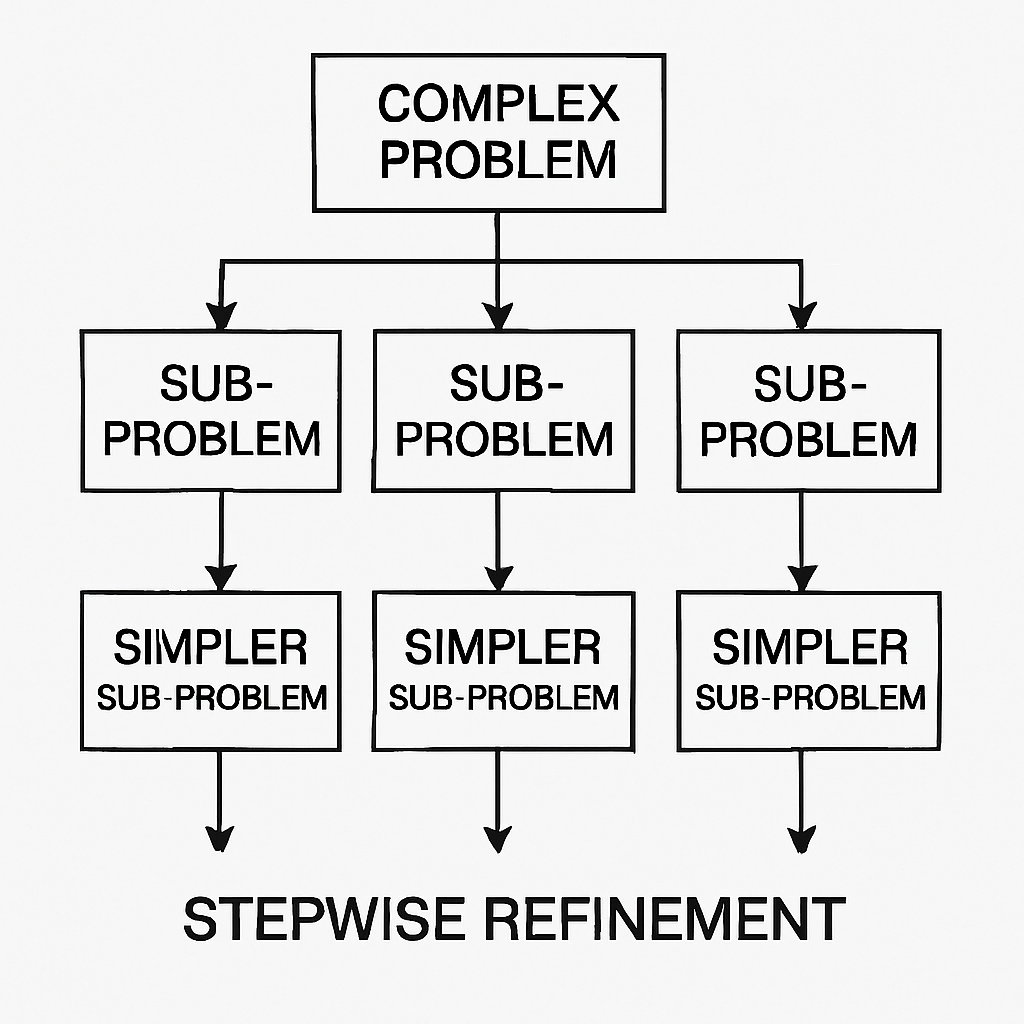
Based on the given diagram of stepwise refinement, answer the following:
What is stepwise refinement?
List the advantages of using stepwise refinement.
Show answersHide answers
1. Stepwise refinement is a method of breaking down complex problems into simpler, more manageable sub-problems.
2. It simplifies problem-solving, makes algorithms easier to understand, and allows for easier debugging.