SUMMARY: The chapter "Respiration in Plants" explores the process of respiration in plants, detailing how they convert glucose into energy. KEY TOPICS: glycolysis, Krebs cycle, electron transport chain, anaerobic respiration, aerobic respiration, respiratory quotient, fermentation, mitochondria, ATP synthesis, oxidative phosphorylation
The net ATP yield from one molecule of glucose by aerobic respiration is:
A2
B4
C36
D38
Check answerHide answer
Correct answer: Option 38
Q21 Mark
Glycolysis occurs in the:
AMitochondria
BCytoplasm
CChloroplast
DNucleus
Check answerHide answer
Correct answer: Option 2 — Cytoplasm
Q31 Mark
The end product of glycolysis is:
APyruvate
BAcetyl CoA
CLactate
DGlucose
Check answerHide answer
Correct answer: Option 1 — Pyruvate
Q41 Mark
Krebs cycle occurs in:
ACytoplasm
BMitochondrial matrix
CInner membrane
DOuter membrane
Check answerHide answer
Correct answer: Option 2 — Mitochondrial matrix
Q51 Mark
The net ATP yield from one molecule of glucose by aerobic respiration is:
A2
B4
C36
D38
Check answerHide answer
Correct answer: Option 4 — 38
Q61 Mark
Anaerobic respiration in yeast produces:
ALactic acid
BEthanol and CO2
CAcetic acid
DPyruvate only
Check answerHide answer
Correct answer: Option 2 — Ethanol and CO2
Q71 Mark
Which of the following processes occurs in the cytoplasm of the cell?
AKrebs cycle
BGlycolysis
CElectron transport chain
DOxidative phosphorylation
Check answerHide answer
Correct answer: Option 2 — Glycolysis
Q81 Mark
What is the primary purpose of the Krebs cycle?
ATo produce glucose
BTo generate ATP and electron carriers
CTo convert pyruvate into lactate
DTo synthesize fatty acids
Check answerHide answer
Correct answer: Option 2 — To generate ATP and electron carriers
Q91 Mark
During aerobic respiration, which molecule is the final electron acceptor in the electron transport chain?
ANAD+
BFAD
COxygen
DCarbon dioxide
Check answerHide answer
Correct answer: Option 3 — Oxygen
Q101 Mark
What is the respiratory quotient (RQ) for carbohydrates?
A0.7
B1.0
C0.9
D0.8
Check answerHide answer
Correct answer: Option 2 — 1.0
Q111 Mark
Which of the following statements about fermentation is true?
AIt requires oxygen
BIt produces more ATP than aerobic respiration
CIt occurs in the absence of oxygen
DIt takes place in mitochondria
Check answerHide answer
Correct answer: Option 3 — It occurs in the absence of oxygen
Q121 Mark
In which part of the mitochondria does oxidative phosphorylation occur?
AMatrix
BInner membrane
COuter membrane
DIntermembrane space
Check answerHide answer
Correct answer: Option 2 — Inner membrane
Q131 Mark
What is the main product of glycolysis?
AAcetyl-CoA
BNADH
CPyruvate
DATP
Check answerHide answer
Correct answer: Option 3 — Pyruvate
Q141 Mark
Which of the following is NOT a product of the Krebs cycle?
ANADH
BFADH2
CATP
DGlucose
Check answerHide answer
Correct answer: Option 4 — Glucose
Q151 Mark
What is the role of NADH and FADH2 in cellular respiration?
AThey are energy carriers that donate electrons
BThey are substrates for glycolysis
CThey are waste products of respiration
DThey are used to synthesize glucose
Check answerHide answer
Correct answer: Option 1 — They are energy carriers that donate electrons
Short Answer Questions10 questions
Q163 Marks
Differentiate between aerobic and anaerobic respiration.
Q173 Marks
What is the respiratory quotient (RQ)? Give RQ values for carbohydrates, fats, and proteins.
Q183 Marks
Explain the steps of glycolysis briefly.
Q193 Marks
Distinguish between fermentation and aerobic respiration.
Q203 Marks
What is the role of oxygen as the terminal electron acceptor?
Q213 Marks
Differentiate between aerobic and anaerobic respiration.
Q223 Marks
What is the respiratory quotient (RQ)? Give RQ values for carbohydrates, fats, and proteins.
Q233 Marks
Explain the steps of glycolysis briefly.
Q243 Marks
Distinguish between fermentation and aerobic respiration.
Q253 Marks
What is the role of oxygen as the terminal electron acceptor?
Long Answer Questions6 questions
Q266 Marks
Describe the steps of glycolysis with a diagram.
Q276 Marks
Explain the Krebs cycle in detail with a diagram.
Q286 Marks
Describe the electron transport system and oxidative phosphorylation.
Q296 Marks
Calculate the net ATP gain during aerobic respiration of one molecule of glucose.
Q306 Marks
Discuss the amphibolic nature of the respiratory pathway.
Q316 Marks
Describe the steps of glycolysis with a diagram.
Assertion–Reason Questions8 questions
Q321 Mark
Assertion (A): Glycolysis occurs in the cytoplasm.
Reason (R): No oxygen is required for glycolysis.
Show explanationHide explanation
Correct answer: Option 1 —
Both A and R are true, and R is the correct explanation of A.
Q331 Mark
Assertion (A): The Krebs cycle is also called the citric acid cycle.
Reason (R): It begins with the formation of citrate from acetyl CoA and oxaloacetate.
Show explanationHide explanation
Correct answer: Option 1 —
Both A and R are true, and R is the correct explanation of A.
Q341 Mark
Assertion (A): Mitochondria are the powerhouses of the cell.
Reason (R): Most of the cell's ATP is produced in the mitochondria.
Show explanationHide explanation
Correct answer: Option 1 —
Both A and R are true, and R is the correct explanation of A.
Q351 Mark
Assertion (A): RQ for fats is less than 1.
Reason (R): Fats require more oxygen for complete oxidation than carbohydrates.
Show explanationHide explanation
Correct answer: Option 1 —
Both A and R are true, and R is the correct explanation of A.
Q361 Mark
Assertion (A): Anaerobic respiration is less efficient than aerobic respiration.
Reason (R): Anaerobic respiration produces only 2 ATP per glucose molecule.
Show explanationHide explanation
Correct answer: Option 1 —
Both A and R are true, and R is the correct explanation of A.
Q371 Mark
Assertion (A): Glycolysis occurs in the cytoplasm.
Reason (R): No oxygen is required for glycolysis.
Show explanationHide explanation
Correct answer: Option 1 —
Both A and R are true, and R is the correct explanation of A.
Q381 Mark
Assertion (A): The Krebs cycle is also called the citric acid cycle.
Reason (R): It begins with the formation of citrate from acetyl CoA and oxaloacetate.
Show explanationHide explanation
Correct answer: Option 1 —
Both A and R are true, and R is the correct explanation of A.
Q391 Mark
Assertion (A): Mitochondria are the powerhouses of the cell.
Reason (R): Most of the cell's ATP is produced in the mitochondria.
Show explanationHide explanation
Correct answer: Option 1 —
Both A and R are true, and R is the correct explanation of A.
Statement-Based Questions8 questions
Q401 Mark
Statement 1: Statement I: NADH and FADH2 carry electrons to ETS.
Statement 2: Statement II: They donate electrons that drive ATP synthesis.
Show answerHide answer
Correct answer: Option 1 —
Both statements are true.
Q411 Mark
Statement 1: Statement I: Pyruvate enters mitochondria from cytoplasm.
Statement 2: Statement II: Inside mitochondria it is converted to acetyl CoA.
Show answerHide answer
Correct answer: Option 1 —
Both statements are true.
Q421 Mark
Statement 1: Statement I: Fermentation produces alcohol or lactic acid.
Statement 2: Statement II: It occurs in the absence of oxygen.
Show answerHide answer
Correct answer: Option 1 —
Both statements are true.
Q431 Mark
Statement 1: Statement I: Substrate-level phosphorylation occurs in glycolysis and Krebs cycle.
Statement 2: Statement II: ATP is directly formed from a substrate molecule.
Show answerHide answer
Correct answer: Option 1 —
Both statements are true.
Q441 Mark
Statement 1: Statement I: ATP synthesis occurs by chemiosmosis in mitochondria.
Statement 2: Statement II: Proton gradient across inner membrane drives ATP synthase.
Show answerHide answer
Correct answer: Option 1 —
Both statements are true.
Q451 Mark
Statement 1: NADH and FADH2 carry electrons to ETS.
Statement 2: They donate electrons that drive ATP synthesis.
Show answerHide answer
Correct answer: Option 1 —
Both statements are true.
Q461 Mark
Statement 1: Pyruvate enters mitochondria from cytoplasm.
Statement 2: Inside mitochondria it is converted to acetyl CoA.
Show answerHide answer
Correct answer: Option 1 —
Both statements are true.
Q471 Mark
Statement 1: Fermentation produces alcohol or lactic acid.
Statement 2: It occurs in the absence of oxygen.
Show answerHide answer
Correct answer: Option 1 —
Both statements are true.
Case Study / Passage Questions2 questions
Q483 Marks
A teacher tells the class that one mole of glucose on complete oxidation releases about 2870 kJ but cells trap only a fraction of this in ATP. She asks students to calculate the net ATP yield from one molecule of glucose under aerobic conditions and explain why ATP is called the energy currency of the cell.
The net ATP yield per glucose by complete aerobic respiration is approximately:
A2
B4
C30
D38
Most of the ATP is produced during:
AGlycolysis
BKrebs cycle
CElectron transport chain
DFermentation
Calculate the total ATP yield from one molecule of glucose by aerobic respiration and justify why ATP is called the energy currency of the cell.
Show answersHide answers
1. Option 4 — 38
2. Option 3 — Electron transport chain
3. Aerobic respiration of one molecule of glucose yields 2 ATP from glycolysis 2 ATP from the Krebs cycle and about 34 ATP from the electron transport chain via oxidative phosphorylation. The total of approximately 38 ATP is used to drive endergonic processes throughout the cell. ATP is called the energy currency because it can be quickly synthesised and quickly hydrolysed to release energy at the site of need.
Q493 Marks
A baker mixes yeast with sugar and flour and sets the dough aside to rise. After a few hours the dough doubles in size. The teacher uses this to explain anaerobic respiration in yeast — the conversion of sugar to ethanol and carbon dioxide which makes the dough rise.
The end products of yeast fermentation are:
AGlucose
BLactic acid
CEthanol and CO2
DAcetic acid
Yeast fermentation is a/an:
AAerobic
BAnaerobic
CPhotosynthetic
DChemosynthetic
Differentiate aerobic respiration and fermentation with reference to ATP yield and end products.
Show answersHide answers
1. Option 3 — Ethanol and CO2
2. Option 2 — Anaerobic
3. Anaerobic respiration in yeast (alcoholic fermentation) converts pyruvate from glycolysis into ethanol and CO2 without using oxygen. The net ATP yield is only 2 ATP per glucose because the Krebs cycle and ETC do not operate. The CO2 released causes bread dough to rise. Some bacteria and human muscle cells under oxygen stress carry out lactic acid fermentation instead.
Table-Based Questions2 questions
Q503 Marks
Study the table comparing aerobic and anaerobic respiration and answer:
Feature
Aerobic
Anaerobic
Oxygen requirement
Required
Not required
Site
Cytoplasm + mitochondria
Cytoplasm only
End products
CO2 + H2O
Ethanol/Lactic acid
ATP yield
~38
2
Examples
Most plants & animals
Yeast, muscle (transient)
The ATP yield per glucose in anaerobic respiration is:
A2
B4
C30
D38
The site of glycolysis is the:
AMitochondrial matrix
BInner mitochondrial membrane
CCytoplasm
DOuter membrane
Compare the energy yield and biological importance of aerobic and anaerobic respiration.
Show answersHide answers
1. Option 1 — 2
2. Option 3 — Cytoplasm
3. Aerobic respiration is a complete oxidation of glucose using oxygen as the terminal electron acceptor and yields about 19 times more ATP than anaerobic respiration. Aerobic respiration occurs partly in the cytoplasm (glycolysis) and partly in the mitochondria (Krebs cycle and ETC). Anaerobic respiration is confined to the cytoplasm and produces ethanol or lactic acid.
Q516 Marks
Compute the net ATP yield at each stage of aerobic respiration of one glucose molecule.
Step
ATP yield
Glycolysis
?
Krebs cycle
?
Electron transport chain
?
Total per glucose
?
Picture-Based Questions1 question
Q524 Marks
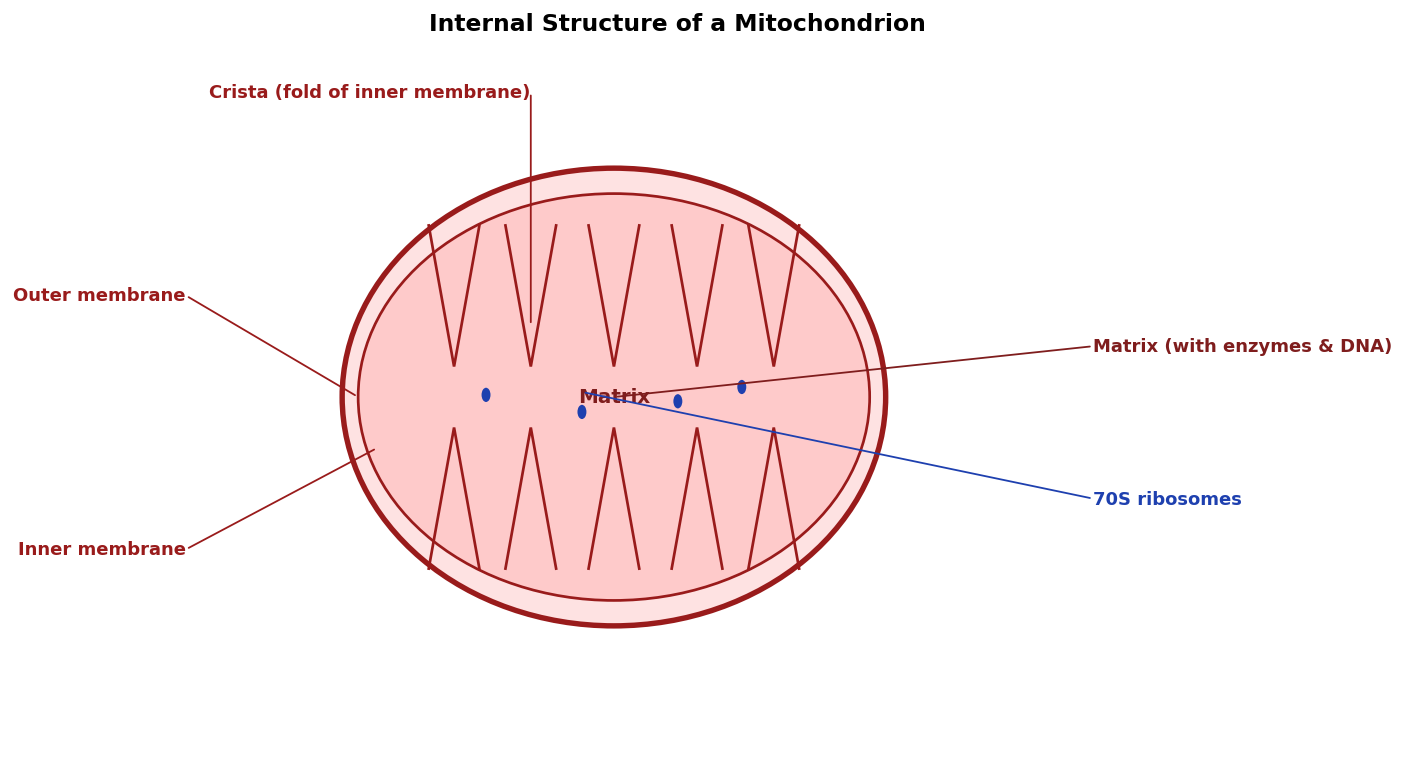
Study the labelled diagram of a mitochondrion and answer:
The folds of the inner mitochondrial membrane are called:
AOuter membrane
BInner membrane
CCristae
DMatrix
The Krebs cycle takes place in the:
ACytoplasm
BOuter membrane
CMitochondrial matrix
DInner membrane
Explain the structure of a mitochondrion and identify the site of each step of aerobic respiration.
Show answersHide answers
1. Option 3 — Cristae
2. Option 3 — Mitochondrial matrix
3. A mitochondrion is the powerhouse of the cell. The inner membrane is folded into cristae increasing surface area for the electron transport chain. The matrix contains enzymes of the Krebs cycle along with mitochondrial DNA and ribosomes. Most cellular ATP is produced here.