Excretory Products and their Elimination — Important Questions
52 questions
With answersCBSE format
SUMMARY: This chapter focuses on the biological processes and structures involved in the removal of waste products from the body in humans and other organisms. KEY TOPICS: excretory system, human excretory system, structure of nephron, urine formation, osmoregulation, kidney function, micturition, disorders of the excretory system, dialysis, excretion in other animals
Correct answer: Option 1 — Stretching of the bladder wall
Q111 Mark
Which of the following conditions is characterized by the presence of excess protein in urine?
ANephritis
BDiabetes mellitus
CGlomerulonephritis
DKidney stones
Check answerHide answer
Correct answer: Option 3 — Glomerulonephritis
Q121 Mark
What is the primary excretory product in mammals?
AAmmonia
BUrea
CUric acid
DCreatinine
Check answerHide answer
Correct answer: Option 2 — Urea
Q131 Mark
Which structure in the kidney is responsible for the filtration of blood?
ARenal pelvis
BGlomerulus
CRenal corpuscle
DNephron loop
Check answerHide answer
Correct answer: Option 2 — Glomerulus
Q141 Mark
What is the main purpose of dialysis in patients with kidney failure?
ATo increase urine output
BTo filter waste products from the blood
CTo enhance kidney function
DTo promote hydration
Check answerHide answer
Correct answer: Option 2 — To filter waste products from the blood
Q151 Mark
Which animal is known for excreting uric acid as its primary nitrogenous waste?
AFrog
BHuman
CBird
DFish
Check answerHide answer
Correct answer: Option 3 — Bird
Short Answer Questions10 questions
Q163 Marks
Differentiate between ammonotelism, ureotelism, and uricotelism.
Q173 Marks
Describe the structure of a nephron.
Q183 Marks
Explain the role of ADH and aldosterone in osmoregulation.
Q193 Marks
What is dialysis? When is it required?
Q203 Marks
Distinguish between glomerular filtration and tubular reabsorption.
Q213 Marks
Differentiate between ammonotelism, ureotelism, and uricotelism.
Q223 Marks
Describe the structure of a nephron.
Q233 Marks
Explain the role of ADH and aldosterone in osmoregulation.
Q243 Marks
What is dialysis? When is it required?
Q253 Marks
Distinguish between glomerular filtration and tubular reabsorption.
Long Answer Questions6 questions
Q266 Marks
Describe the structure of human kidney with a labelled diagram.
Q276 Marks
Explain the process of urine formation in detail.
Q286 Marks
Discuss the role of countercurrent mechanism in concentrating urine.
Q296 Marks
Describe the regulation of kidney function by hormones.
Q306 Marks
Discuss the disorders of the excretory system: kidney stones, glomerulonephritis, and renal failure.
Q316 Marks
Describe the structure of human kidney with a labelled diagram.
Assertion–Reason Questions8 questions
Q321 Mark
Assertion (A): Mammals are ureotelic.
Reason (R): They excrete urea which requires less water than ammonia.
Show explanationHide explanation
Correct answer: Option 1 —
Both A and R are true, and R is the correct explanation of A.
Q331 Mark
Assertion (A): The kidney maintains osmotic balance.
Reason (R): It regulates water and salt content of body fluids.
Show explanationHide explanation
Correct answer: Option 1 —
Both A and R are true, and R is the correct explanation of A.
Q341 Mark
Assertion (A): Bowman's capsule is part of the renal corpuscle.
Reason (R): It receives the glomerular filtrate.
Show explanationHide explanation
Correct answer: Option 1 —
Both A and R are true, and R is the correct explanation of A.
Q351 Mark
Assertion (A): The loop of Henle is involved in concentration of urine.
Reason (R): Its descending and ascending limbs differ in permeability.
Show explanationHide explanation
Correct answer: Option 1 —
Both A and R are true, and R is the correct explanation of A.
Q361 Mark
Assertion (A): Hemodialysis is used for kidney failure patients.
Reason (R): An artificial kidney removes waste from blood.
Show explanationHide explanation
Correct answer: Option 1 —
Both A and R are true, and R is the correct explanation of A.
Q371 Mark
Assertion (A): Mammals are ureotelic.
Reason (R): They excrete urea which requires less water than ammonia.
Show explanationHide explanation
Correct answer: Option 1 —
Both A and R are true, and R is the correct explanation of A.
Q381 Mark
Assertion (A): The kidney maintains osmotic balance.
Reason (R): It regulates water and salt content of body fluids.
Show explanationHide explanation
Correct answer: Option 1 —
Both A and R are true, and R is the correct explanation of A.
Q391 Mark
Assertion (A): Bowman's capsule is part of the renal corpuscle.
Reason (R): It receives the glomerular filtrate.
Show explanationHide explanation
Correct answer: Option 1 —
Both A and R are true, and R is the correct explanation of A.
Statement-Based Questions8 questions
Q401 Mark
Statement 1: Statement I: GFR in a healthy person is about 125 mL/min.
Statement 2: Statement II: It is regulated by JGA.
Show answerHide answer
Correct answer: Option 1 —
Both statements are true.
Q411 Mark
Statement 1: Statement I: PCT reabsorbs all glucose and amino acids.
Statement 2: Statement II: Glucose appears in urine when blood glucose exceeds renal threshold.
Show answerHide answer
Correct answer: Option 1 —
Both statements are true.
Q421 Mark
Statement 1: Statement I: Skin is also an excretory organ in humans.
Statement 2: Statement II: It excretes water, salts, and urea through sweat.
Show answerHide answer
Correct answer: Option 1 —
Both statements are true.
Q431 Mark
Statement 1: Statement I: ADH increases water reabsorption from DCT and collecting duct.
Statement 2: Statement II: This concentrates urine and conserves body water.
Show answerHide answer
Correct answer: Option 1 —
Both statements are true.
Q441 Mark
Statement 1: Statement I: Uremia is the accumulation of urea in blood.
Statement 2: Statement II: It can be fatal and is treated by dialysis.
Show answerHide answer
Correct answer: Option 1 —
Both statements are true.
Q451 Mark
Statement 1: GFR in a healthy person is about 125 mL/min.
Statement 2: It is regulated by JGA.
Show answerHide answer
Correct answer: Option 1 —
Both statements are true.
Q461 Mark
Statement 1: PCT reabsorbs all glucose and amino acids.
Statement 2: Glucose appears in urine when blood glucose exceeds renal threshold.
Show answerHide answer
Correct answer: Option 1 —
Both statements are true.
Q471 Mark
Statement 1: Skin is also an excretory organ in humans.
Statement 2: It excretes water, salts, and urea through sweat.
Show answerHide answer
Correct answer: Option 1 —
Both statements are true.
Case Study / Passage Questions2 questions
Q483 Marks
A 40-year-old man comes to the clinic with severe flank pain and blood in his urine. An ultrasound reveals a calcium oxalate stone lodged in his ureter. The doctor advises increased water intake and prescribes a pain killer. He explains how kidney stones form and how to prevent recurrence.
The narrow tube that carries urine from kidney to bladder is the:
ABladder
BUrethra
CUreter
DRenal cortex
The most common chemical composition of kidney stones is:
ACalcium oxalate
BSodium chloride
CUrea
DGlucose
Discuss the causes, symptoms and prevention of kidney stones.
Show answersHide answers
1. Option 3 — Ureter
2. Option 1 — Calcium oxalate
3. Kidney stones (renal calculi) form when solute concentrations in urine exceed their solubility usually due to dehydration, dietary excess of oxalate or calcium and certain metabolic disorders. They cause severe colicky pain and may be passed naturally or removed by lithotripsy or surgery. Adequate water intake and dietary management are the main preventive measures.
Q493 Marks
A diabetic patient develops chronic kidney failure with rising blood urea and creatinine. The nephrologist prescribes haemodialysis three times a week. The dialysis machine acts as an artificial kidney removing wastes from the blood across a semipermeable membrane.
The principal nitrogenous waste removed during dialysis is:
AUrea
BGlucose
CSodium
DWater
Wastes move from blood to dialysate by:
AFiltration
BDiffusion
COsmosis
DActive transport
Explain the working principle of haemodialysis and its importance for patients with renal failure.
Show answersHide answers
1. Option 1 — Urea
2. Option 2 — Diffusion
3. Haemodialysis uses a dialyser containing a semipermeable membrane that separates the patient's blood from a dialysate solution. Small waste molecules like urea and creatinine diffuse from the blood into the dialysate while essential substances are retained. Dialysate composition is adjusted to maintain electrolyte balance. Patients with chronic kidney failure usually need dialysis until they can receive a kidney transplant.
Table-Based Questions2 questions
Q503 Marks
Study the table on the parts of a nephron and their functions:
Part of nephron
Function
Glomerulus
Ultrafiltration of blood
Bowman's capsule
Receives glomerular filtrate
PCT
Reabsorption of glucose, amino acids, salts
Loop of Henle
Concentration of urine
DCT
Selective reabsorption + secretion
Collecting duct
Final concentration of urine
Ultrafiltration of blood occurs at the:
AGlomerulus
BPCT
CLoop of Henle
DCollecting duct
Final concentration of urine occurs in the:
ALoop of Henle
BDCT
CCollecting duct
DBladder
Describe the structure of a nephron and the function of each part in urine formation.
Show answersHide answers
1. Option 1 — Glomerulus
2. Option 3 — Collecting duct
3. Each nephron is a functional unit of the kidney consisting of a Malpighian corpuscle (glomerulus and Bowman's capsule) and a renal tubule (PCT, Loop of Henle, DCT and collecting duct). Ultrafiltration occurs at the glomerulus producing about 180 L of filtrate per day. Most of this is reabsorbed in the PCT and Loop of Henle. The countercurrent mechanism in the loop concentrates urine. ADH and aldosterone fine-tune water and salt reabsorption.
Q516 Marks
Identify the function of each part of a nephron in urine formation.
Part
Function
Glomerulus
?
Bowman's capsule
?
PCT
?
Loop of Henle
?
DCT
?
Collecting duct
?
Picture-Based Questions1 question
Q524 Marks
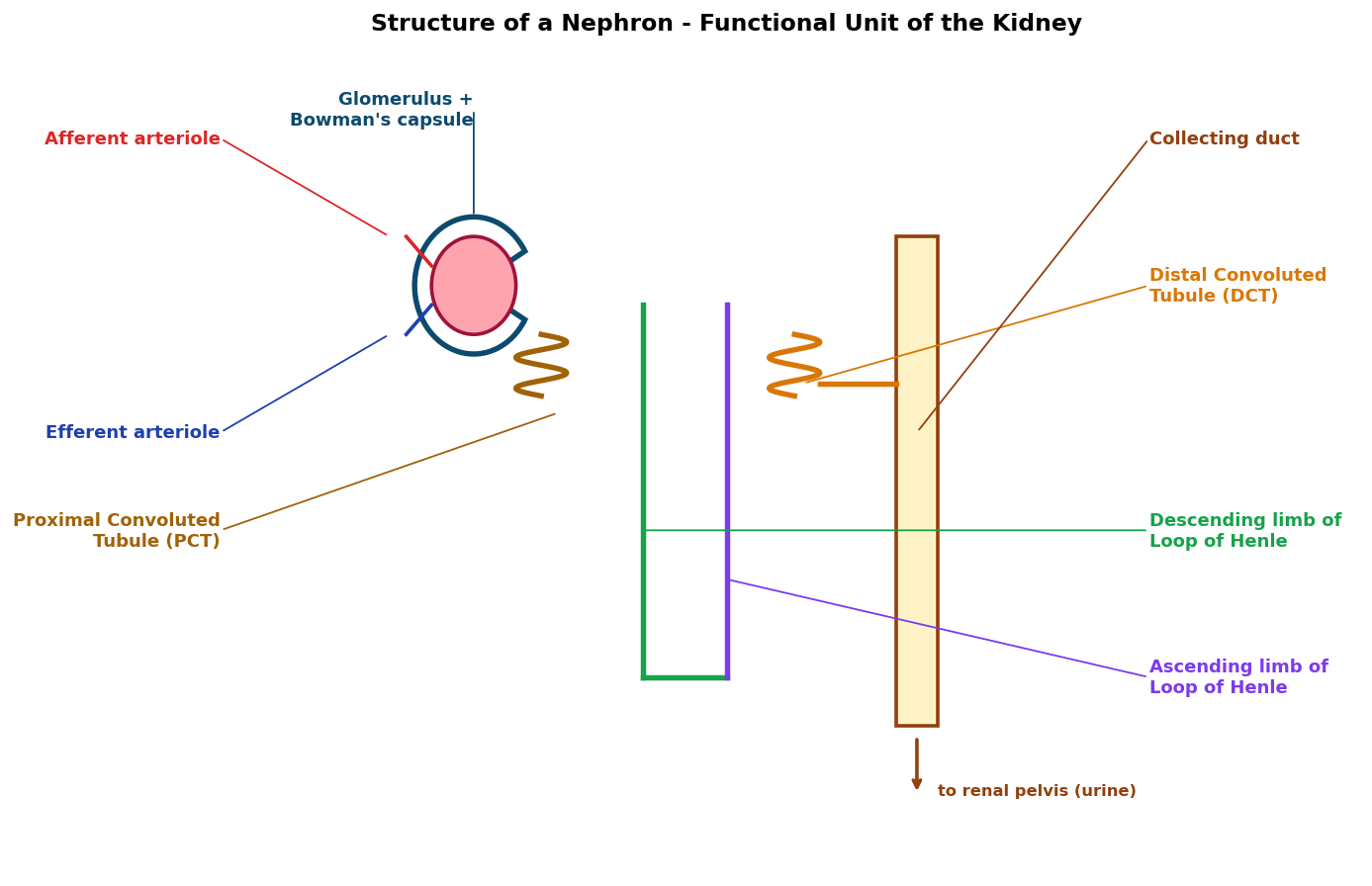
Study the labelled diagram of a nephron and answer:
Ultrafiltration of blood occurs at the:
AGlomerulus
BPCT
CLoop of Henle
DDCT
The countercurrent mechanism that concentrates urine operates at the:
APCT
BLoop of Henle
CDCT
DCollecting duct
Describe the structure of a nephron and explain the function of each part in urine formation.
Show answersHide answers
1. Option 1 — Glomerulus
2. Option 2 — Loop of Henle
3. A nephron is the functional unit of the kidney. Ultrafiltration occurs at the glomerulus producing about 180 L of filtrate per day. The PCT reabsorbs glucose amino acids salts and water. The loop of Henle creates a salt gradient that concentrates urine. The DCT fine-tunes reabsorption and the collecting duct delivers final urine.