SUMMARY: The chapter on Stacks in Class 12 Computer Science covers the concept, implementation, and applications of stack data structures. KEY TOPICS: stack definition, LIFO principle, stack operations, stack implementation using arrays, stack implementation using linked lists, applications of stacks, recursion and stacks, infix to postfix conversion, evaluation of postfix expressions, stack overflow and underflow.
Which of the following best describes a stack data structure?
AFIFO
BLIFO
CRandom access
DPriority based
Check answerHide answer
Correct answer: Option 2 — LIFO
Q21 Mark
Which operation is used to add an element to a stack?
Apush
Bpop
Cpeek
Denqueue
Check answerHide answer
Correct answer: Option 1 — push
Q31 Mark
Which operation is used to remove the top element of a stack?
Apush
Bpop
Cenqueue
Ddequeue
Check answerHide answer
Correct answer: Option 2 — pop
Q41 Mark
A stack overflow occurs when:
AStack is empty and pop is called
BStack is full and push is called
CStack has one element
DStack has integer elements
Check answerHide answer
Correct answer: Option 2 — Stack is full and push is called
Q51 Mark
Which Python data type is most commonly used to implement a stack?
ATuple
BSet
CList
DDictionary
Check answerHide answer
Correct answer: Option 3 — List
Short Answer Questions5 questions
Q63 Marks
Define stack and explain its LIFO principle.
Q73 Marks
List any three real-life applications of stacks.
Q83 Marks
Differentiate between stack and queue with two points.
Q93 Marks
Write a Python function to push an element onto a stack implemented as a list.
Q103 Marks
Explain when a stack overflow and a stack underflow occur.
Long Answer Questions6 questions
Q116 Marks
Write a Python program to implement a stack using a list. Include push pop peek and isEmpty operations.
Q126 Marks
Discuss any five applications of stacks in computer science.
Q136 Marks
Write a Python program using a stack to check if a given string of brackets is balanced.
Q146 Marks
Explain how the call stack works during function execution especially with recursion.
Q156 Marks
Write a Python program using a stack to reverse a string.
Q166 Marks
Differentiate between stack and queue data structures in tabular form on five features.
Assertion–Reason Questions5 questions
Q171 Mark
Assertion (A): Stack follows the LIFO principle.
Reason (R): The last element pushed is the first one popped.
Show explanationHide explanation
Correct answer: Option 1 —
Both A and R are true, and R is the correct explanation of A.
Q181 Mark
Assertion (A): Function calls in most languages use a stack.
Reason (R): The call stack tracks the order of function calls and returns.
Show explanationHide explanation
Correct answer: Option 1 —
Both A and R are true, and R is the correct explanation of A.
Q191 Mark
Assertion (A): The peek operation returns the top element without removing it.
Reason (R): It does not modify the stack.
Show explanationHide explanation
Correct answer: Option 1 —
Both A and R are true, and R is the correct explanation of A.
Q201 Mark
Assertion (A): Stack overflow happens when the stack reaches its maximum capacity.
Reason (R): Pushing more elements is not allowed in a fixed-size stack.
Show explanationHide explanation
Correct answer: Option 1 —
Both A and R are true, and R is the correct explanation of A.
Q211 Mark
Assertion (A): The undo feature in many applications uses a stack.
Reason (R): Each action is pushed and the undo command pops the last action.
Show explanationHide explanation
Correct answer: Option 1 —
Both A and R are true, and R is the correct explanation of A.
Statement-Based Questions5 questions
Q221 Mark
Statement 1: A stack has only one entry/exit point called the top.
Statement 2: All operations are performed at the top.
Show answerHide answer
Correct answer: Option 1 —
Both statements are true.
Q231 Mark
Statement 1: Push and pop are the two basic stack operations.
Statement 2: Both operate on the top of the stack.
Show answerHide answer
Correct answer: Option 1 —
Both statements are true.
Q241 Mark
Statement 1: Stack can be implemented using arrays or linked lists.
Statement 2: In Python list operations append() and pop() implement push and pop.
Show answerHide answer
Correct answer: Option 1 —
Both statements are true.
Q251 Mark
Statement 1: Stacks are used in expression evaluation.
Statement 2: Infix to postfix conversion uses a stack.
Show answerHide answer
Correct answer: Option 1 —
Both statements are true.
Q261 Mark
Statement 1: Browser back button uses a stack.
Statement 2: Each visited page is pushed; back pops the most recent one.
Show answerHide answer
Correct answer: Option 1 —
Both statements are true.
Case Study / Passage Questions1 question
Q273 Marks
A student is asked to write a Python program that takes a string of brackets like ([ {} ]) and checks if all brackets are balanced. She decides to use a stack — push opening brackets and pop when a closing bracket matches. If the stack is empty at the end the brackets are balanced.
A stack uses which principle?
AFIFO
BLIFO
CRandom access
DPriority
Which operation removes the top element of a stack?
Apush
Bpop
Cpeek
Denqueue
Write the Python program using a stack to check balanced brackets.
Show answersHide answers
1. Option 2 — LIFO
2. Option 2 — pop
3. def is_balanced(s): stack = []; pairs = {')':'(' ']':'[' '}':'{'}; for ch in s: if ch in '([{': stack.append(ch); elif ch in ')]}': if not stack or stack.pop() != pairs[ch]: return False; return len(stack) == 0. Push opening brackets; on each closing bracket check that the top of stack matches. After processing if the stack is empty the brackets are balanced.
Table-Based Questions3 questions
Q285 Marks
Trace the stack contents after each operation (push or pop).
Operation
Stack after
push 10
?
push 20
?
push 30
?
pop
?
push 40
?
pop
?
Q296 Marks
Trace the stack to evaluate balanced bracket check on the string '([{}])'.
Char read
Action
Stack after
(
push
[(]
[
push
[(, []
{
push
[(, [, {]
}
?
?
]
?
?
)
?
?
Q303 Marks
Study the operations on a stack and answer:
Operation
Effect
Time complexity
push(x)
Add x at top
O(1)
pop()
Remove top, return
O(1)
peek()/top()
Return top, no remove
O(1)
isEmpty()
Check if empty
O(1)
size()
Return count
O(1)
Which operation returns the top element WITHOUT removing it?
Apush
Bpop
Cpeek
Dsize
The time complexity of push and pop on a stack is:
AO(1)
BO(log n)
CO(n)
DO(n^2)
Discuss any five real-world applications of stacks.
Show answersHide answers
1. Option 3 — peek
2. Option 1 — O(1)
3. All standard stack operations push pop peek isEmpty size run in O(1) constant time when the stack is implemented using an array (e.g., Python list with append/pop). Stacks are widely used in expression evaluation function call management (call stack) undo features in editors browser back button and parsing algorithms.
Picture-Based Questions1 question
Q313 Marks
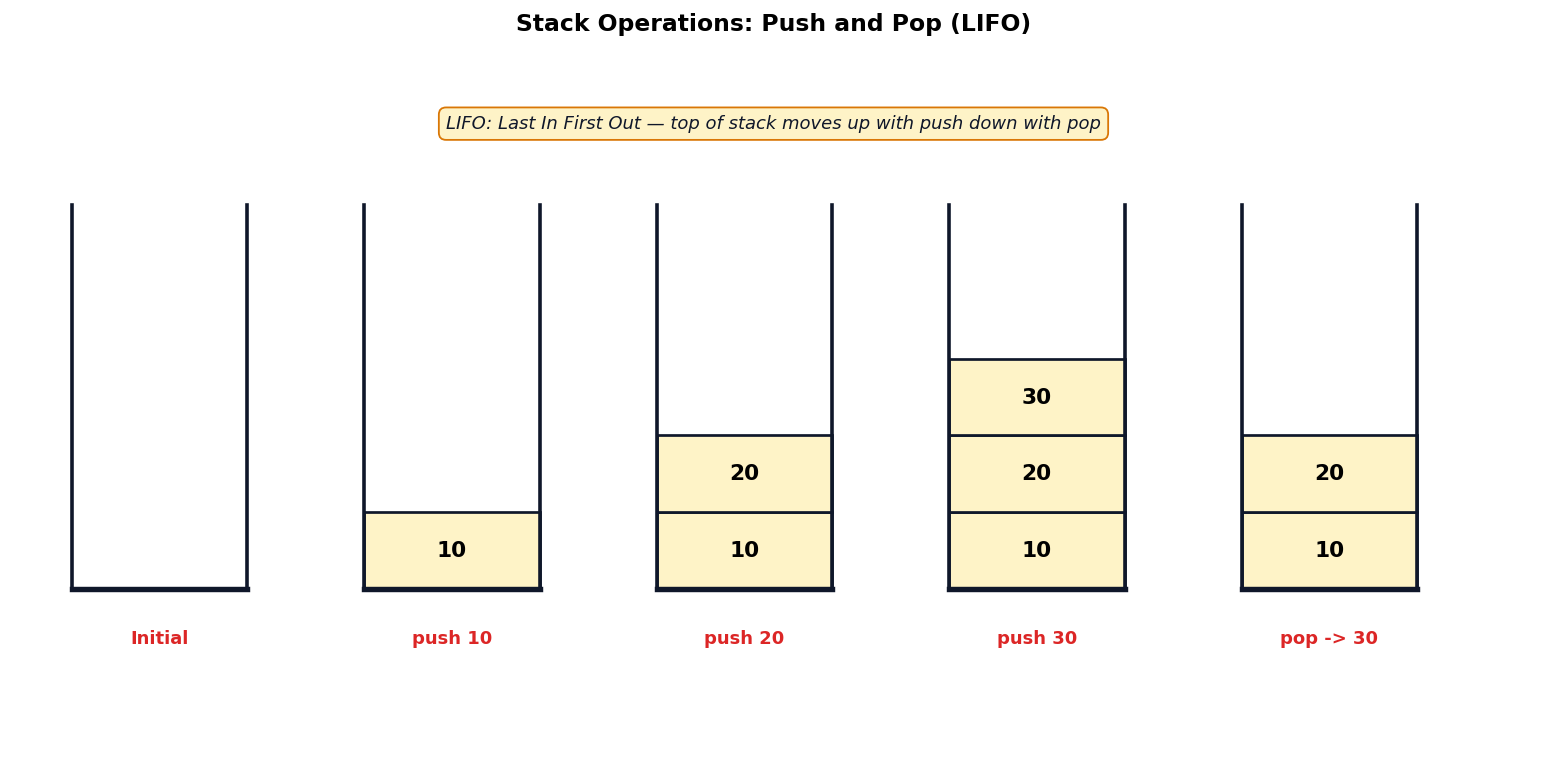
Study the stack push and pop visualisation and answer:
A stack uses which principle?
AFIFO
BLIFO
CRandom
DPriority
Which operation removes the top element?
Apush
Bpop
Cpeek
Denqueue
Discuss the LIFO principle with stack push pop and peek operations.
Show answersHide answers
1. Option 2 — LIFO
2. Option 2 — pop
3. Stack follows LIFO (Last In First Out). push adds to the top; pop removes from the top; peek/top inspects without removing. All operations are O(1). Common applications include function call stack expression evaluation undo features and bracket matching.