SUMMARY: This chapter introduces the fundamental concepts of databases, focusing on their design, management, and application in computer systems. KEY TOPICS: database management system (DBMS), relational databases, SQL, normalization, ER model, data integrity, transactions, database design, data redundancy, primary key
Which of the following is NOT a property of a database?
APersistence
BConcurrency
CVisibility
DRecovery
Check answerHide answer
Correct answer: Option 3 — Visibility
Q21 Mark
A primary key in a database table is:
AAlways a single column
BUnique and not null
CAlways a foreign key
DA column with duplicate values
Check answerHide answer
Correct answer: Option 2 — Unique and not null
Q31 Mark
The relational model represents data in:
ATables
BTrees
CGraphs
DNetworks
Check answerHide answer
Correct answer: Option 1 — Tables
Q41 Mark
A foreign key is used to:
AEncrypt the data
BRefer to a primary key in another table
CSpeed up queries
DBackup the database
Check answerHide answer
Correct answer: Option 2 — Refer to a primary key in another table
Q51 Mark
A column in a relational database is called a/an:
ATuple
BAttribute
CRelation
DCardinality
Check answerHide answer
Correct answer: Option 2 — Attribute
Short Answer Questions5 questions
Q63 Marks
Define database and database management system (DBMS).
Q73 Marks
Differentiate between primary key and foreign key.
Q83 Marks
Define cardinality and degree of a relation.
Q93 Marks
Define unique key and candidate key with one example each.
Q103 Marks
What are the advantages of using a DBMS over file system?
Long Answer Questions6 questions
Q116 Marks
Explain the relational data model with the help of a sample student table.
Q126 Marks
Discuss the various database keys — primary candidate alternate foreign and composite — with examples.
Q136 Marks
Compare DBMS and traditional file system on five points.
Q146 Marks
Explain ACID properties of a database transaction.
Q156 Marks
Discuss the different levels of data abstraction in a DBMS — physical conceptual and view level.
Q166 Marks
Differentiate between primary key and foreign key in tabular form.
Assertion–Reason Questions5 questions
Q171 Mark
Assertion (A): Primary key uniquely identifies each row.
Reason (R): It must be unique and not null.
Show explanationHide explanation
Correct answer: Option 1 —
Both A and R are true, and R is the correct explanation of A.
Q181 Mark
Assertion (A): A foreign key creates a relationship between two tables.
Reason (R): It refers to the primary key of another table.
Show explanationHide explanation
Correct answer: Option 1 —
Both A and R are true, and R is the correct explanation of A.
Q191 Mark
Assertion (A): Tables in relational DBMS are also called relations.
Reason (R): Each row is a tuple and each column is an attribute.
Show explanationHide explanation
Correct answer: Option 1 —
Both A and R are true, and R is the correct explanation of A.
Q201 Mark
Assertion (A): DBMS provides data independence.
Reason (R): Application programs are independent of the data structure.
Show explanationHide explanation
Correct answer: Option 1 —
Both A and R are true, and R is the correct explanation of A.
Q211 Mark
Assertion (A): Normalisation reduces redundancy.
Reason (R): It organises data efficiently and eliminates anomalies.
Show explanationHide explanation
Correct answer: Option 1 —
Both A and R are true, and R is the correct explanation of A.
Statement-Based Questions5 questions
Q221 Mark
Statement 1: A database is a collection of related data.
Statement 2: A DBMS is software to manage that data.
Show answerHide answer
Correct answer: Option 1 —
Both statements are true.
Q231 Mark
Statement 1: Cardinality of a relation is the number of tuples (rows).
Statement 2: Degree is the number of attributes (columns).
Show answerHide answer
Correct answer: Option 1 —
Both statements are true.
Q241 Mark
Statement 1: A candidate key can serve as a primary key.
Statement 2: Among multiple candidate keys one is chosen as the primary.
Show answerHide answer
Correct answer: Option 1 —
Both statements are true.
Q251 Mark
Statement 1: A composite key consists of two or more attributes.
Statement 2: It is needed when no single attribute can uniquely identify a tuple.
Show answerHide answer
Correct answer: Option 1 —
Both statements are true.
Q261 Mark
Statement 1: Examples of DBMS include MySQL Oracle PostgreSQL and SQL Server.
Statement 2: All support SQL as the standard query language.
Show answerHide answer
Correct answer: Option 1 —
Both statements are true.
Case Study / Passage Questions1 question
Q273 Marks
A school librarian wants a database to manage book records and student borrowings. She decides on three tables — Book(book_id title author copies) Member(member_id name class) and BorrowRecord(borrow_id member_id book_id issue_date return_date). She must identify primary and foreign keys.
book_id in the Book table is the:
AComposite key
BPrimary key
CForeign key
DCandidate key
member_id in BorrowRecord table referring to Member.member_id is a:
APrimary key
BForeign key
CCandidate key
DComposite key
Identify all primary and foreign keys in the library database design.
Show answersHide answers
1. Option 2 — Primary key
2. Option 2 — Foreign key
3. Book.book_id is the primary key — uniquely identifies each book. Member.member_id is the primary key of Member. BorrowRecord.borrow_id is its primary key. BorrowRecord.member_id and BorrowRecord.book_id are foreign keys referring to the primary keys of Member and Book respectively. This relational design avoids data redundancy and ensures referential integrity.
Table-Based Questions3 questions
Q286 Marks
Match each database key with its definition.
Key
Definition
Primary
?
Candidate
?
Alternate
?
Foreign
?
Composite
?
Q296 Marks
Match each level of normalisation with its key requirement.
Normal Form
Requirement
1NF
?
2NF
?
3NF
?
BCNF
?
Q303 Marks
Study the database keys table and answer:
Key
Definition
Example
Primary
Unique not null
roll_no
Candidate
Could be primary
roll_no, email
Alternate
Candidate not chosen
email
Foreign
Refers to another
dept_id in Employee
Composite
Multi-column key
(order_id, item_id)
Which key uniquely identifies each row and cannot be NULL?
APrimary
BCandidate
CAlternate
DForeign
Which key creates a relationship between two tables?
APrimary
BForeign
CComposite
DAlternate
Explain different types of database keys with one example each.
Show answersHide answers
1. Option 1 — Primary
2. Option 2 — Foreign
3. A primary key uniquely identifies each row. A candidate key can serve as primary key (multiple may exist). The alternate key is a candidate not chosen. A foreign key references the primary key of another table — the basis of relationships between tables. A composite key uses two or more columns together when no single column can be unique.
Picture-Based Questions1 question
Q313 Marks
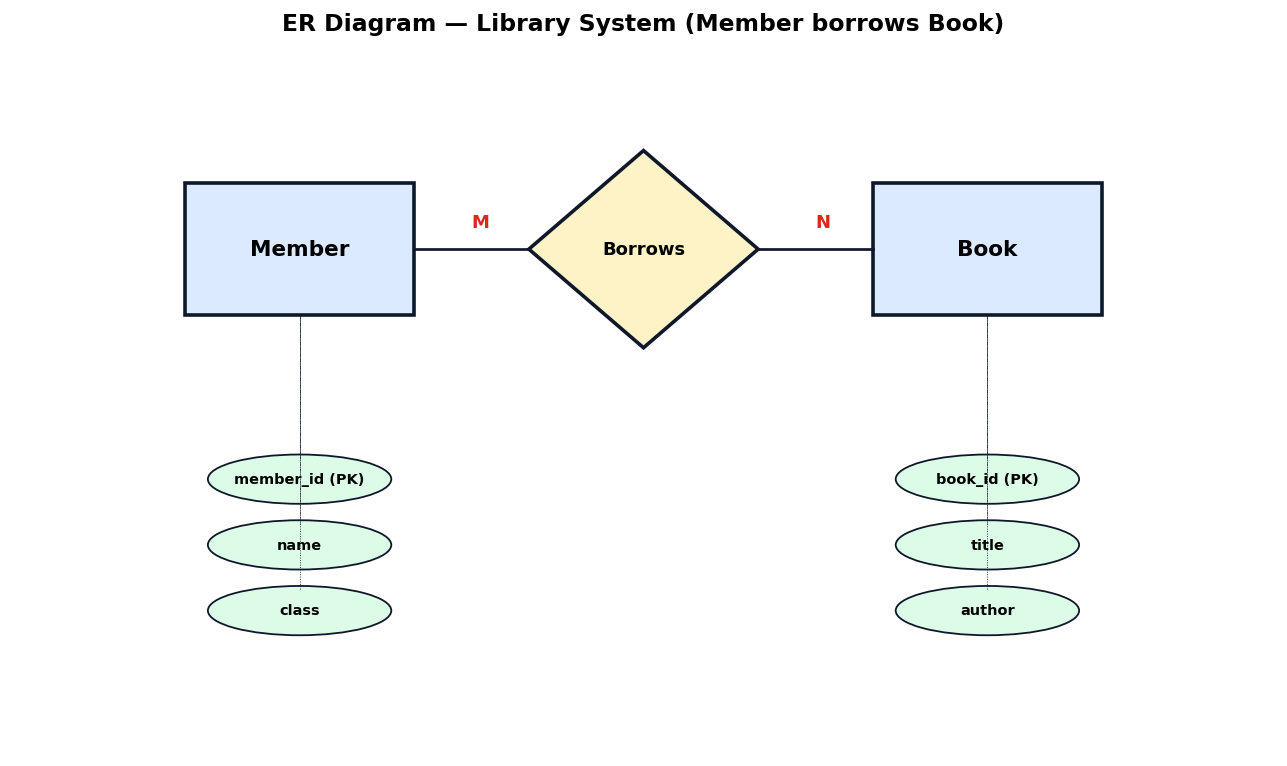
Study the ER diagram of the library system and answer:
In the diagram which is a relationship?
AMember
BBook
CBorrows
Dmember_id
Entities in an ER diagram are represented by:
ARectangle
BDiamond
CEllipse
DCircle
Explain the components of an ER diagram with the library example.
Show answersHide answers
1. Option 3 — Borrows
2. Option 1 — Rectangle
3. In ER diagrams entities are rectangles attributes are ellipses and relationships are diamonds. Cardinality (1:1 1:N M:N) is shown on the relationship lines. Primary keys are underlined. The library example has Member and Book entities connected by a Borrows relationship with cardinality M:N.