SUMMARY: This chapter provides an in-depth understanding of computer networks, including their types, protocols, and architecture. KEY TOPICS: Network types, OSI model, TCP/IP model, network devices, transmission media, network security, IP addressing, domain name system (DNS), network topologies, wireless networks.
Correct answer: Option 1 —
Both A and R are true, and R is the correct explanation of A.
Q211 Mark
Assertion (A): DNS converts domain names to IP addresses.
Reason (R): It allows users to access websites by names instead of numeric IPs.
Show explanationHide explanation
Correct answer: Option 1 —
Both A and R are true, and R is the correct explanation of A.
Statement-Based Questions5 questions
Q221 Mark
Statement 1: A switch is more efficient than a hub.
Statement 2: A switch sends data only to the intended recipient port.
Show answerHide answer
Correct answer: Option 1 —
Both statements are true.
Q231 Mark
Statement 1: HTTP is stateless.
Statement 2: Each request from a client is treated independently.
Show answerHide answer
Correct answer: Option 1 —
Both statements are true.
Q241 Mark
Statement 1: A modem converts digital signals to analog and vice versa.
Statement 2: It allows digital devices to communicate over analog media.
Show answerHide answer
Correct answer: Option 1 —
Both statements are true.
Q251 Mark
Statement 1: Bandwidth refers to the maximum data transfer rate of a network.
Statement 2: It is commonly measured in bits per second (bps).
Show answerHide answer
Correct answer: Option 1 —
Both statements are true.
Q261 Mark
Statement 1: A firewall controls incoming and outgoing network traffic.
Statement 2: It enforces a security policy to protect the network.
Show answerHide answer
Correct answer: Option 1 —
Both statements are true.
Case Study / Passage Questions1 question
Q273 Marks
A school is setting up a new computer lab with 30 desktops one server one printer and Internet access. The IT teacher has to choose a network topology and decide on cables switches and a router. The lab room is 12m x 8m and the desktops will be arranged in 6 rows of 5.
Which topology uses a central switch and is most common in school labs?
ABus
BStar
CRing
DMesh
Which device is used to connect the lab's LAN to the Internet?
AHub
BSwitch
CRouter
DRepeater
Recommend a network design for the lab and justify the choice of topology and devices.
Show answersHide answers
1. Option 2 — Star
2. Option 3 — Router
3. The teacher should use star topology with a central switch because it is reliable easy to troubleshoot and supports high speeds. Each desktop connects to the switch with twisted-pair cable. The router connects the switch to the ISP for Internet. The server can host shared files and the printer can be network-attached. Star topology is preferred because if one cable fails only that desktop is affected.
Table-Based Questions4 questions
Q286 Marks
Match each network device with its OSI layer and function.
Device
OSI layer
Function
Hub
?
?
Switch
?
?
Router
?
?
Bridge
?
?
Repeater
?
?
Modem
?
?
Q296 Marks
Match each network protocol with its port and use.
Protocol
Default port
Use
HTTP
?
?
HTTPS
?
?
FTP
?
?
SMTP
?
?
POP3
?
?
DNS
?
?
Q305 Marks
Match each topology with its diagrammatic feature.
Topology
Feature
Bus
?
Star
?
Ring
?
Mesh
?
Tree
?
Q316 Marks
For each transmission media identify type and a typical use.
Medium
Type
Typical use
Twisted pair
?
?
Coaxial
?
?
Optical fibre
?
?
Microwave
?
?
Satellite
?
?
Bluetooth
?
?
Picture-Based Questions2 questions
Q323 Marks
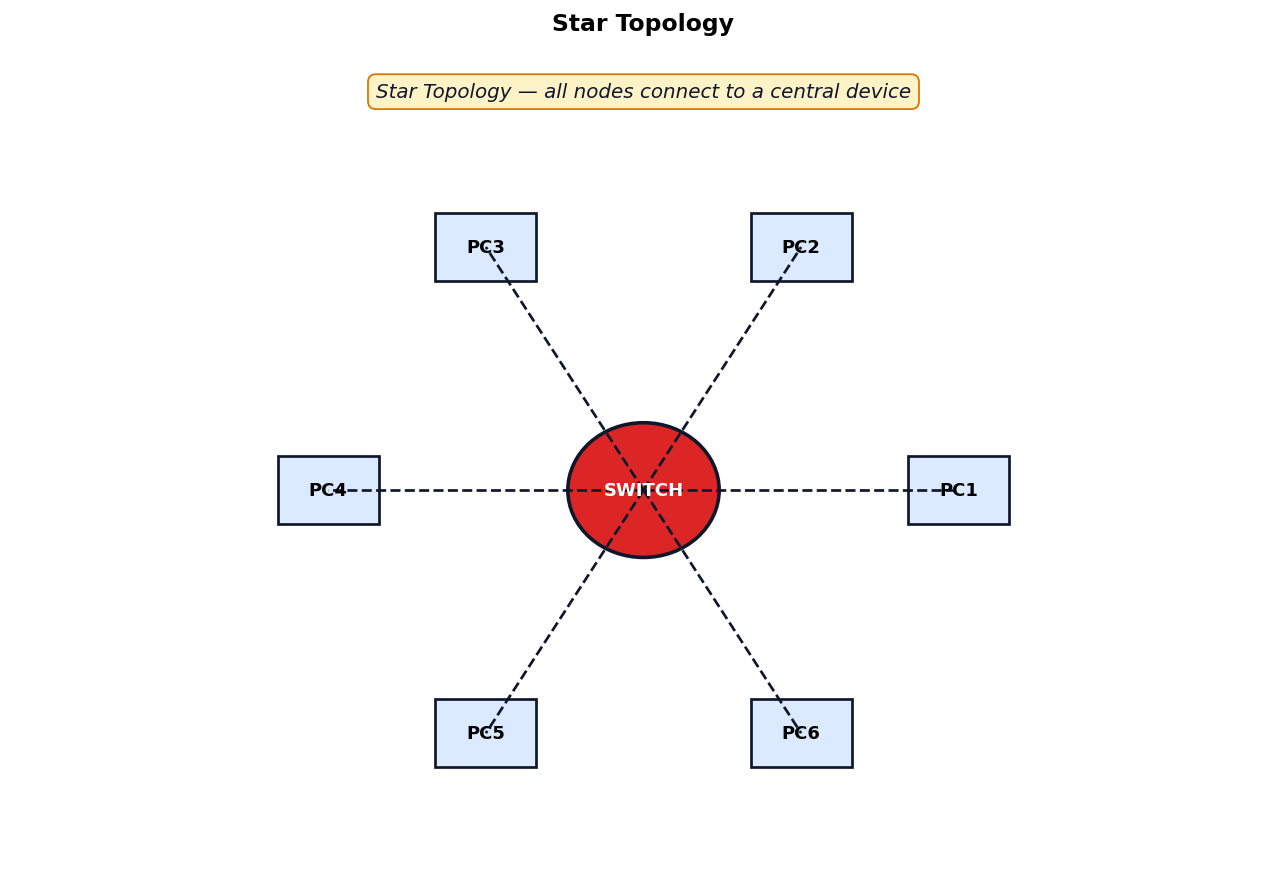
Study the star topology layout and answer:
The topology shown with a central device is:
ABus
BStar
CRing
DMesh
The central device in modern star LANs is typically a:
AHub
BSwitch
CRouter
DRepeater
Discuss star topology with its advantages and disadvantages.
Show answersHide answers
1. Option 2 — Star
2. Option 2 — Switch
3. Star topology connects all nodes to a central device (switch or hub). Advantages: easy to install reliable (a single cable failure affects only one device) high throughput with switches. Disadvantage: central device failure brings down the whole network. Most modern LANs use star topology with a switch.
Q333 Marks
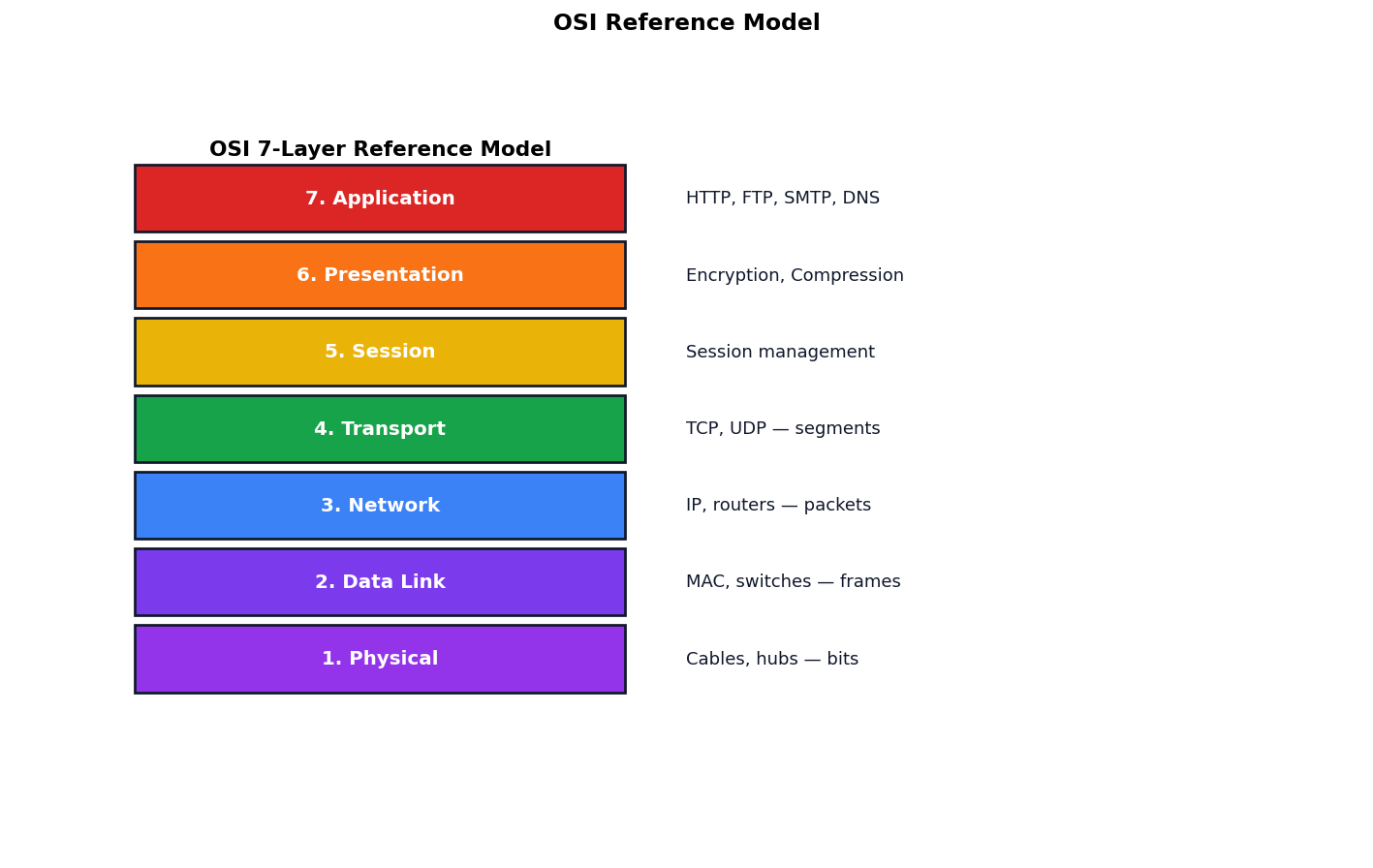
Study the OSI 7-layer model and answer:
The router operates at which OSI layer?
APhysical
BData Link
CNetwork
DTransport
HTTP and FTP belong to which OSI layer?
ATransport
BApplication
CNetwork
DSession
Discuss the seven layers of the OSI model with their function.
Show answersHide answers
1. Option 3 — Network
2. Option 2 — Application
3. The OSI model has 7 layers: 1 Physical (cables hubs - bits) 2 Data Link (MAC switches - frames) 3 Network (IP routers - packets) 4 Transport (TCP UDP - segments) 5 Session 6 Presentation 7 Application (HTTP FTP). Each layer adds its own header and only communicates with adjacent layers.