SUMMARY: This chapter explores the ethical, legal, and societal implications of computing technologies and the internet. KEY TOPICS: Cyber ethics, intellectual property rights, privacy issues, cybercrime, digital footprint, online safety, IT Act 2000, open source software, digital divide, net neutrality.
Reason (R): It requires two independent verification methods to log in.
Show explanationHide explanation
Correct answer: Option 1 —
Both A and R are true, and R is the correct explanation of A.
Statement-Based Questions5 questions
Q221 Mark
Statement 1: A patent protects an invention.
Statement 2: The protection lasts for a fixed period (usually 20 years).
Show answerHide answer
Correct answer: Option 1 —
Both statements are true.
Q231 Mark
Statement 1: Copyright protects original works of authorship.
Statement 2: It applies automatically once a work is created.
Show answerHide answer
Correct answer: Option 1 —
Both statements are true.
Q241 Mark
Statement 1: Cyber bullying is harassment using digital technologies.
Statement 2: It can cause severe psychological harm.
Show answerHide answer
Correct answer: Option 1 —
Both statements are true.
Q251 Mark
Statement 1: e-waste contains toxic substances like lead and mercury.
Statement 2: Improper disposal can harm the environment and human health.
Show answerHide answer
Correct answer: Option 1 —
Both statements are true.
Q261 Mark
Statement 1: Netiquette refers to good behaviour online.
Statement 2: It includes respecting others using polite language and avoiding trolling.
Show answerHide answer
Correct answer: Option 1 —
Both statements are true.
Case Study / Passage Questions1 question
Q273 Marks
A class 12 student posts a screenshot of a friend's private chat on social media to embarrass her after an argument. The friend's parents file a complaint with the cyber cell citing cyber bullying and breach of privacy. The student is summoned for questioning and her future college applications may be affected.
Which law in India covers cyber bullying and digital privacy?
AIT Act 1995
BIT Act 2000
CIT Act 2008
DIT Act 2015
The student's act is best classified as:
APhishing
BCyber bullying
CHacking
DPlagiarism
Discuss the legal and personal consequences of cyber bullying for both victim and perpetrator.
Show answersHide answers
1. Option 2 — IT Act 2000
2. Option 2 — Cyber bullying
3. Cyber bullying is harassment threatening or shaming someone using digital media. The IT Act 2000 (with 2008 amendment) section 66E covers violation of privacy and section 67 covers transmission of obscene material. The student could face fines and imprisonment up to 3 years. Beyond legal consequences such acts leave a digital footprint that can affect college admissions and future career. Always think before posting.
Table-Based Questions3 questions
Q286 Marks
Identify each cyber crime category and one example.
Crime
Description
Example
Phishing
?
?
Hacking
?
?
Identity theft
?
?
Cyber bullying
?
?
Ransomware
?
?
Q295 Marks
Match the IPR with the duration of protection in India.
IPR Type
Duration in India
Patent
?
Copyright
?
Trademark
?
Industrial design
?
Trade secret
?
Q303 Marks
Study the IPR table and answer:
Type
Protects
Duration in India
Patent
Invention
20 years
Copyright
Original work
Lifetime + 60 years
Trademark
Brand / logo
10 years renewable
Industrial design
Visual design
10 + 5 years
Trade secret
Confidential info
While confidential
Which IPR protects an invention for a fixed term?
APatent
BCopyright
CTrademark
DTrade secret
Which protects an original literary or musical work?
APatent
BCopyright
CTrademark
DIndustrial design
Discuss the four major types of intellectual property rights with one example each.
Show answersHide answers
1. Option 1 — Patent
2. Option 2 — Copyright
3. Intellectual property rights protect creations of the mind. Patent protects inventions for 20 years. Copyright protects original works for the author's lifetime plus 60 years (in India). Trademark protects brand identifiers indefinitely (10-year renewals). Industrial design protects the visual aspects of a product. Trade secrets protect confidential business info as long as kept secret. Each requires specific legal procedures.
Picture-Based Questions1 question
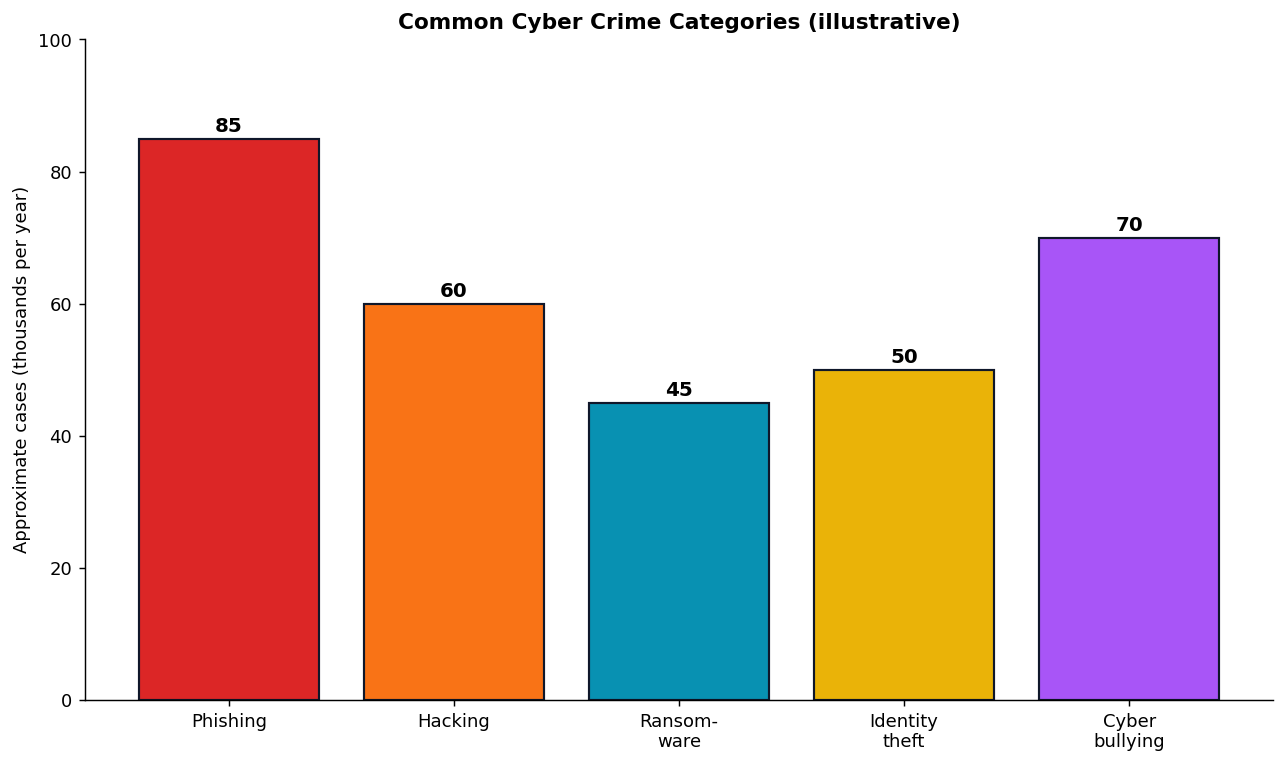
Q313 Marks
Study the cyber crime category bar chart and answer:
Which cyber crime has the highest number of cases in the chart?
APhishing
BHacking
CRansomware
DIdentity theft
The Indian law covering cyber offences is:
AIT Act 1995
BIT Act 2000
CIT Act 2008
DIT Act 2015
Discuss any four common cyber crime categories with one example each.
Show answersHide answers
1. Option 1 — Phishing
2. Option 2 — IT Act 2000
3. Cyber crimes are offences using computer networks. Phishing tricks users into revealing data via fake emails. Hacking is unauthorised access. Ransomware encrypts files for ransom. Identity theft impersonates someone. Cyber bullying is online harassment. The IT Act 2000 (with 2008 amendment) is India's main cyber law with provisions for offences and penalties.