SUMMARY: The chapter on Thermodynamics in Class 11 Chemistry introduces the principles and laws governing energy changes in chemical processes and physical transformations. KEY TOPICS: system and surroundings, types of systems, first law of thermodynamics, internal energy, enthalpy, heat capacity, Hess's law, spontaneous and non-spontaneous processes, second law of thermodynamics, Gibbs free energy
The first law of thermodynamics is a statement of conservation of:
AMass
BEnergy
CMomentum
DCharge
Check answerHide answer
Correct answer: Option 2 — Energy
Q21 Mark
For an isolated system the energy:
AIncreases
BDecreases
CRemains constant
DCannot be measured
Check answerHide answer
Correct answer: Option 3 — Remains constant
Q31 Mark
At constant pressure the heat absorbed equals the change in:
AInternal energy
BEnthalpy
CEntropy
DGibbs free energy
Check answerHide answer
Correct answer: Option 2 — Enthalpy
Q41 Mark
For a spontaneous process at constant temperature and pressure ΔG must be:
APositive
BNegative
CZero
DCannot decide
Check answerHide answer
Correct answer: Option 2 — Negative
Q51 Mark
Hess's law is based on the fact that enthalpy is a:
APath function
BState function
CConserved quantity
DVector
Check answerHide answer
Correct answer: Option 2 — State function
Q61 Mark
Which of the following best describes an open system in thermodynamics?
AA system that can exchange both energy and matter with its surroundings
BA system that can exchange only energy with its surroundings
CA system that cannot exchange energy or matter with its surroundings
DA system that can exchange only matter with its surroundings
Check answerHide answer
Correct answer: Option 1 — A system that can exchange both energy and matter with its surroundings
Q71 Mark
What is the primary focus of the first law of thermodynamics?
AThe transformation of energy from one form to another
BThe direction of spontaneous processes
CThe relationship between entropy and temperature
DThe calculation of Gibbs free energy
Check answerHide answer
Correct answer: Option 1 — The transformation of energy from one form to another
Q81 Mark
In a thermodynamic process, if the internal energy of a system decreases, what can be inferred about the heat and work interactions?
AHeat is absorbed and work is done on the system
BHeat is released and work is done by the system
CBoth heat and work are absorbed by the system
DBoth heat and work are released by the system
Check answerHide answer
Correct answer: Option 2 — Heat is released and work is done by the system
Q91 Mark
Which of the following statements about enthalpy (H) is true?
AEnthalpy is always negative for spontaneous reactions
BEnthalpy is a state function that depends on temperature and pressure
CEnthalpy cannot be measured directly
DEnthalpy is the same as internal energy
Check answerHide answer
Correct answer: Option 2 — Enthalpy is a state function that depends on temperature and pressure
Q101 Mark
According to the second law of thermodynamics, which of the following processes is spontaneous?
AMelting of ice at 0°C
BFreezing of water at 0°C
CDissolving salt in water
DAll of the above
Check answerHide answer
Correct answer: Option 1 — Melting of ice at 0°C
Q111 Mark
What does the term 'heat capacity' refer to?
AThe amount of heat required to raise the temperature of a substance by 1°C
BThe total energy contained in a system
CThe energy required to change the phase of a substance
DThe energy change during a chemical reaction
Check answerHide answer
Correct answer: Option 1 — The amount of heat required to raise the temperature of a substance by 1°C
Q121 Mark
In a closed system, if the work done on the system is positive, what happens to the internal energy?
AIt decreases
BIt increases
CIt remains constant
DIt becomes zero
Check answerHide answer
Correct answer: Option 2 — It increases
Q131 Mark
Which of the following is a characteristic of a spontaneous process?
AIt occurs without external intervention
BIt requires continuous energy input
CIt is always exothermic
DIt can be reversed easily
Check answerHide answer
Correct answer: Option 1 — It occurs without external intervention
Q141 Mark
What is the relationship between Gibbs free energy (G) and spontaneity?
AG must be positive for a process to be spontaneous
BG must be negative for a process to be spontaneous
CG is irrelevant to spontaneity
DG must equal zero for spontaneity
Check answerHide answer
Correct answer: Option 2 — G must be negative for a process to be spontaneous
Q151 Mark
Which of the following statements is true regarding an isolated system?
AIt can exchange energy but not matter with its surroundings
BIt can exchange matter but not energy with its surroundings
CIt cannot exchange either energy or matter with its surroundings
DIt can exchange both energy and matter with its surroundings
Check answerHide answer
Correct answer: Option 3 — It cannot exchange either energy or matter with its surroundings
Short Answer Questions10 questions
Q163 Marks
State the first law of thermodynamics mathematically.
View sample solutionHide solution
ΔU = q + w where ΔU is the change in internal energy q is the heat absorbed by the system and w is the work done on the system. Energy is conserved.
Q173 Marks
Differentiate between an isothermal and an adiabatic process.
View sample solutionHide solution
Isothermal: temperature is constant; ΔT = 0; heat exchange q is non-zero. Adiabatic: no heat exchange; q = 0; temperature changes during the process. Both can occur reversibly or irreversibly.
Q183 Marks
State Hess's law and its significance.
View sample solutionHide solution
Hess's law: the total enthalpy change for a chemical reaction is independent of the path taken — it depends only on initial and final states. Significance: it allows calculation of ΔH for reactions that are difficult to measure directly by combining ΔH values of related reactions.
Q193 Marks
Define standard enthalpy of formation and give one example.
View sample solutionHide solution
Standard enthalpy of formation (ΔH°ₓ) is the enthalpy change when 1 mole of a compound is formed from its elements in their standard states under standard conditions (1 bar 298 K). Example: ΔH°ₓ(H₂O liquid) = −285.83 kJ/mol.
Q203 Marks
Calculate ΔH for the reaction 2H₂(g) + O₂(g) → 2H₂O(l) given ΔH°ₓ(H₂O l) = −285.8 kJ/mol.
View sample solutionHide solution
ΔH = 2 × ΔH°ₓ(H₂O l) − [2 × ΔH°ₓ(H₂) + ΔH°ₓ(O₂)] = 2(−285.8) − [0 + 0] = −571.6 kJ. (Elements in standard states have ΔH°ₓ = 0.)
Q213 Marks
What is the difference between an open system and a closed system in thermodynamics?
View sample solutionHide solution
An open system can exchange both matter and energy with its surroundings, while a closed system can exchange only energy, not matter. An isolated system, in contrast, cannot exchange either matter or energy with its surroundings.
Q223 Marks
Explain the concept of internal energy in thermodynamics.
View sample solutionHide solution
Internal energy is the total energy contained within a system, including kinetic and potential energies of the molecules. It is a state function and depends on the temperature, volume, and amount of substance in the system.
Q233 Marks
What is heat capacity and how does it differ from specific heat capacity?
View sample solutionHide solution
Heat capacity is the amount of heat required to change the temperature of a substance by one degree Celsius, while specific heat capacity is the heat capacity per unit mass of the substance. Specific heat capacity is an intensive property, whereas heat capacity is extensive.
Q243 Marks
Describe the significance of Gibbs free energy in predicting the spontaneity of a process.
View sample solutionHide solution
Gibbs free energy (G) combines enthalpy and entropy to determine the spontaneity of a process at constant temperature and pressure. A negative change in Gibbs free energy (ΔG < 0) indicates a spontaneous process, while a positive change (ΔG > 0) indicates a non-spontaneous process.
Q253 Marks
What is the mathematical expression for the second law of thermodynamics?
View sample solutionHide solution
The second law of thermodynamics can be expressed as ΔS_universe = ΔS_system + ΔS_surroundings > 0 for spontaneous processes, where ΔS is the change in entropy. This indicates that the total entropy of the universe increases in spontaneous processes.
Long Answer Questions6 questions
Q266 Marks
State and explain the second law of thermodynamics. Define entropy.
View sample solutionHide solution
Second law: in any natural (spontaneous) process the total entropy of the system and surroundings (the universe) increases. Equivalent statements include the Clausius statement (heat does not flow spontaneously from cold to hot) and Kelvin-Planck (no heat engine has 100% efficiency). Entropy (S): a measure of disorder or randomness in a system; quantitatively dS = dq_rev/T. Entropy is a state function.
Q276 Marks
Derive the relation between ΔG ΔH and ΔS at constant temperature and pressure.
View sample solutionHide solution
At constant T and P: ΔG = ΔH − TΔS. ΔG < 0 means spontaneous; ΔG = 0 means equilibrium; ΔG > 0 means non-spontaneous. The sign of ΔG depends on signs and magnitudes of ΔH and ΔS — at high T entropy term dominates while at low T enthalpy term dominates.
Q286 Marks
Calculate the work done when 1 mole of an ideal gas expands isothermally and reversibly from 1 L to 10 L at 300 K. (R = 8.314 J/mol K)
View sample solutionHide solution
For isothermal reversible expansion: w = −nRT ln(V₂/V₁) = −1 × 8.314 × 300 × ln(10) = −2494.2 × 2.303 = −5743 J ≈ −5.74 kJ. Negative sign means work is done by the system on the surroundings.
Q296 Marks
Predict the spontaneity at room temperature for: (i) ΔH = −50 kJ ΔS = +100 J/K, (ii) ΔH = +50 kJ ΔS = −100 J/K, (iii) ΔH = −50 kJ ΔS = −200 J/K.
View sample solutionHide solution
At T = 298 K. ΔG = ΔH − TΔS. (i) ΔG = −50000 − (298)(100) = −50000 − 29800 = −79800 J = −79.8 kJ; spontaneous at all T. (ii) ΔG = +50000 − (298)(−100) = +50000 + 29800 = +79.8 kJ; non-spontaneous at all T. (iii) ΔG = −50000 − (298)(−200) = −50000 + 59600 = +9600 J = +9.6 kJ; non-spontaneous at 298 K but becomes spontaneous below T = ΔH/ΔS = 250 K.
Q306 Marks
Explain Hess's law of constant heat summation with an example.
View sample solutionHide solution
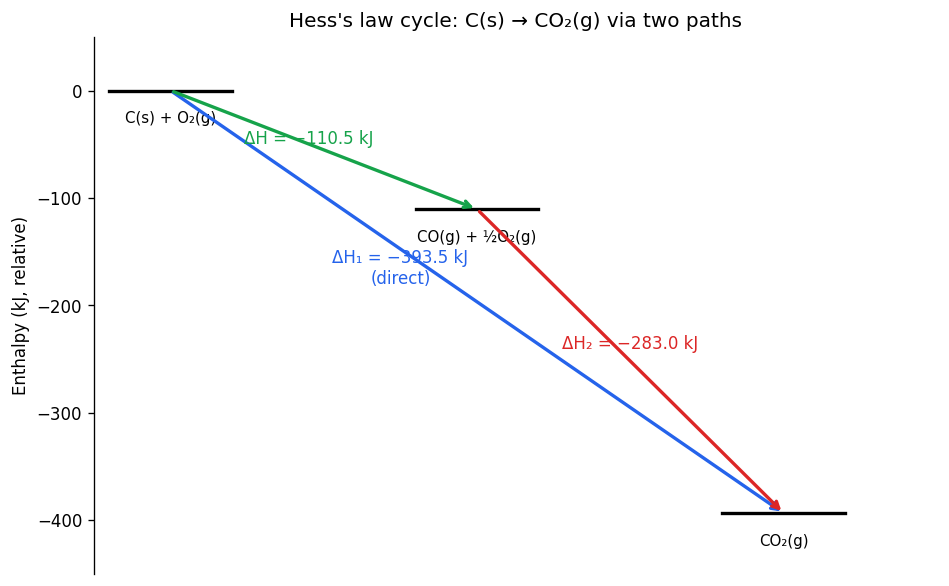
Hess's law: total enthalpy change for a reaction is independent of the path. Example: convert C(s) → CO₂(g). Direct: C + O₂ → CO₂; ΔH₁ = −393.5 kJ. Two-step path: C + ½O₂ → CO; ΔH₂ = −110.5 kJ. CO + ½O₂ → CO₂; ΔH₃ = −283.0 kJ. Sum: ΔH₂ + ΔH₃ = −393.5 kJ = ΔH₁. ✓ Useful for computing enthalpies that cannot be directly measured.
Q316 Marks
Compare intensive and extensive properties with the help of a table giving examples.
Assertion–Reason Questions8 questions
Q321 Mark
Assertion (A): Energy can neither be created nor destroyed.
Reason (R): The first law of thermodynamics states that the internal energy of an isolated system is conserved.
Show explanationHide explanation
Correct answer: Option 1 —
Both A and R are true, and R is the correct explanation of A.
Q331 Mark
Assertion (A): Enthalpy is a state function.
Reason (R): The change in enthalpy depends only on the initial and final states not on the path between them.
Show explanationHide explanation
Correct answer: Option 1 —
Both A and R are true, and R is the correct explanation of A.
Q341 Mark
Assertion (A): Combustion reactions are exothermic.
Reason (R): Combustion reactions release heat to the surroundings hence ΔH is negative.
Show explanationHide explanation
Correct answer: Option 1 —
Both A and R are true, and R is the correct explanation of A.
Q351 Mark
Assertion (A): The entropy of an isolated system always increases or remains constant.
Reason (R): The second law of thermodynamics states that natural processes proceed in the direction of increasing entropy.
Show explanationHide explanation
Correct answer: Option 1 —
Both A and R are true, and R is the correct explanation of A.
Q361 Mark
Assertion (A): A reaction is spontaneous if ΔG < 0.
Reason (R): Negative ΔG means the system can do useful work on the surroundings.
Show explanationHide explanation
Correct answer: Option 1 —
Both A and R are true, and R is the correct explanation of A.
Q371 Mark
Assertion (A): The internal energy of a system can change during an isothermal process.
Reason (R): In an isothermal process, the temperature remains constant, and thus the internal energy does not change.
Show explanationHide explanation
Correct answer: Option 3 —
A is true, but R is false.
Q381 Mark
Assertion (A): A closed system can exchange energy but not matter with its surroundings.
Reason (R): A closed system allows energy transfer in the form of heat or work but does not permit the transfer of matter.
Show explanationHide explanation
Correct answer: Option 1 —
Both A and R are true, and R is the correct explanation of A.
Q391 Mark
Assertion (A): Hess's law states that the total enthalpy change for a reaction is the same, regardless of the number of steps in the reaction.
Reason (R): Hess's law is based on the principle of conservation of energy, which applies to enthalpy changes.
Show explanationHide explanation
Correct answer: Option 1 —
Both A and R are true, and R is the correct explanation of A.
Statement-Based Questions8 questions
Q401 Mark
Statement 1: Heat flows spontaneously from a hot body to a cold body.
Statement 2: Heat does not flow spontaneously from a cold body to a hot body.
Show answerHide answer
Correct answer: Option 1 —
Both statements are true.
Q411 Mark
Statement 1: At constant pressure the heat exchanged equals the enthalpy change.
Statement 2: At constant volume the heat exchanged equals the change in internal energy.
Show answerHide answer
Correct answer: Option 1 —
Both statements are true.
Q421 Mark
Statement 1: Entropy increases when a solid melts to a liquid.
Statement 2: Entropy increases further when a liquid vaporises to a gas.
Show answerHide answer
Correct answer: Option 1 —
Both statements are true.
Q431 Mark
Statement 1: The standard enthalpy of formation of an element in its standard state is zero.
Statement 2: Standard conditions correspond to 1 bar pressure and 298 K.
Show answerHide answer
Correct answer: Option 1 —
Both statements are true.
Q441 Mark
Statement 1: At equilibrium ΔG = 0.
Statement 2: At equilibrium ΔH = TΔS.
Show answerHide answer
Correct answer: Option 1 —
Both statements are true.
Q451 Mark
Statement 1: The internal energy of a system is the sum of the kinetic and potential energies of all the particles in the system.
Statement 2: The first law of thermodynamics states that energy can be created or destroyed in a chemical reaction.
Show answerHide answer
Correct answer: Option 2 —
Only Statement 1 is true.
Q461 Mark
Statement 1: A closed system can exchange energy but not matter with its surroundings.
Statement 2: In an open system, both energy and matter can be exchanged with the surroundings.
Show answerHide answer
Correct answer: Option 1 —
Both statements are true.
Q471 Mark
Statement 1: Hess's law states that the total enthalpy change for a reaction is the same, regardless of the number of steps in the reaction.
Statement 2: The heat capacity of a substance is the amount of heat required to raise the temperature of one mole of the substance by one degree Celsius.
Show answerHide answer
Correct answer: Option 1 —
Both statements are true.
Case Study / Passage Questions3 questions
Q483 Marks
A gas in a cylinder absorbs 500 J of heat from the surroundings and does 300 J of work pushing back the piston. A chemistry student is asked to compute the change in internal energy ΔU using the first law of thermodynamics ΔU = q + w.
The change in internal energy ΔU equals:
A+500 J
B+300 J
C+200 J
D−200 J
A positive value of q means:
AHeat absorbed by system
BHeat released by system
CWork done on system
DWork done by system
Verify ΔU using the alternate convention ΔU = q − w_by_system.
Show answersHide answers
1. Option 3 — +200 J
2. Option 1 — Heat absorbed by system
3. Sign convention: q > 0 if heat is absorbed by the system; w > 0 if work is done ON the system. Here q = +500 J (heat absorbed) and w = −300 J (system does 300 J of work on surroundings so work done on system is −300 J). ΔU = q + w = 500 + (−300) = +200 J. Internal energy increased by 200 J.
Q493 Marks
A chemistry student wants to calculate the enthalpy change for the reaction C(s) + ½O₂(g) → CO(g) which is difficult to measure directly because complete combustion to CO₂ is hard to avoid. Hess's law provides an indirect path using two known enthalpies.
Given ΔH₁ = −393.5 kJ for C → CO₂ and ΔH₂ = −283.0 kJ for CO → CO₂ then ΔH for C → CO equals:
A−110.5 kJ
B−283.0 kJ
C−393.5 kJ
D−176.0 kJ
Hess's law states that ΔH is:
APath-dependent
BPath-independent
CAlways negative
DAlways positive
Verify the answer using the standard enthalpies of formation.
Show answersHide answers
1. Option 1 — −110.5 kJ
2. Option 2 — Path-independent
3. By Hess's law: C → CO₂ in two paths must have the same total ΔH. Path 1 (direct): C + O₂ → CO₂; ΔH₁ = −393.5 kJ. Path 2 (two-step): C + ½O₂ → CO (ΔH = ?); CO + ½O₂ → CO₂ (ΔH₂ = −283.0 kJ). So ΔH₁ = ΔH + ΔH₂ ⇒ ΔH = ΔH₁ − ΔH₂ = −393.5 − (−283.0) = −110.5 kJ.
Q503 Marks
A student investigates a reaction with ΔH = +30 kJ and ΔS = +100 J/K. The student wants to determine the temperature above which the reaction becomes spontaneous.
The reaction is spontaneous:
AAt all temperatures
BBelow 300 K
CAbove 300 K
DNever
The temperature above which spontaneity begins is approximately:
A300 K
B400 K
C200 K
D500 K
Predict the spontaneity at 250 K and 500 K using the same data.
Show answersHide answers
1. Option 3 — Above 300 K
2. Option 1 — 300 K
3. ΔG = ΔH − TΔS. Spontaneity requires ΔG < 0. So ΔH − TΔS < 0 ⇒ T > ΔH/ΔS = 30000/100 = 300 K. Above 300 K the entropy term TΔS dominates and the reaction becomes spontaneous. Below 300 K the reaction is non-spontaneous because the unfavourable enthalpy outweighs the favourable entropy.
Table-Based Questions4 questions
Q513 Marks
Study the standard enthalpies of formation:
Substance
ΔH°ₓ (kJ/mol)
H₂(g)
0
O₂(g)
0
C(s graphite)
0
H₂O(l)
−285.8
CO₂(g)
−393.5
CH₄(g)
−74.8
C₂H₆(g)
−84.7
The standard enthalpy of formation of an element in its standard state is:
AZero
BNegative
CPositive
DVariable
The formation of H₂O(l) from H₂ and O₂ is:
AExothermic
BEndothermic
CEither
DCannot decide
Calculate ΔH for the reaction C(s) + 2H₂(g) → CH₄(g).
Show answersHide answers
1. Option 1 — Zero
2. Option 1 — Exothermic
3. By convention the standard enthalpy of formation of an element in its most stable form (standard state) at 1 bar 298 K is taken as zero. For compounds ΔH°ₓ is measured from a reaction forming 1 mole of compound from constituent elements in their standard states. Negative ΔH°ₓ means exothermic formation — typical for stable compounds.
Q523 Marks
Study the signs of ΔH ΔS and ΔG to determine spontaneity:
ΔH
ΔS
ΔG = ΔH − TΔS
Spontaneity
Negative
Positive
Always negative
Spontaneous at all T
Negative
Negative
Negative below T = ΔH/ΔS
Spontaneous at low T
Positive
Positive
Negative above T = ΔH/ΔS
Spontaneous at high T
Positive
Negative
Always positive
Non-spontaneous at all T
A reaction with ΔH < 0 and ΔS > 0 is:
ASpontaneous at all T
BNon-spontaneous at all T
CSpontaneous at low T
DSpontaneous at high T
A reaction with ΔH > 0 and ΔS > 0 is:
ASpontaneous at low T
BSpontaneous at high T
CNon-spontaneous
DCannot decide
Predict the spontaneity of melting of ice at 200 K and 300 K using ΔH ≈ +6 kJ/mol and ΔS ≈ +22 J/mol·K.
Show answersHide answers
1. Option 1 — Spontaneous at all T
2. Option 2 — Spontaneous at high T
3. ΔG = ΔH − TΔS combines enthalpy and entropy effects. Negative ΔH (exothermic) and positive ΔS (more disorder) both favour spontaneity — combining gives ΔG < 0 always. Positive ΔH and negative ΔS — both unfavourable — gives ΔG > 0 always. The other two cases are temperature-dependent: the dominant term changes with T.
Q535 Marks
Apply Hess's law: given the listed enthalpies, calculate ΔH for the reaction C(s) + ½O₂(g) → CO(g).
Reaction
ΔH (kJ)
C(s) + O₂(g) → CO₂(g)
−393.5
CO(g) + ½O₂(g) → CO₂(g)
−283.0
Q545 Marks
Calculate the work done when 2 mol of an ideal gas expands isothermally and reversibly from 5 L to 25 L at 300 K. (R = 8.314 J/mol·K)
Variable
Value
n
2 mol
V₁
5 L
V₂
25 L
T
300 K
R
8.314 J/mol·K
Picture-Based Questions2 questions
Q553 Marks
Study the Hess's law cycle for the conversion of C(s) to CO₂(g) and answer:
The total enthalpy change ΔH for C(s) + O₂(g) → CO₂(g) (direct path) is:
A−110.5 kJ
B−283.0 kJ
C−393.5 kJ
D−504.0 kJ
Hess's law applied to this cycle states that:
AΔH is path-dependent
BΔH₁ = ΔH(step a) + ΔH₂
CΔH equals heat of reaction at constant volume
DΔH cannot be calculated indirectly
Use Hess's law to calculate ΔH for C(s) + ½O₂(g) → CO(g) and explain why the indirect calculation is necessary.
Show answersHide answers
1. Option 3 — −393.5 kJ
2. Option 2 — ΔH₁ = ΔH(step a) + ΔH₂
3. Hess's law: the total enthalpy change for a reaction is independent of the path. From the diagram, ΔH₁ (direct) = ΔH(step a) + ΔH₂ (step b). So ΔH(step a) for C(s) + ½O₂(g) → CO(g) = ΔH₁ − ΔH₂ = −393.5 − (−283.0) = −110.5 kJ. This is the standard enthalpy of formation of CO, which cannot be measured directly because complete combustion to CO₂ is hard to avoid in the lab.
Q563 Marks
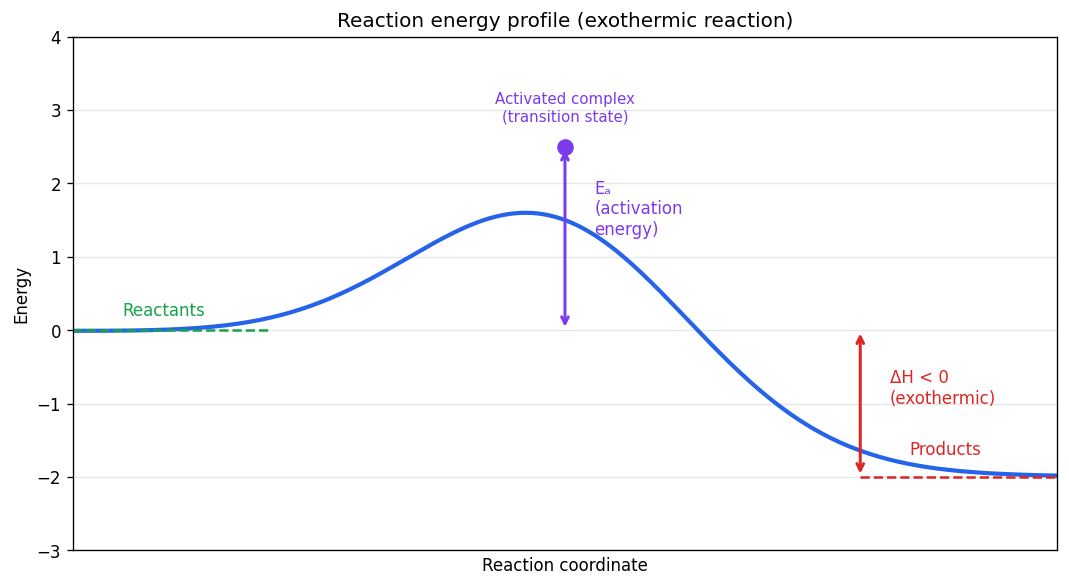
Study the reaction energy profile and answer:
The activation energy Eₐ in the diagram represents:
AEnergy released by the reaction
BMinimum energy required for the reaction to proceed
CHeat capacity of the products
DEnthalpy of formation
Since the products lie below the reactants, the reaction is:
AEndothermic (ΔH > 0)
BExothermic (ΔH < 0)
CEquilibrium (ΔH = 0)
DCannot decide
Distinguish between activation energy and enthalpy change, and state the effect of a catalyst on each.
Show answersHide answers
1. Option 2 — Minimum energy required for the reaction to proceed
2. Option 2 — Exothermic (ΔH < 0)
3. Eₐ (activation energy) is the energy barrier that must be crossed to convert reactants into products — it determines the reaction RATE (kinetics). ΔH (enthalpy change) is the vertical difference between products and reactants — it determines whether the reaction is exothermic (ΔH < 0) or endothermic (ΔH > 0) (thermodynamics). A catalyst lowers Eₐ by providing an alternative pathway with a lower-energy transition state but does NOT change ΔH — the same products are formed with the same enthalpy difference.