SUMMARY: The chapter "Theory Base of Accounting" focuses on the fundamental concepts and principles that form the foundation of accounting practices. KEY TOPICS: Generally Accepted Accounting Principles (GAAP), accounting concepts, accounting conventions, accrual basis of accounting, cash basis of accounting, consistency principle, materiality principle, prudence principle, matching principle, full disclosure principle.
The principle that requires the same accounting method to be used over time is:
AGoing concern
BConsistency
CMateriality
DDisclosure
Check answerHide answer
Correct answer: Option 2 — Consistency
Q51 Mark
Under which concept is the business considered separate from its owner?
AMoney measurement
BBusiness entity
CGoing concern
DCost
Check answerHide answer
Correct answer: Option 2 — Business entity
Q61 Mark
What does the accrual basis of accounting recognize?
ATransactions when cash is received
BTransactions when they occur, regardless of cash flow
COnly expenses when paid
DOnly revenues when earned
Check answerHide answer
Correct answer: Option 2 — Transactions when they occur, regardless of cash flow
Q71 Mark
Which principle requires that all information relevant to a company's financial performance be disclosed?
AMateriality Principle
BFull Disclosure Principle
CPrudence Principle
DMatching Principle
Check answerHide answer
Correct answer: Option 2 — Full Disclosure Principle
Q81 Mark
The matching principle is primarily concerned with which of the following?
ARecording revenues only when cash is received
BMatching expenses with revenues in the same period
CRecording all transactions at their historical cost
DRecognizing profits only when they are realized
Check answerHide answer
Correct answer: Option 2 — Matching expenses with revenues in the same period
Q91 Mark
Which accounting concept assumes that a business will continue to operate indefinitely?
AGoing Concern Concept
BConsistency Concept
CAccrual Concept
DEntity Concept
Check answerHide answer
Correct answer: Option 1 — Going Concern Concept
Q101 Mark
What is the purpose of the prudence principle in accounting?
ATo ensure profits are recorded when earned
BTo avoid overstating assets and income
CTo ensure all expenses are recorded immediately
DTo allow flexibility in financial reporting
Check answerHide answer
Correct answer: Option 2 — To avoid overstating assets and income
Q111 Mark
Which of the following is an example of an accounting convention?
AGoing Concern
BMateriality
CConsistency
DAll of the above
Check answerHide answer
Correct answer: Option 4 — All of the above
Q121 Mark
The cash basis of accounting recognizes revenues and expenses when:
AThey are earned
BThey are incurred
CCash is received or paid
DThey are recorded in the books
Check answerHide answer
Correct answer: Option 3 — Cash is received or paid
Q131 Mark
Which principle states that financial statements should not mislead users?
AMateriality Principle
BPrudence Principle
CConsistency Principle
DFull Disclosure Principle
Check answerHide answer
Correct answer: Option 1 — Materiality Principle
Q141 Mark
The consistency principle is important because it:
AEnsures comparability of financial statements over time
BAllows for changes in accounting methods without disclosure
CRequires that all financial transactions be recorded at market value
DEncourages the use of cash basis accounting
Check answerHide answer
Correct answer: Option 1 — Ensures comparability of financial statements over time
Q151 Mark
Which accounting concept emphasizes that expenses should be matched with revenues?
APrudence Principle
BMatching Principle
CMateriality Principle
DAccrual Concept
Check answerHide answer
Correct answer: Option 2 — Matching Principle
Short Answer Questions10 questions
Q163 Marks
Explain the dual aspect concept with one example.
View sample solutionHide solution
Every transaction has two aspects of equal value — a debit and a credit — recorded in the books. Example: when ₹10000 cash is invested by the owner, Cash A/c is debited (asset increase) and Capital A/c is credited (owner's equity increase). The accounting equation Assets = Liabilities + Capital must always balance after each transaction.
Q173 Marks
Explain the going concern assumption.
View sample solutionHide solution
Going concern assumes the business will continue to operate for the foreseeable future and has no intention to liquidate. Hence assets are valued at cost less depreciation (not at liquidation value), and long-term contracts are entered into. If management believes liquidation is imminent, this assumption is dropped and assets are measured at net realisable value.
Q183 Marks
Distinguish between the cash and accrual basis of accounting.
View sample solutionHide solution
Under cash basis, revenue is recognised when cash is received and expenses when cash is paid; simple but does not match revenues with related expenses. Under accrual basis, revenue is recognised when earned and expenses when incurred, regardless of cash flow; provides a true and fair view of profit. Accrual is mandatory under the Companies Act 2013 for companies in India.
Q193 Marks
Define the materiality concept and give an example.
View sample solutionHide solution
Materiality means accounting reports should disclose all items significant enough to influence user decisions, while immaterial items can be aggregated or ignored. Example: a ₹10 stationery purchase need not be itemised on the balance sheet, but a ₹10 lakh equipment purchase must be disclosed separately. Materiality is judged in relation to the size and nature of the enterprise.
Q203 Marks
What is the purpose of accounting standards?
View sample solutionHide solution
Accounting standards are written policy documents issued by recognised bodies (e.g., ICAI in India) that prescribe rules for measurement and disclosure of accounting transactions. Their purposes: (i) ensure uniformity and comparability of financial statements; (ii) reduce subjectivity and bias; (iii) enhance reliability; (iv) provide guidance to accountants; and (v) facilitate audit and regulatory oversight.
Q213 Marks
What are Generally Accepted Accounting Principles (GAAP)?
View sample solutionHide solution
Generally Accepted Accounting Principles (GAAP) are a set of rules and standards that govern financial accounting and reporting in a particular jurisdiction. They ensure consistency, transparency, and comparability of financial statements across different entities.
Q223 Marks
Describe the consistency principle in accounting.
View sample solutionHide solution
The consistency principle states that once an accounting method is adopted, it should be used consistently throughout the financial reporting period. This ensures that financial statements are comparable over time, allowing users to analyze trends and make informed decisions.
Q233 Marks
What is the matching principle in accounting?
View sample solutionHide solution
The matching principle requires that expenses be matched with the revenues they help to generate within the same accounting period. This ensures that a company's financial performance is accurately reflected in its income statement.
Q243 Marks
Explain the prudence principle in accounting.
View sample solutionHide solution
The prudence principle, also known as the conservatism principle, dictates that accountants should anticipate no profits but anticipate all losses. This means that revenues should only be recognized when they are realized, while potential expenses should be recognized as soon as they are foreseeable.
Q253 Marks
What is the full disclosure principle in accounting?
View sample solutionHide solution
The full disclosure principle requires that all relevant financial information be disclosed in the financial statements or accompanying notes. This ensures that users have all necessary information to make informed decisions regarding the financial health of an entity.
Long Answer Questions6 questions
Q266 Marks
Explain any five fundamental accounting concepts: business entity, money measurement, going concern, cost concept, and dual aspect.
View sample solutionHide solution
(1) Business entity — the business is treated as a separate entity distinct from its owner; owner's personal transactions are kept out of the books. (2) Money measurement — only transactions that can be expressed in money are recorded; events like goodwill among employees are excluded. (3) Going concern — the business is assumed to continue indefinitely; assets are valued at historical cost less depreciation. (4) Cost concept — assets are recorded at the price paid to acquire them (historical cost), not at current market value. (5) Dual aspect — every transaction has two aspects (debit and credit) of equal value, leading to the accounting equation Assets = Liabilities + Capital. Together these concepts form the foundation of double-entry book-keeping.
Q276 Marks
Explain the conservatism (prudence) and consistency conventions with examples.
View sample solutionHide solution
Conservatism (prudence) — anticipate no profits but provide for all possible losses; the accountant chooses the option that least overstates assets or income. Examples: (i) closing stock valued at lower of cost or net realisable value; (ii) provision for doubtful debts is created even when actual default has not occurred; (iii) anticipated profit on a long-term contract is not recognised until earned. Consistency — once an accounting policy is chosen, it should be applied consistently from period to period so that the financial statements are comparable. If a change is necessary (e.g., a different depreciation method), the change and its impact must be disclosed in the notes. Together, these conventions reduce manipulation and enhance reliability.
Q286 Marks
Discuss the difference between cash basis and accrual basis of accounting with a numerical example.
View sample solutionHide solution
Cash basis: revenue and expenses are recorded only when cash is received or paid. Accrual basis: revenue is recorded when earned and expenses when incurred, regardless of cash. Example: Ramesh Traders sells goods worth ₹50000 in March 2024 on credit. The customer pays in May 2024. Salary of ₹20000 for March is paid in April. Under cash basis: March 2024 — no revenue from this sale (cash not received), no salary expense (not paid); May — revenue ₹50000 booked. Under accrual basis: March — revenue ₹50000 recognised, salary expense ₹20000 booked, so March profit reflects actual operations. Accrual is mandatory for companies under the Companies Act 2013 because it gives a true and fair view of profitability.
Q296 Marks
Explain the accounting standards (AS) and their objectives. Also state any three accounting standards prescribed by ICAI.
View sample solutionHide solution
Accounting standards are written documents issued by recognised expert bodies that specify how transactions and events should be recorded and reported. In India ICAI issues AS for non-corporate entities and Ind AS (converged with IFRS) for listed and large corporates. Objectives: (i) bring uniformity and comparability across enterprises; (ii) reduce alternative accounting treatments; (iii) enhance reliability of financial statements; (iv) facilitate audit and regulatory compliance. Examples: AS-1 (Disclosure of Accounting Policies), AS-2 (Valuation of Inventories — lower of cost or net realisable value), AS-9 (Revenue Recognition — when significant risks and rewards transfer to buyer), AS-10 (Property Plant and Equipment), AS-26 (Intangible Assets).
Q306 Marks
Explain the meaning of GST and its features.
View sample solutionHide solution
Goods and Services Tax (GST) is a comprehensive indirect tax on the supply of goods and services in India implemented on 1 July 2017 replacing multiple central and state taxes (excise, service tax, VAT, octroi, etc.). Features: (1) Destination-based — tax accrues to the state where the goods/services are consumed. (2) Multi-stage with input tax credit — tax is collected at each stage but credit is given for tax paid on inputs, eliminating cascading. (3) Dual structure — Central GST (CGST) + State GST (SGST) for intra-state supplies; Integrated GST (IGST) for inter-state supplies. (4) Common tax base across states. (5) Compliance through GSTN portal — registration, return filing, invoice matching. (6) Slabs of 0%, 5%, 12%, 18%, and 28%. Benefits include simpler tax structure, reduced compliance burden, and a unified national market.
Q316 Marks
Compare cash discount and trade discount with the help of a table.
Assertion–Reason Questions8 questions
Q321 Mark
Assertion (A): Fixed assets are recorded at cost and depreciated over their useful life.
Reason (R): The going concern assumption holds that the business will continue operations long enough to use up the asset.
Show explanationHide explanation
Correct answer: Option 1 —
Both A and R are true, and R is the correct explanation of A.
Q331 Mark
Assertion (A): Every transaction is recorded in two accounts.
Reason (R): The dual aspect concept says each transaction has a giving and a receiving aspect of equal value.
Show explanationHide explanation
Correct answer: Option 1 —
Both A and R are true, and R is the correct explanation of A.
Q341 Mark
Assertion (A): Closing stock is valued at the lower of cost or net realisable value.
Reason (R): Conservatism states profits should not be anticipated while losses should be provided for.
Show explanationHide explanation
Correct answer: Option 1 —
Both A and R are true, and R is the correct explanation of A.
Q351 Mark
Assertion (A): Companies in India must follow the accrual basis of accounting.
Reason (R): The Companies Act 2013 mandates accrual-based reporting for all companies.
Show explanationHide explanation
Correct answer: Option 1 —
Both A and R are true, and R is the correct explanation of A.
Q361 Mark
Assertion (A): An enterprise should not change its method of depreciation every year.
Reason (R): The consistency principle requires the same accounting policy to be followed from period to period.
Show explanationHide explanation
Correct answer: Option 1 —
Both A and R are true, and R is the correct explanation of A.
Q371 Mark
Assertion (A): The matching principle ensures that expenses are recognized in the same period as the revenues they help to generate.
Reason (R): This principle is crucial for accurately reflecting the profitability of an enterprise during a specific accounting period.
Show explanationHide explanation
Correct answer: Option 1 —
Both A and R are true, and R is the correct explanation of A.
Q381 Mark
Assertion (A): The materiality principle allows accountants to overlook small errors in financial statements.
Reason (R): This principle states that all significant information must be disclosed in financial statements.
Show explanationHide explanation
Correct answer: Option 3 —
A is true, but R is false.
Q391 Mark
Assertion (A): The consistency principle requires that once an accounting method is adopted, it should be used consistently in future accounting periods.
Reason (R): This principle enhances comparability of financial statements over time.
Show explanationHide explanation
Correct answer: Option 1 —
Both A and R are true, and R is the correct explanation of A.
Statement-Based Questions8 questions
Q401 Mark
Statement 1: The business is treated as separate from its owner.
Statement 2: The owner's drawings are recorded as a deduction from capital not as an expense.
Show answerHide answer
Correct answer: Option 1 —
Both statements are true.
Q411 Mark
Statement 1: Only transactions measurable in money are recorded.
Statement 2: Qualitative information about employee morale is not recorded in the books.
Show answerHide answer
Correct answer: Option 1 —
Both statements are true.
Q421 Mark
Statement 1: Assets are recorded at the price paid to acquire them.
Statement 2: Subsequent changes in market value do not change the recorded cost.
Show answerHide answer
Correct answer: Option 1 —
Both statements are true.
Q431 Mark
Statement 1: Material items must be disclosed separately in the financial statements.
Statement 2: Immaterial items may be aggregated for the sake of conciseness.
Show answerHide answer
Correct answer: Option 1 —
Both statements are true.
Q441 Mark
Statement 1: GST is a destination-based indirect tax.
Statement 2: Inter-state supplies attract IGST collected by the central government.
Show answerHide answer
Correct answer: Option 1 —
Both statements are true.
Q451 Mark
Statement 1: The accrual basis of accounting recognizes revenues and expenses when they are incurred, regardless of cash transactions.
Statement 2: The cash basis of accounting recognizes revenues and expenses only when cash is received or paid.
Show answerHide answer
Correct answer: Option 1 —
Both statements are true.
Q461 Mark
Statement 1: The consistency principle allows businesses to change their accounting methods as frequently as they wish.
Statement 2: The matching principle ensures that expenses are matched to the revenues they help to generate in the same period.
Show answerHide answer
Correct answer: Option 3 —
Only Statement 2 is true.
Q471 Mark
Statement 1: The full disclosure principle requires that all relevant financial information be disclosed in the financial statements.
Statement 2: The prudence principle suggests that profits should be recorded as soon as they are anticipated.
Show answerHide answer
Correct answer: Option 2 —
Only Statement 1 is true.
Case Study / Passage Questions3 questions
Q483 Marks
Mr Khanna runs a textile shop. He has acquired a delivery van for ₹500000 and recorded it at the price he expects to sell it at next year (₹400000). He has also left out a credit purchase of cloth from his books because he has not yet paid for it.
Recording the van at expected sale price violates which concept?
AMoney measurement
BCost concept
CGoing concern
DRealisation
Leaving out the credit purchase violates which concept?
ADual aspect
BMoney measurement
CConservatism
DGoing concern
Explain how Khanna should correct his books with reference to accounting concepts.
Show answersHide answers
1. Option 2 — Cost concept
2. Option 1 — Dual aspect
3. Both errors should be corrected. The van must be recorded at its acquisition cost ₹500000 — the cost concept requires fixed assets to be recorded at the price actually paid, not market or expected value. Subsequent depreciation can be charged but the original cost stays. The credit purchase must be recorded — every transaction has a dual aspect (debit Purchases, credit Creditor) regardless of cash flow. Recording both aspects keeps the accounting equation balanced and ensures reliable books.
Q493 Marks
Sneha is opening an online stationery shop. Her CA explains GST registration is mandatory if her annual turnover exceeds ₹40 lakh (₹20 lakh for special category states). Sneha wonders why GST has replaced the older indirect taxes and how she will collect and pay it.
GST is classified as a:
ADirect tax
BIndirect tax
CWealth tax
DProperty tax
GST is:
AOrigin-based
BDestination-based
CRandom
DEqual in all states
Explain GST and its key features for Sneha's business.
Show answersHide answers
1. Option 2 — Indirect tax
2. Option 2 — Destination-based
3. GST replaced VAT, service tax, excise, and several other taxes from 1 July 2017 to create one unified indirect-tax system. Features: (1) destination-based — tax goes to the state of consumption; (2) multi-stage with input tax credit — tax is collected at each stage but the seller can offset tax paid on inputs against tax collected on outputs, eliminating cascading; (3) dual structure — CGST + SGST for intra-state sales, IGST for inter-state; (4) compliance through the GSTN portal — registration, monthly returns, e-way bills; (5) slabs of 0%, 5%, 12%, 18%, 28%. Benefit: simpler, cheaper compliance and a unified national market.
Q503 Marks
M/s Rohan Traders is incorporated as a Pvt Ltd company. The directors propose to follow cash basis since it is simpler. The CA insists on accrual basis. Rohan is asked to decide.
Under the Companies Act 2013 a company must follow:
ACash basis
BAccrual basis
CEither
DBoth at the same time
To match revenues with the related expenses you must use:
ACash basis
BAccrual basis
CBoth
DSingle entry
Should Rohan Traders follow cash or accrual basis? Explain.
Show answersHide answers
1. Option 2 — Accrual basis
2. Option 2 — Accrual basis
3. Accrual basis is mandatory for companies under the Companies Act 2013 because it gives a true and fair view of profit. Under accrual, revenue is recognised when earned (e.g., when goods are delivered) and expenses when incurred (e.g., salary for the period worked) regardless of cash flow. This matches revenues with the costs incurred to produce them — the matching principle. Cash basis (revenue when cash received, expense when paid) is simpler but distorts profit when there are credit transactions or year-end adjustments. The CA's advice is correct and the directors must follow accrual basis.
Table-Based Questions4 questions
Q513 Marks
Compare key accounting concepts and their applications:
Concept
Statement
Application
Business entity
Business is separate from owner
Owner's drawings deducted from capital
Money measurement
Only money-quantifiable items
Goodwill of brand not recorded
Going concern
Business will continue indefinitely
Assets at cost less depreciation
Cost concept
Assets recorded at acquisition cost
Plant at original price not market
Dual aspect
Every transaction has two aspects
Equal debit and credit
Goodwill of a brand is not recorded due to:
ABusiness entity
BMoney measurement
CGoing concern
DCost
Recording machinery at the price paid (not market) follows:
ACost concept
BGoing concern
CMoney measurement
DConservatism
Why are these concepts called 'fundamental'?
Show answersHide answers
1. Option 2 — Money measurement
2. Option 1 — Cost concept
3. All five fundamental concepts work together. The business entity concept allows separate books of business and owner. Money measurement keeps the books objective. Going concern lets us write off assets over their life. Cost concept anchors valuations to verifiable amounts. Dual aspect ensures the books balance. Together they form the basis of double-entry accounting. Violating any one (e.g., mixing personal and business expenses) compromises the reliability of the financial statements.
Q523 Marks
Study the GST slabs and applicable goods/services:
Slab
Applicable to (examples)
Type
0%
Essentials: milk, eggs, fresh vegetables
Exempt
5%
Coal, sugar, life-saving drugs
Lower
12%
Butter, cheese, mobile phones
Standard
18%
Hair oil, toothpaste, soap
Most goods
28%
Luxury: cars, ACs, tobacco
Highest
Fresh milk attracts which GST rate?
A0%
B5%
C18%
D28%
A luxury car attracts which GST rate?
A5%
B12%
C18%
D28%
Why does GST have multiple rate slabs?
Show answersHide answers
1. Option 1 — 0%
2. Option 4 — 28%
3. GST has multiple slabs to ensure essentials remain affordable while luxury and demerit goods bear higher tax. Slab assignment: 0% for life essentials, 5% for items of mass consumption, 12-18% for most consumer items (the most common slabs), and 28% for luxury items, sin goods (tobacco, alcohol substitutes) and demerit items (often with additional cess). The GST Council periodically reviews slabs to balance revenue and inflation. Compliance is through the GSTN portal — every taxable supply is logged and matched with the buyer's records.
Q536 Marks
Apply each accounting concept to the scenarios in the table and identify the principle being followed (or violated).
Scenario
Concept applied
Owner's drawings deducted from capital
? (Business entity)
Brand goodwill not recorded
? (Money measurement)
Plant at cost less depreciation
? (Going concern + Cost)
Closing stock at lower of cost or NRV
? (Conservatism)
Revenue when earned not when cash received
? (Accrual / Revenue recognition)
Q546 Marks
Compute GST liability for the following intra-state sale: invoice value ₹50000, CGST 9%, SGST 9%. Also compute liability for inter-state sale of ₹50000 at IGST 18%.
Quantity
Intra-state sale
Inter-state sale
Invoice (excl. tax)
₹50000
₹50000
CGST 9%
? ₹4500
—
SGST 9%
? ₹4500
—
IGST 18%
—
? ₹9000
Invoice incl. tax
? ₹59000
? ₹59000
Picture-Based Questions1 question
Q553 Marks
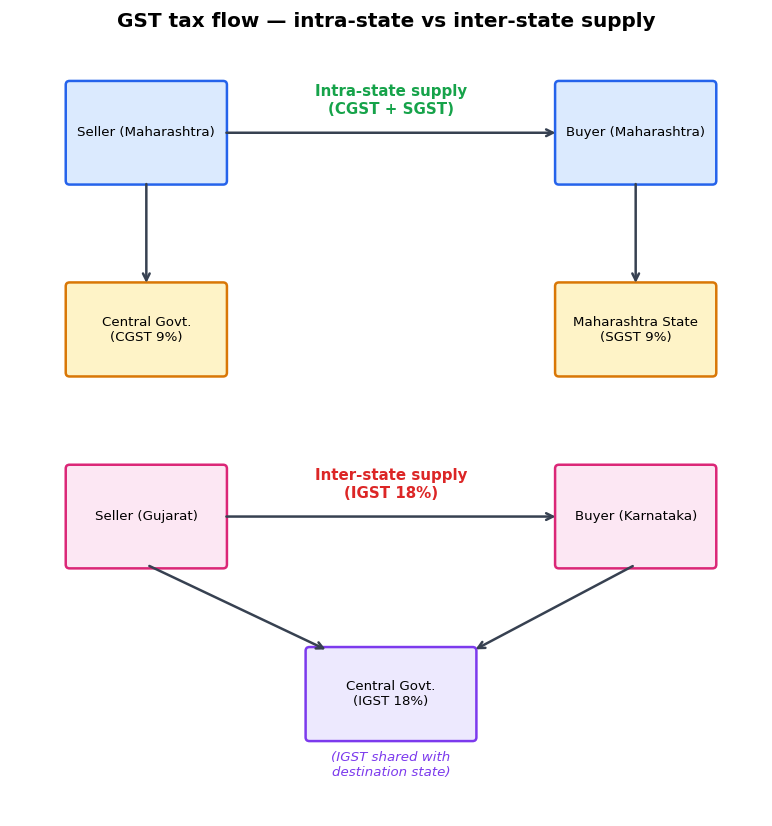
Study the GST tax-flow diagram and answer:
An intra-state supply means:
ATwo states involved
BSame state seller and buyer
CNo GST applicable
DExports
Inter-state supply attracts:
ACGST + SGST
BIGST only
CNo tax
DVAT
Explain CGST, SGST, and IGST and how they apply to intra-state vs inter-state supplies.
Show answersHide answers
1. Option 2 — Same state seller and buyer
2. Option 2 — IGST only
3. GST is a destination-based indirect tax. For an INTRA-state supply (seller and buyer in the same state), the tax is split equally into Central GST (CGST) collected by the central government and State GST (SGST) collected by the state government. For an INTER-state supply (seller and buyer in different states), Integrated GST (IGST) is collected by the central government and later shared with the destination state. The total GST rate is the same in both cases (e.g., 18% = 9%+9% for intra-state, or 18% IGST for inter-state) — only the routing of tax revenue between Centre and States differs. Input tax credit (ITC) makes the GST a value-added tax: tax paid on inputs is offset against tax collected on outputs, so only the value addition at each stage is effectively taxed.