Applications of Computers in Accounting — Important Questions
56 questions
With answersCBSE format
SUMMARY: This chapter explores the role and benefits of using computers in accounting processes and systems. KEY TOPICS: Computerized accounting system, advantages of computer-based accounting, accounting software, data processing cycle, automation in accounting, management information system, enterprise resource planning, limitations of computerized accounting, security and privacy in accounting systems.
Correct answer: Option 1 — Facilitate financial transactions and reporting
Short Answer Questions10 questions
Q163 Marks
Define a computerised accounting system (CAS).
View sample solutionHide solution
A computerised accounting system uses computer software to record, classify, summarise, and report financial transactions. Transactions are entered through pre-defined screens; the software automatically posts to ledgers, balances accounts, generates trial balance and financial statements. Examples in India: Tally, Busy, Marg, Zoho Books, QuickBooks. CAS replaces manual book-keeping and is now standard in most businesses.
Q173 Marks
List any three benefits of computerised accounting over manual accounting.
View sample solutionHide solution
(i) Speed and accuracy — calculations and postings are instant and free of arithmetic errors. (ii) Automatic financial statements — trial balance, P&L, balance sheet generated at any time. (iii) Easy storage and retrieval — large volumes of data stored compactly and searched quickly. (iv) Reduced clerical effort — no manual posting from journal to ledger. (v) Real-time reports for decision making.
Q183 Marks
Distinguish between manual and computerised accounting.
View sample solutionHide solution
Manual accounting — recording done by hand in physical books; slow, error-prone, requires more time and effort; no real-time reporting; suitable for very small entities with few transactions. Computerised accounting — recording done through software; fast, accurate, supports large volumes; instant trial balance and reports; needs hardware, software, trained operators, periodic backups; suitable for any size of organisation. Most modern businesses use computerised accounting; manual systems are now rare.
Q193 Marks
Mention any three risks/limitations of computerised accounting.
View sample solutionHide solution
(i) System failure / data loss — hardware crash or virus attack can lose data; mitigated by regular backups. (ii) Cost of installation and training — initial investment in hardware, software, and training is significant. (iii) Resistance to change — staff may need re-skilling. (iv) Fraud risk — unauthorised access can manipulate data; needs strong access controls. (v) Dependence on power and internet for cloud-based systems.
Q203 Marks
List any three features of accounting software like Tally.
View sample solutionHide solution
(i) Voucher entry — pre-defined screens for receipts, payments, contras, journals, sales, purchases. (ii) Automatic ledger posting — posts each voucher to the related ledger and updates balances. (iii) Real-time reports — trial balance, balance sheet, P&L, day book, GST returns. (iv) Multi-user access with role-based permissions. (v) GST compliance — generates GST-compliant invoices and returns. (vi) Inventory and payroll integration.
Q213 Marks
What is meant by the 'Data Processing Cycle' in computerized accounting?
View sample solutionHide solution
The data processing cycle refers to the series of steps through which raw accounting data is captured, processed, and transformed into meaningful financial information. It typically involves data input, processing (sorting, calculating, and summarizing), and data output in the form of reports.
Q223 Marks
State the primary purpose of a Management Information System (MIS) in an organization.
View sample solutionHide solution
The primary purpose of an MIS is to provide timely, accurate, and relevant information to management for effective decision-making, planning, and control. It processes internal and external data to generate reports that help managers monitor organizational performance.
Q233 Marks
What is 'Ready-to-use' accounting software?
View sample solutionHide solution
Ready-to-use accounting software is pre-developed, off-the-shelf software designed for general users with standard accounting needs. It is highly standardized, easy to install, relatively inexpensive, and suitable for small-scale businesses with low transaction volumes.
Q243 Marks
Why is a regular data backup system essential in computerized accounting?
View sample solutionHide solution
Regular data backup is essential to prevent the permanent loss of critical financial data due to hardware failures, system crashes, virus attacks, or power outages. It ensures business continuity by allowing the quick restoration of accounting records from a secured external storage device.
Q253 Marks
What is meant by 'codification of accounts' in a computerized accounting system?
View sample solutionHide solution
Codification of accounts is the process of assigning unique numerical or alphanumerical codes to different ledger accounts to facilitate systematic classification and rapid retrieval of data. It helps the computer software identify, group, and process transactions efficiently without any ambiguity.
Long Answer Questions6 questions
Q266 Marks
Distinguish between manual and computerised accounting under the following heads: speed, accuracy, security, storage, reports.
View sample solutionHide solution
(1) Speed — Manual: slow, depends on clerks; entries take minutes. Computerised: instantaneous; thousands of transactions in seconds. (2) Accuracy — Manual: prone to arithmetic and posting errors. Computerised: arithmetic is auto, accuracy depends only on data entry. (3) Security — Manual: physical safeguards (locked cupboards); fire/theft risk. Computerised: access controls, encryption, password protection; cyber risks need mitigation through firewalls and antivirus. (4) Storage — Manual: bulky physical books; takes space. Computerised: GBs of data on a small drive; backup to cloud or external drives. (5) Reports — Manual: prepared periodically with effort. Computerised: instant generation of trial balance, balance sheet, P&L, day book, ledger, ageing analysis at the click of a button. Computerised wins on every dimension provided controls are in place.
Q276 Marks
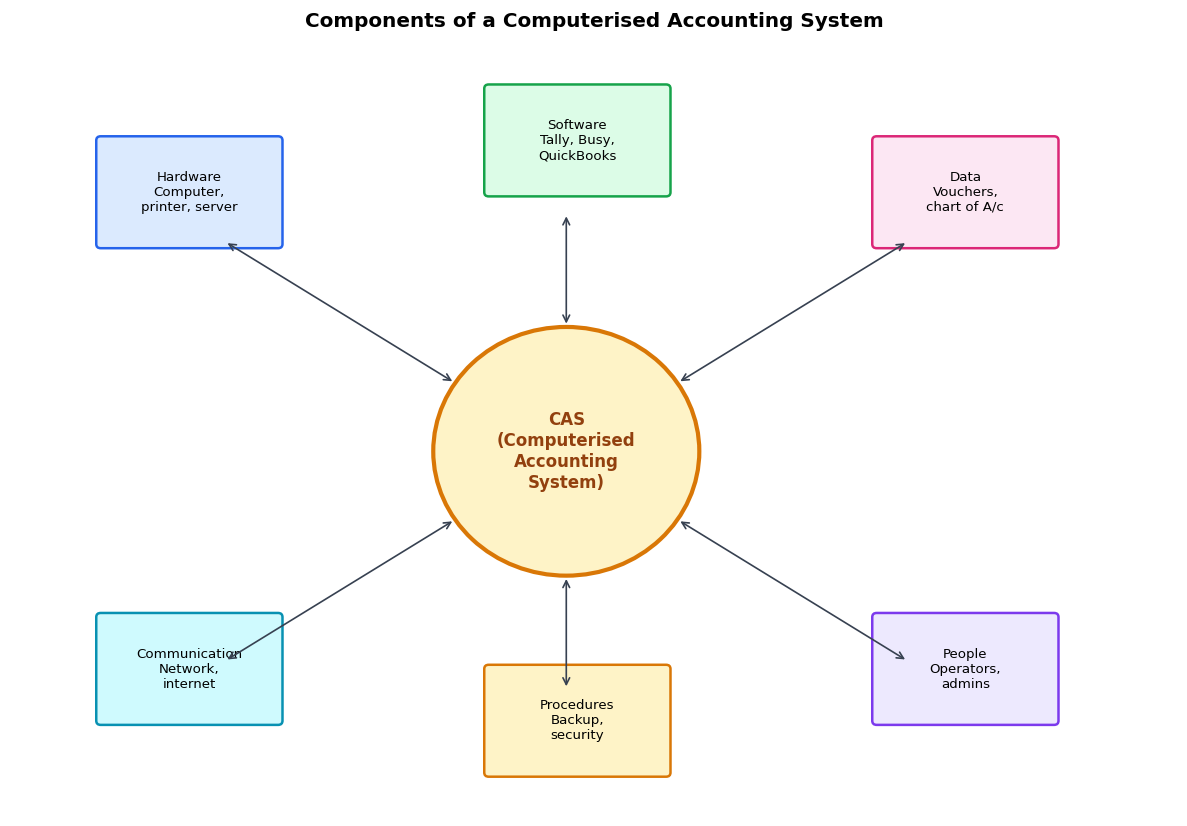
Explain the components of a computerised accounting system.
View sample solutionHide solution
(1) Hardware — physical computer (CPU, monitor, keyboard, mouse, printer); server in larger setups; networking equipment. (2) Software — accounting application (Tally, Busy, QuickBooks, Zoho); operating system (Windows, Linux); database (SQL, MS Access). (3) Data — chart of accounts, vouchers, master data (customers, suppliers, items). (4) People — operators (data entry), administrators (system setup), auditors (reviewers). (5) Procedures — guidelines for voucher entry, backup, period closing, security. (6) Communication — networking for multi-user access, internet for cloud sync. Together these form an integrated information system that turns raw transaction data into actionable financial information.
Q286 Marks
Discuss the advantages and limitations of computerised accounting.
View sample solutionHide solution
Advantages: (i) speed — millions of transactions processed in seconds; (ii) accuracy — eliminates arithmetic errors; (iii) accessibility — multi-user access with role-based permissions; (iv) scalability — handles growth without proportionate increase in staff; (v) integrated reports — financial statements and management reports on demand; (vi) compliance — automated GST and tax computations; (vii) audit trail — every transaction is logged with user and timestamp. Limitations: (i) high initial cost — hardware, software, training; (ii) requires technical expertise — non-tech staff may struggle; (iii) data security risks — hacking, viruses, unauthorised access; (iv) data loss on system failure — backup and disaster recovery are essential; (v) over-dependence — staff may lose underlying accounting skills; (vi) regular maintenance and upgrades. Despite limitations, the advantages overwhelmingly favour computerised systems.
Q296 Marks
Explain the features and uses of any one popular accounting software in India.
View sample solutionHide solution
Tally Prime (formerly Tally ERP 9) is the most widely used accounting software in India for SMEs. Features: (1) Voucher entry — separate screens for receipt, payment, contra, journal, sales, purchase, debit/credit notes. (2) Automatic ledger posting — single voucher posts to multiple ledgers. (3) Real-time reports — trial balance, balance sheet, P&L, day book, debtors/creditors ageing, ratio analysis. (4) GST compliance — GSTR-1, GSTR-3B, e-way bills, e-invoices auto-generated. (5) Inventory management — stock items, batches, godowns, reorder levels. (6) Payroll — salary processing, PF/ESI, professional tax, income tax (TDS). (7) Multi-currency, multi-company, multi-user. Uses: maintains all books of accounts, generates statutory returns, supports audits, integrates with banks for payments. Tally has democratised accounting in India — a small trader with a desktop can run a complete accounting and tax system.
Q306 Marks
Compare manual accounting and computerised accounting with the help of a table on five points.
Q316 Marks
Describe the data processing cycle in the context of computerized accounting and explain its significance.
View sample solutionHide solution
The data processing cycle in computerized accounting consists of four main stages: data input, data processing, data output, and data storage. In the data input stage, financial transactions are recorded using accounting software. During data processing, the software performs calculations, updates accounts, and generates reports based on the input data. The output stage involves producing financial statements and reports that are crucial for decision-making. Finally, data storage ensures that all financial information is securely saved for future reference and audits. The significance of this cycle lies in its ability to enhance efficiency, reduce errors, and provide timely financial information to stakeholders.
Assertion–Reason Questions8 questions
Q321 Mark
Assertion (A): Computerised accounting is faster than manual accounting.
Reason (R): Computers can process transactions and generate reports almost instantaneously.
Show explanationHide explanation
Correct answer: Option 1 —
Both A and R are true, and R is the correct explanation of A.
Q331 Mark
Assertion (A): Computerised accounting requires regular data backup.
Reason (R): Hardware failure or cyber attacks can lead to data loss; backups protect against such risks.
Show explanationHide explanation
Correct answer: Option 1 —
Both A and R are true, and R is the correct explanation of A.
Q341 Mark
Assertion (A): Tally is widely used in Indian businesses.
Reason (R): Tally provides comprehensive accounting features including GST compliance and multi-user access.
Show explanationHide explanation
Correct answer: Option 1 —
Both A and R are true, and R is the correct explanation of A.
Reason (R): The software cannot operate without users who understand both accounting and the software interface.
Show explanationHide explanation
Correct answer: Option 1 —
Both A and R are true, and R is the correct explanation of A.
Q361 Mark
Assertion (A): A trial balance can be generated in real time in computerised accounting.
Reason (R): The software automatically updates ledger balances after every voucher entry.
Show explanationHide explanation
Correct answer: Option 1 —
Both A and R are true, and R is the correct explanation of A.
Q371 Mark
Assertion (A): Computerized accounting systems can enhance the accuracy of financial data.
Reason (R): Automated calculations reduce human error in data entry and processing.
Show explanationHide explanation
Correct answer: Option 1 —
Both A and R are true, and R is the correct explanation of A.
Q381 Mark
Assertion (A): Management Information Systems (MIS) are not beneficial for decision-making in accounting.
Reason (R): MIS provides timely and relevant information to managers.
Show explanationHide explanation
Correct answer: Option 4 —
A is false, but R is true.
Q391 Mark
Assertion (A): Enterprise Resource Planning (ERP) systems integrate various business processes including accounting.
Reason (R): ERP systems provide a unified platform for data management across departments.
Show explanationHide explanation
Correct answer: Option 1 —
Both A and R are true, and R is the correct explanation of A.
Statement-Based Questions8 questions
Q401 Mark
Statement 1: Computerised accounting reduces clerical effort and time.
Statement 2: All journal-to-ledger postings happen automatically once vouchers are entered.
Show answerHide answer
Correct answer: Option 1 —
Both statements are true.
Q411 Mark
Statement 1: Daily or weekly backups are essential in computerised accounting.
Statement 2: Backups protect against data loss from hardware failure or cyber attacks.
Show answerHide answer
Correct answer: Option 1 —
Both statements are true.
Q421 Mark
Statement 1: Modern accounting software automates GST compliance.
Statement 2: Software like Tally generates GSTR-1 and GSTR-3B directly from sales and purchase entries.
Show answerHide answer
Correct answer: Option 1 —
Both statements are true.
Q431 Mark
Statement 1: Computerised accounting involves a high initial cost.
Statement 2: The cost of hardware software and training can be substantial for small businesses.
Show answerHide answer
Correct answer: Option 1 —
Both statements are true.
Q441 Mark
Statement 1: Modern accounting software integrates with banks and tax portals.
Statement 2: Integration enables automatic bank reconciliation and direct tax filing.
Show answerHide answer
Correct answer: Option 1 —
Both statements are true.
Q451 Mark
Statement 1: A computerized accounting system can provide real-time financial information.
Statement 2: Manual accounting systems are faster than computerized systems.
Show answerHide answer
Correct answer: Option 2 —
Only Statement 1 is true.
Q461 Mark
Statement 1: Data processing cycle in accounting includes data collection, processing, and output.
Statement 2: Management information systems are only used for financial reporting.
Show answerHide answer
Correct answer: Option 3 —
Only Statement 2 is true.
Q471 Mark
Statement 1: Enterprise resource planning (ERP) systems integrate various business processes including accounting.
Statement 2: The main limitation of computerized accounting is the ease of data retrieval.
Show answerHide answer
Correct answer: Option 4 —
Both statements are false.
Case Study / Passage Questions4 questions
Q483 Marks
Maple Public School previously kept manual books. The principal decides to migrate to Tally Prime. The accountant is concerned about the migration effort and the cost of training staff.
The benefits of computerised accounting are:
ASpeed and accuracy
BReal-time reports
CReduced clerical effort
DAll of these
Components of a computerised accounting system include:
AHardware
BSoftware
CPeople
DAll of these
Discuss the benefits and challenges of migration to Tally.
Show answersHide answers
1. Option 4 — All of these
2. Option 4 — All of these
3. The school will benefit from migration: (1) Speed — vouchers entered once produce ledgers trial balance and statements automatically. (2) Accuracy — no arithmetic or posting errors. (3) Real-time reports — fee collection daily expense statements teacher salary registers all available on demand. (4) GST compliance — Tally produces GST returns directly from sales/purchase entries. (5) Multi-user access — different staff can work simultaneously on different vouchers. (6) Backup and audit trail. Migration costs (hardware software training) are usually recovered within the first year through reduced clerical effort. The accountant's concerns are valid but manageable: migration in stages with parallel running and structured training avoids disruption.
Q493 Marks
Mr Roy still maintains manual books for his small chemist shop. His son shows him a free version of an accounting app. They debate whether to switch.
Which has higher speed of processing transactions?
AManual
BComputerised
CBoth equally
DNeither
A computerised system can produce trial balance:
ADaily
BMonthly
CReal-time
DAnnually
Help Mr Roy decide whether to switch to a computerised system.
Show answersHide answers
1. Option 2 — Computerised
2. Option 3 — Real-time
3. Manual: slow recording prone to errors; trial balance prepared periodically with effort; physical books take space; security depends on physical safeguards. Computerised: fast accurate recording; trial balance and statements available real-time; data stored compactly with backup options; access controls and password protection. For a small chemist shop the volume may not currently justify a computerised system but as the business grows the benefits become irresistible. Free versions of accounting apps now make adoption affordable for small businesses. Most chemist shops in India have transitioned to computerised systems for GST compliance reasons alone.
Q503 Marks
M/s Verma Stores files monthly GST returns. The accountant currently maintains separate spreadsheets for sales purchases and tax. The CA recommends moving to integrated accounting software like Tally that has GST modules.
For monthly GST returns the most efficient approach is:
ASpreadsheets
BIntegrated software
CManual books
DEmail
An integrated software typically generates:
AGSTR-1 alone
BGSTR-3B alone
CBoth GSTR-1 and GSTR-3B
DNo returns
Explain how integrated software simplifies GST compliance.
Show answersHide answers
1. Option 2 — Integrated software
2. Option 3 — Both GSTR-1 and GSTR-3B
3. Integrated accounting software like Tally Prime has dedicated GST features: (1) GSTIN-aware ledger setup so each customer/supplier carries the GSTIN; (2) automatic computation of CGST/SGST/IGST on each invoice based on intra- vs inter-state classification; (3) automatic generation of GSTR-1 (outward supplies) GSTR-3B (summary return) and GSTR-9 (annual return); (4) e-way bill and e-invoice integration; (5) input tax credit tracking so tax paid on inputs offsets tax on outputs; (6) reconciliation with GSTR-2A (auto-populated from suppliers' GSTR-1). This eliminates the manual spreadsheet effort and reduces the risk of compliance errors and penalties.
Q513 Marks
In recent years, many businesses have transitioned from manual accounting systems to computerized accounting systems. This shift allows for greater accuracy and efficiency in financial reporting. Computerized systems can automate repetitive tasks, such as data entry and calculations, reducing the risk of human error. Furthermore, these systems can generate financial statements and reports in real-time, providing businesses with up-to-date information for decision-making. The integration of accounting software with other business applications, such as inventory management and payroll systems, enhances overall operational efficiency.
What is one primary benefit of transitioning to a computerized accounting system?
AIncreased manual labor
BGreater accuracy and efficiency
CHigher costs
DLimited reporting capabilities
Explain how computerized accounting systems can assist in decision-making.
Which of the following tasks can be automated by computerized accounting systems?
AData entry
BFinancial reporting
CCalculations
DAll of the above
Show answersHide answers
1. Option 2 — Greater accuracy and efficiency
2. Computerized accounting systems provide real-time financial information, which helps businesses make informed decisions quickly.
3. Option 4 — All of the above
Table-Based Questions4 questions
Q523 Marks
Components of a computerised accounting system:
Component
Examples
Role
Hardware
Computer printer server
Physical processing and output
Software
Tally Busy QuickBooks
Application logic
Data
Vouchers chart of accounts
Input to be processed
People
Operators administrators
Use the system
Procedures
Voucher entry backup
Define how the system is used
Communication
Networks internet
Multi-user access and cloud sync
Tally is an example of:
AHardware
BSoftware
CData
DPeople
Backup and security policies are part of:
AHardware
BSoftware
CProcedures
DCommunication
Why is a CAS more than just software?
Show answersHide answers
1. Option 2 — Software
2. Option 3 — Procedures
3. A computerised accounting system is more than just software — it is an integrated information system. Hardware provides the physical platform; software runs the accounting logic; data is the input that becomes information through processing; people operate the system; procedures define controls and routines; communication enables multi-user and cloud access. Weakness in any one component compromises the whole. For example perfect software with poor procedures (no backups no access controls) leads to data loss and fraud. Modern cloud-based systems (Zoho Books QuickBooks Online) bundle these components but each must still be addressed through policies and training.
Q533 Marks
Compare manual and computerised accounting features:
Feature
Manual
Computerised
Speed
Slow
Instant
Accuracy
Error-prone
High
Storage
Physical books
Digital storage
Reports
On demand prepared manually
Auto-generated real-time
Cost
Low initial high recurring
High initial low recurring
Security
Physical safeguards
Access controls and encryption
Real-time auto-generated reports are a feature of:
AManual
BComputerised
CBoth
DNeither
Recurring costs are usually:
ALower in manual
BLower in computerised
CSame in both
DHigher in computerised
Why does the break-even from manual to computerised come quickly?
Show answersHide answers
1. Option 2 — Computerised
2. Option 2 — Lower in computerised
3. Manual accounting is appropriate only for the smallest businesses with very few transactions. Computerised accounting wins on every operational metric — speed accuracy storage and reports — at the cost of higher initial investment and the need for trained staff and security controls. The break-even point comes quickly: any business processing more than a few dozen transactions per day or needing GST compliance will save more in clerical effort than it spends on software. Cloud-based systems further lower the barrier by removing the need for in-house servers and offering subscription pricing. The shift from manual to computerised accounting is now nearly universal in India.
Q546 Marks
Compare manual and computerised accounting under common operational dimensions.
Dimension
Manual
Computerised
Speed
Slow
Instant
Accuracy
Error-prone
High
Storage
Physical books
Digital
Reports
Manual prep
Auto-generated
Cost
Low initial / high recurring
High initial / low recurring
Security
Physical
Access controls
Q556 Marks
Which accounting software has the highest user satisfaction rating according to the table?
Accounting Software
User Satisfaction Rating (%)
Market Share (%)
Software A
85
20
Software B
90
30
Software C
75
25
Picture-Based Questions1 question
Q563 Marks
Study the components of a Computerised Accounting System and answer:
Tally Prime is an example of which component?
AHardware
BSoftware
CProcedures
DCommunication
A complete Computerised Accounting System consists of:
ASoftware only
BHardware only
CAll six components together
DNone of these
Explain why a Computerised Accounting System is more than just software.
Show answersHide answers
1. Option 2 — Software
2. Option 3 — All six components together
3. A Computerised Accounting System is more than just software — it is an integrated information system with six interlocking components: (1) HARDWARE — the physical computer, printer, server, and networking equipment. (2) SOFTWARE — the application that runs the accounting logic (Tally, Busy, QuickBooks, Zoho Books) plus the operating system and database. (3) DATA — vouchers, chart of accounts, master data (customers, suppliers, items). (4) PEOPLE — operators (data entry), administrators (system setup), and auditors (reviewers). (5) PROCEDURES — guidelines for voucher entry, backup, period closing, security, and access control. (6) COMMUNICATION — networking for multi-user access, internet for cloud sync, GST portal integration. Weakness in ANY component compromises the whole system. For example, perfect software with poor procedures (no backup, weak access controls) leads to data loss and fraud. Modern cloud-based accounting bundles these components but each must still be addressed through policies and training.