SUMMARY: The chapter "Introduction to Accounting" provides an overview of the fundamental concepts and objectives of accounting, its role in business, and the basic principles that govern accounting practices. KEY TOPICS: definition of accounting, objectives of accounting, functions of accounting, users of accounting information, branches of accounting, basic accounting terms, accounting principles, accounting standards, importance of accounting, limitations of accounting
BTo provide a systematic record of financial transactions
CTo manage employee performance
DTo enhance customer satisfaction
Check answerHide answer
Correct answer: Option 2 — To provide a systematic record of financial transactions
Q141 Mark
Which accounting term refers to the difference between total assets and total liabilities?
ARevenue
BEquity
CExpense
DProfit
Check answerHide answer
Correct answer: Option 2 — Equity
Q151 Mark
In which branch of accounting would you find budgeting and performance evaluation?
AFinancial Accounting
BCost Accounting
CManagement Accounting
DTax Accounting
Check answerHide answer
Correct answer: Option 3 — Management Accounting
Short Answer Questions10 questions
Q163 Marks
Define accounting and state any two of its objectives.
View sample solutionHide solution
Accounting is the process of identifying, measuring, recording, classifying, summarizing, analyzing and communicating financial information to users for decision making. Two objectives: (i) Maintaining systematic records of all financial transactions; (ii) Ascertaining the profit/loss and financial position of the business at the end of a period.
Q173 Marks
Distinguish between book-keeping and accounting.
View sample solutionHide solution
Book-keeping is the routine recording and classifying of financial transactions in journals and ledgers. Accounting is broader: it includes book-keeping plus summarising (trial balance, financial statements), analysing, interpreting and communicating the results to users. Book-keeping is a subset of accounting.
Q183 Marks
List any three users of accounting information and state their information needs.
View sample solutionHide solution
(i) Owners/shareholders — want profitability and return on investment. (ii) Lenders/creditors — want solvency and ability to repay debt. (iii) Government/tax authorities — want correct tax liability. Other users include employees (job security and bonuses), customers (continuity of supply), and management (planning and control).
Q193 Marks
State any three qualitative characteristics that accounting information should possess.
View sample solutionHide solution
(i) Reliability: information must be free from material error and bias. (ii) Relevance: must be useful for decision-making (timely and capable of influencing decisions). (iii) Understandability: presented in a form that users can comprehend. (Comparability and consistency are also qualitative characteristics.)
Q203 Marks
Differentiate between financial accounting and management accounting.
View sample solutionHide solution
Financial accounting prepares standardised financial statements (P&L, Balance Sheet) for external users; mandatory; based on past data; follows GAAP. Management accounting prepares customised reports for internal managers; voluntary; future-oriented; uses any technique that aids decisions.
Q213 Marks
What are the primary functions of accounting?
View sample solutionHide solution
The primary functions of accounting include recording financial transactions, classifying and summarizing financial data, and interpreting financial information to assist in decision-making.
Q223 Marks
Explain the importance of accounting in business decision-making.
View sample solutionHide solution
Accounting provides critical financial information that helps stakeholders make informed decisions regarding resource allocation, performance evaluation, and strategic planning.
Q233 Marks
What are the branches of accounting? Name at least two.
View sample solutionHide solution
The branches of accounting include financial accounting, management accounting, cost accounting, and tax accounting. Financial accounting focuses on reporting financial information to external users, while management accounting aids internal decision-making.
Q243 Marks
Define the term 'accounting standards'. Why are they important?
View sample solutionHide solution
Accounting standards are formal guidelines that dictate how financial transactions and events should be reported in financial statements. They ensure consistency, comparability, and transparency in financial reporting.
Q253 Marks
What is the role of accounting information for investors?
View sample solutionHide solution
Investors use accounting information to assess the financial health and performance of a business, enabling them to make informed decisions about buying, holding, or selling shares.
Long Answer Questions6 questions
Q266 Marks
Explain the meaning and process of accounting and discuss its role in modern business.
View sample solutionHide solution
Accounting is the process by which financial information is identified, recorded, classified, summarised, analysed and communicated. The process flow: identify a transaction → record in journal → post to ledger → balance the ledger → prepare trial balance → prepare financial statements → analyse and interpret → communicate to users. Roles in modern business: (1) Maintains systematic records — replaces memory; (2) Ascertains profit or loss through P&L Account; (3) Ascertains financial position through Balance Sheet; (4) Provides information for tax authorities and statutory compliance; (5) Helps in decision-making through cost and management accounting; (6) Builds investor and creditor confidence; (7) Acts as legal evidence in disputes. Without accounting, no large enterprise could function — modern accounting is the language of business.
Q276 Marks
Discuss the various branches of accounting with examples of the kind of information each provides.
View sample solutionHide solution
(1) Financial accounting — recording and reporting of past transactions; produces P&L Account, Balance Sheet, Cash Flow Statement for owners, creditors, government. (2) Cost accounting — ascertaining cost of products and services; useful for pricing decisions and cost control. (3) Management accounting — providing customised information for managers; uses budgets, variance analysis, ratio analysis for planning and control. (4) Tax accounting — preparing tax computations and filing returns under income-tax and GST laws. (5) Social responsibility accounting — measuring social and environmental impact (e.g., carbon footprint). (6) Human resource accounting — valuing the workforce as a corporate asset. Each branch serves a different decision-maker and uses different techniques.
Q286 Marks
Explain the qualitative characteristics of accounting information: relevance, reliability, comparability, and understandability.
View sample solutionHide solution
(1) Relevance — information must influence the decisions of users; must be timely and capable of altering judgements. Irrelevant information clutters reports. (2) Reliability — information must be free from material errors and bias; should faithfully represent the transactions. Achieved through verifiability and prudence. (3) Comparability — users should be able to compare the financial information of an enterprise across periods (intra-period) and with other enterprises (inter-period). Requires consistency in accounting policies. (4) Understandability — information must be presented in a form that users with reasonable knowledge of business and accounting can comprehend. Together these characteristics ensure that accounting information is useful for decision-making.
Q296 Marks
Discuss the limitations of financial accounting that have led to the development of other branches of accounting.
View sample solutionHide solution
(1) Records only monetary transactions — qualitative factors (employee morale, customer goodwill) are excluded. (2) Records past events only — does not provide forward-looking information for planning. (3) Uses historical cost — ignores price-level changes and current values. (4) Aggregated information — does not show product-wise or department-wise profitability. (5) Window dressing possible — manipulation of accounting policies can mislead. (6) Subjective judgements — depreciation methods, inventory valuation involve choice. These limitations led to: cost accounting (product-wise costs), management accounting (forward-looking information for managers), responsibility accounting (department-wise control), inflation accounting (price-level adjustments), and human resource accounting (people as assets).
Q306 Marks
What is meant by the qualitative characteristics of accounting information? Explain in brief, indicating their interrelationships.
View sample solutionHide solution
Qualitative characteristics are attributes that make accounting information useful to users. The four primary characteristics are reliability, relevance, comparability, and understandability. Reliability and relevance can sometimes conflict — fully verified information may be too late to be relevant; timely estimates may be less reliable. Comparability requires consistency in policies; if a change is needed for greater relevance, it should be disclosed. Understandability puts a duty on the preparer to present information clearly and on the user to have reasonable accounting knowledge. Together, these characteristics ensure that financial reports are decision-useful.
Q316 Marks
Differentiate between book-keeping and accounting in tabular form on five points.
Assertion–Reason Questions8 questions
Q321 Mark
Assertion (A): Accounting is referred to as the language of business.
Reason (R): Accounting communicates the results of business operations to users in monetary terms.
Show explanationHide explanation
Correct answer: Option 1 —
Both A and R are true, and R is the correct explanation of A.
Q331 Mark
Assertion (A): Book-keeping is part of accounting.
Reason (R): Book-keeping is concerned only with the recording phase of accounting.
Show explanationHide explanation
Correct answer: Option 1 —
Both A and R are true, and R is the correct explanation of A.
Q341 Mark
Assertion (A): Management accounting reports are not prepared in any prescribed format.
Reason (R): Management accounting is meant for internal use and is not regulated by external standards.
Show explanationHide explanation
Correct answer: Option 1 —
Both A and R are true, and R is the correct explanation of A.
Q351 Mark
Assertion (A): Investors are interested in the profitability of an enterprise.
Reason (R): Investors decide on continuing or withdrawing investment based on the return earned by the enterprise.
Show explanationHide explanation
Correct answer: Option 1 —
Both A and R are true, and R is the correct explanation of A.
Q361 Mark
Assertion (A): Accounting information must be reliable.
Reason (R): Reliability ensures that information is free from material error and faithfully represents the transactions.
Show explanationHide explanation
Correct answer: Option 1 —
Both A and R are true, and R is the correct explanation of A.
Q371 Mark
Assertion (A): Accounting helps in making informed business decisions.
Reason (R): It provides financial information that is essential for planning and control.
Show explanationHide explanation
Correct answer: Option 1 —
Both A and R are true, and R is the correct explanation of A.
Q381 Mark
Assertion (A): The primary objective of accounting is to record financial transactions.
Reason (R): This helps in maintaining a systematic record of all business activities.
Show explanationHide explanation
Correct answer: Option 1 —
Both A and R are true, and R is the correct explanation of A.
Q391 Mark
Assertion (A): Users of accounting information include only internal stakeholders.
Reason (R): External stakeholders such as investors and creditors also rely on accounting information.
Show explanationHide explanation
Correct answer: Option 3 —
A is true, but R is false.
Statement-Based Questions8 questions
Q401 Mark
Statement 1: Accounting is the process of recording financial transactions.
Statement 2: Accounting is also concerned with summarizing and communicating financial information.
Show answerHide answer
Correct answer: Option 1 —
Both statements are true.
Q411 Mark
Statement 1: Cost accounting helps in determining product costs.
Statement 2: Tax accounting helps in computing tax liability under different tax laws.
Show answerHide answer
Correct answer: Option 1 —
Both statements are true.
Q421 Mark
Statement 1: Financial accounting reports the past performance of the business.
Statement 2: Financial accounting prepares the P&L Account and Balance Sheet for external users.
Show answerHide answer
Correct answer: Option 1 —
Both statements are true.
Q431 Mark
Statement 1: Owners and managers are internal users of accounting information.
Statement 2: Internal users rely on detailed and customised accounting reports for decision-making.
Show answerHide answer
Correct answer: Option 1 —
Both statements are true.
Q441 Mark
Statement 1: Accounting helps in ascertaining profits or losses of a business.
Statement 2: Accounting also assists in ascertaining the financial position through the Balance Sheet.
Show answerHide answer
Correct answer: Option 1 —
Both statements are true.
Q451 Mark
Statement 1: Accounting is primarily concerned with the recording of financial transactions.
Statement 2: The main objective of accounting is to provide information for decision-making.
Show answerHide answer
Correct answer: Option 1 —
Both statements are true.
Q461 Mark
Statement 1: Users of accounting information include only external parties such as investors and creditors.
Statement 2: Accounting helps in maintaining systematic records of financial transactions.
Show answerHide answer
Correct answer: Option 3 —
Only Statement 2 is true.
Q471 Mark
Statement 1: Branches of accounting include financial accounting, management accounting, and tax accounting.
Statement 2: Accounting standards are optional guidelines that can be ignored by businesses.
Show answerHide answer
Correct answer: Option 2 —
Only Statement 1 is true.
Case Study / Passage Questions3 questions
Q483 Marks
Sundar starts a small grocery store on 1 April 2024 with cash ₹50000 and a delivery cycle worth ₹8000 brought from home. In the first month he buys goods worth ₹30000 (paid ₹20000 cash, ₹10000 on credit) and sells goods for ₹25000 cash. He pays rent ₹3000 and salary ₹2000.
The journal in which Sundar first records each transaction is called:
AProfit-only book
BA book of original entry
CThe trial balance
DA trial run
To know what Sundar's business owns and owes at the end of the month he should prepare a:
ATrading account
BProfit and loss account
CBalance sheet
DCash book
Explain how accounting will help Sundar manage his grocery business better.
Show answersHide answers
1. Option 2 — A book of original entry
2. Option 3 — Balance sheet
3. Accounting helps Sundar by (i) maintaining systematic records of every transaction so nothing is forgotten; (ii) ascertaining profit or loss for the month through a P&L Account; (iii) ascertaining financial position through a Balance Sheet showing assets (cash, stock, cycle, debtors) and liabilities (creditors, capital); (iv) helping him compute taxes; (v) demonstrating creditworthiness to banks if he ever needs a loan; (vi) acting as legal evidence in case of disputes. Without accounting Sundar would rely on memory which is unreliable as the business grows.
Q493 Marks
Maple Public School is moving from a manual accounting register kept by the cashier to a computerised system. The principal wants to know who the users of the school's accounting information will be and what each user will look for.
Accounting information of the school will be used by:
AInternal users only
BExternal users only
CBoth internal and external users
DNo users at all
Which of the following will the principal want the system to track?
AIncome from fees
BSalaries paid
CBuildings owned
DAll of these
Identify the various users of the school's accounting information and what each will look for.
Show answersHide answers
1. Option 3 — Both internal and external users
2. Option 4 — All of these
3. Internal users include the principal, governing body, teachers, and finance officer who use detailed reports for budgeting, decision-making, and control. External users include parents (interested in financial soundness and fee utilisation), donors and CSR partners (interested in expense reporting), banks (for any loans), and government regulators (for grants and tax compliance). The school management would want monthly fee collection reports, expense breakdowns by category, and balance sheet showing buildings, equipment, and reserves. Accounting software supports all these reports automatically.
Q503 Marks
Anita runs a corner bookshop. She maintains a simple cash book and stock register but no formal ledgers or financial statements. Her CA tells her she should adopt full double-entry book-keeping. She is unsure whether the additional effort is worthwhile.
The CA explains the relationship between bookkeeping and accounting:
ABookkeeping is the same as accounting
BBookkeeping is part of accounting
CAccounting is part of bookkeeping
DNeither is related
Adopting full accounting will help Anita because:
ATrial balance can be prepared
BErrors are easier to detect
CProfit and financial position can be ascertained
DAll of these
Should Anita adopt full accounting? Explain.
Show answersHide answers
1. Option 2 — Bookkeeping is part of accounting
2. Option 4 — All of these
3. Anita should adopt full accounting because: (i) it gives a true and fair view of the bookshop's profit and financial position rather than just cash flows; (ii) it allows preparation of a trial balance that catches arithmetic errors; (iii) tax authorities and banks expect proper books; (iv) it helps her compare year-on-year performance; (v) it provides legal evidence in disputes. The additional effort is small once a routine is established and modern accounting software (Tally, Zoho Books) automates most of the work — the benefits far outweigh the cost.
Table-Based Questions3 questions
Q513 Marks
Study the branches of accounting and their main users:
Branch
Main user
Information provided
Financial accounting
External (investors, creditors, govt.)
P&L Account, Balance Sheet, Cash Flow
Cost accounting
Production manager
Cost per unit, variance reports
Management accounting
Top management
Forecasts, budgets, ratio analysis
Tax accounting
Tax authorities
Tax computations and returns
Social accounting
Public, NGOs
CSR and environmental impact reports
Which branch produces P&L Account and Balance Sheet for external users?
ACost accounting
BFinancial accounting
CManagement accounting
DTax accounting
Budgets and forecasts are typically the output of:
ACost accounting
BTax accounting
CManagement accounting
DSocial accounting
Why does a modern enterprise need more than one branch of accounting?
Show answersHide answers
1. Option 2 — Financial accounting
2. Option 3 — Management accounting
3. Each branch of accounting serves a different decision-maker. Financial accounting serves external users with standardised statements. Cost accounting helps production managers control unit costs. Management accounting provides forward-looking information for internal decisions. Tax accounting handles compliance with tax laws. Social/responsibility accounting reports on the firm's impact on society. A modern enterprise typically maintains several of these in parallel — one accounts department but multiple report types feeding different audiences.
Q523 Marks
Compare the qualitative characteristics of accounting information:
Characteristic
Definition
Practical example
Reliability
Free from bias and material error
Audited statements
Relevance
Influences user's decision
Quarterly results before AGM
Comparability
Comparable across periods/firms
Same format in P&L year-on-year
Understandability
Comprehensible to users
Plain-language disclosures
Using the same format of P&L every year reflects:
AReliability
BRelevance
CComparability
DUnderstandability
Quarterly results published just before the AGM illustrate:
AReliability
BMateriality
CRelevance
DUnderstandability
Discuss conflicts among reliability, relevance and comparability.
Show answersHide answers
1. Option 3 — Comparability
2. Option 3 — Relevance
3. Sometimes characteristics conflict — for example, fully audited information may be late and lose relevance, while fast estimates may sacrifice reliability. Comparability requires consistency in policies; if a change is needed for greater relevance, it must be disclosed. Understandability puts a duty on the preparer to present information clearly and on the user to have reasonable accounting knowledge. Together these characteristics ensure that financial reports are useful for decision-making.
Q536 Marks
Match each user of accounting information with the kind of information they primarily need.
User
Information needed
Investor
? (return on investment)
Lender / Bank
? (solvency, repayment ability)
Government
? (tax compliance)
Employees
? (job security, bonus)
Customers
? (continuity of supply)
Picture-Based Questions1 question
Q543 Marks
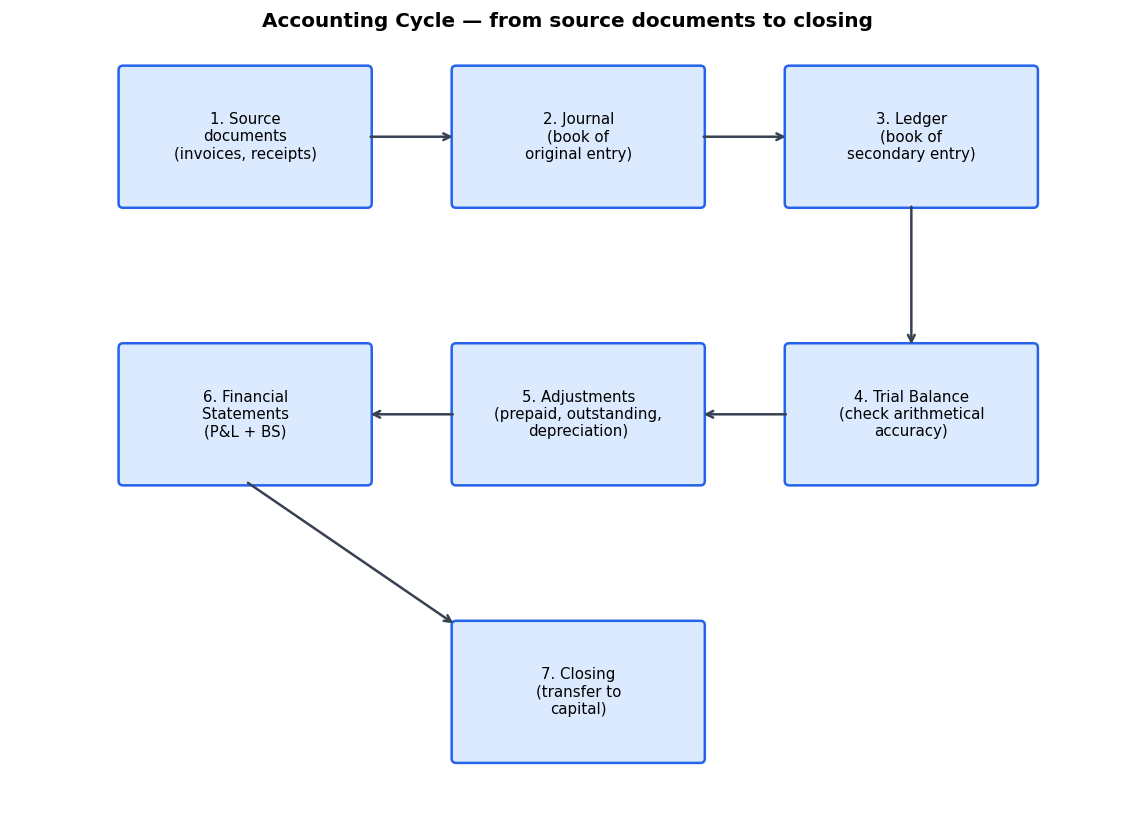
Study the accounting cycle flowchart and answer:
The first step of the accounting cycle is:
ASource documents
BTrial balance
CFinancial statements
DClosing entries
Step 4 in the cycle (after the ledger) is:
ATrial balance
BAdjustments
CFinancial statements
DClosing
Describe each step of the accounting cycle.
Show answersHide answers
1. Option 1 — Source documents
2. Option 1 — Trial balance
3. The accounting cycle is the sequence of steps an accountant follows from raw transactions to final financial statements: (1) Source documents — bills, vouchers, receipts authenticate every transaction. (2) Journal — book of original entry; each transaction recorded chronologically with debit and credit. (3) Ledger — book of secondary entry; transactions from journal posted account-wise. (4) Trial balance — checks arithmetical accuracy of ledger postings. (5) Adjustments — accruals, prepayments, depreciation, provisions are passed at year-end. (6) Financial statements — Trading + P&L Account and Balance Sheet prepared. (7) Closing — nominal accounts closed and net profit transferred to capital. The cycle repeats every accounting period.