SUMMARY: The chapter "Societal Impacts" in Class 12 Informatics Practices explores the influence of information technology on society, including ethical, legal, and environmental considerations. KEY TOPICS: digital footprint, data privacy, cyber safety, intellectual property rights, online fraud, digital divide, e-waste management, net neutrality, cyberbullying, ethical hacking
Reason (R): It requires two independent forms of verification.
Show explanationHide explanation
Correct answer: Option 1 —
Both A and R are true, and R is the correct explanation of A.
Q201 Mark
Assertion (A): Plagiarism is a violation of intellectual property.
Reason (R): Using someone's work without permission or credit is unethical.
Show explanationHide explanation
Correct answer: Option 1 —
Both A and R are true, and R is the correct explanation of A.
Q211 Mark
Assertion (A): Free software allows users to view and modify source code.
Reason (R): This promotes collaboration and rapid software improvement.
Show explanationHide explanation
Correct answer: Option 1 —
Both A and R are true, and R is the correct explanation of A.
Statement-Based Questions5 questions
Q221 Mark
Statement 1: A patent protects an invention.
Statement 2: It is granted for a fixed term (usually 20 years).
Show answerHide answer
Correct answer: Option 1 —
Both statements are true.
Q231 Mark
Statement 1: Copyright protects original works.
Statement 2: It applies automatically when a work is created.
Show answerHide answer
Correct answer: Option 1 —
Both statements are true.
Q241 Mark
Statement 1: Trademark protects a brand name or logo.
Statement 2: It distinguishes products of one company from another.
Show answerHide answer
Correct answer: Option 1 —
Both statements are true.
Q251 Mark
Statement 1: Cyber bullying is harassment using digital technologies.
Statement 2: It can have serious psychological effects.
Show answerHide answer
Correct answer: Option 1 —
Both statements are true.
Q261 Mark
Statement 1: e-waste contains toxic materials like lead and mercury.
Statement 2: Improper disposal harms the environment.
Show answerHide answer
Correct answer: Option 1 —
Both statements are true.
Case Study / Passage Questions1 question
Q273 Marks
A class 12 student posts a screenshot of a friend's private chat on social media to embarrass her after an argument. The friend's parents file a complaint with the cyber cell citing cyber bullying and breach of privacy. The student is summoned for questioning and her future college applications may be affected.
Which law in India covers cyber bullying and digital privacy?
AIT Act 1995
BIT Act 2000
CIT Act 2008
DIT Act 2015
The student's act is best classified as:
APhishing
BCyber bullying
CHacking
DPlagiarism
Discuss the legal and personal consequences of cyber bullying for both victim and perpetrator.
Show answersHide answers
1. Option 2 — IT Act 2000
2. Option 2 — Cyber bullying
3. Cyber bullying is harassment threatening or shaming someone using digital media. The IT Act 2000 (with 2008 amendment) section 66E covers violation of privacy and section 67 covers transmission of obscene material. The student could face fines and imprisonment up to 3 years. Beyond legal consequences such acts leave a digital footprint that can affect college admissions and future career. Always think before posting.
Table-Based Questions4 questions
Q285 Marks
Identify each cyber crime category with one example.
Crime
Example
Phishing
?
Hacking
?
Identity theft
?
Cyber bullying
?
Ransomware
?
Q295 Marks
Match each IPR with the duration of protection in India.
IPR
Duration
Patent
?
Copyright
?
Trademark
?
Industrial design
?
Trade secret
?
Q305 Marks
Match each cyber safety practice with its protection.
Practice
Protection
Strong password
?
Two-factor authentication
?
Antivirus
?
Firewall
?
HTTPS
?
Q315 Marks
For each scenario identify whether it's a cyber crime and which type.
Scenario
Type
Sending fake bank email
?
Posting embarrassing photos
?
Copying internet content
?
Using cracked software
?
Encrypting files for ransom
?
Picture-Based Questions2 questions
Q323 Marks
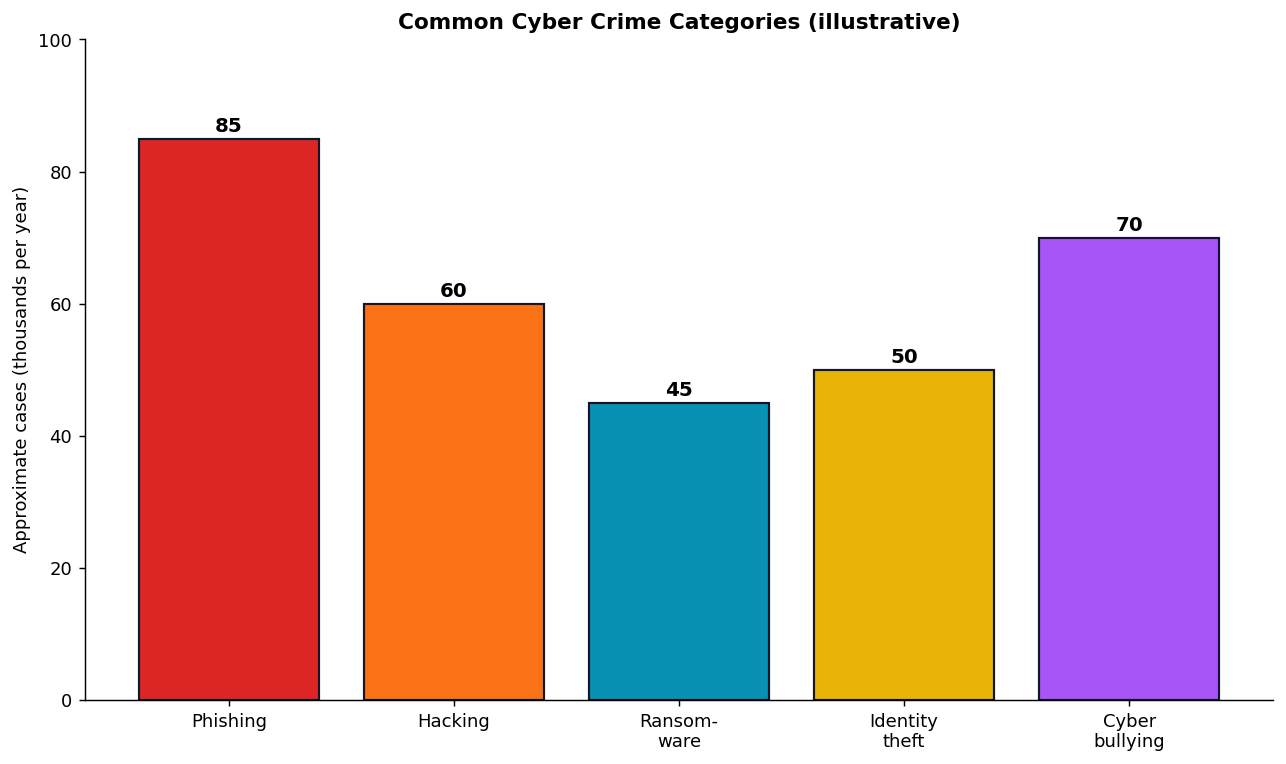
Study the cyber crime category bar chart and answer:
Which cyber crime has the highest number of cases?
APhishing
BHacking
CRansomware
DIdentity theft
The Indian law covering cyber offences is:
AIT Act 1995
BIT Act 2000
CIT Act 2008
DIT Act 2015
Discuss any four common cyber crime categories with one example each.
Show answersHide answers
1. Option 1 — Phishing
2. Option 2 — IT Act 2000
3. Cyber crimes are offences using computer networks. Phishing tricks users into revealing data via fake emails. Hacking is unauthorised access. Ransomware encrypts files for ransom. Identity theft impersonates someone. Cyber bullying is online harassment. The IT Act 2000 (with 2008 amendment) is India's main cyber law with provisions for offences and penalties.
Q333 Marks
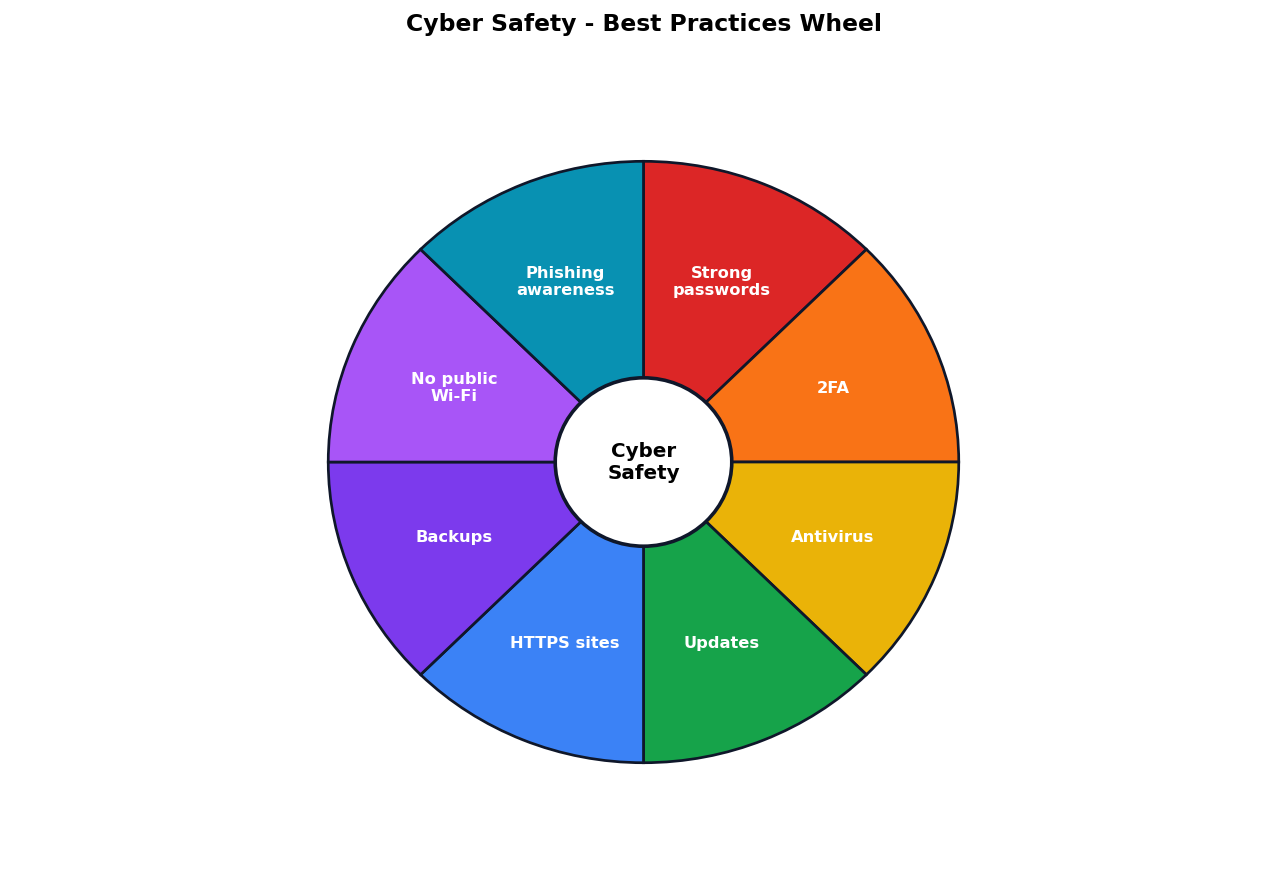
Study the cyber safety practices wheel and answer:
Which of the following is a cyber safety practice?
AStrong passwords
BTwo-factor auth
CAntivirus
DAll of these
Which is the BEST cyber safety practice?
AUse unique passwords
BReuse same password
CClick unknown links
DUse public Wi-Fi for banking
Discuss any five cyber safety best practices.
Show answersHide answers
1. Option 4 — All of these
2. Option 1 — Use unique passwords
3. Cyber safety practices include using strong unique passwords enabling two-factor authentication keeping software updated using antivirus avoiding public Wi-Fi for sensitive transactions verifying URLs before clicking using HTTPS sites and backing up important data. Awareness of phishing and social engineering is also essential.